Question
Define molal elevation constant or ebullioscopic constant.

Answer

Molal elevation constant is defined as increase in boiling point of the solvent, when one mole of solute is dissolved in $1000g$ of solvent. The elevation is proportional to the number of particles dissolved and given by $\Delta T_b= K _{ b }$ m,where m is the molal concentration of solute. The constant $K_b$ is the ebullioscopic constant of the solvent.

Need a full question paper?

Generate a complete, print-ready paper with questions like this in minutes — across 16+ boards, with answer keys.
Start Generating Free

Similar questions

Differentiate between globular and fibrous proteins.
Explain isocyanide test for primary amines.
State Raoult’s law for a solution containing volatile components. Write two characteristics of the solution which obeys Raoult’s law at all concentrations.
For the decomposition of azoisopropane to hexane and nitrogen at $543 K,$ the following data are obtained.
$t (\sec)$ $P(mm$ of $Hg)$
$0$ $35.0$
$360$ $54.0$
$720$ $63.0$
Calculate the rate constant.
Elimination reactions $($especially $\beta-$elimination$)$ are as common as the nucleophilic substitution reaction in case of alkyl halides. Specify the reagents used in both cases.
(i) When does sickle cell anemia disease appears?
(ii) What is the difference between the structure formula of thymine and uracil?
(iii) Define heredity and chromosome.
Name the products of hydrolysis of sucrose. Why is sucrose not a reducing sugar? 
Discuss the reactivity of aldehydes and ketones towards the nucleophilic addition reaction.
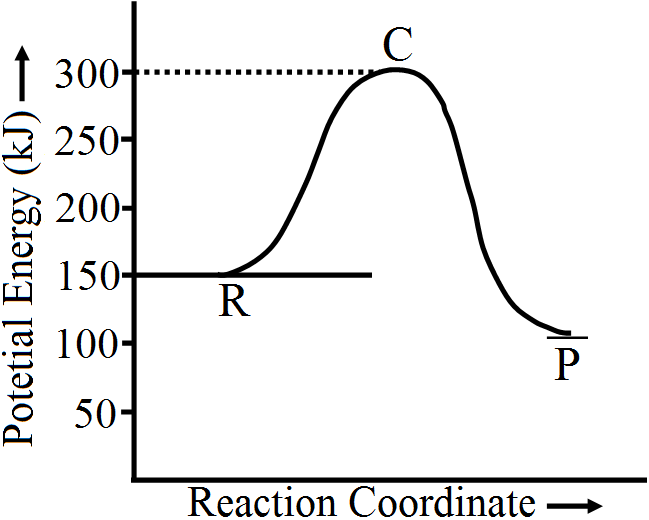
Answer the following questions on the basis of the given plot of potential energy vs reaction coordinate:
  1. What is the threshold energy for the reaction?
  2. What is the activation energy for forward reaction?
  3. What is the activation energy for backward reaction?
  4. What is enthalpy change for the forward reaction?
$A + 2B \rightarrow 3C + 2D$. The rate of disappearance of $B$ is $1 \times 10^{-2}\ mol\ L^{-1}s ^{-1. }$ What will be:
  1. Rate of the reaction.
  2. Rate of change in concentration of $A$ and $C$?