Questions

5 Marks Questions

Take a timed test

5 questions · self-marked practice — reveal the answer and mark yourself.

Question 15 Marks
$\ce{COSO_4Cl._5NH_3}$ exists in two isomeric forms $'A\ '$ and $'B\ '.$ Isomer $'A\ '$ reacts with $AgNO_3$ to give white precipitate but does not react with $BaCl_2.$ Isomer $'B\ '$ gives a white precipitate with $BaCl_2$ but does not react with $AgNO_3.$ Answer the following questions.
i. Identify $'A\ '$ and $'B\ '$ and write their structural formulas.
ii. Name the type of isomerism involved.
iii. Give the $\text{IUPAC}$ name of $'A\ '$ and $'B\ '.$
Answer
$\ce{COSO _4 Cl .5 NH _3:}$
i. Isomer $A$ reacts with $AgNO _3$ but not with $BaCl _2$, it shows that it has $Cl$ ion outside the coordination sphere. Hence, $A =$
$\ce{\left[ CO \left( NH _3\right)_5 SO _4\right] CI}$
Isomer B reacts with $BaCl _2$ but not with $AgNO _3$, it shows that it has $SO _4{ }^{-}$ outside the coordination sphere
Hence, $\ce{B =\left[ CO \left( NH _3\right)_5 Cl \right] SO _4}$
ii. Type of isomerism $-$ Ionization isomerism.
iii. $\text{IUPAC}$ name of, $A =$ Pentaamminesulphatocobalt $(III)$
chloride and $B =$ Pentaamminesulphatocobalt $(III)$ sulphate.
View full question & answer
Question 25 Marks
Attempt any five of the following:
$(a)$ Deficiency of which vitamin causes night-blindness.
$(b)$ Give two examples of reducing sugars.
$(c)$ Define the following terms:
$i.$ Glycosidic linkage
$ii.$ Native protein
$(d)$ Write function of carbohydrates in plants.
$(e)$ Differentiate between:
$i.$ Peptide linkage and Glycosidic linkage
$ii.$ Nucleoside and Nucleotide
$(f)$ What type of linkage holds together the monomers of $\text{DNA}$?
$(g)$ Write the product obtained when $D-$glucose reacts with $H_2N-OH.$
Answer
Attempt any five of the following:
$(i)$ Vitamin $A$
$(ii)$ Examples of reducing sugars $-$ Maltose and Lactose.
$(iii) i. A$ linkage between two monosaccharide units through oxygen atom.
$ii. $Protein having a unique three$-$dimensional structure and biological activity.
$(iv)$They store energy in the form of starch in plants.
$(v) i.$ Peptide linkage: $A$ linkage formed when two amino acids are joined through $-\text{CONH}-$ bond.
Glycosidic linkage: When two monosaccharides are joined through oxygen atom.
$ii. $Nucleoside: Base $+$ Sugar
Nucleotide: Base $+$ Sugar $+$ Phosphate
$(vi)$ The $2$ strands of $\text{DNA}$ are attached to each other by hydrogen bonds that connect the nitrogenous bases of one strand to the bases of the other strand $($this is called complementary base pairing$)$ where Adenine pairs with Thymine by $2$ hydrogen bonds and Guanine pairs with Cytosine using $3$ hydrogen bonds.
While nucleotides of $\text{DNA}$ are held together by Phosphodiester linkages. The structure of $\text{DNA}$ holds the nucleotides in place using phosphodiester bonds. A phosphodiester bond occurs when exactly two of the hydroxyl group in phosphoric acid react with hydroxyl groups on other molecules to form two ester bonds. The phosphodiester bond is the linkage between the $3$' carbon atom of one sugar molecule and the $5'$ carbon atom of another, deoxyribose in $\text{DNA}$
$(vii) D-$glucose on reaction with $NH_2OH ($hydroxylamine$)$ yield glucose oxime.
Image
View full question & answer
Question 45 Marks
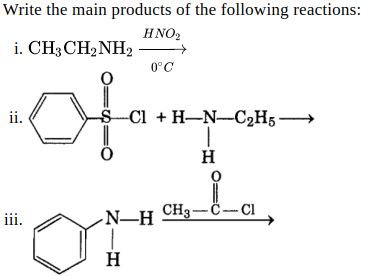
Giving an example for each describe the following reactions:
i. Hofmann bromamide reaction.
ii. Gattermann reaction.
iii. Coupling reaction.
Answer
i. Hofmann bromamide degradation reaction It is a method for the preparation of primary amines by treating an amide with bromine in an aqueous or ethanolic solution of sodium hydroxide. The amines so formed contain one carbon less than that present in the parent amide.
ii. Gattermann reaction When benzene diazonium chloride is treated with Cu/HCl Cu/HBr, chlorobenzene or bromobenzene is obtained. This reaction is known as Gattermann reaction
iii. Coupling reaction Arenediazonium salts react with highly reactive (i.e. electron rich) aromatic compounds such as aniline, phenols to form brightly coloured azo compounds, Ar-N =N-Ar. This reaction is called coupling reaction. e.g. Benzene diazonium chloride reacts with aniline in faintly acidic medium (pH 4-5) at 273-278K, in which the molecule at its para- position is coupled with the diazonium salt to form p-aminoazobenzene. This is an example of coupling reaction.

Image
View full question & answer
Question 55 Marks
$\ce{[NIC14]^{2-}}$ is paramagnetic while $\ce{[Ni(CO)_4]}$ is diamagnetic though both are tetrahedral. Why?
Answer
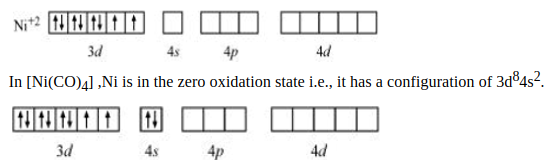
Though both $\ce{[ NICl _4]^{2-}}$ and $\ce{[ Ni ( CO )_4]}$ are tetrahedral, their magnetic characters are different.
This is due to a difference in the nature of ligands. $\ce{CN ^{-}}$ is a weak field ligand and it does not cause the pairing of unpaired $3d$ electrons.
Hence, $\ce{[ NICl _4]^{2-}}$ is paramagnetic.
Image
But $CO$ is a strong field ligand.
Therefore, it causes the pairing of unpaired $3d$ electrons.
Also, it causes the $4s$ electrons to shift to the $3d$ orbital, thereby giving rise to $sp^3$ hybridization.
Since no unpaired electrons are present in this case, $\ce{[Ni(CO)_4]}$ is diamagnetic.
View full question & answer