Question
$\ce{[NIC14]^{2-}}$ is paramagnetic while $\ce{[Ni(CO)_4]}$ is diamagnetic though both are tetrahedral. Why?
Answer

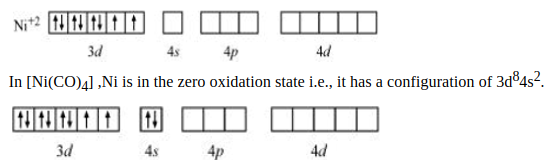
Though both $\ce{[ NICl _4]^{2-}}$ and $\ce{[ Ni ( CO )_4]}$ are tetrahedral, their magnetic characters are different.
This is due to a difference in the nature of ligands. $\ce{CN ^{-}}$ is a weak field ligand and it does not cause the pairing of unpaired $3d$ electrons.
Hence, $\ce{[ NICl _4]^{2-}}$ is paramagnetic.
Image
But $CO$ is a strong field ligand.
Therefore, it causes the pairing of unpaired $3d$ electrons.
Also, it causes the $4s$ electrons to shift to the $3d$ orbital, thereby giving rise to $sp^3$ hybridization.
Since no unpaired electrons are present in this case, $\ce{[Ni(CO)_4]}$ is diamagnetic.

Need a full question paper?

Generate a complete, print-ready paper with questions like this in minutes — across 16+ boards, with answer keys.

Start Generating Free

Similar questions

Account for the following :
(i) $p K _b$ of aniline is more than that of methylamine.
(ii) Ethylamine is soluble in water whereas aniline is not.
(iii) Methylamine in water reacts with ferric chloride to precipitate hydrated ferric oxide.
(iv) Aniline does not undergo Friedel-Crafts reaction.
(v) Diazonium salts of aromatic amines are more stable than those of aliphatic amines.
An aromatic compound $'A\ ’$ on treatment with $\ce{CHCl_3/ KOH}$ gives two compounds $'B\ ’$ and $'C\ ’.$ Both $B$ and $C$ give the same product $'D\ ’$ when distilled with zinc dust. Oxidation of $D$ gives $E$ having molecular formula $\ce{C_7H_6O_2}.$ The sodium salt of $E$ on heating with sodalime gives $F$ which may also be obtained by distilling $A$ with zinc dust. Identify $A$ to $F.$
Write the applications of organometallic compounds.
  1. How are lipids classified? Give an example of each class.
  2. Explain the following terms:
  1. Mutarotation.
  2. Avitaminosis.
Match the items given in Column I and Column II.
 
Column I
 
Column II
i.
Saturated solution
a.
Solution having same osmotic pressure at a given temperature as that of given solution.
ii.
Binary solution
b.
A solution whose osmotic pressure is less than that of another.
iii.
Isotonic solution
c.
Solution with two components.
iv.
Hypotonic solution
d.
A solution which contains maximum amount of solute that can be dissolved in a given amount of solvent at a given temperature.
v.
Solid solution
e.
A solution whose osmotic pressure is more than that of another.
vi
Hypertonic solution
f.
A solution in solid phase.
The decomposition of a hydrocarbon follows the equation. $\text{k}=(4.5\times10^{11}\text{s}^{-1})\text{e}^{-28000}\text{ K/T}$
Calculate $Ea.$
Give the preparation and two uses of the following:
(i) Bakelite,
(ii) Melamine,
(iii) Nylon-6,
(iv) Glyptal.
Explain the acidic property of carboxylic acid and dicuss the effect of substituents on their acidity.
i. Write structures of different isomeric amines corresponding to the molecular formula$, \ce{C4H11N}$.
ii. Write $\text{IUPAC}$ names of all the isomers.
iii. What type of isomerism is exhibited by different pairs of amines?
Giving an example for each describe the following reactions:
i. Hofmann bromamide reaction.
ii. Gattermann reaction.
iii. Coupling reaction.