Questions

3 Marks Question

Take a timed test

34 questions · self-marked practice — reveal the answer and mark yourself.

Question 13 Marks
Write the monomers used for getting the following polymers:
  1. Polyvinyl chloride.
  2. Teflon.
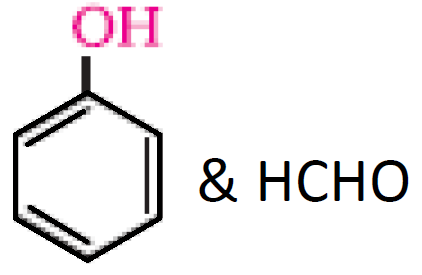
  3. Bakelite.
Answer
  1. The monomer of polyvinyl chloride is $CH_2 = CHCl$ vinyl chloride.
  2. The monomer of teflon is $CF_2 = CF_2$ tetrafluoroethylene.
  3. The monomers involved in the formation of bakelite are $HCH$O formaldehyde and $C_6H_5OH$ phenol.
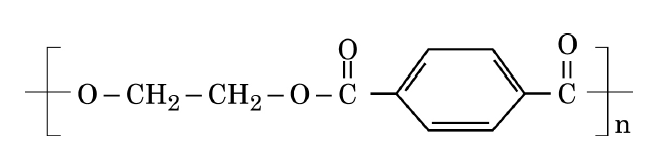
View full question & answer
Question 23 Marks
  1. What is the role of Sulphur in the vulcanization of rubber?
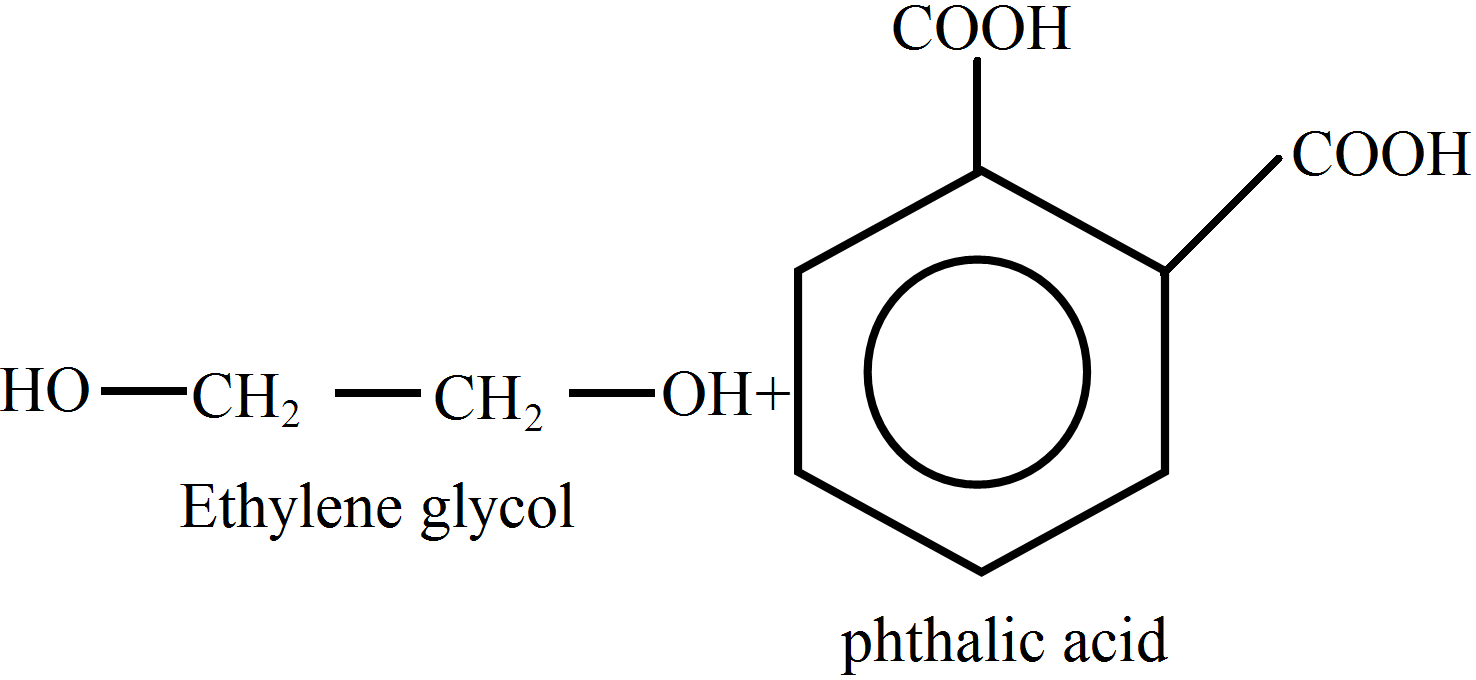
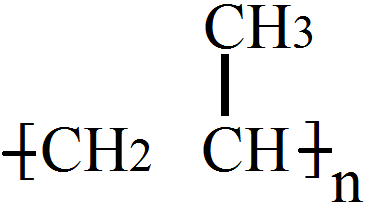
  2. Identify the monomers in the following polymer:
  1. Arrange the following polymers in the increasing order of their intermolecular forces:
Terylene, Polythene, Neoprene.
Answer
  1. On vulcanization, sulphur forms cross links at the reactive sites of double bond, the rubber gets stiffened.
  2. Ethylene glycol$/HO–CH_2 CH_2–OH,$
  1. Neoprene < Polythene < Terylene.
View full question & answer
Question 33 Marks
Write the names and structures of the monomers of the following polymers:
  1. Nylon-6,6.
  2. Bakelite.
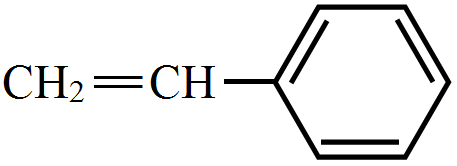
  3. Polystyrene.
View full question & answer
Question 43 Marks
Write the structures of the monomers used for getting the following polymers :
  1. Teflon
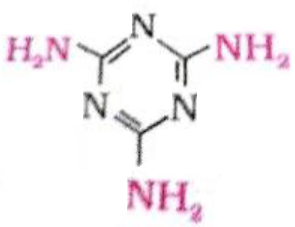
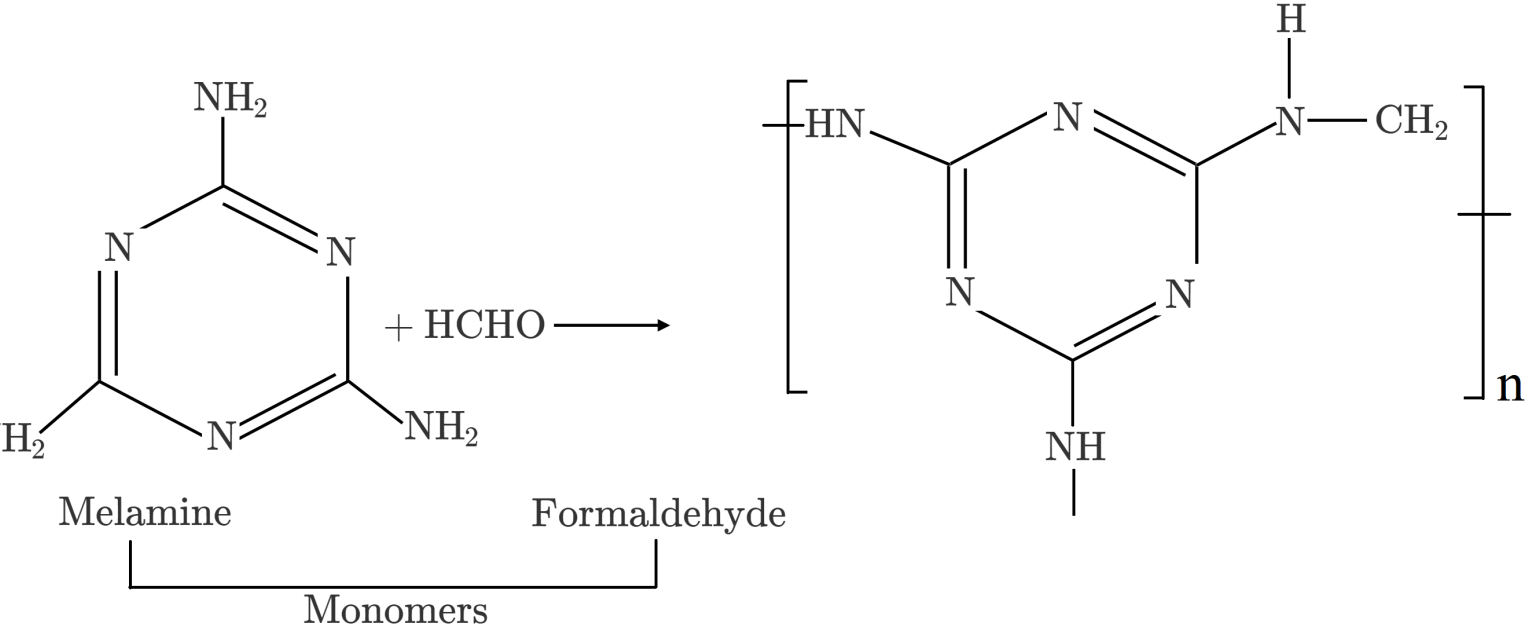
  2. Melamine-formaldehyde polymer
  3. Neoprene
Answer
  1. $CF_2= CF_2$
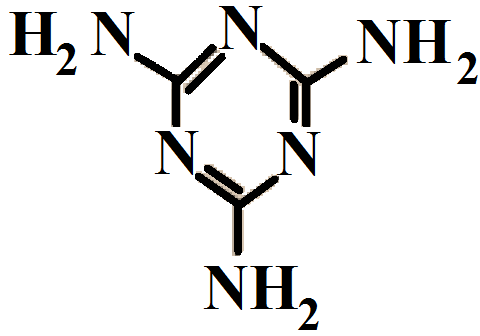
  2.  

and HCHO
  1.  
$\text{H}\text{ }\text{ }\text{ }\text{ }\text{Cl}\text{ }\text{ }\text{ }\text{ }\text{ }\text{H}\text{ }\text{ }\text{ }\text{ }\text{ }\text{H}\\\text{ }|\text{ }\text{ }\text{ }\text{ }\text{ }\text{ }\text{ }|\text{ }\text{ }\text{ }\text{ }\text{ }\text{ }\text{ }|\text{ }\text{ }\text{ }\text{ }\text{ }\text{ }\text{ }|\\\text{C}=\text{C}-\text{C}=\text{C}\\\text{ }|\text{ }\text{ }\text{ }\text{ }\text{ }\text{ }\text{ }\text{ }\text{ }\text{ }\text{ }\text{ }\text{ }\text{ }\text{ }\text{ }\text{ }\text{ }\text{ }\text{ }\text{ }\text{ }\text{ }\text{ }|\\\text{H}\text{ }\text{ }\text{ }\text{ }\text{ }\text{ }\text{ }\text{ }\text{ }\text{ }\text{ }\text{ }\text{ }\text{ }\text{ }\text{ }\text{ }\text{ }\text{ }\text{ }\text{ }\text{ }\text{H}$
View full question & answer
Question 53 Marks
Write the structures of the monomers used for getting the following polymers :
  1. Polyvinyl chloride (PVC)
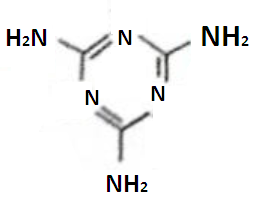
  2. Melamine formaldehyde polymer
  3. Buna-N
Answer
  1. CH2 = CHCl
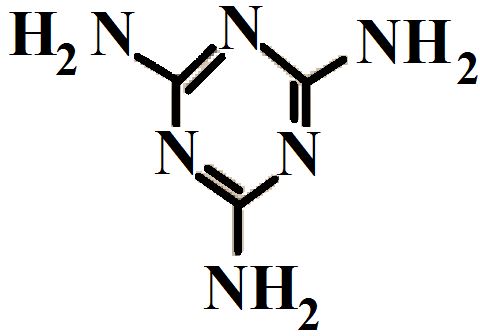
  2.  

and HCHO
  1. CH2 = CH-CH = CH2 , CH2 = CHCN
View full question & answer
Question 63 Marks
Write the structures of the monomers used for getting the following polymers:
  1. Nylon$-6, 6.$
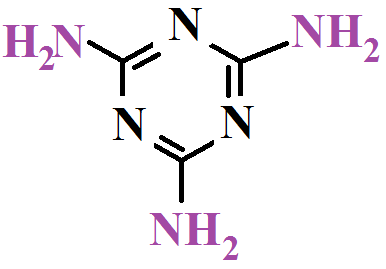
  2. Melamine-formaldehyde polymer.
  3. Buna-S.
Answer
  1. $H_2N - (CH_2)_6-NH2, HOOC - (CH_2)_4- COOH$
  2.  
and $HCHO$
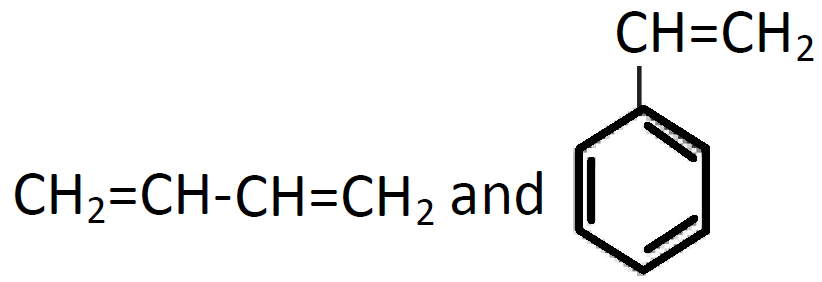
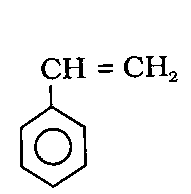
  1. $CH_2= CH - CH = CH_2, C_6H_5- CH = CH_2$
View full question & answer
Question 73 Marks
Differentiate between thermoplastic and thermosetting polymers. Give one example of each.
Answer
Thermoplastic polymers:- These are the linear or slightly branched long chain molecules capable of repeatedly softening on heating and hardening on cooling. Some common examples are polythene, polystyrene, polyvinylchloride.
Thermosetting polymers:- These polymers are cross-linked or heavily branched molecules, which on heating undergo extensive cross-linking in moulds and again become infusible.These cannot be reused. Some common examples are bakelite, urea-formaldehyde resins.
View full question & answer
Question 83 Marks
Draw the structures of the monomers of the following polymers:
  1. Polythene.
  2. PVC.
  3. Teflon.
Answer
  1. $CH_2=CH_{2}.$
  2. $CH_2=CHCI.$
  3. $CF_2=CF_{2}.$
View full question & answer
Question 93 Marks
Write the names and structures of the monomers of the following polymers :
  1. Neoprene
  2. Buna$-N$
  3. PHBV
Answer
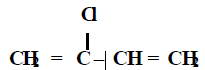
  1. Chloroprene, $CH_2=C(Cl)-CH=CH_2$
  2. $1, 3-$ Butadiene $\&$ Acrylonitrile
$CH_2=CH-CH=CH_2\ \&\ CH_2=CHCN$
  1. 3-Hydroxybutanoic acid & 3-Hydroxypentanoic acid
$CH_3CH(OH)CH_2COOH\ \&\ CH_3CH_2CH(OH)CH_2COOH$
View full question & answer
Question 103 Marks
Calculate the freezing point of solution when $2\ g$ of $Na_2SO_4(M = 142\ g\ mol^{–1})$ was dissolved in $50\ g$ of water, assuming $Na_2SO_4$ undergoes complete ionisation.
$(K_f$ for water $= 1.86\ K\ kg\ mol^{–1})$
Answer
$\triangle\text{T}_{\text{f}}=\text{iK}_{\text{f}}\text{m}$
For complete ionisation of $Na_2SO_4 $ $ {i}=3$
$\triangle\text{T}_{\text{f}}=\triangle\text{T}_{\text{f}}\text{ }^0-\triangle\text{T}_{\text{f}}=3 \times1.86 \text{K kg mol}^{-1}\times\frac{2\text{g}}{142\text{g mol}^{-1}}\times\frac{1000 \text{g kg}^{-1}}{50\text{g}}$
$\triangle\text{T}_{\text{f}}=1.57$
$\text{So},\text{ }\text{ }\text{ }\text{T}_{\text{f}}=-1.57^\circ\text{C}\text{ }\text{ }\text{or}\text{ }\text{ }271.43\text{K}$
View full question & answer
Question 113 Marks
Write the names and structures of the monomers of the following polymers :
  1. Bakelite
  2. PVC
  3. Buna-S
Answer
  1. Phenol & Formaldehyde
  1. Vinyl chloride , $CH_2 = CHCl$
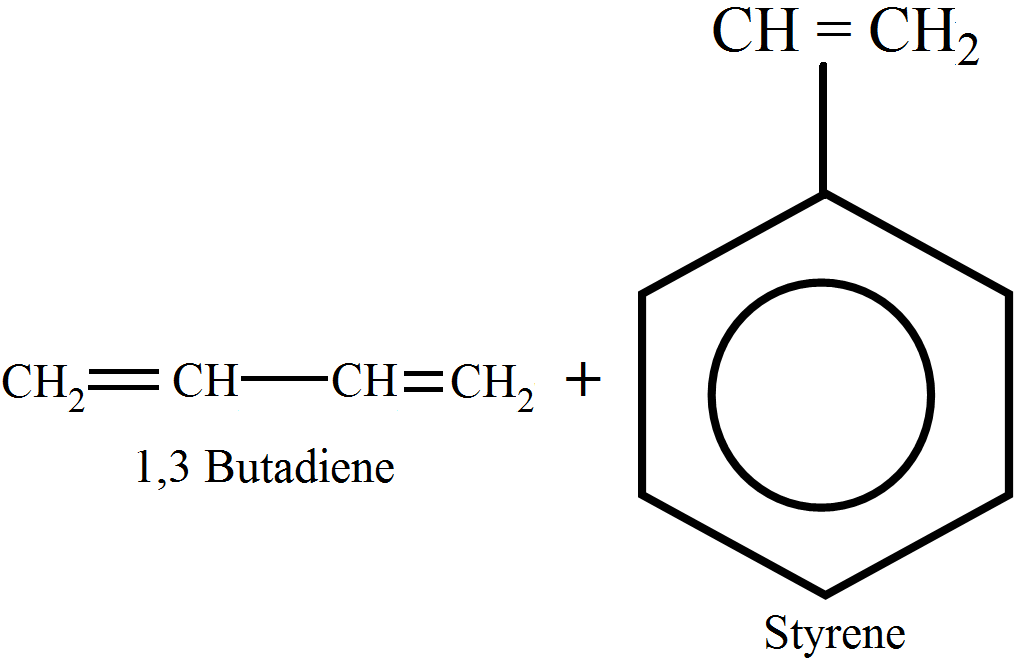
  2. $1, 3 -$ Butadiene & styrene
View full question & answer
Question 123 Marks
Write the names and structures of the monomers of the following polymers:
  1. Terylene.
  2. Teflon.
  3. Nylon$-6, 6.$
Answer
  1. Ethylene Glycol and Terephthalic acid
$HOH_2C-CH_2OH, p-HOOC-C_6H_4-COOH$
  1. Tetrafluoroethene, $CF_2=CF_2$
  2. Hexamethylenediamine and adipic acid
$H_2N(CH_2)_6NH_2, HOOC(CH_2)_4 COOH$
View full question & answer
Question 133 Marks
Write the name of monomers and their structures in the following:
  1. Buna-N
  2. PVC
  3. Neoprene
Answer
  1. Butadiene and acrylonitrile
$CH_2 = CH – CH = CH_2$ and $CH_2= CH – CN$
  1. Vinyl chloride
$CH_2 = CH – Cl$​​​​​​​
  1. Chloroprene
$\text{ }\text{ }\text{ }\text{ }\text{ }\text{ }\text{ }\text{ }\text{ }\text{ }\text{ }\text{ }\text{CI}\text{ }\text{ }\text{ }\text{ }\\\text{ }\text{ }\text{ }\text{ }\text{ }\text{ }\text{ }\text{ }\text{ }\text{ }\text{ }\text{ }\text{ }\text{ }\text|\text{ }\text{ }\text{ }\\\text{CH}_2=\text{C}-\text{CH}=\text{CH}_2$
View full question & answer
Question 143 Marks
Write one difference between each of the following :
  1. Multimolecular colloid and Macromolecular colloid.
  2. Sol and Gel.
  3. O/W emulsion and W/O emulsion.
Answer
  1. Multimolecular colloid : a large number of atoms or smaller molecules of a substance aggregate together to form species having size in the colloidal range.
Macromolecular: Large sized molecules whose particle size lies in the colloidal range.
  1. Sol are solid dispersed in liquid while gel are liquid dispersed in solid.
  2. In O/W emulsion, water acts as dispersion medium while in W/O oil acts as dispersion medium.
View full question & answer
Question 153 Marks
Write the structures of the monomers used for getting the following polymers :
  1. Nylon-6.
  2. Melamine–formaldehyde polymer
  3. Teflon.
View full question & answer
Question 163 Marks
Write the mechanism of free radical polymerization of ethene.
Answer

chain initiation steps

$\mathring{\text{C}}_6\text{H}_5+\text{C}\text{H}_2=\text{C}\text{H}_2\rightarrow\text{C}_6\text{H}_5-\text{C}\text{H}_2-\mathring{\text{C}}\text{H}_2$
chain propagatting step
View full question & answer
Question 173 Marks
  1. What is the role of t-butyl peroxide in the polymerization of ethene?
  2. Identify the monomers in the following polymer:
$– [NH – (CH_2)_6 – NH – CO – (CH_2)_4 – CO– ]_n$
  1. Arrange the following polymers in the increasing order of their intermolecular forces:
Polystyrene, Terylene, Buna-$S.$
Answer
  1. Catalyst/initiator of free radical.
  2. Hexamethylene diamine and adipic acid/structure/IUPAC name.
  3. Buna-$S$
View full question & answer
Question 183 Marks
Write the names and structures of the monomers of the following polymers:
  1. Nylon$-6, 6.$
  2. PHBV.
  3. Neoprene.
Answer
  1. Hexamethylene diamine $NH_2(CH_2)_6NH_2$ and adipic acid $HOOC-(CH_2)_4-COOH.$
  2. $3$ hydroxybutanoic acid $CH_3CH(OH)CH_2COOH$ and $3$ hydroxypentanoic acid $CH_3CH_2CH(OH)CH_2COOH.$
  3. Chloroprene $H_2C=C(CI)CH=CH_2$ IUPAC names are accepted.
View full question & answer
Question 193 Marks
Write the structures of the monomers used for getting the following polymers:
  1. Neoprene.
  2. Melamine–formaldehyde polymer
  3. Buna-S.
Answer
  1. Neoprene: Monomeric unit of neoprene is chloroprene.
$\text{CH}_2=\text{C}-\text{CH}=\text{CH}_2\\\text{ }\text{ }\text{ }\text{ }\text{ }\text{ }\text{ }\text{ }\text{ }\text{ }\text{ }\text{ }\text{ }\text{ }|\\\text{ }\text{ }\text{ }\text{ }\text{ }\text{ }\text{ }\text{ }\text{ }\text{ }\text{ }\text{ }\text{Cl}\\\text{ }\text{ }\text{ }\text{ }\text{ }\text{ }\text{ }\text{Chloroprene}$
  1. Melamine-formaldehyde polymer: Monomers used in the melamine-formaldehyde polymer are melamine and formaldehyde.
  1. Buna-S: Monomers used in the Buna-S polymer are 1,3-butadiene and styrene.
$\text{CH}_2=\text{CH - CH}=\text{CH}_2\text{ and }\text{C}_6\text{H}_5\text{CH}_2=\text{CH}_2\\\text{ }\text{ }\text{ }\text{ }\text{ }\text{ }\text{ }\text{ }\text{1, 3- Butadine}\text{ }\text{ }\text{ }\text{ }\text{ }\text{ }\text{ }\text{ }\text{ }\text{ }\text{ }\text{ }\text{ }\text{ }\text{ }\text{ }\text{ }\text{ }\text{ }\text{ }\text{ }\text{ }\text{ }\text{ }\text{ }\text{ }\text{styrene}$
View full question & answer
Question 203 Marks
After the ban on plastic bags, students of one school decided to make the people aware of the harmful effects of plastic bags on environment and Yamuna River. To make the awareness more impactful, they organised rally by joining hands with other schools and distributed paper bags to vegetable vendors, shopkeepers and departmental stores. All students pledged not to use polythene bags in future to save Yamuna River.
After reading the above passage, answer the following questions:
  1. What values are shown by the students?
  2. What are biodegradable polymers? Give one example.
  3. Is polythene a condensation or an addition polymer?
Answer
  1. Concern towards environment/caring/socially aware/team work.
  2. Polymers which can be degraded by the action of microorganisms. Eg. PHBV, Nylon- 2 - nylon- 6/any natural polymer.
  3. Addition polymer.
View full question & answer
Question 213 Marks
Write the structures of the monomers used for getting the following polymers:
  1. Dacron.
  2. Melamine–formaldehyde polymer
  3. Buna-N.
Answer
  1.  
  1.  
  1. $CH_2= CH - CH = CH_2 + CH_2= CHCN$
View full question & answer
Question 223 Marks
Write the name and structures of the monomers of the following polymers:
  1. Buna $– S.$
  2. Neoprene.
  3. Nylon$-6,6.$
Answer
  1. Buna-S: 1,3- Butadiene and Styrene
$CH_2=CH–CH=CH_2$ and
  1. Neoprene: Chloroprene
  1. Nylon$-6,6:$ Hexamethylene diamine and Adipic acid
$H_2N-(CH_2)_6-NH_2 HOOC-(CH_2)4-COOH.$
View full question & answer
Question 233 Marks
Give one example each of
  1. Addition polymers,
  2. Condensation polymers,
  3. Copolymers.
Answer
  1. Polythene, PVC,
  2. Nylon-6,6, Nylon-6, Terylene.
  3. Buna-S, Buna-N.
View full question & answer
Question 253 Marks
Write the structures of monomers used for getting the following polymers:
  1. Nylon$-6, 6$
  2. Glyptal
  3. Buna$-S$
Answer
  1. Nylon$-6, 6$: Hexamethylenediamine $→ H_2N-CH_2-CH_2-CH_2-CH_2-CH_2-CH_2-NH_2$
$\ \ \ \ \ \ \ \ \ \ \ \ \ \ \ \ \ \ \ \ \ \ \ \ \ \ \ \ \ \ \ \ \ \ \text{O}\ \ \ \ \ \ \ \ \ \ \ \ \ \ \ \ \ \ \ \ \ \ \ \ \ \ \ \ \ \ \ \ \ \ \ \ \ \ \ \ \ \ \ \ \ \ \ \ \ \ \ \ \ \text{O}\\\ \ \ \ \ \ \ \ \ \ \ \ \ \ \ \ \ \ \ \ \ \ \ \ \ \ \ \ \ \ \ \ \ \ \ ||\ \ \ \ \ \ \ \ \ \ \ \ \ \ \ \ \ \ \ \ \ \ \ \ \ \ \ \ \ \ \ \ \ \ \ \ \ \ \ \ \ \ \ \ \ \ \ \ \ \ \ \ \ \ || \\\text{Adipic acid}\ \ \ \text{ HO}-\text{C}-\text{CH}_2-\text{CH}_2-\text{CH}_2-\text{CH}_2-\text{C}-\text{OH}$
  1. Glyptal:
  1. Buna-S:
View full question & answer
Question 263 Marks
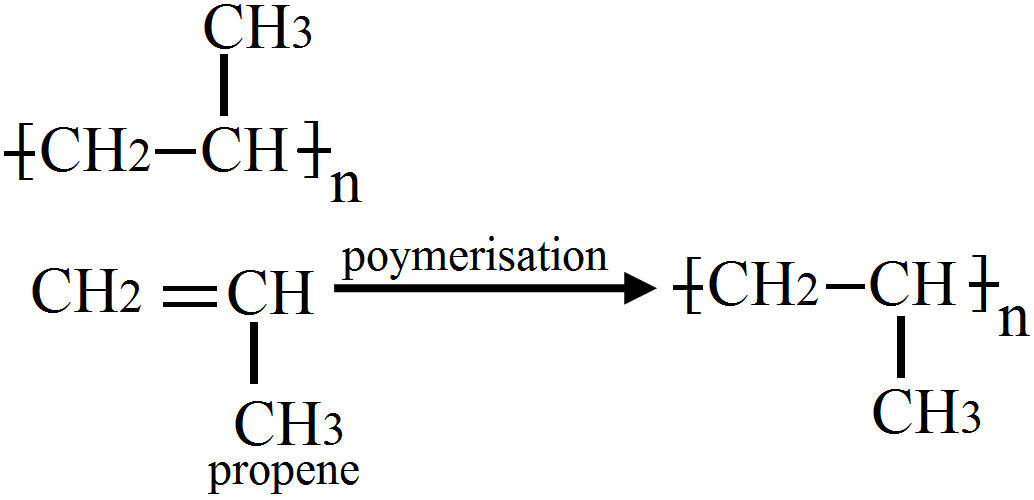
  1. Is a homopolymer or copolymer? Give reason.
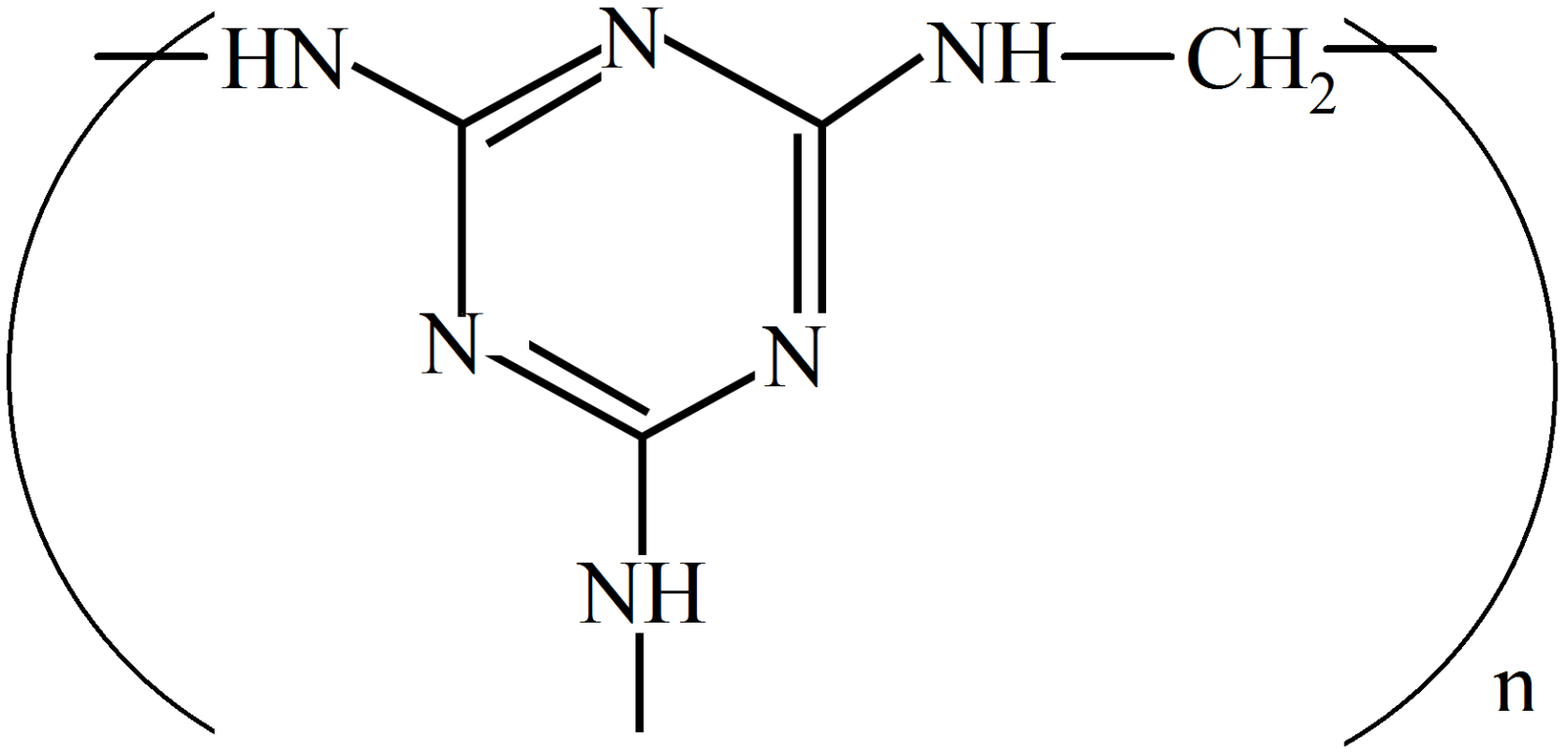
  2. Write the monomers of the following polymer:
  1. What is the role of Sulphur in vulcanization of rubber?
Answer
  1. This is a homopolymer formed by a propene monomer because in this polymerization only one monomer is being used without losing any molecule.
  1.  
  1. Sulfur is used in vulcanization to produce cross-links between two polymer chains to produce more tensile strength, elasticity, and resistance to abrasion.
View full question & answer
Question 273 Marks
Explain the following processe with a suitable example in case:
Chain growth polymerization.
Answer
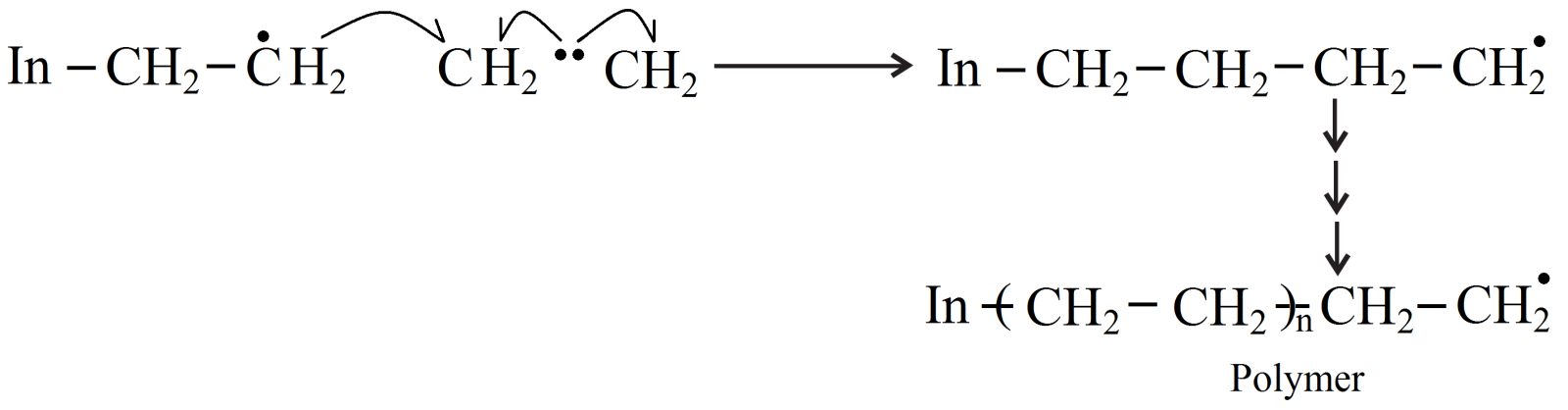
Chain growth polymerisation: This type of polymerisation involves the initial formation of a free radical or an ion (from small amount of initiator such as organic peroxide) to which monomers get added up by a chain reaction. Here, the polymers are exact multiples of organic monomeric molecules and have only carbon atoms in their main chain. Various steps involved in chain growth polymerisation of ethene are:
  1. $\text{Initiator}\ \ \ \xrightarrow[\text{split up}]{\ \ \text{Heat, light, etx.}\ \ \ \ }\ \ \ \stackrel{{\cdot}}{\hbox{A}}\\\ \ \ \ \ \ \ \ \ \ \ \ \ \ \ \ \ \ \ \ \ \ \ \ \ \ \ \ \ \ \ \ \ \ \ \ \ \ \ \ \ \ \ \ ^{\text{Free redical}}$
  2. $\stackrel{{\cdot}}{\hbox{A}}+\text{CH}_2=\text{CH}_2\xrightarrow{\ \ \ \ \ \ \ \ \ \ }\text{A}-\text{CH}_2-\stackrel{{\cdot\ \ \ \ \ \ }}{\hbox{CH}_2}\\ \ \ \ \ \ \ \ \ \ \ \ \ ^\text{Monomer} \ \ \ \ \ \ \ \ \ \ \ \ \ \ \ ^\text{(Intermediate species)}$
  3. $\text{A}-\text{CH}_2-\stackrel{{\cdot}\ \ \ \ \ \ }{\hbox{CH}_2}+\text{CH}_2=\text{CH}_2\xrightarrow{\ \ \ \ \ \ }\text{A}-\text{CH}_2-\text{CH}_2-\text{CH}_2-\stackrel{{\cdot\ \ \ \ \ \ }}{\hbox{CH}_2}\\ \ \ \ \ \ \ \ \ \ \ \ \ \ \ \ \ \ \ \ \ \ \ \ \ \ \ \ \ \ \ \ \ \ \ \ \ \ ^\text{Monomer}\ \ \ \ \ \ \ \ \ \ \ \ \ \ \ \ \ ^\text{(Bigger intermediate spwcies)}$
Examples: polyethylene, teflon, etc.
View full question & answer
Question 283 Marks
Explain the following processe with a suitable example in case:
Step growth polymerisation.
Answer
Step growth polymerisation: This type of polymerisation involves a series of condensation reactions between simple monomers containing polar groups, with or without the elimination of small molecules like water, $HCl,\ NH_3,$ etc. In addition to carbon atoms, these polymers contain other atoms also in their main chain. Steps may be illustrated as follows:
  1. $\ \ \ \ \text{A}\ \ \ +\ \ \ \text{B} \ \ \ \xrightarrow{\ \ \ \ \text{Condensation}\ \ \ \ } \ \ \ \text{AB}\\^\text{Monomer} \ \ ^\text{Monomer}$
  2. $\text{A}-\text{B}+\text{A}\ \xrightarrow{\ \ \text{Condensation}\ \ } \ \text{A}-\text{B}-\text{A}$
  3. $\text{A}-\text{B}+\text{A}-\text{B}\ \xrightarrow{\ \ \text{Condensation}\ \ }\ \text{A}-\text{B}-\text{A}-\text{B}\cdots$
Examples: Terylene, nylon, etc.

The step wise growth can also occur in another manner:
  1. $\text{A}\ \ +\ \ \text{B}\ \ \xrightarrow{\ \ \ \text{Condensation}\ \ }\ \ \text{A}-\text{B}$
  2. $\text{AB}\ \ +\ \ \text{AB}\ \ \xrightarrow{ \ \ \text{Condensaton}\ \ }\ \ \text{ABAB}\cdots\text{(AB)}_\text{n}\\ \ \ \ \ \ \ \ \ \ \ \ \ \ \ \ \ \ \ \ \ \ \ \ \ \ \ \ \ \ \ \ \ \ \ \ \ \ \ \ \ \ \ \ \ \ \ \ \ \ \ \ \ \ \ \ \ \ \ ^\text{Plymer}$
View full question & answer
Question 293 Marks
Which of the following polymers soften on heating and harden on cooling? What are the polymers with this property collectively called? What are the structural similarities between such polymers? Bakelite, urea formaldehyde resin, polythene, polyvinyls, polystyrene.
Answer
Thermoplastic polymers: Thermoplastic polymers are the linear or slightly branched long chain molecules capable of repeatedly softening on heating and hardening on cooling. These polymers possess intermolecular forces of attraction intermediate between elastomers and fibres. Some common thermoplastics are polythene, polystyrene, polyvinyls, etc.
Thermosetting polymers: These polymers are cross linked or heavily branched molecules, which on heating undergo extensive cross linking in moulds and again become infusible. These cannot be reused. Some common examples are Bakelite, urea-formaldelyde resins etc.
View full question & answer
Question 303 Marks
What is the role of benzoyl peroxide in addition polymerisation of alkenes? Explain its mode of action with the help of an example.
Answer

Benzoyl peroxide acts as an initiator in free radical addition polymerisation of alkenes by providing chain initiation. The radical formed adds to the carbon-carbon double bond of an alkene molecules and ultimately forms the polymer.
The new free radical adds to a double bond of monomer to form a larger free radical which adds to another alkene molecules and ultimately forms the polymer.

The radical formed adds to the carbon-carbon double bond of an alkene molecules and ultimately form the polymer.

The new free radical adds to a double bond of monomer to form a larger free radical which adds to anther alkene molecules and ultimately forms the polymer.
View full question & answer
Question 313 Marks
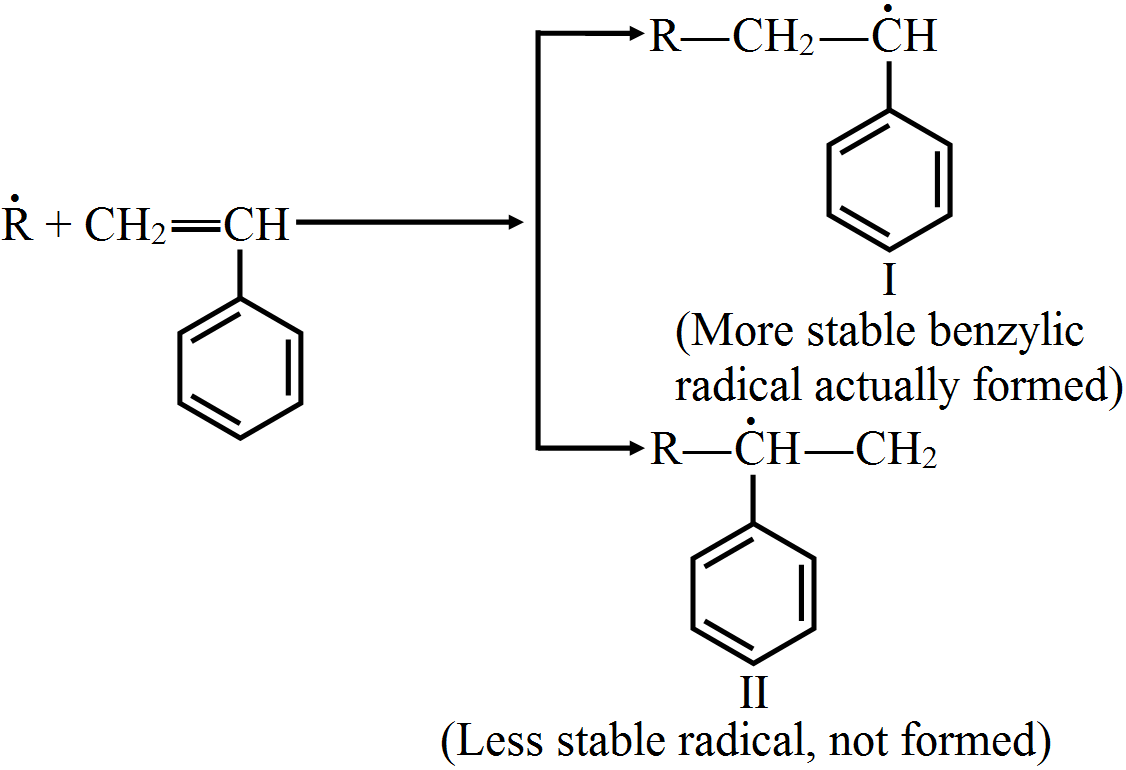
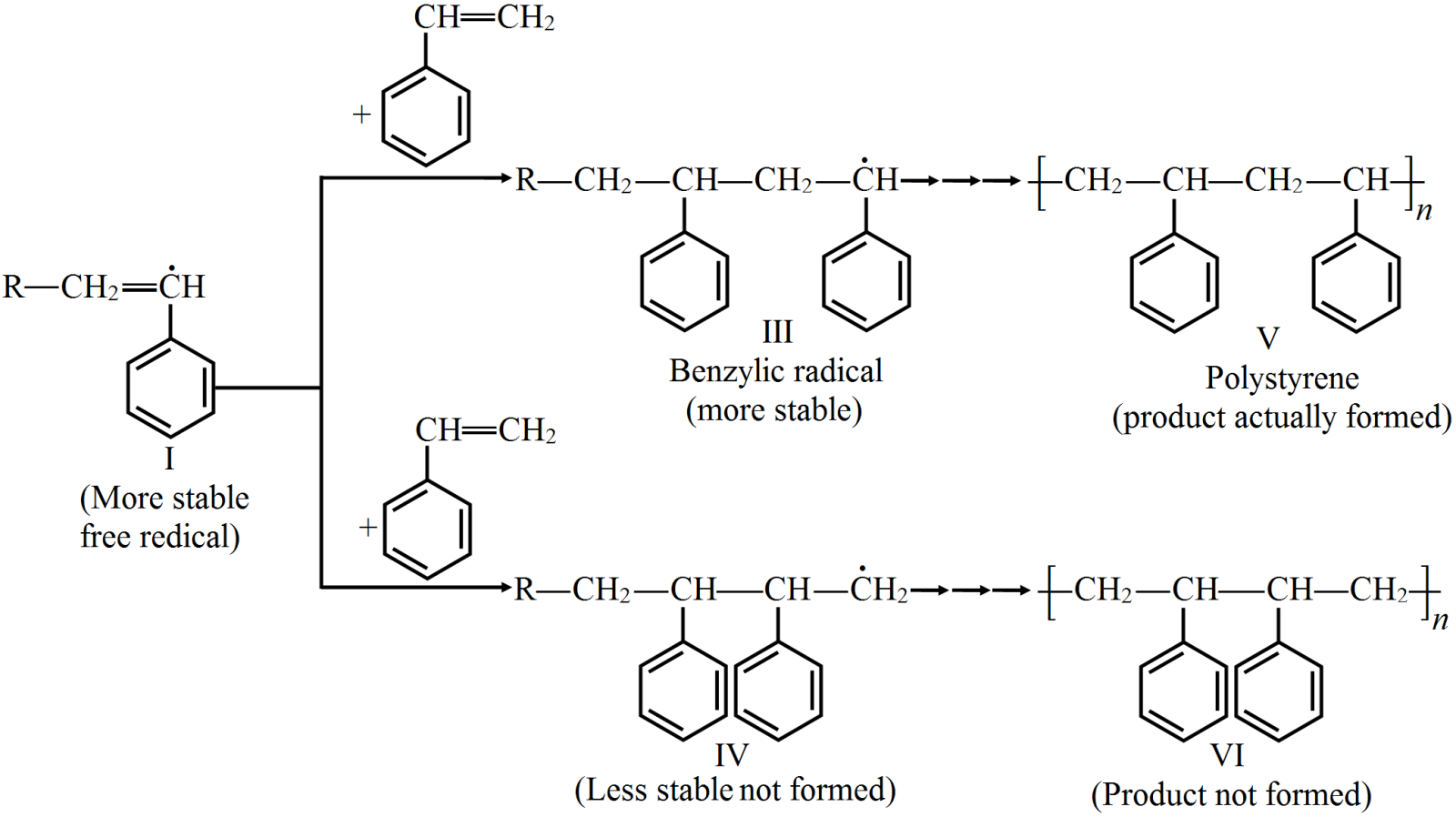
Explain why free radical polymerisation of styrene gives a product in which phenyl groups are on alternate carbon atoms rather than on adjacent carbon atoms.
Answer

During free radical polymerisation, the addition of free radical to monomer molecules occurs in accordance with Markovnikov’s rule so as to give more stable benzylic free radical.
For example,

This process goes on till polystrene (V) in which the phenyl groups are on alternate carbon atoms is obtained rather than the product (VI) in which the phenyl groups are on adjacent carbon atoms.
View full question & answer
Question 323 Marks
A monomer of a polymer upon ozonolysis gives one mole of methylglyoxal and two moles of formaldehyde.
  1. Identify the monomer of the polymer.
  2. Give its free radical mode of addition polymerisation.
Answer
  1. As the monomer on ozonolysis gives one mole of methylglyoxal and two moles of formaldehyde, therefore, the monomer is isoprene.
$2\text{H}_2\text{C}=\text{O}+\text{O}=\text{C}-\text{C}=\text{O}\ \xleftarrow[\text{(ii)H}_2\text{O/Zn}]{\ \ \text{(i)O}_3\ \ \ \ \ \ \ \ \ \ \ \ }\ \ \text{H}_2\text{C}=\text{C}-\text{CH}=\text{CH}_2\\ \ \ \ \ \ \ \ \ \ \ \ \ \ \ \ \ \ \ \ \ \ \ \ \ \ \ \ \ \ \ \ \ | \ \ \ \ \ \ \ | \ \ \ \ \ \ \ \ \ \ \ \ \ \ \ \ \ \ \ \ \ \ \ \ \ \ \ \ \ \ \ \ \ \ \ \ \ \ \ \ \ \ \ \ \ \ \ | \\ \ \ \ \ \ \ \ \ \ \ \ \ \ \ \ \ \ \ \ \ \ \ \ \ \ \ \ \ \ \ \ \text{CH}_3 \ \text{H}\ \ \ \ \ \ \ \ \ \ \ \ \ \ \ \ \ \ \ \ \ \ \ \ \ \ \ \ \ \ \ \ \ \ \ \ \ \ \ \ \ \ \ \ \text{CH}_3\\ \ \ \ ^\text{Formaldehyde}\ \ \ \ \ \ \ ^\text{Methylglyoxal}\ \ \ \ \ \ \ \ \ \ \ \ \ \ \ \ \ \ \ \ \ \ \ \ \ \ \ \ \ \ \ \ \ \ \ \ \ \ \ \ \ ^\text{Isoprene}$
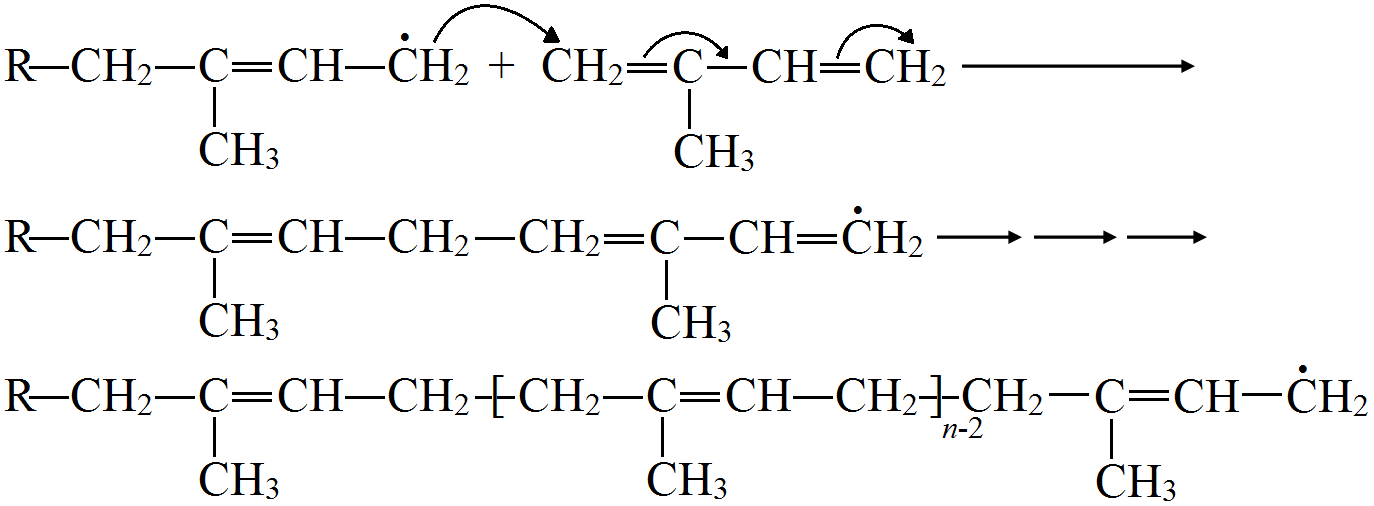
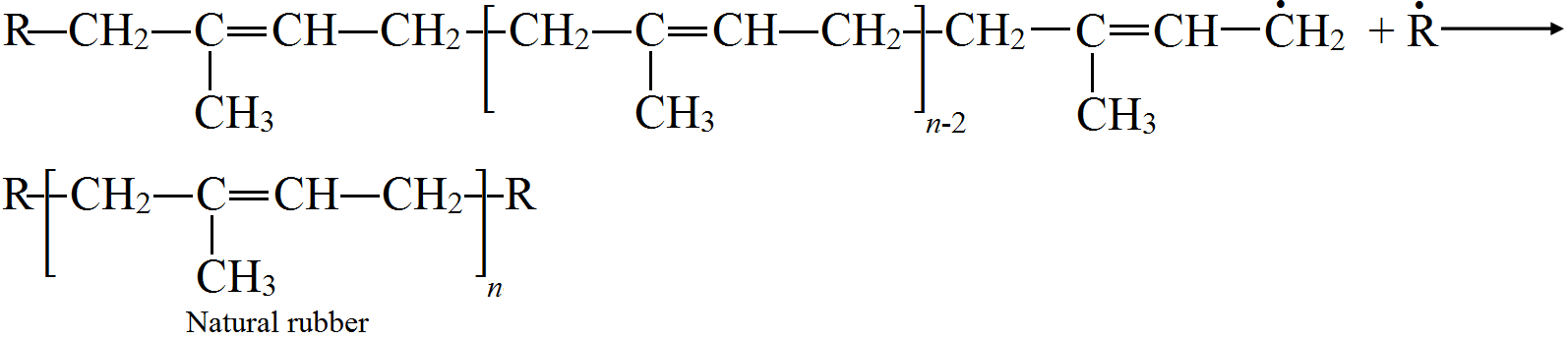
  1. The free radical mechanism of polymerisation of isoprene may be given as follows:
Chain initiation: $\text{Initiator}\ \ \ \ \ \xrightarrow{\ \ \ \ \ \ \ \ \ \ } \ \ \ \ \stackrel{{\cdot}}{\hbox{R}}\\ \ \ \ \ \ \ \ \ \ \ \ \ \ \ \ \ \ \ \ \ \ \ \ \ \ \ \ \ \ \ \ ^\text{Free-radical}$
Chain propagation:

Chain termination: One of the mode of chain termination is.
View full question & answer
Question 333 Marks
Write names of monomer of the following polymer and classify them as addition or condensation polymer.
  1. Teflon.
  2. Bakelite.
  3. Natural Rubber.
Answer
S. No. Polymers Type Monomer
(i) Teflon Addition Tetrafluoroethene
(ii) Bakelite Condensation Phenol and fomaldehyde
(iii) Natural rubber Addition Cis-isoprene
View full question & answer
Question 343 Marks
Write the structure and name of the monomers of the following polymers:
  1. Buna$-S$
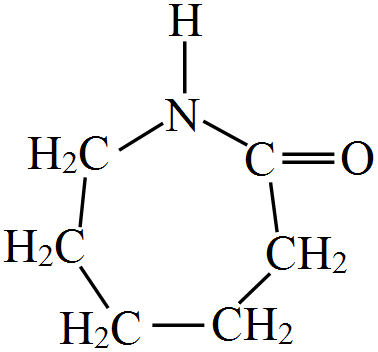
  2. Nylon$-6$
  3. Teflon.
Answer
S. No. Polymers Monomer Names Monomer Structures
(i) Buns$-S$ $1,3-$Butadiene
Styene
$CH_2-CH-CH=CH_2$
(ii) Nylon$-6$ Caprolactam
(iii) Teflon Tetrafluoroethene $CF_2=CF_2$
View full question & answer