Questions

5 Marks Questions

🎯

Test yourself on this topic

20 questions · timed · auto-graded

Question 15 Marks
Derive formula for degree of dissociation and degree of condensation of the solute in the solvent.
Answer
self
View full question & answer
Question 25 Marks
(a) What is reverse osmosis? How is water purified through it? Explain.
(b) Write the applications of osmosis.
Answer
self
View full question & answer
Question 35 Marks
How to determine the vapour pressure and total pressure of the components in binary solution of two volatile liquids? Explain their mathematical form and also explain the graph between mole fraction and vapour pressure for an ideal solution.
Answer
self
View full question & answer
Question 45 Marks
Prove that boiling point elevation (AT) is proportional to the molality of solute present in the solution. Also find its mathematical form.
Answer
self
View full question & answer
Question 65 Marks
(a) What is van't Hoff factor? Explain.
(b) Write the equation of molecular number properties including van't Hoff factor.
Answer
self
View full question & answer
Question 85 Marks
What is vapour pressure? When a non- volatile solute is dissolved in any liquid, the vapour pressure of the liquid decreases. Give reason.
Answer
self
View full question & answer
Question 95 Marks
Prove that the relative depression of vapour pressure is equal to the mole fraction of solute.
Answer
self
View full question & answer
Question 105 Marks
How many mL of 0.1 M HCl are required to react completely with 1 g mixture of $Na _2 CO _3$ and $NaHCO _3$ containing equimolar amounts of both?
Answer
Let the mass of Na2CO3 in 1 g mixture = x g
Molar mass of Na2CO3$=(2 \times 23)+12+(3 \times 16)$
$\qquad\qquad\qquad\qquad\qquad$$=106$
Hence, moles of Na2CO3 (n1) = $\frac{x}{106} mol$
Mass of NaHCO3 in the mixture = (1 - x) g
Molar mass of NaHCO3= 23 + 1 + 12 + 48 = 84
Hence, moles of NaHCO3 (n2) = $\frac{1-x}{84} mol$
The balanced reaction of Na2CO3 and NaHCO3 with HCl are as follows :
$Na _2 CO _3+2 HCl \rightarrow 2 NaCl + CO _2+ H _2 O$
1 Mol $\qquad\qquad\qquad$ 2 Mol
$NaHCO _3+ HCl \rightarrow NaCl + CO _2+ H _2 O$
1 Mol $\qquad\qquad\qquad$2 Mol
Therefore, according to the balanced equation :
$\frac{x}{106}$mol of $Na _2 CO _3$ required for
$HCl =\frac{2 x }{106} mol$
and $\frac{1-x}{84} mol$ $NaHCO _3$ is required for
$HCl =\frac{1-x}{84} mol$
Since, the number of moles of Na2CO3 and NaHCO3 are same in given mixture, therefore,
$ \frac{x}{106}  =\frac{1-x}{84} $
$106  -106 x=84 x $
$106  =190 x $
$x  =\frac{106}{190} $
$x  =0.56$ $mol$
Moles of HCl required for the reaction with both Na2CO3 and NaHCO3
$=\left(\frac{2 x}{106}+\frac{1-x}{84}\right) $
$=\frac{2 \times 0.56}{106}+\frac{1-0.56}{84} $
$=0.01056+0.00523 $
$=0.01579 $
$=0.01578$ $mol$
In the volume of HCl required is V,
Molarity × Volume (L) = Mole
0.1 × V(L) = 0.01578
V(litre)=0.1578 L
Hence, Volume of required HCl = 157.8 mL
View full question & answer
Question 115 Marks
The air is a mixture of a number of gases. The major components are oxygen and nitrogen with approximate proportion of 20% is to 79% by volume at 298 K. The water is in equilibrium with air at a pressure of 10 atm. At 298 K if the Henry's law constants for oxygen and nitrogen at 298 K are 3.3 × 107 mm and 6.51 × 107 mm respectively. Calculate the composition of these gases in water.
Answer
Let the volume of 1 mole of air at 10 atmospheric pressure (atm P) = V 
Air contains 20% O2 (by volume)
Hence volume of $O _2=\frac{ V \times 20}{100}=0.2 V$
Percentage of N2 in the air (by volume) = 79%
Hence volume of $N _2=\frac{ V \times 79}{100}=0.79 V$
Partial pressure of a gas
$=\frac{\text { Volume of that gas }}{\text { Total volume }} \times$ Total pressure
Partial pressure of $O _2, P _{ O _2}=\frac{0.2 V}{ V } \times 10=2 atm$.
Partial pressure of $N _2, P _{ N _2}=\frac{0.79 V}{ V } \times 10=7.9 atm$.
Therefore the solubility of O2 in solution (in mole fraction)
According to Henry's law:
$\begin{array}{l}x_{ O _2}=\frac{ P _{ O _2}}{K_{ H }}=\frac{2 \times 760(mm)}{3.30 \times 10^7(mm)} \\ x_{ O _2}=\frac{1520}{3.30 \times 10^7}=4.606 \times 10^{-5}\end{array}$
Similarly, solubility of N2 (in mole fraction)
$\begin{array}{l}\left(x_{ N _2}\right)=\frac{ p _{ N _2}}{ k _{ H }}=\frac{7.9 \times 760(mm)}{6.51 \times 10^7(mm)} \\ \left( x _{ N _2}\right)=\frac{6004}{6.51 \times 10^7}=9.22 \times 10^{-5}\end{array}$
Hence, solubility of O2 in water (mole fraction) = 4.606 × 10⁵ and solubility of N₂ (mole fraction) = 9.22 × 10⁻⁵

View full question & answer
Question 125 Marks
Benzene and toluene form ideal solution over the entire range of composition. The vapour pressure of pure benzene and toluene at 300 K are 50.71 mm Hg and 32.06 mm Hg respectively. Calculate the mole fraction of benzene in vapour phase if 80 g of benzene is mixed with 100 g of toluene.
Answer
Consider the mole fraction of benzene in vapour state = y2 then
$y _2=\frac{\text { Partial pressure of benzene }}{\text { Total vapour pressure }}$ 
$y _2=\frac{p_2}{p_1+p_2}=\frac{x_2 p_2^0}{x_1 p_1^0+x_2 p_2^0}$
n2= Moles of benzene $=\frac{80}{78}=1.025$
[Molar mass of benzene $\left.\left( C _6 H _6\right)=78\right]$
Molar mass of toluene $\left( C _7 H _8\right)=92$
Hence moles of toluene $\left(n_1\right)=\frac{100}{92}=1.086$
Mole fraction of benzene in solution,
$\begin{array}{l}x_2=\frac{n_2}{n_1+n_2}=\frac{1.025}{1.086+1.025} \\ x_2=\frac{1.025}{2.111}=0.485\end{array}$
Mole fraction toluene $\left(x_1\right)=1-x_2$
$=1-0.485=0.515$
Mole fraction of benzene in vapour state 
$\begin{array}{l} y _2=\frac{p_2}{p_{\text {total }}} \\ p_2=p_2^0 x_2\end{array}$
$\begin{array}{l}p_2^0=50.71 mm Hg , x _2=0.485 \\ p_2=50.71 \times 0.485=24.59\end{array}$
$p_1=p_1^0 x_1$
$\begin{array}{l}p_1^0=32.06 mm Hg , x_1=0.515 \\ p_1=32.06 \times 0.515=16.51\end{array}$
$p_{\text {total }}=p_1+p_2=16.51+24.59=41.1$
Hence, $y _2=\frac{p_2}{p_{\text {total }}}=\frac{24.59}{41.1}=0.59=0.60$
Therefore, mole fraction of benzene in vapour state 
$y _2=0.60$
and mole fraction toluene in vapour state
$y_1=1-y_2=1-0.60=0.40$
View full question & answer
Question 135 Marks
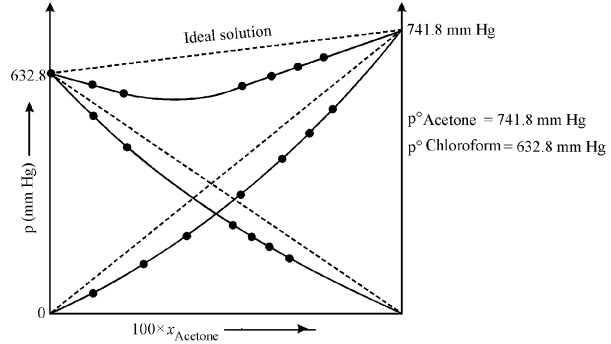
Vapour pressures of pure acetone and chloroform at 328 K are 741.8 mm Hg and 632.8 mm Hg respectively. Assuming that they form ideal solution over the entire range of composition, plot $p_{\text {total }}, p_{\text {chloroform }}$ and $p_{\text {acetone }}$ as a function of $x_{\text {acetone }}$ The experimental data observed for different compositions of mixture is :
$100 \times x_{\text {acetone }}$011.823.436.050.858.264.572.1
$p_{\text {acetone }} / mm Hg$054.9110.1202.4322.7405.9454.1521.1
$p_{\text {chloroform }} / mm Hg$632.8548.1469.4359.7257.7193.6161.2120.7
Plot this data also on the same graph paper. Indicate whether it has positive deviation or negative deviation from the ideal solution.
View full question & answer
Question 145 Marks
100 g of liquid A (molar mass 140 g mol-1) was dissolved in 1000 g of liquid B (molar mass 180 g mol-1). The vapour pressure of pure liquid B was found to be 500 Torr. Calculate the vapour pressure of pure liquid A and its vapour pressure in the solution if the total vapour pressure of the solution is 475 Torr.
Answer
Let vapour pressure of liquid $A = p _{ A }^0$  and vapour pressure of liquid B in pure state $p_{ B }^0=500$ Torr
Moles of liquid $A \left(n_{ A }\right)=\frac{\text { Mass of liquid }}{\text { Molar mass }}$
$=\frac{100}{140}=0.714$
$\begin{aligned} \text { Moles of liquids } B \left(n_{ B }\right) & =\frac{\text { Mass of liquid }}{\text { Molar mass }}=\frac{1000}{180} \\ & =5.55\end{aligned}$
Mole fraction of liquid A 
$\begin{aligned} x_{ A } & =\frac{n_{ A }}{n_{ A }+n_{ B }}=\frac{0.714}{0.714+5.55} \\ & =\frac{0.714}{6.264}=0.1139=0.114\end{aligned}$
Mole fraction of liquid B 
$\begin{aligned}\left(x_{ B }\right) & =\left(1-x_{ A }\right)=(1-0.114) \\ & =0.886\end{aligned}$
From Dalton's law of partial pressure
Total pressure $(p)=p_{ A }+p_{ B }$
$p=p_{ A }^0 x_{ A }+p_{ B }^0 x_{ B }$
$\begin{array}{l}\text { Total vapour pressure }=475 \text { Torr } \\ \qquad 475=\left(p_{ A }^0 \times 0.114\right)+500 \times 0.886 \\ 475=0.114 p _{ A }^0+443 \\ 0.114 p_{ A }^0=475-443 \\ 0.114 p_{ A }^0=32\end{array}$
Vapour pressure of A in pure liquid
$
p_{A}^0=\frac{32}{0.114}=280.70 \text { Torr }
$
Vapour pressure of A in solution $p_A=p_A^0 x_A$
$\begin{array}{l} p _{ A }=280.70 \times 0.114 \\ p _{ A }=31.99=32\end{array}$
Hence, $p _{ A }=32$ Torr.
View full question & answer
Question 155 Marks
19.5 g of CH2FCOOH is dissolved in 500 g of water. The depression in the freezing point of water observed is 1.0°C. Calculate the van't Hoff factor and dissociation constant of fluoroacetic acid. [If $K_f=1.86 K kg mol ^{-1}$ and density of solution $\left.=1.124 g mL ^{-1}\right]$
Answer
(i) Molality of solution (M)
$=\frac{\text { Mass of solute }( g ) \times 1000}{\text { Molar mass of solute } \times \text { Mass of solvent }( g )}$
Mass of solute = 19.5 g,
Molar mass of CH2FCOOH = 12 + 2 + 19 + 12 + 16 + 16 + 1 = 78
Mass of solvent = 500 g
Hence, $m=\frac{19.5 \times 1000}{78 \times 500}=0.5$
Freezing pont depression $\Delta T _{ F }=1.0^{\circ} C$
(ii)$\Delta T _{ F }= P \times H _{ F } \times m$
$P =\frac{\Delta T _{ f }}{ K _{ f } \times m }=\frac{1.0}{1.86 \times 0.5}=0.07526$
van't Hoff coefficient (i) = 1.0753
(iii) Degree of dissociation of acid $(\alpha)=\frac{i-1}{n-1}$
$\alpha=\frac{1.0753-1}{2-1}=0.0753$
(iv) Degree of dissociation $(\alpha)=\sqrt{\frac{K_a}{C}}$
C = Molarity, Ka = Dissociation constant of acid Molarity M
$=\frac{\text { Mass of solute }( g ) \times 1000}{\text { Molar mass of solute } \times \text { Volume of solution }( mL )}$
Total mass of solution = 500 + 19.5 = 519.5 g
$\begin{array}{l}\text { Volume of solution }( V )=\frac{\text { Mass }}{\text { Density }} \\ \qquad\left[\text { Density of solution } d =1.124 g mL ^{-1}\right]\end{array}$
Hence, $V =\frac{519.5}{1.124}=462.18 mL$
$\begin{aligned} \text { Molarity }( M ) & =\frac{19.5 \times 1000}{78 \times 462.18} \\ & =0.5409 \\ C & = M =0.541 mol L ^{-1}\end{aligned}$
Therefore,  $\alpha=\sqrt{\frac{ K _{ a }}{ C }}$
$\begin{aligned} K _{ a } & =\alpha^2 \times C \\ K _{ a } & =(0.0753)^2 \times 0.541 \\ K_{ a } & =3.067 \times 10^{-3}=3.07 \times 10^{-3}\end{aligned}$
Hence, dissociation constant of acid Ka
= 3.07 × 10⁻³
View full question & answer
Question 165 Marks
Calculate the depression in the freezing point of water when 10 g of
CH3CH2CHClCOOH is added to 250 g of water. Ka = 1.4 × 10⁻³, Kf = 1.86 K kg mol-1.
View full question & answer
Question 175 Marks
Two elements A and B form compounds having formula AB2 and AB4. When dissolved in 20 g of benzene $\left( C _6 H _6\right), 1 g$ of $AB _2$ lowers the freezing point by 2.3 K whereas 1.0 g of AB4 lowers it by 1.3 K. The molar depression constant for benzene is 5.1 K kg mol-1. Calculate atomic masses of A and B.
Answer
Freezing point depression :
$\Delta T _{ f }=\frac{ K _{ f } \times w_2 \times 1000}{ M _2 \times w_1}$
Molar mass $\left( M _2\right)=\frac{ K _{ f } \times w_2 \times 1000}{\Delta T_{ f } \times w_1}$
$ M _2= M _{ AB _2}=  \text { Molar mass of } AB _2=\text { ? } $
$ K _{ f }=5.1$ $K$ $kg$ $mol ^{-1} $
$ w_2=1 g, w_1=20 g, \Delta T _{ f }=2.3 K $
$ M _{ AB _2}=\frac{5.1 \times 1 \times 1000}{2.3 \times 20}=110.869 $
$ M _{ AB _2}=110.87$ $g mol ^{-1}$
Similarly, molar mass of AB4
$ M _{ AB _4}  =\frac{ K _{ f } \times w_2 \times 1000}{\Delta T_{ f } \times w_1} $
$\Delta T_{ f }  =1.3 K $
$M _{ AB _4}  =\frac{5.1 \times 1 \times 1000}{1.3 \times 20}=196.15 $
$ =196.15$ $g mol ^{-1}$
Let x and y be atomic masses of A and B respectively, Then
$M _{ AB _2}=x+2 y$
$110.87=x+2 y \quad \quad \ldots \ldots(1)$
$M _{ AB _4}=x+4 y$
$196.15=x+4 y$$\quad \quad \ldots \ldots(2)$
On substracting equation (1) from equation (2),
$ 196.15-110.87  =2 y $
$85.28  =2 y $
$y  =42.64 u$
On putting value of y in equation (1),
$ 110.87  =x+2 \times 42.64 $
$110.87  =x+85.28 $
$x  =110.87-85.28 $
$x  =25.59 u$
Hence, atomic mass of A = 25.59 u
atomic mass of B = 42.64 u
View full question & answer
Question 185 Marks
A solution containing 30 g of non-volatile solute exactly in 90 g of water has a vapour pressure of 2.8 kPa at 298 K. Further, 18 g of water is then added to the solution and the new vapour pressure becomes 2.9 kPa at 298 K. Calculate :
(i) molar mass of the solute
(ii) vapour pressure of water at 298 K
Answer
(i) Mass of solute 30 g and
Let the molar mass of solute = M
Hence moles of solute $\left(n_2\right)=\frac{30}{M}$
Mass of solvent $\left( H _2 O \right)=90 g$,
$\text {Molar mass }=18$ $g mol ^{-1} $
$\text {Hence moles of solvent }=\frac{90}{18}=5$
Mole fraction of solvent (x1) = $\frac{5}{5+(30 / M)}=\frac{5 M}{5 M+30}$
$x_1=\frac{ M }{6+ M }$
Vapour pressure of solution $p_1=p_1^0 x_1$
$2.8=p_1^0 \times \frac{ M }{6+ M }$ $\quad \quad \ldots \ldots(1)$
18 g (1 mole) water is added to solution
then, moles of water = 5 + 1 = 6
So, mole fraction of solvent $(H_{2}O)$
$x_1=\frac{6}{6+(30 / M)}=\frac{M}{5+M}$
Vapour pressure of solution $\left(p_1^1\right)=p_1^0 x_1^1$
$2.9=p_1^0 \times \frac{ M }{5+ M }$ $\quad \quad \ldots \ldots(2)$
On dividing equation (2) and equation (1),
$ \frac{2.8}{2.9} =\frac{5+ M }{6+ M } $
$2.8(6+ M ) =2.9(5+ M ) $
$16.8+2.8 M =14.5+2.9 M $
$0.1 M =2.3 $
$M =23$ $g mol ^{-1}$
Hence, Molar mass of solute $=23$ $g mol^{-1}$
(ii) On putting value of M in equation (2)
$2.9=p_1^0 \times \frac{23}{5+23}$
$ 2.9 =\frac{p_1^0 \times 23}{28} $
$23 p_1^0 =2.9 \times 28 $
$23 p_1^0 =81.2 $
$p_1^0 =\frac{81.2}{23}=3.53$ $k Pa $
Therefore, at 298 K, vapour pressure of water = 3.53 kPa.
View full question & answer
Question 195 Marks
Calculate the mass of a non-volatile solute (molar mass $40$ $g$ $mol ^{-1}$) which should be dissolved in 114 g octane to reduce its vapour pressure to 80%.
Answer
Vapour pressure of solution $p _1=80 \%$ of $p_1^0$
Hence, $\quad p_1=p_1^0 \times 0.8$
Let mass of solute = w g
Molar mass $=40$ $g mol ^{-1}$
Moles of solute $=\frac{w}{40}$
Molar mass of octane $\left( C _8 H _{18}\right)=114$ $g mol ^{-1}$
Mass of solute = 114 g
Moles of solvent (octane) $=\frac{114}{114}=1$ $mol$
Mole fraction of solute (x2) $=\frac{w / 40}{\frac{w}{40}+1}$
Depression in vapour pressure $=\frac{p_1^0-p_1}{p_1^0}$
=Mole fraction of solute
$=\frac{n_2}{n_1+n_2}=x_2$
$\frac{p_1^0-0.8 p_1^0}{p_1^0}=\frac{w / 40}{\frac{w}{40}+1}$
$\frac{p_1^0}{p_1^0}-\frac{0.8 p_1^0}{p_1^0}=\frac{w / 40}{\frac{w+40}{40}}$
$1-0.8=\frac{w}{40} \times \frac{40}{w+40}$
$0.2=\frac{w}{w+40}$
$ 0.2 w+8  =w $
$0.8 w  =8 $
$w  =\frac{8}{0.8}=10 g$
Mass of solute = 10 g
View full question & answer
Question 205 Marks
State Henry's law and mention some important applications.
Answer
Henry's law :
(i) The solubility of a gas in liquid at constant temperature is proportional to the pressure of that gas. The solubility of a gas in a liquid solution depends on the partial pressure of the gas and the solubility of gas in solution is expressed in mole fraction.
(ii) The mole fraction of a gas in the solution is proportional to the partial pressure of the gas present above that solution.
(iii) The partial pressure (p) of a gas in vapour state is proportional to mole fraction (x) of gas in that solution.
$p= K _{ H } x$ where $K _{ H }=$ Henry's constant
Important Applications of Henry's Law :
Henry's law has many applications in industries and biological phenomena of which the following applications are as follows :
  • The partial pressure of oxygen at high altitude places is less than at ground level, hence the concentration of oxygen in blood and tissues of the people and climbers living at these places reduces. Due to which they become weak and their thinking ability reduces, this disease is called anoxia.
  • To increase the solubility of CO2 in soda water and soft drinks, the bottle is closed at high pressure.
  • The divers have to face high pressure and high solubility of gases while breathing in deep sea. Due to greater external pressure, the solubility of atmospheric gases taken in with respiration increases in blood. As the diver comes to the surface, the external pressure gadually decreases, causing dissolved gases to escape forming nitrogen bubbles in blood. These create blockages in the cells which are called Bends. These are painful and fatal. To avoid the toxic effects of excessive amounts of bends and nitrogen in the blood, divers uses air diluted with helium for breathing (11.7% helium, 56.2% nitrogen and 32.1% oxygen.)
View full question & answer
5 Marks Questions - Chemistry STD 12 Science Questions - Vidyadip