Question 13 Marks
- Urea forms an ideal solution in water. Determine the vapour pressure of anaqueous solution containing 10% by mass of urea at 40°C. (Vapour pressure of water at 40°C = 55.3 mm of Hg)
- Why is freezing point depression of 0.1 M sodium chloride solution nearly twice that of 0.1 M glucose solution?
Answer
- $\frac{\text{P}^{\circ}_{A}-\text{P}_{A}}{\text{P}^{\circ}_{A}}=\frac{\text{Moles of Solvent}}{\text{Moles solute + Moles of solvent}}$
$\text{P}^{\circ}_{\text{A}}=55.3\text{ mm of Hg, P}_{\text{A}}=?$
Mass of Solvent = (100 - 10)g = 90g,
No. of Moles of solvent =$\frac{\text{90g}}{\text{18g mol}^{-1}}=\text{5 mol} $
No. of Moles of solute$\frac{\text{10}}{\text{60}}=\frac{\text{1}}{\text{6}}\text{ mol}$
$\frac{\text{55.3 - P}_{A}}{\text{55.3}}=\frac{\frac{1}{6}}{\frac{1}{6}+5}=\frac{\text{1}}{\text{31}}$
$\text{P}_{A}\text{=53.52 mm Hg}.$
- Sodium chloride dissolves in water to form two ions whereas glucose is non–electrolyte and remains in molecular form only.
View full question & answer→Question 23 Marks
Calculate the boiling point of solution when $4\ g$ of $MgSO_4\ (M = 120\ g\ mol^{-1})$ was dissolved in $100\ g$ of water, assuming $MgSO_4$ undergoes complete ionization.
$(K_b$ for water$=0.52\ K\ kg\ mol^{-1}).$
Answer$\Delta\text{T}_{b} = \text{iK}_{b}.\text{m}$
$i=2$
$ = \text{i}\times\text{K}_{b}\times\frac{\text{w}_{2}\times1000}{\text{M}\times\text{W}_{1}}$
$ =2\times0.52\text{ K }\text{ Kg }\text{mol}^{-1}\times\frac{4\text{ g }\times1000\text{ g }/\text{kg}}{120\text{ g/mol}\times100\text{ g}} $
$ = \frac{2\times0.52}{3}$
$= 0.346\ K$
Boiling point of water $= 373.15\ K / 373\ K$
$T_b = {T_b}^o + \triangle T_b$
$= 373.15\ K + 0.346\ K / 373\ K + 0.346\ K$
$= 373.496\ K / 373.346\ K.$
View full question & answer→Question 33 Marks
Vapour pressure of water at $20^o\ C$ is $17.5\ mm$ Hg. Calculate the vapour pressure of water at $20^o\ C$ when $15\ g$ of glucose $($Molar mass $=180\ g\ mol^{-1})$ is dissolved in $150\ g$ of water.
Answer$\text{P}^{o}_{A}=\text{17.5 mm of Hg}$.gif)
 $\text{W}_{B}=\text{15g}$ $\text{M}_{B}=\text{180g/mol}$$\text{W}_{A}=\text{150g}$ $\text{P}_{s}=\text{?}$
$\frac{\text{P}^{o}_{A}-\text{Ps}}{\text{P}^{o}_{A}}$ $=\frac{\text{W}_{B}\times\text{M}_{A}}{\text{M}_{B}\times\text{W}_{A}}$ $\therefore\frac{\text{P}^{o}_{A}-\text{P}_{S}}{\text{P}^{o}_{A}}=\frac{\text{15}\times\text{18}}{\text{180}\times\text{150}}=0.01$
$\frac{\text{P}^{o}_{A}-\text{P}_{S}}{\text{P}^{o}_{A}}=\frac{\text{17.5}\times\text{P}_{s}}{\text{17.5}}=0.01$
$\therefore\text{P}_{s}=\text{17.325 mm of Hg}$ View full question & answer→Question 43 Marks
A solution prepared by dissolving 8.95mg of a gene fragment in 35.0mL. of water has an osmotic pressure of 0.335 torr at 25°C. Assuming that the gene fragment is a non-electrolyte, calculate its molar mass.
Answer$\pi = \text{CRT}$$\text{M}_{2}=\frac{\text{W}_{2}\text{R}\text{T}}{\pi\text{V}}$
$\text{M}_{2}=\frac{\text{8.95}\times\text{10}^{-3}\text{g}\times\text{0.0821 L atm mol}^{-1}\text{K}^{-1}\times\text{298 K}\times760\times1000}{0.335\text{ atm}\times35\text{ L}}$
$\text{M}_2 = 14193.3 \text{g mol}^{–1} \text{ or } 1.42\times104\text{g mol}^{–1}.$
View full question & answer→Question 53 Marks
What mass of $\mathrm{NaCl}\left(\right.$ molar mass $\left.=58.5 \mathrm{~g} \mathrm{~mol}^{-1}\right)$ must be dissolved in $65$ g of water to lower the freezing point by $7.50^{\circ} \mathrm{C}$ ? The freezing point depression constant, $\mathrm{K}_{\mathrm{f}}$, for water is $1.86 \mathrm{~K} \mathrm{~kg} \mathrm{~mol}^{-1}$. Assume van't Hoff factor for $NaCl$ is $1.87.$
Answer$ \Delta \mathrm{T}_{\mathrm{f}}=7.50 \mathrm{C} $
$ \Delta \mathrm{~T}_{\mathrm{f}}=i \mathrm{K}_{\mathrm{f}} \mathrm{~m} $
$ 7.50 \mathrm{C}=1.87 \times 1.86^0 \mathrm{C} \mathrm{~kg} \mathrm{~mol}^{-1} \times \frac{\mathrm{w}}{58.5 \mathrm{~g} \mathrm{~mol}^{-1}} \times \frac{10001}{65 \mathrm{~kg}} $
$ \mathrm{w}=8.2 \mathrm{~g}$
View full question & answer→Question 63 Marks
Calculate the temperature at which a solution containing $54$ g of glucose, $C_6H_{12}O_6,$ in $250$ g of water will freeze. $[K_f$ for water $= 1.86\ K\ kg\ mol^{–1}].$
Answer$\triangle T_f = K_f\ m$
No. of moles of glucose = $\frac{\text{54 g}}{\text{180 g mol}^{-1}}$
Molality of Glucose solution = $\frac{\text{54 mol}}{180}\times\frac{1000}{\text{250kg}} = 1.20\ mol\ kg^{-1}$
$\triangle T_f = K_f\ m$
$= 1.86\ K\ kg\ mol^{-1} x 1.20\ mol\ kg^{–1}$
$= 2.23\ K$
Temp. at which solution freezes $= (273.15 – 2.23)K = 270.77K$ or $-2.23^0C /$
$=(273.000 – 2.23)K = 270.7\ K.$
View full question & answer→Question 73 Marks
A solution containing $8$ g of a substance in $100$ g of diethyl ether boils at $36,86^\circ C,$ whereas pure ether boils at $35.60^\circ C$. Determine the molecular mass of the solute. $($For ether $K_b = 2.02\ K\ kg\ mol^{–1}).$
Answer$ \Delta T_b=(36.86-35.60)^{\circ} \mathrm{C}=1.26^{\circ} \mathrm{C} \text { or } 1.26 \mathrm{~K} $
$ \text { No. of moles of solute }=\frac{8 \mathrm{~g}}{\mathrm{M}} $
$ \text { Molality of Glucose solution }=\frac{8 \mathrm{~g}}{\mathrm{M}} \times \frac{1000}{100 \mathrm{~kg}} $
$ \Delta \mathrm{~T}_{\mathrm{b}}=\mathrm{K}_{\mathrm{b}} \mathrm{~m} $
$ 1.26 \mathrm{~K}=2.02 \mathrm{~K} \mathrm{~kg} \mathrm{~mol}^{-1} \times \frac{8 \mathrm{~g}}{\mathrm{M}} \times \frac{1000}{100 \mathrm{~kg}} $
$ \mathrm{M}=128.25 \mathrm{~g} \mathrm{~mol}^{-1}$
$\text { Where } \mathrm{M} \text { is molar mass of the solute. }$
View full question & answer→Question 83 Marks
$A\ 0.1539$ molal aqueous solution of cane sugar $($mol. mass $=342 \mathrm{~g} \mathrm{~mol}^{-1} )$ has a freezing point of $271\ K$ while the freezing point of pure water is $273.15\ K $. What will be the freezing point of an aqueous solution containing 5 g of glucose $\left(\mathrm{mol}^2\right.$ mass $\left.=180 \mathrm{~g} \mathrm{~mol}^{-1}\right)$ per $100\ g$ of solution?
Answer$\Delta\text{T}_{\text{f}}=\text{K}_{\text{f}}\text{m}$
$\text{K}_{\text{f}}=\frac{\Delta\text{T}_{f}}{\text{m}}=\frac{2.15\text{k}}{0.1539\text{m}}=13.97\text{K kg mol}^{-1}$
No. of moles of glucose = $\frac{5}{180}\text{moles}$
Molality of glucose = $\frac{5}{180}\times\frac{1000}{95}=0.292\text{ m}$
$\Delta\text{T}_{f}=\text{K}_{f}\text{M}$
$ =13.97 \mathrm{~K} \mathrm{~kg} \mathrm{~mol}^{-1} \times 0.292 \mathrm{~mol} \mathrm{~kg}^{-1}$
$ =4.07 \mathrm{~K}$
Freezing point of solution $=(273.15-4.07) \mathrm{K}=269.08 \mathrm{~K}$.
View full question & answer→Question 93 Marks
A solution of glucose $\left(\right.$ Molar mass $\left.=180 \mathrm{~g} \mathrm{~mol}^{-1}\right)$ in water has a boiling point of $100.20^{\circ} \mathrm{C}$. Calculate the freezing point of the same solution. Molal constants for water $\mathrm{K}_{\mathrm{f}}$ and $\mathrm{K}_{\mathrm{b}}$ are $1.86 \mathrm{~K} \mathrm{~kg} \mathrm{~mol}^{-1}$ and $0.512 \mathrm{~K} \mathrm{~kg} \mathrm{~mol}^{-1}$ respectively.
AnswerGiven: Tb of glucose solution $=100.20^{\circ} \mathrm{C}$
$\Delta T_b=K_b \cdot m$
$\mathrm{m}=0.20 / 0.512$
$\mathrm{m}=0.390 \mathrm{~mol} / \mathrm{kg}$
$\Delta \mathrm{T}_{\mathrm{f}}=\mathrm{K}_{\mathrm{f} .} \mathrm{m}$
$\Delta \mathrm{T}_{\mathrm{f}}=1.86 \mathrm{~K} \mathrm{~kg} / \mathrm{mol} \times 0.390 \mathrm{~mol} / \mathrm{kg}$
$\Delta \mathrm{T}_{\mathrm{f}}=0.725 \mathrm{~K}$
Freezing point of solution $=273.15 \mathrm{~K}-0.725$
$=272.425 \mathrm{~K}$
View full question & answer→Question 103 Marks
$A\ 10 \%$ solution (by mass) of sucrose in water has freezing point of $269.15\ K$. Calculate the freezing point of $10 \%$ glucose in water if freezing point of pure water is $273.15\ K .$
Given: (Molar mass of sucrose $=342 \mathrm{~g} \mathrm{~mol}^{-1}$ )
(Molar mass of glucose $\left.=180 \mathrm{~g} \mathrm{~mol}^{-1}\right)$
Answer$\triangle T_f=K_f m$
Here, $\mathrm{m}=\mathrm{w}_2 \times 1000 / \mathrm{M}_2 \times \mathrm{M}_1$
$273.15-269.15=K_{\mathrm{f}} \times 10 \times 1000 / 342 \times 90$
$\mathrm{K}_{\mathrm{f}}=12.3 \mathrm{~K} \mathrm{~kg} / \mathrm{mol}$
$\triangle T_f=K_f m$
$=12.3 \times 10 \times 1000 / 180 \times 90$
$=7.6 \mathrm{~K}$
$T_f=273.15-7.6=265.55 \mathrm{~K}$
View full question & answer→Question 113 Marks
$3.9\ g$ of benzoic acid dissolved in $49\ g$ of benzene shows a depression in freezing point of $1.62\ K.$ Calculate the van't Hoff factor and predict the nature of solute (associated or dissociated).
$($Given: Molar mass of benzoic acid $=122 \mathrm{~g} \mathrm{~mol}^{-1}, \mathrm{~K}_{\mathrm{f}}$ for benzene $=4.9 \mathrm{~K} \mathrm{~kg} \mathrm{~mol}^{-1} )$
Answer$\Delta\text{T}_{\text{f}}=\text{i}\text{K}_{\text{f}}\text{m}$
$\Delta\text{T}_{\text{f}}=\text{i}\text{K}_{\text{f}}\frac{\text{w}_{\text{b}}\times\text{1000}}{\text{M}_{\text{b}}\times\text{w}_{\text{a}}}$
$\text{1.62K}=\text{i}\times\text{4.9K kg mol}^{-1}\times\frac{\text{3.9 g}}{\text{122 gmol}^{-1}}\times\frac{\text{1000}}{\text{49 kg}}$
$i = 0.506$
As $i < 1,$ therefore solute gets associated.
View full question & answer→Question 123 Marks
Determine the osmatic pressure of a solution prepared by dissolving $2.5 \times 10^{-2} \mathrm{~g}$ of $\mathrm{K}_2 \mathrm{SO}_4$ in $2$ L of water at $25^{\circ} \mathrm{C}$, assuming that it is completely dissociated. $\left(\mathrm{R}=0.0821 \mathrm{~L} \mathrm{~atm} \mathrm{~K}^{-1} \mathrm{~mol}^{-1}\right.$, Molar mass of $\left.\mathrm{K}_2 \mathrm{SO}_4=174 \mathrm{~g} \mathrm{~mol}^{-1}\right)$.
AnswerWhen $K_2SO_4$ is dissolved in water, ions are produced.
Total number of ions produced $= 3$
$i =3\pi=\text{iCRT}$
$\Rightarrow\text{i}\times\frac{\text{n}}{\text{V}}\times\text{R}\times{T}$
$\pi=3\times\frac{\text{2.5}\times10^{-2}}{\text{174g mol}^{-1}}\times\frac{\text{1}}{\text{2L}}\times{0.0821 L}\text{ atm}\text{ K}^{1}\text{mol}^{-1}\times\text{298K}$
$\pi=5.27\times10^{-3}\text{atm}$
View full question & answer→Question 133 Marks
Calculate the amount of $KCl$ which must be added to $1\ kg$ of water so that the freezing point is depressed by $2K.\ (K_f$ for water $= 1.86\ K\ kg\ mol^{–1}).$
AnswerSince one mole of $KCl$ gives $2$ mole particles, the value of $i = 2$
$\Delta\text{T}_{f} = 2 K$
$K_f = 1.86\ kg\ mol^{-1}$ Applying equation
$\Delta T_f= iK_fm$
$\text{m}=\frac{\Delta\text{T}_{f}}{\text{iK}_{f}}=\frac{2}{2\times1.86}=\text{0.54 mol kg}^{-1}.$
Therefore, $0.54$ mole of $KCl$ should be added to one kg of water.
Alternate answer
Since one mole of $KCl$ gives $2$ mole particles, the value of $i = 2$
$\Delta\text{T}_{f} = 2 K$
$K_f = 1.86\ kg\ mol^{-1}$ Applying equation
$\Delta T_f= iK_fm$
$\text{m}=\frac{\Delta\text{T}_{f}}{\text{iK}_{f}}=\frac{2}{2\times1.86}=\text{0.54 mol kg}^{-1}.$
Therefore, $0.54$ mole of KCl should be added to one kg of water.Molar mass of
$KCl = 39 + 35.5 = 74.5\ g$
Amount of $KCl = 0.54 \times 74.5\ g = 40.05\ g.$
View full question & answer→Question 143 Marks
A solution prepared by dissolving $1.25g$ of oil of winter green (methyl salicylate) in $99.0g$ of benzene has a boiling point of $80.31^\circ C.$ Determine the molar mass of this compound. $(B.P.$ of pure benzene $= 80.10^\circ C$ and Kb for benzene $= 2.53^\circ C\ kg\ mol^{–1}).$
Answer$\triangle T_b = (80.31 – 80.10)^oC = 0.21^oC$ or $0.21\ K$
$\triangle T_b = K_bm$
$\text{0.21}^{\circ}\text{C}=\text{2.53}^{\circ}\text{C kg mol}^{-1}\times\frac{1.25\text{g}}{\text{M}}\times\frac{1000}{99\text{kg}}$
$M\ ò\ 152\ g\ mol^{-1}.$
Where $M$ is molar mass of the solute.
View full question & answer→Question 153 Marks
$100$ mg of a protein is dissolved in just enough water to make $10.0$ mL of solution. If this solution has an osmotic pressure of $13.3$ mm Hg at $25^{\circ} \mathrm{C}$, what is the molar mass of the protein? $\left(\mathrm{R}=0.0821 \mathrm{~L} \mathrm{~atm} \mathrm{~mol}{ }^{-1} \mathrm{~K}^{-1}\right.$ and $760$ mm Hg $=1 \mathrm{~atm}$.
Answer$\pi=\text{CRT}$
$\text{M}_{2}=\frac{\text{w}_{2}\text{RT}}{\pi\text{V}}$
$\text{M}_{2}=\frac{\text{100}\times\text{10}^{-3}\text{g}\times\text{0.0821L atm mol}^{-1}\text{K}^{-1}\times\text{298K}\times\text{760}\times{1000}}{\text{13.3 atm}\times\text{10 L}}$
$\text{M}_{2}=\text{13980g mol}^{-1}\text{or 1.4}\times\text{10}^{4}\text{g mol}^{-1}$
View full question & answer→Question 163 Marks
Calculate the temperature at which a solution containing $54$ g of glucose. $(C_6H_{12}O_6),$ in $250$ g of water will freeze. $(K_f$ for water $= 1.86\ K\ mol^{–1}\ kg).$
Answer$\triangle T_f = K_f\ m$
No. of moles of glucose = $\frac{54\text{ g}}{180\text{ g mol}^{-1} }$
Molality of Glucose solution = $\frac{54\text{ mol}}{180}\times\frac{1000}{250\text{ kg}}=1.20\text{ mol kg}^{-1}$
$\triangle T_f = K_f\ m$
$= 1.86\ K\ kg\ mol^{-1} \times 1.20\ mol\ kg ^{–1}$
$= 2.23\ K$
Temperature at which solution freezes $= ( 273.15 – 2.23)K = 270.77K$ or $-2.23^0C$
or $(273.000 – 2.23)K = 270.7\ K$.
View full question & answer→Question 173 Marks
An antifreeze solution is prepared from $222.6g$ of ethylene glycol $(C_2H_4(OH)_2)$ and $200$g of water. Calculate the molality of the solution. If the density of this solution be $1.072\ g\ mL^{-1},$ what will be the molarity of the solution?
AnswerMolar mass of ethylene glycol$= 62g\ mol^{-1}$ Number of moles of ethylene glycol= $\frac{\text{222.6g}}{\text{62g mol}^{-1}}=\text{3.59 mol}$
Molality of the solution=$\frac{\text{222.6g}}{\text{62g mol}^{-1}}\times\frac{\text{1000}}{\text{200kg}}=\text{17.95m or $17.95$ mol kg}^{-1}$
Mass of solution= $\text{200g}+\text{222.6g}=\text{422.6g}$
Volume= $\frac{\text{Mass of solution}}{\text{Density}}=\frac{\text{422.6g}}{\text{1.072gL}^{-1}}=\text{394.2 mL or 0.3942 L}$
Molarity= $\frac{\text{Mass of solute}}{\text{Volume of solution in liters}}=\frac{\text{3.59 mol}}{\text{0.349 L}}=\text{9.10M or 9.1 mol L}^{-1}$
View full question & answer→Question 183 Marks
- Why is the vapour pressure of a solution of glucose in water lower than that of water?
- A $6.90$ M solution of KOH in water contains $30\%$ by mass of KOH. Calculate the density of the KOH solution.
$[$Molar mass of $KOH=56\ g\ mol^{-1}].$Answer
- Glucose is a nonvolatile, so it decreases the vapour pressure of solution/the number of solvent molecules escaping from the surface is reduced resulting in the decrease of vapour pressure of the solvent.
- Let the density of solution be $= d\ g\ cm^{-3}$
Volume of solution $= 1L = 1000\ cm^3$
Mass of solution $= (1000\ d)\ g$
$6.90$ M solution means $1$ L solution contains $6.90$ moles of KOH.
Mass of KOH $=\text{6.90}\times\text{56}=\text{386.4 g}$
But only $30\%$ of the solution by mass is KOH
$\frac{\text{30}}{\text{100}}\text{cm}^{3}\times\text{(1000 d)}=\text{386.4g}$
$d = 1.288g\ cm^{-3}.$
Alternate Answer
Strength $=$ molarity $\times$ mol mass
$=\text{6.9}\times\text{56}=\text{386.4g/L}$
$30$g of solute is present in $100$g of solution
$1$g is present in $=\frac{\text{100}}{\text{30g}}\text{g}\text{ of solution}$
$\therefore\text{ 386.4g of solute is present in}=\frac{\text{100g}\times\text{386.4g}}{\text{30 g}}=\text{1288 g of solution}$
$\therefore\text{ Density}=\frac{\text{mass}}{\text{volume}}=\frac{\text{1288g}}{\text{1000 cm}^{3}}=\text{1.288g/cm}^{3}.$
Alternate answer
$\text{M}=\frac{\text{%}\times\text{d}\times\text{10}}{\text{M}_{B}}$
$6.9=\frac{\text{30}\times\text{d}\times\text{10}}{\text{56}}$
$\text{d}=\frac{\text{6.9}\times\text{56}}{\text{30}\times\text{10}}=\text{1.288g/cm}^{3}.$ View full question & answer→Question 193 Marks
Give reasons for the following:
- Measurement of osmotic pressure method is preferred for the determination of molar masses of macromolecules such as proteins and polymers.
- Aquatic animals are more comfortable in cold water than in warm water.
- Elevation of boiling point of $1M\ KCl$ solution is nearly double than that of $1M$ sugar solution.
Answer
- Measurement of the osmotic pressure method is preferred for the determination of molar masses of macromolecules such as proteins and polymers because,
- At room temperature, osmotic pressure can be measured, while other colligative properties need high temperature or low temperature conditions.
- They are generally not stable at higher temperatures.
- In water, oxygen is present in the dissolved state.
The solubility of oxygen increases with a decrease of temperature. It is due to this reason that aquatic species are more comfortable in cold waters rather than in warm waters.
- $KCl$ dissociates into $K^+$ and Cl^-, i.e. $i = 2;$ whereas sugar does not dissociate to give ions.
Elevation in the boiling point is directly proportional to the ‘i’ value. So, the elevation in boiling point of $1M\ KCl$ solution is nearly double that of $1M$ sugar solution. View full question & answer→Question 203 Marks
$A\ 4\%$ solution(w/ w) of sucrose $(M = 342g\ mol^{-1})$ in water has a freezing point of $271.15K$. Calculate the freezing point of $5\%$ glucose $(M = 180g\ mol^{-1})$ in water.
$($Given: Freezing point of pure water $= 273.15\ K)$
Answer$4\%$ solution $(w/ w)$ of sucrose
$4g$ sucrose in $96g$ water
$w_2 ($solute$) = 4g$
$w_1 ($solvent$) = 96g$
$M_2 ($solute$) = 342g\ mol^{-1}$
$\Delta\text{T}_\text{f}=\text{k}_\text{f}\text{ m}$
$\text{T}_\text{f}=271.15$
$\text{T}^0_\text{f}=273.15$
$\Delta\text{T}_\text{f}=\text{T}^0_\text{f}-\text{T}_\text{f}$
$\Delta\text{T}_\text{f}=(273.15-271.15)\text{K}$
$\Delta\text{T}_\text{f}=2.0\text{K}$
$\text{k}_\text{f}=\frac{\Delta\text{T}_\text{f}}{\text{m}}$
$\text{m}=\frac{\text{w}_2}{\text{M}_2\ \times\text{w}_1}\times1000$
$\text{m}=\frac{4\times1000}{96\times342}=0.122\text{m}$
$\text{k}_\text{f}=\frac{2}{0.122}=16.39\text{Km}^{-1}$
$\Delta\text{T}_\text{f}=\text{k}_\text{f}\text{ m}$
$*5\%$ Solution(w/ w) of glucosw in water
$5$g glucose in $95$g $H_2O$
$w_2 = 5g$
$w_1 = 95g$
$M_2 = 180g$
$\Delta\text{T}_\text{f}=16.39\times\frac{5\times100}{95\times180}$
$\Delta\text{T}_\text{f}=0.479$
$\Delta\text{T}_\text{f}\cong0.48$
$\text{T}^0_\text{f}-\text{T}_\text{f}=0.48$
$\text{T}_\text{f}=\text{T}^0_\text{f}-0.48$
$\text{T}_\text{f}=273.15-0.48$
$\text{T}_\text{f}=272.67$
View full question & answer→Question 213 Marks
Calculate the mass of ascorbic acid $($Molar mass $= 176g\ mol^{-1})$ to be dissolved in $75$g of acetic acid, to lower its freezing point by $1·5^\circ C. (K_f = 3.9K\ kg\ mol^{-1})$
AnswerMass of acetic acid, $w1 = 75g$ Molar mass of ascorbic acid $(C_6H_8O_6).$
$M2 = 6 \times 12 + 8 \times 1 + 6 \times 16$
$= 176g\ mol^{-1}$
Lowering of melting point, $\Delta\text{T}_\text{f}=1.5\text{K}$
We know that,
$\Delta\text{T}_\text{b}=\frac{\text{K}_\text{b}\times1000\times\omega_2}{\text{M}_2\times\omega_\text{1}}$
$\omega_2=\frac{\Delta\text{T}_\text{b}\times\text{M}_2\times\omega_1}{\text{K}_\text{b}\times1000}$
$\omega_2=\frac{1.5\times176\times75}{3.9\times1000}$
$\omega_2=5.08\text{g}.$
Hence, $5.08g $of ascorbic acid is needed to be dissolved.
View full question & answer→Question 223 Marks
$A\ 4 \%$ solution $(\mathrm{w} / \mathrm{w})$ of sucrose $\left(\mathrm{M}=342 \mathrm{~g} \mathrm{~mol}^{-1}\right)$ in water has a freezing point of $271.15$ K . Calculate the freezing point of $5 \%$ glucose $\left(\mathrm{M}=180 \mathrm{~g} \mathrm{~mol}^{-1}\right)$ in water.
$($Given: Freezing point of pure water $=273.15 \mathrm{~K} )$
Answer$4\%$ solution (w/w) of sucrose means $4g$ of sucrose in $96g$ water.
$\text{W}_\text{solvent} = 96\text{g}, \text{w}_\text{solute}= 4\text{g}, \text{M}_\text{solute}= 342\text{g-}\text{mol}^{-1}$
Using the formula, $\Delta\text{T}_\text{f}=\text{K}_\text{f}\times\text{m}$
$\big(273.15-271.15)=\frac{4\times18\times100\text{k}_\text{f}}{96\times342}$
$\text{K}_\text{f}=16.39\text{K}$
For 5% solution (w/w) of sucrose means 5g of sucrose in 95g water,
$\text{W}_\text{solvent} = 95\text{g}, \text{w}_\text{solute}= 5\text{g}, \text{M}_\text{solute}= 180\text{g-}\text{mol}^{-1}$
Using the formula, $\Delta\text{T}_\text{f}=\text{K}_\text{f}\times\text{m}$
$\Delta\text{T}_\text{f}=\frac{5\times18\times100\times16.39}{95\times180}\text{K}$
$\Delta\text{T}_\text{f}=0.48\text{K}$
$\Delta\text{T}_\text{f}=\Delta\text{T}_{\text{f}^0}-\Delta\text{T}_\text{f}$
$\Delta\text{T}_\text{f}=(273.15-0.48)\text{K}$
$\Delta\text{T}_\text{f}=272.67\text{K}$
View full question & answer→Question 233 Marks
Calculate the boiling point of a $1$ M aqueous solution $($density $1.04 \mathrm{~g} \mathrm{~mL}^{-1} )$ of potassium chloride $( \mathrm{K}_{\mathrm{b}}$ for water $=0.52 \mathrm{~K} \mathrm{~kg} \mathrm{~mol}{ }^{-1}$, Atomic masses: $\mathrm{K}=39 \mathrm{u}, \mathrm{Cl}=35.5 \mathrm{u} )$ Assume, potassium chloride is completely dissociated in solution.
Answer$ \text { Mass of solution = Density of solution } \times \text { Volume of solution } $
$ =1.04 \mathrm{~g} \mathrm{~mL}^{-1} \times 1000 \mathrm{~mL}=1040 \mathrm{~g} $
$ \text { Molar mass of solute } \mathrm{KCl}, \mathrm{M}_{\mathrm{B}}=39+35.5=74.5 \mathrm{~g} \mathrm{~mol}^{-1} $
$ \therefore \text { Mass of solvent water, } \mathrm{W}_{\mathrm{A}}=1040 \mathrm{~g}-74.5 \mathrm{~g} $
$ =965.5 \mathrm{~g} \mathrm{~As} \mathrm{~KCl} \text { dissociates }\left(\mathrm{KCl} \rightarrow \mathrm{~K}^{+}+\mathrm{Cl}^{-}\right) \text {completely, } $
$ \mathrm{i}=\frac{2}{1}=2 \text { For water, } $
$ \mathrm{K}_{\mathrm{b}}=0.52 \mathrm{~K} \mathrm{~kg} \mathrm{~mol}^{-1}, \mathrm{~W}_{\mathrm{B}}=74.5 \mathrm{~g}$
Substituting these values in the expression $\Delta\text{T}_\text{b}=\frac{\text{i}\times\text{K}_\text{b}\times\text{W}_\text{B}\times1000}{\text{M}_\text{B}\times\text{W}_\text{A}}$$\Delta \text{T}_\text{b}=\frac{2\times0.52\text{K kg mol}^{-1}\times74.5\text{g}\times1000\text{g kg}^{-1}}{74.5\text{g mol}^{-1}\times965.5\text{g}}$
$=1.077\text{K}$
Boiling point of solution, $\text{T}_\text{b}=\text{T}_\text{b}^{0}-\Delta\text{T}_\text{b}$ $=373.15\text{K}+1.077\text{K}$ $=374.227\text{K}$
View full question & answer→Question 243 Marks
Calculate $(a)$ molality $(b)$ molarity and $(c)$ mole fraction of KI if the density of $20\%$ $($mass/mass$)$ aqueous KI is $1.202\ g\ mL^{-1}.$
Answer$20\%\text{ aq. KOH solution}\Rightarrow20\text{g of KI in 100g}$$\therefore\ \text{Mass of solvent}=100-20=80\text{g}$
- $\text{Molality}=\frac{\text{no. of moles of Kl}}{\text{mass of solvent (Kg)}}$
$=\frac{0.120}{0.080}=1.5\text{ mol Kg}^{-1}$
- Density of solution $= 1.202\ g\ mL^{-1}$
$\text{Volume of solution}=\frac{100}{1.202}=83.2\text{ mL}\\=0.0832\text{ L}$
$\therefore\ \text{Molarity}=\frac{0.120}{0.0832}=1.44\text{ M}$
- No. of moles of $KI = 0.120$
$^\text{n}\text{H}_2\text{O}=\frac{80}{18}=4.44$
$\text{x}_{\text{KI}}=\frac{0.120}{0.120+4.44}$
$=\frac{0.120}{4.560}=0.0263$ View full question & answer→Question 253 Marks
State Raoult’s law for a solution containing volatile components. How does Raoult’s law become a special case of Henry’s law?
AnswerFor a solution of volatile liquids, Raoult’s law states that the partial vapour pressure of each component of the solution is directly proportional to its mole fraction present in solution, i.e., $\text{P}_\text{A}\propto\text{x}_\text{A},\ \text{or }\text{P}_{\text{A}}=\text{P}_\text{A}^0\text{x}_\text{A}$ According to Henry’s law, the partial pressure of a gas in vapour phase (p) is directly proportional to mole fraction (x) of the gas in the solution. $p = K_HxOn$ comparing it with Raoult’s law it can be seen that partial pressure of the volatile component or gas is directly proportional to its mole fraction in solution, only the proportionality constant $K_H$ differs from $\text{P}_\text{A}^0,$
$\text{p}_\text{A}\propto\text{x}$
Thus, it becomes a special case of Henry's law in which $\text{K}_\text{H}=\text{P}^0_\text{A}.$
View full question & answer→Question 263 Marks
At $300 \mathrm{~K}, 36 \mathrm{~g}$ of glucose, $\mathrm{C}_6 \mathrm{H}_{12} \mathrm{O}_6$ present per litre in its solution has an osmotic pressure of $4.98$ bar. If the osmotic pressure of another glucose solution is $1.52$ bar at the same temperature, calculate the concentration of the other solution.
Answer$\pi=\frac{\text{W}_{\text{B}}\times\text{R}\times{T}}{\text{M}_{\text{B}}\times\text{V}}=\text{CRT}$$4.98=\frac{36\times\text{R}\times300}{180\times1}=60\text{R}\ \dots(\text{i})$
$1.52=\text{C}\times\text{R}\times300=300\text{CR}\ \dots(\text{ii})$
Dividing equation (ii) by (i), we get
$\frac{300\text{ CR}}{60\text{ R}}=\frac{1.52}{4.98}$
$\text{C}=0.061\text{M}$
View full question & answer→Question 273 Marks
How does sprinkling of salt help in clearing the snow covered roads in hilly areas? Explain the phenomenon involved in the process.
AnswerThe phenomenon involved in clearing the snow-covered roads in hilly areas is 'Depression in freezing point of water when a non volatile solute is dissolves in it'. Thus when salt is spread over snow covered roads, snow starts melting from the surface because of the depression in freezing point of water and it helps in clearing the roads.
View full question & answer→Question 283 Marks
$CCl_4$ and water are immiscible whereas ethanol and water are miscible in all proportions. Correlate this behaviour with molecular structure of these compounds.$CCl_4$ is a non-polar covalent compound, whereas water is a polar compound. $CCl_4$ can neither form hydrogen bonds with water molecules nor can it break hydrogen bonds between water molecule, therefore, it is insoluble in water. Ethanol is a polar compound and can form hydrogen bonds with water, which is a polar solvent, therefore it is miscible with water in all proportions.
Answer$CCl_4$ is a non-polar covalent compound, whereas water is a polar compound. $CCl_4$ can neither form hydrogen bonds with water molecules nor can it break hydrogen bonds between water molecule, therefore, it is insoluble in water.
Ethanol is a polar compound and can form hydrogen bonds with water, which is a polar solvent, therefore it is miscible with water in all proportions.
View full question & answer→Question 293 Marks
Will the elevation in boiling point be same if $0.1$mol of sodium chloride or $0.1$mol of sugar is dissolved in $1$L of water? Explain.
AnswerNo, the elevation in boiling point is not the same. $NaCl,$ being an electrolyte, dissociates almost completely to give $Na^+$ and $Cl^-$ ions whereas glucose, being non-electrolyte does not dissociate. Hence, the number of particles in $0.1\ M$ $NaCl$ solution is nearly double than $0.1\ M$ glucose solution. Elevation in boiling point being a colligative property, is therefore, nearly twice for $0.1\ M\ NaCl$ solution than for $0.1\ M$ glucose solution.
View full question & answer→Question 303 Marks
Which aqueous solution has higher concentration-1 molar or 1 molal solution of the same solute? Give reason.
AnswerHere density determines the relative concentrations of the solutions.Case I:
When density of solvent is 1g/ mL: In aqueous solution, density of water is normally taken as 1. This means that 1m solution has 1 mole of the solute dissolved in 1000g or 1000mL of the solvent. At the same time 1M solution contains 1 mole of the solute in 1000mL solution, which is the volume of both the solute and solvent present in the solution. This clearly shows that the solvent present in 1M solution is less as compared to 1m solution. Therefore, 1M solution is more concentrated than 1m solution.
Case II:
When density of the solvent is less than 1g/ mL: This means that the volume of solvent (mass/ density) will be more as compared to its mass. Thus, 1M solution will be less concentrated than 1m solution.
Case III:
When density of the solvent is more than 1g/ mL: This means that the volume of solvent will be less than its mass. Under these circumstances, 1M solution will be more concentrated than 1m solution.
View full question & answer→Question 313 Marks
Vapour pressures of pure acetone and chloroform at $328$ K are $741.8$ mm Hg and $632.8$ mm Hg respectively. Assuming that they form ideal solution over the entire range of composition, plot $p_{total}, p_{chloroform},$ and $p_{acetone}$ as a function of $x_{acetone}$. The experimental data observed for different compositions of mixture is:
| $100 \times x_{acetone}$ |
$0$ |
$11.8$ |
$23.4$ |
$36.0$ |
$50.8$ |
$58.2$ |
$64.5$ |
$72.1$ |
| $p_{acetone}/ mm\ Hg$ |
$0$ |
$54.9$ |
$110.1$ |
$202.4$ |
$322.7$ |
$405.9$ |
$454.1$ |
$521.1$ |
| $p_{chloroform}/ mm\ Hg$ |
$632.8$ |
$548.1$ |
$469.4$ |
$359.7$ |
$257.7$ |
$193.6$ |
$161.2$ |
$120.7$ |
Plot this data also on the same graph paper. Indicate whether it has positive deviation or negative deviation from the ideal solution. Answer
From the question, we have the following data:
| $100 \times x_{acetones}$ |
$0$ |
$11.8$ |
$23.4$ |
$36.0$ |
$50.8$ |
$58.2$ |
$64.5$ |
$72.1$ |
| $p_{acetone}/ mm\ Hg$ |
$0$ |
$54.9$ |
$110.1$ |
$202.4$ |
$322.7$ |
$405.9$ |
$454.1$ |
$521.1$ |
| $P_{chloroform}/ mm\ Hg$ |
$632.8$ |
$548.1$ |
$469.4$ |
$359.7$ |
$257.7$ |
$193.6$ |
$161.2$ |
$120.7$ |
| $p_{total}(mm\ Hg)$ |
$632.8$ |
$603.0$ |
$579.5$ |
$562.1$ |
$580.4$ |
$599.5$ |
$615.3$ |
$641.8$ |
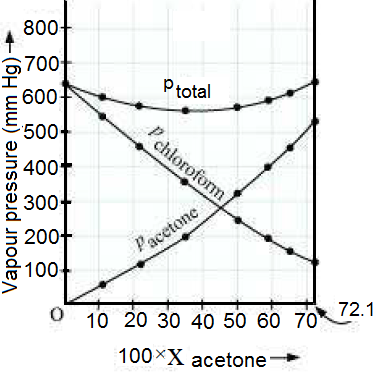
It can be observed from the graph that the plot for the p total of the solution curves downwards. Therefore, the solution shows negative deviation from the ideal behaviour. View full question & answer→Question 323 Marks
Nalorphene $(C_{19}H_{21}NO_3)$, similar to morphine, is used to combat withdrawal symptoms in narcotic users. Dose of nalorphene generally given is $1.5$ mg. Calculate the mass of $1.5 – 10^{–3}$ m aqueous solution required for the above dose.
AnswerMolar Mass of $C_{19}H_{12}NO_3 = 19 x 12 + 21 x 1 + 14 + 48$
$= 228 + 21 + 14 + 48 = 311\ gmol^{-1}$
$\text{Molality (m)}=\frac{\text{Mass of solute}/\text{molarmass}}{\text{Mass of solvant in kg}}$
$1.5=\frac{\text{Mass of solute/311}}{11}$
$\text{or}\ \ 1.5=\frac{\text{Mass of solute}}{311}$
or Mass of solute $= 1.5 \times 10^{-3} \times 311 = 0.4665 g$
Mass of total solution $= 1000\ g + 0.467\ g$
$=1000.467\ g$ To convert $1.5\ g$ of nalorphene in tog divide by $1000$
we get $1.5 mg/ 1000 = 0.0015 g$
Thus, $0.467$ g mass of nalorphene contain by $= 1000.467$ g
solution for $0.0015$ g mass of nalorphene contain by
$= 1000.467 × 0.0015/ 0.467 = 3.21\ g.$
View full question & answer→Question 333 Marks
$H_2S,$ a toxic gas with rotten egg like smell, is used for the qualitative analysis. If the solubility of $H_2S$ in water at STP is $0.195\ m$, calculate Henry’s law constant.
AnswerIt is given that the solubility of $H_2S$ in water at $STP$ is 0$.195m$,
i.e., $0.195$ mol of $H_2S$ is dissolved in $1000$ g of water. $=\frac{1000\text{g}}{18\text{g mol}^{-1}}$
$=$ moles of water = 55.56 mol $=\frac{\text{moles of H}_2\text{S}}{\text{moles of H}_2\text{S}+\text{ moles of water}}$ $=\frac{0.195}{0.195+55.56}=0.0035$
At STP pressure $(P) = 0.987$ bar
According to henry's law $p = k_Hx$
$\text{K}_\text{H}=\frac{\text{P}}{\text{x}}$
$=\frac{0.987}{0.0035}\text{ bar}$
$= 282$ bar
View full question & answer→Question 343 Marks
The vapour pressure of pure liquids A and B are 450 and 700 mm Hg respectively, at 350 K . Find out the composition of the liquid mixture if total vapour pressure is 600 mm Hg. Also find the composition of the vapour phase.
Answer$\text{P}_{\text{A}^{\circ}}=450\text{ mm}, \text{P}_{\text{B}^\circ}=700\text{ mm}, \text{P}_{\text{total}}=600\text{ mm}$$\text{As}, \ \ \ \text{P}_{\text{total}}=\text{P}_{\text{A}}+\text{P}_{\text{B}}$
$=\text{x}_{\text{A}}\text{P}_{\text{A}^\circ}+\text{x}_{\text{B}}\text{P}_{\text{B}^\circ}$
(from Raoult's law)
$=\text{x}_{\text{A}}\text{P}_{\text{A}^\circ}+(1-\text{x}_{\text{A}})\text{P}_{\text{B}^\circ}$
$=\text{P}_{\text{B}^\circ}+(\text{P}_{\text{A}^\circ}-\text{P}_{\text{B}^\circ})\text{x}_{\text{A}}$
$\Rightarrow\ 600=700+(450-700)\text{x}_{\text{A}}$
$\text{or}\ \ \ \text{x}_{\text{A}}=0.40$
$\therefore\ \text{x}_{\text{B}}=1-\text{x}_{\text{A}}=1-0.40=0.60$
$\therefore\ \text{P}_{\text{A}}=\text{x}_{\text{A}}\text{P}_{\text{A}^\circ}=0.40\times450=180\text{ mm}$
$\therefore\ \text{P}_{\text{B}}=\text{x}_{\text{B}}\text{P}_{\text{B}^\circ}=0.60\times700=420\text{ mm}$
$\therefore$ Mole fraction of A in vapour phase
$=\frac{\text{P}_{\text{A}}}{\text{P}_{\text{A}}+\text{P}_{\text{B}}}=\frac{180}{180+420}=0.30$
and, Mole fraction of B in vapour phase
= 1 - 0.30 = 0.70
View full question & answer→Question 353 Marks
Calculate the amount of benzoic acid $(C_6H_5COOH)$ required for preparing $250$ mL of $0.15$ M solution in methanol.
AnswerMol. mass of benzoic acid, $C_6H_5COOH = 6 \times 12 + 5 \times 1 + 12 + 16 + 16 + 1$
$= 72 + 5 + 12 + 1 6+ 16 + 1 = 122\ g\ mol^{-1}$ by using formula;
$\text{M}=\frac{\text{x}}{\text{molecular mass of given substance}}\times\frac{1000}{\text{required volume }}$
here $x =$ amount of substance required
$0.15\text{ M}=\frac{\text{x}}{122}\times\frac{1000}{250}$
Amount of benzoic acid required$=\frac{122}{1000}\times250\times0.15$
$=\frac{4575}{1000}=4.575\text{ g}.$
View full question & answer→Question 363 Marks
Two elements $A$ and $B$ form compounds having formula $AB_2$ and $AB_4.$ When dissolved in $20$ g of benzene $(C_6H_6),$ $1$ g of $AB_2$ lowers the freezing point by $2.3$ K whereas $1.0$ g of $AB_4$ lowers it by $1.3$ K. The molar depression constant for benzene is $5.1\ K\ kg\ mol^{–1}$. Calculate atomic masses of $A$ and $B.$
Answer$\text{Using the relation},\text{ M}_2=\frac{1000\times\text{k}_\text{f}\times\text{w}_2}{\text{w}_1\times\Delta\text{T}_\text{f}}$$\therefore\ \text{M}_{\text{AB}_2}=\frac{1000\times5.1\times1}{20\times2.3}=110.87\text{ g mol}^{-1}$
$\text{M}_{\text{AB}_4}=\frac{1000\times5.1\times1}{20\times1.3}=196.15\text{ g mol}^{-1}$
Let the atomic masses of A and B are 'p' and 'q' respectively.
Then molar mass of
$AB_2= p + 2q = 110.87\ g\ mol^{-1} .... (i)$
And molar mass of
$AB_4 = p + 4q = 196.15\ g\ mol^{-1}.... (ii)$
Substracting equation (ii) from equation(i), we
get $2q = 85.28 ⇒ q = 42.64$
Putting $q = 42.64$ in equ. (i), we get
$p = 110.87 - 85.28$
$p = 25.59$
Thus, atomic mass of $A = 25.59\ g\ mol^{-1}$ and atomic mass of $B = 42.64\ g\ mol^{-1}$
View full question & answer→Question 373 Marks
Calculate the mass of urea $(NH_2CONH_2)$ required in making $2.5$ kg of $0.25$ molal aqueous solution.
AnswerMolar mass of urea $(NH_2CONH_2)= 2(1 \times 14 + 2 \times 1) + 1 \times 12 + 1 \times 16$
$= 60\ g\ mol^{-1} 0.25$ molar aqueous solution of urea means:
$1000$ g of water contains $0.25$ mol
$= (0.25 × 60)$ g of urea $= 15$ g of urea
That is, $(1000 + 15)$ g of solution contains $15$ g of urea
$=\frac{15\times2500}{1000+15}\text{ g}$
Therefore, $2.5\ kg\ (2500\ g)$ of solution contains $= 36.95$ g $= 37$ g of urea (approximately)
Hence, mass of urea required $= 37$ g
View full question & answer→Question 383 Marks
Using Raoult’s law explain how the total vapour pressure over the solution is related to mole fraction of components in the following solutions.
$CHCl_3(l)$ and $CH_2Cl_2(l)$
AnswerFor a binary solution having both components as volatile liquids $($viz. $CHCl_3$ and $CH_2Cl_2),$ the total pressure will be
$\text{p}=\text{p}_1=\text{x}_1\text{p}^0_1+\text{x}_2\text{p}^0_2$
$=\text{x}_1\text{p}^0_1+(1-\text{x}_1)\text{p}^0_2$
$=(\text{p}^0_1-\text{p}^0_1)\text{x}_1+\text{p}^0_2$
$p =$ total vapour pressure of the given mixture/ binary solution of the given volatile liquids
$p_1=$ partial vapour pressure of component $1 ($i.e. $CHCl_3)$
$p_2=$ partial vapour pressure of component $2 ($i.e. $CH_2 Cl_2)$
View full question & answer→Question 393 Marks
Henry’s law constant for $CO_2$ in water is $1.67 x 10⁸$ Pa at $298$ K. Calculate the quantity of $CO_2$ in $500$ mL of soda water when packed under $2.5$ atm $CO_2$ pressure at $298$ K.
AnswerIt is given that: $K_H = 1.67 \times 10^8 Pa$
$\text{P}_{\text{CO}_2}=2.5\text{ atm}=2.5\times1.01325\times10^5\text{ Pa}$
$\text{P}_{\text{CO}_2}=2.533125\times10^5\text{ Pa}$
According to Henry’s law:
$\text{P}_{\text{CO}_2}=\text{K}_{\text{H}}\text{x}$
$\Rightarrow\ \text{x}=\frac{\text{P}_{\text{CO}_2}}{\text{K}_{\text{H}}}$
$=\frac{2.533125\times10^5}{1.67\times10^8}$
$= 0.00152$
We can write,
$\text{x}=\frac{\text{n}_{\text{CO}_2}}{\text{n}_{\text{CO}_2+\text{n}_{\text{H}_2\text{O}}}}\approx\frac{\text{n}_{\text{CO}_2}}{\text{n}_{\text{H}_2\text{O}}}$
$\text{n}_{\text{CO}_2}$ is negligible as compared to $\text{n}_{\text{H}_2\text{O}}$ [Since, ]
In 500 mL of soda water, the volume of water $= 500$ mL
[Neglecting the amount of soda present]
We can write:
$500$ mL of water $= 500$ g of water
$=\frac{500}{18}\text{ mol of water}$
$= 27.78$ mol of water
Now,
$\frac{\text{n}_{\text{CO}_2}}{\text{n}_{\text{H}_2\text{O}}}=\text{x}$
$\frac{\text{n}_{\text{CO}_2}}{27.78}=0.00152$
$\text{n}_{\text{CO}_2}=0.042\text{ mol}$
Hence, quantity of $CO_2$ in 500 mL of soda water $= (0.042 \times 44)g$
$= 1.848$ g
View full question & answer→Question 403 Marks
Calculate the mass percentage of benzene $(C_6H_6) $ and carbon tetrachloride $(CCl_4)$ if $22$ g of benzene is dissolved in $122$ g of carbon tetrachloride.
Answer$=\frac{\text{Mass of C}_6\text{H}_6}{\text{Total mass of the solution}}\times100\%$Mass percentage of $C_6H_6$
$=\frac{\text{Mass of C}_6\text{H}_6}{\text{Mass of C}_6\text{H}_6 +\text{ Mass of CCl}_4}\times100\%$
$=\frac{22}{22+122}\times100\%$
$=15.28\%$
$=\frac{\text{Mass of CCl}_4}{\text{Total mass of the solution}}\times100\%$
Mass percentage of $CCl_4$
$=\frac{\text{Mass of CCl}_4}{\text{Mass of C}_6\text{H}_6 +\text{ Mass of CCl}_4}\times100\%$
$=\frac{122}{22+122}\times100\%$
$=84.72\%$
Alternatively,
Mass percentage of $CCl_4 = (100 - 15.28)\% = 84.72\%$
View full question & answer→Question 413 Marks
A decimolar solution of potassium ferrocyanide is $50\%$ dissociated at $300K.$ Calculate the osmotic pressure of the solution. $(R = 8.314J\ K^{-1}\ mol^{-1}).$
AnswerHere, a = 0.5
|
|
$\text{K}_4[\text{Fe}(\text{CN})_0]\rightleftharpoons4\text{K}^++[\text{Fe}(\text{CN})_0]^{4-}$
|
|
Initial moles
|
$1$
|
$0$
|
$0$
|
|
Moles after dissociation
|
$1-\alpha$
|
$4\alpha$
|
$\alpha$
|
Total moles of particles $=1-\alpha+4\alpha+\alpha=1+4\alpha$ $\therefore$ Van't Hoff factor, $\text{i}=\frac{1+4\alpha}{1}$ $=1+4\times0.5=3$ Osmotic pressure, $\pi=\text{iCRT}$$\text{R}=8.314\text{J K}^{-1}\text{mol}^{-1},$ i.e., it is in SI units.
$\text{C}=0.1\text{ M}=\frac{0.1}{10^{-3}}\text{ mol m}^{-3}=10^{2}\text{ mol m}^{-3}$ $\alpha=\frac{\text{i}-1}{\text{n}-1}$
$n =$ number of particles after dissociation $\frac{50}{100}=\frac{\text{i}-1}{5-1}$ $\text{i}=3$
Hence, $\pi=3\times10^{2}\times8.314\times300$$=7.483\times10^{5}\text{ Nm}^{-2}$
$=7.483\text{ atm}$ View full question & answer→Question 423 Marks
What is the significance of Henry's Law constant $K_H?$
AnswerHenry's law is expressed mathematically as,
$p = K_Hx ($where, $p$ is the partial pressure of the gas in vapour phase $\&$ $x$ is the mole fraction of the gas in solution$)$
Thus it is significant from above equation that, "Higher the value of Henry’s law constant $K_H$ at a given pressure, the lower is the solubility of the gas in the liquid".
View full question & answer→Question 433 Marks
$100\ g$ of liquid $A ($molar mass $140\ g\ mol^{–1})$ was dissolved in $1000\ g$ of liquid $B ($molar mass $180\ g\ mol^{–1}).$ The vapour pressure of pure liquid $B$ was found to be $500$ torr. Calculate the vapour pressure of pure liquid $A$ and its vapour pressure in the solution if the total vapour pressure of the solution is $475$ Torr.
AnswerNumber of moles of liquid $A, \text{n}_\text{A}=\frac{100}{140}\text{mol}= 0.714$ mol
Number of moles of liquid $B, \text{n}_\text{B}=\frac{1000}{180}\text{mol} = 5.556$ mol
Then, mole fraction of $A, \text{x}_\text{A}=\frac{\text{n}_\text{A}}{\text{n}_\text{A}+\text{n}_\text{B}}$$=\frac{0.714}{0.714+5.556}$
$= 0.114$ And, mole fraction of $B, x_B = 1 - 0.114 = 0.886$
Vapour pressure of pure liquid $B, \text{P}^0_1=500\text{ torr}$
Therefore, vapour pressure of liquid $B$ in the solution, $\text{P}_\text{B}=\text{P}^0_\text{B}\text{x}_\text{B} = 500 × 0.886 = 443$ torr
Total vapour pressure of the solution, ptotal $= 475$ torr Therefore,
Vapour pressure of liquid $A$ in the solution, $\text{P}_\text{A}=\text{P}_\text{total}-\text{P}_\text{B} = 475 - 443 = 32$ torr $\text{P}_\text{A}=\text{P}^0_\text{A}\text{x}_\text{A}$
$\text{Now,}\ \text{ P}^0_\text{A}=\frac{\text{P}_\text{A}}{\text{x}_\text{A}}$
$=\frac{32}{0.114} = 280.7$ torr
Hence, the vapour pressure of pure liquid $A$ is $280.7$ torr.
View full question & answer→Question 443 Marks
Heptane and Octane form an ideal solution. At $373\ K$, the vapour pressures of the two liquid components are $105.2$ kPa and $46.8$ kPa respectively. What will be the vapour pressure of a mixture of $26.0\ g$ of heptane and $35\ g$ of octane?
AnswerMolar mass of heptane $(C_7H_{16}) = 7 x 12 + 16 = 100\ g\ mol^{-1}$Molar mass of octane $(C_8H_{18})$
$= 8 \times 12 + 18 = 114 g mol^{-1}$
Moles of heptane present in mixture $=\frac{26.0}{100}=0.26\text{ mol}$
Moles of octane present in mixture$=\frac{35.0}{114}=0.307\text{ mol}$
Mole fraction of heptane $x_H =\frac{0.26}{0.26+0.307}=0.458$
Mole fraction ofoctane, $x_0 = (l - 0.458) = 0.542$
Vapour pressure of heptane $= x_H \times P^\circ= 0.458 \times 105.2\ KPa = 48.18\ kPa$
Vapour pressure of octane $= x_0\times P^\circ$
$= 0.542 \times 46.8\ kPa = 25.36\ kPa$ Vapour pressure of mixture $= 48.18 + 25.36 = 73.54\ kPa.$
View full question & answer→Question 453 Marks
Define the term solution. How many types of solutions are formed? Write briefly about each type with an example.
AnswerHomogeneous mixtures of two or more than two components are known as solutions.
There are three types of solutions.
- Gaseous solution:
The solution in which the solvent is a gas is called a gaseous solution. In these solutions, the solute may be liquid, solid, or gas. For example, a mixture of oxygen and nitrogen gas is a gaseous solution.
- Liquid solution:
The solution in which the solvent is a liquid is known as a liquid solution. The solute in these solutions may be gas, liquid, or solid. For example, a solution of ethanol in water is a liquid solution.
- Solid solution:
The solution in which the solvent is a solid is known as a solid solution. The solute may be gas, liquid or solid. For example, a solution of copper in gold is a solid solution.
View full question & answer→Question 463 Marks
Determine the amount of $CaCl_2 (i = 2.47)$ dissolved in $2.5$ litre of water such that its osmotic pressure is $0.75$ atm at $27^\circ C.$
AnswerWe know that, $\pi= i \frac{ n }{ V } RT$
$\pi=i \frac{w}{MV} RT$
$w=\frac{\pi MV}{iRT}$
$\pi=0.75$ atm $V=2.5$ Li$=2.47 $
$T=(27+273) K=300 K$
Here, $R =0.0821 L atm K ^{-1} mol^{-1}$
$M=1 \times 40+2 \times 35.5=111 g mol^{-1}$
Therefore, $w =\frac{0.75 \times 111 \times 2.5}{2.47 \times 0.0821 \times 300}=3.42 g$
Hence, the required amount of $CaCl _2$ is $3.42$ g .
View full question & answer→Question 473 Marks
Why is the vapour pressure of an aqueous solution of glucose lower than that of water?
AnswerIn pure liquid water, the entire surface of liquid is occupied by the molecules of water. When a non-volatile solute, such as glucose is dissolved in water some of the surface is covered by non-volatile glucose molecules. Therefore, the fraction of surface covered by the solvent molecules escaping. As a result number of solvent molecules escaping from the surface also gets reduced and consequently the vapour pressure of aqueous solution of glucose is reduced.
View full question & answer→Question 483 Marks
State Henry’s Law. What is the significance of $K_H?$
AnswerHenry’s law: It states that “the partial pressure of the gas in vapour phase (p) is proportional to the mole fraction of the gas (x) in the solution” and is expressed as:
$p = K_Hx$
where, $K_H$ is the Henry’s law constant.
Significance of $K_H:$ Higher the value of Henry’s law constant $K_H,$ the lower is the solubility of the gas in the liquid.
View full question & answer→Question 493 Marks
How many mL of $0.1$ M HCl are required to react completely with $1$ g mixture of $Na_2CO_3$ and $NaHCO_3$ containing equimolar amounts of both?
AnswerLet the amount of $Na_2CO_3$ in the mixture be $x\ g.$
Then, the amount of $NaHCO_3$ in the mixture is $(1 - x) g.$
Molar mass of $Na_2CO_3= 2 \times 23 + 1 \times 12 + 3 \times 16 = 106\ g\ mol^{−1}$
$\therefore\ \text{Number of moles Na}_2\text{CO}_3=\frac{\text{x}}{106}\text{mol}$
Molar mass of $NaHCO_3= 1 \times 23 + 1 \times 1 \times 12 + 3 \times 16$
$= 84\ g\ mol^{-1}$ Number of moles of $\text{NaHCO}_3=\frac{1-\text{x}}{84}\text{mol}$
According to the question,
$\frac{\text{x}}{106}=\frac{1-\text{x}}{84}⇒ 84x = 106 - 106x ⇒ 190x = 106 ⇒ x = 0.5579$
Therefore, number of moles of $\text{Na}_2\text{CO}_3=\frac{0.5579}{106}\text{mol} = 0.0053$ mol And,
number of moles of $\text{NaHCO}_3=\frac{1-0.5579}{84} = 0.0053$
molHCl reacts with $Na_2CO_3$ and $NaHCO_3$
according to the following equation.
$2\text{HCl}+\text{Na}_2\text{CO}_3\rightarrow2\text{NaCl}+\text{H}_2\text{O}+\text{CO}_2\\ \text{2 mol}\ \ \ \ \ \ \ \ \text{1 mol}$
$\text{HCl}+\text{NaHCO}_3\rightarrow\text{NaCl}+\text{H}_2\text{O}+\text{CO}_2\\ \text{1 mol}\ \ \ \ \text{1 mol}$
$1$ mol of $Na_2CO_3$ reacts with $2$ mol of HCl.
Therefore, $0.0053$ mol of $Na_2CO_3$ reacts with $2 \times 0.0053\ mol = 0.0106\ mol.$
Similarly, $1$ mol of $NaHCO_3$ reacts with $1$ mol of HCl.
Therefore, $0.0053$ mol of $NaHCO_3$ reacts with $0.0053$ mol of HCl.
Total moles of HCl required $= (0.0106 + 0.0053)$ mol $= 0.0159$ mol In
$0.1$ M of HCl, $0.1$ mol of HCl is preset in $1000$ mL of the solution.
Therefore, $0.0159$ mol of HCl is present in $\frac{1000\times0.0159}{0.1}\text{ mol} = 159$ mL of the solution
Hence, $159$ mL of $0.1$ M of HCl is required to react completely with $1$ g mixture of $Na_2CO_3$ and $NaHCO_3,$ containing equimolar amounts of both.
View full question & answer→Question 503 Marks
$A\ 5\%$ solution (by mass) of cane sugar in water has freezing point of $271K.$ Calculate the freezing point of $5\%$ glucose in water if freezing point of pure water is $273.15\ K.$
AnswerMass of sugar in $5\%$ (by mass) solution means 5gin $100g$ of solvent (water)Molar mass of sugar $= 342\ g\ mol^{-1}$
$\text{Molality of sugar solution}=\frac{5\times1000}{342\times100}=0.146$
$\therefore\ \Delta\text{T}_\text{f}$ for sugar solution $= 273.15 - 271 = 2.15°$
$\Delta\text{T}_\text{f}=\text{K}_\text{f}\times\text{m}$
$\Delta\text{T}_\text{f}=\text{K}_\text{f}\times0.146\Rightarrow\text{K}_\text{f}=2.15/0.146$
Molality of glucose solution
$=\frac{5}{180}\times\frac{1000}{100}=0.278$
$($Molar mass of glucose $= 180\ g\ mol^{-1})$
$\Delta\text{T}_\text{f}=\text{K}_\text{f}\times\text{m}=\frac{2.15}{0.146}\times0.278=4.09^\circ$
$\therefore$ Freezing point of glucose solution
$= 273.15 - 4·09 = 269.06\ K.$
View full question & answer→Question 513 Marks
Vapour pressure of water at $293$ K is $17.535$ mm Hg. Calculate the vapour pressure of water at $293$ K when $25$ g of glucose is dissolved in $450$ g of water.
AnswerVapour pressure of water, $\text{P}^0_1=17.535\text{ mm of Hg}$
Mass of glucose, $w_2 = 25$ g Mass of water, $w_1 = 450$ g
We know that,
Molar mass of glucose $(C_6H_{12}O_6), M_2 = 6 \times 12 + 12 \times 1 + 6 \times 16$
$= 180\ g\ mol^{−1}$ Molar mass of water, $M_1 = 18\ g\ mol^{-1}$
Then, number of moles of glucose, $\text{n}_2=\frac{25}{180\text{ g mol}^{-1}}= 0.139$ mol And,
number of moles of water, $\text{n}_1=\frac{450}{18\text{ g mol}^{-1}} = 25$ mol
We know that, $\frac{\text{P}^0_1-\text{P}_1}{\text{P}^0_1}=\frac{\text{n}_1}{\text{n}_2+\text{n}_1}$
$\frac{17.535-\text{P}_1}{17.535}=\frac{0.139}{0.139+25}$
$17.535-\text{P}_1=\frac{0.139\times17.535}{25.139}$
$17.535-\text{P}_1=0.097$
$p_1 = 17.44$ mm of Hg
Hence, the vapour pressure of water is $17.44$ mm of Hg.
View full question & answer→Question 523 Marks
Determine the osmotic pressure of a solution prepared by dissolving $25$ mg of $K_2SO_4$ in $2$ litre of water at $25^\circ C$, assuming that it is completely dissociated.
AnswerWhen $K_2S0_4$ is dissolved in water, $K^+$ and $\text{SO}^{2-}_4$ ion produced$\text{K}_2\text{SO}_4\rightarrow2\text{K}^++\text{SO}^{2-}_4$
total number of ion produced 3
therfore, $i = 3$
given that
$w = 25, mg= 0.0259$
$T = 25^0C + 273 = 298\ K$
Also we know that
$R = 0.0821\ L\ atm\ K^{-1}\ mol^{-1}$
$M = (2 \times 39) + (1 \times 32) + (4 \times 16)$
Osmotic pressure, $\pi=?$
$V = 2L,\ i = 3$
$\pi=\frac{\text{i}\text{ n}_2\text{ RT}}{\text{V}}=\frac{\text{i w RT}}{\text{m V}}$
$\pi=\frac{3\times25\times10^{-3}\times0.0821\times298}{174\times2}$
$= 5.27 \times 10^{-3}$ atm.
View full question & answer→Question 533 Marks
Calculate the mass of a non-volatile solute $($molar mass $40$ g mol$^{–1})$ which should be dissolved in $114$ g octane to reduce its vapour pressure to $80\%$.
Answer$P_s = 80\%$ of $P^0=\frac{80}{100}\text{ P}^\circ=0.8\text{ P}^\circ$
Let $W_g$ of solute is present in mixture.
Moles of solute present $=\frac{\text{W}}{40}\text{ moles}$
Molar mass of octane, $C_8H_{18}$
$= 8 x 12 + 18 = 114\ gmol^{-1}$
$\therefore\ \text{Moles of octane}=\frac{114}{114}=1\text{ mol}$
$\text{Now},\ \frac{\text{P}^\circ-\text{P}_\text{s}}{\text{P}^\circ}=\text{x}_2=\frac{\frac{\text{W}}{40}}{\frac{\text{W}}{40}+1}$
$\frac{\text{P}^\circ-0.80\text{ P}^\circ}{\text{P}^\circ}=\frac{\frac{\text{W}}{40}}{\frac{\text{W}}{40}+1}$
$1-0.80=\frac{\text{W}\times40}{40(\text{W}+40)}=\frac{\text{W}}{\text{W}+40}$
$0.20=\frac{\text{W}}{\text{W}+40}$
$0.2 W + 8 = W$
$8 = W(l - 0.2)$
$8 = 0.8\ W$
$\therefore\ \text{W}=\frac{8}{0.8}=10g.$
View full question & answer→Question 543 Marks
A solution containing $30$ g of non-volatile solute exactly in $90$ g of water has a vapour pressure of $2.8$ kPa at $298$ K. Further, $18$ g of water is then added to the solution and the new vapour pressure becomes $2.9$ kPa at $298$ K. Calculate:
- Molar mass of the solute.
- Vapour pressure of water at $298$ K.
AnswerLet the molar mass of solute $= Mg\ mol^{-1}$
$\therefore\ \text{Moles of solute present}$ $=\frac{30\text{g}}{\text{Mg mol}^{-1}}=\frac{30}{\text{M}}\text{ mol}$
$\text{Moles of solvent present}, (\text{n}_1)=\frac{90}{18}=5\text{ moles.}$
$\therefore\ \frac{\text{P}^\circ-\text{P}_\text{s}}{\text{P}^\circ}=\frac{\text{n}_2}{\text{n}_1+\text{n}_2}$
$\frac{\text{P}^\circ-2.8}{\text{P}^\circ}=\frac{\frac{30}{\text{M}}}{\frac{5+30}{\text{M}}}$
$1-\frac{2.8}{\text{P}^\circ}=\frac{30}{(5\text{M}+30)}$
$1-\frac{30}{5\text{M}+30}=\frac{2.8}{\text{P}^\circ}$
$1-\frac{6}{\text{M}+6}=\frac{2.8}{\text{P}^\circ}$
$\frac{\text{M}+6-6}{\text{M}+6}=\frac{2.8}{\text{P}^\circ}$
$\frac{\text{M}}{\text{M}+6}=\frac{2.8}{\text{P}^\circ}$
$\frac{\text{P}^\circ}{2.8}=1+\frac{6}{\text{M}}\ ....(\text{i})$
After adding 18 g of water,
Moles of water becomes $=\frac{90+18}{18}=\frac{108}{18}=6\text{ moles}$
$\therefore\ \frac{\text{P}^\circ-\text{P}_\text{s}}{\text{P}^\circ}=\frac{\frac{30}{\text{M}}}{\frac{6+30}{\text{M}}}$
$P_s$ New vapour pressure = 2.9 KPa .
$\frac{\text{P}^\circ-2.9}{\text{P}^\circ}=\frac{30\text{M}}{\text{M}(6\text{M}+30)}=\frac{5}{\text{M}+5}$
$1-\frac{2.9}{\text{P}^\circ}=\frac{5}{\text{M}+5}$
$1-\frac{5}{\text{M}+5}=\frac{2.9}{\text{P}^\circ}$
$\frac{\text{M}+5-5}{\text{M}+5}=\frac{2.9}{\text{P}^\circ}$
$\frac{\text{P}^\circ}{2.9}=\frac{\text{M}+5}{\text{M}}\Rightarrow\ =1+\frac{5}{\text{M}}$
$\frac{\text{P}^\circ}{2.9}=1+\frac{5}{\text{M}}\ .... (\text{ii})$ Dividing equation (i) by (ii),
we get, $\frac{2.9}{2.8}=\frac{1+\frac{6}{\text{M}}}{1+\frac{5}{\text{M}}}$
$2.9\Big(1+\frac{5}{\text{M}}\Big)=2.8\Big(1+\frac{6}{\text{M}}\Big)$
$2.9+\frac{2.9\times5}{\text{M}}=2.8+\frac{2.8\times6}{\text{M}}$
$2.9+\frac{14.5}{\text{M}}=2.8+\frac{16.8}{\text{M}}$
$0.1=\frac{16.8}{\text{M}}-\frac{14.5}{\text{M}}=\frac{2.3}{\text{M}}$
$\text{M}=\frac{2.3}{0.1}$
$M = 23\ g\ mol^{-1}$ Putting $M = 23,$ in equation (i), we get,
$\frac{\text{P}^\circ}{2.8}=1+\frac{6}{23}=\frac{29}{23}$
$\text{P}^\circ=\frac{29}{23}\times2.8=3.53\text{ KPa}$
View full question & answer→Question 553 Marks
An aqueous solution of $2\%$ non-volatile solute exerts a pressure of $1.004$ bar at the normal boiling point of the solvent. What is the molar mass of the solute?
AnswerVapour pressure of pure water at the boiling poin$(\text{P}^\circ)=1.013\text{ bar}$
Vapour pressure of solution $(Ps) = 1·004$ bar
Mass of solute $(w_2) = 2g$ Molar
mass of solvent, water $(M_1) = 18g$ Mass of solvent $(w_1) = 98g$
Mass of solution $= 100g$
Applying Raoult's Law for dilute solutions, $\frac{\text{P}^\circ-\text{P}_\text{s}}{\text{P}^\circ}=\frac{\text{n}_2}{\text{n}_1+\text{n}_2}\simeq\frac{\text{n}_2}{\text{n}_1}$
$[$Dilute solution being $2\%]$ $\frac{\text{P}^\circ-\text{P}_\text{s}}{\text{P}^\circ}=\frac{\text{n}_2}{\text{n}_1}=\frac{\frac{\text{W}_2}{\text{M}_2}}{\frac{\text{W}_1}{\text{M}_1}}$
$\frac{(1.013-1.004)}{(1.013)}=\frac{2\times18}{\text{M}_2\times98}$
$\therefore\ \text{M}_2=\frac{2\times18}{98\times0.009}\times1.013=41.35\text{ g mol}^{-1}.$
View full question & answer→Question 563 Marks
Calculate the molarity of each of the following solutions:
- $30$ g of $Co(NO_3)_2. 6H_2O$ in $4.3$ L of solution.
- $30$ mL of $0.5$ $M H_2SO_4$ diluted to $500$ mL.
AnswerMolarity (M) is defined as number of moles of solute dissolved in one litre (or one cubic decimetre) of solution.
- Mol. mass of $Co (NO_3). 6H_2O$
$= 58.9 + (14 + 3 × 16)2 + 6(18)$
$= 58.9 + (14 + 48) × 2 + 108$
$= 58.9 + 124 + 108 = 290.9$
Moles of $Co (NO)_3. 6H_2O$
$=\frac{30}{290.9}=0.103\text{ mol}$
Volume of solution $= 4.3$ L
Molarity,
$\text{M}=\frac{\text{Moles of solute}}{\text{Volume of solution in litre}}$
$=\frac{103}{4.3}=0.024\text{ M}.$
- Number of moles present in $1000$ ml of $0.5$ M $H_2SO_4= 0.5$ mol
therefore number of moles present in $30$ml of $0.5$M $H_2SO_4=\frac{0.5\times30}{1000}\text{ mol}$
$= 0.015$ mol
Therefore molarity $= 0.015/0.5$ L
Thus molarity is $0.03$M. View full question & answer→Question 573 Marks
Explain the following:
- Solution of chloroform and acetone is an example of maximum boiling azeotrope.
- A doctor advised a person suffering from high blood pressure to take less quantity of common salt.
Answer
- This solution has lesser vapour pressure due to stronger interactions (hydrogen bonds) between chloroform and acetone molecules.
- Because higher quantity of NaCl will increase number of sodium and chloride ions in the body fluid which can increase the osmotic pressure of body fluid, i.e., blood pressure of a person.
View full question & answer→Question 583 Marks
Boiling point of water at $750$ mm Hg is $99.63^\circ C.$ How much sucrose is to be added to $500$ g of water such that it boils at $100^\circ C.$
AnswerHere, elevation of boiling point $\triangle T_b = (100 + 273) - (99.63 + 273) = 0.37 K$
Mass of water, $w_1 = 500 $g Molar
mass of sucrose $(C_{12}H_{22}O_{11}), M_2 = 11 \times 12 + 22 \times 1 + 11 \times 16 = 342$ g mol
Molal elevation constant, $K_b = 0.52$ K kg mol$^{-1}$
We know that:
$\Delta\text{T}_\text{b}=\frac{\text{K}_\text{b}\times1000\times\text{w}_2}{\text{M}_2\times\text{w}_1}$ $\Rightarrow\text{w}_2=\frac{\Delta\text{T}_\text{b}\times\text{M}_2\times\text{w}_1}{\text{K}_\text{b}\times1000}$$=\frac{0.37\times342\times500}{0.52\times1000}$
$= 121.67$ g (approximately) Hence, $121.67$ g of sucrose is to be added.
View full question & answer→Question 593 Marks
Benzene and toluene form ideal solution over the entire range of composition. The vapour pressure of pure benzene and naphthalene at $300 K$ are $50.71$ mm Hg and 32.06 mm Hg respectively. Calculate the mole fraction of benzene in vapour phase if $80 g$ of benzene is mixed with $100 g$ of naphthalene.
AnswerMolar mass of benzene $\left(\mathrm{C}_6 \mathrm{H}_6\right)=6 \times 12+6 \times 1=78 \mathrm{~g} \mathrm{~mol}^{-1}$ Molar mass of toluene $\left(\mathrm{C}_6 \mathrm{H}_5 \mathrm{CH}_3\right)=7 \times 12+8 \times 1=$ $92 \mathrm{~g} \mathrm{~mol}^{-1}$ Now, no. of moles present in 80 g of benzene $=\frac{80}{78} \mathrm{~mol}=1.026 \mathrm{~mol}$ And, no. of moles present in 100 g of toluene $=\frac{100}{92} \mathrm{~mol}$
$=1.087 \mathrm{~mol}$ Therefore, Mole fraction of benzene, $\mathrm{x}_{\mathrm{b}}=\frac{1.026}{1.026+1.087}=0.486$ And, mole fraction of toluene, $\mathrm{x}_{\mathrm{t}}=1$ $0.486=0.514$ It is given that vapour pressure of pure benzene, $\mathrm{P}_{\mathrm{b}}^0=50.71 \mathrm{~mm} \mathrm{Hg}$ And, vapour pressure of pure toluene, $\mathrm{P}_1^0=32.06 \mathrm{~mm}$ HG Therefore, partial vapour pressure of benzene, $\mathrm{P}_{\mathrm{b}}=\mathrm{x}_{\mathrm{b}} \times \mathrm{P}_{\mathrm{b}}=0.486 \times 50.71=24.645$ mm Hg And, partial vapour pressure of toluene, $P_1=x_t \times P_t=0.514 \times 32.06=16.479 \mathrm{~mm} \mathrm{Hg}$ Hence, mole fraction of benzene in vapour phase is given by: $\frac{\mathbf{P}_{\mathrm{b}}}{\mathbf{P}_{\mathrm{b}}+\mathbf{P}_{\mathrm{t}}}$
$=\frac{24.645}{24.645+16.479}$
$=\frac{24.645}{41.124}$
$=0.599=0.6$
View full question & answer→Question 603 Marks
Using Raoult’s law explain how the total vapour pressure over the solution is related to mole fraction of components in the following solutions.
$NaCl(s)$ and $H_2O(l)$
AnswerFor a solution containing non-volatile solute i.e. $NaCl(s)$ and $H_2O(l),$ the Raoult’s law is applicable only to vaporisable component (1) i.e. $H_2O(l)$ and total vapour pressure is written as,
$\text{p}=\text{p}_1=\text{x}_1\text{p}^0_1$
Where ${p_1}^o$ reresents the vapour pressure of pure $H_2O(l)$
View full question & answer→Question 613 Marks
An antifreeze solution is prepared from $222.6 g$ of ethylene glycol $(C_2H_6O_2)$ and $200 g$ of water. Calculate the molality of the solution. If the density of the solution is $1.072 g mL^{–1}$, then what shall be the molarity of the solution?
AnswerMolar mass of ethylene glycol $\left[\mathrm{C}_2 \mathrm{H}_4(\mathrm{OH})_2\right]=2 \times 12+6 \times 1+2 \times 16=62 \mathrm{~g} \mathrm{~mol}^{-1}$
Number of moles of ethylene glycol $\frac{222.6 \mathrm{~g}}{62 \mathrm{~g} \mathrm{~mol}^{-1}}$
$=3.59 \mathrm{~mol}$
Therefore, molality of the solution $=\frac{3.59 \mathrm{~mol}}{0.200 \mathrm{~kg}}$
$=17.95 \mathrm{~m}$
Total mass of the solution $=(222.6+200) \mathrm{g}$
$=422.6 \mathrm{~g}$
Given,
Density of the solution $=1.072 \mathrm{~g} \mathrm{~mL}^{-1}$
Therefore, Volume of the solution $=\frac{422.6 \mathrm{~g}}{1.072 \mathrm{~g} \mathrm{~mL}^{-1}}$
$=394.22 \mathrm{~mL}$
$=0.3942 \times 10^{-3} \mathrm{~L}$
Molarity of the solution $=\frac{3.59 \mathrm{~mol}}{0.39422 \times 10^{-3} \mathrm{~L}}$
$=9.11 \mathrm{M}$
View full question & answer→Question 623 Marks
A solution of glucose in water is labelled as $10\%$ w/w, what would be the molality and mole fraction of each component in the solution? If the density of solution is $1.2\ g\ mL^{–1},$ then what shall be the molarity of the solution?
Answer10% w/w solution of glucose in water means that $10$ g of glucose in present in $100$ g of the solution
i.e., $10$ g of glucose is present in $(100 - 10)\ g = 90\ g$ of water.
Molar mass of glucose $(C_6H_{12}O_6) = 6 \times 12 + 12 \times 1 + 6 \times 16 = 180\ g\ mol^{-1}$ Then,
number of moles of glucose $=\frac{10}{180}\text{ mol} = 0.056$ mol
$\text{Molality of solution}=\frac{0.056\text{ mol}}{0.09\text{ kg}}=0.62\text{m}$ $\text{Number of moles of water}=\frac{90\text{g}}{18\text{ g mol}^{-1}}$= 5 mol
Mole fraction of glucose $(x_g) =\frac{0.056}{0.056+5}$
$= 0.011$ And, mole fraction of water $x_w= 1 - x_g = 1 - 0.011 = 0.989$
If the density of the solution is $1.2g\ ml^{−1} $, then the volume of the $100$ g solution can be given as:
$=\frac{100\text{g}}{1.2\text{ g ml}^{-1}}= 83.33\ mL = 83.33 \times 10^{-3}L$
$\therefore\ \text{Molarity of the solution}=\frac{0.056\text{ mol}}{83.33\times10^{-3}\text{L}} = 0.67\ M$
View full question & answer→Question 633 Marks
When fruits and vegetables that have dried are placed in water, they slowly swell and return to the original form. Explain why. Would a temperature increase accelerate the process? Explain.
AnswerThe cell walls of the fruits and vegetables act as semipermeable membrane. When they are dried, concentration inside becomes higher. On placing in water, the process of osmosis takes place. So, they swell and return to their original form. The process will be accelerated with increase of temperature because osmosis becomes faster with increase in temperature.
View full question & answer→