Question 11 Mark
The maximum value of $[x(x-1)+1]^{\frac{1}{3}}, 0 \leq x \leq 1$ is
AnswerLet f(x) = $[x(x-1)+1]^{\frac{1}{3}}$
$f^{\prime}(x)=\frac{2 x-1}{3[[x(x-1)+1]]^{\frac{2}{3}}}$
Now, if f'(x) = 0
$\Rightarrow \mathrm{x}=\frac{1}{2}$
Then, we evaluate the value of f at critical point x = $\frac{1}{2}$ and at the end points of the interval [0, 1].
f(0) = $[0(0-1)+1]^{\frac{1}{3}}=1$
f(1) = $[1(1-1)+1]^{\frac{1}{3}}=1$
$f\left(\frac{1}{2}\right)=\left[\frac{1}{2}\left(\frac{1}{2}-1\right)+1\right]^{\frac{1}{3}}=\left(\frac{3}{4}\right)^{\frac{1}{3}}$
Therefore, we can conclude that the maximum value of f in the interval [0, 1] is 1.
View full question & answer→Question 21 Mark
For all real values of $x$, the minimum value of $\frac{1-x+x^{2}}{1+x+x^{2}}$ is
AnswerLet f(x) = $\frac{1-x+x^{2}}{1+x+x^{2}}$
$\therefore \mathrm{f}^{\prime}(\mathrm{x})=\frac{\left(1+\mathrm{x}+\mathrm{x}^{2}\right)(-1+2 \mathrm{x})-\left(1-\mathrm{x}+\mathrm{x}^{2}\right)(1+2 \mathrm{x})}{\left(1+\mathrm{x}+\mathrm{x}^{2}\right)^{2}}$
$=\frac{-1+2 \mathrm{x}-\mathrm{x}+2 \mathrm{x}^{2}-\mathrm{x}^{2}+2 \mathrm{x}^{3}-1-2 \mathrm{x}+\mathrm{x}+2 \mathrm{x}^{2}-\mathrm{x}^{2}-2 \mathrm{x}^{3}}{\left(1+\mathrm{x}+\mathrm{x}^{2}\right)^{2}}$
$=\frac{2 x^{2}-2}{\left(1+x+x^{2}\right)^{2}}$
$=\frac{2\left(x^{2}-1\right)}{\left(1+x+x^{2}\right)^{2}}$
Then, f'(x) = 0
$\Rightarrow x^2 = 1$
$\Rightarrow$ x = $\pm$ 1
Now, $\mathrm{f}^{\prime \prime}(\mathrm{x})=\frac{2\left[\left(1+\mathrm{x}+\mathrm{x}^{2}\right)^{2}(2 \mathrm{x})-\left(\mathrm{x}^{2}-1\right)(2)\left(1+\mathrm{x}+\mathrm{x}^{2}\right)(1+2 \mathrm{x})\right]}{\left(1+\mathrm{x}+\mathrm{x}^{2}\right)^{4}}$
$=\frac{4\left(1+x+x^{2}\right)\left[\left(1+x+x^{2}\right) x-\left(x^{2}-1\right)(1+2 x)\right]}{\left(1+x+x^{2}\right)^{4}}$
$=\frac{4\left[\mathrm{x}+\mathrm{x}^{2}+\mathrm{x}^{3}-\mathrm{x}^{2}-2 \mathrm{x}^{3}+1+2 \mathrm{x}\right]}{\left(1+\mathrm{x}+\mathrm{x}^{2}\right)^{3}}$
$=\frac{4\left[1+2 x-x^{3}\right]}{\left(1+x+x^{2}\right)^{3}}$
And $f^{\prime \prime}(1)=\frac{4\left[1+2(1)-(1)^{3}\right]}{\left(1+1+1^{2}\right)^{3}}=\frac{4[3]}{(3)^{3}}=\frac{4}{9}>0$
Also, f''(-1) = -4 < 0
Then, by second derivative test, f is minimum at x = 1 and the minimum value is given by
$f(1)=\frac{1-1+1}{1+1+1}=\frac{1}{3}$
View full question & answer→Question 31 Mark
The point on the curve $x^2 = 2y$ which is nearest to the point $(0, 5)$ is
AnswerIt is given that $x^2 = 2y$
For each value of x, the position of the point will be $\left(x, \frac{x^{2}}{2}\right)$
The distance d(x) between the points $\left(x, \frac{x^{2}}{2}\right)$ and (0, 5) is given by:
$d(x)=\sqrt{(x-0)^{2}+\left(\frac{x^{2}}{2}-5\right)^{2}}$
$=\sqrt{x^{2}+\frac{x^{2}}{4}+25-5 x^{2}}$
$=\sqrt{\frac{x^{4}}{4}-4 x^{2}+25}$
$\therefore~~~ \mathrm{d}^{\prime}(\mathrm{x})=\frac{\left(\mathrm{x}^{3}-8 \mathrm{x}\right)}{2 \sqrt{\frac{\mathrm{x}^{4}}{4}-4 \mathrm{x}^{2}+25}}$
d'(x) = 0
$\Rightarrow x^3 - 8x = 0$
$\Rightarrow x(x^2 - 8) = 0$
$\Rightarrow$ x = 0, $\pm 2 \sqrt{2}$
And, $\mathrm{d}^{\prime \prime}(\mathrm{x})=\frac{\sqrt{\mathrm{x}^{4}-16 \mathrm{x}^{2}+100}\left(3 \mathrm{x}^{2}-8\right)-\left(\mathrm{x}^{3}-8 \mathrm{x}\right) \cdot \frac{4 \mathrm{x}^{3}-32 \mathrm{x}}{2 \sqrt{\mathrm{x}^{4}-16 \mathrm{x}^{2}+100}}}{\mathrm{x}^{4}-16 \mathrm{x}^{2}+100}$
= $\frac{\left(x^{4}-16 x^{2}+100\right)\left(3 x^{2}-8\right)-2\left(x^{3}-8 x\right)\left(x^{3}-8 x\right)}{\left(x^{4}-16 x^{2}+100\right)^{\frac{3}{2}}}$
So, now when x = 0, then d''(x) = $\frac{36(-8)}{6^{3}}<0$
And when, $x=\pm 2 \sqrt{2},~~~ \mathrm{d}^{\prime \prime}(x)>0$
Then, by second derivative test, d(x) is minimum at $x=\pm 2 \sqrt{2}$
So, when $x=\pm 2 \sqrt{2},~~~ y=\frac{(2 \sqrt{2})^{2}}{2}=4$
Therefore, the point on the curve $x^2 = 2y$, which is nearest to the point (0, 5) is $(\pm 2 \sqrt{2}, 4)$ .
View full question & answer→Question 41 Mark
Find the interval of the function that is strictly increasing or decreasing: $(x + 1)^3 (x - 3)^3$
Answer$f(x) = {(x + 1)^3}{(x - 3)^3}$
$f'(x) = {(x + 1)^3}.3{(x - 3)^2} + {(x - 3)^3}.3{(x + 1)^2}$
$ = 3{(x + 1)^2}{(x - 3)^2}[x + 1 + x - 3]$
$ = 3{(x + 1)^2}{(x - 3)^2}[2x - 2]$
$ = 6{(x + 1)^2}{(x - 3)^2}(x - 1)$
Put f'(x) = 0
x = -1, 3, 1

| int |
Sign of f’(x) |
Result |
| $( - \infty , - 1)$ |
-ve |
Decrease |
| (-1, 1) |
-ve |
Decrease |
| (1, 3) |
+ve |
Increase |
| $(3,\infty )$ |
+ve |
Increase |
View full question & answer→Question 51 Mark
Find the interval in function $6 - 9x - x^2$ is increasing or decreasing.
AnswerIt is given that function $f(x) = 6 - 9x - x^2$
$f'(x) = -9 - 2x$
If f'(x) = 0,
$\Rightarrow x=\frac{-9}{2}$
So, the point x = $\frac{-9}{2}$ divides the real line two disjoint intervals, $\left(-\infty, \frac{-9}{2}\right)$ and $\left(\frac{-9}{2}, \infty\right)$
So, in interval $\left(-\infty, \frac{-9}{2}\right)$
f'(x) = -9 - 2x > 0
Therefore, the given function 'f' is strictly increasing for x < $\frac{-9}{2}$.
And in interval $\left(\frac{-9}{2}, \infty\right)$
f'(x) = -9 - 2x < 0
Therefore, the given function 'f' is strictly decreasing for $x>\frac{-9}{2}$
Thus, f is strictly decreasing for $x>\frac{-9}{2}$
View full question & answer→Question 61 Mark
Find the interval in function $-2x^3 - 9x^2 - 12x + 1$ is increasing or decreasing:
AnswerIt is given that function $f(x)=-2 x^3-9 x^2-12 x+1$
$\Rightarrow f^{\prime}(x)=-6 x^2-18 x+12$
$\Rightarrow f^{\prime}(x)=-6\left(x^2+3 x+6\right)$
$\Rightarrow f^{\prime}(x)=-6(x+1)(x+2)$
If $f^{\prime}(x)=0$, then we get,
$\Rightarrow x=-1 \text { and }-2$
So, the points $x=-1$ and $x=-2$ divides the real line into three disjoint intervals, $(-\infty,-2),(-2,-1)$ and $(-1, \infty)$
So, in intervals $(-\infty,-2),(-1, \infty)$
$f^{\prime}(x)=-6(x+1)(x+2)<0$
Therefore, the given function ' f ' is strictly decreasing for $x<-2$ and $x>-1$
Further, in interval $(-2,-1)$
$f^{\prime}(x)=-6(x+1)(x+2)>0$
Therefore, the given function ( $f$ ) is strictly increasing for $-2<x<-1$
View full question & answer→Question 71 Mark
Find the interval of the function that is strictly increasing or decreasing: $10 - 6x - 2x^2$
AnswerIt is given that function $f(x) = 10 - 6x - 2x^2$
$f'(x) = -6 - 4x$
If f'(x) = 0, then we get,
$\Rightarrow$ $x=\frac{-3}{2}$
So, the point $x=\frac{-3}{2}$ divides the real line into two disjoint intervals, $\left(-\infty, \frac{-3}{2}\right)$ and $\left(\frac{-3}{2}, \infty\right)$
So, in interval $\left(-\infty, \frac{-3}{2}\right)$
x < $\frac{-3}{2}$
$\Rightarrow$ -4x > 6
$\Rightarrow$-6 - 4x > 0
i.e, f'(x) > 0
Therefore, the given function (f) is strictly increasing in interval $\left(-\infty, \frac{-3}{2}\right)$ and in interval $\left(\frac{-3}{2}, \infty\right)$
f'(x) = -6 - 4x < 0
Therefore, the given function (f) is strictly decreasing in interval $\left(\frac{-3}{2}, \infty\right)$
Thus, function is strictly increasing in $\left(-\infty, \frac{-3}{2}\right)$and strictly decreasing in $\left(\frac{-3}{2}, \infty\right)$
View full question & answer→Question 81 Mark
Find the interval in which the function
$f(x) = x^2 + 2x – 5$
is strictly increasing or decreasing.
AnswerThe given function is, $f(x) = x^2 + 2x - 5$
Derivative, $f'(x) = 2x + 2$
If $f'(x) = 0$,
$\Rightarrow$ x = -1
So, the point x = -1 divides the real line into two disjoint intervals $(-\infty,-1)$ and $(-1, \infty)$
So, in interval $(-\infty,-1)$
f'(x) = 2x + 2 < 0
Therefore, the given function (f) is strictly decreasing in interval $(-\infty,-1)$
Now, in interval $(1, \infty)$, we have
f'(x) = 2x + 2 > 0
Therefore, the given function (f) is strictly increasing in interval $(-1, \infty)$
Thus, f is strictly increasing for x > -1
View full question & answer→Question 91 Mark
Find the intervals in which the function f given by $f(x) = 2x^3 – 3x^2 – 36x + 7$ is decreasing.
AnswerIt is given that function $f(x) = 2x^3 - 3x^2 - 36x + 7$
$\Rightarrow f'(x) = 6x^2 - 6x + 36$
$\Rightarrow f'(x) = 6(x^2 - x + 6)$
$\Rightarrow f'(x) = 6(x + 2)(x - 3)$
If $f'(x) = 0,$ then we get,
$\Rightarrow x = -2, 3$
So, the point $x = -2$ and $x = 3$ divides the real line into two disjoint intervals, $(-\infty, 2),(-2,3)$ and $(3, \infty)$

So, in interval $(-2, 3)$
$f'(x) = 6(x + 2)(x - 3) < 0$
Therefore, the given function (f) is strictly decreasing in interval $(-2, 3).$ View full question & answer→Question 101 Mark
Find the intervals in which the function f given by $f(x) = 2x^3 – 3x^2 – 36x + 7$ is increasing.
AnswerIt is given that function $f(x) = 2x^3 - 3x^2 - 36x + 7$
$\Rightarrow f'(x) = 6x^2 - 6x - 36$
$\Rightarrow f'(x) = 6(x^2 - x - 6)$
$\Rightarrow f'(x) = 6(x + 2) (x - 3)$
$\Rightarrow f'(x) = 6(x + 2)(x - 3)$
If $f'(x) = 0$, then we get,
$\Rightarrow x = -2, 3$
So, the points $x = -2$ and $x = 3$ divides the real line into two disjoint intervals, $(-\infty, -2),(-2,3) $ and $(3, \infty)$

So, in interval $(-\infty, -2) and (3, \infty)$
$f^\prime$(x) = 6(x + 2)(x - 3) > 0
But, in $(-2, 3)$, $f^\prime(x)<0$
Therefore, the given function 'f' is strictly increasing in interval $(-\infty, 2)and(3, \infty)$ while as strictly decreasing in $(-2, 3)$ View full question & answer→Question 111 Mark
Show that the function given by f (x) = sin x is neither increasing nor decreasing in (0, $\pi$)
AnswerThe function is f (x) = sin x
Then, $f^\prime$(x) = cos x
Since for each x $\in$ $\left(0, \frac{\pi}{2}\right)$, cos x > 0, we have $f^\prime(x)$ >0
Therefore, $f$ is strictly increasing in$\left(0, \frac{\pi}{2}\right)$……(1)
Now, The function is f (x) = sin x
Then, $f^\prime(x)=cosx$
Since, for each $x\in\left(\frac{\pi}{2}, \pi\right)$, cos x < 0, we have $f^\prime(x)$ < 0
Therefore, $f$ is strictly decreasing in $\left(\frac{\pi}{2}, \pi\right)$……(2)
From (1) and (2),
It is clear that f is neither increasing nor decreasing in (0, $\pi$).
View full question & answer→Question 121 Mark
Show that the function given by f (x) = sin x is decreasing in $\left(\frac{\pi}{2}, \pi\right)$
AnswerThe function is f (x) = sin x
Then, $f^\prime(x)=cosx$
Since for each x $\in\left(\frac{\pi}{2}, \pi\right)$, cos x < 0, we have $f^\prime(x)<0$
Therefore, $f$ is strictly decreasing in$\left(\frac{\pi}{2}, \pi\right)$.
View full question & answer→Question 131 Mark
Show that the function given by f (x) = sin x is increasing in $\left(0, \frac{\pi}{2}\right)$
AnswerThe function is f (x) = sin x
Then, f’(x) = cos x
Since for each x $\in$ $\left(0, \frac{\pi}{2}\right)$, cos x > 0, we have f’(x) > 0
Therefore, f’ is strictly increasing in$\left(0, \frac{\pi}{2}\right)$.
View full question & answer→Question 141 Mark
Show that the function given by $f\left( x \right) = {e^{2x}}$ is increasing on R.
AnswerGiven: $f\left( x \right) = {e^{2x}}$ $\therefore f'\left( x \right) = {e^{2x}}\frac{d}{{dx}}(2x) = {e^{2x}}\left( 2 \right) = 2{e^{2x}} > 0$ i.e., positive for all $x \in R$
Therefore, f(x) is strictly increasing on R.
View full question & answer→Question 151 Mark
The interval in which $y = x^2 e^{–x}$ is increasing is
AnswerIt is given that $y = x^2 e^{–x}$
then $\frac{d y}{d x} = 2xe^{-x} - x^2e^{-x} = xe^{-x} (2-x)$
Now, if $\frac{d y}{d x}$ = 0
$\Rightarrow$ x = 0 and x =2
The points x = 0 and x= 2 divide the real line into three disjoint intervals ie, (-$\infty$,0), (0,2) and (2,$\infty$).
In interval (-$\infty$,0) and (2,$\infty$),
$f’(x) < 0$ as $e^{-x}$ is always positive.
Therefore, f is decreasing on (-$\infty$,0) and (2,$\infty$).
In interval (0,2), f’(x) > 0
Therefore, f is strictly increasing in interval (0.2).
View full question & answer→Question 161 Mark
Prove that the function given by $f\left( x \right) = {x^3} - 3{x^2} + 3x - 100$ is increasing in R.
AnswerGiven: $f\left( x \right) = {x^3} - 3{x^2} + 3x - 100$ $\Rightarrow f'\left( x \right) = 3{x^2} - 6x + 3 = 3\left( {{x^2} - 2x + 1} \right)$
$\Rightarrow f'\left( x \right) = 3{\left( {x - 1} \right)^2} \geqslant 0$ for all x in R.
Therefore, $f\left( x \right)$ is increasing in R.
View full question & answer→Question 171 Mark
Let I be any interval disjoint from [-1, 1]. Prove that the function f given by $f\left( x \right) = x + \frac{1}{x}$ is increasing on I.
AnswerGiven: $f\left( x \right) = x + \frac{1}{x} = x + {x^{ - 1}}$ $\Rightarrow f'\left( x \right) = 1 + \left( { - 1} \right){x^{ - 2}} = 1 - \frac{1}{{{x^2}}} = \frac{{{x^2} - 1}}{{{x^2}}}$
$\Rightarrow f'\left( x \right) = \frac{{\left( {x - 1} \right)\left( {x + 1} \right)}}{{{x^2}}}$ ...(i)
Here for every x either $x < - 1$ or x > 1
$\therefore$ for x< -1, x = -2 (say)
$f'\left( x \right)\frac{{\left( - \right)\left( - \right)}}{{\left( + \right)}} = \left( + \right) > 0$
And for x > 1, x = 2 (say),
$f'\left( x \right)\frac{{\left( + \right)\left( + \right)}}{{\left( + \right)}} = \left( + \right) > 0$
$\therefore f'\left( x \right) > 0$ for all $x \in I$, hence f(x) is strictly increasing on I.
View full question & answer→Question 181 Mark
For what values of a the function f given by $f(x) = x^2 + ax + 1$ is increasing on $[1, 2]$?
AnswerIt is given that function $f(x) = x^2 + ax + 1$
$f^{\prime}(x)=2 x+a$
Now, function $f$ will be increasing in $[1,2]$,
$\text { if } f^{\prime}(x)>0 \text { in }[1,2]$
$\Rightarrow 2 x+a>0$
$\Rightarrow 2 x>-a$
$\Rightarrow a<-2 x$
Therefore, we have to find the least value of a such that
$\Rightarrow a<-2 x \text { when } x \in[1,2]$
Now, $1 \leq \mathrm{x} \leq 2$
$\Rightarrow-4 \leq-2 x \leq-2$
Therefore, the least value of a for $f$ to be increasing on $[1,2]$ is given by
$\Rightarrow a=-4$
Therefore, the least value of $a$ is -4
View full question & answer→Question 191 Mark
On which of the following intervals is the function $f$ given by $f(x) = x^{100} + sinx – 1$, decreasing?
AnswerIt is given that $f(x)=x^{100}+\sin x-1$
Then, $f^{\prime}(x)=100 x^{99}+\cos x$
In interval $(0,1), \cos x>0$ and $100 x^{99}>0$
$\Rightarrow f^{\prime}(x)>0$
Therefore, function f is strictly increasing in interval $(0,1)$.
In interval $\left(\frac{\pi}{2}, \pi\right), \cos x<0$ and $100 x^{99}>0$.
Also, $100 x^{99}>\cos x$
$\Rightarrow f^{\prime}(x)>0 \text { in }\left(\frac{\pi}{2}, \pi\right)$
Therefore, function f is strictly increasing in interval $\left(\frac{\pi}{2}, \pi\right)$. In interval $\left(0, \frac{\pi}{2}\right), \cos x>0$ and $100 x^{99}>0$.
Also, $100 x^{99}>\cos x$
$\Rightarrow f^{\prime}(x)>0 \text { on }\left(0, \frac{\pi}{2}\right)$
Therefore, function f is strictly increasing in interval $\left(0, \frac{\pi}{2}\right)$.
Hence, function $f$ is strictly decreasing on none of the intervals.
View full question & answer→Question 201 Mark
Is function tan x decreasing on ($0, \frac{\pi}{2}$)?
AnswerLet $f_3 = tan\ x$
$\therefore \mathrm{f}_{3}^{\prime}(\mathrm{x})=\sec ^{2} \mathrm{x}$
In interval $\left(0, \frac{\pi}{2}\right)$
$\mathrm{f}_{3}^{\prime}(\mathrm{x})=\sec ^{2} \mathrm{x}>0$
Therefore, $f_3$ is strictly increasing in interval $\left(0, \frac{\pi}{2}\right)$.
View full question & answer→Question 211 Mark
Is the function $cos3x$ decreasing on $(0, \frac{\pi}{2})$?
AnswerLet f(x) = cos 3x
$\therefore$ $\mathrm{f}^{\prime}(\mathrm{x})$ = -3 sin 3x
Now, $f^\prime(x)$ = 0
$\Rightarrow$ sin 3x = 0
$\Rightarrow$ 3x = $\pi$, as $x \in\left(0, \frac{\pi}{2}\right)$
$\Rightarrow x=\frac{\pi}{3}$
The point $x=\frac{\pi}{3}$ divides the interval $\left(0, \frac{\pi}{2}\right)$ into two distinct intervals.
i.e. $\left(0, \frac{\pi}{3}\right)$ and $\left(\frac{\pi}{3}, \frac{\pi}{2}\right)$
Now, in the interval, $\left(0, \frac{\pi}{3}\right)$
$f^{\prime}(x)=-3 \sin 3 x<0 \text { as }\left(0<x<\frac{\pi}{3} \Rightarrow 0<3 x<\pi\right)$
Therefore, 'f ' is strictly decreasing in interval $\left(0, \frac{\pi}{3}\right)$
Now, in the interval $\left(\frac{\pi}{3}, \frac{\pi}{2}\right)$
$f^{\prime}(x)=-3 \sin 3 x>0$ as $\frac{\pi}{3}<\mathrm{x}<\frac{\pi}{2} \Rightarrow \pi<3 \mathrm{x}<\frac{3 \pi}{2}$
Therefore, 'f ' is strictly increasing in the interval $\left(\frac{\pi}{3}, \frac{\pi}{2}\right)$.
View full question & answer→Question 221 Mark
Is the function $cos2x$ decreasing on ($0, \frac{\pi}{2}$)?
AnswerLet f(x) = cos 2x
$\therefore$ $\mathrm{f}^{\prime}(\mathrm{x})$ = -2 sin 2x
Now, $0<x<\frac{\pi}{2}$
$\Rightarrow$ $0<2 x<\pi$
$\Rightarrow$ sin 2x > 0
$\Rightarrow$ -2 sin 2x < 0
$\therefore$ $\mathrm{f}^{\prime}(\mathrm{x})$ = -2 sin 2x < 0 on $\left(0, \frac{\pi}{2}\right)$
Therefore, f(x) = cos 2x is strictly decreasing in interval $\left(0, \frac{\pi}{2}\right)$.
View full question & answer→Question 231 Mark
Is function cos x decreasing on ($0, \frac{\pi}{2}$)?
AnswerLet $f_1(x) = cos x$
$\therefore$ $\mathrm{f}_{1}^{\prime}(\mathrm{x})$ = -sin x
In interval $\left(0, \frac{\pi}{2}\right)$, $\mathrm{f}_{1}^{\prime}(\mathrm{x})$ = -sin x < 0.
Therefore, $f_1(x)$ = cos x is strictly decreasing in interval $\left(0, \frac{\pi}{2}\right)$.
View full question & answer→Question 241 Mark
Show that the function given by f(x) = 3x + 17 is increasing on R.
AnswerLet $x_1$ and $x_2$ be any two numbers in R such that
$x_1$ < $x_2$
$\Rightarrow$ $3x_1 < 3x_2$
$\Rightarrow$ $3x_1 + 17 < 3x_2 + 17$
$\Rightarrow$ $f(x_1) < f(x_2)$
Therefore, f is strictly increasing on R.
View full question & answer→Question 251 Mark
The total revenue in Rupees received from the sale of x units of a product is given by
$R(x) = 3x^2 + 36x + 5$. The marginal revenue, when $x = 15$ is
AnswerMarginal revenue (MR) is the rate of change of total revenue with respect to the number of units sold.
So, MR = $\frac{\mathrm{d} \mathrm{R}}{\mathrm{d} \mathrm{x}}$ = 6x + 36 = 6x + 36
$\therefore$ when x = 15, then
$MR = 6(15) + 36 = 126$
Therefore, the marginal revenue when x = 15 is 126.
View full question & answer→Question 261 Mark
The rate of change of the area of a circle with respect to its radius r at $r = 6$ cm is
AnswerWe know that area of a circle (A) is A = $\pi r^2$
Then, Rate of change of the area with respect to its radius is given by
$\frac{d}{dr} A = \frac{d}{dr}\pi {r}^{2}=2 \pi \mathrm{r}$
When r = 6 cm
Then $\frac{d }{d r}A=2 \pi(6)=12 \pi$
Therefore, the area of the circle is changing at the rate of 12 $\pi cm^2/s$ when its radius is 6 cm
View full question & answer→Question 271 Mark
The total revenue in rupees received from the sale of x units of a product is given by $R(x) = 13x^2 + 26x + 15$. Find the marginal revenue when $x = 7$.
AnswerMarginal Revenue (MR) $= \frac{{dR}}{{dx}}$
$= \frac{d}{{dx}} (13x^2 + 26x + 15)$
= 26x + 26
Now, when x = 7, MR = 26 $\times$ 7 + 26 = 208
Thus, the required marginal revenue is Rs 208.
View full question & answer→Question 281 Mark
The total cost $C(x)$ in rupees associated with the production of x units of an item given by $c(x) = 0.007x^3 - 0.003x^2 + 15x + 4000$. Find the marginal cost when $17$ units are produced.
AnswerMarginal cost $= \frac{{dC}}{{dx}}$$= \frac{d}{{dx}}\left( {0.007{x^3} - 0.003{x^2} + 15x + 4000} \right)$
$= 0.021x^2 - 0.006x + 15$
Now, when x = 17, MC
$= 0.021(17)^2 - 0.006 \times 17 + 15$
$= 0.069 - 0.102 + 15 = 20.967$
Therefore, required Marginal cost is Rs 20.97
View full question & answer→Question 291 Mark
Sand is pouring from a pipe at the rate of $12cm^3/s$. the falling sand forms a cone on the ground in such a way that the height of the cone is always one-sixth of the radius of the base. How fast is the height of the sand cone increasing when the height is $4 cm$?
Answer
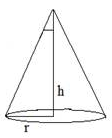
Let radius of the cone = r
Height of the cone = h
Volume of the cone $= \frac{1}{3}\pi {r^2}h$
$\frac{{dv}}{{dt}} = 12c{m^3}/s$ (Given)
$h = \frac{1}{6}r$ (Given)
$v = \frac{1}{3}\pi {r^2}h$
$v = \frac{1}{3}.\pi .{\left( {6h} \right)^2}.h\,\,\left[ {\because h = \frac{1}{6}r} \right]$
$\Rightarrow$ $v = \frac{1}{3}.\pi .36.{h^3}$
$\Rightarrow v = 12\pi {h^3}$
Now $\frac{{dv}}{{dt}} = 12\pi .3{h^2}.\frac{{dh}}{{dt}}$
$12 = 12\pi .3{\left( 4 \right)^2}.\frac{{dh}}{{dt}}$ [h = 4cm]
$\Rightarrow \frac{{12}}{{12\pi .3.16}} = \frac{{dh}}{{dt}}$
$\therefore \frac{{dh}}{{dt}} = \frac{1}{{48\pi }}cm/s$ View full question & answer→Question 301 Mark
A balloon which always remains spherical, has a variable diameter $\frac{3}{2}\left( {2x + 1} \right)$ Find the rate of change of its volume with respect to x.
AnswerGiven: Diameter of the balloon $= \frac{3}{2}\left( {2x + 1} \right)$ $\therefore$ Radius of the balloon $= \frac{3}{4}\left( {2x + 1} \right)$
$\therefore$ Volume of the balloon $= \frac{4}{3}\pi {\left( {\frac{3}{4}\left( {2x + 1} \right)} \right)^3}$
$= \frac{{9\pi }}{{16}}{\left( {2x + 1} \right)^3}$ cube units
$\therefore$ Rate of change of volume w.r.t. $x = \frac{{dV}}{{dx}}$
$= \frac{{9\pi }}{{16}}.3{\left( {2x + 1} \right)^2}.\frac{d}{{dx}}\left( {2x + 1} \right)$
$= \frac{{27\pi }}{16}{\left( {2x + 1} \right)^2}.2$
$= \frac{{27\pi }}{8}{\left( {2x + 1} \right)^2}$
View full question & answer→Question 311 Mark
The radius of an air bubble is increasing at the rate of $\frac{1}{2}$ cm/s. At what rate is the volume of the bubble increasing when the radius is 1 cm?
AnswerLet x cm be the radius of the air bubble at time t. According to question, $\frac{{dx}}{{dt}}$ is positive $= \frac{1}{2}$ cm/sec ……….(i)
Volume of air bubble $\left( z \right) = \frac{{4\pi }}{3}{x^3}$
$\Rightarrow \frac{{dz}}{{dt}} = \frac{{4\pi }}{3}\frac{d}{{dt}}{x^3}$
$= \frac{{4\pi }}{3}.3{x^2}\frac{{dx}}{{dt}}$
$= 4\pi {x^2}\left( {\frac{1}{2}} \right)$
$\Rightarrow \frac{{dz}}{{dt}} = 3\pi {x^2}$
$= 2\pi {\left( 1 \right)^2} = 2\pi$
Therefore, required rate of increase of volume of air bubble is $2\pi c{m^3}/\sec$
View full question & answer→Question 321 Mark
Find the rate of change of the area of a circle with respect to its radius r when r = 4 cm.
AnswerWe know that area A of a circle is, A = $\pi$$r^2$
Then, Rate of change of the area with respect to its radius is given by,
$\frac{d }{d r}(A)=\frac{d}{d r}\left(\pi r^{2}\right)=2 \pi r$
When $r = 4~~cm$
Then $\frac{d }{d r}(A)=2 \pi(4)=8 \pi$
Therefore, the area of the circle is changing at the rate of $8\pi~~cm^2/s$ when its radius is $ 4~~cm$.
View full question & answer→Question 331 Mark
Find the rate of change of the area of a circle with respect to its radius r when $r = 3 cm$
AnswerWe know that area of a circle (A) is A = $\pi r^2$
Then, Rate of change of the area with respect to its radius is given by,
$\frac{d A}{d r}=\frac{d\left(\pi r^{2}\right)}{d r}=2 \pi r$
When r = 3cm
Then $\frac{\mathrm{d} \mathrm{A}}{\mathrm{dr}}$ = 2$\pi$(3) = 6$\pi$
Therefore, the area of the circle is changing at the rate of 6$\pi\ cm^2/s$ when its radius is 3cm.
View full question & answer→Question 341 Mark
Prove that the function given by f(x) = cos x is neither increasing nor decreasing in (0, 2$\pi$).
AnswerNote that $f ′(x) = – sin x$
Clearly, for $$$(0, \pi)$, we have
$f ′(x) = – sin x<0$
So, the function is decreasing in $(0, \pi)$.
Now, for $x \in (\pi, 2\pi)$ we have
$f ′(x) = – sin x>0$
Therefore, $f(x)$ is increasing in $(\pi, 2\pi)$
Hence, f is neither increasing nor decreasing in (0, 2$\pi$).
View full question & answer→Question 351 Mark
Prove that the function given by f(x) = cos x is increasing in ($\pi$, 2$\pi$)
AnswerNote that f ′(x) = – sin x
Since for each x $\in$ ($\pi$, 2$\pi$), sin x < 0,
we have f ′(x) > 0
Therefore, f is increasing in ($\pi$, 2$\pi$).
View full question & answer→Question 361 Mark
Prove that the function given by f(x) = cos x is decreasing in (0, $\pi$).
AnswerNote that f ′(x) = – sin x
Since for each x ∈ (0, $\pi$), sin x > 0, we have f ′(x) < 0 and so f is decreasing in (0, $\pi$).
View full question & answer→Question 371 Mark
Show that the function $f$ given by $f(x) = x^3 – 3x^2 + 4x, x \in R$ is increasing on $R$.
AnswerNot that
$f ′(x) = 3x^2 – 6x + 4$
$= 3(x^2 – 2x + 1) + 1$
$= 3(x – 1)^2 + 1 > 0$, in every interval of R
Therefore, the function f is increasing on R.
View full question & answer→Question 381 Mark
Show that the function given by $f(x) = 7x – 3$ is increasing on $R$.
AnswerLet $x_1$ and $x_2$ be any two numbers in $R$. Then
$\mathrm{x}_1<\mathrm{x}_2$
$\Rightarrow 7 \mathrm{x}_1<7 \mathrm{x}_2$
$\Rightarrow 7 \mathrm{x}_1-3<7 \mathrm{x}_2-3$
$\Rightarrow \mathrm{f}\left(\mathrm{x}_1\right)<\mathrm{f}\left(\mathrm{x}_2\right)$
Thus, f is strictly increasing on $R$.
View full question & answer→Question 391 Mark
The total revenue in Rupees received from the sale of x units of a product is given by $R(x) = 3x^2 + 36x + 5$. Find the marginal revenue, when $x = 5$, where by marginal revenue we mean the rate of change of total revenue with respect to the number of items sold at any instant.
AnswerSince Marginal Revenue is the rate of change of total revenue with respect to the number of units sold, we have
Marginal Revenue (MR) = $\frac{d {R}}{d x}$ = 6x + 36
When x = 5, MR = 6(5) + 36 = 66
Hence, the required marginal revenue is ₹ 66.
View full question & answer→Question 401 Mark
The total cost $C(x)$ in Rupees, associated with the production of x units of an item is given by $C(x) = 0.005x^3 - 0.02x^2 + 30x + 5000.$
Find the marginal cost when 3 units are produced, where by marginal cost we mean the instantaneous rate of change of total cost at any level of output.
AnswerWe have, $C(x) = 0.005x^3 - 0.02x^2 + 30x + 5000$
The marginal cost,$ MC(x) = \frac{d}{dx}C(x)$
Now, $\frac{d}{dx}(0.005x^3 - 0.02x^2 + 30x + 5000)$
$= 0.005 \times 3x^2 - 0.02 \times 2x + 30 + 0$
$= 0.015 x^2 - 0.04x + 30$
Marginal cost when 3 units are produced is
$MC(3)=0.015(9) - 0.04(3) + 30$
$= 0.135 - 0.12 + 30$
$= 30.015$
View full question & answer→Question 411 Mark
The length x of a rectangle is decreasing at the rate of 3 cm/minute and the width y is increasing at the rate of 2cm/minute. when x = 10cm and y = 6cm, find the rates of change of (a) the perimeter (b) the area of the rectangle.
AnswerGiven $\frac{{dx}}{{dt}} = - 3cm/{\text{min, }}\frac{{dy}}{{dt}} = 2cm/{\text{min}}$
- Let P be the perimeter
$P = 2\left( {x + y} \right)$
$\frac{{dp}}{{dx}} = 2\left( {\frac{{dx}}{{dt}} + \frac{{dy}}{{dt}}} \right)$
$= 2\left( { - 3 + 2} \right)$
$= - 2cm/{\text{min}}$ (i.e perimeter is decreasing) - Now area of rectangle A = xy
$\frac{{dy}}{{dt}} = x\frac{{dy}}{{dx}} + y.\frac{{dx}}{{dt}}$
$= 10\left( 2 \right) + 6\left( { - 3} \right)$
$= 20 - 18$
$= 2c{m^2}/{\text{min}}$
View full question & answer→Question 421 Mark
Manufacturer can sell x items at a price of rupees $ \left( 5 - \frac { x } { 100 } \right)$ each. The cost price of x items is Rs $ \left( \frac { x } { 5 } + 500 \right)$. Find the number of items he should sell to earn maximum profit.
AnswerGiven manufacturer sells x items at a price of Rs. $ \left( 5 - \frac { x } { 100 } \right)$ each.
$ \therefore$ Total revenue obtained $ = Rs. \left[ x \left( 5 - \frac { x } { 100 } \right) \right] = Rs. \left( 5 x - \frac { x ^ { 2 } } { 100 } \right)$
Also, cost price of x item $ = Rs. \left( \frac { x } { 5 } + 500 \right)$
Let P(x) be the profit function.
We know that,
Profit = Revenue - Cost
$ \therefore \quad P = \left( 5 x - \frac { x ^ { 2 } } { 100 } \right) - \left( \frac { x } { 5 } + 500 \right)$
$ \Rightarrow \quad P = \frac { - x ^ { 2 } } { 100 } + \frac { 24 x } { 5 } - 500$
On differentiating both sides w.r.t. x, we get
$ \frac { d P } { d x } = \frac { - 2 x } { 100 } + \frac { 24 } { 5 }$
For maxima or minima, put $ \frac { d P } { d x } = 0$
$ \Rightarrow \quad \frac { - 2 x } { 100 } + \frac { 24 } { 5 } = 0 \Rightarrow x = 240$
Also, $ \frac { d ^ { 2 } P } { d x ^ { 2 } } = \frac { d } { d x } \left( \frac { d P } { d x } \right) = \frac { d } { d x } \left( - \frac { 2 x } { 100 } + \frac { 24 } { 5 } \right)$
$ = - \frac { 2 } { 100 } = - \frac { 1 } { 50 } < 0$
Thus, at x = 240, $ \frac { d ^ { 2 } P } { d x ^ { 2 } } < 0 \Rightarrow P$ is maximum.
Hence, number of items sold to have maximum profit is 240.
View full question & answer→Question 431 Mark
An open topped box is to be constructed by removing equal squares from each corner of a $3$ metre by $8$ metre rectangular sheet of aluminium and folding up the sides. Find the volume of the largest such box
AnswerLet $x$ be the length of side of each square to be removed. Then, the height of the box is $x,$ length is $8 – 2x$ and breadth is $3 – 2x$
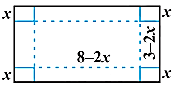
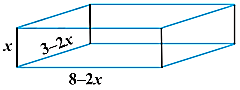 .
.
If $V(x)$ is the volume of the box, then
$V(x) = x (3 – 2x) (8 – 2x)$
$= 4x^3 – 22x^2 + 24x$
$\Rightarrow{\mathrm{V}^{\prime}(x)=12 x^{2}-44 x+24=4(x-3)(3 x-2)} \\ \Rightarrow{\mathrm{V}^{\prime \prime}(x)=24 x-44} $
Now $V′(x) = 0$ gives $x = 3$, $\frac{2}{3}$. But x $\neq$ 3, as we cannot cut a square of length 6m from a sheet of breadth 3m.
Thus, we have x = $\frac{2}{3}$.
Now V''$\left(\frac{2}{3}\right)=24\left(\frac{2}{3}\right)-44 = - 28 < 0.$
Therefore, x = $\frac{2}{3}$ is the point of maxima, i.e., if we remove a square of side $\frac{2}{3}$ mtere from each corner of the sheet and make a box from the remaining sheet, then the volume of the box so obtained will be the largest and it is given by
$V\left(\frac{2}{3}\right)=4\left(\frac{2}{3}\right)^{3}-22\left(\frac{2}{3}\right)^{2}+24\left(\frac{2}{3}\right)$
= $\frac{200}{27}$ $m^3$ View full question & answer→Question 441 Mark
A circular disc of radius 3 cm is being heated. Due to expansion, its radius increases at the rate of 0.05 cm/s. Find the rate at which its area is increasing when radius is 3.2 cm.
AnswerGiven , $\frac{dr}{dt}=0.05cm/sec$ $A = \pi {r^2}$
Now $\frac{{dA}}{{dt}} = 2\pi r.\frac{{dr}}{{dt}}$
$ = 2\pi \left( {3.2} \right) \times 0.05$(given r=3.2cm)
$= 0.320\pi c{m^2}/s$
View full question & answer→Question 451 Mark
Show that the function f given by $f(x) = \tan^{–1} (sin x + cos x), x > 0$ is always an increasing function in $\left(0, \frac{\pi}{4}\right)$
AnswerWe have, $f\left( x \right) = {\tan ^{ - 1}}\left( {\sin x + \cos x} \right)$$\therefore f'\left( x \right) = \frac{1}{{1 + {{\left( {\sin x + \cos x} \right)}^2}}}.\left( {\cos x - \sin x} \right)$
$= \frac{1}{{1 + {{\sin }^2}x + {{\cos }^2}x + 2\sin x.\cos x}}\left( {\cos x - \sin x} \right)$
$= \frac{1}{{\left( {2 + \sin 2x} \right)}}\left( {\cos x - \sin x} \right)$
$\left[ {\because \sin 2x = 2\sin x\cos x\,\,and\,\,{{\sin }^2}x + {{\cos }^2}x = 1} \right]$
For $f'\left( x \right) \geqslant 0$
$\frac{1}{{\left( {2 + \sin 2x} \right)}}.\left( {\cos x - \sin x} \right) \geqslant 0$
$\Rightarrow \cos x - \sin x \geqslant 0\,\,\left[ {\because \left( {2 + \sin 2x} \right) \geqslant 0\,\,in\,\left( {0,\frac{\pi }{4}} \right)} \right]$
$\Rightarrow \cos x \geqslant \sin x$
Which is true, if $x \in \left( {0,\frac{\pi }{4}} \right)$
Hence, f(x) is an increasing function in $\left( {0,\frac{\pi }{4}} \right)$.
View full question & answer→Question 461 Mark
Find intervals in which the function given by $f(x) = \frac{3}{{10}}{x^4} - \frac{4}{5}{x^3} - 3{x^2} + \frac{{36}}{5}x + 11$ is increasing or decreasing.
Answer$f(x) = \frac{3}{{10}}{x^4} - \frac{4}{5}{x^3} - 3{x^2} + \frac{{36}}{5}x + 11$
$f'(x) = \frac{3}{{10}}.4{x^3} - \frac{4}{5}3{x^2} - 6x + \frac{{36}}{5}$
$ = \frac{6}{5}{x^3} - \frac{{12}}{5}{x^2} - \frac{{6x}}{1} + \frac{{36}}{5}$
$f'(x) = \frac{{6{x^3} - 12{x^2} - 30x + 36}}{5}$
$ = \frac{6}{5}\left[ {{x^3} - 2{x^2} - 5x + 6} \right]$
let f'(x) = 0
$\frac{6}{5}({x^3} - 2{x^2} - 5x + 6) = 0$
${x^3} - 2{x^2} - 5x + 6 = 0$
Put x = 1
f'(1) = 1 - 2 - 5 + 6 = 0
x-1 is the factor of f'(x)
$f'(x) = \frac{6}{5}(x - 1)({x^2} - x - 6)$
$ = \frac{6}{5}(x - 1)\left[ {{x^2} - 3x + 2x - 6} \right]$
$ = \frac{6}{5}(x - 1)\left[ {x(x - 3) + 2(x - 2)} \right]$
$ = \frac{6}{5}(x - 1)(x - 3)(x + 2)$
put f'(x) = 0
x = 1, x = 3, x = -2

| int
| Sign of f’(x)
| Result
|
| $( - \infty , - 2)$
| -ve
| Decrease
|
| (-2, 1)
| +ve
| Increase
|
| (1,3)
| -ve
| Decrease
|
| $(3,\infty )$
| +tve
| increase
|
View full question & answer→Question 471 Mark
A man of height 2 metres walks at a uniform speed of 5 km/h away from a lamp post which is 6 metres high. Find the rate at which the length of his shadow increases.
Answer
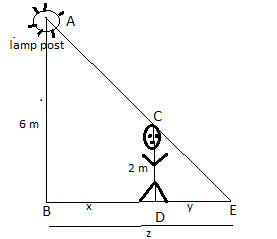
AB is lamp post DC is man
$\frac{{dx}}{{dt}} = 5km/h,\frac{{dy}}{{dt}} = ?$
$\triangle DEC \sim \triangle BEA$
$\frac{2}{6} = \frac{y}{{x + y}}$
x + y = 3y
x = 2y
$\frac{{dx}}{{dt}} = 2\frac{{dy}}{{dt}}$
$5 = 2\frac{{dy}}{{dt}}$
$ \frac{{dy}}{{dt}}=\frac{5}{2}$ km\h
View full question & answer→Question 481 Mark
A water tank has the shape of an inverted right circular cone with its axis vertical and vertex lower most. Its semi vertical angle is $\tan^{-1}(0.5)$ water is poured into it at a constant rate of $5$ cubic metre per hour. Find the rate at which the level of the water is rising at the instant when the depth of water in the tank is $4 m$.
Answer
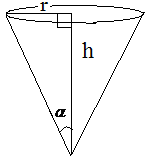
Clearly, $\tan \alpha = \frac{r}{h}$
Given that ${\tan ^{ - 1}}(0.5) = \alpha $
$\Rightarrow \tan \alpha = 0.5$
$\Rightarrow\frac{r}{h} = \frac{5}{{10}}$
$\Rightarrow$ h = 2r
Now, $V = \frac{1}{3}\pi {r^2}h$
$ = \frac{1}{3}\pi .{\left( {\frac{h}{2}} \right)^2}.h$
$ = \frac{1}{3}\pi {\frac{h}{4}^3}$
$\therefore \frac{{dv}}{{dt}} = \frac{1}{{12}}\pi .3{h^2}\frac{{dh}}{{dt}}$
$\Rightarrow$ $5 = \frac{1}{{12}}\pi .3{(4)^2}.\frac{{dh}}{{dt}}$
$\Rightarrow$ $\frac{{dh}}{{dt}} = \frac{{5}}{{4π}} m/hr$ View full question & answer→Question 491 Mark
A car starts from a point P at time $t = 0$ seconds and stops at point Q. The distance x, in metres, covered by it, in t seconds is given by
$x=t^{2}\left(2-\frac{t}{3}\right)$
Find the time taken by it to reach Q and also find distance between P and Q.
AnswerLet v be the velocity of the car at t seconds.
Now $x=t^{2}\left(2-\frac{t}{3}\right)$
Therefore $v=\frac{d x}{d t} = 4t – t^2 = t(4 – t)$
Clearly, v = 0 gives t = 0 and t = 4
Now v = 0 at P as well as at Q and at P, t = 0. So, at Q, t = 4.
Thus, the car will reach the point Q after 4 seconds. Also the distance travelled in 4 seconds is given by
$x]_{t=4}=4^{2}\left(2-\frac{4}{3}\right)=16\left(\frac{2}{3}\right)=\frac{32}{3}$m
View full question & answer→Question 501 Mark
A stone is dropped into a quiet lake and waves move in circles at a speed of 4 cm/s. At the instant, when the radius of the circular wave is 10 cm, how fast is the enclosed area increasing?
AnswerLet A be the area of the circle of radius r.
Then, A = $\pi r^2$
Therefore, the rate of change of area A with respect to time 't' is
$\frac{d \mathbf{A}}{d t}=\frac{d}{d t}\left(\pi r^{2}\right)=\frac{d}{d r}\left(\pi r^{2}\right) \cdot \frac{d r}{d t}=2 \pi r \frac{d r}{d t}$ ...(By Chain Rule)
Given that $\frac{d r}{d t}$ = 4cm/s
Therefore, when r = 10, $\frac{d \mathrm{A}}{d t} $ = $2\pi \times10\times4$ = $80\pi$
Thus, the enclosed area is increasing at a rate of $80\pi$ $cm^2/s$ , when r = 10 cm.
View full question & answer→