MCQ 1511 Mark
By graphical method, the solution of linear programming problem Maximize $Z=3 x_1+5 x_2$ Subject to $3 x_1+2 x_2 \leq 18\ x_1 \leq 4\ x_2 \leq 6\ x 1 \geq 0, x_2 \geq 0$, is:
- A
$x_1 = 2, x_2 = 0, Z = 6$
- ✓
$x_1 = 2, x_2 = 6, Z = 36$
- C
$x_1 = 4, x_2 = 3, Z = 27$
- D
$x_1 = 4, x_2 = 6, Z = 42$
AnswerCorrect option: B. $x_1 = 2, x_2 = 6, Z = 36$
We need to maximize the function $Z = 3x_4 + 5x_2$
First, we will convert the given inequations into equations, we obtain the following equations:
$3 x_1+2 x_2=18, x_1=4, x_2=6, x_1=0$ and $x_2=0$
Region represented by $3x_1 + 2x_2 ≤ 18:$
The line $3x_1 + 2x_2 = 18$ meets the coordinate axes at $A(6, 0)$ and $B(0, 9)$ respectively.
By joining these points we obtain the line $3X_1 + 2x_2 = 18.$
Clearly $(0, 0)$ satisfies the inequation $3x_1 + 2x_2 = 18.$
So the region in the plane which contain the origin represents the solution set of the inequation $3x_1 + 2x_2 ≤ 18.$
Region represented by $x_1 ≤ 4:$
The line $x_1 = 4$ is the line that passes through $C(4, 0)$ and is parallel to the $Y$ axis.
The region to the left of the line $x_1 = 4$ will satisfy the inequation $x_1 ≤ 4.$
Region represented by $x_2 ≤ 6:$
The line $x_2 = 6$ is the line that passes through $D(0, 6)$ and is parallel to the $X$ axis.
The region below the line $x_2 = 6$ will satisfy the inequation $X_2 ≤ 6$.
Region represented by $x_1 ≥ 0$ and $x_2 ≥ 0:$
Since, every point in the first quadrant satisfies these inequations.
So, the first quadrant is the region represented by the inequations $x_1 ≥ 0$ and $x_2 ≥ 0.$
The feasible region determined by the system of constraints, $3x_1 + 2x_2 ≤ 18, x_1 ≤ 4, x_2 ≤ 6, x_1 ≥ 0$ and $x_2 ≥ 0$ are as follows
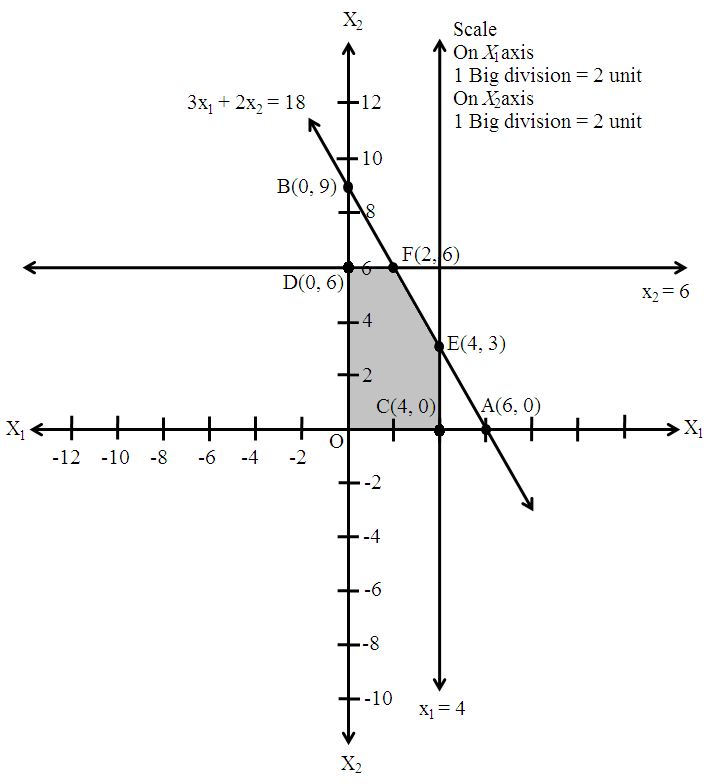
Corner points are $O(0, 0), D(0, 6), F(2, 6), E(4, 3)$ and $C(4, 0).$
The values of the objective function at these points are given in the following table.
|
Points
|
Value of $Z$
|
| $O(0, 0)$ |
$3(0) + 5(0) = 0$ |
| $D(0, 6)$ |
$3(0) + 5(6) = 30$ |
| $F(2, 6)$ |
$3(2) + 5(6) = 36$ |
| $E(4, 3)$ |
$3(4) + 5(3) = 27$ |
| $C(4, 0)$ |
$3(4) + 5(0) = 12$ |
We see that the maximum value of the objective function $Z$ is $36$ which is at $F(2, 6).$ View full question & answer→MCQ 1521 Mark
The maximum value of $Z = 3x + 4y$ subjected to constraints $\text{x}+\text{y}\leq4,\text{x}\geq0$ and $\text{y}\geq0$ is :
AnswerThe feasible region determined by the constraints, $\text{x}+\text{y}\leq4,\text{x}\geq0, \text{y}\geq0,$ is given below
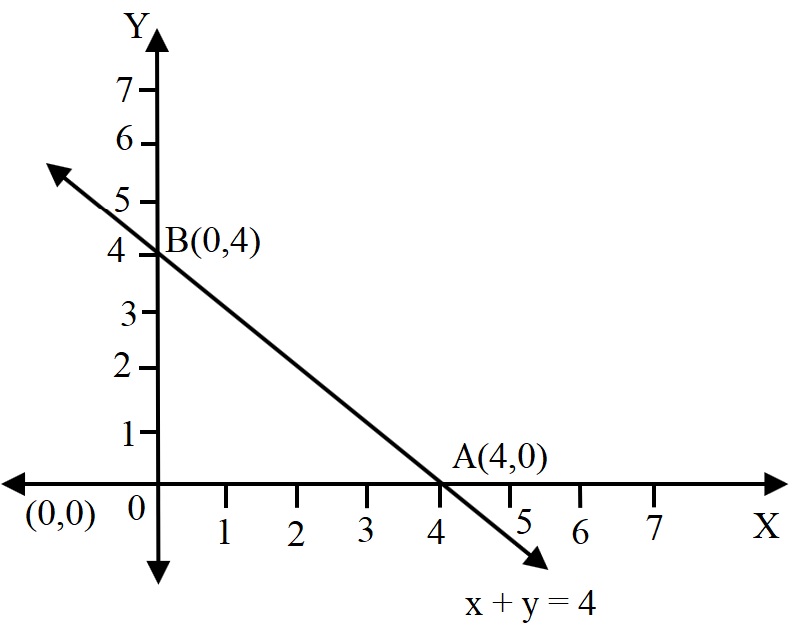
$O (0, 0), A (4, 0),$ and $B (0, 4)$ are the corner points of the feasible region.
The values of $Z$ at these points are given below :
|
Corner Point
|
$z = 3x + 4y$ |
| $O(0, 0)$ |
$0$ |
| $A(4, 0)$ |
$12$ |
| $B(0, 4)$ |
$16$ |
Hence, the maximum value of $Z$ is $16$ at point $B (0, 4)$ View full question & answer→MCQ 1531 Mark
Objective function of a $\text{L.P.P.}$ is:
- A
- ✓
A function to be optimised
- C
A relation between the variables
- D
AnswerCorrect option: B. A function to be optimised
View full question & answer→MCQ 1541 Mark
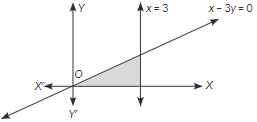
In a linear programming problem, the constraints on the decision variables $x$ and $y$ are $x-3 y \geq 0, y \geq 0$, $0 \leq x \leq 3$. The feasible region
- A
is not in the first quadrant
- B
is bounded in the first quadrant
- C
is unbounded in the first quadrant
- D
AnswerFrom the graph, we can say that the feasible region is bounded in the first quadrant.
View full question & answer→MCQ 1551 Mark
For an objective function $Z=a x+b y$, where $a, b>0$; the corner points of the feasible region determined by a set of constraints (linear inequalities) are $(0,20),(10,10),(30,30)$ and $(0,40)$. The condition on $a$ and $b$ such that the maximum $Z$ occurs at both the points $(30,30)$ and $(0,40)$ is
- A
$b-3 a=0$
- B
$a=3 b$
- C
$a+2 b=0$
- D
$2 a-b=0$
AnswerAs, $Z$ is maximum at $(30,30)$ and $(0,40)$.
$\Rightarrow \quad 30 a+30 b=40 b \Rightarrow b-3 a=0$
View full question & answer→MCQ 1561 Mark
A linear programming problem is as follows : Minimize $Z=30 x+50 y$ Subject to the constraints, $3 x+5 y \geq 15\ ,\ 2 x+3 y \leq 18 \ ,\ x \geq 0, y \geq 0$ In the feasible region, the minimum value of $Z$ occurs at
AnswerHere, the feasible region is shaded.
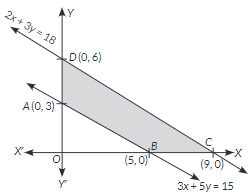
| Corner points |
Value of $Z=30 x+50 y$ |
| $A(0,3)$ |
$30 xx0+50 xx3=150 ($Minimum$)$ |
| $B(5,0)$ |
$30 xx5+50 xx0=150 ($Minimum$)$ |
| $C(9,0)$ |
$30 xx9+50 xx0=270$ |
| $D(0,6)$ |
$30 xx0+50 xx6=300$ |
Since, minimum value of $Z$ occurs at both $A$ and $B$.
So, $Z$ is minimum at every point on the line joining $A B$.
So, minimum value of $Z$ occurs at infinitely many points. View full question & answer→MCQ 1571 Mark
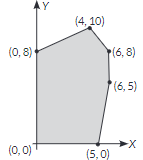
In the given graph, the feasible region for a LPP is shaded. The objective function $Z=2 x-3 y$, will be minimum at
- A
$(4,10)$
- B
$(6,8)$
- C
$(0,8)$
- D
$(6,5)$
AnswerWe have,| Corner points | Value of Z=2x-3y |
| (0,0) | 2xx0-3xx0=0 |
| (0,8) | 2xx0-3xx8=-24 (Minimum) |
| (4,10) | 2xx4-3xx10=-22 |
| (6,8) | 2xx6-3xx8=-12 |
| (6,5) | 2xx6-3xx5=-3 |
| (5,0) | 2xx5-3xx0=10 |
$\therefore \quad$ Value of $Z$ is minimum at $(0,8)$. View full question & answer→MCQ 1581 Mark
Based on the given shaded region as the feasible region in the graph, at which point(s) is the objective function $Z=3 x+9 y$ maximum?
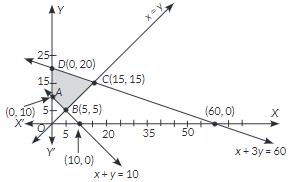
AnswerWe have,| Corner points | Value of Z=3x+9y |
| A(0,10) | 3xx0+9xx10=90 |
| B(5,5) | 3xx5+9xx5=60 |
| C(15,15) | 3xx15+9xx15=180 (Maximum) |
| D(0,20) | 3xx0+9xx20=180 (Maximum) |
$\because \quad Z$ is maximum at $C(15,15)$ and $D(0,20)$.
$\therefore \quad Z$ is maximum at every point on the line joining $C D$. View full question & answer→MCQ 1591 Mark
For the following LPP, maximise $Z=3 x+4 y$ subject to constraints $x-y \geq-1, x \leq 3, x \geq 0, y \geq 0$ the maximum value is
AnswerGiven, $Z=3 x+4 y$
Subject to constraints, $x-y \geq-1, x \leq 3 ; x \geq 0, y \geq 0$
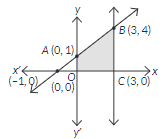
The shaded region $O A B C$ is the feasible region, where corner points are $O(0,0), A(0,1), B(3,4)$ and $C(3,0)$.
At $O(0,0), Z=3(0)+4(0)=0$
At $A(0,1), Z=3(0)+4(1)=4$
At $B(3,4), Z=3(3)+4(4)=25$
At $C(3,0), Z=3(3)+4(0)=9$
$\therefore \quad$ Maximum value of $Z$ is 25 , which occurs at $B(3,4)$. View full question & answer→MCQ 1601 Mark
If the minimum value of an objective function $Z=a x+$ by occurs at two points $(3,4)$ and $(4,3)$ then
- A
$a+b=0$
- B
$a=b$
- C
$3 a=b$
- D
$a=3 b$
AnswerSince, minimum value of $Z=a x+b y$ occurs at two points $(3,4)$ and $(4,3)$.
$\therefore \quad 3 a+4 b=4 a+3 b \Rightarrow a=b$
View full question & answer→MCQ 1611 Mark
The feasible region of an LPP is given in the following figure
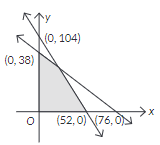
Then, the constraints of the LPP are $x \geq 0, y \geq 0$ and - A
$2 x+y \leq 52$ and $x+2 y \leq 76$
- B
$2 x+y \leq 104$ and $x+2 y \leq 76$
- C
$x+2 y \leq 104$ and $2 x+y \leq 76$
- D
$x+2 y \leq 104$ and $2 x+y \leq 38$
AnswerClearly, the pair of points given in graph, and $(0,104) ;(52,0)$ and $(0,38) ;(76,0)$ satisfy the corresponding equations given in option(b) i.e., $2 x+y \leq 104$ and $x+2 y \leq 76$.
View full question & answer→MCQ 1621 Mark
The maximum value of $Z=3 x+4 y$ subject to the constraints $x \geq 0, y \geq 0$ and $x+y \leq 1$ is
AnswerWe have to maximise $Z=3 x+4 y$
Subject to constraints, $x \geq 0, y \geq 0$ and $x+y \leq 1$
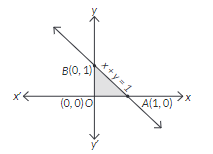
The shaded portion $O A B$ is the feasible region, where $O(0,0), A(1,0)$ and $B(0,1)$ are the corner points.
At $O(0,0), Z=3 \times 0+4 \times 0=0$
At $A(1,0), Z=3 \times 1+4 \times 0=3$
At $B(0,1), Z=3 \times 0+4 \times 1=4$
$\therefore \quad$ Maximum value of $Z$ is 4 , which occurs at $B(0,1)$. View full question & answer→MCQ 1631 Mark
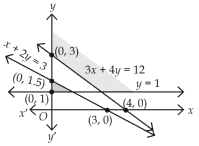
The number of solutions of the system of inequations $x+2 y \leq 3,3 x+4 y \geq 12, x \geq 0, y \geq 1$ is
AnswerGiven,
$x+2 y \leq 3,3 x+4 y \geq 12, x \geq 0, y \geq 1$
The graph of given constraints is shown here.
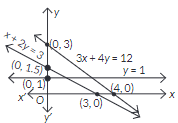
Since, there is no common region, so, no solution exists. View full question & answer→MCQ 1641 Mark
If the corner points of the feasible region of an LPP are $(0,3),(3,2)$ and $(0,5)$, then the minimum value of $z=11 x+7 y$ is
AnswerGiven, $Z=11 x+7 y$
At $(0,3), Z=11 \times 0+7 \times 3=21$
At $(3,2), Z=11 \times 3+7 \times 2=47$
At $(0,5), Z=11 \times 0+7 \times 5=35$
Thus, $Z$ is minimum at $(0,3)$ and minimum value of $Z$ is 21 .
View full question & answer→MCQ 1651 Mark
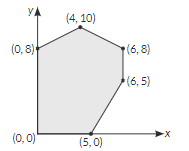
The feasible region for an LPP is shown below: Let $z=3 x-4 y$ be the objective function. Minimum of $z$ occurs at
- A
$(0,0)$
- B
$(0,8)$
- C
$(5,0)$
- D
$(4,10)$
AnswerWe know that minimum of objective function occurs at corner points.
| Corner points | Value of z=3x-4y |
| (0,0) | 0 |
| (5,0) | 15 |
| (6,5) | -2 |
| (6,8) | -14 |
| (4,10) | -28 |
| (0,8) | -32 larr Minimum |
View full question & answer→MCQ 1661 Mark
The maximum value of $Z=4 x+y$ for a $\text{L.P.P.}$ whose feasible region is given below is:
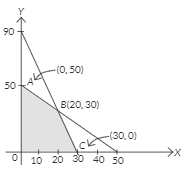
AnswerWe have, Max. $Z=4 x+y$
The corner points of feasible region are $O, A, B$ and $C$. Thus,
$Z_{(0,0\rangle}=0 ;$
$Z_{\langle 0,50\rangle}=50 ;$
$Z_{\langle 20,30\rangle}=20 \times 4+30=110 ;$
$Z_{\{30,0\rangle}=4 \times 30=120$
$\therefore\ M a x\ Z=4 x+y \text { is } 120 .$
View full question & answer→MCQ 1671 Mark
The common region determined by all the constraints of a linear programming problem is called:
MCQ 1681 Mark
The feasible region corresponding to the linear constraints of a Linear Programming Problem is given below
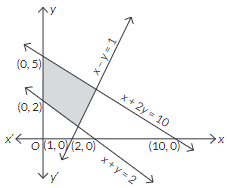
Which of the following is not a constraint to the given Linear Programming Problem?
- A
$x+y \geq 2$
- B
$x+2 y \leq 10$
- C
$x-y \geq 1$
- D
$x-y \leq 1$
AnswerWe observe, $(0,0)$ does not satisfy the inequality
$x-y \geq 1$
So, the half plane represented by the above inequality will not contain origin therefore, it will not contain the shaded feasible region.
View full question & answer→MCQ 1691 Mark
The corner points of the bounded feasible region determined by a system of linear constraints are $(0,3),(1,1)$ and $(3,0)$. Let $Z=p x+q y$, where $p, q>0$,. The condition on $p$ and $q$ so that the minimum of $Z$ occurs at $(3,0)$ and $(1,1)$ is
- A
$p=2 q$
- B
$p=\frac{q}{2}$
- C
$p=3 q$
- D
$p=q$
Answer| Corner point | Value of Z=px+qy;p,q > 0 |
| (0,3) | p xx0+q xx3=3q |
| (1,1) | p xx1+q xx1=p+q |
| (3,0) | p xx3+q xx0=3p |
The minimum of $Z$ occurs at $(3,0)$ and $(1,1)$
$
\therefore p+q=3 p \Rightarrow p=\frac{q}{2}
$ View full question & answer→MCQ 1701 Mark
The feasible region of a linear programming problem is bounded. The corresponding objective function is $Z=6 x-7 y$.
The objective function attains $\qquad$ in the feasible region.
- A
- B
- ✓
- D
either maximum or minimum but not both
View full question & answer→MCQ 1711 Mark
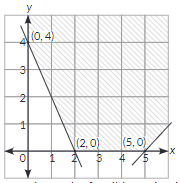
A linear programming problem (LPP) along with the graph of its constraints is shown below. The corresponding objective function is
Minimize: $Z=3 x+2 y$. The minimum value of the objective function is obtained at the corner point ( 2 , 0).
The optimal solution of the above linear programming problem $\qquad$
- A
does not exist as the feasible region is unbounded.
- B
does not exist as the inequality $3 x+2 y<6$ does not have any point in common with the feasible region.
- C
exists as the inequality $3 x+2 y>6$ has infinitely many points in common with the feasible region.
- ✓
exists as the inequality $3 x+2 y<6$ does not have any point in common with the feasible region.
AnswerCorrect option: D. exists as the inequality $3 x+2 y<6$ does not have any point in common with the feasible region.
exists as the inequality $3 x+2 y<6$ does not have any point in common with the feasible region.
View full question & answer→MCQ 1721 Mark
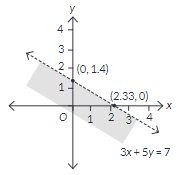
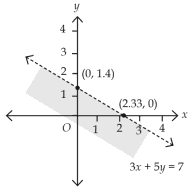
The solution set of the inequation $3 x+5 y<7$ is
- A
whole $x y$-plane except the points lying on the line $3 x+5 y=7$.
- B
whole $x y$-plane along with the points lying on the line $3 x+5 y=7$.
- C
open half plane containing the origin except the points of line $3 x+5 y=7$.
- D
open half plane not containing the origin.
View full question & answer→MCQ 1731 Mark
Which of the following points satisfies both the inequations $2 x+y \leq 10$ and $x+2 y \geq 8$ ?
- A
$(-2,4)$
- B
$(3,2)$
- C
$(3,2)$
- D
$(4,2)$
View full question & answer→MCQ 1741 Mark
The number of corner points of the feasible region determined by the constraints $x-y \geq 0,2 y \leq x+2$, $x \geq 0, y \geq 0$ is:
AnswerWe have, $x-y \geq 0,2 y \leq x+2, x \geq 0$ and $y>0$. Let us draw the graph of given constraints, we get $x-y=0$and 2y = x + 2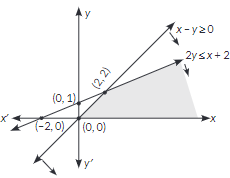
The feasible region is unbounded.
$\therefore \quad$ There are two corner points as $(0,0)$ and $(2,2)$. View full question & answer→MCQ 1751 Mark
The corner points of the feasible region in the graphical representation of a linear programming problem are $(2,72),(15,20)$ and $(40,15)$. If $z=18 x+9 y$ be the objective function, then:
- A
$z$ is maximum at $(2,72)$, minimum at $(15,20)$
- B
$z$ is maximum at $(15,20)$, minimum at $(40,15)$
- C
$z$ is maximum at $(40,15)$, minimum at $(15,20)$
- D
$z$ is maximum at $(40,15)$, minimum at $(2,72)$
AnswerThe objective function is given as $z=18 x+9 y$
The corner points are given as $(2,72),(15,20)$ and $(40,15)$
At $(2,72), z=18 \times 2+9 \times 72=36+648=684$
At $(15,20), z=18 \times 15+9 \times 20=270+180=450$
At $(40,15)=z=18 \times 40+9 \times 15=720+135=855$
$\therefore \quad z$ is maximum at $(40,15)$ and minimum at $(15,20)$.
View full question & answer→MCQ 1761 Mark
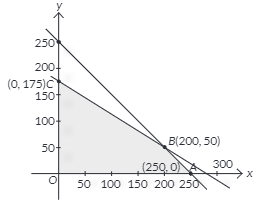
The corner points of the bounded feasible region of an LPP are $O(0,0), A(250,0), B(200,50)$ and $C(0,175)$. If the maximum value of the objective function $Z=2 a x+$ by occurs at the points $A(250,0)$ and $B(200,50)$, then the relation between $a$ and $b$ is:
- A
$2 a=b$
- B
$2 a=3 b$
- C
$a=b$
- D
$a=2 b$
AnswerGiven, $Z=2 a x+b y$.........(i)
Putting $x=250$ and $y=0$ in (i), we get
$Z_{\max }=2 a(250)+b(0)=500 a$.........(ii)
Putting $x=200$ and $y=50$ in (i), we get
$Z_{\max }=2 a(200)+b(50)=400 a+50 b$..........(iii)
From (ii) and (iii), we get $500 a=400 a+50 b$
$\Rightarrow \quad 100 a=50 b \Rightarrow 2 a=b$
View full question & answer→MCQ 1771 Mark
The point which lies in the half-plane $2 x+y-4 \leq 0$ is:
- A
$(0,8)$
- B
$(1,1)$
- C
$(5,5)$
- D
$(2,2)$
AnswerSubstitute $x=1$ and $y=1$ in $2 x+y \leq 4$
$\Rightarrow 2(1)+1 \leq 4 \Rightarrow 3 \leq 4$ which is true.
So, $(1,1)$ lies in the half plane $2 x+y-4 \leq 0$
View full question & answer→MCQ 1781 Mark
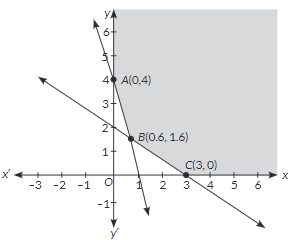
The corner points of the shaded unbounded feasible region of an LPP are $(0,4),(0.6,1.6)$ and $(3,0)$ as shown in the figure. The minimum value of the objective function $Z=4 x+6 y$ occurs at
- A
$(0.6,1.6)$ only
- B
$(3,0)$ only
- C
$(0.6,1.6)$ and $(3,0)$ only
- D
at every point of the line-segment joining the points $(0.6,1.6)$ and $(3,0)$
AnswerThe minimum value of the objective function occurs at two adjacent corner points $(0.6,1.6)$ and $(3,0)$ and there is no point in the half plane $4 x+6 y<12$ in common with the feasible region.
So, the minimum value occurs at every point of the linesegment joining the two points.
View full question & answer→MCQ 1791 Mark
The solution set of the inequality $3 x+5 y<4$ is
AnswerThe strict inequality represents an open half plane and it contains the origin, as $(0,0)$ satisfies it.
View full question & answer→MCQ 1801 Mark
The objective function of an LPP is
- A
- B
a linear function to be optimised
- C
- D
AnswerA linear function to be optimized is called an objective function
View full question & answer→MCQ 1811 Mark
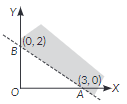
The graph of the inequality $2 x+3 y>6$ is
AnswerFrom the graph of inequality $2 x+3 y>6$. It is clear that it does not contain the origin nor the points of the line $2 x+3 y=6$
View full question & answer→MCQ 1821 Mark
In an LPP, if the objective function $z=a x+$ by has the same maximum value on two corner points of the feasible region, then the number of points at which $z_{\max }$ occurs is
AnswerIn an LPP, if the objective function $z=a x+b y$ has the same maximum value on two corner points of the feasible region, then the number of points at which $z_{\max }$ occurs is infinite.
View full question & answer→MCQ 1831 Mark
The corner points of the feasible region determined by the system of linear inequalities are $(0,0),(4,0)$, $(2,4)$ and $(0,5)$. If the maximum value of $z=a x+b y$, where $a, b>0$ occurs at both $(2,4)$ and $(4,0)$, then
- A
$a=2 b$
- B
$2 a=b$
- C
$a=b$
- D
$3 a=b$
AnswerSince, maximum value of $z=a x+b y$ occurs at both
$(2,4)$ and $(4,0)$.
$
\therefore \quad 2 a+4 b=4 a+0 \Rightarrow 4 b=2 a \Rightarrow 2 b=a$
View full question & answer→MCQ 1841 Mark
Maximize $Z=7 x+11 y$, subject to $3 x+5 y \leq 26$, $5 x+3 y \leq 30, x \geq 0, y \geq 0$.
AnswerCorrect option: A. 59 at $\left(\frac{9}{2}, \frac{5}{2}\right)$
(a): We have, maximize $Z=7 x+11 y$
Subject to $3 x+5 y \leq 26,5 x+3 y \leq 30, x \geq 0, y \geq 0$
Let $l_1: 3 x+5 y=26, l_2: 5 x+3 y=30, l_3: x=0, l_4: y=0$
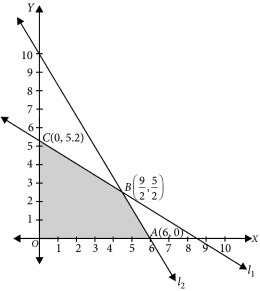
For B : Solving $l_1$ and $l_2$, we get $B\left(\frac{9}{2}, \frac{5}{2}\right)$
Shaded portion $O A B C$ is the feasible region, where $O(0,0), A(6,0), B(9 / 2,5 / 2), C(0,5.2)$.
Now maximize $Z=7 x+11 y$
$Z$ at $O(0,0)=7(0)+11(0)=0$
$Z$ at $A(6,0)=7(6)+11(0)=42$
$Z$ at $B\left(\frac{9}{2}, \frac{5}{2}\right)=7\left(\frac{9}{2}\right)+11\left(\frac{5}{2}\right)=59$
$Z$ at $C(0,5.2)=7(0)+11(5.2)=57.2$
Thus, $Z$ is maximized at $B\left(\frac{9}{2}, \frac{5}{2}\right)$ and its maximum value is 59 . View full question & answer→MCQ 1851 Mark
The graph of the inequality $2 x+3 y>6$ is
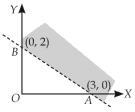
AnswerCorrect option: B. half plane that neither contains the origin nor the points of the line $2 x+3 y=6$.
(b) : From the graph of inequality $2 x+3 y>6$. It is clear that it does not contain the origin nor the points of the line $2 x+3 y=6$.
View full question & answer→MCQ 1861 Mark
In an LPP, if the objective function $Z=a x+b y$ has the same maximum value on two corner points of the feasible region, then the number of points at which $Z_{\max }$ occurs is
Answer(d) : In an LPP, if the objective function $Z=a x+b y$ has the same maximum value on two corner points of the feasible region, then the number of points at which $Z_{\max }$ occurs is infinite.
View full question & answer→MCQ 1871 Mark
The corner points of the feasible region determined by the system of linear inequalities are $(0,0),(4,0),(2,4)$ and $(0,5)$. If the maximum value of $Z=a x+b y$, where $a, b>0$ occurs at both $(2,4)$ and $(4,0)$, then
- ✓
$a=2 b$
- B
$2 a=b$
- C
$a=b$
- D
$3 a=b$
AnswerCorrect option: A. $a=2 b$
(a) : Since, maximum value of $Z=a x+b y$ occurs at both $(2,4)$ and $(4,0)$.
$
\therefore \quad 2 a+4 b=4 a+0 \Rightarrow 4 b=2 a \Rightarrow 2 b=a
$
View full question & answer→MCQ 1881 Mark
For the following LPP, maximise $Z=3 x+4 y$ subject to constraints $x-y \geq-1, x \leq 3, x \geq 0, y \geq 0$, the maximum value is
Answer(c) : Given, $Z=3 x+4 y$
Subject to constraints, $x-y \geq-1, x \leq 3 ; x \geq 0, y \geq 0$
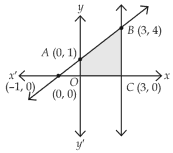
The shaded region $O A B C$ is the feasible region, where corner points are $O(0,0), A(0,1), B(3,4)$ and $C(3,0)$
At $O(0,0), Z=3(0)+4(0)=0$
At $A(0,1), Z=3(0)+4(1)=4$
At $B(3,4), Z=3(3)+4(4)=25$
At $C(3,0), Z=3(3)+4(0)=9$
$\therefore \quad$ Maximum value of $Z$ is 25 , which occurs at $B(3,4)$. View full question & answer→MCQ 1891 Mark
If the minimum value of an objective function $Z=a x+b y$ occurs at two points $(3,4)$ and $(4,3)$ then
- A
$a+b=0$
- ✓
$a=b$
- C
$3 a=b$
- D
$a=3 b$
Answer(b) : Since, minimum value of $Z=a x+b y$ occurs at two points $(3,4)$ and $(4,3)$.
$
\therefore 3 a+4 b=4 a+3 b \Rightarrow a=b
$
View full question & answer→MCQ 1901 Mark
The feasible region of an LPP is given in the following figure
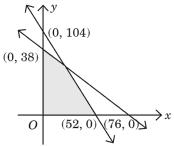
Then, the constraints of the LPP are $x \geq 0, y \geq 0$ and - A
$2 x+y \leq 52$ and $x+2 y \leq 76$
- ✓
$2 x+y \leq 104$ and $x+2 y \leq 76$
- C
$x+2 y \leq 104$ and $2 x+y \leq 76$
- D
$x+2 y \leq 104$ and $2 x+y \leq 38$
AnswerCorrect option: B. $2 x+y \leq 104$ and $x+2 y \leq 76$
(b) : Clearly, the pair of points given in graph, and $(0,104) ;(52,0)$ and $(0,38) ;(76,0)$ satisfy the corresponding equations given in option(b) i.e., $2 x+y \leq 104$ and $x+2 y \leq 76$.
View full question & answer→MCQ 1911 Mark
The maximum value of $Z=3 x+4 y$ subject to the constraints $x \geq 0, y \geq 0$ and $x+y \leq 1$ is
Answer(b) : We have to maximise $Z=3 x+4 y$
Subject to constraints, $x \geq 0, y \geq 0$ and $x+y \leq 1$
The shaded portion $O A B$ is the feasible region, where $O(0,0), A(1,0)$ and $B(0,1)$ are the corner points.
At $O(0,0), Z=3 \times 0+4 \times 0=0$
At $A(1,0), Z=3 \times 1+4 \times 0=3$
At $B(0,1), Z=3 \times 0+4 \times 1=4$
$\therefore$ Maximum value of $Z$ is 4 , which occurs at $B(0,1)$. View full question & answer→MCQ 1921 Mark
The number of solutions of the system of inequations $x+2 y \leq 3,3 x+4 y \geq 12, x \geq 0$, $y \geq 1$ is
Answer(a) : Given,
$
x+2 y \leq 3,3 x+4 y \geq 12, x \geq 0, y \geq 1
$
The graph of given constraints is shown here.
Since, there is no common region. So, no solution exists. View full question & answer→MCQ 1931 Mark
If the corner points of the feasible region of an LPP are $(0,3),(3,2)$ and $(0,5)$, then the minimum value of $Z=11 x+7 y$ is
Answer(a) : Given, $Z =11 x+7 y$
At $(0,3), Z=11 \times 0+7 \times 3=21$
At $(3,2), Z=11 \times 3+7 \times 2=47$
At $(0,5), Z=11 \times 0+7 \times 5=35$
Thus, $Z$ is minimum at $(0,3)$ and minimum value of $Z$ is 21.
View full question & answer→MCQ 1941 Mark
The solution set of the inequation $3 x+5 y<7$ is
- A
whole $x y$-plane except the points lying on the line $3 x+5 y=7$.
- B
whole $x y$-plane along with the points lying on the line $3 x+5 y=7$.
- C
open half plane containing the origin except the points of line $3 x+5 y=7$.
- D
open half plane not containing the origin.
View full question & answer→MCQ 1951 Mark
Which of the following points satisfies both the inequations $2 x+y \leq 10$ and $x+2 y \geq 8$ ?
- A
$(-2,4)$
- B
$(3,2)$
- C
$(-5,6)$
- ✓
$(4,2)$
AnswerCorrect option: D. $(4,2)$
We have, $2 x+y \leq 10$ and $x+2 y \geq 8$
Let us check which of the given points satisfy the given inequation one by one.
(a) $(-2,4)$
$2 \times(-2)+4=-4+4=0 \leq 10$
and $-2+2 \times 4=-2+8=6 \nsucceq 8$
(b) $(3,2)$
$2 \times 3+2=6+2=8 \leq 10$
$3+2 \times 2=3+4=7 \nsucceq 8$
(c) $(-5,6)$
$2 \times(-5)+6=-10+6=-4 \leq 10$
$-5+2 \times 6=-5+12=7 \nsucceq 8$
(d) $(4,2)$
$2 \times 4+2=10 \leq 10 ; 4+2 \times 2=8 \geq 8$
$\therefore \quad(4,2)$ satisfy both the inequations.
View full question & answer→MCQ 1961 Mark
The maximum value of $Z=5 x+3 y$, if the shaded region represents the feasible region, is
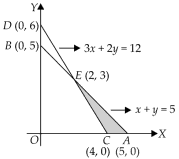
AnswerWe have,
$Z(C)=5 \times 4+3 \times 0=20$
$Z(A)=5 \times 5+3 \times 0=25$
$Z(E)=5 \times 2+3 \times 3=19$
$\therefore \quad$ Maximum value of $Z$ is 25 at point $A(5,0)$
View full question & answer→MCQ 1971 Mark
Maximum value of $Z=3 x+5 y$ subject to $3 x+2 y \leq 18, x \leq 4, y \leq 6, x \geq 0, y \geq 0$ is
AnswerOn plotting the constraints, we get $\text{O C D E F}$ as the feasible region with corner points $\text{O, C, D, E, F}$.
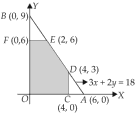
$\therefore Z(O)=0$
$Z(C)=3 \times 4=12$
$Z(D)=3 \times 4+5 \times 3=27$
$Z(E)=3 \times 2+5 \times 6=36$
$Z(F)=5 \times 6=30$
$\therefore \quad$ Maximum value of $Z$ is $36$ at point $E(2,6)$. View full question & answer→MCQ 1981 Mark
Maximise $Z=2 x+3 y$ subject to the constraints : $x+y \leq 5, x \geq 0$, $y \geq 0$. the maximum value of $Z$
AnswerCorrect option: B. is $15$
On plotting the given constraints $x+y=5$, $x=y=0$, we get $O(0,0)$, $A(5,0)$ and $B(0,5)$ as corner points of the feasible region $\text{O A B}$.
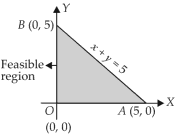
$\therefore Z(O)=2 \times 0+3 \times 0=0,$
$Z(A)=2 \times 5+3 \times 0=10,$
$Z(B)=2 \times 0+3 \times 5=15$
$\therefore \quad$ Maximum value of $Z$ is 15 at point $B(0,5)$. View full question & answer→MCQ 1991 Mark
Consider $Z(x, y)=p x+q y$ subject to $2 x+y \leq 10$, $x+3 y \leq 15, x, y \geq 0$. If $Z$ is maximum at both the points $(3,4)$ and $(0,5)$, then find $q$.
Answer$\because$ Value of $Z$ at $(3,4)=$ Value of $Z$ at $(0,5)$
$\Rightarrow 3 p+4 q=5 q$
$\therefore q=3 p .$
View full question & answer→MCQ 2001 Mark
Consider the linear programming problem Max. $Z=4 x+y$
Subject to $x+y \leq 50 ; x+y \geq 100 ; x, y \geq 0$ The max. value of $Z$
Answer(d) : Let $l_1: x+y=50 ; l_2: x+y=100 ; l_3: x=0$; $l_4: y=0$
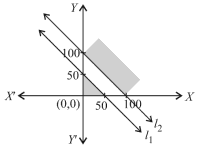
Since, no feasible region determined, hence, no maximum value of $Z$ exists. View full question & answer→