MCQ 2011 Mark
In a LPP, if the objective function $Z=a x+b y$ has the same maximum value on two corner points of the feasible region, then every point on the line segment joining these two points give the same ______ value.
View full question & answer→MCQ 2021 Mark
A feasible region of a system of linear inequalities is said to be ______, if it can be enclosed within a circle.
MCQ 2031 Mark
The feasible region for an LPP is always a ______ polygon.
MCQ 2041 Mark
In an LPP, the objective function is always
MCQ 2051 Mark
Corner points of the feasible region determined by the system of linear constraints are $(0,3),(1,1)$ and $(3,0)$. Let $Z=p x+q y$, where $p, q>0$. Condition on $p$ and $q$ so that the minimum of $Z$ occurs at $(3,0)$ and $(1,1)$ is
- A
$p=2 q$
- ✓
$p=\frac{q}{2}$
- C
$p=3 q$
- D
$p=q$
AnswerCorrect option: B. $p=\frac{q}{2}$
(b) : We must have value of $Z$ at $(3,0)=$ value of $Z$ at $(1,1)$
$\Rightarrow \quad 3 p+0 \cdot q=1 p+1 \cdot q \Rightarrow 3 p=p+q \Rightarrow p=\frac{1}{2} q$
View full question & answer→MCQ 2061 Mark
Corner points of the feasible region for an LPP are $(0,2),(3,0)$, $(6,0),(6,8)$ and $(0,5)$.
Let $F=4 x+6 y$ be the objective function.
Maximum of $F$ - Minimum of $F=$
Answer(a): Max. $F-$ Min. $F=72-12=60$.
View full question & answer→MCQ 2071 Mark
Corner points of the feasible region for an LPP are $(0,2),(3,0)$, $(6,0),(6,8)$ and $(0,5)$.
Let $F=4 x+6 y$ be the objective function.
0The minimum value of $F$ occurs at
- A
$(0,2)$ only
- B
$(3,0)$ only
- C
the mid-point of the line segment joining the points $(0,2)$ and $(3,0)$ only
- ✓
any point on the line segment joining the points $(0,2)$ and $(3,0)$
AnswerCorrect option: D. any point on the line segment joining the points $(0,2)$ and $(3,0)$
(d) : Construct the following table of values of objective function :| Corner Point | Value of $F= 4 x+6 y$ |
| (0,2) | $4 \times 0+6 \times 2=12$ (Minimum) |
| (3,0) | $4 \times 3+6 \times 0=-12$ (Minimum) |
| (6,0) | $4 \times 6+6 \times 0=-24$ |
| (6,8) | $4 \times 6+6 \times 8=-72$ (Maximum) |
| (0,5) | $4 \times 0+6 \times 5=-30$ |
Since the minimum value $(F)=12$ occurs at two distinct corner points, it occurs at every point of the segment joining these two points. View full question & answer→MCQ 2081 Mark
The feasible region for an LPP is shown shaded in the figure. Let $F=3 x-4 y$ be the objective function.
Minimum value of $F$ is
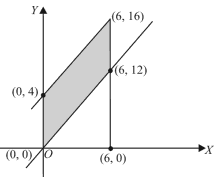
Answer(d) : Minimum of $F=-46$
View full question & answer→MCQ 2091 Mark
The feasible region for an LPP is shown shaded in the figure. Let $F=3 x-4 y$ be the objective function.
Maximum value of $F$ is
Answer(a) : Construct the following table of values of the objective function $F$ :| Corner Point | Value of $F= 3 x-4 y$ |
| (0,0) | $3 \times 0-4 \times 0=0$ (Maximum) |
| (6,12) | $3 \times 6-4 \times 12=-30$ |
| (6,16) | $3 \times 6-4 \times 16=-46$ (Minimum) |
| (0,4) | $3 \times 0-4 \times 4=-16$ |
Hence, maximum of $F=0$ View full question & answer→MCQ 2101 Mark
An owner of a lodge plans an extension which contains not more than 50 rooms. At least 5 must be executive single rooms. The number of executive double rooms should be at least 3 times the number of executive single rooms. He charges ₹ 3000 for executive double room and ₹ 1800 for executive single room per day. Formulate the above problem as L.P.P. to maximize the profit.
- A
Maximize $P=1800 x_1+3000 x_2$ subject to, $x_1+x_2 \geq 50, x_1=5, x_2=3 x_1, x_1 \geq 0, x_2 \geq 0$
- B
Maximize $P=1800 x_1+3000 x_2$ subject to $x_1+x_2 \leq 50, x_1 \geq 5, x_2 \geq 3 x_1, x_1 \leq 0, x_2 \leq 0$
- C
Maximize $P=1800 x_1+3000 x_2$ subject to $x_1+x_2 \geq 50, x_1 \geq 5, x_2 \geq 3 x_1, x_1 \geq 0, x_2 \geq 0$
- ✓
Maximize $P=1800 x_1+3000 x_2$ subject to, $x_1+x_2 \leq 50, x_1 \geq 5, x_2 \geq 3 x_1, x_1 \geq 0, x_2 \geq 0$
AnswerCorrect option: D. Maximize $P=1800 x_1+3000 x_2$ subject to, $x_1+x_2 \leq 50, x_1 \geq 5, x_2 \geq 3 x_1, x_1 \geq 0, x_2 \geq 0$
View full question & answer→MCQ 2111 Mark
The construction company uses concrete blocks made up of cement and sand. The weight of a concrete block has to be at least $5 kg$. Cement costs ₹ 20 per kg, while sand costs ₹ 6 per kg. Strength considerations dictate that the concrete block should contain minimum $4 kg$ of cement and not more than $2 kg$ of sand. Formulate the L.P.P for the cost to be minimum.
- A
Minimize $C=20 x+6 y$ subject to, $x \geq 4, y \leq 2$, $x+y \geq 5, x \geq 0, y \geq 0$
- B
Minimize $C=6 x+20 y$ subject to, $x \leq 4, y \leq 2$, $x+y \leq 5, x \leq 0, y \leq 0$
- C
Minimize $C=20 x+6 y$ subject to, $x \geq 4, y \geq 2$, $x+y \geq 5, x \geq 0, y \geq 0$
- D
Minimize $C=20 x+6 y$ subject to, $x \geq 4, y \leq 2$, $x+y=5, x \geq 0, y 0 \geq 0$
Answer18. (a) : Let the concrete block contains x kg of cement and y kg of sand. As the cost of cement and sand is given to be ₹ 20 and ₹ 6 per kg respectively. Hence, we would like to minimize it. Let us denote the cost by $C$.
$
\therefore \quad C=20 x+6 y
$
The weight of the concrete block has to at least 5 kg.
$
\therefore \quad x+y \geq 5
$
Minimum 4 kg of cement is to be used, $\therefore x \geq 4$
Also sand cannot exceed 2 kg. $\therefore y \leq 2$
Obviously weight of the concrete block cannot be negative. $\therefore x \geq 0, y \geq 0$
Thus the L.P.P. is
Minimize $C=20 x+6 y$
Subject to, $x \geq 4, y \leq 2, x+y \geq 5, x \geq 0, y \geq 0$.
View full question & answer→MCQ 2121 Mark
The corner points of the feasible region determined by the system of linear constraints are $(0,0),(0,40),(20,40),(60,20),(60,0)$. The objective function is $Z=4 x+3 y$.
Compare the quantity in Column A and Column B| Column A | Column B |
| Maximum of Z | 325 |
AnswerCorrect option: A. The quantity in column $A$ is greater
(a) : The objective function is $Z=5 x+3 y$| Corner Point | Value of $Z= 4 x+3 y$ |
| (0,0) | $4 \times 0+3 \times 0=0$ |
| (0,40) | $4 \times 0+3 \times 40=120$ |
| (20,40) | $4 \times 20+3 \times 40=200$ |
| (60,20) | $4 \times 60+3 \times 20=300$ (Maximum) |
| (60,0) | $4 \times 60+3 \times 0=240$ |
View full question & answer→MCQ 2131 Mark
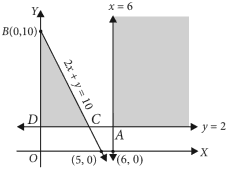
The region represented by the inequalities $x \geq 6, y \geq 2,2 x+y \leq 10, x \geq 0, y \geq 0$ is
View full question & answer→MCQ 2141 Mark
Solution set of the inequality $x \geq 0$ is
- A
half plane on the left of $Y$-axis
- B
half plane on the right of $Y$-axis excluding the points on $Y$-axis
- ✓
half plane on the right of $Y$-axis including the points on $Y$-axis
- D
AnswerCorrect option: C. half plane on the right of $Y$-axis including the points on $Y$-axis
(c) : Solution set of the given inequality is $\{(x, y): x \geq 0\}$ i.e., the set of all points whose abscissae are non-negative. All these points lie either on $Y$-axis or on the right of $Y$-axis.
View full question & answer→MCQ 2151 Mark
Region represented by $x \geq 0, y \geq 0$ is
View full question & answer→MCQ 2161 Mark
The optimal value of the objective function is attained at the points
- A
on $X$-axis
- B
on $Y$-axis
- ✓
which are corner points of the feasible region
- D
AnswerCorrect option: C. which are corner points of the feasible region
(c) : When we solve an L.P.P. graphically, the optimal (or optimum) value of the objective function is attained at corner points of the feasible region.
View full question & answer→MCQ 2171 Mark
Objective function of a L.P.P. is
- A
- ✓
a function to be optimised
- C
a relation between the variables
- D
AnswerCorrect option: B. a function to be optimised
(b) : Objective function is a linear function (involve variable) whose maximum or minimum value is to be found.
View full question & answer→MCQ 2181 Mark
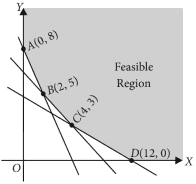
Feasible region for an L.P.P. is shown shaded in the following figure. Minimum of $Z=5 x+3 y$ occurs at the point point
- ✓
$(0,8)$
- B
$(2,5)$
- C
$(4,3)$
- D
$(12,0)$
AnswerCorrect option: A. $(0,8)$
(a) : The objective function is $Z=5 x+3 y$| Corner Point | Value of $Z= 5x+3 y$ |
| A(0,8) | $5 \times 0+3 \times 8=24$ |
| B(2,5) | $5 \times 2+3 \times 5=25$ (minimum) |
| C(4,3) | $5 \times 4+3 \times 3=29$ |
| D(12,0) | $5 \times 12+3 \times 0=60$ |
View full question & answer→MCQ 2191 Mark
The corner points of the feasible region determined by the system of linear constraints are $(0,10),(5,5),(15,15),(0,20)$. Let $Z=p x+q y$, where $p, q>0$. Condition on $p$ and $q$ so that the maximum of $Z$ occurs at both the points $(15,15)$ and $(0,20)$ is
- A
$p=q$
- B
$p=2 q$
- C
$q=2 p$
- ✓
$q=3 p$
AnswerCorrect option: D. $q=3 p$
(d) : Value of $Z=p x+q y$ at $(15,15)$ is $15 p+15 q$ and that at $(0,20)$ is $20 q$. According to given condition, we must have
$
15 p+15 q=20 q \Rightarrow 15 p=5 q \Rightarrow q=3 p
$
View full question & answer→MCQ 2201 Mark
The point which does not lie in the half plane $2 x+3 y-12 \leq 0$ is
- A
$(1,2)$
- B
$(2,1)$
- ✓
$(2,3)$
- D
AnswerCorrect option: C. $(2,3)$
(c) : We have, $2 x+3 y-12 \leq 0$ ...(i)
Putting $(1,2)$ in (i), we get $-4 \leq 0$
Putting $(2,1)$ in (i), we get $-5 \leq 0$
Putting $(2,3)$ in (i), we get $1 \leq 0$, which is not true.
So, $(2,3)$ does not lie in the half plane.
View full question & answer→MCQ 2211 Mark
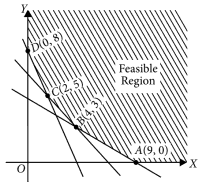
Feasible region for an L.P.P. is shown shaded in the following figure. Minimum of $Z=4 x+3 y$ occurs at the point
- A
$(0,8)$
- ✓
$(2,5)$
- C
$(4,3)$
- D
$(9,0)$
AnswerCorrect option: B. $(2,5)$
(b) : The objective function is $Z=4 x+3 y$| Corner Point | Value of $Z= 4 x+3 y$ |
| (0,8) | $4 \times 0+3 \times 8=24$ |
| (2,5) | $4 \times 2+3 \times 5=23$ (minimum) |
| (4,3) | $4 \times 4+3 \times 3=25$ |
| (9,0) | $4 \times 9+3 \times 0=36$ |
View full question & answer→MCQ 2221 Mark
Which of the following statement is correct?
- A
Every L.P.P. has atleast one optimal solution.
- B
Every L.P.P. has a unique optimal solution.
- ✓
If an L.P.P. has two optimal solutions, then it has infinitely many solutions.
- D
AnswerCorrect option: C. If an L.P.P. has two optimal solutions, then it has infinitely many solutions.
(c) : If optimal solution is obtained at two distinct points $A$ and $B$ (corners of the feasible region), then optimal solution is obtained at every point of segment $[A B]$.
View full question & answer→MCQ 2231 Mark
Which of the following statements is false?
- ✓
The feasible region is always a concave region.
- B
The maximum (or minimum) solution of the objective function occurs at the vertex of the feasible region.
- C
If two corner points produce the same maximum (or minimum) value of the objective function, then every point on the line segment joining these points will also give the same maximum (or minimum) value.
- D
AnswerCorrect option: A. The feasible region is always a concave region.
(a) : The feasible region is always a convex region.
View full question & answer→MCQ 2241 Mark
A set is said to be convex if
- A
all points except the end points of the line segment inside the set lie inside the set
- B
- ✓
all points on the line segment in the set lie inside the set
- D
AnswerCorrect option: C. all points on the line segment in the set lie inside the set
View full question & answer→MCQ 2251 Mark
Which of the following term is used in a linear programming problem?
MCQ 2261 Mark
Minimize $z=\sum_{j=1}^n \sum_{i=1}^m c_{i j} x_{i j}$, subject to
$
\sum_{j=1}^n x_{i j}=a_i, i=1,2, \ldots, m \text { and } \sum_{i=1}^m x_{i j}=b_j, j=1,2, \ldots, n
$
is an L.P.P. with number of constraints
- ✓
$m+n$
- B
$m-n$
- C
$m n$
- D
$\frac{m}{n}$
View full question & answer→MCQ 2271 Mark
Corner points of the feasible region of inequalities gives
- ✓
Optimal solution of L.P.P.
- B
- C
- D
AnswerCorrect option: A. Optimal solution of L.P.P.
View full question & answer→MCQ 2281 Mark
Optimization of the objective function is a process of
- A
Maximizing the objective function
- ✓
Maximizing or minimizing the objective function
- C
Minimizing the objective function
- D
AnswerCorrect option: B. Maximizing or minimizing the objective function
View full question & answer→