Question 515 Marks
Find the foot of the perpendicular drawn from the point A(1, 0, 3) to the joint of the points B(4, 7, 1) and C(3, 5, 3).
AnswerLet the foot of the perpendicular drawn from A(1, 0, 3) to the line joining the points B(4, 7, 1) And C(3, 5, 3) be D
Equation of line passing through B(4, 7, 1) and C(3, 5, 3) is
$\frac{\text{x}-\text{x}1}{\text{x}2-\text{x}1}=\frac{\text{y}-\text{y}1}{\text{y}2-\text{y}1}=\frac{\text{z}-\text{z}1}{\text{z}2-\text{z}1}$
$\Rightarrow\frac{\text{x}-4}{3-4}=\frac{\text{y}-7}{5-7}=\frac{\text{z}-1}{3-1}$
$\Rightarrow\frac{\text{x}-4}{-1}=\frac{\text{y}-7}{-2}=\frac{\text{z}-1}{2}=\lambda$ (say)
Direction ratios of AD are
$(-\lambda+4-1),(-2\lambda+7-0),(2\lambda+1-3)$
$=(-\lambda+3),(-2\lambda+7),(2\lambda-2)$
Line AD is perpendicular to BC so
$\text{a}_1\text{a}_2+\text{b}_1\text{b}_2+\text{c}_1\text{c}_2=0$
$\Rightarrow(-1)(-\lambda+3)+(-2)(-2\lambda+7)+2(2\lambda-2)=0$
$\Rightarrow\lambda-3+4\lambda-14+4\lambda-4=0$
$\Rightarrow9\lambda-21=0$
$\Rightarrow\lambda=\frac{21}{9}$
Co-ordinates of D are
$=\Big(-\frac{21}{9}+4,(-2)\Big(\frac{21}{9}+7\Big),2\Big(\frac{21}{9}+1\Big)\Big)$
$=\Big(\frac{15}{9},\frac{21}{9},\frac{51}{9}\Big)$
$=\Big(\frac{5}{3},\frac{7}{3},\frac{17}{3}\Big)$
View full question & answer→Question 525 Marks
Find the angle between the following pairs of lines:$\frac{\text{x}-1}{2}=\frac{\text{y}-2}{3}=\frac{\text{z}-3}{-3}$ and $\frac{\text{x}+3}{-1}=\frac{\text{y}-5}{8}=\frac{\text{z}-1}{4}$
Answer$\frac{\text{x}-1}{2}=\frac{\text{y}-2}{3}=\frac{\text{z}-3}{-3}$ and $\frac{\text{x}+3}{-1}=\frac{\text{y}-5}{8}=\frac{\text{z}-1}{4}$
Let $\vec{\text{b}}_1$ and $\vec{\text{b}}_2$ be vectors parallel to the given lines.
Now,
$\vec{\text{b}}_1=2\hat{\text{i}}+3\hat{\text{j}}-3\hat{\text{k}}$
$\vec{\text{b}}_2=-\hat{\text{i}}+8\hat{\text{j}}+4\hat{\text{k}}$
If $\theta$ is the angle between the given lines, then
$\cos\theta=\frac{\vec{\text{b}}_1.\vec{\text{b}}_2}{\big|\vec{\text{b}}_1\big|\big|\vec{\text{b}}_2\big|}$
$=\frac{\big(2\hat{\text{i}}+3\hat{\text{j}}-3\hat{\text{k}}\big).\big(-\hat{\text{i}}+8\hat{\text{j}}+4\hat{\text{k}}\big)}{\sqrt{2^2+3^2+(-3)^2}\sqrt{(-1)^2+8^2+4^2}}$
$=\frac{-2+24-12}{9\sqrt{22}}$
$=\frac{10}{9\sqrt{22}}$
$\Rightarrow\theta=\cos^{-1}\Big(\frac{10}{9\sqrt{22}}\Big)$
View full question & answer→Question 535 Marks
Prove that the lines through A(0, -1, -1) and B(4, 5, 1) intersects the line through C(3, 9, 4) and D(-4, 4, 4). Also, find their point of intersection.
AnswerThe coordinates of any point on the line AB are given by
$\frac{\text{x}-0}{4-0}=\frac{\text{y}+1}{5+1}=\frac{\text{z}+1}{1+1}=\lambda$
$\Rightarrow\text{x}=4\lambda$
$\text{y}=6\lambda-1$
$\text{z}=2\lambda-1$
The coordinates of a general point on AB are $4\lambda,6\lambda-1,2\lambda-1.$
The coordinates of any point on the line CD are given by
$\frac{\text{x}-3}{3+4}=\frac{\text{y}-9}{9-4}=\frac{\text{z}-4}{4-4}=\mu$
$\Rightarrow\text{x}=7\mu+3$
$\text{y}=5\mu+9$
$\text{z}=4$
The coordinates of a general point on CD are $7\mu+3,5\mu+9,4.$
If the lines AB and CD intersect, then they have a common point. so, for some valuse of $\lambda$ and $\mu,$
We must have
$4\lambda=7\mu+3,6\lambda-1=5\mu+9,2\lambda-1=4$
$\Rightarrow4\lambda-7\mu=3\dots(1)$
$6\lambda-5\mu=10\dots(2)$
$\lambda=\frac{5}{2}\dots(3)$
Solving (2) and (3), we get
$\lambda=\frac{5}{2}$
$\mu=1$
Substituting $\lambda=\frac{5}{2}$ and $\mu=1$ in (1), we get
$\text{LHS}=4\lambda-7\mu$
$=4\Big(\frac{5}{2}\Big)-7(1)$
$=3$
$=\text{RHS}$
Since $\lambda=\frac{5}{2}$ and $\mu=1$ satisfy (3), the given lines intersect.
substituting the value of $\lambda$ in the coordinates of a general point on the line AB, we get
x = 10
y = 14
z = 4
Hence, AB and CD intersect at point (10, 14, 4).
View full question & answer→Question 545 Marks
Find the distance between the lines $ l_1$ and $l_2$ given by $\vec{\text{r}}=\hat{\text{i}}+2\hat{\text{j}}-4\hat{\text{k}}+\lambda\big(2\hat{\text{i}}+3\hat{\text{j}}+6\hat{\text{k}}\big)$ and, $\vec{\text{r}}=3\hat{\text{i}}+3\hat{\text{j}}-5\hat{\text{k}}+\mu\big(2\hat{\text{i}}+3\hat{\text{j}}+6\hat{\text{k}}\big)$
Answer$\vec{\text{a}}_1=\hat{\text{i}}+2\hat{\text{j}}-4\hat{\text{k}}$
$\vec{\text{a}}_2=3\hat{\text{i}}+3\hat{\text{j}}-5\hat{\text{k}}$
$\vec{\text{a}}_2-\vec{\text{a}}_1=3\hat{\text{i}}+3\hat{\text{j}}-5\hat{\text{k}}-\hat{\text{i}}-2\hat{\text{j}}+4\hat{\text{k}}$
$=2\hat{\text{i}}+\hat{\text{j}}-\hat{\text{k}}$
$\vec{\text{b}}=2\hat{\text{i}}+3\hat{\text{j}}+6\hat{\text{k}}$
$\big(\vec{\text{a}}_2-\vec{\text{a}}_1\big)\times\vec{\text{b}}=\begin{vmatrix}\hat{\text{i}}&\hat{\text{j}}&\hat{\text{k}}\\2&1&-1\\2&3&6\end{vmatrix}$
$=\hat{\text{i}}(6+3)-\hat{\text{j}}(12+2)+\hat{\text{k}}(6-2)$
$=9\hat{\text{i}}-14\hat{\text{j}}+4\hat{\text{k}}$
Shortest distance between $2$ lines
$=\Bigg|\frac{\big(\vec{\text{a}}_2-\vec{\text{a}}_1\big)\times\vec{\text{b}}}{\big|\vec{\text{b}}\big|}\Bigg|$
$=\Bigg|\frac{9\hat{\text{i}}-14\hat{\text{j}}+4\hat{\text{k}}}{\big|\sqrt{2^2+3^2+6^2}\big|}\Bigg|$
$=\Bigg|\frac{9\hat{\text{i}}-14\hat{\text{j}}+4\hat{\text{k}}}{\sqrt{49}}\Bigg|$
$=\Bigg|\frac{\sqrt{9^2+(-14)^2+4^2}}{\sqrt{49}}\Bigg|$
$=\Big|\frac{\sqrt{293}}{\sqrt{49}}\Big|$
$=\frac{\sqrt{293}}{7}\text{ units}$
View full question & answer→Question 555 Marks
Find the angle between the follwing pairs of lines: $\vec{\text{r}}=\big(3\hat{\text{i}}+2\hat{\text{j}}-4\hat{\text{k}}\big)+\lambda\big(\hat{\text{i}}+2\hat{\text{j}}+2\hat{\text{k}}\big)$ and $\vec{\text{r}}=\big(5\hat{\text{j}}-2\hat{\text{k}}\big)+\mu\big(3\hat{\text{i}}+2\hat{\text{j}}+6\hat{\text{k}}\big)$
Answer$\vec{\text{r}}=\big(3\hat{\text{i}}+2\hat{\text{j}}-4\hat{\text{k}}\big)+\lambda\big(\hat{\text{i}}+2\hat{\text{j}}+2\hat{\text{k}}\big)$ and $\vec{\text{r}}=\big(5\hat{\text{j}}-2\hat{\text{k}}\big)+\mu\big(3\hat{\text{i}}+2\hat{\text{j}}+6\hat{\text{k}}\big)$
Let $b_1$ and $b_2$ be vectors parallel to the given lines.
Now,
$\vec{\text{b}}_1=\hat{\text{i}}+2\hat{\text{j}}+2\hat{\text{k}}$
$\vec{\text{b}}_2=3\hat{\text{i}}+2\hat{\text{j}}+6\hat{\text{k}}$
If $\theta$ is the angle between the given lines, then
$\cos\theta=\frac{\vec{\text{b}}_1.\vec{\text{b}}_2}{\big|\vec{\text{b}}_1\big|\big|\vec{\text{b}}_2\big|}$
$=\frac{\big(\hat{\text{i}}+2\hat{\text{j}}+2\hat{\text{k}}\big).\big(3\hat{\text{i}}+2\hat{\text{j}}+6\hat{\text{k}}\big)}{\sqrt{1^1+2^2+2^2}\sqrt{3^2+2^2+6^2}}$
$=\frac{3+4+12}{3\times7}$
$=\frac{19}{21}$
$\Rightarrow\theta=\cos^{-1}\Big(\frac{19}{21}\Big)$
View full question & answer→Question 565 Marks
Find the vector equation of the line passing through the points (-1, 0, 2) and (3, 4, 6).
AnswerWe know that the vector equation of a line passing through the points with position vectors $\vec{\text{a}}$ and $\vec{\text{b}}$ is $\vec{\text{r}}=\vec{\text{a}}+\lambda\big(\vec{\text{b}}-\vec{\text{a}}\big) $ where $\lambda$ is a scalar.
Here,
$\vec{\text{a}}=-1\hat{\text{i}}+0\hat{\text{j}}+2\hat{\text{k}}$
$\vec{\text{b}}=3\hat{\text{i}}+4\hat{\text{j}}+6\hat{\text{k}}$
Vector equation of the required line is
$\vec{\text{r}}=\big(-1\hat{\text{i}}+0\hat{\text{j}}+2\hat{\text{k}}\big)+\lambda\big\{\big(3\hat{\text{i}}+4\hat{\text{j}}+6\hat{\text{k}}\big)-\big(-1\hat{\text{i}}+0\hat{\text{j}}+12\hat{\text{k}}\big)\big\}$
$\Rightarrow\vec{\text{r}}=\big(-1\hat{\text{i}}+0\hat{\text{j}}+2\hat{\text{k}}\big)+\lambda\big(4\hat{\text{i}}+4\hat{\text{j}}+4\hat{\text{k}}\big)$
Here, $\lambda$ is a parameter.
View full question & answer→Question 575 Marks
Find the angle between the following pairs of lines:$\frac{\text{x}-2}{3}=\frac{\text{y}+3}{-2},\text{z}=5$ and $\frac{\text{x}+1}{1}=\frac{2\text{y}-3}{3}=\frac{\text{z}-5}{2}$
Answer$\frac{\text{x}-2}{3}=\frac{\text{y}+3}{-2},\text{z}=5$ and $\frac{\text{x}+1}{1}=\frac{2\text{y}-3}{3}=\frac{\text{z}-5}{2}$ The equations of the given lines can be re-written as $\frac{\text{x}-2}{3}=\frac{\text{y}+3}{-2}=\frac{\text{z}-5}{0}$ and $\frac{\text{x}+1}{1}=\frac{\text{y}-\frac{3}{2}}{\frac{3}{2}}=\frac{\text{z}-5}{2}$ Let $\vec{\text{b}}_1$ and $\vec{\text{b}}_2$ be vectors parallel to the given lines. Now, $\vec{\text{b}}_1=3\hat{\text{i}}-2\hat{\text{j}}+0\hat{\text{k}}$ $\vec{\text{b}}_2=\hat{\text{i}}+\frac{3}{2}\hat{\text{j}}+2\hat{\text{k}}$ If $\theta$ is the angle between the given lines, then $\cos\theta=\frac{\vec{\text{b}}_1.\vec{\text{b}}_2}{\big|\vec{\text{b}}_1\big|\big|\vec{\text{b}}_2\big|}$ $=\frac{\big(3\hat{\text{i}}-2\hat{\text{j}}+0\hat{\text{k}}\big).\big(\hat{\text{i}}+\frac{3}{2}\hat{\text{j}}+2\hat{\text{k}}\big)}{\sqrt{3^2+(-2)^2+0^2}\sqrt{1^2+\Big(\frac{3}{2}\Big)+2^2}}$ $=\frac{3-3+0}{\sqrt{13}\sqrt{\frac{29}{4}}}$ $=0$$\Rightarrow\theta=\frac{\pi}{2}$
View full question & answer→Question 585 Marks
Find the cartesian and vector equations of a line which passes through the point $(1, 2, 3)$ and is parallel to the line $\frac{-\text{x}-2}{1}=\frac{\text{y}+3}{7}=\frac{2\text{z}-6}{3}.$
Answerwe know that, equation of a line passing through a point $(x_1, y_1, z_1)$ and having direction ratios proportional to $a, b, c$ is
$\frac{\text{x}-\text{x}_1}{\text{a}}=\frac{\text{y}-\text{y}_1}{\text{b}}=\frac{\text{z}-\text{z}_1}{\text{c}}\dots(1)$
Here, $(x_1, y_1, z_1) = (1, 2, 3)$ and
Given line $\frac{-\text{x}-2}{1}=\frac{\text{y}+3}{7}=\frac{2\text{z}-6}{3}$
$\Rightarrow\frac{\text{x}+2}{-1}=\frac{\text{y}+3}{7}=\frac{\text{z}-6}{\frac{3}{2}}$
It parallel to the required line, so
$\text{a}=\mu,\text{b}7\mu,\text{c}=\frac{3}{2}\mu$
So, equation of required line using equation $(1)$ is,
$\frac{\text{x}-1}{-\mu}=\frac{\text{y}-2}{7\mu}=\frac{\text{z}-3}{\frac{3}{2}\mu}$
$\Rightarrow\frac{\text{x}-1}{-1}=\frac{\text{y}-2}{7}=\frac{\text{z}-3}{\frac{3}{2}}$
View full question & answer→Question 595 Marks
Find the cartesian equation of a line passing through (1, -1, 2) and parallel to the line whose equation are $\frac{\text{x}-3}{1}=\frac{\text{y}-1}{2}=\frac{\text{z}+1}{-2}.$ Also, reduce the equation obtained in vector form.
AnswerWe know that the cartesian equation of a line passing through a point with position vector $\vec{\text{a}}$ and parallel to the vector $\vec{\text{m}}$ is $\frac{\text{x}-\text{x}_1}{\text{a}}=\frac{\text{y}-\text{y}_1}{\text{b}}=\frac{\text{z}-\text{z}_1}{\text{c}}.$
Here,
$\vec{\text{a}}=\text{x}_1\hat{\text{i}}+\text{y}_1\hat{\text{j}}+\text{z}_1\hat{\text{k}}$
$\vec{\text{m}}=\text{a}\hat{\text{i}}+\text{b}\hat{\text{j}}+\text{c}\hat{\text{k}}$
Here, $\vec{\text{a}}=\hat{\text{i}}-\hat{\text{j}}+2\hat{\text{k}}$ and $\vec{\text{b}}=\hat{\text{i}}+2\hat{\text{j}}-2\hat{\text{k}}$
Cartesian equation of the required line is
$\frac{\text{x}-1}{1}=\frac{\text{y}-(-1)}{2}=\frac{\text{z}-2}{-2}$
$\Rightarrow\frac{\text{x}-1}{1}=\frac{\text{y}+1}{2}=\frac{\text{z}-2}{-2}$
We know that the cartesian equation of a line passing through a points with position vector $\vec{\text{a}}$ and parallel to the vector $\vec{\text{m}}$ is $\vec{\text{r}}=\vec{\text{a}}+\lambda\vec{\text{m}}.$
Here, the line is passing through the point (1, 1, -2) and its direction ration are proportional to 1, 2, -2.
Vector equation of the required line is
$\vec{\text{r}}=\big(\hat{\text{i}}-\hat{\text{j}}+2\hat{\text{k}}\big)+\lambda\big(\hat{\text{i}}+2\hat{\text{j}}-2\hat{\text{k}}\big)$
View full question & answer→Question 605 Marks
Find the foot of the perpendicular from (0, 2, 7) on the line $\frac{\text{x}+2}{-1}=\frac{\text{y}-1}{3}=\frac{\text{z}-3}{-2}.$
AnswerLet L be the foot of the perpendicular drawn from the point P (0, 2, 7) to the given line. The coordoinates of a general point on the line $\frac{\text{x}+2}{-1}=\frac{\text{y}-1}{3}=\frac{\text{z}-3}{-2}$ are given by $\frac{\text{x}+2}{-1}=\frac{\text{y}-1}{3}=\frac{\text{z}-3}{-2}=\lambda$ $\Rightarrow\text{x}=-\lambda-2$ $\text{y}=3\lambda+1$ $\text{z}=-2\lambda+3$ Let the coordinates of L be $-\lambda-2,3\lambda+1,-2\lambda+3.$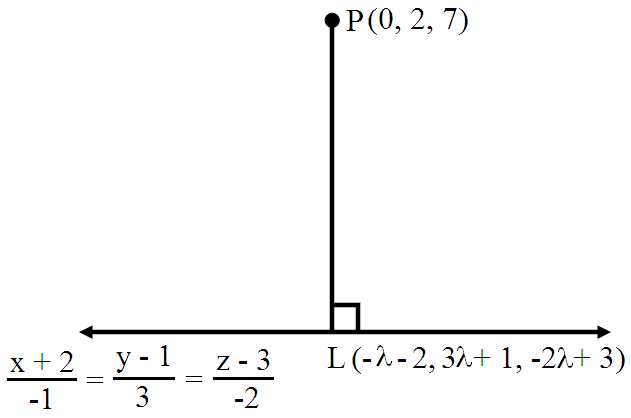
The direction ratios of PL are proportional to $-\lambda-2-0,3\lambda+1-2,-2\lambda+3-7,$ i,e. $-\lambda-2,3\lambda-1,-2\lambda-4.$ The direction ratios of the given line are proportionl to -1, 3, -2, but PL is perpendicular to the given line. $\therefore-1-\lambda-2+33\lambda-1-2\lambda-4=0\Rightarrow\lambda=-12$ Substituting $\lambda=-12$ in $-\lambda-2,3\lambda+1.-2\lambda+3,$ we get the coordinates of L as -32, -12, 4. View full question & answer→Question 615 Marks
ABCD is aparallelogram. the position vectora of the points A, B and C are respectively, $4\hat{\text{i}}+5\hat{\text{j}}-10\hat{\text{k}},2\hat{\text{i}}-3\hat{\text{j}}+4\hat{\text{k}}$ and $-\hat{\text{i}}+2\hat{\text{j}}+\hat{\text{k}}.$ Find the vector equation of the line BD. Also, reduce it to cartesian form.
AnswerWe know that the position vector of the mid-point of $\vec{\text{a}}$ and $\vec{\text{b}}$ is $\frac{\vec{\text{a}}+\vec{\text{b}}}{2}.$
Let the position of mid-point of A and C= position vector of mid-point of B and D
$\therefore\frac{\big(4\hat{\text{i}}+5\hat{\text{j}}-10\hat{\text{k}}\big)+\big(-\hat{\text{i}}+2\hat{\text{j}}+\hat{\text{k}}\big)}{2}=\frac{\big(2\hat{\text{i}}-3\hat{\text{j}}+4\hat{\text{k}}\big)+\big(\text{x}\hat{\text{i}}+\text{y}\hat{\text{j}}+\text{z}\hat{\text{k}}\big)}{2}$
$\Rightarrow\frac{3}{2}\hat{\text{i}}+\frac{7}{2}\hat{\text{j}}-\frac{9}2{}\hat{\text{k}}=\Big(\frac{\text{x}+2}{2}\Big)\hat{\text{i}}+\Big(\frac{-3+\text{y}}{2}\Big)\hat{\text{j}}+\Big(\frac{4+\text{z}}{2}\Big)\hat{\text{k}}$
Comparing the coeffient of $\hat{\text{i}},\hat{\text{j}}$ and $\hat{\text{k}},$ we get
$\frac{\text{x}+2}{2}=\frac{3}{2}$
$\Rightarrow\text{x}=1$
$\frac{-3+\text{y}}{2}=\frac{7}{2}$
$\Rightarrow\text{y}=10$
$\frac{4+\text{z}}{2}=-\frac{9}{2}$
$\Rightarrow\text{z}=-13$
Position vector of point $\text{D}=\hat{\text{i}}+10\hat{\text{j}}-13\hat{\text{k}}$
View full question & answer→Question 625 Marks
Find the angle between the following pairs of lines:$\frac{\text{x}-5}{1}=\frac{2\text{y}+6}{-2}=\frac{\text{z}-3}{1}$ and $\frac{\text{x}-2}{3}=\frac{\text{y}+1}{4}=\frac{\text{z}-6}{5}$
Answer$\frac{\text{x}-5}{1}=\frac{2\text{y}+6}{-2}=\frac{\text{z}-3}{1}$ and $\frac{\text{x}-2}{3}=\frac{\text{y}+1}{4}=\frac{\text{z}-6}{5}$The equation of the given lines can be re-written as
$\frac{\text{x}-5}{1}=\frac{\text{y}+3}{-1}=\frac{\text{z}-3}{1}$ and $\frac{\text{x}-2}{3}=\frac{\text{y}+1}{4}=\frac{\text{z}-6}{5}$
Let $\vec{\text{b}}_1$ and $\vec{\text{b}}_2$ be vectors parallel to the given lines.
Now,
$\vec{\text{b}}_1=\hat{\text{i}}-\hat{\text{j}}+\hat{\text{k}}$
$\vec{\text{b}}_2=3\hat{\text{i}}+4\hat{\text{j}}+5\hat{\text{k}}$
If $\theta$ is the angle between the given lines, then
$\cos\theta=\frac{\vec{\text{b}}_1.\vec{\text{b}}_2}{\big|\vec{\text{b}}_1\big|\big|\vec{\text{b}}_2\big|}$
$=\frac{\big(\hat{\text{i}}-\hat{\text{j}}+\hat{\text{k}}\big).\big(3\hat{\text{i}}+4\hat{\text{j}}+5\hat{\text{k}}\big)}{\sqrt{1^2+(-1)^2+1^2}\sqrt{3^2+4^2+5^2}}$
$=\frac{3-4+5}{\sqrt{3}\sqrt{50}}$
$=\frac{4}{5\sqrt{6}}$
$\Rightarrow\theta=\cos^{-1}\Big(\frac{4}{5\sqrt{6}}\Big)$
View full question & answer→Question 635 Marks
If the coordinates of the points $A, B, C,$ are $(1, 2, 3), (4, 5, 6), (-4, 3, -6)$ and $(2, 9, 2),$ then find the angle between $AB$ and $CD.$
AnswerThe given points are $A(1, 2, 3), B(4, 5, 6), C(-4, 3, -6)$ and $D(2, 9, 2).$
We know that the direction ratios of the line joining the points $(x_1, y_1, z_1)$ and $(x_2, y_2, z_2)$ are $x_2 x_1, y_2 y_1, z_2 z_1. 2$
The direction ratios of $AB$ are $(4 - 1), (5 - 2), (7 - 3),$ i.e. $(3, 3, 4).$
The direction ratios of $CD$ are $[2(-4)], (9 - 3), [2(-6)],$ i.e. $ 6, 6, 8.$
Let, $\theta$ be the angle between $AB$ and $CD.$
We have, $\text{a}_1=3, \text{c}_1=3, \text{c}_1=4$
$\text{a}_2=6, \text{c}_2=6, \text{c}_2=8$
$\therefore\cos\theta=\frac{\text{a}_1\text{a}_2+\text{b}_1\text{b}_2+\text{c}_1\text{c}_2}{\sqrt{\text{a}_1^2+\text{b}_1^2+\text{c}_1^2}\sqrt{\text{a}_2^2+\text{b}_2^2+\text{c}_2^2}}$
$=\frac{18+18+32}{\sqrt{9+9+16}\sqrt{36+36+64}}=\frac{68}{68}$
$=1$
$\Rightarrow\theta=0^\circ$
Thus, the angle between $AB$ and $CD$ measures $0^\circ$.
View full question & answer→Question 645 Marks
Find the vector equation of a line which is parallel to the vector $2\hat{\text{i}}-\hat{\text{j}}+3\hat{\text{k}}$ and which passes through the point (5, -2, 4). Also, reduce it to cartesian from.
AnswerWe know that, vector equation of line passing through a fixed point $\vec{\text{a}}$ and paralel to vector $\vec{\text{b}}$ is $\vec{\text{r}}=\vec{\text{a}}+\lambda\vec{\text{b}},$ where $\lambda$ is scalar Here, $\vec{\text{b}}=2\hat{\text{i}}-\hat{\text{j}}+3\hat{\text{k}}$ and $\vec{\text{a}}=5\hat{\text{i}}-2\hat{\text{j}}+4\hat{\text{k}}$ So, rquation of required line is $\vec{\text{r}}=\vec{\text{a}}+\lambda\vec{\text{b}}$ $\vec{\text{r}}=\big(5\hat{\text{i}}-2\hat{\text{j}}+4\hat{\text{k}}\big)+\lambda\big(2\hat{\text{i}}-\hat{\text{j}}+3\hat{\text{k}}\big)$ Put $\vec{\text{r}}=\text{x}\hat{\text{i}}+\text{y}\hat{\text{j}}+\text{z}\hat{\text{k}},$ so $\big(\text{x}\hat{\text{i}}+\text{y}\hat{\text{j}}+\text{z}\hat{\text{k}}\big)=(5+2\lambda)\hat{\text{i}}+(-2-\lambda)\hat{\text{j}}+(4+3\lambda)\hat{\text{k}}$ Comparing the cofficients of $\hat{\text{i}},\hat{\text{j}},\hat{\text{k}}$ so $\text{x}=5+2\lambda,\text{y}=-2-\lambda,\text{z}=4+3\lambda$ $\Rightarrow\frac{\text{x}-5}{2}=\lambda,\frac{\text{y}+2}{-0}=\lambda,\frac{\text{z}-4}{3}=\lambda$ Cortesian form of equation of the line is,$\frac{\text{x}-5}{5}=\frac{\text{y}+2}{-0}=\frac{\text{z}-4}{3}$
View full question & answer→Question 655 Marks
The cartesian equation of a line are $3x + 1 = 6y - 2 =1 - z.$ Find the fixed point through which it passes, its direction ratios and also its vector equation.
AnswerGiven equation of line is,
$3x + 1 = 6y - 2 = 1 - z$
Dividing all by $6,$
$\frac{3\text{x}+1}{6}=\frac{6\text{y}-2}{6}=\frac{1-\text{z}}{6}$
$\Rightarrow\frac{3\text{x}}{6}+\frac{1}{6}=\frac{6\text{y}}{6}-\frac{2}{6}=\frac{1}{6}-\frac{\text{z}}{6}$
$\Rightarrow\frac{1}2{}\text{x}+\frac{1}{6}=\text{y}-\frac{1}{3}=-\frac{\text{z}}{6}+\frac{1}{6}$
$\Rightarrow\frac{1}{2}\Big(\text{x}+\frac{1}{3}\Big)=1\Big(\text{y}-\frac{1}{3}\Big)=+\frac{1}{6}(\text{z}-1)$
$\Rightarrow\frac{\text{x}\frac{1}{3}}{2}=\frac{\text{y}-\frac{1}{3}}{1}=\frac{\text{z}-1}{-6}=\lambda\text{ (say)}\dots(1)$
Comparing it with equation of line passing through $(x_1, y_{1, }z_1)$ and direction ratios $a, b, c,$
$\frac{\text{x}-\text{x}_1}{\text{a}}=\frac{\text{y}-\text{y}_1}{\text{b}}=\frac{\text{z}-\text{z}_1}{\text{c}}$
$\Rightarrow\big(\text{x}_1,\text{y}_1,\text{z}_1\big)=\Big(-\frac{1}{3},\frac{1}{3},1\Big)$
$\text{a}=2,\text{b}=1,-6$
So, direction ratios of the line are $= 2, 1, -6$
From equation $(1),$
$\text{x}=\Big(2\lambda-\frac{1}{3}\Big),\text{y}=\Big(\lambda+\frac{1}{3}\Big),\text{z}=(-6\lambda+1)$
So, vector equation of the given line is,
$\text{x}\hat{\text{i}}+\text{y}\hat{\text{j}}+\text{z}\hat{\text{k}}=\Big(2\lambda-\frac{1}{3}\Big)\hat{\text{i}}+\Big(\lambda+\frac{1}{3}\Big)\hat{\text{j}}+(-6\lambda+1)\hat{\text{k}}$
$\vec{\text{r}}=\Big(-\frac{1}{3}\hat{\text{i}}+\frac{1}{3}\hat{\text{j}}+\hat{\text{k}}\Big)+\lambda\big(2\hat{\text{i}}+\hat{\text{j}}-6\hat{\text{k}}\big)$
View full question & answer→Question 665 Marks
Show that the three lines with direction cosines $\frac{12}{13},\frac{-3}{13},\frac{-4}{13},\frac{4}{13},\frac{12}{13},\frac{3}{13},\frac{3}{13},\frac{-4}{13},\frac{12}{13}$ are mutually perpendicular.
Answerlet $\text{l}_1=\frac{12}{13},\text{m}_1=-\frac{3}{13},\text{n}_1=-\frac{4}{13}$
$\text{l}_2=\frac{4}{13},\text{m}_2=\frac{12}{13},\text{n}_2=\frac{3}{13}$
$\text{l}_3=\frac{3}{13},\text{m}_3=-\frac{4}{13},\text{n}_3=\frac{12}{13}$
$\text{l}_1\text{l}_2+\text{m}_1\text{m}_2+\text{n}_1\text{n}_2$
$=\frac{12}{13}\times\frac{4}{13}+\big(-\frac{3}{13}\big)\times\frac{12}{13}+\big(-\frac{4}{13}\big)\times\frac{3}{13}$
$=\frac{48-36-13}{169}=0$
$\text{l}_2\text{l}_3+\text{m}_2\text{m}_3+\text{n}_2\text{n}_3$
$=\frac{4}{13}\times\frac{3}{13}+\frac{12}{13}\times\Big(-\frac{4}{13}\Big)+\frac{3}{13}\times\frac{12}{13}$
$=\frac{12-48+36}{169}=0$
$\text{l}_1\text{l}_3+\text{m}_1\text{m}_3+\text{n}_1\text{n}_3$
$=\frac{12}{13}\times\frac{3}{13}+\Big(-\frac{3}{13}\Big)\times\Big(-\frac{4}{13}\Big)+\Big(-\frac{4}{13}\Big)\times\frac{12}{13}$
$=\frac{36+12-48}{169}=0$
$\therefore$ The lines are mutually perpendicular.
View full question & answer→Question 675 Marks
Find the vector equation for the line which passes through the point (1, 2, 3) and parallel to the vector $\hat{\text{i}}-2\hat{\text{j}}+3\hat{\text{k}}.$ Reduce the corresponding equation in cartesian form.
AnswerWe know that the vector equation of a line passing through a point with position vector $\vec{\text{a}}$ and parallel to the vector $\vec{\text{b}}$ is $\vec{\text{r}}=\vec{\text{a}}+\lambda\vec{\text{b}}.$
Here,
$\vec{\text{a}}=\hat{\text{i}}+2\hat{\text{j}}+3\hat{\text{k}}$
$\vec{\text{b}}=\hat{\text{i}}-2\hat{\text{j}}+3\hat{\text{k}}$
vector equation of the required line is
$\vec{\text{r}}=\big(\hat{\text{i}}+2\hat{\text{j}}+3\hat{\text{k}}\big)+\lambda\big(\hat{\text{i}}+2\hat{\text{j}}+3\hat{\text{k}}\big)$
Here, $\lambda$ is a parameter.
Reducing (1) to cartesian form, we get
$\text{x}\hat{\text{i}}+\text{y}\hat{\text{i}}+\text{z}\hat{\text{k}}=\big(\hat{\text{i}}+2\hat{\text{j}}+3\hat{\text{k}}\big)+\lambda\big(\hat{\text{i}}-2\hat{\text{j}}+3\hat{\text{k}}\big)$ $\big[\text{putting }\vec{\text{r}}=\text{x}\hat{\text{i}}+\text{y}\hat{\text{j}}+\text{z}\hat{\text{k}} \text{ in }(1)\big]$
$\Rightarrow\text{x}\hat{\text{i}}+\text{y}\hat{\text{j}}+\text{z}\hat{\text{k}}=(1+\lambda)\hat{\text{i}}+(2-2\lambda)\hat{\text{j}}+(3+3\lambda)\hat{\text{k}}$
Comparing the cofficients of $\hat{\text{i}},\hat{\text{j}}$ and $\hat{\text{k}},$ we get
$\text{x}=1+\lambda,\text{y}=2-2\lambda,\text{z}=3+3\lambda$
$\Rightarrow\text{x}-1=\lambda,\frac{\text{y}-2}{-2}=\lambda,\frac{\text{z}-3}{3}=\lambda$
$\Rightarrow\frac{\text{x}-1}{1}=\frac{\text{y}-2}{-2}=\frac{\text{z}-3}{3}=\lambda$
Hence, the cartesian form of (1) is
$\frac{\text{x}-1}{1}=\frac{\text{y}-2}{-2}=\frac{\text{z}-3}{3}$
View full question & answer→Question 685 Marks
Find the length and the foot ofo perpendicular from the point $\Big(1,\frac{3}{2},2\Big)$ to the plane 2x - 2y + 4z + 5 = 0
AnswerLet M be the foot of the perpendicular from $\text{P}\Big(1,\frac{3}{2},2\Big)$ on the plane 2x - 2y + 4z + 5 = 0
Then, PM is the normal to the plane. So, its directions rations are proportional to 2, -2, 4.
Since PM passes through $\text{P}\Big(1,\frac{3}{2},2\Big)$, therefore, its equation is
$\frac{\text{x}-1}{2}=\frac{\text{y}-\frac{3}{2}}{-2}=\frac{\text{z}-2}{4}=\lambda\text{ (say)}$
Let the coordinates of M be $\Big(2\lambda+1,-2\lambda+\frac{3}{2},4\lambda+2\Big).$
Now, M lies on the plane 2x - 2y + 4z + 5 = 0.
$\therefore\ 2(2\lambda+1)-2\Big(-2\lambda+\frac{3}{2}\Big)+4(4\lambda+2)+5=0$
$\Rightarrow 24\lambda+12=0$
$\Rightarrow \lambda=-\frac{1}{2}$
So, the coordinates of M are $\Big(2\times\Big(-\frac{1}{2}\big)+1,-2\times\Big(-\frac{1}{2}\Big)+\frac{3}{2},4\times\Big(-\frac{1}{2}\Big)+2\Big)$ or $\Big(0,\frac{5}{2},0\Big)$
Thus, the coordinates of the foot of the perpendicular are $\Big(0,\frac{5}{2},0\Big).$
Now,
$\text{PM}=\sqrt{(1-0)^2+\Big(\frac{3}{2}-\frac{5}{2}\Big)^2+(2-0)^2}$
$=\sqrt{1+1+4}$
$=\sqrt{6}$
Thus, the length of the perpendicular from the given point to the plane is $\sqrt{6}$ units.
View full question & answer→Question 695 Marks
Write the vector equation of the following lines and hence determine the distance between them $\frac{\text{x}-1}{2}=\frac{\text{y}-2}{3}=\frac{\text{z}+4}{6}$ and $\frac{\text{x}-3}{4}=\frac{\text{y}-3}{6}=\frac{\text{z}+5}{12}$
AnswerWe have
$\frac{\text{x}-1}{2}=\frac{\text{y}-2}{3}=\frac{\text{z}+4}{6}$
$\frac{\text{x}-3}{4}=\frac{\text{y}-3}{6}=\frac{\text{z}+5}{12}$
Since the first line passes line passes through the point (1, 2, -4) and has direction ratios proportional to 2, 3, 6, its vector equation is
$\vec{\text{r}}=\vec{\text{a}}_1+\lambda\vec{\text{b}}_1\dots(1)$
$\Rightarrow\vec{\text{r}}=\hat{\text{i}}+2\hat{\text{j}}+\lambda\big(2\hat{\text{i}}+3\hat{\text{j}}+6\hat{\text{k}}\big)$
Also, the second line passes through the point (3, 3, -5) and has directional to 4, 6, 12.
Its vector equation is
$\vec{\text{r}}=\vec{\text{a}}_2+\mu\vec{\text{b}}_2\dots(2)$
$\Rightarrow\vec{\text{r}}=3\hat{\text{i}}+3\hat{\text{j}}-5\hat{\text{k}}+\mu\big(4\hat{\text{i}}+6\hat{\text{j}}+12\hat{\text{k}}\big)$
$\Rightarrow\vec{\text{r}}=3\hat{\text{i}}+3\hat{\text{j}}-5\hat{\text{k}}+2\mu\big(2\hat{\text{i}}+3\hat{\text{j}}+6\hat{\text{k}}\big)$
These two lines pass through the points having position vectors
$\vec{\text{a}}_1=\hat{\text{i}}+2\hat{\text{j}}-4\hat{\text{k}}$ and $\vec{\text{a}}_2=3\hat{\text{i}}+3\hat{\text{j}}-5\hat{\text{k}}$ and are parallel to the vector $\vec{\text{b}}=2\hat{\text{i}}+3\hat{\text{j}}+6\hat{\text{k}}.$
Now,
$\vec{\text{a}}_2-\vec{\text{a}}_1=2\hat{\text{i}}+\hat{\text{j}}-\hat{\text{k}}$
and
$\big(\vec{\text{a}}_2-\vec{\text{a}}_1\big)\times\vec{\text{b}}=\big(2\hat{\text{i}}+\hat{\text{j}}-\hat{\text{k}}\big)\times\big(2\hat{\text{i}}+3\hat{\text{j}}+6\hat{\text{k}}\big)$
$=\begin{vmatrix}\hat{\text{i}}&\hat{\text{j}}&\hat{\text{k}}\\2&1&-1\\2&3&6 \end{vmatrix}$
$=9\hat{\text{i}}-14\hat{\text{j}}+4\hat{\text{k}}$
$\Rightarrow\big|\big(\vec{\text{a}}_2-\vec{\text{a}}_1\big)\times\vec{\text{b}}\big|=\sqrt{9^2+(-14)^2+4^2}$
$=\sqrt{81+196+16}$
$=\sqrt{293}$
and $\big|\vec{\text{b}}\big|=\sqrt{2^2+3^2+6^2}$
$=\sqrt{4+9+36}$
$=7$
The shortest distance between the two lines is given by
$\frac{\big|\big(\vec{\text{a}}_2-\vec{\text{a}}_1\big)\times\vec{\text{b}}\big|}{\big|\vec{\text{b}}\big|}=\frac{\sqrt{293}}{7}\text{ units}$
View full question & answer→Question 705 Marks
Find the coordinates of the point where the line $\frac{\text{x}-2}{3}=\frac{\text{y}+1}{4}=\frac{\text{z}-2}{2}$ intersect the plane x - y + z - 5 = 0. Also, find the angle between the line and the plane.
AnswerThe coordinates of any point on this line are of the form
$\frac{\text{x}-2}{3}=\frac{\text{y}+1}{4}=\frac{\text{z}-2}{2}=\lambda$
$\Rightarrow\text{x}=3\lambda+2,\text{ y}=4\lambda-1,\text{ z}=2\lambda+2$
So, the coordinates of the point on the given line are $(3\lambda+2,4\lambda-1,2\lambda+2).$ This point lies on the plane x - y + z - 5 = 0
$\Rightarrow3\lambda+2-4\lambda+1+2\lambda+2-5=0$
$\Rightarrow\lambda=0$
So, the coordinates of the point are
$(3\lambda+2,4\lambda-1,2\lambda+2)$
$=\big(3(0)+2,4(0)-1,2(0)+2\big)$
$=(2,-1,2)$
Finding the angle between the line and the plane.
The given line is parallel to the vector $\vec{\text{b}}=3\hat{\text{i}}+4\hat{\text{j}}+2\hat{\text{k}}$ and the given plane is normal to the vector $\vec{\text{n}}=\hat{\text{i}}-\hat{\text{j}}+\hat{\text{k}}$
We know that the angle $\theta$ between the linr and the plane is given by
$\sin\theta=\frac{\vec{\text{b}}\cdot\vec{\text{n}}}{|\vec{\text{b}}||\vec{\text{n}}|}$
$=\frac{(3\hat{\text{i}}+4\hat{\text{j}}+2\hat{\text{k}})\cdot(\hat{\text{i}}-\hat{\text{j}}+\hat{\text{k}})}{|3\hat{\text{i}}+4\hat{\text{j}}+2\hat{\text{k}}||\hat{\text{i}}-\hat{\text{j}}+\hat{\text{k}}|}$
$=\frac{3-4+2}{\sqrt{9+16+4}\sqrt{1+1+1}}$
$=\frac{1}{\sqrt{87}}$
$\theta=\sin^{-1}\Big(\frac{1}{\sqrt{87}}\Big)$
View full question & answer→Question 715 Marks
Find the angle between the lines whose direction cosines are given by the equations:
$2l - m + 2n = 0$ and $mn + nl + lm = 0$
AnswerGiven that,
$2l - m + 2n = 0 .....(1)$
$mn + nl + lm = 0 .....(2)$
From equation $(1),$
$2l - m + 2n = 0$
$m = 2l + 2n $
Put the value of $m$ in equation $(2),$
$mn + nl + lm = 0$
$(2l + 2n) n + nl + l(2l + 2n) = 0$
$2ln + 2n^2 +nl +2l^2 + 2ln = 0$
$2l^2 + 5ln + 2n^2 = 0$
$2l^2 + 4ln + ln + 2ln^2 = 0$
$2l (l + 2n) + n(l + 2n) = 0$
$(1 + 2n) (2l = n) = 0$
$l + 2n = 0$ or $2l + n = 0$
$l = -2n$ or $\text{l}=-\frac{\text{n}}{2}$
Put the value of $l = -2n$ in equation $(1)$
$2l - m + 2n = 0$
$2 (-2n) - m + 2n = 0$
$-4n - m + 2n = 0$
$-2n - m = 0$
$-2n = m$
$m = -2n$
Again, put the value of $\text{l}=-\frac{1}{2}$ in equation $(1)$
$2l - m + 2n = 0$
$2\Big(-\frac{1}{2}\text{n}\Big)-\text{m}+2\text{n}=0$
$-n - m + 2n = 0$
$-m + n = 0$
$-m = -n$
$m = n$
So, direction cosines of the lines are given by,
$-2n, -2n, n$ or $-\frac{1}{2},\text{n},\text{n},\text{n}$
$-2, -2, 1$ or $-\frac{1}{2},1,1$
So, vectors parallel to these lines
$\vec{\text{a}}=2\hat{\text{i}}-2\hat{\text{j}}+\hat{\text{k}}$ and $\vec{\text{b}}=-\frac{1}{2}\hat{\text{i}}+\hat{\text{j}}+\hat{\text{k}}$ respectively.
Let, $\theta$ be the angle between the $\vec{\text{a}}$ and $\vec{\text{b}},$
$\cos\theta=\frac{\vec{\text{a}}\times\vec{\text{b}}}{\big|\vec{\text{a}}\big|\big|\vec{\text{b}}\big|}$
$=\frac{\big(-2\hat{\text{i}}-2\hat{\text{j}}+\hat{\text{k}}\big)\times\Big(-\frac{1}{2}\hat{\text{i}}+\hat{\text{j}}+\hat{\text{k}}\Big)}{\sqrt{(-2)^2+(-2)^2+(1)^2}\sqrt{\Big(-\frac{1}{2}^2\Big)+(1)^2+(1)^2}}$
$=\frac{(-2)\big(-\frac{1}{2}\big)+(-2)(1)+(1)(1)}{\sqrt{4+4+1}\sqrt{\frac{1}{4}1+1}}$
$=\frac{1-2+1}{\sqrt{9}\sqrt{\frac{9}{4}}}$
$=\frac{0}{3\times\frac{3}{2}}$
$\cos\theta=0$
$\theta=\cos^{-1}(0)$
$\theta=\frac{\pi}{2}$
So, angle between the lines $=\frac{\pi}{2}$.
View full question & answer→Question 725 Marks
Using direction ratios show that the points A(2, 3, -4) B(1, - 2, 3) and C(3, 8, -11) are collinear.
AnswerHere A(2, 3, -4), B(1, -2, 3) and C(3, 8, -11).
Direction ratios of AB = (1 - 2, -2 - 3, 3 + 4) = (-1, -5, 7)
Direction ratios of BC = (3 - 1, 8 + 2, -11 - 3) = (2, 10, -14)
Here, the respective direction consines of AB and AC,
$\frac{-1}{2}=\frac{-5}{10}=\frac{7}{-14}$ are proportional.
Also, Bis the common point between the two lines,
$\therefore$ The points A(2, 3, -4) B(1, -2, 3) and C(3, 8, -11) are collinear.
View full question & answer→Question 735 Marks
Find the equation of the plane which bisects the line segment joining the points (-1, 2, 3) and (3, -5, 6) at right angles.
AnswerThe normal is passing through the point A(-1, 2, 3) and B(3, -5, 6) So,
$\overrightarrow{\text{n}}=\overrightarrow{\text{AB}}=\overrightarrow{\text{OB}}-\overrightarrow{\text{OA}}$
$=(3\hat{\text{i}}-5\hat{\text{j}}+6\hat{\text{k}})-(-\hat{\text{i}}+2\hat{\text{j}}+3\hat{\text{k}})$
$=14\hat{\text{i}}-7\hat{\text{j}}+3\hat{\text{k}}$
$\text{Mid}-\text{point of AB} =\Big(\frac{-1+3}{2},\frac{2-5}{2},\frac{3+6}{2}\Big)$
$=\Big(1,\frac{-3}{2},\frac{9}{2}\Big)$
Since the plane passes through $\Big(1,\frac{-3}{2},\frac{9}{2}\Big)$
$\vec{\text{a}}=\hat{\text{i}}-\frac{3}{2}\hat{\text{j}}+\frac{9}{2}\hat{\text{k}}$
We know that the vector equation of the plane passing through a point $\vec{\text{a}}$ and normal to $\vec{\text{n}}$ is,
$\vec{\text{r}}\cdot\vec{\text{n}}=\vec{\text{a}}\cdot\vec{\text{n}}$
Substituting $\vec{\text{a}}=\hat{\text{i}}-\hat{\text{j}}+\hat{\text{k}}$ and $\vec{\text{n}}=4\hat{\text{i}}-7\hat{\text{j}}+3\hat{\text{k}},$ we get
$(\text{x}\hat{\text{i}}+\text{y}\hat{\text{j}}+\text{z}\hat{\text{k}})\cdot(4\hat{\text{i}}-7\hat{\text{j}}+3\hat{\text{k}})=28$
$\Rightarrow4\text{x}-7\text{y}+3\text{z}=28$
$\Rightarrow4\text{x}-7\text{y}+3\text{z}-28=0$
View full question & answer→Question 745 Marks
Find the equation of the plane passing through the point (2, 3, 1), given that the direction ratios of the normal to the plane are proportional to 5, 3, 2.
AnswerGiven that, the plane is passing throught p(2, 3, 1) having 5, 3, 2 as the direction ratio of the normal to the plane.
We know that,
Equation of a plane passing through a point $\vec{\text{a}}$ and $\vec{\text{n}}$ is a vector normal to the plane, is given by,
$(\vec{\text{r}}-\vec{\text{a}})\vec{\text{n}}=0\ ...(\text{i})$
So, $\vec{\text{a}}=2\hat{\text{i}}+3\hat{\text{j}}+2\hat{\text{k}}$
$\vec{\text{n}}=5\hat{\text{i}}+3\hat{\text{j}}+2\hat{\text{k}}$
Put, $\vec{\text{a}}$ and $\vec{\text{n}}$ in equation (i),
$\Big[\vec{\text{r}}-(2\hat{\text{i}}+\hat{\text{j}}+\hat{\text{k}})\Big](5\hat{\text{i}}+3\hat{\text{j}}+2\hat{\text{k}})=0$
$\vec{\text{r}}(5\hat{\text{i}}+3\hat{\text{j}}+2\hat{\text{k}})-(2\hat{\text{i}}+3\hat{\text{j}}+\hat{\text{k}})(5\hat{\text{i}}+3\hat{\text{j}}+2\hat{\text{k}})=0$
$\vec{\text{r}}(5\hat{\text{i}}+3\hat{\text{j}}+2\hat{\text{k}})-\big[(2)(5)+(3)(3)+(1)(2)\big]=0$
$\vec{\text{r}}(5\hat{\text{i}}+3\hat{\text{j}}+2\hat{\text{k}})-[10+9+2]=0$
$\vec{\text{r}}(5\hat{\text{i}}+3\hat{\text{j}}+2\hat{\text{k}})-21=0$
Put, $\vec{\text{r}}=\text{x}\hat{\text{i}}+\text{y}\hat{\text{j}}+\text{z}\hat{\text{k}}$
$(\text{x}\hat{\text{i}}+\text{y}\hat{\text{j}}+\text{z}\hat{\text{k}})(5\hat{\text{i}}+3\hat{\text{j}}+2\hat{\text{k}})-21=0$
$(\text{x})(5)+(\text{y})(3)+(\text{z})(2)=21$
$5\text{x}+3\text{y}+2\text{z}=21$
View full question & answer→Question 755 Marks
Find the angle between the vectors whose direction cosines are proportional to 2, 3, -6 and 3, -4, 5.
AnswerLet $\vec{\text{a}}$ be a vector with direction ratios 2, 3, -6.
$\Rightarrow\vec{\text{a}}=2\hat{\text{i}}+3\hat{\text{j}}-6\hat{\text{k}}$
Let $\vec{\text{b}}$ be a vector with direction ratios 3, -4, 5.
$\Rightarrow\vec{\text{b}}=3\hat{\text{i}}-4\hat{\text{j}}+5\hat{\text{k}}$
Let $\theta$ be the angle between the given vectors.
Now,
$\cos\theta=\frac{\vec{\text{a}}.\vec{\text{b}}}{\big|\vec{\text{a}}\big|\big|\vec{\text{b}}\big|}$
$=\frac{(2\hat{\text{i}}+3\hat{\text{j}}-6\hat{\text{k}}).(3\hat{\text{i}}-4\hat{\text{j}}+5\hat{\text{k}})}{\big|2\hat{\text{i}}+3\hat{\text{j}}-6\hat{\text{k}}\big|\big|3\hat{\text{i}}-4\hat{\text{j}}+5\hat{\text{k}}\big|}$
$=\frac{6-12-30}{\sqrt{4+9+36}\sqrt{9+16+25}}$
$=\frac{-36}{\sqrt{49}\sqrt{50}}$
$=\frac{-36}{35\sqrt{2}}$
Rationalising the result, we get
$\cos\theta=-\frac{18\sqrt{2}}{35}$
$\therefore\theta=\cos^{-1}\Big(-\frac{18\sqrt{2}}{35}\Big)$
Thus, the angle between the given vectors measures $\cos^{-1}\Big(-\frac{18\sqrt{2}}{35}\Big)$.
View full question & answer→Question 765 Marks
Find the angle between the pairs of lines with direction ratios proportional to
$5, -12, 13$ and $-3, 4, 5$
AnswerWe know that, angle $(\theta)$ between two lines
$\frac{\text{x}-\text{x}_1}{\text{a}_1}=\frac{\text{y}-\text{y}_1}{\text{b}_1}=\frac{\text{z}-\text{z}_1}{\text{c}_1}$ and $\frac{\text{x}-\text{x}_2}{\text{a}_2}=\frac{\text{y}-\text{y}_2}{\text{b}_2}=\frac{\text{z}-\text{z}_2}{\text{c}_2}$
Is given by,
$\cos\theta=\frac{\text{a}_1\text{a}_2+\text{b}_1\text{b}_2+\text{c}_1\text{c}_2}{\sqrt{{\text{a}_1}^2+{{\text{b}_1}^2}+{{\text{c}_1}^2}}\sqrt{{\text{a}_2}^2+{{\text{b}_2}^2}+{{\text{c}_2}^2}}}\dots(1)$
Here, $a_{1 }= 5, b_{1 }= -12, c_{1 =}13$
$a_{2 }= -3, b_{2 }= 4, c_{2 }= 5$
Let $\theta$ be the required angle, so using equation $(1),$
$\cos\theta=\frac{(5)(-3)+(-12)(4)+(13)(5)}{\sqrt{(5)^2+(-12)^2+(13)^2}\sqrt{(-3)^2+(4)^2+(5)^2}}$
$=\frac{-15-48+65}{\sqrt{169\times2}\sqrt{25\times2}}$
$=\frac{2}{65\times2}$
$\cos\theta=\frac{1}{65}$
$\theta=\cos^{-1}\Big(\frac{1}{65}\Big)$
View full question & answer→Question 775 Marks
If a variable line in two adjacent positions has direction cosines l, m, n and $\text{l}+\delta\text{l},\text{m}+\delta\text{m},\text{n}+\delta\text{n},$ show that the small angle $\delta\theta$ between the two positions is given by $\delta\theta^2=\delta\text{l}^2+\delta\text{m}^2+\delta\text{n}^2.$
AnswerWe have l, m, n and $\text{l}+\delta\text{l},\text{m}+\delta\text{m},\text{n}+\delta\text{n}$ as direction cosines of a variable line in two different positions.
$\therefore\text{l}^2+\text{m}^2+\text{n}^2=1\ ....(\text{i})$
and $(\text{l}+\delta\text{l})^2+(\text{m}+\delta\text{m})^2+(\text{n}+\delta)\ ....(\text{ii})$
$\Rightarrow\text{l}^2+\text{m}^2+\text{n}^2+\delta\text{l}^2+\delta\text{m}^2+\delta\text{n}^2+2(\text{l}\delta\text{l}+\text{m}\delta\text{m}+\text{n}\delta\text{n})=1$
$\Rightarrow\delta\text{l}^2+\delta\text{m}^2+\delta\text{n}^2=2(\text{l}\delta\text{l}+\text{m}\delta\text{m}+\text{n}\delta\text{n})$ $[\because\text{l}^2+\text{m}^2+\text{n}^2=1]$
$\Rightarrow\text{l}\delta\text{l}+\text{m}\delta\text{m}+\text{n}\delta\text{n}=\frac{-1}{2}(\delta\text{l}^2+\delta\text{m}^2+\delta\text{n}^2)\ ....(\text{iii})$
Now $\vec{\text{a}}$ and $\vec{\text{b}}$ are unit vectors along a line with direction cosines l, m, n and
$(\text{l}+\delta\text{l}),(\text{m}+\delta\text{m}),(\text{n}+\delta\text{n}),$ respectively.
$\therefore\vec{\text{a}}=\text{l}\hat{\text{i}}+\text{m}\hat{\text{j}}+\text{n}\hat{\text{k}}$ and $\vec{\text{b}}=(\text{l}+\delta\text{l})\hat{\text{i}}+(\text{m}+\delta\text{m})\hat{\text{j}}+(\text{n}+\delta\text{n})\hat{\text{k}}$
$\Rightarrow\cos\delta\theta=\text{l}(\text{l}+\delta\text{l})+\text{m}(\text{m}+\delta\text{m})+\text{n}(\text{n}+\delta\text{n})$
$=(\text{l}^2+\text{m}^2+\text{n}^2)+(\text{l}\delta\text{l}+\text{m}\delta\text{m}+\text{n}\delta\text{n})$
$=1-\frac{1}{2}(\delta\text{l}^2+\delta\text{m}^2+\delta\text{n}^2)$
$\Rightarrow2(1-\cos\delta\theta)=(\delta\text{l}^2+\delta\text{m}^2+\delta\text{n}^2)$
$\Rightarrow2\cdot2\sin^2\frac{\delta\theta}{2}=\delta\text{l}^2+\delta\text{m}^2+\delta\text{n}^2$
$\Rightarrow4\Big(\frac{\delta\theta}{2}\Big)=\delta\text{l}^2+\delta\text{m}^2+\delta\text{n}^2$$\Big[\text{Since}\frac{\delta\theta}{2}\text{is small,}\sin\frac{\delta\theta}{2}=\frac{\delta\theta}{2}\Big]$
$\Rightarrow\delta\theta^2=\delta\text{l}^2+\delta\text{m}^2+\delta\text{n}^2$
View full question & answer→Question 785 Marks
Find the equation of the plane determined by the intersection of the lines $\frac{\text{x}+3}{3}=\frac{\text{y}}{-2}=\frac{\text{z}-7}{6}$ and $\frac{\text{x}+6}{1}=\frac{\text{y}+5}{-3}=\frac{\text{z}-1}{2}$
AnswerLet $\text{L}_1:=\frac{\text{x}+3}{3}=\frac{\text{y}}{-2}=\frac{\text{z}-7}{6}$ and $\text{L}_2:\frac{\text{x}+6}{1}=\frac{\text{y}+5}{-3}=\frac{\text{z}-1}{2}$ be the equation of two lines.
Let the plane be $ax + by + cz + d = 0 ....(i)$
Given that the required plane passes through the intersection of the lines $L_1$ and $L_2$
Hence the normal to the plane is perpendicular to the lines $L_1$ and $L_2$
$\therefore 3a - 2b + 6c = 0$
$a - 3b + 2c = 0$
Using cross-multiplication we get
$\frac{\text{a}}{-4+18}=\frac{\text{b}}{6-6}=\frac{\text{c}}{-9+2}$
$\Rightarrow\frac{\text{a}}{14}=\frac{\text{b}}{0}=\frac{\text{c}}{-7}$
$\Rightarrow\frac{\text{a}}{2}=\frac{\text{b}}{0}=\frac{\text{c}}{-1}$
View full question & answer→Question 795 Marks
Find the equation of the plane which is perpendicular to the plane 5x + 3y + 6z + 8 = 0 and which contains the line of intersection of the planes x + 2y + 3z – 4 = 0 and 2x + y – z + 5 = 0.
AnswerThe equation of a plane through the line of intersection of the planes x + 2y + 3z - 4 = 0 and 2x + y - z + 5 = 0.
$(\text{x}+2\text{y}+3\text{z} – 4)+\lambda(2\text{x}+\text{y}- \text{z} + 5) = 0$
$\Rightarrow\text{x}(1+2\lambda)+\text{y}(2+\lambda)+\text{z}(-\lambda+3)-4+5\lambda=0\ .....(\text{i})$
Also, this is perpendicular to the plane $5\text{x}+3\text{y}+6\text{z}+8=0.$
$\therefore5(1+2\lambda)+3(2+\lambda)+6(3-\lambda)=0$ $[\because\text{a}_1\text{a}_2+\text{b}_1\text{b}_2+\text{c}_1\text{c}_1=0]$
$\Rightarrow5+10\lambda+6+3\lambda+18-6\lambda=0$
$\Rightarrow\lambda=-\frac{29}{7}$
Putting this value of $\lambda$ in equation (i), we get
$\text{x}\Big[1+2\Big(\frac{-29}{7}\Big)\Big]+\text{y}\Big(2-\frac{29}{7}\Big)+\Big(\frac{29}{7}+3\Big)-4+5\Big(\frac{-29}{7}\Big)=0\Big]$
$\Rightarrow\text{x}(7-58)+\text{y}(14-29)+\text{z}(29+21)-28-145=0$
$\Rightarrow-51\text{x}-15\text{y}+50\text{z}-173=0$
So, the required equation of plane is $-51\text{x}-15\text{y}+50\text{z}-173=0.$
View full question & answer→Question 805 Marks
Find the direction cosines of the line $\frac{\text{x}+2}{2}=\frac{2\text{y}-7}{6}=\frac{5-\text{z}}{6}.$ Also, find the vector equation of the line through the point A(-1, 2, 3) and parallel to the given line.
AnswerThe equation of the given line is $\frac{\text{x}+2}{2}=\frac{2\text{y}-7}{6}=\frac{5-\text{z}}{6}.$
The given equation can be re-written as $\frac{\text{x}+2}{2}=\frac{\text{y}-\frac{7}{2}}{3}=\frac{\text{z}-5}{-6.}$
This line passes through the point $\big(-2, \frac{7}{2}, 5\big)$ and has direction ratios proportionl to 2, 3, -6.
So, its direction cosines are
$\frac{2}{\sqrt{2^2+3^2+(-6)^2}},\frac{3}{\sqrt{2^2+3^2+(-6)^2}},\frac{-6}{\sqrt{2^2+3^2+(-6)^2}}$
$\text{or }\frac{2}{7},\frac{3}{7},\frac{-6}{7}$
The required line passes throuth the point having position vector $\vec{\text{a}}=-\hat{\text{i}}+2\hat{\text{j}}+3\hat{\text{k}}$ and is parallel to the vector $\vec{\text{b}}=2\hat{\text{i}}+3\hat{\text{j}}-6\hat{\text{k}}.$
So, its vector equation is
$\vec{\text{r}}=\big(-\hat{\text{i}}+2\hat{\text{j}}+3\hat{\text{k}}\big)+\lambda\big(2\hat{\text{i}}+3\hat{\text{j}}-6\hat{\text{k}}\big)$
View full question & answer→Question 815 Marks
Find the equation of the plane mid-parallel to the planes $2x - 2y + z + 3 = 0$ and $2x - 2y + z + 9 = 0$
AnswerWe know that the distance between two planes $ax + by + cz = d_1$ and $ax + by + cz = d_2$ is $\frac{\big|\text{d}_2-\text{d}_1\big|}{\sqrt{\text{a}^2+\text{b}^2+\text{c}^2}}$
The equation of plane thatb is mid-parallel to the planes
$2x - 2y + z + 3 = 0 ...(i)$
$2x - 2y + z + 9 = 0 ....(ii)$
is of the form $2x - 2y + z + k = 0 ...(iii)$
It meance that the distance between $(i) $ and $(iii) =$ distance between $(i)$ and $(ii)$
$\Rightarrow\frac{|\text{k}-3|}{\sqrt{4+4+1}}=\frac{|\text{k}-9|}{\sqrt{4+4+1}}$
$\Rightarrow |k - 3| = |k - 9|$
$\Rightarrow k - 3 = k - 9$ or $k - 3 = -(k - 9)$
$\Rightarrow 3 = 9 ($false$); k - 3 = -k + 9$
$\Rightarrow 2k = 12$
$\Rightarrow k = 6$
Substituting this in $(iii)$ we get $2x - 2y + z + 6 = 0,$ which is the required equation of the plane.
View full question & answer→Question 825 Marks
the cartesian equation of a line are $\frac{\text{x}-5}{3}=\frac{\text{y}+4}{7}=\frac{\text{z}-6}{2}.$ Find a vector equation for the line.
AnswerThe cartesian equation of the given line is $\frac{\text{x}-5}{3}=\frac{\text{y}+4}{7}=\frac{\text{z}-6}{2}.$
It can be re-written as
$\frac{\text{x}-5}{3}=\frac{\text{y}-(-4)}{7}=\frac{\text{z}-6}{2}.$
Thus, the given line passes through the point having position vector $\vec{\text{a}}=5\hat{\text{i}}-4\hat{\text{j}}+6\hat{\text{k}}$ and is parallel to the vector $\vec{\text{b}}=3\hat{\text{i}}+7\hat{\text{j}}+2\hat{\text{k}}.$
We know that the vector equation of a line passing through a point with position vector $\vec{\text{a}}$ and parallel to the vector $\vec{\text{b}}$ is $\vec{\text{r}}=\vec{\text{a}}+\lambda\vec{\text{b}}.$
Vector equation of the required line is
$\vec{\text{r}}=\big(5\hat{\text{i}}-4\hat{\text{j}}+6\hat{\text{k}}\big)+\lambda\big(3\hat{\text{i}}+7\hat{\text{j}}+2\hat{\text{k}}\big)$
Here, $\lambda$ is a parameter.
View full question & answer→Question 835 Marks
If the lines $\frac{\text{x}-1}{-3}=\frac{\text{y}-2}{-2\text{k}}=\frac{\text{z}-3}{2}$ and $\frac{\text{x}-1}{\text{k}}=\frac{\text{y}-2}{1}=\frac{\text{z}-3}{5}$ are perpendicular, find the value of $k$ and, hence find the equation of the plane containing these lines.
AnswerWe know that the lines $\frac{\text{x}-\text{x}_1}{\text{l}_1}=\frac{\text{y}-\text{y}_1}{\text{m}_1}=\frac{\text{z}-\text{z}_1}{\text{n}_1}$ and $\frac{\text{x}-\text{x}_2}{\text{l}_2}=\frac{\text{y}-\text{y}_2}{\text{m}_2}=\frac{\text{z}-\text{z}_2}{\text{n}_2}$ are perpendicular if
$l_1l_2 + m_1m_2 + n_1n_2= 0$
Here,
$l_1 = -3, m_1 = -2k, n_1 = 2, l_2 = k, m_2 = 1, n_2 = 5$
It is given that given are perpendicular.
$\Rightarrow l_1l_2 + m_1m_2 + n_1n_2= 0$
$\Rightarrow (-3)(k) + (-2k)(1) + (2)(5) = 0$
$\Rightarrow -3k - 2k + 10 = 0$
$\Rightarrow -5k = -10$
$\Rightarrow k = 2$
Substituting this value in the given equation of the lines, we get
$\frac{\text{x}-1}{-3}=\frac{\text{y}-2}{-4}=\frac{\text{z}-3}{2}\ ...(\text{i})$
$\frac{\text{x}-1}{2}=\frac{\text{y}-2}{1}=\frac{\text{z}-3}{5}\ ...(\text{ii})$
Finding the equation of the plane
Let the direction ratios of the required plane be proporional to $a, b, c.$
We know from $(i)$ and $(ii)$ that lines $(i)$ and $(ii)$ pass through the point $(1, 2, 3)$ and the direction ratios of $(i)$ and $(ii)$ are proportional to $-3, -4, 2$ and $2, 1, 5$ respectively.
Since the plane contains the lines $(i)$ and $(ii)$, the plane must pass through the point $(1, 2, 3)$ and it must be parallel to the line.
So, the equation of the plane is
$a(x - 1) + b(y - 2) + c(z - 3) = 0 ....(iii)$
$-3a - 4b + 2c = 0 ....(iv)$
$2a + b + 5c = 0 ....(v)$
Solving $(i), (ii)$ and $(iii)$ we get
$\begin{vmatrix}\text{x}-1&\text{y}-2&\text{z}-3\\-3&-4&2\\2&1&5 \end{vmatrix}=0$
$\Rightarrow -22(x - 1) + 19(y - 2) + 5(z - 3) = 0$
$\Rightarrow -22x + 19y + 5z = 31$
View full question & answer→Question 845 Marks
Find the length and the foot of the perpendicular from the point $(1, 1, 2)$ to the plane $\vec{\text{r}}.\big(\hat{\text{i}}-2\hat{\text{j}}+4\hat{\text{k}}\big)+5=0.$
AnswerThe Cartesian equation of the given plane is $2x - 2y + 4z + 5 = 0$
Let $P(x_1, y_1, z_1)$ be the foot of perpendicular formula $(1, 1, 2)$ to the plane $2x - 2y + 4z + 5 = 0$
Direction ratios of the line $PQ$ are proportional to the direction ratios of the given plane
$\frac{\text{x}_1-1}{1}=\frac{\text{y}_1-1}{-2}=\frac{\text{z}_1-2}{4}=\lambda$
$\Rightarrow\ \text{x}_1=2\lambda+1,\text{y}_1=-2\lambda+1,\text{z}_1=4\lambda+2$
$\text{P}(2\lambda+1,-2\lambda+1,4\lambda+2)$ lies on the plane $2x - 2y + 4z + 5 = 0$
$\therefore\ 2(2\lambda+1) -2(2\lambda+1)+4(4\lambda+2)+5=0$
$\Rightarrow 4\lambda+2+4\lambda-2+16\lambda+8+5=0$
$\Rightarrow 24\lambda+13=0$
$\Rightarrow\lambda=-\frac{13}{24}$
$\therefore\ \text{x}_1=2\Big(\frac{-13}{24}\Big)+1=-\frac{-13}{12}+\frac{-1}{12}$
$\text{y}_1=-2\Big(\frac{-13}{24}\Big)+1=\frac{13}{12}+1=\frac{25}{12}$
$\text{z}_1=4\lambda+2=4\Big(\frac{-13}{24}\Big)+4=\frac{-7}{6}$
$\therefore$ Coordinates of foot of perpendicular are $\Big(\frac{-1}{12},\frac{25}{12},\frac{-7}{6}\Big)$
Length of perpendicular from $(1, 1, 2)$ to the plane $2x - 2y + 4z + 5 = 0$
$=\Bigg|\frac{2\times1-2\times1+4\times2+5}{\sqrt{(2)^2+(-2)^2+(4)^2}}\Bigg|\ \begin{pmatrix} \text{Length of perpendicular from P}(\text{x}_1,\text{y}_1,\text{z}_1)\text{ to the plane}\\ \text{ax}+\text{by}+\text{cz}+\text{d}=0=\Bigg|\frac{\text{ax}_1+\text{by}_1+\text{cz}_1+\text{d}}{\sqrt{\text{a}^2+\text{b}^2+\text{c}^2}}\bigg| \end{pmatrix}$
$=\Big|\frac{2-2+8+5}{\sqrt{24}}\Big|$
$=\frac{13}{\sqrt{24}}$
View full question & answer→Question 855 Marks
Prove that the line $\vec{\text{r}}=\big(\hat{\text{i}}+\hat{\text{j}}-\hat{\text{k}}\big)+\lambda\big(3\hat{\text{i}}-\hat{\text{j}}\big)$ and $\vec{\text{r}}=\big(4\hat{\text{i}}-\hat{\text{k}}\big)+\mu\big(2\hat{\text{i}}+3\hat{\text{k}}\big)$ intersect and find their point of intersection.
AnswerThe position vectors of two arbitrary points on the given lines are
$\big(\hat{\text{i}}+\hat{\text{j}}-\hat{\text{k}}\big)+\lambda\big(3\hat{\text{i}}-\hat{\text{j}}\big)=(1+3\lambda)\hat{\text{i}}+(1-\lambda)\hat{\text{j}}-\hat{\text{k}}$
$\big(4\hat{\text{i}}-\hat{\text{k}}\big)+\mu\big(2\hat{\text{i}}+3\hat{\text{k}}\big)=(4+2\mu)\hat{\text{i}}+0\hat{\text{j}}+(3\mu-1)\hat{\text{k}}$
If the lines intersect, then they have a common point. so, for some values of $\lambda$ and $\mu,$ we must have
$(1+3\lambda)\hat{\text{i}}+(1-\lambda)\hat{\text{j}}-\hat{\text{k}}=(4+2\mu)\hat{\text{i}}+0\hat{\text{j}}+(3\mu-1)\hat{\text{k}}$
Equating the coefficients of $\hat{\text{i}},\hat{\text{j}}$ and $\hat{\text{k}},$ we get
$1+3\lambda=4+2\mu\dots(1)$
$1-\lambda=0\dots(2)$
$3\mu-1=-1\dots(3)$
Solving (2) and (3), we get
$\lambda=1$
$\mu=0$
Substituting the valuse $\lambda=1$ and $\mu=0$ in (1), we get
$\text{LHS}=1+3\lambda$
$=1+3(1)$
$=4$
$\text{RHS}=4+2\mu$
$=4+2(0)$
$=4$
$\Rightarrow\text{LHS}=\text{RHS}$
Since $\lambda=1$ and $\mu=0$ satisfy (3), the given lines intersect.
Substituting $\mu=0$ in the second line, we get $\vec{\text{r}}=4\hat{\text{i}}+0\hat{\text{j}}-\hat{\text{k}}$ as the position vector of the point of intersection.
Thus, the coordinates of the point of intersection are (4, 0, -1).
View full question & answer→Question 865 Marks
Find the shortest distance between the lines
$\vec{\text{r}}=\Big(4\hat{\text{i}}-\hat{\text{j}}\Big)+\lambda\Big(\hat{\text{i}}+2\hat{\text{j}}-3\hat{\text{k}}\Big)$ $\text{and}\ \vec{\text{r}}=\Big(\hat{\text{i}}-\hat{\text{j}}+2\hat{\text{k}}\Big)+\mu\Big(2\hat{\text{i}}+4\hat{\text{j}}-5\hat{\text{k}}\Big).$
Answer$\vec{\text{r}}=\Big(4\hat{\text{i}}-\hat{\text{j}}\Big)+\lambda\Big(\hat{\text{i}}+2\hat{\text{j}}-3\hat{\text{k}}\Big)$
$\vec{\text{a}}_1=4\hat{\text{i}}-\hat{\text{j}}\ \ \ \vec{\text{b}}_1=\hat{\text{i}}+2\hat{\text{j}}-3\hat{\text{k}}$
$\vec{\text{r}}=\Big(\hat{\text{i}}-\hat{\text{j}}+2\hat{\text{k}}\Big)+\mu\Big(2\hat{\text{i}}+4\hat{\text{j}}-5\hat{\text{k}}\Big)$
$\vec{\text{a}}_2=\hat{\text{i}}-\hat{\text{j}}+2\hat{\text{k}},\ \vec{\text{b}}_2=2\hat{\text{i}}+4\hat{\text{j}}-5\hat{\text{k}}$
$\text{S.D.}=\begin{vmatrix}\frac{\big(\vec{\text{a}}_2-\vec{\text{a}}_1\big)\cdot\big(\vec{\text{b}}_2\times\vec{\text{b}}_2\big)}{\big|\vec{\text{b}}_1-\vec{\text{b}}_2\big|}\end{vmatrix}$
$\vec{\text{b}}_1\times\vec{\text{b}}_2=\begin{vmatrix}\hat{\text{i}} &\hat{\text{j}}&\hat{\text{k}}\\1 & 2&-3\\2&4&-5 \end{vmatrix}$
$=\hat{\text{i}}(-10+12)-\hat{\text{j}}(-5+6)+\hat{\text{k}}(4-4)$
$=2\hat{\text{i}}-\hat{\text{j}}$
$\text{S.D.}=\begin{vmatrix}\frac{\big(-3\hat{\text{i}}+0\hat{\text{j}}+2\hat{\text{k}}\big)\cdot\big(2\hat{\text{i}}-\hat{\text{j}}\big)}{\sqrt{4+1}}\end{vmatrix}$
$=\begin{vmatrix}\frac{-6}{\sqrt{5}}\end{vmatrix}=\frac{6}{\sqrt{5}}$
View full question & answer→Question 875 Marks
Find the distance between the planes $\vec{\text{r}}\cdot(\hat{\text{i}}+2\hat{\text{j}}+3\hat{\text{k}})+7=0$ and $\vec{\text{r}}\cdot(2\hat{\text{i}}+4\hat{\text{j}}+6\hat{\text{k}})+7=0$
AnswerThe given plane are,
$\vec{\text{r}}\cdot(\hat{\text{i}}+2\hat{\text{j}}+3\hat{\text{k}})=-7$
$\Rightarrow\text{x}+2\text{y}+3\text{z}=-7$
Multiplying this equation of the plane by $2,$ we get
$2\text{x}+4\text{y}+6\text{z}=-14\ ...(\text{i})$
and
$\vec{\text{r}}\cdot(2\hat{\text{i}}+4\hat{\text{j}}+6\hat{\text{k}})=-7$
$2\text{x}+4\text{y}+6\text{z}=-7\ ...(\text{ii})$
We know that distance between two planes $ax + by + cz = d_1$ and $ax + by + cz = d_2$ is $\frac{\big|\text{d}_2-\text{d}_1\big|}{\sqrt{\text{a}^2+\text{b}^2+\text{c}^2}}$
So, the required distance
$=\frac{|-7-(-14)|}{\sqrt{2^2+4^2+6^2}}$
$=\frac{|7|}{\sqrt{4+16+36}}$
$=\frac{7}{\sqrt{56}}\text{ units}$
View full question & answer→Question 885 Marks
Find the distance of the point (2, 12, 5) from the point of intersection of the line $\vec{\text{r}}=2\hat{\text{i}}-4\hat{\text{j}}+2\hat{\text{k}}+\lambda(3\hat{\text{i}}+4\hat{\text{j}}+2\hat{\text{k}})$ and $\vec{\text{r}}\cdot(\hat{\text{i}}-2\hat{\text{j}}+\hat{\text{k}})=0.$
AnswerThe equation of the given line is $\vec{\text{r}}=2\hat{\text{i}}-4\hat{\text{j}}+2\hat{\text{k}}+\lambda(3\hat{\text{i}}+4\hat{\text{j}}+2\hat{\text{k}})$
The position vector of any point on the line is
$\vec{\text{r}}=(2+3\lambda)\hat{\text{i}}+(-4+4\lambda)\hat{\text{j}}+(2-2\lambda)\hat{\text{k}}$
If this lies on the plane $\vec{\text{r}}\cdot(\hat{\text{i}}-2\hat{\text{j}}+\hat{\text{k}})=0,$ then
$\Big[(2+3\lambda)\hat{\text{i}}+(-4+4\lambda)\hat{\text{j}}+(2-2\lambda)\hat{\text{k}}\Big]\cdot(\hat{\text{i}}-2\hat{\text{j}}+\hat{\text{k}})=0$
$\Rightarrow(2+3\lambda)-2(-4+4\lambda)+(2+2\lambda)=0$
$\Rightarrow2+3\lambda+8-8\lambda+2+2\lambda=0$
$\Rightarrow3\lambda=12$
$\Rightarrow\lambda=4$
View full question & answer→Question 895 Marks
Find the distance of the point (1, -5, 9) from the plane x - y + z = 5 measured along the line x = y = z.
AnswerThe equation of line parallel to the line x = y = z and passing through the point (1, -5, 9) is
$\frac{\text{x}-1}{1}=\frac{\text{y}+5}{1}=\frac{\text{z}-9}{1}\ ...(\text{i})$
Any point on this line is of the form (k + 1, k - 5, k + 9)
If (k + 1, k - 5, k + 9) be the point of intersection of line (i) and the given plane, then
(k + 1) - (k - 5) + (k + 9) = 5
⇒ k = -10
So, the point of intersection of line (i) and the given plane is (-10 + 1, -10 - 5, -10 + 9) i.e., (-9, -15, -1).
$\therefore$ Required distance = Distance between (1, -5. 9) and (-9, -15, -1)
$=\sqrt{(1+9)^2+(-5+15)^2+(9+1)^2}$
$=\sqrt{3\times10^2}$
$=10\sqrt{3}\text{ units}$
View full question & answer→Question 905 Marks
Find the vector equation of the line passing through (1, 2, 3) and perpendicular to the plane $\vec{\text{r}}\cdot(\hat{\text{i}}+2\hat{\text{j}}-5\hat{\text{k}})+9=0.$
AnswerLet a, b, c be the direction ratios of the given line.
Since the line passes through the point (1, 2, 3) is,
$\frac{\text{x}-1}{\text{a}}=\frac{\text{y}-2}{\text{b}}=\frac{\text{z}-3}{\text{c}}\ ...(\text{i})$
Since this line is perpendicular to the planer $\vec{\text{r}}\cdot(\hat{\text{i}}+2\hat{\text{j}}-5\hat{\text{k}})+9=0$ or x + 2y - 5z + 9 = 0, this line is parallel to the normal of the plane.
So, the direction ratios of the line are proportional to the direction ratios of the given plane.
So, $\frac{\text{a}}{1}=\frac{\text{b}}{2}=\frac{\text{c}}{-5}=\lambda$
$\text{a}=\lambda,\text{ b}=2\lambda,\text{ c}=-5\lambda$
Substituting these value in (i) we get
$\frac{\text{x}-1}{1}=\frac{\text{y}+1}{2}=\frac{\text{z}-2}{-5},$ which is the cartesian form of the line.
vector from
The given line passes through a point whose position vector is $\vec{\text{a}}=\hat{\text{i}}+2\hat{\text{j}}+3\hat{\text{k}}$ and is parallel to the vector $\vec{\text{b}}=\hat{\text{i}}+2\hat{\text{j}}-5\hat{\text{k}}.$ So, its equation in vector form is
$\vec{\text{r}}=\vec{\text{a}}+\lambda\vec{\text{b}}$
$\vec{\text{r}}=(\hat{\text{i}}+2\hat{\text{j}}+3\hat{\text{k}})+\lambda(\hat{\text{i}}+2\hat{\text{j}}-5\hat{\text{k}})$
View full question & answer→Question 915 Marks
By computing the shortest distance determine whether the following pairs of lines intersect or not:
$\vec{\text{r}}=\big(\hat{\text{i}}-\hat{\text{j}}\big)+\lambda\big(2\hat{\text{i}}+\hat{\text{k}}\big)$ and $\vec{\text{r}}=\big(2\hat{\text{i}}-\hat{\text{j}}\big)+\mu\big(\hat{\text{i}}+\hat{\text{j}}-\hat{\text{k}}\big)$
AnswerGiven equations of lines are,
$\vec{\text{r}}=\big(\hat{\text{i}}-\hat{\text{j}}\big)+\lambda\big(2\hat{\text{i}}+\hat{\text{k}}\big)$
$\Rightarrow\vec{\text{a}}_1=\big(\hat{\text{i}}-\hat{\text{j}}\big),\vec{\text{b}}_1=\big(2\hat{\text{i}}+\hat{\text{k}}\big)$
and, $\vec{\text{r}}=\big(2\hat{\text{i}}-\hat{\text{j}}\big)+\mu\big(\hat{\text{i}}+\hat{\text{j}}-\hat{\text{k}}\big)$
$\Rightarrow\vec{\text{a}}_2=\big(2\hat{\text{i}}-\hat{\text{j}}\big),\vec{\text{b}}_2=\big(\hat{\text{i}}+\hat{\text{j}}-\hat{\text{k}}\big)$
We know that, shortest distance between lines $\vec{\text{r}}=\vec{\text{a}}_1+\lambda\vec{\text{b}}_1$ and $\vec{\text{r}}=\vec{\text{a}}_2+\lambda\vec{\text{b}}_2$ is given by
$\text{S.D.}=\Bigg|\frac{\big(\vec{\text{a}}_2-\vec{\text{a}}_1\big).\big(\vec{\text{b}}_1\times\vec{\text{b}}_2\big)}{\big|\vec{\text{b}}_1\times\vec{\text{b}}_2\big|}\Bigg|\dots(1)$
$\big(\vec{\text{a}}_2-\vec{\text{a}}_1\big)=\big(2\hat{\text{i}}-\hat{\text{j}}\big)-\big(\hat{\text{i}}-\hat{\text{j}}\big)$
$=2\hat{\text{i}}-\hat{\text{j}}-\hat{\text{i}}+\hat{\text{j}}$
$=\hat{\text{i}}$
$\big|\vec{\text{b}}_1\times\vec{\text{b}}_2\big|=\begin{vmatrix}\hat{\text{i}}&\hat{\text{j}}&\hat{\text{k}}\\2&0&1\\1&1&-1 \end{vmatrix}$
$=\hat{\text{i}}(0-1)-\hat{\text{j}}(-2-1)+\hat{\text{k}}(2-0)$
$=-\hat{\text{i}}+3\hat{\text{j}}+2\hat{\text{k}}$
$\big(\vec{\text{a}}_2-\vec{\text{a}}_1\big)\big(\vec{\text{b}}_1\times\vec{\text{b}}_2\big)=(\hat{\text{i}})\big(-\hat{\text{i}}+3\hat{\text{j}}+2\hat{\text{k}}\big)$
$=(1)(-1)+(0)(3)+(0)(2)$
$=-1+0+0$
$\big(\vec{\text{a}}_2-\vec{\text{a}}_1\big)\big(\vec{\text{b}}_1\times\vec{\text{b}}_2\big)=-1$
$\big|\vec{\text{b}}_1\times\vec{\text{b}}_2\big|=\sqrt{(-1)^2+(3)^2+(2)^2}$
$=\sqrt{1+9+4}$
$\big|\vec{\text{b}}_1\times\vec{\text{b}}_2\big|=\sqrt{14}$
So, shortest distance between the given lines using equation (1) is,
$\text{S.D.}=\Big|\frac{-1}{\sqrt{14}}\Big|$
$=\frac{1}{\sqrt{14}}\text{ units}$
$\text{S.D.}\neq0$
Since, shortest distance between lines is not zero, so lines are not intersecting.
View full question & answer→Question 925 Marks
Find the distance of the point with position vector $-\hat{\text{i}}-5\hat{\text{j}}-10\hat{\text{k}}$ from the point of intersection of the line $\vec{\text{r}}=(2\hat{\text{i}}-\hat{\text{j}}+2\hat{\text{k}})+\lambda(3\hat{\text{i}}+4\hat{\text{j}}+12\hat{\text{k}})$ with the plane $\vec{\text{r}}.(\hat{\text{i}}-\hat{\text{j}}+\hat{\text{k}})=5.$
AnswerThe given equation of the line is,
$\vec{\text{r}}=(2\hat{\text{i}}-\hat{\text{j}}+2\hat{\text{k}})+\lambda(3\hat{\text{i}}+4\hat{\text{j}}+12\hat{\text{k}})$
$\Rightarrow\vec{\text{r}}=(2+3\lambda)\hat{\text{i}}+(-1+4\lambda)\hat{\text{j}}+(2+2\lambda)\hat{\text{k}}$
The coordinated of any point on line are of the form $(2+3\lambda)\hat{\text{i}}+(-1+4\lambda)\hat{\text{j}}+(2+2\lambda)\hat{\text{k}}$ or $(2+3\lambda,-1+4\lambda,2+2\lambda)$
Since this point lies on the plane $\vec{\text{r}}.(\hat{\text{i}}-\hat{\text{j}}+\hat{\text{k}})=5$
$\big[(2+3\lambda)\hat{\text{i}}+(-1+4\lambda)\hat{\text{j}}+(2+2\lambda)\hat{\text{k}}\big].(\hat{\text{i}}-\hat{\text{j}}+\hat{\text{k}})=5$
$\Rightarrow 2+3\lambda+1-4\lambda+2+2\lambda-5=0$
$\Rightarrow \lambda=0$
So, the coordinates ofthe point are
$(2+3\lambda,-4+4\lambda,2+2\lambda)$
$=(2+1,-1+0,2+0)$
$=(2,-1,2)$
The coordinated of the point corresponding to the position vector $-\hat{\text{i}}-5\hat{\text{j}}-10\hat{\text{k}}$ are (-1, -5, -10).
Distance between (2, -1, 2) and (-1, -5, -10)
$=\sqrt{(-1-2)^2+(-5+1)^2+(-10-2)^2}$
$=\sqrt{9+16+144}$
$=13\text{ units}$
View full question & answer→Question 935 Marks
Show that the lines $\vec{\text{r}}=(\hat{\text{i}}+\hat{\text{j}}-\hat{\text{k}})+\lambda(3\hat{\text{i}}-\hat{\text{j}})\ \text{and}\ \vec{\text{r}}=({4\hat{\text{i}}-\hat{\text{k}})+\mu(2\hat{\text{i}}+3\hat{\text{k}}})$intersect. Also find their point of intersection.
AnswerGeneral points on the lines are
$(1+3\lambda)\hat{\text{i}}+(1-\lambda)\hat{\text{j}}-\hat{\text{k}}\ \ \&\ \ ({4+2\mu)\hat{\text{i}}+(3\mu-1)\hat{\text{k}}}$
lines intersect if
$1+3\lambda=4+2\mu\ \ \ \ \dots(1);$ $1-\lambda=0\ \ \ \ \dots(2);$ $3\mu-1=-1\ \ \ \ \dots(3)$ $\text{ for some }\lambda\ \&\ \mu$
From (2) & (3) λ =1, μ = 0
substituting in equation (1)
Since, 1 + 3(1) = 4 + 2 (0) is true $\therefore$ lines interset
Point of intersection is : $4\hat{\text{i}}-\hat{\text{k}}$ or (4, 0, -1)
View full question & answer→Question 945 Marks
Show that the lines $\frac{5-\text{x}}{-4}=\frac{\text{y}-7}{4}=\frac{\text{z}+3}{-5}$ and $\frac{\text{x}-8}{7}=\frac{2\text{y}-8}{2}=\frac{\text{z}-5}{3}$ are coplanar.
Answer$\frac{5-\text{x}}{-4}=\frac{\text{y}-7}{4}=\frac{\text{z}+3}{-5}$
$\frac{\text{x}-5}{4}=\frac{\text{y}-7}{4}=\frac{\text{z}+3}{-5}\ ...(\text{i})$
$\frac{\text{x}-8}{7}=\frac{2\text{y}-8}{2}=\frac{\text{z}-5}{3}$
$\frac{\text{x}-8}{7}=\frac{\text{y}-4}{1}=\frac{\text{z}-5}{3}\ ....(\text{ii})$
Here, $a_1 = 4, b_1 = 4, c_1 = -5$
$a_2 = 7, b_2 = 1, c_2= 3$
$x_1= 5, y_1 = 7, z_1 = -3$
$x_2 = 8, y_2= 4, z_2 = 5$
Condition for two lines to be coplanar,
$\begin{vmatrix}\text{x}_2-\text{x}_1&\text{y}_2-\text{y}_1&\text{z}_2-\text{z}_1\\\text{a}_1&\text{b}_1&\text{c}_1\\\text{a}_2&\text{b}_2&\text{c}_2 \end{vmatrix}=0$
$\therefore\begin{vmatrix}8-5&4-7&5+3\\4&4&-5\\7&1&3\end{vmatrix}$
$=\begin{vmatrix}3&-3&8\\4&4&-5\\7&1&3\end{vmatrix}$
$=3(12+5)+3(12+35)+8(4-28)$
$=3\times17+3\times47+8\times(-24)$
$=51+141-192$
$=192-192$
$=0$
$\therefore$ The lines are coplanar to each other.
View full question & answer→Question 955 Marks
Show that the lines $\frac{\text{x}}{1}=\frac{\text{y}-2}{2}=\frac{\text{z}+3}{3}$ and $\frac{\text{x}-2}{2}=\frac{\text{y}-6}{3}=\frac{\text{z}-3}{4}$ intersect and find their point of intersection.
AnswerThe coordinates of any point on the first line are given by
$\frac{\text{x}}{1}=\frac{\text{y}-2}{2}=\frac{\text{z}+3}{3}=\lambda$
$\Rightarrow\text{x}=\lambda$
$\text{y}=2\lambda+2$
$\text{z}=3\lambda-3$
The coordinales of a general point on the first line are $\big(\lambda,2\lambda+2,3\lambda-3\big)$
Also, the coordinates of any point on the second line are given by
$\frac{\text{x}-2}{2}=\frac{\text{y}-6}{3}=\frac{\text{z}-3}{4}=\mu$
$\Rightarrow\text{x}=2\mu+2$
$\text{y}=3\mu+6$
$\text{z}=4\mu+3$
The coordinates of a general point on the second line are $\big(2\mu+2,3\mu+6,4\mu+3\big)$
It the lines intersect, then they have a common point. so, for some veluse of $\lambda$ and $\mu,$ we must have
$\lambda=2\mu+2,2\lambda+2=3\mu+6,3\lambda-3=4\mu+3$
$\Rightarrow\lambda-2\mu=2\dots(1)$
$2\lambda-3\mu=4\dots(2)$
$3\lambda-4\mu=6\dots(3)$
Solving (1) and (2), we get
$\lambda=2$ and $\mu=0$
Substituting $\lambda=2$ and $\mu=0$ in (3), we get
$\text{LHS}=3\lambda-4\mu$
$=3(2)-4(0)$
$=6$
$=\text{RHS}$
Since $\lambda=2$ and $\mu=0$ satisty the thied equation, the given lines intersect at (2, 6, 3).
View full question & answer→Question 965 Marks
Find the points on the curve $y = x^3$ at which the slope of the tangent is equal to the $y-$coordinate of the point.
AnswerEquation of curve is $y = x^3 $
$\Rightarrow\frac{\text{dy}}{\text{dx}}=\text{3x}^{2}.........(i) = y –$ coordinate of the point
$\Rightarrow 3x^2 = y = x^3$
$\Rightarrow x^2 (x – 3) = 0x = 0, x = 3$
When $x = 0, y = 0,$ when $x = 3, y = 27$
The points are $(0,0), (3, 27).$
View full question & answer→Question 975 Marks
Find the vector equations of the following planes in scalar product form $(\vec{\text{r}}\cdot\vec{\text{n}}=\text{d}):$
$\vec{\text{r}}=(2\hat{\text{i}}-\hat{\text{k}})+\lambda\hat{\text{i}}+\mu(\hat{\text{i}}-2\hat{\text{j}}-\hat{\text{k}})$
AnswerHere, $\vec{\text{r}}=(2\hat{\text{i}}-\hat{\text{k}})+\lambda\hat{\text{i}}+\mu(\hat{\text{i}}-2\hat{\text{j}}-\hat{\text{k}})$
We know that, $\vec{\text{r}}=\vec{\text{a}}+\lambda\vec{\text{b}}+\mu\vec{\text{c}}$ represent a plane passing throught a point having position vector $\vec{\text{a}}$ and parallel to vectors $\vec{\text{b}}$ and $\vec{\text{c}}$
Here, $\vec{\text{a}}=2\hat{\text{i}}-\hat{\text{k}},\vec{\text{b}}=\hat{\text{i}},\vec{\text{c}}=\hat{\text{i}}-2\hat{\text{j}}-\hat{\text{k}}$
The given plane is perpendicular to a vector
$\vec{\text{n}}=\vec{\text{b}}\times\vec{\text{c}}$
$=\begin{vmatrix}\hat{\text{i}}&\hat{\text{j}}&\hat{\text{k}}\\1&0&0\\1&-2&-1\end{vmatrix}$
$=\hat{\text{i}}(0-0)-\hat{\text{j}}(-1-0)+\hat{\text{k}}(-2-0)$
$=0\hat{\text{i}}+\hat{\text{j}}-2\hat{\text{k}}$
$\vec{\text{n}}=\hat{\text{j}}-2\hat{\text{k}}$
We know that vector equation of plane in scalar product form is,
$\vec{\text{r}}\cdot\vec{\text{n}}=\vec{\text{a}}\cdot\vec{\text{n}}\ ...(\text{i})$
Put $\vec{\text{n}}$ and $\vec{\text{a}}$ in equation (i),
$\vec{\text{r}}\cdot(\hat{\text{j}}-2\hat{\text{k}})=(2\hat{\text{i}}-\hat{\text{k}})(\hat{\text{j}}-2\hat{\text{k}})$
$\vec{\text{r}}\cdot(\hat{\text{j}}-2\hat{\text{k}})=(2)(0)+(0)+(1)+(-1)(-2)$
$\vec{\text{r}}\cdot(\hat{\text{j}}-2\hat{\text{k}})=0+0+2$
$\vec{\text{r}}\cdot(\hat{\text{j}}-2\hat{\text{k}})=2$
The equation in required form is,
$\vec{\text{r}}\cdot(\hat{\text{j}}-2\hat{\text{k}})=2$
View full question & answer→Question 985 Marks
Find the distance between the point (-1, -5, -10) and the point of intersection of the line $\frac{x - 2}{3} = \frac{y + 1}{4} = \frac{z - 2}{12}$ and the plane $x - y + z = 5.$
AnswerAny point on the line $\frac{\text{x} - 2}{3} = \frac{\text{y} + 1}{4} = \frac{\text{z} - 2}{12} = \text{is} (3\lambda + 2, 4\lambda - 1, 12\lambda + 2)$
If this is the point of intersection with plane $\text{x - y + z = 5}$
$\text{then 3} \lambda + 2 - 4\lambda + 1 + 12\lambda + 2 - 5 = 0 \Rightarrow \lambda = 0$
$\therefore$ Point of intersection is (2, -1, 2)
Required distance = $\sqrt{(2 + 1)^{2} +(-1 + 5)^{2} + (2 + 10)^{2} } = 13$
View full question & answer→Question 995 Marks
Find the vector equation of the following planes in non-parametric form.
$\vec{\text{r}}=(\lambda-2\mu)\hat{\text{i}}+(3-\mu)\hat{\text{j}}+(2\lambda+\mu)\hat{\text{k}}$
AnswerThe given equation of the plane is,
$\vec{\text{r}}=(\lambda-2\mu)\hat{\text{i}}+(3-\mu)\hat{\text{j}}+(2\lambda+\mu)\hat{\text{k}}$
$\Rightarrow\vec{\text{r}}=(0\hat{\text{i}}+3\hat{\text{j}}+0\hat{\text{k}})+\lambda(\hat{\text{i}}+0\hat{\text{j}}+2\hat{\text{k}})+\mu(-2\hat{\text{i}}-\hat{\text{j}}+\hat{\text{k}})$
We know that equation $\vec{\text{r}}=\vec{\text{a}}+\lambda\vec{\text{b}}+\mu\vec{\text{c}} $ represents a plane passing through a point whose position vector is $\vec{\text{a}}$ and parallel to t.
Here, $\vec{\text{a}}=0\hat{\text{i}}+3\hat{\text{j}}+0\hat{\text{k}},\vec{\text{b}}=\hat{\text{i}}+0\hat{\text{j}}+2\hat{\text{k}},\hat{\text{c}}=-2\hat{\text{i}}-\hat{\text{j}}+\hat{\text{k}}$
Normal vector, $\vec{\text{n}}=\vec{\text{b}}\times\vec{\text{c}}$
$=\begin{vmatrix}\hat{\text{i}}&\hat{\text{j}}&\hat{\text{k}}\\1&0&2\\-2&-1&1\end{vmatrix}$
$=2\hat{\text{i}}-5\hat{\text{j}}-\hat{\text{k}}$
The vector equation of the plane in scalar product form is,
$\vec{\text{r}}\cdot\vec{\text{n}}=\vec{\text{a}}\cdot\vec{\text{n}}$
$\Rightarrow\vec{\text{r}}\cdot(2\hat{\text{i}}-5\hat{\text{j}}-\hat{\text{k}})=(0\hat{\text{i}}+3\hat{\text{j}}+0\hat{\text{k}})(2\hat{\text{i}}-5\hat{\text{j}}-\hat{\text{k}})$
$\Rightarrow\vec{\text{r}}\cdot(2\hat{\text{i}}-5\hat{\text{j}}-\hat{\text{k}})=0-15+0$
$\Rightarrow\vec{\text{r}}\cdot(2\hat{\text{i}}-5\hat{\text{j}}-\hat{\text{k}})+15=0$
View full question & answer→Question 1005 Marks
If $\hat{\text{i}}+\hat{\text{j}}+\hat{\text{k}},\ 2\hat{\text{i}}+5\hat{\text{J}},\ 3\hat{\text{i}}+2\hat{\text{j}}-3\hat{\text{k}}$ and $\hat{\text{i}}-6\hat{\text{j}}-\hat{\text{k}}$ respectively are the position vectors of points $A, B, C$ and $D,$ then find the angle between the straight lines $AB$ and $CD.$ Find whether $\vec{\text{AB}}$ and $\vec{\text{CD}}$ are collinear or not.
AnswerGiven:
The position vector of $A$ is $\hat{\text{i}}+\hat{\text{j}}+\hat{\text{k}}.$
The position vector of $B$ is $2\hat{\text{i}}+5\hat{\text{j}}.$
Therefore, $\vec{\text{AB}}=(2-1)\hat{\text{i}}+(5-1)\hat{\text{j}}+(0-1)\hat{\text{k}}=\hat{\text{i}}+\hat4{\text{j}}-\hat{\text{k}}$
The position vector of C is $3\hat{\text{i}}+2\hat{\text{j}}-3\hat{\text{k}}$ and
The postion vector of D is $\hat{\text{i}}-6\hat{\text{j}}-\hat{\text{k}}.$
Therefore, $\vec{\text{CD}}=(1-3)\hat{\text{i}}+(-6-2)\hat{\text{j}}\\+(-1+3)\hat{\text{k}}=-2\hat{\text{i}}-\hat8{\text{j}}+2\hat{\text{k}}$
$\cos\theta=\frac{\vec{\text{AB}}.\vec{\text{CD}}}{|\vec{\text{AB}}||\vec{\text{CD}}|}$
$\Rightarrow\cos\theta=\frac{-2-32-2}{\sqrt{18}\sqrt{72}}=-1$
$\Rightarrow\theta=180^\circ$
Since, angle between Line $AB$ and $CD$ is $180^\circ ,$
therefore $\vec{\text{AB}}$ and $\vec{\text{CD}}$ are collinear.
View full question & answer→