Question 1015 Marks
Find the equation of the plane passing through (a, b, c) and parallel to the plane $\vec{\text{r}}\cdot(\hat{\text{i}}+\hat{\text{j}}+\hat{\text{k}})=2.$
AnswerLet the equation of a plane parallel to the given plane be
$\vec{\text{r}}\cdot(\hat{\text{i}}+\hat{\text{j}}+\hat{\text{k}})=\text{k}$
$(\text{x}\hat{\text{i}}+\text{y}\hat{\text{j}}+\text{z}\hat{\text{k}})\cdot(\hat{\text{i}}+\hat{\text{j}}+\hat{\text{k}})=\text{k}\ ...(\text{i})$
This passes through (a, b, c). So,
$(\text{a}\hat{\text{i}}+\text{b}\hat{\text{j}}+\text{c}\hat{\text{k}})\cdot(\hat{\text{i}}+\hat{\text{j}}+\hat{\text{k}})=\text{k}$
$\Rightarrow\text{k}=\text{a}+\text{b}+\text{c}$
Substituting this in (i), we get
$(\text{x}\hat{\text{i}}+\text{y}\hat{\text{j}}+\text{z}\hat{\text{k}})\cdot(\hat{\text{i}}+\hat{\text{j}}+\hat{\text{k}})=\text{a}+\text{b}+\text{c}$
$\text{x}+\text{y}+\text{z}=\text{a}+\text{b}+\text{c},$ Which is the equation of the required plane.
View full question & answer→Question 1025 Marks
A plane passes through the point (1, -2, 5) and is perpendicular to the line joining the origin to the point $2\hat{\text{i}}+\hat{\text{j}}-\hat{\text{k}}.$ Find the vector and cartesian forms of the equation of the plane.
AnswerThe normal is passing throught the point A(0, 0, 0) and B(3, 1, -1). So,
$\vec{\text{n}}=\overrightarrow{\text{OP}}$
$=(3\hat{\text{i}}+\hat{\text{j}}-\hat{\text{k}})-(0\hat{\text{i}}+0\hat{\text{j}}+0\hat{\text{k}})$
$=3\hat{\text{i}}+\hat{\text{j}}-\hat{\text{k}}$
Since the plane passes throught (1, -2, 5)
$\vec{\text{a}}=\hat{\text{i}}-2\hat{\text{j}}+5\hat{\text{k}}$
We know that the vector equation of the plane passing through a point $\vec{\text{a}}$ and normal to $\vec{\text{n}}$ is,
$\vec{\text{r}}\cdot\vec{\text{n}}=\vec{\text{a}}\cdot\vec{\text{n}}$
Substituting $\vec{\text{a}}=\hat{\text{i}}-\hat{\text{j}}+\hat{\text{k}}$ and $\vec{\text{n}}=4\hat{\text{i}}+2\hat{\text{j}}-3\hat{\text{k}},$ we get
$\vec{\text{r}}\cdot(3\hat{\text{i}}+\hat{\text{j}}-\hat{\text{k}})=(\hat{\text{i}}-2\hat{\text{j}}+5\hat{\text{k}})\cdot(3\hat{\text{i}}+\hat{\text{j}}-\hat{\text{k}})$
$\Rightarrow\vec{\text{r}}\cdot(3\hat{\text{i}}+\hat{\text{j}}-\hat{\text{k}})=3-2-5$
$\Rightarrow\vec{\text{r}}\cdot(3\hat{\text{i}}+\hat{\text{j}}-\hat{\text{k}})=-4$
Substituting $\vec{\text{r}}=\text{x}\hat{\text{i}}+\text{y}\hat{\text{j}}+\text{z}\hat{\text{k}}$ in the vector equation we get
$(\text{x}\hat{\text{i}}+\text{y}\hat{\text{j}}+\text{z}\hat{\text{k}})\cdot(3\hat{\text{i}}+\hat{\text{j}}-\hat{\text{k}})=-4$
$\Rightarrow3\text{x}+\text{y}-\text{z}=-4$
View full question & answer→Question 1035 Marks
Find the vector equations of the following planes in scalar product form $(\vec{\text{r}}\cdot\vec{\text{n}}=\text{d}):$
$\vec{\text{r}}=(1+\text{s}-\text{t})\hat{\text{t}}+(2-\text{s})\hat{\text{j}}+(3-2\text{s}+2\text{t})\hat{\text{k}}$
AnswerHere, $\vec{\text{r}}=(1+\text{s}-\text{t})\hat{\text{t}}+(2-\text{s})\hat{\text{j}}+(3-2\text{s}+2\text{t})\hat{\text{k}}$
$\vec{\text{r}}=(\hat{\text{i}}+\hat{\text{j}}+3\hat{\text{k}})+\text{s}(\hat{\text{i}}-\hat{\text{j}}-2\hat{\text{k}})+\text{t}(-\hat{\text{i}}+2\hat{\text{k}})$
We know that, $\vec{\text{r}}=\vec{\text{a}}+\lambda\vec{\text{b}}+\mu\vec{\text{c}}$ represent a plane passing through a point having position vector $\vec{\text{a}}$ and parallel to vectors $\vec{\text{b}}$ and $\vec{\text{c}}.$
Here, $\vec{\text{a}}=\hat{\text{i}}+\hat{\text{j}}+3\hat{\text{k}},\vec{\text{b}}=\hat{\text{i}}-\hat{\text{j}}-2\hat{\text{k}},\vec{\text{c}}=-\hat{\text{i}}+2\hat{\text{k}}$
The given plane is perpendicular to a vector
$\vec{\text{n}}=\vec{\text{b}}\times\vec{\text{c}}$
$=\begin{vmatrix}\hat{\text{i}}&\hat{\text{j}}&\hat{\text{k}}\\1&-1&-2\\-1&0&2\end{vmatrix}$
$=\hat{\text{i}}(-2-0)-\hat{\text{j}}(2-2)+\hat{\text{k}}(0-1)$
$\vec{\text{n}}=-2\hat{\text{i}}-\hat{\text{k}}$
We know that vector equation of plane in scalar product form is,
$\vec{\text{r}}\cdot\vec{\text{n}}=\vec{\text{a}}\cdot\vec{\text{n}}\ ...(\text{i})$
Put $\vec{\text{n}}$ and $\vec{\text{a}}$ in equation (i),
$\vec{\text{r}}\cdot(-2\hat{\text{i}}-\hat{\text{k}})=(-2\hat{\text{i}}-\hat{\text{k}})(\hat{\text{i}}+2\hat{\text{j}}+3\hat{\text{k}})$
$\vec{\text{r}}\cdot(-2\hat{\text{i}}-\hat{\text{k}})=(-2)(1)+(0)(2)+(-1)(3)$
$\vec{\text{r}}\cdot(-2\hat{\text{i}}-\hat{\text{k}})=-2+0-3$
$\vec{\text{r}}\cdot(-2\hat{\text{i}}-\hat{\text{k}})=-5$
Multiplying both the sides by (-1),
$\vec{\text{r}}\cdot(2\hat{\text{i}}+\hat{\text{k}})=5$
The equation in required form,
$\vec{\text{r}}\cdot(2\hat{\text{i}}+\hat{\text{k}})=5$
View full question & answer→Question 1045 Marks
Find the angle between the following pair of lines:
$\frac{\text{-x + 2}}{-2}=\frac{\text{y - 1}}{7}=\frac{\text{z + 3}}{-3}$ and $\frac{\text{x + 2}}{-1}=\frac{\text{2y - 8}}{4}=\frac{\text{z -5 }}{4}$
and check whether the lines are parallel or perpendicular.
Answer$\frac{\text{x}-2}{2}=\frac{\text{y}-1}{7}=\frac{\text{z}+3}{-3}$
$\frac{\text{x}+2}{-1}=\frac{\text{y}-4}{2}=\frac{\text{z}-5}{4}$
The direction ratios of given lines are
2, 7, -3 and -1, 2, 4
Let $\theta$be the angle between these lines, then
$\cos\theta=\frac{2(-1)+7(2)+(-3)4}{\sqrt{4+49+9}\cdot\sqrt{1+4+16}}=0$
$\Rightarrow\theta=\frac{\pi}{2}$
Hence the lines are perpendicular to each other.
View full question & answer→Question 1055 Marks
Find the shortest distance between the lines whose vector equations are:
$\vec{\text{r}}=\Big(\hat{\text{i}}+2\hat{\text{j}}+3\hat{\text{k}}\Big)+\lambda\Big(\hat{\text{i}}-3\hat{\text{j}}+2\hat{\text{k}}\Big)$
$\text{and}\ \vec{\text{r}}=4\hat{\text{i}}+5\hat{\text{j}}+6\hat{\text{k}}+\mu\Big(2\hat{\text{i}}+3\hat{\text{j}}+\hat{\text{k}}\Big)$
AnswerEquation of the first line is $\vec{\text{r}}=\Big(\hat{\text{i}}+2\hat{\text{j}}+3\hat{\text{k}}\Big)+\lambda\Big(\hat{\text{i}}-3\hat{\text{j}}+2\hat{\text{k}}\Big)$
Comparing this equation with $\vec{\text{r}}=\vec{\text{a}_1}+\lambda\vec{\text{b}_1},$
$\vec{\text{a}_1}=\hat{\text{i}}+2\hat{\text{j}}+3\hat{\text{k}}\ \text{and}\ \vec{\text{b}_1}=\hat{\text{i}}-3\hat{\text{j}}+2\hat{\text{k}}$
Again equation of second line $\vec{\text{r}}=\Big(4\hat{\text{i}}+5\hat{\text{j}}+6\hat{\text{k}}\Big)+\mu\Big(2\hat{\text{i}}+3\hat{\text{j}}+\hat{\text{k}}\Big)$
Comparing this equation with $\vec{\text{r}}=\vec{\text{a}_2}+\mu\vec{\text{b}_2},$
$\vec{\text{a}_2}=4\hat{\text{i}}+5\hat{\text{j}}+6\hat{\text{k}}\ \text{and}\ \vec{\text{b}_2}=2\hat{\text{i}}+3\hat{\text{j}}+\hat{\text{k}}$
Now shortest distance $(\text{d})=\frac{\Big|\Big(\vec{\text{a}_2}-\vec{\text{a}_1}\Big).\Big(\vec{\text{b}_1}\times\vec{\text{b}_2}\Big)\Big|}{\Big|\vec{\text{b}_1}\times\vec{\text{b}_2}\Big|}\ \ \ \ ...(\text{i})$
Here $\vec{\text{a}_2}-\vec{\text{a}_1}=\Big(4\hat{\text{i}}+5\hat{\text{j}}+6\hat{\text{k}}\Big)-\Big(\hat{\text{i}}+2\hat{\text{j}}+3\hat{\text{k}}\Big)$
$=3\hat{\text{i}}+3\hat{\text{j}}+3\hat{\text{k}}$
$\vec{\text{b}_1}\times\vec{\text{b}_2}=\begin{vmatrix}\hat{\text{i}}&\hat{\text{j}}&\hat{\text{k}}\\1&-3&2\\2&3&1\end{vmatrix}$
$=(-3-6)\hat{\text{i}}-(1-4)\hat{\text{j}}+(3+6)\hat{\text{k}}=-9\hat{\text{i}}+3\hat{\text{j}}+9\hat{\text{k}}$
$\Big|\vec{\text{b}}_1\times\vec{\text{b}}_2\Big|=\sqrt{(-9)^2+(3)^2+(9)^2}=\sqrt{171}=3\sqrt{19}$
$\Big(\vec{\text{a}_2}-\vec{\text{a}_1}\Big).\Big(\vec{\text{b}_1}\times\vec{\text{b}_2}\Big)=3\times(-9)+(3\times3)+(3\times9)$
$=-27+9+27=9$
Putting these values in eq.(i),
Shortest distance $(\text{d})=\frac{|9|}{3\sqrt{19}}=\frac{9}{3\sqrt{19}}=\frac{3}{\sqrt{19}}.$
View full question & answer→Question 1065 Marks
Find the vector equation of the plane through the line of intersection of the planes $x + y + z = 1$ and $2x + 3y + 4z = 5$ which is perpendicular to the plane $x - y + z = 0.$
AnswerThe equation of the plane passing through the line of intersection of the given planes is,
$\text{x}+\text{y}+\text{z}-1+\lambda(2\text{x}+3\text{y}+4\text{z}-5)=0$
$(1+2\lambda)\text{x}+(1+3\lambda)\text{y}+(1+4\lambda)\text{z}-1-5\lambda=0\ ...(\text{i})$
This plane is perpendicular to $x - y + z = 0.$ So,
$1+2\lambda-1(1+3\lambda)+1+4\lambda=0 ($Because $a_1a_2 + b_1b_2 + c_1c_{2 }= 0)$
$\Rightarrow1+2\lambda-1-3\lambda+1+4\lambda=0$
$\Rightarrow3\lambda+1=0$
$\Rightarrow\lambda=\frac{-1}{3}$
Substituting this in $(i),$ we get
$\Big(1+2\Big(\frac{-1}{3}\Big)\Big)\text{x}+\Big(1+3\Big(\frac{-1}{3}\Big)\Big)\text{y}+\Big(1+4\Big(\frac{-1}{3}\Big)\text{z}-1-5\Big(\frac{-1}{3}\Big)\Big)=0$
$\Rightarrow\text{x}-\text{z}+2=0$
View full question & answer→Question 1075 Marks
$\text{Let } \vec{\text a} = \hat{\text{i}} + \hat{\text{j}} + \hat{\text{k}}, \vec{\text{b}} = \hat{\text{i}} \text{ and } \vec{\text{c}} = \text{c}_{1} \hat{\text{i}} + \text{c}_{2} \hat{\text{j}} + \text{c}_{3} \hat{\text{k}}, \text{then}$
- Let $c_1 = 1$ and $c_2 = 2,$ find $c_3$ which makes $\vec{\text{a}}, \vec{\text{b}} \text{ and }\vec{\text{c}} \text{ coplanar.}$
- If $c_2 = –1$ and $c_3 = 1,$ show that no value of $c_1$ can make $\vec{\text{a}}, \vec{\text{b}} \text{ and } \vec{\text{c}} \text{ coplanar}.$
Answer$[\vec{\text{a}} \text{ }\vec{\text{b}} \text{ } \vec{\text{c}}] = \begin{vmatrix} 1 & 1 & 1 \\ 1 & 0 & 0 \\ \text{c}_{1} & \text{c}_{2} & \text{c}_{3} \end{vmatrix} = \text{c}_{2} - \text{c}_{3}$
- $\text{c}_{1} = 1, \text{ c}_{2} = 2$
$[\vec{\text{a}} \text{ }\vec{\text{b}} \text{ } \vec{\text{c}}] = 2 - \text{c}_{3}$
$\therefore \vec{\text{a}}, \text{ }\vec{\text{b}}, \text{ } \vec{\text{c}} \text{ are coplanar} [\vec{\text{a}} \text{ }\vec{\text{b}} \text{ } \vec{\text{c}}] = 0 \Rightarrow \text{c}_{3} = 2$
- $\text{c}_{2} = -1, \text{c}_{3} = 1$
$[\vec{\text{a}} \text{ }\vec{\text{b}} \text{ } \vec{\text{c}}] = \text{c}_{2} - \text{c}_{3} = -2 \neq 0$
$\Rightarrow \text{No value of }\text{c}_{1} \text{can make }\vec{\text{a}}, \text{ }\vec{\text{b}}, \text{ } \vec{\text{c}} \text{ coplanar}.$ View full question & answer→Question 1085 Marks
Find the angle between the following pairs of lines:
$\frac{\text{x}+4}{3}=\frac{\text{y}-1}{5}=\frac{\text{z}+3}{4}$ and $\frac{\text{x}+1}{1}=\frac{\text{y}-4}{1}=\frac{\text{z}-5}{2}$
Answer$\frac{\text{x}+4}{3}=\frac{\text{y}-1}{5}=\frac{\text{z}+3}{4}$ and $\frac{\text{x}+1}{1}=\frac{\text{y}-4}{1}=\frac{\text{z}-5}{2}$ Let $\vec{\text{b}}_1$ and $\vec{\text{b}}_2$ be vectors parallel to the given lines. $\vec{\text{b}}_1=3\hat{\text{i}}+5\hat{\text{j}}+4\hat{\text{k}}$ $\vec{\text{b}}_2=\hat{\text{i}}+\hat{\text{j}}+2\hat{\text{k}}$ If $\theta$ is the angle between the given lines, then $\cos\theta=\frac{\vec{\text{b}}_1.\vec{\text{b}}_2}{\big|\vec{\text{b}}_1\big|\big|\vec{\text{b}}_2\big|}$ $=\frac{\big(3\hat{\text{i}}+5\hat{\text{j}}+4\hat{\text{k}}\big).\big(\hat{\text{i}}+\hat{\text{j}}+2\hat{\text{k}}\big)}{\sqrt{3^2+5^2+4^2}\sqrt{1^2+1^2+2^2}}$ $=\frac{3+5+8}{10\sqrt{3}}$ $=\frac{8}{5\sqrt{3}}$$\Rightarrow\theta=\cos^{-1}\Big(\frac{8}{5\sqrt{3}}\Big )$
View full question & answer→Question 1095 Marks
Find the vector and cartesian equation of the line through the point (5, 2, -4) and which is parallel to the vector $3\hat{\text{i}}+2\hat{\text{j}}-8\hat{\text{k}}.$
AnswerWe know that the vector equation of a line passing through a point with position vector $\vec{\text{a}}$ and parallel to vector $\vec{\text{b}}$ is $\vec{\text{r}}=\vec{\text{a}}+\lambda\vec{\text{b}}.$
Here,
$\vec{\text{a}}=5\hat{\text{i}}+2\hat{\text{j}}-4\hat{\text{k}}$
$\vec{\text{b}}=3\hat{\text{i}}+2\hat{\text{j}}-8\hat{\text{k}}$
Vector equation of the required line is given by
$\vec{\text{r}}=\big(5\hat{\text{i}}+2\hat{\text{j}}-4\hat{\text{k}}\big)+\lambda\big(3\hat{\text{i}}+2\hat{\text{j}}-8\hat{\text{k}}\big)\dots(1)$
Here, $\lambda$ is a parameter.
reducing (1) to cartesian from, we get
$\text{x}\hat{\text{i}}+\text{y}\hat{\text{j}}+\text{z}\hat{\text{k}}=\big(5\hat{\text{i}}+2\hat{\text{j}}-4\hat{\text{k}}\big)+\lambda\big(3\hat{\text{i}}+2\hat{\text{j}}-8\hat{\text{k}}\big)$ $\big[\text{putting }\vec{\text{r}}=\text{x}\hat{\text{i}}+\text{y}\hat{\text{j}}+\text{z}\hat{\text{k}}\text{ in}(1)\big]$
$\Rightarrow\text{x}\hat{\text{i}}+\text{y}\hat{\text{j}}+\text{z}\hat{\text{k}}=(5+3\lambda)\hat{\text{i}}+(2+2\lambda)\hat{\text{j}}+(-4-8\lambda)\hat{\text{k}}$
Comparing the cofficients of $\hat{\text{i}},\hat{\text{j}}$ and $\hat{\text{k}},$ we get
$\text{x}=5+3\lambda,\text{y}=2+2\lambda,\text{z}=-4-8\lambda$
$\Rightarrow\frac{\text{x}-5}{3}=\lambda,\frac{\text{y}-2}{2}=\lambda,\frac{\text{z+4}}{-8}=\lambda$
$\Rightarrow\frac{\text{x}-5}{3}=\frac{\text{y}-2}{2}=\frac{\text{z}+4}{-8}=\lambda$
Hence, the cartesian form of (1) is
$\frac{\text{x}-5}{3}=\frac{\text{y}-2}{2}=\frac{\text{z}+4}{-8}$
View full question & answer→Question 1105 Marks
If the straight lines $\frac{\text{x}-1}{2}=\frac{\text{y}+1}{\text{k}}=\frac{\text{z}}{2}$ and $\frac{\text{x}+1}{2}=\frac{\text{y}+1}{2}=\frac{\text{z}}{\text{k}}$ are coplanar, find the equation of the planes containing them.
AnswerThe lines $\frac{\text{x}-\text{x}_1}{\text{a}_1}=\frac{\text{y}-\text{y}_1}{\text{b}_1}=\frac{\text{z}-\text{z}_1}{\text{c}_1}$ and $\frac{\text{x}-\text{x}_2}{\text{a}_2}=\frac{\text{y}-\text{y}_2}{\text{b}_2}=\frac{\text{z}-\text{z}_2}{\text{c}_2}$ are coplanar if
$\begin{vmatrix}\text{x}_2-\text{x}_1&\text{y}_2-\text{y}_1&\text{z}_2-\text{z}_1\\\text{a}_1&\text{b}_1&\text{c}_1\\\text{a}_2&\text{b}_2&\text{c}_2\end{vmatrix}=0$
The given lines $\frac{\text{x}-1}{2}=\frac{\text{y}+1}{\text{k}}=\frac{\text{z}}{2}$ and $\frac{\text{x}+1}{2}=\frac{\text{y}+1}{2}=\frac{\text{z}}{\text{k}}$ are coplanar.
$\therefore\ \begin{vmatrix} -1-1&-1-(-1)&0-0\\2&\text{k}&2\\2&2&\text{k}\end{vmatrix}=0$
$\Rightarrow\begin{vmatrix} -2&0&0\\2&\text{k}&2\\2&2&\text{k}\end{vmatrix}=0$
$\Rightarrow-2(\text{k}^2-4)-0+0=0$
$\Rightarrow\text{k}^2-4=0$
$\Rightarrow\text{k}=\pm2$
The equation of the plane containing the given lines is $\begin{vmatrix} \text{x}-1&\text{y}+1&\text{z}\\2&\text{k}&2\\2&2&\text{k}\end{vmatrix}=0$
For k = 2, $\begin{vmatrix} \text{x}-1&\text{y}+1&\text{z}\\2&\text{k}&2\\2&2&\text{k}\end{vmatrix}=\begin{vmatrix} \text{x}-1&\text{y}+1&\text{z}\\2&\text{2}&2\\2&2&\text{2}\end{vmatrix}=0$
So, no plane exists for k = 2
For k = -2
$\begin{vmatrix} \text{x}-1&\text{y}+1&\text{z}\\2&\text{k}&2\\2&2&\text{k}\end{vmatrix}=0$
$\Rightarrow\begin{vmatrix} \text{x}-1&\text{y}+1&\text{z}\\2&-\text{2}&2\\2&2&-\text{2}\end{vmatrix}=0$
$\Rightarrow(\text{x})(4-4)-(\text{y}+1)(-4-4)+\text{z}(4+4)=0$
$\Rightarrow8(\text{y}+1)+8\text{z}=0$
$\Rightarrow\text{y}+\text{z}+1=0$
Thus, the equation of the plane containing the given lines is y + z + 1 = 0
View full question & answer→Question 1115 Marks
In the following cases, determine whether the given planes are parallel or perpendicular, and in case they are neither, find the angles between them.
$4x + 8y + z - 8 = 0$ and $y + z - 4 = 0$
AnswerThe direction ratios of normal to the plane, $L_1: a_1x + b_1y + c_1z = 0,$
are $a_1, b_1, c_1$ and $L_2: a_2x + b_2y + c_2z = 0$ are $a_2, b_2, c_2$
$\text{L}_1||\text{L}_2,\ \text{if }\frac{\text{a}_1}{\text{a}_2}=\frac{\text{b}_1}{\text{b}_2}=\frac{\text{c}_1}{\text{c}_2}$
$\text{L}_1\perp\text{L}_2,\ \text{if}\ \text{a}_1\text{a}_2+\text{b}_1\text{b}_2+\text{c}_1\text{c}_2=0$
The angle between $L_1$ and $L_2$ is given by,
$\text{Q}=\cos^{-1}\Bigg|\frac{\text{a}_1\text{a}_2+\text{b}_1\text{b}_2+\text{c}_1\text{c}_2}{\sqrt{\text{a}_1^2+\text{b}_1^2+\text{c}_1^2}.\sqrt{\text{a}_2^2+\text{b}_2^2+\text{c}_2^2}}$
The equations of the given planes are $4x + 8y + z - 8 = 0$ and $y + z - 4 = 0$
Here, $a_1 = 4, b_1 = 8, c_1 = 1$ and $a_2 = 0, b_2 = 1, c_2 = 1$
$a_1a_2 +b_1b_2 + c_1c_2 = 4\times 0 + 8 \times 1 + 1$
$=9\neq0$
$\frac{\text{a}_1}{\text{a}_2}=\frac{4}{0},\ \frac{\text{b}_1}{\text{b}_2}=\frac{8}{1}=8\text{ and } \frac{\text{c}_1}{\text{c}_2}=\frac{1}{1}=1$
$\therefore\ \ \frac{\text{a}_1}{\text{a}_2}\neq\frac{\text{b}_1}{\text{b}_2}\neq\frac{\text{c}_1}{\text{c}_2}$
Therefore, the given lines are not parallel to each other.
The angle between the planes is given by,
$\text{Q}=\cos^{-1}\Bigg|\frac{4\times0+8\times1+1\times1}{\sqrt{4^2+8^2+1^2}\times\sqrt{0^2+1^2+1^2}}\Bigg|=\cos^{-1}\Bigg|\frac{9}{9\sqrt{2}}\Bigg|$
$=\cos^{-1}\Big(\frac{1}{\sqrt{2}}\Big)=45^{\circ}.$
View full question & answer→Question 1125 Marks
Show that the lines $\vec{\text{r}}=(2\hat{\text{i}}-3\hat{\text{k}})+\lambda(\hat{\text{i}}+2\hat{\text{j}}+3\hat{\text{k}})$ and $\vec{\text{r}}=(2\hat{\text{i}}+6\hat{\text{j}}+3\hat{\text{k}})+\mu(2\hat{\text{i}}+3\hat{\text{j}}+4\hat{\text{k}})$ are coplanar. Also, find the equation of the plane containing them.
AnswerWe know that the lines $\vec{\text{r}}=\vec{\text{a}}_1+\lambda\vec{\text{b}}_1$ and $\vec{\text{r}}=\vec{\text{a}}_2+\mu\vec{\text{b}}_2$ are coplanar if
$\vec{\text{a}}_1\cdot(\vec{\text{b}}_1\times\vec{\text{b}}_2)=\vec{\text{a}}_2\cdot(\vec{\text{b}}_1\times\vec{\text{b}}_2)$ and the equation of the plane containing them is
$\vec{\text{r}}\cdot(\vec{\text{b}}_1\times\vec{\text{b}}_2)=\vec{\text{a}}_1\cdot(\vec{\text{b}}_1\times\vec{\text{b}}_2)$
Here,
$\vec{\text{a}}_1=0\hat{\text{i}}+2\hat{\text{j}}-3\hat{\text{k}},\vec{\text{b}}_1=\hat{\text{i}}+2\hat{\text{j}}+3\hat{\text{k}}$
$\vec{\text{a}}_2=2\hat{\text{i}}+6\hat{\text{j}}+3\hat{\text{k}},\vec{\text{b}}_2=2\hat{\text{i}}+3\hat{\text{j}}+4\hat{\text{k}}$
$\vec{\text{b}}_1\times\vec{\text{b}}_2=\begin{vmatrix}\hat{\text{i}}&\hat{\text{j}}&\hat{\text{k}}\\1&2&3\\2&3&4\end{vmatrix}$
$=-\hat{\text{i}}+2\hat{\text{j}}-\hat{\text{k}}$
$\vec{\text{a}}_1\cdot(\vec{\text{b}}_1\times\vec{\text{b}}_2)=(0\hat{\text{i}}+2\hat{\text{j}}-3\hat{\text{k}})\cdot(-\hat{\text{i}}+2\hat{\text{j}}-\hat{\text{k}})$
$=0+4+3=7$
$\vec{\text{a}}_2\cdot(\vec{\text{b}}_1\times\vec{\text{b}}_2)=(2\hat{\text{i}}+6\hat{\text{j}}+3\hat{\text{k}})\cdot(-\hat{\text{i}}+2\hat{\text{j}}-\hat{\text{k}})$
$=-2+12-3=7$
Clearly, $\vec{\text{a}}_1\cdot(\vec{\text{b}}_1\times\vec{\text{b}}_2)=\vec{\text{a}}_2\cdot(\vec{\text{b}}_1\times\vec{\text{b}}_2)$
Hence, the given lines are coplanar.
The equation of the plane containing the given lines is
$\vec{\text{r}}\cdot(\vec{\text{b}}_1\times\vec{\text{b}}_2)=\vec{\text{a}}_1\cdot(\vec{\text{b}}_1\times\vec{\text{b}}_2)$
$\Rightarrow\vec{\text{r}}\cdot(-\hat{\text{i}}+2\hat{\text{j}}-\hat{\text{k}})=(0\hat{\text{i}}+2\hat{\text{j}}-3\hat{\text{k}})\cdot(-\hat{\text{i}}+2\hat{\text{j}}-\hat{\text{k}})$
$\Rightarrow\vec{\text{r}}\cdot(-\hat{\text{i}}+2\hat{\text{j}}-\hat{\text{k}})=7$
$\Rightarrow\vec{\text{r}}\cdot(-\hat{\text{i}}+2\hat{\text{j}}-\hat{\text{k}})+7=0$
View full question & answer→Question 1135 Marks
Show that the vectors $\overrightarrow{\text{a}},\overrightarrow{\text{b}} \text{and}{\overrightarrow{\text{c}}}$ are coplanar if $\overrightarrow{\text{a}} +\overrightarrow{\text{b}}, \overrightarrow{\text{b}}+\overrightarrow{\text{c}}\text{and} \overrightarrow{\text{c}} + \overrightarrow{\text{a}}$ are coplanar.
AnswerGiven that $\overrightarrow{\text{a}} +\overrightarrow{\text{b}}, \overrightarrow{\text{b}} + \overrightarrow{\text{c}}, \overrightarrow{\text{c}} + \overrightarrow{\text{a}}$ are coplanar
$\therefore[\overrightarrow{\text{a}} +\overrightarrow{\text{b}}, \overrightarrow{\text{b}} + \overrightarrow{\text{c}}, \overrightarrow{\text{c}} + \overrightarrow{\text{a}}] = 0$
$\text{i.e} \overrightarrow{\text{(a}} +\overrightarrow{\text{b})}, \big\{\overrightarrow{\text{(b}} + \overrightarrow{\text{c})} \times\overrightarrow{\text{(c}} + \overrightarrow{\text{a})}\big\} = 0$
$\overrightarrow{\text{(a}} +\overrightarrow{\text{b})}. \big\{\overrightarrow{\text{(b}} \times \overrightarrow{\text{c}}+ \overrightarrow{\text{b}} \times\overrightarrow{\text{a}}\times\overrightarrow{\text{c}} \times \overrightarrow{\text{a})}\big\} = 0$
$\Rightarrow\overrightarrow{\text{a}}.(\overrightarrow{\text{b}}\times\overrightarrow{\text{c})} + \overrightarrow{\text{a}}.(\overrightarrow{\text{b}}\times\overrightarrow{\text{a})} + \overrightarrow{\text{a}}(\overrightarrow{\text{c}}\times\overrightarrow{\text{a})}+\overrightarrow{\text{b}}. (\overrightarrow{\text{b}}\times\overrightarrow{\text{c})} + \overrightarrow{\text{b}}.(\overrightarrow{\text{b}}\times\overrightarrow{\text{a})} + \overrightarrow{\text{b}}.(\overrightarrow{\text{c}}\times\overrightarrow{\text{a})} = 0$
$\Rightarrow 2 [\overrightarrow{\text{a}}, \overrightarrow{\text{b}}, \overrightarrow{\text{c}}] = \text{0 or} [\overrightarrow{\text{a}},\overrightarrow{\text{b}}, \overrightarrow{\text{c] }} = 0$
$\Rightarrow\overrightarrow{\text{a}}, \overrightarrow{\text{b}}, \overrightarrow{\text{c}}\text{are coplanar}.$
View full question & answer→Question 1145 Marks
Using vectors, find the area of the triangle with vertices A(1, 1, 2), B(2, 3, 5) and C(1, 5, 5).
AnswerArea $\Delta$ ABC = $\frac{1}{2}|\overrightarrow{\text{AB}}\times\overrightarrow{\text{BC}}|$
Here, $\overrightarrow{\text{AB}}$ = $\hat{\text{i}}+2\hat{\text{j}}+3\hat{\text{k}}\text{ and }\overrightarrow{\text{BC}}=-\hat{\text{i}}+2\hat{\text{j}}$
$\overrightarrow{\text{AB}}\times\overrightarrow{\text{BC}}=\begin{vmatrix} \hat{\text{i}} & \hat{\text{j}} & \hat{\text{k}}\\ 1 & 2 & 3\\ -1 & 2 & 0 \end{vmatrix}=-6 \hat{\text{i}}-3 \hat{\text{j}}+4 \hat{\text{k}}$
$\Rightarrow\text{Area}=\frac{1}{2}\sqrt{36+9+16}=\frac{1}{2}\sqrt{61}\text{ sq. units}$
View full question & answer→Question 1155 Marks
Find the vector equation of the plane passing through points $3\hat{\text{i}}+4\hat{\text{j}}+2\hat{\text{k}},2\hat{\text{i}}-2\hat{\text{j}}-\hat{\text{k}}$ and $7\hat{\text{i}}+6\hat{\text{k}}.$
Answer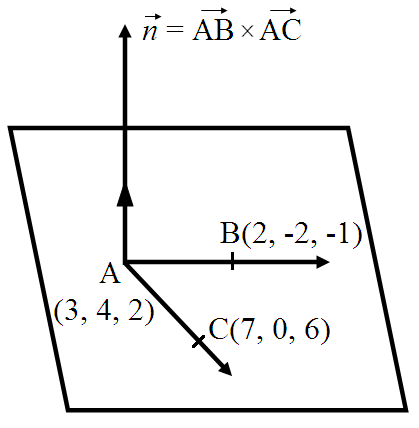 Let A(3, 4, 2), B(2, -2, -1) and C(7, 0, 6) be the points respresented by the given position vectors.The required plane passes through the point A(3, 4, 2) whose position vector is $\vec{\text{a}}=3\hat{\text{i}}+4\hat{\text{j}}+2\hat{\text{k}}$ and is normal to the vector $\vec{\text{n}}$ given by
$\vec{\text{n}}=\overrightarrow{\text{AB}}\times\overrightarrow{\text{AC}}$ Clearly, $\overrightarrow{\text{AB}}=\overrightarrow{\text{OB}}-\overrightarrow{\text{OA}}$ $=(2\hat{\text{i}}-2\hat{\text{j}}-\hat{\text{k}})-(3\hat{\text{i}}+4\hat{\text{j}}+2\hat{\text{k}})$ $=-\hat{\text{i}}-6\hat{\text{j}}-3\hat{\text{k}}$ $\overrightarrow{\text{AC}}=\overrightarrow{\text{OC}}-\overrightarrow{\text{OA}}$ $=(7\hat{\text{i}}+0\hat{\text{j}}+6\hat{\text{k}})-(3\hat{\text{i}}+4\hat{\text{j}}+2\hat{\text{k}})$ $=4\hat{\text{i}}-4\hat{\text{j}}+4\hat{\text{k}}$ $\vec{\text{n}}=\overrightarrow{\text{AB}}\times\overrightarrow{\text{AC}}$ $=\begin{vmatrix}\hat{\text{i}}&\hat{\text{j}}&\hat{\text{k}}\\-1&-6&-3\\4&-4&4\end{vmatrix}$ $=-36\hat{\text{i}}-8\hat{\text{j}}+28\hat{\text{k}}$ The vector equation of the required plane is $\vec{\text{r}}\cdot\vec{\text{n}}=\vec{\text{a}}\cdot\vec{\text{n}}$ $\Rightarrow\vec{\text{r}}\cdot(36\hat{\text{i}}-8\hat{\text{j}}+28\hat{\text{k}})=(3\hat{\text{i}}+4\hat{\text{j}}+2\hat{\text{k}})\cdot(36\hat{\text{i}}-8\hat{\text{j}}+28\hat{\text{k}})$ $\Rightarrow\vec{\text{r}}\cdot\Big[-4(9\hat{\text{i}}+2\hat{\text{j}}+7\hat{\text{k}})\Big]=-108-32+56$ $\Rightarrow\vec{\text{r}}\cdot\Big[-4(9\hat{\text{i}}+2\hat{\text{j}}+7\hat{\text{k}})\Big]=-84$ $\Rightarrow\vec{\text{r}}\cdot(9\hat{\text{i}}+2\hat{\text{j}}+7\hat{\text{k}})=21$ View full question & answer→Question 1165 Marks
Reduce the equation $\vec{\text{r}}\cdot(\hat{\text{i}}-2\hat{\text{j}}+2\hat{\text{k}})+6=0$ to the normal form and, hence, find the length of the perpendicular from the origin to the plane.
AnswerThe given equation of the plane is,
$\vec{\text{r}}\cdot(\hat{\text{i}}-2\hat{\text{j}}+2\hat{\text{k}})+6=0$
$\Rightarrow\vec{\text{r}}\cdot(\hat{\text{i}}-2\hat{\text{j}}+2\hat{\text{k}})=-6$ or $\vec{\text{r}}\cdot\vec{\text{n}}=-6,$ where $\vec{\text{n}}=\hat{\text{i}}-2\hat{\text{j}}+2\hat{\text{k}}$
$|\vec{\text{n}}|=\sqrt{1+4+4}=3$
For reducing the given equation to normal form, we need to divide it by $|\vec{\text{n}}|$ Then, we get
$|\vec{\text{r}}|\cdot\frac{\vec{\text{n}}}{|\vec{\text{n}}|}=\frac{-6}{|\vec{\text{n}}|}$
$\Rightarrow\vec{\text{r}}\cdot\Big(\frac{\hat{\text{i}}-2\hat{\text{j}}+2\hat{\text{k}}}{3}\Big)=\frac{-6}{3}$
$\Rightarrow\vec{\text{r}}\cdot\Big(\frac{1}{3}\hat{\text{i}}-\frac{2}{3}\hat{\text{j}}+\frac{2}{3}\hat{\text{k}}\Big)=-2$
Dividing both sides by -1 we get
$\vec{\text{r}}\cdot\Big(-\frac{1}{3}\hat{\text{i}}+\frac{2}{3}\hat{\text{j}}-\frac{2}{3}\hat{\text{k}}\Big)=2\ ...(\text{i})$
The equation of the plane in normal form is
$\vec{\text{r}}\cdot\vec{\text{n}}=\text{d}\ ...(\text{ii})$
(where d is distance of the plane from the origin)
Comparing (i) and (ii)
length of the perpendicular from the origin to the plane = d = 2 units
View full question & answer→Question 1175 Marks
Find the shortest distance between the following pairs of lines whose vector equation are:
$\vec{\text{r}}=3\hat{\text{i}}+8\hat{\text{j}}+3\hat{\text{k}}+\lambda\big(3\hat{\text{i}}-\hat{\text{j}}+\hat{\text{k}}\big)$ and $\vec{\text{r}}=-3\hat{\text{i}}-7\hat{\text{j}}+6\hat{\text{k}}+\mu\big(-3\hat{\text{i}}+2\hat{\text{j}}+4\hat{\text{k}}\big)$
AnswerWe know that, shortest distance betwee lines
$\vec{\text{r}}=\vec{\text{a}}_1+\lambda\vec{\text{b}}_1$ and $\vec{\text{r}}=\vec{\text{a}}_2+\mu\vec{\text{b}}_2$ is given by
$\text{S.D}=\Bigg|\frac{(\vec{\text{a}}_2-\vec{\text{a}}_1).(\vec{\text{b}}_1\times\vec{\text{b}}_2)}{\big|\vec{\text{b}}_1\times\vec{\text{b}}_2\big|}\Bigg|\dots(1)$
Given equation of lines are.
$\vec{\text{r}}=3\hat{\text{i}}+8\hat{\text{j}}+3\hat{\text{k}}+\lambda\big(3\hat{\text{i}}-\hat{\text{j}}+\hat{\text{k}}\big)$
$\vec{\text{r}}=\big(-3\hat{\text{i}}-7\hat{\text{j}}+9\hat{\text{k}}\big)+\mu\big(-3\hat{\text{i}}+2\hat{\text{j}}+4\hat{\text{k}}\big)$
$\Rightarrow\vec{\text{a}}_1=\big(3\hat{\text{i}}+8\hat{\text{j}}+3\hat{\text{k}}\big),\vec{\text{b}}_1=3\hat{\text{i}}-\hat{\text{j}}+\hat{\text{k}}$
$\Rightarrow\vec{\text{a}}_2=\big(-3\hat{\text{i}}-7\hat{\text{j}}+6\hat{\text{k}}\big),\vec{\text{b}}_2=\big(-3\hat{\text{i}}+2\hat{\text{j}}+4\hat{\text{k}}\big)$
Now,
$\vec{\text{a}}_2-\vec{\text{a}}_1=\big(-3\hat{\text{i}}-7\hat{\text{j}}+6\hat{\text{k}}\big)-\big(3\hat{\text{i}}+8\hat{\text{j}}+3\hat{\text{k}}\big)$
$=-3\hat{\text{i}}-7\hat{\text{j}}+6\hat{\text{k}}-3\hat{\text{i}}-8\hat{\text{j}}-3\hat{\text{k}}$
$\big(\vec{\text{a}}_2-\vec{\text{a}}_1\big)=-6\hat{\text{i}}-15\hat{\text{j}}+3\hat{\text{k}}$
$\big(\vec{\text{b}}_1\times\vec{\text{b}}_2\big)=\begin{vmatrix}\hat{\text{i}}&\hat{\text{J}}&\hat{\text{k}}\\3&-1&1\\-3&2&4 \end{vmatrix}$
$=\hat{\text{i}}(-4-2)-\hat{\text{j}}(12+3)+\hat{\text{k}}(6-3)$
$=\big(-6\hat{\text{i}}-15\hat{\text{j}}+3\hat{\text{k}}\big)$
$\big(\vec{\text{a}}_2-\vec{\text{a}}_1\big).\big(\vec{\text{b}}_1-\vec{\text{b}}_2\big)$
$=\big(-6\hat{\text{i}}-15\hat{\text{j}}+3\hat{\text{k}}\big).\big(-6\hat{\text{i}}-15\hat{\text{j}}+3\hat{\text{k}}\big)$
$=(-6)(6)+(-15)(-15)+(3)(3)$
$=36+225+9$
$=270$
$\big|\vec{\text{b}}_1\times\vec{\text{b}}_2\big|=\sqrt{(-6)^2+(-15)^2+(3)^2}$
$=\sqrt{36+25+9}$
$=\sqrt{270}$
Substituting values of $\big|\vec{\text{b}}_1\times\vec{\text{b}}_2\big|$ and $\big(\vec{\text{a}}_2-\vec{\text{a}}_1\big).\big(\vec{\text{b}}_1\times\vec{\text{b}}_2\big)$ in equation (1) to get shortest distance between given lines, so
$\text{S.D.}=\frac{270}{\sqrt{270}}$
$=\sqrt{270}$
$\text{S.D.}=3\sqrt{30}\text{ units}$
View full question & answer→Question 1185 Marks
Let $\overrightarrow{\text{a}} = \hat{\text{i}} + 4\hat{\text{j}} +2\hat{\text{k}}, \overrightarrow{\text{b}} = 3\hat{\text{i}} - 2\hat{\text{j}} +7\hat{\text{k}}$ and $\overrightarrow{\text{c}} = 2\hat{\text{i}} - \hat{\text{j}} + 4\hat{\text{k}}$ Find a vector $\overrightarrow{\text{d}}$ which is perpendicular to both $\overrightarrow{\text{a}} \text{and} \overrightarrow{\text{b}}\text{and} \overrightarrow{\text{c}} . \overrightarrow{\text{d}} = 27.$
Answer$\text{Writing} \overrightarrow{\text{d}} = \lambda\bigg(\overrightarrow{\text{a}}\times\overrightarrow{\text{b}}\bigg)$
$= \lambda \begin{vmatrix} \hat{\text{i}} & \hat{\text{j}} & \hat{\text{k}} \\ 1 & 4 & 2 \\ 3 & -2 & 7 \end{vmatrix} $
$ = \lambda \bigg(32 \hat{\text{i}} - \hat{\text{j}} - 14\hat{\text{k}}\bigg)\dots\dots\dots\dots\text{(1)}$
$\overrightarrow{\text{c}}. \overrightarrow{\text{d}} = 27$
$\bigg(2\hat{\text{i}} - \hat{\text{j}} + 4\hat{\text{k}}\bigg).\lambda\bigg(32\hat{\text{i}} - \hat{\text{j}} + 14\hat{\text{k}}\bigg) = 27$
$9\lambda = 27$
$\lambda = 3$
$\therefore\overrightarrow{\text{d}} = \bigg(96\hat{\text{i}} - \hat{\text{3j}} + 42\hat{\text{k}}\bigg)$
View full question & answer→Question 1195 Marks
If $\hat{\text{i}}+\hat{\text{j}}+\hat{\text{k}},\ 2\hat{\text{i}}+5\hat{\text{j}},\ 3\hat{\text{i}}+2\hat{\text{j}}-3\hat{\text{k}}$ and $\hat{\text{i}}-6\hat{\text{j}}-\hat{\text{k}}$ respectively are the position vectors of points $A, B, C$ and $D,$ then find the angle between the straight lines $AB$ and $CD.$ Find whether $\vec{\text{AB}}$ and $\vec{\text{CD}}$ are collinear or not.
AnswerGiven:
The position vector of $A$ is $\hat{\text{i}}+\hat{\text{j}}+\hat{\text{k}}.$
The position vector of $B$ is $2\hat{\text{i}}+5\hat{\text{j}}.$
Therefore, $\vec{\text{AB}}=(2-1)\hat{\text{i}}+(5-1)\hat{\text{j}}+(0-1)\hat{\text{k}}=\hat{\text{i}}+\hat4{\text{j}}-\hat{\text{k}}$
The position vector of $C$ is $3\hat{\text{i}}+2\hat{\text{j}}-3\hat{\text{k}}$ and
The postion vector of $D$ is $\hat{\text{i}}-6\hat{\text{j}}-\hat{\text{k}}.$
Therefore, $\vec{\text{CD}}=(1-3)\hat{\text{i}}+(-6-2)\hat{\text{j}}\\+(-1+3)\hat{\text{k}}=-2\hat{\text{i}}-\hat8{\text{j}}+2\hat{\text{k}}$
$\cos\theta=\frac{\vec{\text{AB}}.\vec{\text{CD}}}{|\vec{\text{AB}}||\vec{\text{CD}}|}$
$\Rightarrow\cos\theta=\frac{-2-32-2}{\sqrt{18}\sqrt{72}}=-1$
$\Rightarrow\theta=180^\circ$
Since, angle between Line $AB$ and $CD$ is $180^\circ ,$
therefore $\vec{\text{AB}}$ and $\vec{\text{CD}}$ are collinear.
View full question & answer→Question 1205 Marks
Find the vector and Cartesian equations of the line through the point (1, 2, – 4) and perpendicular to the two lines.
$\overrightarrow{\text{r}} = (8\hat{\text{i}} - 19\hat{\text{j}} + 10\hat{\text{k}})+\lambda(3\hat{\text{i}} - 16\hat{\text{j}} + 7\hat{\text{k})}$ and $\overrightarrow{\text{r}} = (15\hat{\text{i}} - 29\hat{\text{j}} + 5\hat{\text{k}})+\mu(3\hat{\text{i}} - 8\hat{\text{j}} + 5\hat{\text{k})}.$
AnswerVector equation of the required line is
$\overrightarrow{\text{r}} = (\hat{\text{i}} + 2\hat{\text{j}} - 4\hat{\text{k}})+\mu[(3\hat{\text{i}} - 16\hat{\text{j}} + 7\hat{\text{k})}\times(3\hat{\text{i}} + 8\hat{\text{j}} - 5\hat{\text{k})]}$
$\Rightarrow\overrightarrow{\text{r}} = (\hat{\text{i}} + 2\hat{\text{j}} - 4\hat{\text{k}})+\lambda[(2\hat{\text{i}} + 3\hat{\text{j}} + 6\hat{\text{k})]}$
in cartesian form, $\frac{\text{x - 1}}{2} = \frac{\text{y - 2}}{3} = \frac{\text{z + 4}}{6}$
View full question & answer→Question 1215 Marks
The two adjacent sides of a parallelogram are $2\hat{i} - 4\hat{j} - 5\hat{k} \text{ and } 2\hat{i} + 2\hat{j} + 3\hat{k}.$ Find the two unit vectors parallel its diagonals. Using the diagonal vectors, find the area of the parallelogram.
Answer$\text{let } \text{d}_{1} \& \text{ d}_{2}$ be the two diagonal vectors:
$\therefore \overrightarrow{\text{d}}_{1} = 4\hat{\text{i}} - 2\hat{\text{j}} - 2\hat{\text{k}}, \overrightarrow{\text{d}}_{2} = -6\hat{\text{j}} - 8\hat{\text{k}}$
$\text{or} \overrightarrow{\text{d}}_{2} = 6\hat{\text{j}} + 8\hat{\text{k}}$
Unit vectors parallel to the diagonals are:
$\overrightarrow{\text{d}}_{1} = \frac{2}{\sqrt{6}}\hat{\text{i}} - \frac{1}{\sqrt{6}}\hat{\text{j}} - \frac{1}{\sqrt{6}}\hat{\text{k}}$
$\overrightarrow{\text{d}}_{2} = \frac{3}{5}\hat{\text{j}} - \frac{4}{5}\hat{\text{k}} \bigg(\overrightarrow{\text{d}}_{2} = \frac{3}{5}\hat{\text{j}} + \frac{4}{5}\hat{\text{k}}\bigg)$
$\overrightarrow{\text{d}}_{1}\times\overrightarrow{\text{d}}_{2} = \begin{vmatrix} \hat{\text{i}} & \hat{\text{j}} & \hat{\text{k}} \\ 4 & -2 & -2 \\ 0 & -6 & -8 \end{vmatrix} = 4\hat{\text{i}} + 32\hat{\text{j}} - 24\hat{\text{k}} $
Area of parallelogram $= \frac{1}{2}|\overrightarrow{\text{d}}_{1}\times\overrightarrow{\text{d}}_{2}| = \sqrt{404} \text{ or } 2\sqrt{101} \text{sq. units}$
View full question & answer→Question 1225 Marks
Find the equation of the plane through the intersection of the planes $\vec{\text{r}}\cdot(\hat{\text{i}}+3\hat{\text{j}})-6=0$ and $\vec{\text{r}}\cdot(3\hat{\text{i}}-\hat{\text{j}}-4\hat{\text{k}})=0,$ whose perpendicular distance from origin is unity.
AnswerGiven planes are $\vec{\text{r}}\cdot(\hat{\text{i}}+3\hat{\text{j}})-6=0$ and $\vec{\text{r}}\cdot(3\hat{\text{i}}-\hat{\text{j}}-4\hat{\text{k}})=0$
Equation of family of planes through intersection of these of these planes is
$\vec{\text{r}}\cdot(\hat{\text{i}}+3\hat{\text{j}})-6+\lambda\big[\vec{\text{r}}\cdot(3\hat{\text{i}}-\hat{\text{j}}-4\hat{\text{k}})\big]=0$
$\Rightarrow\vec{\text{r}}\cdot\big[(1+3\lambda)\hat{\text{i}}+(3-\lambda)\hat{\text{j}}+\hat{\text{k}}(-4\lambda)\big]=6\ ...(\text{i})$
$\Rightarrow\frac{{\text{r}}\cdot\big[(1+3\lambda)\hat{\text{i}}+(3-\lambda)\hat{\text{j}}+\hat{\text{k}}(-4\lambda)\big]}{\sqrt{(1+3\lambda)^2+(3-\lambda)^2+(-4\lambda)^2}}$
$=\frac{6}{\sqrt{(1+3\lambda)^2+(3-\lambda)^2+(-4\lambda)^2}}$
Since, the perpendicular distance from origin is unity.
$\therefore\ \frac{6}{\sqrt{(1+3\lambda)^2+(3-\lambda)^2+(-4\lambda)^2}}=1$
$\Rightarrow(1+3\lambda)^2+(3-\lambda)^2+(-4\lambda)^2=36$
$\Rightarrow1+9\lambda^2+6\lambda+9+\lambda^2-6\lambda+16\lambda^2=36$
$\Rightarrow\lambda^2=1$
$\therefore\lambda=\pm1$
Using Eq. (i) the required equation of plane is
$\vec{\text{r}}\cdot\big[(1\pm3\lambda)\hat{\text{i}}+(3\pm\lambda)\hat{\text{j}}+\hat{\text{k}}(\pm4\lambda)\big]=6$
$\Rightarrow\vec{\text{r}}\cdot(4\hat{\text{i}}+2\hat{\text{j}}-4\hat{\text{k}})=6$ and $\vec{\text{r}}\cdot(2\hat{\text{i}}+4\hat{\text{j}}+4\hat{\text{k}})=6$
Or $4\text{x}+2\text{y}-4\text{z}-6=0$ and $-2\text{x}+4\text{y}+4\text{z}-6=0$
View full question & answer→Question 1235 Marks
If $\hat{\text{i}}+\hat{\text{j}}+\hat{\text{k}},\ 2\hat{\text{i}}+5\hat{\text{j}},\ 3\hat{\text{i}}+2\hat{\text{j}}-3\hat{\text{k}}$ and $\hat{\text{i}}-6\hat{\text{j}}-\hat{\text{k}}$ respectively are the position vectors of points $A, B, C$ and $D,$ then find the angle between the straight lines $AB$ and $CD.$ Find whether $\vec{\text{AB}}$ and $\vec{\text{CD}}$ are collinear or not.
AnswerGiven:
The position vector of $A$ is $\hat{\text{i}}+\hat{\text{j}}+\hat{\text{k}}.$
The position vector of $B$ is $2\hat{\text{i}}+5\hat{\text{j}}.$
Therefore, $\vec{\text{AB}}=(2-1)\hat{\text{i}}+(5-1)\hat{\text{j}}+(0-1)\hat{\text{k}}=\hat{\text{i}}+\hat4{\text{j}}-\hat{\text{k}}$
The position vector of C is $3\hat{\text{i}}+2\hat{\text{j}}-3\hat{\text{k}}$ and
The postion vector of D is $\hat{\text{i}}-6\hat{\text{j}}-\hat{\text{k}}.$
Therefore, $\vec{\text{CD}}=(1-3)\hat{\text{i}}+(-6-2)\hat{\text{j}}\\+(-1+3)\hat{\text{k}}=-2\hat{\text{i}}-\hat8{\text{j}}+2\hat{\text{k}}$
$\cos\theta=\frac{\vec{\text{AB}}.\vec{\text{CD}}}{|\vec{\text{AB}}||\vec{\text{CD}}|}$
$\Rightarrow\cos\theta=\frac{-2-32-2}{\sqrt{18}\sqrt{72}}=-1$
$\Rightarrow\theta=180^\circ$
Since, angle between Line $AB$ and $CD$ is $180^\circ ,$
therefore $\vec{\text{AB}}$ and $\vec{\text{CD}}$ are collinear.
View full question & answer→Question 1245 Marks
Find the distance between the point (-1, -5, -10) and the point of intersection of the line $\frac{x - 2}{3} = \frac{y + 1}{4} = \frac{z - 2}{12}$ and the plane $x - y + z = 5.$
AnswerAny point on the line $\frac{\text{x} - 2}{3} = \frac{\text{y} + 1}{4} = \frac{\text{z} - 2}{12} = \text{is} (3\lambda + 2, 4\lambda - 1, 12\lambda + 2)$
If this is the point of intersection with plane $\text{x - y + z = 5}$
$\text{then 3} \lambda + 2 - 4\lambda + 1 + 12\lambda + 2 - 5 = 0 \Rightarrow \lambda = 0$
$\therefore$ Point of intersection is (2, -1, 2)
Required distance = $\sqrt{(2 + 1)^{2} +(-1 + 5)^{2} + (2 + 10)^{2} } = 13$
View full question & answer→Question 1255 Marks
Find the angle between the lines $\vec{\text{r}}=3\hat{\text{i}}-2{\hat{\text{j}}}+6\hat{\text{k}}+\lambda(2\hat{\text{i}}+{\hat{\text{j}}}+2\hat{\text{k}})$ and $\vec{\text{r}}=(2\hat{\text{i}}-5\hat{\text{k}})+\mu(6\hat{\text{i}}+3{\hat{\text{j}}}+2\hat{\text{k}}).$
AnswerWe have $\vec{\text{r}}=3\hat{\text{i}}-2{\hat{\text{j}}}+6\hat{\text{k}}+\lambda(2\hat{\text{i}}+{\hat{\text{j}}}+2\hat{\text{k}})$
And $\vec{\text{r}}=(2\hat{\text{i}}-5\hat{\text{k}})+\mu(6\hat{\text{i}}+3{\hat{\text{j}}}+2\hat{\text{k}})$
where $\vec{\text{a}_1}=3\hat{\text{i}}-2{\hat{\text{j}}}+6\hat{\text{k}},\ \vec{\text{b}_1}=(2\hat{\text{i}}+{\hat{\text{j}}}+2\hat{\text{k}})$
And $\vec{\text{a}_2}=2\hat{\text{i}}-5\hat{\text{k}},\ \vec{\text{b}_2}=6\hat{\text{i}}+3{\hat{\text{j}}}+2\hat{\text{k}}$
If $\theta$ is angle between the lines, then
$\cos\theta=\frac{|\vec{\text{b}_1}\cdot\vec{\text{b}_2}|}{|\vec{\text{b}_1|}\cdot|\vec{\text{b}_1}|}$
$=\frac{|(2\hat{\text{i}}+{\hat{\text{j}}}+2\hat{\text{k}})\cdot|(6\hat{\text{i}}+3{\hat{\text{j}}}+2\hat{\text{k}})|}{|2\hat{\text{i}}+{\hat{\text{j}}}+2\hat{\text{k}}||6\hat{\text{i}}+3{\hat{\text{j}}}+2\hat{\text{k}}|}$
$=\frac{|12+3+4|}{\sqrt{9}\sqrt{49}}=\frac{19}{21}$
$\theta=\cos^{-1}\frac{19}{21}$
View full question & answer→Question 1265 Marks
Find the equation of a plane which is at a distance $3\sqrt{3}$ units from origin and the normal to which is equally inclined to coordinate axis.
AnswerSince, normal to the plane is equally inclined to the coordinate axis.
Therefore, $\cos\alpha+\cos\beta=\cos\gamma=\frac{1}{\sqrt{3}}$
So, the normal is $\vec{\text{N}}=\frac{1}{\sqrt{3}}\hat{\text{i}}+\frac{1}{\sqrt{3}}\hat{\text{j}}+\frac{1}{\sqrt{3}}\hat{\text{k}}$ and plane is at a distance of $3\sqrt{3}$ units from origin.
The equation of plane is $\vec{\text{r}}\cdot\hat{\text{N}}=3\sqrt{3}$ $\Big[\because\hat{\text{N}}=\frac{\vec{\text{N}}}{|\text{N}|}\Big]$
$[$Since, vector equation of the plane at a distance p from the origin is $\vec{\text{r}}\cdot\hat{\text{N}}=\text{p}]$
$\Rightarrow(\text{x}\hat{\text{i}}+\text{y}\hat{\text{j}}+\text{k}\hat{\text{k}})\cdot\frac{\Big(\frac{1}{\sqrt{3}}\hat{\text{i}}+\frac{1}{\sqrt{3}}\hat{\text{j}}+\frac{1}{\sqrt{3}}\hat{\text{k}}\Big)}{1}=3\sqrt{3}$
$\Rightarrow\frac{\text{x}}{\sqrt{3}}+\frac{\text{y}}{\sqrt{3}}+\frac{\text{z}}{\sqrt{3}}=3\sqrt{3}$
$\therefore\text{x}+\text{y}+\text{z}=3\sqrt{3}\cdot\sqrt{3}=9$
So, the required equation of plane is $\text{x}+\text{y}+\text{z}=9.$
View full question & answer→Question 1275 Marks
Find the position vector of a point A in space such that $\overrightarrow{\text{OA}}$ is is inclined at 60° to OX and at 45° to OY and $|\overrightarrow{\text{OA}}|=10$ units.
AnswerGiven that, $\overrightarrow{\text{OA}}$ is inclined at 60° to OX and at 45° To OY.
Let $\overrightarrow{\text{OA}}$ makes angle a with OZ.
$\therefore\cos^260^\circ+\cos^245^\circ+\cos^2\alpha=1$
$\Rightarrow\Big(\frac{1}{2}\Big)^2+\Big(\frac{1}{\sqrt{2}}\Big)^2+\cos^2\alpha=1$ $[\because\text{l}^2+\text{m}^2+\text{n}^2=1]$
$\Rightarrow\frac{1}{4}+\frac{1}{2}+\cos^2\alpha=1$
$\Rightarrow\cos^2\alpha=1-\Big(\frac{1}{2}+\frac{1}{4}\Big)$
$\Rightarrow\cos^2\alpha=1-\Big(\frac{6}{8}\Big)$
$\Rightarrow\cos^2\alpha=\Big(\frac{1}{4}\Big)$
$\Rightarrow\cos\alpha=\frac{1}{2}=\cos60^\circ$
$\therefore\alpha=60^\circ$
$\therefore\overrightarrow{\text{OA}}=|\overrightarrow{\text{OA}}|\Big(\frac{1}{2}\hat{\text{i}}+\frac{1}{\sqrt{2}}\hat{\text{j}}+\frac{1}{2}\hat{\text{k}}\Big)$
$=10\Big(\frac{1}{2}\hat{\text{i}}+\frac{1}{\sqrt{2}}\hat{\text{j}}+\frac{1}{2}\hat{\text{k}}\Big)$ $[\because|\overrightarrow{\text{AB}}|=10]$
$=5\hat{\text{i}}+5{\sqrt{2}\hat{\text{j}}}+5\hat{\text{k}}$
View full question & answer→Question 1285 Marks
Find the vector equation of the plane which is at a distance of $\frac{6}{\sqrt{29}}$ from the origin and its normal vector from the origin is $2\hat{\text{i}}-3\hat{\text{j}}+4\hat{\text{k}}$ Also, find its cartesian form.
AnswerGiven, normal vector, $\vec{\text{n}}=2\hat{\text{i}}-3\hat{\text{j}}+4\hat{\text{k}}$
Now, $\hat{\text{n}}=\frac{\vec{\text{n}}}{|\vec{\text{n}}|}$
$=\frac{2\hat{\text{i}}-3\hat{\text{j}}+4\hat{\text{k}}}{\sqrt{29}}$
$=\frac{2}{\sqrt{29}}\hat{\text{i}}-\frac{3}{\sqrt{29}}\hat{\text{j}}+\frac{4}{\sqrt{29}}\hat{\text{k}}$
The equation of the plane in normal from is
$\vec{\text{r}}\cdot\hat{\text{n}}={\text{d}}$ (where d is distance of the plane from the origin)
Substituting, $\hat{\text{n}}=\frac{2}{\sqrt{29}}\hat{\text{i}}-\frac{3}{\sqrt{29}}\hat{\text{j}}+\frac{4}{\sqrt{29}}\hat{\text{k}}$ and $\text{d}=\frac{6}{\sqrt{29}}$ here, we get
$\vec{\text{r}}\cdot\Big(\frac{2}{\sqrt{29}}\hat{\text{i}}-\frac{3}{\sqrt{29}}\hat{\text{j}}+\frac{4}{\sqrt{29}}\hat{\text{k}}\Big)=\frac{6}{\sqrt{29}}\ ...(\text{i})$
Cartesian form
For cartesian form, substituting $\vec{\text{r}}=\text{x}\hat{\text{i}}+\text{y}\hat{\text{j}}+\text{z}\hat{\text{k}}$ in (i) we get
$(\text{x}\hat{\text{i}}+\text{y}\hat{\text{j}}+\text{z}\hat{\text{k}})\cdot\Big(\frac{2}{\sqrt{29}}\hat{\text{i}}-\frac{3}{\sqrt{29}}\hat{\text{j}}+\frac{4}{\sqrt{29}}\hat{\text{k}}\Big)=\frac{6}{\sqrt{29}}$
$\Rightarrow\frac{2\text{x}-3\text{y}+4\text{z}}{\sqrt{29}}=\frac{6}{\sqrt{29}}$
$\Rightarrow2\text{x}-3\text{y}+4\text{z}=6$
View full question & answer→Question 1295 Marks
Show that the lines$\frac{\text{X} + 1 }{3} =\frac{\text{y} + 3}{5} = \frac{\text{z} + 5}{7}\text{ and } \frac{\text{x} - 2}{1} =\frac{\text{y} - 4}{3} =\frac{\text{z} - 6 }{5}$ intersect. Also find their point of intersection.
Answerlet $\frac{\text{x} + 1 }{3} =\frac{\text{y} + 3}{5} =\frac{\text{z} + 5}{7} = \text{u};\frac{\text{x} - 2 }{1} = \frac{\text{y} - 4}{3} =\frac{\text{z} - 6}{5} = \text{v}$
General points on the lines are
(3u – 1, 5u – 3, 7u – 5) & (v + 2, 3v + 4, 5v + 6)
lines intersect if
3u – 1 = v + 2, 5u – 3 = 3v + 4, 7u – 5 = 5v + 6 for some u & v
or 3u – v = 3 ........... (1), 5u – 3v = 7 .............. (2), 7u – 5v = 11 ................... (3)
Solving equations (1) and (2),weget $\text{u} = \frac{1}{2},\text{v} = - \frac{3}{2}$
Putting u&v in equation (3), $ 7.\frac{1}{2} - 5 \big(-\frac{3}{2}\big) = 11 \therefore\text{ lines intersect }$
Point of intersection of lines is: $\bigg(\frac{1}{2},-\frac{1}{2}, - \frac{3}{2}\bigg).$
View full question & answer→Question 1305 Marks
Show that the points whose position vectors are $-2\hat{\text{i}}+3\hat{\text{j}},\hat{\text{i}}+2\hat{\text{j}}+3\hat{\text{k}}$ and $7\hat{\text{i}}-\hat{\text{k}}$ are collinear.
AnswerLet the given points be P, Q and R and let their position vectors be $\vec{\text{a}},\vec{\text{b}}$ and $\vec{\text{c}},$ respectively.
$\vec{\text{a}}=-2\hat{\text{i}}+3\hat{\text{j}}$
$\vec{\text{b}}=\hat{\text{i}}+2\hat{\text{j}}+3\hat{\text{k}}$
$\vec{\text{c}}=7\hat{\text{i}}+9\hat{\text{k}}$
Vector equation of line passing through P and Q is
$\vec{\text{r}}=\vec{\text{a}}+\lambda\big(\vec{\text{b}}-\vec{\text{a}}\big)$
$\Rightarrow\vec{\text{r}}=\big(-2\hat{\text{i}}+3\hat{\text{j}}\big)+\lambda\big\{\big(\hat{\text{i}}+2\hat{\text{j}}+3\hat{\text{k}}\big)-\big(-2\hat{\text{i}}+3\hat{\text{j}}\big)\big\}$
$\Rightarrow\vec{\text{r}}=\big(-2\hat{\text{i}}+3\hat{\text{j}}\big)+\lambda\big(3\hat{\text{i}}-\hat{\text{j}}+3\hat{\text{k}}\big)\dots(1)$
If points P, Qand R are collinear, then point R must satisfy (1).
Replacing $\vec{\text{r}}$ by $\vec{\text{c}}=7\hat{\text{i}}+9\hat{\text{k}}$ in (1), we get
$7\hat{\text{i}}+9\hat{\text{k}}=\big(-2\hat{\text{i}}+3\hat{\text{j}}\big)+\lambda\big(3\hat{\text{i}}-\hat{\text{j}}+3\hat{\text{k}}\big)$
Comparing the coefficients of $\hat{\text{i}},\hat{\text{j}}$ and $\hat{\text{k}},$ we get
$7=-2+3\lambda,0=3-\lambda,9=3\lambda$
$\therefore\lambda=3$
These three equations are consistent, i.e. they give the same value of $\lambda.$
Hence, the given three points are colinear.
Disclaimar: The question given in the book has a minor error. The third vectors should be $7\hat{\text{i}}+9\hat{\text{k}}.$
The solution here is created accordingly
View full question & answer→Question 1315 Marks
Find the equation of the sphere passing through the points $(0, 0, 0), (a, 0, 0), (0, b, 0)$ and $(0, 0, c).$
AnswerLet the equation of sphere be $x^2 + y^2 + z^2+ 2ux + 2vy + 2wz + d = 0........ (i) (0,0,0,)$ lies on it
$\therefore d = 0 (a,0,0,)$ lies on it
$\Rightarrow 2ua + a_2 = 0$
$\Rightarrow 2u = – a (0,b,0,)$ lies on it
$\Rightarrow 2vb + b_2 = 0$
$\Rightarrow 2v = – b (0,0,c,)$ lies on it
$\Rightarrow 2wc + c^2 = 0$
$\Rightarrow 2w = – c$
$\therefore$ Equation of sphere is $x^2 + y^2 + z^2– ax – by – cz = 0.$
View full question & answer→Question 1325 Marks
Find the shortest distance between the following pairs of parallel lines whose equations are:
$\vec{\text{r}}=\big(\hat{\text{i}}+\hat{\text{j}}\big)+\lambda\big(2\hat{\text{i}}-\hat{\text{j}}+\hat{\text{k}}\big)$ and $\vec{\text{r}}=\big(2\hat{\text{i}}+\hat{\text{j}}-\hat{\text{k}}\big)+\mu\big(4\hat{\text{i}}-2\hat{\text{j}}+2\hat{\text{k}}\big)$
Answer$\vec{\text{r}}=\big(\hat{\text{i}}+\hat{\text{j}}\big)+\lambda\big(2\hat{\text{i}}-\hat{\text{j}}+\hat{\text{k}}\big)$ and $\vec{\text{r}}=\big(2\hat{\text{i}}+\hat{\text{j}}-\hat{\text{k}}\big)+\mu\big(4\hat{\text{i}}-2\hat{\text{j}}+2\hat{\text{k}}\big)$ or $\vec{\text{r}}=\big(2\hat{\text{i}}+\hat{\text{j}}-\hat{\text{k}}\big)+2\mu\big(2\hat{\text{i}}-\hat{\text{j}}+\hat{\text{k}}\big)$
These two lines pass through the points having position vectors
$\vec{\text{a}}_1=\hat{\text{i}}+\hat{\text{j}}$ and $\vec{\text{a}}_2=2\hat{\text{i}}+\hat{\text{j}}-\hat{\text{k}}$ and are parallel to the vector $\vec{\text{b}}=2\hat{\text{i}}-\hat{\text{j}}+\hat{\text{k}}.$
Now,
$\vec{\text{a}}_2-\vec{\text{a}}_1=\hat{\text{i}}-\hat{\text{k}}$
and
$\big(\vec{\text{a}}_2-\vec{\text{a}}_1\big)\times\vec{\text{b}}=\big(\hat{\text{i}}-\hat{\text{k}}\big)\times\big(2\hat{\text{i}}-\hat{\text{j}}+\hat{\text{k}}\big)$
$=\begin{vmatrix}\hat{\text{i}}&\hat{\text{j}}&\hat{\text{k}}\\1&0&-1\\2&-1&1 \end{vmatrix}$
$=-\hat{\text{i}}-3\hat{\text{j}}-\hat{\text{k}}$
$\Rightarrow\big|\big(\vec{\text{a}}_2-\vec{\text{a}}_1\big)\times\vec{\text{b}}\big|=\sqrt{(-1)^2+(-3)^2+(-1)^2}$
$=\sqrt{1+9+1}$
$=\sqrt{11}$
The shortest distance between the two lines is given by
$\frac{\big|\big(\vec{\text{a}}_2-\vec{\text{a}}_1\big)\times\vec{\text{b}}\big|}{\big|\vec{\text{b}}}\big|=\frac{\sqrt{11}}{\sqrt{6}}$
View full question & answer→Question 1335 Marks
Find the angle between the lines whose direction cosines are given by the equations
$l + 2m + 3n = 0$ and $3lm - 4ln + mn = 0$
AnswerGiven that,
$l + 2m + 3n = 0 .....(1)$
$3lm - 4ln + mn = 0 .....(2)$
From equation $(1),$
$l + 2m + 3n = 0$
$l = -2m - 3n$
Put the value of $l$ in equation $(2),$
$3lm - 4ln + mn = 0$
$3(-2m - 3n) m - 4(-2m - 3n) n + mn = 0$
$-6m^{2 }- 9nm + 8mn + 12n^2 + mn = 0$
$-6m^2 + 12n^2 = 0$
$m^2 = 2n^2$^
$\text{m}=\pm\sqrt{2\text{n}^2}$
$\text{m}=\text{n}\sqrt{2}$ or $\text{m}=-\text{n}\sqrt{2}$
Put $\text{m}=\text{n}\sqrt{2}$ in equation $(1)$
$l + 2m + 3n = 0$
$\text{l}+2\big(\text{n}\sqrt{2}\big)+3\text{n}=0$
$\text{l}+\text{n}\big(2\sqrt{2}+3\big)=0$
$\text{l}+-\big(2\sqrt{2}+3\big)\text{n}$
Again, $\text{m}=-\sqrt{2\text{n}}$ in equation $(1)$
$l + 2m + 3n = 0$
$\text{l}+2\big(-\sqrt{2\text{n}}\big)+3\text{n}=0$
$\text{l}-2\sqrt{2\text{n}}+3\text{n}=0$
$\text{l}+\text{n}\big(-2\sqrt{2\text{n}}+3\big)=0$
$\text{l}=\big(2\sqrt{2\text{n}}-3\big)\text{n}$
Thus, direction cosines of the lines are given by,
$-\big(2\sqrt{2}+3\big)\text{n},\sqrt{2\text{n}},\text{n}$ or $\big(2\sqrt{2}-3\big)\text{n},\sqrt{2\text{n}},\text{n}$
$-\big(2\sqrt{2}+3\big)\text{n},\sqrt{2},1$ or $\big(2\sqrt{2}-3\big)\text{n},-\sqrt{2},1$
So, vectors parallel to these lines are
$\vec{\text{a}}=-\Big(2\sqrt{2}+3\Big)\hat{\text{i}}+\sqrt{2}\hat{\text{j}}+\hat{\text{k}}$ and $\vec{\text{b}}=\Big(2\sqrt{2}-3\Big)\hat{\text{i}}-\sqrt{2}\hat{\text{j}}+\hat{\text{k}}$ respectively.
Let, $\theta$ be the angle between the lines,
then,
$\cos\theta=\frac{\vec{\text{a}}\times\vec{\text{b}}}{\big|\vec{\text{a}}\big|\times\big|\vec{\text{b}}\big|}$
$=\frac{-\big(2\sqrt{2}+3\big)\times{\big(2\sqrt{2}-3\big)+\big(\sqrt{2}\big)}\times\big(-\sqrt{2}\big)+(1)(1)}{\sqrt{\big(2\sqrt{2}+3\big)^2+\big(-\sqrt{2}\big)^2+(1)^2}\sqrt{\big(2\sqrt{2}-3\big)^2+\big(-\sqrt{2}\big)^2+(1)^2}}$
$=\frac{-(8-9)-2+1}{\sqrt{8+9+12\sqrt{2}+2+1\sqrt{8+9-12\sqrt{2}+2+1}}}$
$=\frac{-(-1)-2+1}{\sqrt{20+12\sqrt{2}}\sqrt{20-12\sqrt{2}}}$
$=\frac{1-2+1}{\sqrt{20+12\sqrt{2}}\sqrt{20-12\sqrt{2}}}$
$\cos\theta=0$
$\theta=\cos^{-1}(0)$
$\theta=\frac{\pi}{2}$
Angle between the lines $=\frac{\pi}{2}$.
View full question & answer→Question 1345 Marks
Find the equation of the plane passing through (a, b, c) and parallel to the plane $\vec{\text{r}}\cdot(\hat{\text{i}}+\hat{\text{j}}+\hat{\text{k}})=2.$
AnswerSubstituting $\vec{\text{r}}=\text{x}\hat{\text{i}}+\text{y}\hat{\text{j}}+\text{z}\hat{\text{k}}$ in the given equation of the plane, we get
$(\text{x}\hat{\text{i}}+\text{y}\hat{\text{j}}+\text{z}\hat{\text{k}})\cdot(\hat{\text{i}}+\hat{\text{j}}+\hat{\text{k}})=2$
x + y + z - 2 = 0 ....(i)
The equation of a plane which is parallel to plane (i) is of the form
x + y + z = k ....(ii)
It is given that plane (ii) is passing through the point (a, b, c). So,
a + b + c = k
Substituting this value of k in (ii) we get
x + y + z = a + b + c, which is the required of the plane.
View full question & answer→Question 1355 Marks
Find the vector equation of the plane passing through the points (1, 1, 1), (1, -1, 1) and (-7, -3, -5)
Answer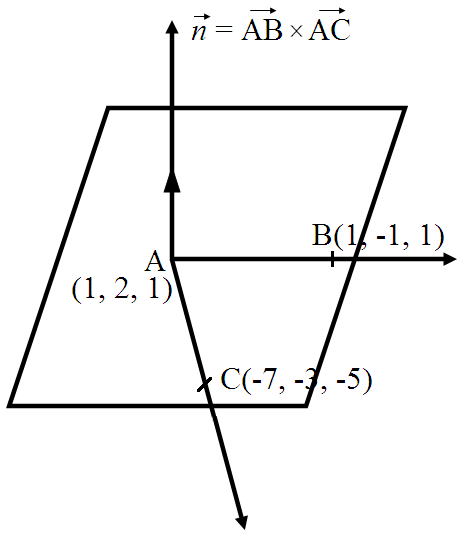
Let A(1, 1, 1), B(1, -1, 1) and C(-7, -3, -5) be the coordinates.
The required plane passes through the point A(1, 1, 1)
Whose position vector is $\vec{\text{a}}=\hat{\text{i}}+\hat{\text{j}}+\hat{\text{k}}$ and is normal to the vector $\vec{\text{n}}$ given by
$\vec{\text{n}}=\overrightarrow{\text{AB}}\times\overrightarrow{\text{AC}}$
Clearly, $\overrightarrow{\text{AB}}=\overrightarrow{\text{OB}}-\overrightarrow{\text{OA}}$
$=(\hat{\text{i}}-\hat{\text{j}}+\hat{\text{k}})-(\hat{\text{i}}+\hat{\text{j}}+\hat{\text{k}})$
$=0\hat{\text{i}}-2\hat{\text{j}}+0\hat{\text{k}}$
$\overrightarrow{\text{AC}}=\overrightarrow{\text{OC}}-\overrightarrow{\text{OA}}$
$=(-7\hat{\text{i}}-3\hat{\text{j}}-5\hat{\text{k}})-(\hat{\text{i}}+\hat{\text{j}}+\hat{\text{k}})$
$=-8\hat{\text{i}}-4\hat{\text{j}}-6\hat{\text{k}}$
$\vec{\text{n}}=\overrightarrow{\text{AB}}\times\overrightarrow{\text{AC}}$
$=\begin{vmatrix}\hat{\text{i}}&\hat{\text{j}}&\hat{\text{k}}\\0&-2&0\\-8&-4&-6\end{vmatrix}$
$=12\hat{\text{i}}+0\hat{\text{j}}-16\hat{\text{k}}$
The vector equation of the required plane is,
$\vec{\text{r}}\cdot\vec{\text{n}}=\vec{\text{a}}\cdot\vec{\text{n}}$
$\Rightarrow\vec{\text{r}}\cdot(12\hat{\text{i}}+0\hat{\text{j}}-16\hat{\text{k}})=(\hat{\text{i}}+\hat{\text{j}}+\hat{\text{k}})(12\hat{\text{i}}+0\hat{\text{j}}-16\hat{\text{k}})$
$\Rightarrow\vec{\text{r}}\cdot\Big[4(3\hat{\text{i}}-4\hat{\text{k}})\Big]=12+0-16$
$\Rightarrow\vec{\text{r}}\cdot\Big[4(3\hat{\text{i}}-4\hat{\text{k}})\Big]=-4$
$\Rightarrow\vec{\text{r}}\cdot(3\hat{\text{i}}-4\hat{\text{k}})=-1$
$\Rightarrow\vec{\text{r}}\cdot(3\hat{\text{i}}-4\hat{\text{k}})+1=0$ View full question & answer→Question 1365 Marks
If the product of the distances of the point $(1, 1, 1)$ from the origin and the plane $x - y + z + \lambda = 0$ be $5,$ find the value of $\lambda .$
AnswerWe know that the distance of the point $(x_1, y_1, z_1)$ from the plane $ax + by + cz + d = 0$ is given by
$\frac{|\text{ax}_1+\text{by}_1+\text{cz}_1+\text{d}|}{\sqrt{\text{a}^2+\text{d}^2+\text{c}^2}}$
Distance of the point $(1, 1, 1)$ from the plane $\text{x}-\text{y}+\text{z}+\lambda=0$
The required distance,
$=\frac{|1-1+1+\lambda|}{\sqrt{1^2+(-1)^2+1^2}}$
$=\frac{|1+\lambda|}{\sqrt{3}}\text{ units}\ ...(\text{i})$
Distance of the point $(0, 0, 0)$ from the plane $\text{x}-\text{y}+\text{z}+\lambda=0$
The required distance,
$=\frac{|0-0+0+\lambda|}{\sqrt{1^2+(-1)^2+1^2}}$
$=\frac{|\lambda|}{\sqrt{3}}\text{ units}\ ...(\text{ii})$
It is given that the product of the distance $(i)$ and $(ii)$ is $5$
$\frac{|1+\lambda|}{\sqrt{3}}\times\frac{|\lambda|}{\sqrt{3}}=5$
$\lambda^2+\lambda-15=0$
View full question & answer→Question 1375 Marks
Find the equation of a plane which is at a distance of $3\sqrt{3}\text{ units}$ from the origin and the normal to which is equally inclined to the coordinate axes.
AnswerLet $\alpha,\beta$ and $\gamma$ be the angle made by $\vec{\text{n}}$ with x, y and z-axes, respectively.
It is given that
$\alpha=\beta=\gamma$
$\Rightarrow\cos\alpha=\cos\beta=\cos\gamma$
$\Rightarrow\text{l}=\text{m}=\text{n},$ where l, m, n are direction cosines of $\vec{\text{n}}$
But $\text{l}^2+\text{m}^2+\text{n}^2=1$
$\Rightarrow\text{l}^2+\text{l}^2+\text{l}^2=1$
$\Rightarrow3\text{l}^2=1$
$\Rightarrow\text{l}^2=\frac{1}{3}$
$\Rightarrow\text{l}=\frac{1}{\sqrt{3}}$
So, $\text{l}=\text{m}=\text{n}=\frac{1}{\sqrt{3}}$
It is given that the length of the perpendicular of the plane from the origin, $\text{p}=3\sqrt{3}$
The normal from of the plane is lx + my + nz = p
$\Rightarrow\frac{1}{\sqrt{3}}\text{x}+\frac{1}{\sqrt{3}}\text{y}+\frac{1}{\sqrt{3}}\text{z}=3\sqrt{3}$
$\Rightarrow\text{x}+\text{y}+\text{z}=3\sqrt{3}(\sqrt{3})$
$\Rightarrow\text{x}+\text{y}+\text{z}=9$
View full question & answer→Question 1385 Marks
Let $\overrightarrow{\text{a}} = \hat{\text{i}} + 4\hat{\text{j}} +2\hat{\text{k}}, \overrightarrow{\text{b}} = 3\hat{\text{i}} - 2\hat{\text{j}} +7\hat{\text{k}}$ and $\overrightarrow{\text{c}} = 2\hat{\text{i}} - \hat{\text{j}} + 4\hat{\text{k}}$ Find a vector $\overrightarrow{\text{d}}$ which is perpendicular to both $\overrightarrow{\text{a}} \text{and} \overrightarrow{\text{b}}\text{and} \overrightarrow{\text{c}} . \overrightarrow{\text{d}} = 27.$
Answer$\text{Writing} \overrightarrow{\text{d}} = \lambda\bigg(\overrightarrow{\text{a}}\times\overrightarrow{\text{b}}\bigg)$
$= \lambda \begin{vmatrix} \hat{\text{i}} & \hat{\text{j}} & \hat{\text{k}} \\ 1 & 4 & 2 \\ 3 & -2 & 7 \end{vmatrix} $
$ = \lambda \bigg(32 \hat{\text{i}} - \hat{\text{j}} - 14\hat{\text{k}}\bigg)\dots\dots\dots\dots\text{(1)}$
$\overrightarrow{\text{c}}. \overrightarrow{\text{d}} = 27$
$\bigg(2\hat{\text{i}} - \hat{\text{j}} + 4\hat{\text{k}}\bigg).\lambda\bigg(32\hat{\text{i}} - \hat{\text{j}} + 14\hat{\text{k}}\bigg) = 27$
$9\lambda = 27$
$\lambda = 3$
$\therefore\overrightarrow{\text{d}} = \bigg(96\hat{\text{i}} - \hat{\text{3j}} + 42\hat{\text{k}}\bigg)$
View full question & answer→Question 1395 Marks
The equation of tangent at (2, 3) on the curve $y^{2} = \text{ax}^{3} + \text{b is y = 4x - 5}. $ Find the value of a and b.
Answer$\text{y}^{2} = \text{ax}^{3} + \text{b} \Rightarrow\text{2y}\frac{\text{dy}}{\text{dx}} = \text{3ax}^{2}\therefore \frac{\text{dy}}{\text{dx}} = \frac{\text{3a}}{2} \frac{\text{x}^{2}}{\text{y}}$
Slope of tangent at (2, 3) $\frac{\text{dy}}{\text{dx}}\bigg]_{(2, 3)} =\frac{\text{3a}}{2}. \frac{4}{3} = \text{2a}$
Comparing with slope of tangent $\text{y = 4x - 5, we get, 2a = 4}\therefore$
Also (2, 3) lies on the curve $\therefore 9 = \text{8a + b, put a = 2, we get b = -7}$
View full question & answer→Question 1405 Marks
Show that the points A, B, C with position vectors $2\hat{\text{i}} - \hat{\text{j}} + \hat{\text{k}}, \hat{\text{i}} - 3\hat{\text{j}} - 5\hat{\text{k}} \text{ and } 3\hat{\text{i}} - 4\hat{\text{j}} - 4\hat{\text{k}}$ respectively, are the vertices of a right-angled triangle. Hence find the area of the triangle.
Answer$\vec{\text{AB}} = - \hat{\text{i}} - 2\hat{\text{j}} - 6\hat{\text{k}}, \vec{\text{BC}} = 2\hat{\text{i}} - \hat{\text{j}} + \hat{\text{k}}, \vec{\text{CA}} = -\hat{\text{i}} + 3\hat{\text{j}} + 5\hat{\text{k}}$
Since $\vec{\text{AB}}, \vec{\text{BC}}, \vec{\text{CA}},$ are not parallel vectors, and $\vec{\text{AB}} + \vec{\text{BC}} + \vec{\text{CA}} = \vec{0} \therefore \text{A, B, C}$ form a triangle
$\text{Also} \vec{\text{ BC}}. \vec{\text{CA}} = 0 \text{ }\text{ }\text{ }\text{ }\text{ } \therefore\text{A, B, C}$ form a right triangle
$\text{Area of} \Delta = \frac{1}{2} | \vec{\text{AB}} \times \vec{\text{BC}}| = \frac{1}{2} \sqrt{210}$
View full question & answer→Question 1415 Marks
Find the shortest distance between the lines:
$\vec{\text{r}}=(\hat{\text{i}}+2\hat{\text{j}}+\hat{\text{k}})+\lambda(\hat{\text{i}}-\hat{\text{j}}+\hat{\text{k}})\ \text{and}\ $
$\vec{\text{r}}=2\hat{\text{i}}-\hat{\text{j}}-\hat{\text{k}}+\mu(2\hat{\text{i}}+\hat{\text{j}}+2\hat{\text{k}})$
AnswerComparing the given equations with
$\vec{\text{r}}=\vec{\text{a}_1}+\lambda\vec{\text{b}_1}\ \text{and}\ \vec{\text{r}}=\vec{\text{a}_2}+\lambda\vec{\text{b}_2},$ we get
$\vec{\text{a}_1}=\hat{\text{i}}+2\hat{\text{j}}+\hat{\text{k}},\ \ \vec{\text{b}_1}=\hat{\text{i}}-\hat{\text{j}}+\hat{\text{k}} \ \ \text{and}$
$\vec{\text{a}_2}=2\hat{\text{i}}-\hat{\text{j}}-\hat{\text{k}},\ \ \vec{\text{b}_2}=2\hat{\text{i}}+\hat{\text{j}}+2\hat{\text{k}}$
Since, the shortest distance between the two skew lines is given by
$\text{d}=\frac{\Big|\Big(\vec{\text{a}_2}-\vec{\text{a}_1}\Big).\Big(\vec{\text{b}_1}\times\vec{\text{b}_2}\Big)\Big|}{\Big|\vec{\text{b}_1}\times\vec{\text{b}_2}\Big|}\ \ \ .....(\text{i})$
Here, $\vec{\text{a}_2}-\vec{\text{a}_1}=\Big(2\hat{\text{i}}-\hat{\text{j}}-\hat{\text{k}}\Big)-\Big(\hat{\text{i}}+2\hat{\text{j}}+\hat{\text{k}}\Big)=\hat{\text{i}}-3\hat{\text{j}}-2\hat{\text{k}}$
$\vec{\text{b}_1}\times\vec{\text{b}_2}=\begin{vmatrix}\hat{\text{i}}&\hat{\text{j}}&\hat{\text{k}}\\1&-1&1\\2&1&2\end{vmatrix}$
$=(-2-1)\hat{\text{i}}-(2-2)\hat{\text{j}}+(1+2)\hat{\text{k}}=-3\hat{\text{i}}+3\hat{\text{k}}$
$\Big|\vec{\text{b}_1}\times\vec{\text{b}_2}\Big|=\sqrt{(-3)^2+(0)^2+(3)^2}=\sqrt{18}=3\sqrt{2}$
$\Big(\vec{\text{a}_2}-\vec{\text{a}_1}\Big).\Big(\vec{\text{b}_1}\times\vec{\text{b}_2}\Big)=\Big(\hat{\text{i}}-3\hat{\text{j}}-2\hat{\text{k}}\Big).\Big(-3\hat{\text{i}}+3\hat{\text{k}}\Big)$
=1 × (-3) + (-3 × 0) + (-2 × 3) = -9
Putting these values in eq. (i)
Shortest distance $(\text{d})=\frac{|-9|}{3\sqrt{2}}=\frac{9}{3\sqrt{2}}=\frac{3}{\sqrt{2}}=\frac{3\sqrt{2}}{2}.$
View full question & answer→Question 1425 Marks
Find the vector and Cartesian equations of the line through the point (1, 2, – 4) and perpendicular to the two lines.
$\overrightarrow{\text{r}} = (8\hat{\text{i}} - 19\hat{\text{j}} + 10\hat{\text{k}})+\lambda(3\hat{\text{i}} - 16\hat{\text{j}} + 7\hat{\text{k})}$ and $\overrightarrow{\text{r}} = (15\hat{\text{i}} - 29\hat{\text{j}} + 5\hat{\text{k}})+\mu(3\hat{\text{i}} - 8\hat{\text{j}} + 5\hat{\text{k})}.$
AnswerVector equation of the required line is
$\overrightarrow{\text{r}} = (\hat{\text{i}} + 2\hat{\text{j}} - 4\hat{\text{k}})+\mu[(3\hat{\text{i}} - 16\hat{\text{j}} + 7\hat{\text{k})}\times(3\hat{\text{i}} + 8\hat{\text{j}} - 5\hat{\text{k})]}$
$\Rightarrow\overrightarrow{\text{r}} = (\hat{\text{i}} + 2\hat{\text{j}} - 4\hat{\text{k}})+\lambda[(2\hat{\text{i}} + 3\hat{\text{j}} + 6\hat{\text{k})]}$
in cartesian form, $\frac{\text{x - 1}}{2} = \frac{\text{y - 2}}{3} = \frac{\text{z + 4}}{6}$
View full question & answer→Question 1435 Marks
A line passes through (2, –1, 3) and is perpendicular to the lines$\overrightarrow{\text{r}}= (\hat{\text{i}} + \hat{\text{j}} - \hat{\text{k}}) + \lambda(2 \hat{\text{i}} - 2\hat{\text{j}} + \hat{\text{k}})\text{ and }\overrightarrow{\text{r}} = (2\hat{\text{i}} -\hat{\text{j}} - 3\hat{\text{k}}) + \mu(\hat{\text{i}} + 2 \hat{\text{j}} + 2\hat{\text{k}}).$Obtain its equation in vector and cartesian form.
AnswerThe direction perpendicular to the given lines is given by
$(2\hat{\text{i}} - 2 \hat{\text{j}} +\hat{\text{k}})\times(\hat{\text{i}} + 2\hat{\text{j}} + 2\hat{\text{k}})$
$= \begin{bmatrix} \hat{\text{i}} &\hat{\text{j}}&\hat{\text{k}} \$0.3em] 2 & -2 & 1 \$0.3em] 1 & 2& 2 \end{bmatrix} = -6\hat{\text{i}} - 3\hat{\text{j}} + 6\hat{\text{k}}\text{ or }2\hat{\text{i}} +\hat{\text{j}} - 2\hat{\text{k}}$
$\therefore$ Vector equation of required line is
$\overrightarrow{\text{r}} = (2\hat{\text{i}} -\hat{\text{j}} + 3 \hat{\text{k}}) + \lambda(2\hat{\text{i}} + \hat{\text{j}} - 2 \hat{\text{k}})$
and the cartesian form is
$\frac{\text{x} - 2}{2} = \frac{\text{y} + 1 }{1} =\frac{\text{z} - 3}{-2}.$
View full question & answer→Question 1445 Marks
Prove that the line through A(0, –1, –1) and B(4, 5, 1) intersects the line through C(3, 9, 4) and D(–4, 4, 4).
AnswerEquation of line $\vec{\text{AB}}$
$\vec{\text{r}} = (-\hat{\text{j}} - \hat{\text{k}}) + \lambda (4\hat{\text{i}} + 6\hat{\text{j}} + 2\hat{\text{k}})$
Equation of line $\vec{\text{CD}}$
$\vec{\text{r}} = (3\hat{\text{i}} + 9\hat{\text{j}} + 4\hat{\text{k}}) + \mu (-7\hat{\text{i}} - 5\hat{\text{j}})$
$\vec{\text{a}}_{2} - \vec{\text{a}}_{1} = 3\hat{\text{i}} + 10\hat{\text{j}} + 5 \hat{\text{k}}$
$\vec{\text{b}}_{1} \times \vec{\text{b}}_{2} = \begin{vmatrix} \hat{\text{i}} & \hat{\text{j}} & \hat{\text{k}} \\ 4 & 6 & 2 \\ -7 & -5 & 0 \end{vmatrix} = 10\hat{\text{i}} - 14\hat{\text{j}} + 22\hat{\text{k}}$
$(\vec{\text{a}}_{2} - \vec{\text{a}}_{1}). (\vec{\text{b}}_{1} \times \vec{\text{b}}_{2}) = 30 – 140 + 110 = 0$
$\Rightarrow$ Lines intersect.
View full question & answer→Question 1455 Marks
Find the shortest distance between the following lines whose vector equations are:$\overrightarrow{r}=\text{(1 - t)}\hat{\text{i}}+\text{(t - 2)}\hat{\text{j}}+\text{(3 - 2t)}\hat{\text{k}}$ and
$\overrightarrow{r}=\text{(s + 1)}\hat{\text{i}}+\text{(2s - 1)}\hat{\text{j}}-\text{(2s + 1)}\hat{\text{k}}$
AnswerEquations of the lines are,
$\overrightarrow{r}=(\hat{\text{i}}-2\hat{\text{j}}+3\hat{\text{k})}+\text{t}(-\hat{\text{i}}+\hat{\text{j}}-2\hat{\text{k})}\text{ and }$
$\overrightarrow{r}=(\hat{\text{i}}-\hat{\text{j}}-\hat{\text{k})}+\text{s}(\hat{\text{i}}+2\hat{\text{j}}-2\hat{\text{k})}$
shortest distance =$\frac{\Big|(\overrightarrow{\text{a}_{2}}-\overrightarrow{\text{a}_{1}})\cdot(\overrightarrow{\text{b}_{1}}\times\overrightarrow{\text{b}_{2}})\Big|}{\Bigg|\overrightarrow{\text{b}_{1}}\times\overrightarrow{\text{b}_{2}}\Bigg|}$ where
$\overrightarrow{\text{a}_{1}}=\hat{\text{i}}-2\hat{\text{j}}+3\hat{\text{k}},\text{ }\overrightarrow{\text{a}_{2}}=\hat{\text{i}}-\hat{\text{j}}-\hat{\text{k}},\overrightarrow{\text{b}_{1}}=-\hat{\text{i}}+\hat{\text{j}}-2\hat{\text{k}},\text{ }\overrightarrow{\text{b}_{2}}=\hat{\text{i}}+2\hat{\text{j}}-2\hat{\text{k}},$
$\overrightarrow{\text{a}_{2}}-\overrightarrow{\text{a}_{1}}=\hat{\text{j}}-4\hat{\text{k}},\text{ }\overrightarrow{\text{b}_{1}}\times\overrightarrow{\text{b}_{2}}=2\hat{\text{i}}-4\hat{\text{j}}-3\hat{\text{k}}$
$\therefore$ S.D. = $\frac{0-4+12}{\sqrt{29}}=\frac{8}{\sqrt{29}}$.
View full question & answer→Question 1465 Marks
Show that the points $\hat{\text{i}}-\hat{\text{j}}+3\hat{\text{k}}$ and $3\hat{\text{i}}+3\hat{\text{j}}+3\hat{\text{k}}$ are equidistant from the plane $\vec{\text{r}}\cdot(5\hat{\text{i}}+2\hat{\text{j}}-7\hat{\text{k}})+9=0$
AnswerWe know that, distance of a point $P$ of position vector $\vec{\text{a}}$ from the plane $\vec{\text{r}}\cdot\hat{\text{n}}=\text{d}$ is given by
$\text{p}=\frac{\big|\vec{\text{a}}\cdot\vec{\text{n}}-\text{d}\big|}{|\vec{\text{n}}|}\ ...(\text{i})$
Let $D_1$ be the distance of point $(\hat{\text{i}}-\hat{\text{j}}+\hat{\text{k}})$ from the plane $\vec{\text{r}}\cdot(5\hat{\text{i}}+2\hat{\text{j}}-7\hat{\text{k}})+9=0,$ then
$\text{D}_1=\Bigg|\frac{(\hat{\text{i}}-\hat{\text{j}}+3\hat{\text{k}})\cdot(5\hat{\text{i}}+2\hat{\text{j}}-7\hat{\text{k}})+9}{\sqrt{(5)^2+(2)^2+(-7)^2}}\Bigg| [$Using equation $(i)]$
$=\Bigg|\frac{(1)(5)+(-1)(2)+(3)(-7)+9}{\sqrt{25+4+49}}\Bigg|$
$=\Big|\frac{5-2-21+9}{\sqrt{78}}\Big|$
$=\Big|-\frac{9}{\sqrt{78}}\Big|$
$\text{D}_1=\frac{9}{\sqrt{78}}\text{ units}\ ...(\text{ii})$
Again, let $D_2$ be the distance of point $(3\hat{\text{i}}-3\hat{\text{j}}+3\hat{\text{k}})$ from the plane $\vec{\text{r}}\cdot(5\hat{\text{i}}+2\hat{\text{j}}-7\hat{\text{k}})+9=0,$ then using equation $(i)$ we get,
$\text{D}_2=\Bigg|\frac{(3\hat{\text{i}}-3\hat{\text{j}}+3\hat{\text{k}})\cdot(5\hat{\text{i}}+2\hat{\text{j}}-7\hat{\text{k}})+9}{\sqrt{(5)^2+(2)^2+(-7)^2}}\Bigg|$
$=\Bigg|\frac{(3)(5)+(3)(2)+(3)(-7)+9}{\sqrt{25+4+49}}\Bigg|$
$=\Big|\frac{15+6-21+9}{\sqrt{78}}\Big|$
$=\Big|\frac{9}{\sqrt{78}}\Big|$
$\text{D}_2=\frac{9}{\sqrt{78}}\text{ units}\ ...(\text{iii})$
From equation $(i)$ and $(iii)$
$\text{D}_1=\text{D}_2$
Distance of point $(\hat{\text{i}}-\hat{\text{j}}+3\hat{\text{k}})$ from plane $\vec{\text{r}}\cdot(5\hat{\text{i}}+2\hat{\text{j}}-7\hat{\text{k}})+9=0$
$=$ Distance of point $(3\hat{\text{i}}-3\hat{\text{j}}+3\hat{\text{k}})$ from plane $\vec{\text{r}}\cdot(5\hat{\text{i}}+2\hat{\text{j}}-7\hat{\text{k}})+9=0$
View full question & answer→Question 1475 Marks
The coordinates of the foot of the perpendicular drawn from the origin to a plane are (12, -4, 3). Find the equation of the plane.
AnswerThe given equation of the line are
$\frac{\text{x}+3}{3}=\frac{\text{y}}{-2}=\frac{\text{z}-7}{6}\ ....(\text{i})$
$\frac{\text{x}+6}{1}=\frac{\text{y}+5}{-3}=\frac{\text{z}-1}{2}\ ....(\text{ii})$
Let the directions of the plane be proportional to a, b, c.
Since the plane contains line (i), it should pass through (-3, 0, 7)
And is parallel to the line (i)
Equation of the plane through (i) is,
a(x + 3) + b(y) + c(z - 7) = 0 ....(iii)
Where 3a - 2b + 6c = 0 ...(iv)
Since the plane contains line (ii), the plane is parallel to line (ii) also
⇒ a - 3b + 2c = 0 ....(v)
Solving (iv) and (v) using cross-multiplication, we get
$\frac{\text{a}}{14}=\frac{\text{b}}{0}=\frac{\text{c}}{-7}$
Substituting a, b and c in (iii) we get
14(x + 3) + 0(y) - 7(z - 7) = 0
⇒ 2(x + 3) + 0(y) - 1(z - 7) = 0
⇒ 2x - z + 13 = 0
View full question & answer→Question 1485 Marks
Find the equatoion of the passing through the points (1, -1, 2) and (2, -2, 2) and which is perpendicular to the plane 6x - 2y + 2z = 9.
AnswerThe equation of any plane passing through (1, -1, 2) is
a(x - 1) + b(y + 1) + c(z - 2) = 0 ....(i)
It is given that (i) is passing through (2, -2, 2). So,
a(2 - 1) + b(-2 + 1) + c(2 - 2) = 0
⇒ a - b + 0c = 0 ...(ii)
It is given that (i) is perpendicular to the plane 6x - 2y + 2z = 9. So,
6a - 2b + 2c = 0
⇒ 3a - b + c = 0 ...(iii)
Solving (i), (ii) and (iii) we get,
$\begin{vmatrix}\text{x}-1&\text{y}+1&\text{z}-2\\1&-1&0\\3&-1&1\end{vmatrix}=0$
⇒ -1(x - 1) - 1(y + 1) + 2(z - 2) = 0
⇒ -x + 1 - y - 1 + 2z - 4= 0
⇒ x + y - 2z + 4 = 0
View full question & answer→Question 1495 Marks
Let $\overrightarrow{\text{a}} = \hat{\text{i}} + 4\hat{\text{j}} +2\hat{\text{k}}, \overrightarrow{\text{b}} = 3\hat{\text{i}} - 2\hat{\text{j}} +7\hat{\text{k}}$ and $\overrightarrow{\text{c}} = 2\hat{\text{i}} - \hat{\text{j}} + 4\hat{\text{k}}$ Find a vector $\overrightarrow{\text{d}}$ which is perpendicular to both $\overrightarrow{\text{a}} \text{and} \overrightarrow{\text{b}}\text{and} \overrightarrow{\text{c}} . \overrightarrow{\text{d}} = 27.$
Answer$\text{Writing} \overrightarrow{\text{d}} = \lambda\bigg(\overrightarrow{\text{a}}\times\overrightarrow{\text{b}}\bigg)$
$= \lambda \begin{vmatrix} \hat{\text{i}} & \hat{\text{j}} & \hat{\text{k}} \\ 1 & 4 & 2 \\ 3 & -2 & 7 \end{vmatrix} $
$ = \lambda \bigg(32 \hat{\text{i}} - \hat{\text{j}} - 14\hat{\text{k}}\bigg)\dots\dots\dots\dots\text{(1)}$
$\overrightarrow{\text{c}}. \overrightarrow{\text{d}} = 27$
$\bigg(2\hat{\text{i}} - \hat{\text{j}} + 4\hat{\text{k}}\bigg).\lambda\bigg(32\hat{\text{i}} - \hat{\text{j}} + 14\hat{\text{k}}\bigg) = 27$
$9\lambda = 27$
$\lambda = 3$
$\therefore\overrightarrow{\text{d}} = \bigg(96\hat{\text{i}} - \hat{\text{3j}} + 42\hat{\text{k}}\bigg)$
View full question & answer→Question 1505 Marks
Show that the four points (0, -1, -1), (4, 5, 1), (3, 9, 4) and (-4, 4, 4) are coplanar and find the equation of the common plane.
AnswerThe equation of the plane passing through points (0, -1, -1), (4, 5, 1) and (3, 9, 4) is given by,
$\begin{vmatrix}\text{x}-0&\text{y}+1&\text{z}+1\\4-0&5+1&1+1\\3-0&9+1&4+1\end{vmatrix}=0$
$\Rightarrow\begin{vmatrix}\text{x}&\text{y}+1&\text{z}+1\\4&6&2\\3&10&5\end{vmatrix}=0$
$\Rightarrow10\text{x}-14(\text{y}+1)+22(\text{z}+1)=0$
$\Rightarrow5\text{x}-7(\text{y}+1)+11(\text{z}+1)=0$
$\Rightarrow5\text{x}-7\text{y}+11\text{z}+4=0$
Substituting the last points (-4, 4, 4) (it means x = -4; y = 4; z = 4) in this plane equation, we get
5(-4) - 7(4) + 11(4) + 4 = 0
⇒ -48 + 48 = 0
So, the plane equation is satisfied by the points (-4, 4, 4)
So, the given pointsa are coplanar and the equation of the common plane (as we already founded) is
5x - 7y + 11z + 4 = 0
View full question & answer→