Question 1013 Marks
If $|\vec{\text{a}}|=\text{a}$ and $\big|\vec{\text{b}}\big|=\text{b},$ prove that $\Big(\frac{\vec{\text{a}}}{\text{a}^2}-\frac{\vec{\text{b}}}{\text{b}^2}\Big)^2=\Big(\frac{\vec{\text{a}}-\vec{\text{b}}}{\text{ab}}\Big)^2.$
Answer$\Big(\frac{\vec{\text{a}}}{\text{a}^2}-\frac{\vec{\text{b}}}{\text{b}^2}\Big)^2$
$=\Big|\frac{\vec{\text{a}}}{\text{a}^2}\Big|^2+\Big|\frac{\vec{\text{b}}}{\text{b}^2}\Big|^2=\frac{2\vec{\text{a}}.\vec{\text{b}}}{\text{a}^2\text{b}^2}$
$=\frac{|\vec{\text{}a}|^2}{\text{a}^4}+\frac{\big|\vec{\text{b}}\big|^2}{\text{b}^4}-\frac{2\vec{\text{a}}.\vec{\text{b}}}{\text{a}^2\text{b}^2}$
$=\frac{\text{a}^2}{\text{a}^4}+\frac{\text{b}^2}{\text{b}^4}-\frac{2\vec{\text{a}}.\vec{\text{b}}}{\text{a}^2\text{b}^2}$ (From the given information)
$=\frac{1}{\text{a}^2}+\frac{1}{\text{b}^2}-\frac{2\vec{\text{a}}.\vec{\text{b}}}{\text{a}^2\text{b}^2}$
$=\frac{\text{b}^2+\text{a}^2-2\vec{\text{a}}.\vec{\text{b}}}{\text{a}^2\text{b}^2}$
$=\frac{\text{a}^2+\text{b}^2-2\vec{\text{a}}.\vec{\text{b}}}{\text{a}^2\text{b}^2}$
$=\frac{|\vec{\text{a}}|^2+|\vec{\text{a}}|^2-2\vec{\text{a}}.\vec{\text{b}}}{\text{a}^2\text{b}^2}$ (From the given information)
$=\frac{\big(\vec{\text{a}}-\vec{\text{b}}\big)^2}{\text{a}^2\text{b}^2}$
$=\Big(\frac{\vec{\text{a}}-\vec{\text{b}}}{\text{ab}}\Big)^2$
View full question & answer→Question 1023 Marks
Find the unit vector in the direction of vector $\overrightarrow{\text{PQ}}$, where P and Q are the points (1, 2, 3) and (4, 5, 6).
AnswerLet $\vec{\text{a}}\text{ and }\vec{\text{b}}$ are the position vectors of the point P(1, 2, 3) and Q(4, 5, 6)
Then,
$\vec{\text{a}}=\hat{\text{i}}+2\hat{\text{j}}+3\hat{\text{k}}$
$\vec{\text{b}}=4\hat{\text{i}}+5\hat{\text{j}}+6\hat{\text{k}}$
So,
$\overrightarrow{\text{PQ}}=\vec{\text{b}}-\vec{\text{a}}$
$=4\hat{\text{i}}+5\hat{\text{j}}+6\hat{\text{k}}-\hat{\text{i}}-2\hat{\text{j}}-3\hat{\text{k}}$
$=3\hat{\text{i}}+3\hat{\text{j}}+3\hat{\text{k}}$
Now, $\Big|\overrightarrow{\text{PQ}}\Big|=\sqrt{3^2+3^2+3^2}$
$=\sqrt{9+9+9}$
$=3\sqrt3$
Therefore, Unit vector parallel to $\overrightarrow{\text{PQ}}=\frac{\overrightarrow{\text{PQ}}}{|\text{PQ}|}=\frac{1}{3\sqrt3}\big(3\hat{\text{i}}+3\hat{\text{j}}+3\hat{\text{k}}\big)$
$=\frac{1}{\sqrt3}\big(\hat{\text{i}}+\hat{\text{j}}+\hat{\text{k}}\big)$
View full question & answer→Question 1033 Marks
Find $\big[\vec{\text{a}}\ \vec{\text{b}}\ \vec{\text{c}}\big]$, when
$\vec{\text{a}}=2\hat{\text{i}}-3\hat{\text{j}},\vec{\text{b}}=\hat{\text{i}}+\hat{\text{j}}-\hat{\text{k}}$ and $\vec{\text{c}}=3\hat{\text{i}}-\hat{\text{k}}$
AnswerGiven:
$\vec{\text{a}}=2\hat{\text{i}}-3\hat{\text{j}}$
$\vec{\text{b}}=\hat{\text{i}}+\hat{\text{j}}-\hat{\text{k}}$
$\vec{\text{c}}=3\hat{\text{i}}-\hat{\text{k}}$
$\therefore\vec{\text{a}}\times\vec{\text{b}}=(2\hat{\text{i}}-3\hat{\text{j}})\times(\hat{\text{i}}+\hat{\text{j}}-\hat{\text{k}})$
$=2\hat{\text{k}}+2\hat{\text{j}}+3\hat{\text{k}}+3\hat{\text{i}}$
$=3\hat{\text{i}}+2\hat{\text{j}}+5\hat{\text{k}}$
$\big(\vec{\text{a}}\times\vec{\text{b}}\big).\vec{\text{c}}=\big(3\hat{\text{i}}+2\hat{\text{j}}+5\hat{\text{k}}\big).\big(3\hat{\text{i}}-\hat{\text{k}}\big)$
$=9-5=4\ ....(1)$
Now,
$\big[\vec{\text{a}}\vec{\text{b}}\vec{\text{c}}\big]=\big(\vec{\text{a}}\times\vec{\text{b}}\big).\vec{\text{c}}$
$=4$ [Using (1)]
View full question & answer→Question 1043 Marks
Show that the points A(1, 2, 7), B(2, 6, 3) and C(3, 10, -1) are collinear.
AnswerVertices A, B, C of a triangle are A (1, 2, 7), B(2, 6, 3) and C(3, 10, -1) respectively. $\therefore\ \ \ \text{Position vector of point}\ \text{A}=\overrightarrow{\text{OA}}$ $=(1, 2, 7)=\hat{i}+2\hat{j}+7\hat{k}$$\text{Position vector of point}\ \text{B}=\overrightarrow{\text{OB}}$ $=(2, 6, 3)=2\hat{i}+6\hat{j}+3\hat{k}$
$\text{Position vector of point}\ \text{C}=\overrightarrow{\text{OC}}$ $=(3, 10, -1)=3\hat{i}+10\hat{j}-\hat{k}$
Now $\ \ \overrightarrow{\text{AB}}$ = Position vector of point B - Position vector of point A$=2\hat{i}+6\hat{j}+3\hat{k}-\big(\hat{i}+2\hat{j}+7\hat{k}\big)$
$=2\hat{i}+6\hat{j}+3\hat{k}-\hat{i}-2\hat{j}-7\hat{k}=\hat{i}+4\hat{j}-4\hat{k}\ \ \ \ \ \ \text{ ........(i)}$
And $\ \overrightarrow{\text{AC}}$ = Position vector of Point C - Position vector of point A$=3\hat{i}+10\hat{j}-\hat{k}-(\hat{i}+2\hat{j}+7\hat{k})$
$=3\hat{i}+10\hat{j}-\hat{k}- \hat{i}-2\hat{j}-7\hat{k}$ $=2\hat{i}+8\hat{j}-8\hat{k}=2(\hat{i}+4\hat{j}-4\hat{k})\ \ \ \ \ ......\text{(ii)}$
$\Rightarrow\ \ \overrightarrow{\text{AC}}=2.\overrightarrow{\text{AB}}\ \ \ \big[\text{Using eq. (i)}\big]$ $\Rightarrow\ \text{Vectors}\ \overrightarrow{\text{AB}}\ \text{and}\ \overrightarrow{\text{AC}}\ \text{are collinear and parallel.}$ $\ \ \Big[\because\ \vec{a}=m\vec{b}\Big]$ Thus, Points A, B and C are collinear. And also vectors $\overrightarrow{\text{AB}}\ \text{and}\ \overrightarrow{\text{AC}}$ have a common point A and hence can't be parallel.
View full question & answer→Question 1053 Marks
Find the area of the parallelogram whose diagonals are:
$2\hat{\text{i}}+\hat{\text{k}}$ and $\hat{\text{i}}+\hat{\text{j}}+\hat{\text{k}}$
AnswerGiven, $\text{d}_1=2\hat{\text{i}}+\hat{\text{k}}$
$\text{d}_2=\hat{\text{i}}+\hat{\text{j}}+\hat{\text{k}}$
$\vec{\text{d}_1}\times\vec{\text{d}_2}=\begin{vmatrix}\hat{\text{i}}&\hat{\text{j}}&\hat{\text{k}}\\2&0&1\\1&1&1 \end{vmatrix}$
$=\hat{\text{i}}(0-1)-\hat{\text{j}}(2-1)+\hat{\text{k}}(2-0)$
$=-\hat{\text{i}}-\hat{\text{j}}+2\hat{\text{k}}$
$\big|\vec{\text{d}}_1\times\vec{\text{d}}_2\big|=\sqrt{(-1)^2+(-1)^2+(2)^2}$
$=\sqrt{1+1+4}$
$=\sqrt{6}$
Area of parallelogram $=\frac{1}{2}\big|\vec{\text{d}}_1\times\vec{\text{d}}_2\big|$
Area of parallelogram $=\frac{1}{2}\sqrt{6}\text{ sq. unit}$
View full question & answer→Question 1063 Marks
If $\big[3\vec{\text{a}}+7\vec{\text{b}}\vec{\text{c}}\vec{\text{d}}\big]=\lambda\big[\vec{\text{a}}\vec{\text{c}}\vec{\text{d}}\big]+\mu\big[\vec{\text{b}}\vec{\text{c}}\vec{\text{d}}\big],$ then find the value of $\lambda+\mu.$
AnswerWe have
$\big[3\vec{\text{a}}+7\vec{\text{b}}\vec{\text{c}}\vec{\text{d}}\big]=\lambda\big[\vec{\text{a}}\vec{\text{c}}\vec{\text{d}}\big]+\mu\big[\vec{\text{b}}\vec{\text{c}}\vec{\text{d}}\big]$
$\Rightarrow\big[\big(3\vec{\text{a}}+7\vec{\text{b}}\big)\times\vec{\text{c}}\big].\vec{\text{d}}=\lambda\big[\vec{\text{a}}\vec{\text{c}}\vec{\text{d}}\big]+\mu\big[\vec{\text{b}}\vec{\text{c}}\vec{\text{d}}\big]$(By definition of scalar triple product)
$\Rightarrow\big[\big(3\vec{\text{a}}\times\vec{\text{c}}\big)+\big(7\vec{\text{b}}\times\vec{\text{c}}\big)\big].\vec{\text{d}}=\lambda\big[\vec{\text{a}}\vec{\text{c}}\vec{\text{d}}\big]+\mu\big[\vec{\text{b}}\vec{\text{c}}\vec{\text{d}}\big]$
$\Rightarrow\big(3\vec{\text{a}}\times\vec{\text{c}}\big].\vec{\text{d}}+\big(7\vec{\text{b}}\times\vec{\text{c}}\big).\vec{\text{d}}=\lambda\big[\vec{\text{a}}\vec{\text{c}}\vec{\text{d}}\big]+\mu\big[\vec{\text{b}}\vec{\text{c}}\vec{\text{d}}\big]$
$\Rightarrow\big[3\vec{\text{a}}\vec{\text{c}}\vec{\text{d}}\big]+\big[7\vec{\text{b}}\vec{\text{c}}\vec{\text{d}}\big]=\lambda\big[\vec{\text{a}}\vec{\text{c}}\vec{\text{d}}\big]+\mu\big[\vec{\text{b}}\vec{\text{c}}\vec{\text{d}}\big]$
$\Rightarrow3\big[\vec{\text{a}}\vec{\text{c}}\vec{\text{d}}\big]+7\big[\vec{\text{b}}\vec{\text{c}}\vec{\text{d}}\big]=\lambda\big[\vec{\text{a}}\vec{\text{c}}\vec{\text{d}}\big]+\mu\big[\vec{\text{b}}\vec{\text{c}}\vec{\text{d}}\big]$
$\big(\therefore\big[\lambda\vec{\text{a}}\vec{\text{b}}\vec{\text{c}}\big]=\lambda\big[\vec{\text{a}}\vec{\text{b}}\vec{\text{c}}\big]$ for any scalar $\lambda\big)$
Comparing both sides, we get
$\lambda=3$
$\mu=7$
$\therefore\lambda+\mu=3+7=10$
View full question & answer→Question 1073 Marks
Find the area of the parallelogram determinrd by the vectors:
$2\hat{\text{i}}+\hat{\text{j}}+3\hat{\text{k}}$ and $\hat{\text{i}}-\hat{\text{j}}$
AnswerLet:
$\vec{\text{a}}=2\hat{\text{i}}+\hat{\text{j}}+3\hat{\text{k}}$
$\vec{\text{b}}=\hat{\text{i}}-\hat{\text{j}}+0\hat{\text{k}}$
$\therefore\vec{\text{a}}\times\vec{\text{b}}=\begin{vmatrix}\hat{\text{i}}&\hat{\text{j}}&\hat{\text{k}}\\2&1&3\\1&-1&0 \end{vmatrix}$
$=(0+3)\hat{\text{i}}-(0-3)\hat{\text{j}}+(-2-1)\hat{\text{k}}$
$=3\hat{\text{i}}+3\hat{\text{j}}-3\hat{\text{k}}$
Area of the parallelogram $=\big|\vec{\text{a}}\times\vec{\text{b}}\big|$
$=\sqrt{3^2+3^2+3^2}$
$=\sqrt{27}$
$=3\sqrt{3}\text{ sq. units}$
View full question & answer→Question 1083 Marks
Show that the four points having position vectors
$6\hat{\text{i}}-7\hat{\text{j}},16\hat{\text{i}}-19\hat{\text{j}}-4\hat{\text{k}},3\hat{\text{j}}-6\hat{\text{k}},2\hat{\text{i}}+5\hat{\text{j}}+10\hat{\text{k}}$ are not coplanar.
AnswerLet
$\text{OA}=6\hat{\text{i}}-7\hat{\text{j}},{\text{OB}}=16\hat{\text{i}}-19\hat{\text{j}}-4\hat{\text{k}},$
$\text{OC}=3\hat{\text{j}}-6\hat{\text{k}},\text{OD}=2\hat{\text{i}}+5\hat{\text{j}}+10\hat{\text{k}}$
$\text{AB}=\text{OB}-\text{OA}=16\hat{\text{i}}-25\hat{\text{j}}-4\hat{\text{k}}$
$\text{AC}=\text{OC}-\text{OA}=-16\hat{\text{i}}-16\hat{\text{j}}+2\hat{\text{k}}$
$\text{CD}=\text{OD}-\text{OC}=2\hat{\text{i}}+2\hat{\text{j}}+16\hat{\text{k}}$
$\text{AD}=\text{OD}-\text{OA}=4\hat{\text{i}}+12\hat{\text{j}}+10\hat{\text{k}}$
The four points are co-planer if vectors $\vec{\text{AB}},\vec{\text{AC}},\vec{\text{AD}}$ are co-planer.
$\begin{vmatrix}16&-25&-4\\-16&-16&2\\-4&12&10 \end{vmatrix}$
$=16(-160-24)+25(-160+8)-4(-144+64)$
$\neq 0$
Hence the point are not co-planar.
View full question & answer→Question 1093 Marks
Find a unit vector in the direction of $\overrightarrow{\text{PQ}},$ where P and Q have co-ordinates (5, 0, 8) and (3, 3, 2), respectively.
AnswerSince, the e coordinates of P and Q are (5, 0, 8) and (3, 3, 2), respectively.
$\therefore\overrightarrow{\text{PQ}}=\overrightarrow{\text{OQ}}-\overrightarrow{\text{OP}}$
$=(3\hat{\text{i}}+3\hat{\text{j}}+2\hat{\text{k}})-(5\hat{\text{i}}+0\hat{\text{j}}+8\hat{\text{k}})$
$=-2\hat{\text{i}}+3\hat{\text{j}}-6\hat{\text{k}}$
View full question & answer→Question 1103 Marks
Find the value of $\lambda$ so that the following vectors are coplanar:
$\vec{\text{a}}=\hat{\text{i}}-\hat{\text{j}}+\hat{\text{k}},\vec{\text{b}}=2\hat{\text{i}}+\hat{\text{j}}-\hat{\text{k}},\vec{\text{c}}=\lambda\hat{\text{i}}-\hat{\text{j}}+\lambda\hat{\text{k}}$
AnswerGiven:
$\vec{\text{a}}=\hat{\text{i}}-\hat{\text{j}}+\hat{\text{k}}$
$\vec{\text{b}}=2\hat{\text{i}}+\hat{\text{j}}-\hat{\text{k}}$
$\vec{\text{c}}=\lambda\hat{\text{i}}-\hat{\text{j}}+\lambda\hat{\text{k}}$
We know that vectors $\vec{\text{a}},\vec{\text{b}},\vec{\text{c}}$ are coplanar if $\Big[\vec{\text{a}}\ \vec{\text{b}}\ \vec{\text{c}}\Big]=0$
It is given that $\vec{\text{a}},\vec{\text{b}},\vec{\text{c}}$ are coplanar.
$\therefore\Big[\vec{\text{a}}\ \vec{\text{b}}\ \vec{\text{c}}\Big]=0$
$\Rightarrow\begin{vmatrix}1&-1&1\\2&1&-1\\\lambda&-1&\lambda \end{vmatrix}=0$
$\Rightarrow 1(\lambda-1)+1(2\lambda+\lambda)+1(-2-\lambda)=0$
$\Rightarrow \lambda -1+3\lambda-2-\lambda=0$
$\Rightarrow 3\lambda-3=0$
$\Rightarrow\lambda=1$
View full question & answer→Question 1113 Marks
Find the area of the parallelogram determinrd by the vectors:
$3\hat{\text{i}}+\hat{\text{j}}-2\hat{\text{k}}$ and $\hat{\text{i}}-3\hat{\text{j}}+4\hat{\text{k}}$
AnswerLet:$\vec{\text{a}}=3\hat{\text{i}}+\hat{\text{j}}-2\hat{\text{k}}$
$\vec{\text{b}}=1\hat{\text{i}}-3\hat{\text{j}}+4\hat{\text{k}}$
$\vec{\text{a}}\times\vec{\text{b}}=\begin{vmatrix}\hat{\text{i}}&\hat{\text{j}}&\hat{\text{k}}\\3&1&-2\\1&-3&4 \end{vmatrix}$
$=\hat{\text{i}}(4-6)-\hat{\text{j}}(12+2)+\hat{\text{k}}(-9-1)$
$=-2\hat{\text{i}}-14\hat{\text{j}}-10\hat{\text{k}}$
Area of the parallelogram $=\big|\vec{\text{a}}\times\vec{\text{b}}\big|$
$=\sqrt{(-2)^2+(-14)^2+(-10)^2}$
$=\sqrt{300}$
$=10\sqrt{3}\text{ sq. units}$
View full question & answer→Question 1123 Marks
If $\vec{\text{a}}$ are $\vec{\text{b}}$ are unit vectors, then find the between $\vec{\text{a}}$ and $\vec{\text{b}},$ given that $\big(\sqrt{3}\vec{\text{a}}-\vec{\text{b}}\big)$ is aunit vector.
AnswerLet the angle between $\vec{\text{a}}$ and $\vec{\text{b}}$ be $\theta.$
It is given that $|\vec{\text{a}}|=\big|\vec{\text{b}}\big|=\big|\vec{\text{a}}+\vec{\text{b}}\big|=1.$
$\big|\sqrt{3}\vec{\text{a}}-\vec{\text{b}}\big|=1$
$\Rightarrow\big|\sqrt{3}\vec{\text{a}}-\vec{\text{b}}\big|^2=1$
$\Rightarrow\big|\sqrt{3}\vec{\text{a}}\big|^2-2\sqrt{3}\vec{\text{a}}.\vec{\text{b}}+\big|\vec{\text{b}}\big|^2=1$
$\Rightarrow3|\vec{\text{a}}|^2-2\sqrt{3}|\vec{\text{a}}|\big|\vec{\text{b}}\big|\cos\theta+\big|\vec{\text{b}}\big|^2=1$
$\Rightarrow3\times1-2\sqrt{3}\times1\times1\times\cos\theta+1=1$
$\Rightarrow2\sqrt{3}\cos\theta=3$
$\Rightarrow\cos\theta=\frac{\sqrt{3}}{2}=\cos\frac{\pi}{6}$
$\Rightarrow\theta=\frac{\pi}{6}$
Thus, the angle between $\vec{\text{a}}$ and $\vec{\text{b}}$ is $\frac{\pi}{6}.$
View full question & answer→Question 1133 Marks
ABCD is a quadrilateral. Find the sum of the vectors $\overrightarrow{\text{BA}},\overrightarrow{\text{BC}},\overrightarrow{\text{CD}}\text{ and }\overrightarrow{\text{DA}}$.
AnswerGiven: ABCD is a quadrilateral.
We need to find the sum of $\overrightarrow{\text{BA}}+\overrightarrow{\text{BC}}+\overrightarrow{\text{CD}}+\overrightarrow{\text{DA}}$.
Consider,
$\overrightarrow{\text{BA}}+\overrightarrow{\text{BC}}+\overrightarrow{\text{CD}}+\overrightarrow{\text{DA}}$
$=\Big(\overrightarrow{\text{BA}}+\overrightarrow{\text{DA}}\Big)+\Big(\overrightarrow{\text{BC}}+\overrightarrow{\text{CD}}\Big)$
$=\Big(\overrightarrow{\text{BD}}+2\overrightarrow{\text{DA}}\Big)+\overrightarrow{\text{BD}}$ $\Big[\because\ \overrightarrow{\text{BD}}+\overrightarrow{\text{DA}}=\overrightarrow{\text{BA}}\text{ and }\overrightarrow{\text{BC}}+\overrightarrow{\text{CD}}=\overrightarrow{\text{BD}}\Big]$
$=2\Big(\overrightarrow{\text{BD}}+\overrightarrow{\text{DA}}\Big)$
$=2\ \overrightarrow{\text{BA}}$
View full question & answer→Question 1143 Marks
Find $\Big[\vec{\text{a}}\ \vec{\text{b}}\ \vec{\text{c}}\Big]$, when
$\vec{\text{a}}=\hat{\text{i}}-2\hat{\text{j}}+3\hat{\text{k}},\vec{\text{b}}=2\hat{\text{i}}+\hat{\text{j}}-\hat{\text{k}}$ and $\vec{\text{c}}=\hat{\text{j}}+\hat{\text{k}}$
AnswerGiven:
$\vec{\text{a}}=\hat{\text{i}}-2\hat{\text{j}}+3\hat{\text{k}}$
$\vec{\text{b}}=2\hat{\text{i}}+\hat{\text{j}}-\hat{\text{k}}$
$\vec{\text{c}}=\hat{\text{j}}+\hat{\text{k}}$
$\therefore\vec{\text{a}}\times\vec{\text{b}}=\big(\hat{\text{i}}-2\hat{\text{j}}+3\hat{\text{k}}\big)\times\big(2\hat{\text{i}}+\hat{\text{j}}-\hat{\text{k}}\big)$
$=\hat{\text{k}}+\hat{\text{j}}+4\hat{\text{k}}+2\hat{\text{i}}+6\hat{\text{j}}-3\hat{\text{i}}$
$=-\hat{\text{i}}+7\hat{\text{j}}+5\hat{\text{k}}$
$\big(\vec{\text{a}}\times\vec{\text{b}}\big).\vec{\text{c}}=\big(-\hat{\text{i}}+7\hat{\text{j}}+5\hat{\text{k}}\big).\big(\hat{\text{j}}+\hat{\text{k}}\big)$
$=7+5=12\ ...(1)$
Now,
$\big[\vec{\text{a}}\ \vec{\text{b}}\ \vec{\text{c}}\big]=\big(\vec{\text{a}}\times\vec{\text{b}}\big).\vec{\text{c}}$
$=12$ [Using (1)]
View full question & answer→Question 1153 Marks
Find $|\vec{\text{a}|}$ and $\big|\vec{\text{b}}\big|$ if
$\big(\vec{\text{a}}+\vec{\text{b}}\big).\big(\vec{\text{a}}-\vec{\text{b}}\big)=12$ and $|\vec{\text{a}}|=2\big|\vec{\text{b}}\big|$
AnswerHere, $\big(\vec{\text{a}}+\vec{\text{b}}\big).\big(\vec{\text{a}}-\vec{\text{b}}\big)=12$
$|\vec{\text{a}}|^2-\big|\vec{\text{b}}\big|^2=12$
$\big(2\big|\vec{\text{b}}\big|\big)^2-\big|\vec{\text{b}}\big|^2=12$ $\big[\text{Using|}\vec{\text{a}}|=2\big|\vec{\text{b}}\big|\big]$
$4\big|\vec{\text{b}}\big|^2-\big|\vec{\text{b}}\big|^2=12$
$3\big|\vec{\text{b}}\big|^2=12$
$\big|\vec{\text{b}}\big|^2=\frac{12}{3}$
$\big|\vec{\text{b}}\big|^2=4$
$\big|\vec{\text{b}}\big|=2$
$\big|\vec{\text{a}}\big|=2\big|\vec{\text{b}}\big|=2(2)$
$\big|\vec{\text{a}}\big|=4$
$\big|\vec{\text{b}}\big|=2$
View full question & answer→Question 1163 Marks
Find the area of the parallelogram whose diagonals are:
$2\hat{\text{i}}+3\hat{\text{j}}+6\hat{\text{k}}$ and $3\hat{\text{i}}-6\hat{\text{i}}+2\hat{\text{k}}$
AnswerHere, $\text{d}_1=2\hat{\text{i}}+3\hat{\text{j}}+6\hat{\text{k}}$
$\text{d}_2=3\hat{\text{i}}-6\hat{\text{j}}+2\hat{\text{k}}$
$\vec{\text{d}_1}\times\vec{\text{d}_2}=\begin{vmatrix}\hat{\text{i}}&\hat{\text{j}}&\hat{\text{k}}\\2&3&6\\3&-6&2 \end{vmatrix}$
$=\hat{\text{i}}(6+36)-\hat{\text{j}}(4-18)+\hat{\text{k}}(-12-9)$
$=42\hat{\text{i}}+14\hat{\text{j}}-21\hat{\text{k}}$
$=7\big(6\hat{\text{i}}+2\hat{\text{j}}-3\hat{\text{k}}\big)$
$\big|\vec{\text{d}}_1\times\vec{\text{d}}_2\big|=7\sqrt{(6)^2+(2)^2+(-3)^2}$
$=7\sqrt{36+4+9}$
$=7\sqrt{49}$
$=7\times7$
$=49$
Area of parallelogram $=\frac{1}{2}\big|\vec{\text{d}}_1\times\vec{\text{d}}_2\big|$
Area of parallelogram $=\frac{49}{2}\text{ sq.unit}$
View full question & answer→Question 1173 Marks
Find the value of $\lambda$ so that the following vectors are coplanar:
$\vec{\text{a}}=\hat{\text{i}}+2\hat{\text{j}}-3\hat{\text{k}},\vec{\text{b}}=3\hat{\text{i}}+\lambda\hat{\text{j}}+\hat{\text{k}},\vec{\text{c}}=\hat{\text{i}}+2\hat{\text{j}}+2\hat{\text{k}}$
AnswerGiven:
$\vec{\text{a}}=\hat{\text{i}}+2\hat{\text{j}}-3\hat{\text{k}}$
$\vec{\text{b}}=3\hat{\text{i}}+\lambda\hat{\text{j}}+\hat{\text{k}}$
$\vec{\text{c}}=\hat{\text{i}}+2\hat{\text{j}}+2\hat{\text{k}}$
We know that vectors $\vec{\text{a}},\vec{\text{b}},\vec{\text{c}}$ are coplanar iff $\Big[\vec{\text{a}}\ \vec{\text{b}}\ \vec{\text{c}}\Big]=0.$
It is given that $\vec{\text{a}},\vec{\text{b}},\vec{\text{c}}$ are coplanar.
$\therefore\Big[\vec{\text{a}}\ \vec{\text{b}}\ \vec{\text{c}}\Big]=0$
$\Rightarrow\begin{vmatrix}1&2&-3\\3&\lambda&1\\1&2&2 \end{vmatrix}=0$
$\Rightarrow1(2\lambda-2)-2(6-1)-3(6-\lambda)=0$
$\Rightarrow5\lambda-30=0$
$\Rightarrow\lambda=6$
View full question & answer→Question 1183 Marks
If $\vec{\text{a}}$ are $\vec{\text{b}}$ are two unit vectors such that $\vec{\text{a}}+\vec{\text{b}}$ is $\frac{\pi}{6}.$
AnswerLet the angle between $\vec{\text{a}}$ and $\vec{\text{b}}$ be $\theta.$
It is given that $|\vec{\text{a}}|=\big|\vec{\text{b}}\big|=\big|\vec{\text{a}}+\vec{\text{b}}\big|=1.$
$\big|\vec{\text{a}}+\vec{\text{b}}\big|=1$
$\Rightarrow\big|\vec{\text{a}}+\vec{\text{b}}\big|^2=1$
$\Rightarrow|\vec{\text{a}}|^2+2|\vec{\text{a}}|\big|\vec{\text{b}}\big|\cos\theta+\big|\vec{\text{b}}\big|^2=1$
$\Rightarrow1+2\times1\times1\times\cos\theta+1=1$
$\Rightarrow2\cos\theta=-1$
$\Rightarrow\cos\theta=-\frac{1}{2}=\cos\frac{2\pi}{3}$
$\Rightarrow\theta=\frac{2\pi}{3}$
View full question & answer→Question 1193 Marks
If the vertices A, B, C of a triangle ABC are (1, 2, 3), (-1, 0, 0), (0, 1, 2), respectively, then find $\angle\text{ABC}.[\angle\text{ABC is the angle between the vectors}\ \overrightarrow{\text{BA}}\ \text{and} \ \overrightarrow{\text{BC}}].$
AnswerVertices A, B, C of a triangle are A(1, 2, 3), B(-1, 0, 0) and C(0, 1, 2) respectively. $\therefore\ \ \text{Position vector of point A = }\overrightarrow{\text{OA}} $ $=(1, 2, 3)=\hat{i}+2\hat{j}+3\hat{k}$$\text{Position vector of point B}=\overrightarrow{\text{OB}}$ $=(-1, 0, 0)=-\hat{i}+0\hat{j}+0\hat{k}$
$\text{Position vector of point C}=\overrightarrow{\text{OC}}$ $=(0, 1, 2)=0\hat{i}+1\hat{j}+2\hat{k}$
Now $\ \overrightarrow{\text{BA}}$ = Position vector of point A - Position vector of point B$=\hat{i}+2\hat{j}+3\hat{k}-\big(-\hat{i}+0\hat{j}+0\hat{k}\big)$
$=\hat{i}+2\hat{j}+3\hat{k}+\hat{i}-0\hat{j}-0\hat{k}$ $=2\hat{i}+2\hat{j}+3\hat{k}\ \ \ \ \ \ \ \ \ ......\text{(i)}$
And $ \ \overrightarrow{\text{BC}}$ = Position vector of point C - Position vector of point B$=0\hat{i}+\hat{j}+2\hat{k}-\big(-\hat{i}+0\hat{j}+0\hat{k}\big)$
$=0\hat{i}+\hat{j}+2\hat{k}+\hat{i}-0\hat{j}-0\hat{k}$ $=\hat{i}+\hat{j}+2\hat{k}\ \ \ \ \ \ \ \ \ ......\text{(ii)}$
Let $\theta$ be the angle between the vectors $\overrightarrow{\text{BA}}\ \text{and}\ \overrightarrow{\text{BC}}.$$\therefore\ \ \text{cos}\theta=\frac{\overrightarrow{\text{BA}}.\overrightarrow{\text{BC}}}{\Big|\overrightarrow{\text{BA}}\Big|.\Big|\overrightarrow{\text{BC}}\Big|}=\frac{2(1)+2(1)+3(2)}{\sqrt{4+4+9}\sqrt{1+1+4}}\ $ [Using eq. (i) and (ii)]
$\Rightarrow\ \text{cos}\theta=\frac{10}{\sqrt{17}\sqrt{6}}=\frac{10}{\sqrt{102}}$ $\Rightarrow\ \theta=\cos^{-1}\Big(\frac{10}{\sqrt{102}}\Big)$
View full question & answer→Question 1203 Marks
Dot product of a vector with $\hat{\text{i}}+\hat{\text{j}}-3\hat{\text{k}},\hat{\text{i}}+3\hat{\text{j}}-2\hat{\text{k}}$ and $2\hat{\text{i}}+\hat{\text{j}}+4\hat{\text{k}}$ are 0, 5 and 8 respectively. Find the vector.
AnswerLet $\text{a}\hat{\text{i}}+\text{b}\hat{\text{j}}+\text{c}\hat{\text{k}}$ be the required vector.
Given that
$\big(\text{a}\hat{\text{i}}+\text{b}\hat{\text{j}}+\text{c}\hat{\text{k}}\big).\big(\hat{\text{i}}+\hat{\text{j}}-3\hat{\text{k}}\big)=0$
$\Rightarrow\text{a+b}-3\text{c}=0\dots(1)$
$\big(\text{a}\hat{\text{i}}+\text{b}\hat{\text{j}}+\text{c}\hat{\text{k}}\big).\big(\hat{\text{i}}+3\hat{\text{j}}-2\hat{\text{k}}\big)=5$
$\Rightarrow\text{a}+3\text{b}-2\text{c}=5\dots(2)$
$\big(\text{a}\hat{\text{i}}+\text{b}\hat{\text{j}}+\text{c}\hat{\text{k}}\big).\big(2\hat{\text{i}}+\hat{\text{j}}+4\hat{\text{k}}\big)=5$
$\Rightarrow2\text{a+b}+4\text{c}=8\dots(3)$
Solving (1), (2) and (3), we get
$\text{a}=1,\text{b}=2,\text{c}=1$
So, $\text{a}\hat{\text{i}}+\text{b}\hat{\text{j}}+\text{c}\hat{\text{k}}=\hat{\text{i}}+2\hat{\text{j}}+\hat{\text{k}}$
View full question & answer→Question 1213 Marks
Find the angle between the vectors $2\hat{\text{i}}-\hat{\text{j}}+\hat{\text{k}}$ and $3\hat{\text{i}}+4\hat{\text{j}}-\hat{\text{k}}.$
AnswerLet $\vec{\text{a}}=2\hat{\text{i}}-\hat{\text{j}}+\hat{\text{k}}$ and $\vec{\text{b}}=3\hat{\text{i}}+4\hat{\text{j}}-\hat{\text{k}}$
We know that, angle between two vectors $\vec{\text{a}}$ and $\vec{\text{b}}$ is given by
$\cos\theta=\frac{\vec{\text{a}}\cdot\vec{\text{b}}}{|\vec{\text{a}}||\vec{\text{b}}|}$
$=\frac{(2\hat{\text{i}}-\hat{\text{j}}+\hat{\text{k}})(3\hat{\text{i}}+4\hat{\text{j}}-\hat{\text{k}})}{\sqrt{4+1+1}\sqrt{9+16+1}}$
$=\frac{6-4-1}{\sqrt{6}\sqrt{26}}=\frac{1}{2\sqrt{39}}$
$\therefore\theta=\cos^{-1}\Big(\frac{1}{2\sqrt{39}}\Big)$
View full question & answer→Question 1223 Marks
The two adjacent sides of a parallelogram are $2\hat{\text{i}}-4\hat{\text{j}}+5\hat{\text{k}}\ \text{and}\ \hat{\text{i}}-2\hat{\text{j}}-3\hat{\text{k}}.$ Find the unit vector parallel to its diagonal. Also, find its area.
AnswerAdjacent sides of a parallelogram are given as: $\vec{\text{a}}=2\hat{\text{i}}-4\hat{\text{j}}+5\hat{\text{k}}\ \text{and}\ \vec{\text{b}}=\hat{\text{i}}-2\hat{\text{j}}-3\hat{\text{k}}$
Then, the diagonal of a parallelogram is given by $\vec{\text{a}}+\vec{\text{b}}.$
$\vec{\text{a}}+\vec{\text{b}}=(2+1)\hat{\text{i}}+(-4-2)\hat{\text{j}}+(5-3)\hat{\text{k}}$ $=3\hat{\text{i}}-6\hat{\text{j}}+2\hat{\text{k}}$
Thus, the unit vector parallel to the diagonal is
$\frac{\vec{\text{a}}+\vec{\text{b}}}{\Big|\vec{\text{a}}+\vec{\text{b}}\Big|}=\frac{3\hat{\text{i}}-6\hat{\text{j}}+2\hat{\text{k}}}{\sqrt{3^2+(-6)^2+2^2}}=\frac{3\hat{\text{i}}-6\hat{\text{j}}+2\hat{\text{k}}}{\sqrt{9+36+4}}$ $=\frac{3\hat{\text{i}}-6\hat{\text{j}}+2\hat{\text{k}}}{7}=\frac{3}{7}\hat{\text{i}}-\frac{6}{7}\hat{\text{j}}+\frac{2}{7}\hat{\text{k}}.$
$\therefore$ Area of parallelogram ABCD $=\big|\vec{\text{a}}\times\vec{\text{b}}\big|$
$\vec{\text{a}}\times\vec{\text{b}}=\begin{vmatrix}\hat{\text{i}}&\hat{\text{j}}&\hat{\text{k}}\\2&-4&5\\1&-2&-3\end{vmatrix}$
$=\hat{\text{i}}(12+10)-\hat{\text{j}}(-6-5)+\hat{\text{k}}(-4+4)$
$=22\hat{\text{i}}+11\hat{\text{j}}$
$=11\big(2\hat{\text{i}}+\hat{\text{j}}\big)$
$\therefore\big|\vec{\text{a}}\times\vec{\text{b}}\big|=11\sqrt{2^2+1^2}=11\sqrt{5}$
Hence, the area of the parallelogram is $11\sqrt{5}$ square units.
View full question & answer→Question 1233 Marks
Find the unit vector in the direction of the resultant of the vectors $\hat{\text{i}}-\hat{\text{j}}+3\hat{\text{k}},\ 2\hat{\text{i}}+\hat{\text{j}}-2\hat{\text{k}}$ and $\hat{\text{i}}+2\hat{\text{j}}-2\hat{\text{k}}$.
AnswerGiven: $\vec{\text{a}}=\hat{\text{i}}-\hat{\text{j}}+3\hat{\text{k}},\ 2\hat{\text{i}}+\hat{\text{j}}-2\hat{\text{k}}$ and $\hat{\text{i}}+2\hat{\text{j}}-2\hat{\text{k}}$ are the position vectors. Then, Resultant of vectors $=\vec{\text{a}}+\vec{\text{b}}+\vec{\text{c}}$$=\hat{\text{i}}-\hat{\text{j}}+3\hat{\text{k}}+2\hat{\text{i}}+\hat{\text{j}}-2\hat{\text{k}}+\hat{\text{i}}+2\hat{\text{j}}-2\hat{\text{k}}$
$=4\hat{\text{i}}+2\hat{\text{j}}-\hat{\text{k}}$
So, $\big|\vec{\text{a}}+\vec{\text{b}}+\vec{\text{c}}\big|=\sqrt{4^2+2^2+1^2}$$=\sqrt{16+4+1}$
$=\sqrt{21}$
$\therefore$ Unit vector in the direction of the resultant vector $=\frac{\vec{\text{a}}+\vec{\text{b}}+\vec{\text{c}}}{\big|\vec{\text{a}}+\vec{\text{b}}+\vec{\text{c}}\big|}$ $=\frac{1}{\sqrt{21}}\big(4\hat{\text{i}}+2\hat{\text{j}}-\hat{\text{k}}\big)$
View full question & answer→Question 1243 Marks
If $\vec{\text{a}},\vec{\text{b}},\vec{\text{c}}$ are three non-coplanar vectors, such that $\vec{\text{d}}.\vec{\text{a}}=\vec{\text{d}}.\vec{\text{b}}=\vec{\text{d}}.\vec{\text{c}}=0,$ then show that $\vec{\text{d}}$ is the null vector.
AnswerGiven that
$\vec{\text{a}},\vec{\text{b}},\vec{\text{c}}$ are three non-coplanar vectors such that
$\vec{\text{d}}.\vec{\text{a}}=\vec{\text{d}}.\vec{\text{b}}=\vec{\text{d}}.\vec{\text{c}}=0$
Given that
$\vec{\text{d}}.\vec{\text{a}}=0$
⇒ $\vec{\text{d}}$ perpendicular to $\vec{\text{a}}$
or $\vec{\text{d}}=0\dots(1)$
$\vec{\text{d}}.\vec{\text{b}}=0$
⇒ $\vec{\text{d}}$ is perpendicular to $\vec{\text{b}}$ or $\vec{\text{d}}=0\dots(2)$
$\vec{\text{d}}.\vec{\text{c}}=0$
⇒ $\vec{\text{d}}$ is perpendicular to $\vec{\text{c}}$ or $\vec{\text{d}}=0\dots(3)$
From (1), (2), (3), we get
$\vec{\text{d}}$ is perpendicular to $\vec{\text{a}},\vec{\text{b}},\vec{\text{c}}$ or $\vec{\text{d}}=0,$ but $\vec{\text{d}}$ can not be perpendicular to $\vec{\text{a}},\vec{\text{b}}$ and $\vec{\text{c}},$ because $\vec{\text{a}},\vec{\text{b}},\vec{\text{c}}$ are three non-coplanar vectors, so
$\vec{\text{d}}=0,$
View full question & answer→Question 1253 Marks
Find $|\vec{\text{a}|}$ and $\big|\vec{\text{b}}\big|$ if
$\big(\vec{\text{a}}+\vec{\text{b}}\big).\big(\vec{\text{a}}-\vec{\text{b}}\big)=3$ and $|\vec{\text{a}}|=2\big|\vec{\text{b}}\big|$
AnswerHere, $\big(\vec{\text{a}}+\vec{\text{b}}\big).\big(\vec{\text{a}}-\vec{\text{b}}\big)=3$
$|\vec{\text{a}}|^2-\big|\vec{\text{b}}\big|^2=3$ $\big(2\big|\vec{\text{b}}\big|\big)^2-\big|\vec{\text{b}}\big|^2=3$ $\big[\text{using} |\vec{\text{a}}|=2\big|\vec{\text{b}}\big|\big]$ $4\big|\vec{\text{b}}\big|^2-\big|\vec{\text{b}}\big|^2=3$$3\big|\vec{\text{b}}\big|^2=3$
$\big|\vec{\text{b}}\big|^2=\frac{3}{3}$
$\big|\vec{\text{b}}\big|^2=1$
$\big|\vec{\text{b}}\big|=1$
$|\vec{\text{a}}|=2\big|\vec{\text{b}}\big|$ $=2(1)$ $|\vec{\text{a}}|=2$ $\big|\vec{\text{b}}\big|=1$
View full question & answer→Question 1263 Marks
$\text{If}\ \vec{\text{a}}=\hat{\text{i}}+\hat{\text{j}}+\hat{\text{k}},\ \vec{\text{b}}=2\hat{\text{i}}-\hat{\text{j}}+3\hat{\text{k}}$ and $\vec{\text{c}}=\hat{\text{i}}-2\hat{\text{j}}+\hat{\text{k}},$ find a unit vector parallel to the vector $2\vec{\text{a}}-\vec{\text{b}}+3\vec{\text{c}}.$
Answer$\vec{\text{a}}=\hat{\text{i}}+\hat{\text{j}}+\hat{\text{k}},\ \vec{\text{b}}=2\hat{\text{i}}-\hat{\text{j}}+3\hat{\text{k}}$ and $\vec{\text{c}}=\hat{\text{i}}-2\hat{\text{j}}+\hat{\text{k}}$ $2\vec{\text{a}}-\vec{\text{b}}+3\vec{\text{c}}=2\big(\hat{\text{i}}+\hat{\text{j}}+\hat{\text{k}}\big)-\big(2\hat{\text{i}}-\hat{\text{j}}+3\hat{\text{k}}\big)+3\big(\hat{\text{i}}-2\hat{\text{j}}+\hat{\text{k}}\big)$ $=2\hat{\text{i}}+2\hat{\text{j}}+2\hat{\text{k}}-2\hat{\text{i}}+\hat{\text{j}}-3\hat{\text{k}}+3\hat{\text{i}}-6\hat{\text{j}}+3\hat{\text{k}}$ $=3\hat{\text{i}}-3\hat{\text{j}}+2\hat{\text{k}}$ $\Big|2\vec{\text{a}}-\vec{\text{b}}+3\vec{\text{c}}\Big|=\sqrt{3^{2}+(-3)^{2}+2^{2}}$ $=\sqrt{9+9+4}=\sqrt{22}$Hence, the unit vector along $2\vec{\text{a}}-\vec{\text{b}}+3\vec{\text{c}}\ \text{is}$
$\frac{2\vec{\text{a}}-\vec{\text{b}}+3\vec{\text{c}}}{\Big|2\vec{\text{a}}-\vec{\text{b}}+3\vec{\text{c}}\Big|}=\frac{3\hat{\text{i}}-3\hat{\text{j}}+2\hat{\text{k}}}{\sqrt{22}}$ $\frac{3}{\sqrt{22}}\hat{\text{i}}-\frac{3}{\sqrt{22}}\hat{\text{j}}+\frac{2}{\sqrt{22}}\hat{\text{k}}.$
View full question & answer→Question 1273 Marks
Find the angle between the vectors $\hat{i}-2\hat{j}+3\hat{k}\ \text{and}\ 3\hat{i}-2\hat{j}+\hat{k}.$
Answer$\text{Given:}\ \ \ \text{Let}\ \ \ \ \vec{a}=\hat{i}-2\hat{j}+3\hat{k}\ \text{and}\ \vec{b}=3\hat{i}-2\hat{j}+\hat{k}$ $\Rightarrow\ \ \big|\vec{a}\big|=\sqrt{1+4+9}=\sqrt{14}\ \text{and}\ \Big|\vec{b}\Big|=\sqrt{9+4+1}=\sqrt{14}$ $\Big[\because\ \text{x}\hat{i}+\text{y}\hat{j}+\text{z}\hat{k}=\sqrt{\text{x}^2+\text{y}^2+\text{z}^2}\ \Big]$ $\text{Also}\ \ \ \ \vec{a}.\vec{b}$= Product of coefficients of $\hat{i}$ + Product of coefficients of $\hat{j}$ + Product of coefficients $\hat{k}$
= 1(3) + (-2)(-2) + 3(1) = 3 + 4 + 3 = 10
Let $\theta$ be the angle between the vector $\vec{a}\ \text{and}\ \vec{b}.$ We know that $\text{cos}\ \theta=\frac{\vec{a}.\vec{b}}{\big|\vec{a}\big|.\big| \vec{b}\big|}$$\Rightarrow\ \ \text{cos}\ \theta=\frac{10}{\sqrt{14}\ .\sqrt{14}}=\frac{10}{14}=\frac{5}{7}$ $ \Rightarrow\ \text{cos}\ \theta=\frac{5}{7}$
$\Rightarrow\ \ \theta=\cos^{-1}\frac{5}{7}$
View full question & answer→Question 1283 Marks
Using vector method, prove that the point is collinear:
A(2, -1, 3), B(4, 3, 1) and C(3, 1, 2)
AnswerGiven the points A(2, -1, 3), B(4, 3, 1) and C(3, 1, 2). Then, $\overrightarrow{\text{AB}}=$ Position vector of B - Position vector of A$=4\hat{\text{i}}+3\hat{\text{j}}+\hat{\text{k}}-2\hat{\text{i}}+\hat{\text{j}}-3\hat{\text{k}}$
$=2\hat{\text{i}}+4\hat{\text{j}}-2\hat{\text{k}}$
$=-2\big(-\hat{\text{i}}-2\hat{\text{j}}+\hat{\text{k}}\big)$$\overrightarrow{\text{BC}}=$ Position vector of C - Position vector of B
$=3\hat{\text{i}}+\hat{\text{j}}+2\hat{\text{k}}-4\hat{\text{i}}-3\hat{\text{j}}-\hat{\text{k}}$
$=-\hat{\text{i}}-2\hat{\text{j}}+\hat{\text{k}}$
$\therefore\ \overrightarrow{\text{AB}}=-2\overrightarrow{\text{BC}}$
So, $\overrightarrow{\text{AB}}$ and $\overrightarrow{\text{BC}}$ are parallel vectors. But B is a point common to them. Hence, the given points A, B, and C are collinear.
View full question & answer→Question 1293 Marks
Find the value of $\lambda$ so that the following vectors are coplanar:
$\vec{\text{a}}=2\hat{\text{i}}-\hat{\text{j}}++\hat{\text{k}},\vec{\text{b}}=\hat{\text{i}}+2\hat{\text{j}}-3\hat{\text{k}},\vec{\text{c}}=\lambda\hat{\text{i}}+\lambda\hat{\text{j}}+5\hat{\text{k}}$
AnswerGiven:
$\vec{\text{a}}=2\hat{\text{i}}-\hat{\text{j}}+\hat{\text{k}}$
$\vec{\text{b}}=\hat{\text{i}}+2\hat{\text{j}}-3\hat{\text{k}}$
$\vec{\text{c}}=\lambda\hat{\text{i}}+\lambda\hat{\text{j}}+5\hat{\text{k}}$
We know that vectors $\vec{\text{a}},\vec{\text{b}},\vec{\text{c}}$ are coplanar iff $\Big[\vec{\text{a}}\ \vec{\text{b}}\ \vec{\text{c}}\Big]=0.$
It is given that $\vec{\text{a}},\vec{\text{b}},\vec{\text{c}}$ are coplanar.
$\therefore\Big[\vec{\text{a}}\ \vec{\text{b}}\ \vec{\text{c}}\Big]=0$
$\Rightarrow\begin{vmatrix}2&-1&1\\1&2&-3\\\lambda&\lambda&5 \end{vmatrix}=0$
$\Rightarrow2(10+3\lambda)+1(5+3\lambda)+1(\lambda-2\lambda)=0$
$\Rightarrow 8\lambda +25=0$
$=-\frac{25}{8}$
View full question & answer→Question 1303 Marks
If $\vec{\text{a}}=2\hat{\text{i}}-\hat{\text{j}}+\hat{\text{k}},\vec{\text{b}}=\hat{\text{i}}+\hat{\text{j}}-2\hat{\text{k}}$ and $\vec{\text{c}}=\hat{\text{i}}+3\hat{\text{j}}-\hat{\text{k}}.$ find $\lambda$ such that $\vec{\text{a}}$ is perpendicular to $\lambda\vec{\text{b}}+\vec{\text{c}}.$
AnswerThe given vectors are $\vec{\text{a}}=2\hat{\text{i}}-\hat{\text{j}}+\hat{\text{k}},\vec{\text{b}}=\hat{\text{i}}+\hat{\text{j}}-2\hat{\text{k}}$ and $\vec{\text{c}}=\hat{\text{i}}+3\hat{\text{j}}-\hat{\text{k}}.$
Now,
$\lambda\vec{\text{b}}+\vec{\text{c}}=\lambda(\hat{\text{i}}+\hat{\text{j}}-2\hat{\text{k}})+(\hat{\text{i}}+3\hat{\text{j}}-\hat{\text{k}})\\=(\lambda+1)\hat{\text{i}}+(\lambda+3)\hat{\text{j}}-(2\lambda+1)\hat{\text{k}}$
It is given
$\vec{\text{a}}\perp\big(\lambda\vec{\text{b}}+\vec{\text{c}}\big)$
$\Rightarrow\vec{\text{a}}.\big(\lambda\vec{\text{b}}+\vec{\text{c}}\big)=0$
$\Rightarrow\big(2\hat{\text{i}}-\hat{\text{j}}+\hat{\text{k}}\big).\Big[(\lambda+1)\hat{\text{i}}+(\lambda+3)\hat{\text{j}}-(2\lambda+1)\hat{\text{k}}\Big]=0$
$\Rightarrow2(\lambda+1)-(\lambda+3)-(2\lambda+1)=0$
$\Rightarrow2\lambda+2-\lambda-3-2\lambda-1=0$
Thus, the value of $\lambda$ is -2
View full question & answer→Question 1313 Marks
Find the unit vector in the direction of sum of vectors $\vec{\text{a}}=2\hat{\text{i}}-\hat{\text{j}}+\hat{\text{k}}$ and $\vec{\text{b}}=2\hat{\text{j}}+\hat{\text{k}}.$
AnswerLet $\vec{\text{c}}$ denote the sum of vectors $\vec{\text{a}}$ and $\vec{\text{b}}.$
Thus $\vec{\text{c}}=\vec{\text{a}}+\vec{\text{b}}=2\hat{\text{i}}-\hat{\text{j}}+\hat{\text{k}}+2\hat{\text{j}}+\hat{\text{k}}$
$=2\hat{\text{i}}+\hat{\text{j}}+2\hat{\text{k}}$
Now, we know that, unit vector in the direction of a vector $\vec{\text{a}}$ is given as $\frac{\vec{\text{a}}}{|\vec{\text{a}}|}.$
$\therefore$ unit vector in the direction of $\vec{\text{c}}=\frac{\vec{\text{c}}}{|\vec{\text{c}}|}=\frac{2\hat{\text{i}}+\hat{\text{j}}+\hat{2\text{k}}}{\sqrt{2^2+1^1+2^2}}$
$=\frac{2\hat{\text{i}}+\hat{\text{j}}+\hat{2\text{k}}}{\sqrt{9}}$
Thus, $\vec{\text{c}}=\frac{2\hat{\text{i}}+\hat{\text{j}}+\hat{2\text{k}}}{3}$
View full question & answer→Question 1323 Marks
Using vector method, prove that the point is collinear:
A(1, 2, 7), B(2, 6, 3) and C(3, 10, -1)
AnswerGiven the points A(1, 2, 7), B(2, 6, 3) and C(3, 10, -1). Then, $\overrightarrow{\text{AB}}=$ Position vector of B - Position vector of A$=2\hat{\text{i}}+6\hat{\text{j}}+3\hat{\text{k}}-\hat{\text{i}}-2\hat{\text{j}}-7\hat{\text{k}}$
$=\hat{\text{i}}+4\hat{\text{j}}-4\hat{\text{k}}$
$\overrightarrow{\text{BC}}=$ Position vector of C - Position vector of B
$=3\hat{\text{i}}+10\hat{\text{j}}-\hat{\text{k}}-2\hat{\text{i}}-6\hat{\text{j}}-3\hat{\text{k}}$
$=\hat{\text{i}}+4\hat{\text{j}}-4\hat{\text{k}}$
$\therefore\ \overrightarrow{\text{AB}}=\overrightarrow{\text{BC}}$
So, $\overrightarrow{\text{AB}}$ and $\overrightarrow{\text{BC}}$ are parallel vectors. But B is a point common to them. Hence, the given points A, B, and C are collinear.
View full question & answer→Question 1333 Marks
Find the position vector of the mid-point of the vector joining the points $\text{P}\big(2\hat{\text{i}}-3\hat{\text{j}}+4\hat{\text{k}}\big)$ and $\text{Q}\big(4\hat{\text{i}}+\hat{\text{j}}-2\hat{\text{k}}\big)$.
AnswerGiven: $\text{P}\big(2\hat{\text{i}}-3\hat{\text{j}}+4\hat{\text{k}}\big)$ and $\text{Q}\big(4\hat{\text{i}}+\hat{\text{j}}-2\hat{\text{k}}\big)$The position vector of the mid-point of the vector
joining these points $=\frac{\text{Position vector of P}+\text{Position vector of Q}}{2}$
$=\frac{\big(2\hat{\text{i}}-3\hat{\text{j}}+4\hat{\text{k}}\big)+\big(4\hat{\text{i}}+\hat{\text{j}}-2\hat{\text{k}}\big)}{2}$
$=\frac{6\hat{\text{i}}-2\hat{\text{j}}+2\hat{\text{k}}}{2}$
$=3\hat{\text{i}}-\hat{\text{j}}+\hat{\text{k}}$
View full question & answer→Question 1343 Marks
If $\vec{\text{a}}$ and $\vec{\text{b}}$ are the position vectors of A and B, respectively, find the position vector of a point C in BA produced such that BC = 1.5 BA.
AnswerSince, $\overrightarrow{\text{OA}}=\vec{\text{a}}$ and $\overrightarrow{\text{OB}}=\vec{\text{b}}$$\therefore\overrightarrow{\text{BA}}=\overrightarrow{\text{OA}}-\overrightarrow{\text{OB}}$
$=\vec{\text{a}}-\vec{\text{b}}$
Also, given that $\overrightarrow{\text{BC}}=1.5\ \overrightarrow{\text{BA}}$
$\Rightarrow\overrightarrow{\text{BC}}=1.5(\vec{\text{a}}-\vec{\text{b}})$
Or $\overrightarrow{\text{OC}}-\overrightarrow{\text{OB}}=1.5\vec{\text{a}}-1.5\vec{\text{b}}$
$\Rightarrow\overrightarrow{\text{OC}}=1.5\vec{\text{a}}-1.5\vec{\text{b}}+\vec{\text{b}}$ $[\because\overrightarrow{\text{OB}}=\vec{\text{b}}]$
$=1.5\vec{\text{a}}-0.5\vec{\text{b}}$
$=\frac{3\vec{\text{a}}-\vec{\text{b}}}{2}$
View full question & answer→Question 1353 Marks
ABCD is a parallelogram and P is the point of intersection of its diagonals. If O is the origin of reference, show that $\overrightarrow{\text{OA}}+\overrightarrow{\text{OB}}+\overrightarrow{\text{OC}}+\overrightarrow{\text{OD}}=4\ \overrightarrow{\text{OP}}$.
Answer
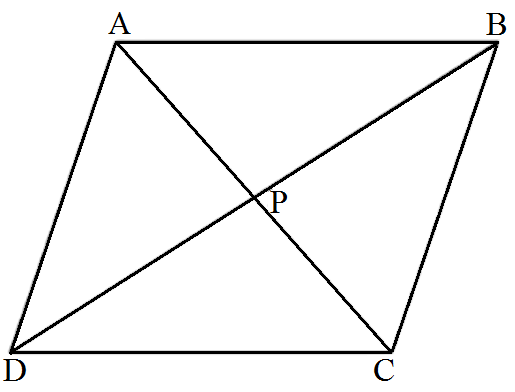 Given a parallelogram ABCD and P is the point of intersection of its diagonals. We know the diagonals of a parallelogram, bisect eacg other. Therefore,
$\frac{\overrightarrow{\text{OA}}+\overrightarrow{\text{OC}}}2=\overrightarrow{\text{OP}}$
$\overrightarrow{\text{OA}}+\overrightarrow{\text{OC}}=2\ \overrightarrow{\text{OP}}\ \dots(1)$
and $\frac{\overrightarrow{\text{OB}}+\overrightarrow{\text{OD}}}2=\overrightarrow{\text{OP}}$
$\overrightarrow{\text{OB}}+\overrightarrow{\text{OD}}=2\ \overrightarrow{\text{OP}}\ \dots(2)$
Adding (1) and (2), We get,
$\overrightarrow{\text{OA}}+\overrightarrow{\text{OB}}+\overrightarrow{\text{OC}}+\overrightarrow{\text{OD}}=4\ \overrightarrow{\text{OP}}$ View full question & answer→Question 1363 Marks
Find a vector $\vec{\text{r}}$ of magnitude $3\sqrt{2}$ units which makes an angle of $\frac{\pi}{4}$ and $\frac{\pi}{2}$ with and z-axes respectively.
AnswerSuppose vector $\vec{\text{r}}$ makes an angle with the $\alpha$ x-axis.Let l, m, n be the direction cosines of $\vec{\text{r}}$. Then,
$\text{l}=\cos\alpha,\text{m}=\cos\frac{\pi}{4}=\frac{1}{\sqrt{2}},\text{n}=\cos\frac{\pi}{2}=0$
Now,
$\text{l}^2+\text{m}^2+\text{n}^2=1$
$\Rightarrow\cos^2\alpha+\frac{1}{2}+0=1$
$\Rightarrow\cos^2\alpha=1-\frac{1}{2}=\frac{1}{2}$
$\Rightarrow\cos^2\alpha=\pm\frac{1}{\sqrt{2}}$
We know that,
$\vec{\text{r}}=|\vec{\text{r}}|\big(\text{l}\hat{\text{i}}+\text{m}\hat{\text{j}}+\text{n}\hat{\text{k}}\big)$
$\therefore\vec{\text{r}}=3\sqrt{2}\Big(\pm\frac{1}{\sqrt{2}}\hat{\text{i}}+\frac{1}{\sqrt{2}}\hat{\text{i}}+0\hat{\text{k}}\Big)\ (|\vec{\text{a}}|=3\sqrt{2})$
$\Rightarrow\vec{\text{r}}=\pm3\hat{\text{i}}+3\hat{\text{j}}$
View full question & answer→Question 1373 Marks
Write two different vectors having same direction.
AnswerConsider $\vec{P}=\Big(\hat{i}+\hat{j}+\hat{k}\Big)\ \text{and}\ \vec{q}=\Big(2\hat{i}+2\hat{j}+2\hat{k}\Big).$The direction cosines of $\vec{p}$ are given by,
$I=\frac{1}{\sqrt{1^2+1^2+1^2}}=\frac{1}{\sqrt{3}},$ $m=\frac{1}{\sqrt{1^2+1^2+1^2}}=\frac{1}{\sqrt{3}},$ $\text{and}\ n=\frac{1}{\sqrt{1^2+1^2+1^2}}=\frac{1}{\sqrt{3}},$ The direction cosines of $\vec{q}$ are given by,$I=\frac{2}{\sqrt{2^2+2^2+2^2}}=\frac{2}{2\sqrt{3}}=\frac{1}{\sqrt{3}},$ $m=\frac{2}{\sqrt{2^2+2^2+2^2}}=\frac{2}{2\sqrt{3}}=\frac{1}{\sqrt{3}},$ $\text{and}\ n=\frac{2}{\sqrt{2^2+2^2+2^2}}=\frac{2}{2\sqrt{3}}=\frac{1}{\sqrt{3}},$
The direction cosines of $\vec{p}\ \text{and}\ \vec{q}$ are the same. Hence, the tow vectors have the same direction.
View full question & answer→Question 1383 Marks
Find the area of the pallallelogram determined by the vectors:$2\hat{\text{i}}$ and $3\hat{\text{j}}$
AnswerLet:
$\vec{\text{a}}=2\hat{\text{i}}+0\hat{\text{j}}+0\hat{\text{k}}$
$\vec{\text{b}}=0\hat{\text{i}}+3\hat{\text{j}}+0\hat{\text{k}}$
$\therefore\vec{\text{a}}\times\vec{\text{b}}=\begin{vmatrix}\hat{\text{i}}&\hat{\text{j}}&\hat{\text{k}}\\2&0&0\\0&3&0 \end{vmatrix}$
$=(0-0)\hat{\text{i}}-(0-0)\hat{\text{j}}+(6 - 0) \hat{\text{k}}$
$=0\hat{\text{i}}+0\hat{\text{j}}+6\hat{\text{k}}$
Area of the parallelogram $=\big|\vec{\text{a}}\times\vec{\text{b}}\big|$
$=\sqrt{0+0+6 ^2}$
$=6\text{ sq. units}$
View full question & answer→