Question 513 Marks
If $|\vec{\text{a}}|=2,\big|\vec{\text{b}}\big|=5$ and $\big|\vec{\text{a}}\times\vec{\text{b}}\big|=8,$ find $\vec{\text{a}}.\vec{\text{b}}.$
AnswerWe know
$\big(\vec{\text{a}}.\vec{\text{b}}\big)^2+\big|\vec{\text{a}}\times\vec{\text{b}}\big|^2=|\vec{\text{a}}|^2\big|\vec{\text{b}}\big|^2$
$\Rightarrow\big(\vec{\text{a}}.\vec{\text{b}}\big)^2+8^2=2^2\times5^2$ $\big(\therefore\big|\vec{\text{a}}\times\vec{\text{b}}\big|=8,|\vec{\text{a}}|=2$and $\big|\vec{\text{b}}\big|=5\big)$
$\Rightarrow\big(\vec{\text{a}}.\vec{\text{b}}\big)^2+64=100$
$\Rightarrow\big(\vec{\text{a}}.\vec{\text{b}}\big)^2=36$
$\Rightarrow\big(\vec{\text{a}}.\vec{\text{b}}\big)=6$
View full question & answer→Question 523 Marks
Write the projection of $\vec{\text{b}}+\vec{\text{c}}$ on $\vec{\text{a}}$ when $\vec{\text{a}}=2\hat{\text{i}}-2\hat{\text{j}}+\hat{\text{k}},\vec{\text{b}}=\hat{\text{i}}+2\hat{\text{j}}-2\hat{\text{k}}$ and $\vec{\text{c}}=2\hat{\text{i}}-\hat{\text{j}}+4\hat{\text{k}}.$
AnswerGiven that
$\vec{\text{a}}=2\hat{\text{i}}-2\hat{\text{j}}+\hat{\text{k}}$
$\vec{\text{b}}=\hat{\text{i}}+2\hat{\text{j}}-2\hat{\text{k}}$
$\vec{\text{c}}=2\hat{\text{i}}-\hat{\text{j}}+4\hat{\text{k}}$
$\vec{\text{b}}+\vec{\text{c}}=\hat{\text{i}}+2\hat{\text{j}}-2\hat{\text{k}}+2\hat{\text{i}}-\hat{\text{j}}+4\hat{\text{k}}$
$=3\hat{\text{i}}+\hat{\text{j}}+2\hat{\text{k}}$
Projection of $\vec{\text{b}}+\vec{\text{c}}$ on $\vec{\text{a}}$ is
$\frac{\big(\vec{\text{b}}+\vec{\text{c}}\big).\vec{\text{a}}}{|\vec{\text{a}}|}$
$=\frac{\big(3\hat{\text{i}}+\hat{\text{j}}+2\hat{\text{k}}\big).\big(2\hat{\text{i}}-2\hat{\text{j}}+\hat{\text{k}}\big)}{2\hat{\text{i}}-2\hat{\text{j}}+\hat{\text{k}}}$
$=\frac{6-2+2}{\sqrt{4+4+1}}$
$=\frac{6}{3}$
$=2$
View full question & answer→Question 533 Marks
Using vectors, find the value of $\lambda$ such that the points ($\lambda$, -10, 3), (1, -1, 3) and (3, 5, 3) are collinear.
AnswerPoints ($\lambda$, -10, 3), (1, -1, 3) and (3, 5, 3) are collinear.$\therefore$ ($\lambda$, -10, 3) = x(1, -1, 3) + y(3, 5, 3) for some scalars x and y.
$\Rightarrow\lambda$ = x + 3y, -10 = -x + 5y and 3 = 3x +3y
Solving -10 = -x + 5y and 3 = 3x + 3y for x and y we get,
$\text{x}=\frac{5}2$ and $\text{y}=-\frac{3}2$
Now,
$\lambda=\text{x}+3\text{y}$
$\Rightarrow\lambda=\frac{5}2+3\Big(-\frac{3}2\Big)=-2$
View full question & answer→Question 543 Marks
Find a vector whose length is 3 and which is perpendicular to the vector $\vec{\text{a}}=3\hat{\text{i}}+\hat{\text{j}}-4\hat{\text{k}}$ and $\vec{\text{b}}=6\hat{\text{i}}+5\hat{\text{j}}-2\hat{\text{k}}.$
Answervector perpendicular to $\vec{\text{a}}$ and $\vec{\text{b}}$
with magnitude $1=\frac{\vec{\text{a}}\times\vec{\text{b}}}{\big|\vec{\text{a}}\times\vec{\text{b}}\big|}$
$=\frac{1}{49}\big(7\big(6\hat{\text{i}}+2\hat{\text{j}}-3\hat{\text{k}}\big)\big)$
$=\frac{1}{7}\big(6\hat{\text{i}}+2\hat{\text{j}}-3\hat{\text{k}}\big)$
vector of magnitude 49, which is perpendicular to $\vec{\text{a}}$ and $\vec{\text{b}}$
$=49\Bigg(\frac{\vec{\text{a}}\times\vec{\text{b}}}{\big|\vec{\text{a}}\times\vec{\text{b}}\big|}\Bigg)$
$=49\big[\frac{1}{7}\big(6\hat{\text{i}}+2\hat{\text{j}}-3\hat{\text{k}}\big)\big]$
$=42\hat{\text{i}}+14\hat{\text{j}}-21\hat{\text{k}}$
The required vector $=42\hat{\text{i}}+14\hat{\text{j}}-21\hat{\text{k}}$
View full question & answer→Question 553 Marks
If $\big|\vec{\text{a}}\times\vec{\text{b}}\big|^2+\big|\vec{\text{a}}.\vec{\text{b}}\big|^2=400$ and $|\vec{\text{a}}|=5,$ then write the value of $\big|\vec{\text{b}}\big|.$
Answer$\big|\vec{\text{a}}\times\vec{\text{b}}\big|^2+\big|\vec{\text{a}}.\vec{\text{b}}\big|^2=400$ $\Rightarrow\Big\{|\vec{\text{a}}|\big|\vec{\text{b}}\big|\sin\theta\Big\}^2+\Big\{|\vec{\text{a}}|\big|\vec{\text{b}}\big|\cos\theta\Big\}^2=400$ $\Rightarrow|\vec{\text{a}}|^2\big|\vec{\text{b}}\big|^2\sin^2\theta+|\vec{\text{a}}|^2\big|\vec{\text{b}}\big|^2\cos^2\theta=400$ $\Rightarrow|\vec{\text{a}}|^2\big|\vec{\text{b}}\big|^2=400$ $\Rightarrow25\times\big|\vec{\text{b}}\big|^2=400$ $\Rightarrow\big|\vec{\text{b}}\big|^2=16$$\Rightarrow\big|\vec{\text{b}}\big|^2=4$
View full question & answer→Question 563 Marks
Let $\vec{\text{a}},\vec{\text{b}},\vec{\text{c}},\vec{\text{d}}$ be the position vectors of the four distinct points A, B, C, D. If $\vec{\text{b}}-\vec{\text{a}}=\vec{\text{c}}-\vec{\text{d}}$, then show that ABCD is a parallelogram.
AnswerHere it is given that $\vec{\text{a}},\vec{\text{b}},\vec{\text{c}}\text{ and }\vec{\text{d}}$ be the position vectors of the four distinct points A, B, C, D such that,
$\vec{\text{b}}-\vec{\text{a}}=\vec{\text{c}}-\vec{\text{d}}$
Given that,
$\vec{\text{b}}-\vec{\text{a}}=\vec{\text{c}}-\vec{\text{d}}$
$\overrightarrow{\text{AB}}=\overrightarrow{\text{DC}}$
So, AB is parallel and equal to DC (in magnitude).
Hence,
ABCD is a parallelogram.
View full question & answer→Question 573 Marks
If $\vec{\text{a}}=\hat{\text{i}}-2\hat{\text{j}}+3\hat{\text{k}},$ and $\vec{\text{b}}=2\hat{\text{i}}+3\hat{\text{j}}-5\hat{\text{k}},$ then find $\vec{\text{a}}\times\vec{\text{b}}.$ verify that $\vec{\text{a}}$ and $\vec{\text{a}}\times\vec{\text{b}}$ are perpendicular to each other.
AnswerGiven:
$\vec{\text{a}}=\hat{\text{i}}-2\hat{\text{j}}+3\hat{\text{k}}$
$\vec{\text{b}}=2\hat{\text{i}}+3\hat{\text{j}}-5\hat{\text{k}}$
$\vec{\text{a}}\times\vec{{\text{b}}}=\begin{vmatrix}\hat{\text{i}}&\hat{\text{j}}&\hat{\text{k}}\\1&-2&3\\2&3&-5 \end{vmatrix}$
$=\hat{\text{i}}+11\hat{\text{j}}+7\hat{\text{k}}$
Now,
$\vec{\text{a}}.\big(\vec{\text{a}}\times\vec{\text{b}}\big)=1-22+21$
$=0$
Thus, $\vec{\text{a}}$ is perpendicular to $\vec{\text{a}}\times\vec{\text{b}}.$
View full question & answer→Question 583 Marks
Find a vector in the direction of vector $5\hat{i}-\hat{j}+2\hat{k}$ which has magnitude 8 units.
Answer$\text{Let}\ \vec{a}=5\hat{i}-\hat{j}+2\hat{k.}$
$\therefore\ {|\vec{a}|}=\sqrt{5^2+(-1)^2+2^2}=\sqrt{25+1+4}=\sqrt{30}$
$\therefore\ {\hat{a}}=\frac{\vec{a}}{|\vec{a}|}=\frac{5\hat{i}-\hat{j}+2\hat{k}}{{\sqrt{30}}}$
Hence, the vector in the direction of vector $5\hat{i}-\hat{j}+2\hat{k}$ which has magnitude 8 units is given by,
$8\hat{a}=8\bigg(\frac{5\hat{i}-{\hat{j}+2\hat{k}}}{\sqrt{30}}\bigg)=\frac{40}{\sqrt{30}}\hat{i}-\frac{8}{\sqrt{30}}\hat{j}+\frac{16}{\sqrt{30}}\hat{k}$
$=8\bigg(\frac{5\vec{i}-\vec{j}+2\vec{k}}{\sqrt{30}}\bigg)$
$=\frac{40}{\sqrt{30}}\vec{i}-\frac{8}{\sqrt{30}}\vec{j}+\frac{16}{\sqrt{30}}\vec{k}$
View full question & answer→Question 593 Marks
A vector makes an angle of $\frac{\pi}4$ with each of x-axis and y-axis. Find the angle made by it with the z-axis.
AnswerLet the vector $\overrightarrow{\text{OP}}$ makes an angle $\alpha=45^{\circ}$ and $\beta=45^{\circ}$ with OX, OY respectively. Suppose $\overrightarrow{\text{OP}}$ is inclined at angle $\gamma$ to OZ.
Let l, m, n be the direction cosines of $\overrightarrow{\text{OP}}$. Then,
$\text{l}=\cos\frac{\pi}4=\frac{1}{\sqrt2}$
$\text{m}=\cos\frac{\pi}4=\frac{1}{\sqrt2}$
$\text{n}=\cos\gamma$
Now, we have,
$\text{l}^2+\text{m}^2+\text{n}^2=1$
$\Rightarrow\ \frac{1}2+\frac{1}2+\text{n}^2=1$
$\Rightarrow\ \text{n}^2=0$
$\Rightarrow\ \text{n}=0$
$\Rightarrow\ \cos\gamma=\cos\frac{\pi}2$
$\Rightarrow\ \gamma= \frac{\pi}2$
Hence, the angle made by it with the z-axis is $\frac{\pi}2$.
View full question & answer→Question 603 Marks
Find a vector of magnitude of 5 units parallel to the resultant of the vectors $\vec{\text{a}}=2\hat{\text{i}}+3\hat{\text{j}}-\hat{\text{k}}$ and $\vec{\text{b}}=\hat{\text{i}}-2\hat{\text{j}}+\hat{\text{k}}$.
AnswerGiven that, $\vec{\text{a}}=2\hat{\text{i}}+3\hat{\text{j}}-\hat{\text{k}}$ and $\vec{\text{b}}=\hat{\text{i}}-2\hat{\text{j}}+\hat{\text{k}}$Thus, Find a vector of mangnitude of 5 units parallel to the resultant of the vectors
$\vec{\text{a}}+\vec{\text{b}}=2\hat{\text{i}}+3\hat{\text{j}}-\hat{\text{k}}+\hat{\text{i}}-2\hat{\text{j}}+\hat{\text{k}}$
$\Rightarrow\vec{\text{a}}+\vec{\text{b}}=3\hat{\text{i}}+\hat{\text{j}}$
$\Rightarrow\big|\vec{\text{a}}+\vec{\text{b}}\big|=\sqrt{9+1}=\sqrt{10}$
Thus, the unit vector along the resultant vector $\vec{\text{a}}+\vec{\text{b}}$ is $\frac{3\hat{\text{i}}+\hat{\text{j}}}{\sqrt{10}}$
The vector of magnitude of 5 units parallel to the resultant vector$=\frac{3\hat{\text{i}}+\hat{\text{j}}}{\sqrt{10}}\times5=\sqrt{\frac{5}{2}}\big(3\hat{\text{i}}+\hat{\text{j}}\big)$
View full question & answer→Question 613 Marks
If $\vec{\text{a}}$ and $\vec{\text{b}}$ are perpendicular vectors, $\big|\vec{\text{a}}+\vec{\text{b}}\big|=3$ and $|\vec{\text{a}}|=5,$ find the value of $\big|\vec{\text{b}}\big|.$
AnswerDisclamer: $\big|\vec{\text{a}}+\vec{\text{b}}\big|=3$ has been taken in order to solve question.
It is given that $\vec{\text{a}}$ and $\vec{\text{b}}$ are perpendicular vectors.
$\therefore\vec{\text{a}}.\vec{\text{b}}=0\dots(1)$
$\big|\vec{\text{a}}+\vec{\text{b}}\big|=13$
$\Rightarrow\big|\vec{\text{a}}+\vec{\text{b}}\big|^2=169$
$\Rightarrow|\vec{\text{a}}|^2+2\vec{\text{a}}.\vec{\text{b}}+\big|\vec{\text{b}}\big|^2=169$
$\Rightarrow25+2\times0+\big|\vec{\text{b}}\big|^2=169$ [using (1)]
$\Rightarrow\big|\vec{\text{b}}\big|^2=169-25=144$
$\Rightarrow\big|\vec{\text{b}}\big|=12$
Thus, the value of $\big|\vec{\text{b}}\big|$ is 12.
View full question & answer→Question 623 Marks
If $\vec{\text{a}},\vec{\text{b}},\vec{\text{c}}$ are three unit vectors such that $\vec{\text{a}}\times\vec{\text{b}}=\vec{\text{c}},\vec{\text{b}}\times\vec{\text{c}}=\vec{\text{a}},\vec{\text{c}}\times\vec{\text{a}}=\vec{\text{b}}.$Show that $\vec{\text{a}},\vec{\text{b}},\vec{\text{c}}$ from an orthonormal right handed triad of unit vectors.
AnswerGiven:
$\vec{\text{a}}\times\vec{\text{b}}=\vec{\text{c}}$
$\vec{\text{b}}\times\vec{\text{c}}=\vec{\text{a}}$
$\vec{\text{c}}\times\vec{\text{a}}=\vec{\text{b}}\dots(1)$
Now,
$\big|\vec{\text{a}}\times\vec{\text{b}}\big|=|\vec{\text{c}}|=1$ ( $\because\vec{\text{c}}$ is a unit vector)
$\big|\vec{\text{b}}\times\vec{\text{c}}\big|=|\vec{\text{a}}|=1$ ($\because\vec{\text{a}}$ is a unit vector)
$\big|\vec{\text{c}}\times\vec{\text{a}}\big|=\big|\vec{\text{b}}\big|=1$ ($\because\vec{\text{b}}$ is a unit vector)
$\therefore\big|\vec{\text{a}}\times\vec{\text{b}}\big|=\big|\vec{\text{b}}\times\vec{\text{c}}\big|=\big|\vec{\text{c}}\times\vec{\text{a}}\big|=1\dots(2)$
From (1) and (2), we know
$\vec{\text{a}},\vec{\text{b}}$ and $\vec{\text{c}}$ form an orthonormal right handed triad of unit vectors.
View full question & answer→Question 633 Marks
If $\vec{\text{c}}$ is perpendicular to both $\vec{\text{a}}$ and $\vec{\text{b}},$ then prove that it is perpendicular to both $\vec{\text{a}}+\vec{\text{b}}$ and $\vec{\text{a}}-\vec{\text{b}}.$
AnswerGiven that $\vec{\text{c}}$ is perpendicular to both $\vec{\text{a}}$ and $\vec{\text{b}}.$
$\Rightarrow\vec{\text{c}}.\vec{\text{a}}=0$ and $\vec{\text{c}}.\vec{\text{b}}=0\dots(1)$
Now,
$\vec{\text{c}}.\big(\vec{\text{a}}+\vec{\text{b}}\big)=\vec{\text{c}}.\vec{\text{a}}+\vec{\text{c}}.\vec{\text{b}}=0+0=0$ [From (1)]
So, $\vec{\text{c}}$ is perpendicular to $\vec{\text{a}}+\vec{\text{b}}.$
Again,
$\vec{\text{c}}.\big(\vec{\text{a}}-\vec{\text{b}}\big)=\vec{\text{c}}.\vec{\text{a}}-\vec{\text{c}}.\vec{\text{b}}=0-0=0$ [From (1)]
So, $\vec{\text{c}}$ is perpendicular to $\vec{\text{a}}-\vec{\text{b}}.$
View full question & answer→Question 643 Marks
Show that the vectores $\vec{\text{a}}=3\hat{\text{i}}-2\hat{\text{j}}+\hat{\text{k}},\vec{\text{b}}=\hat{\text{i}}-3\hat{\text{j}}+5\hat{\text{k}},\vec{\text{c}}=2\hat{\text{i}}+\hat{\text{j}}-4\hat{\text{k}}$from a right-angled triangle.
AnswerLet ABC be the given triangle and
$\overrightarrow{\text{AC}}=\vec{\text{b}}=\hat{\text{i}}-3\hat{\text{j}}+5\hat{\text{k}}$
$\overrightarrow{\text{CB}}=\vec{\text{a}}=3\hat{\text{i}}-2\hat{\text{j}}+\hat{\text{k}}$
$\overrightarrow{\text{AB}}=\vec{\text{c}}=2\hat{\text{i}}+\hat{\text{j}}-4\hat{\text{k}}$
$\vec{\text{a}}.\vec{\text{b}}=3+6+5=14$
$\vec{\text{b}}.\vec{\text{c}}=2-3-20=-21$
$\vec{\text{c}}.\vec{\text{a}}=6-2-4=0$
So, $\overrightarrow{\text{AB}}$ is perpendicular to $\overrightarrow{\text{CB}}.$
Thus, $\triangle\text{ABC}$ is aright-angled triangle.
View full question & answer→Question 653 Marks
Express $\overrightarrow{\text{AB}}$ in terms of unit vectors $\hat{\text{i}}\text{ and }\hat{\text{j}}$, when the point is:A(-6, 3), B(-2, -5)
Find $\Big|\overrightarrow{\text{AB}}\Big|$
AnswerHere, A = (-6, 3) B = (-2, -5) Position vector of $\text{A}=-6\hat{\text{i}}+3\hat{\text{j}}$ Position vector of $\text{B}=-2\hat{\text{i}}-5\hat{\text{j}}$ $\overrightarrow{\text{AB}}$ = Position vector of B - Position vector of A$=\big(-2\hat{\text{i}}-5\hat{\text{j}}\big)-\big(-6\hat{\text{i}}+3\hat{\text{j}}\big)$
$=-2\hat{\text{i}}-5\hat{\text{j}}+6\hat{\text{i}}-3\hat{\text{j}}$
$\overrightarrow{\text{AB}}=4\hat{\text{i}}-8\hat{\text{j}}$
$\Big|\overrightarrow{\text{AB}}\Big|=\sqrt{(4)^2+(-8)^2}$
$=\sqrt{16+64}$
$=\sqrt{80}$
$=\sqrt{16\times5}$ $=4\sqrt5$$\Big|\overrightarrow{\text{AB}}\Big|=4\sqrt5$
$\overrightarrow{\text{AB}}=4\hat{\text{i}}-8\hat{\text{j}}$
View full question & answer→Question 663 Marks
If $|\vec{\text{a}}|=2,\big|\vec{\text{b}}\big|=7$ and $\vec{\text{a}}\times\vec{\text{b}}=3\hat{\text{i}}+2\hat{\text{j}}+6\hat{\text{k}},$ find the angle between $\vec{\text{a}}$ and $\vec{\text{b}}.$
AnswerWe know that, if $\theta$ be the angle between $\vec{\text{a}}$ and $\vec{\text{b}},$ then $\vec{\text{a}}.\vec{\text{b}}=|\vec{\text{a}}|\big|\vec{\text{b}}\big|\cos\theta\dots(1)$ And, $\vec{\text{a}}\times\vec{\text{b}}=|\vec{\text{a}}|\big|\vec{\text{b}}\big|.\sin\theta.\hat{\text{n}}$ $\big|\vec{\text{a}}\times\vec{\text{b}}\big|=|\vec{\text{a}}|.\big|\vec{\text{b}}\big|.|\sin\theta|.|\hat{\text{n}}|$$=|\vec{\text{a}}|\big|\vec{\text{b}}\big||\sin\theta|.1$ [Since, $\hat{\text{n}}$ is a unit vector]
$\big|\vec{\text{a}}\times\vec{\text{b}}\big|=|\vec{\text{a}}|\big|\vec{\text{b}}\big|\sin\theta\dots(2)$ Given that, $\big|\vec{\text{a}}\times\vec{\text{b}}\big|=\vec{\text{a}}.\vec{\text{b}}$ $|\vec{\text{a}}|\big|\vec{\text{b}}\big|\sin\theta=|\vec{\text{a}}|.\big|\vec{\text{b}}\big|\cos\theta$ $\sin\theta=\cos\theta$ $\theta=\frac{\pi}{4}$ Angle between $\vec{\text{a}}$ and $\vec{\text{b}}=\frac{\pi}{4}$
View full question & answer→Question 673 Marks
Find the coordinates of the tip of the position vector which is equivalent to $\overrightarrow{\text{AB}}$, where the coordinates of A and B are (-1, 3) and (-2, 1) respectively.
AnswerLet O be the origin. Let P(x, y) be the required point. Then $\vec{\text{P}}$ is the tip of the position vector $\overrightarrow{\text{OP}}$ of the point P. We have,$\overrightarrow{\text{OP}}=\text{x}\hat{\text{i}}+\text{y}\hat{\text{j}}$
And, $\overrightarrow{\text{AB}}$ = Position vector of B - Position vector of A $=\big(-2\hat{\text{i}}+\hat{\text{j}}\big)-\big(-\hat{\text{i}}+3\hat{\text{j}}\big)$ $=-2\hat{\text{i}}+\hat{\text{j}}+\hat{\text{i}}-3\hat{\text{j}}$ $=-\hat{\text{i}}-2\hat{\text{j}}$ Given that $\overrightarrow{\text{OP}}=\overrightarrow{\text{AB}}$ So, $\text{x}\hat{\text{i}}+\text{y}\hat{\text{j}}=-\hat{\text{i}}-2\hat{\text{j}}\Leftrightarrow\text{x}=-1,\ \text{y}=-2$ Hence, coordinated of the required point is (-1, -2)
View full question & answer→Question 683 Marks
Show that $\big|\vec{a}|\ \vec{b}+\big|\vec{b}\big|\ \vec{a}$ is perpendicular to $\big|\vec{a}|\ \vec{b}-\big|\vec{b}\big|\ \vec{a},$ for any two nonzero vectors $\vec{a}\ \text{and}\ \vec{b}.$
Answer$\text{Let}\ \vec{c}=\big|\vec{a}\big|\ \vec{b}+\big|\vec{b}\big|\ \vec{a}=l\vec{b}+m\vec{a},$ $\text{where}\ l=\big|\vec{a}\big|\ \text{and}\ m=\big|\vec{b}\big|$ $\text{Let}\ \ \ \ \ \ \vec{d}=\big|\vec{a}\big|\ \vec{b}-\big|\vec{b}\big|\ \vec{a}=l\vec{b}-m\vec{a}$ $\text{Now}\ \ \ \ \ \ \big|\vec{c}\big|.\Big|\vec{d}\Big|=\big(l\vec{b}+m\vec{a}\big)\big(l\vec{b}-m\vec{a}\big)$ $=l^2\vec{b}.\vec{b}-lm\ \vec{b}.\vec{a}+lm\vec{a}.\vec{b}-m^2\vec{a}.\vec{a}$$=l^2\Big|\vec{b}\Big|^2-lm\vec{a}.\vec{b}+lm\vec{a}.\vec{b}-m^2\big|\vec{a}|^2$
$=l^2\Big|\vec{b}\Big|^2-m^2\big|\vec{a}|^2$
$\text{Putting},\ l=\big|\vec{a}\big|\ \text{and}\ m=\Big|\vec{b}\Big|,$$=\big|\vec{a}\big|^2\big|\vec{b}\big|^2-\big|\vec{b}\big|^2\cdot|\vec{a}|^2$
$\Rightarrow\ \ \ \ \ \ \big|\vec{c}\big|.\Big|\vec{d}\Big|=0$
View full question & answer→Question 693 Marks
$\text{Let}\ \vec{\text{a}}=\hat{\text{i}}+4\hat{\text{j}}+2\hat{\text{k}},\ \vec{\text{b}}=3\hat{\text{i}}-2\hat{\text{j}}+7\hat{\text{k}}$ and $ \vec{\text{c}}=2\hat{\text{i}}-\hat{\text{j}}+4\hat{\text{k}}.$ Find a vector $\vec{\text{d}}$ which is perpendicular to both $\vec{\text{a}}\ \text{and}\ \vec{\text{b}},\ \text{and}\ \vec{\text{c}}\cdot\vec{\text{d}}=15.$
Answer$\text{Let}\ \vec{\text{d}}=\text{d}_{1}\hat{\text{i}}+\text{d}_{2}\hat{\text{j}}+\text{d}_{3}\hat{\text{k}}$ Since $\vec{\text{d}}$ is perpendicular to both $\vec{\text{a}}\ \text{and}\ \vec{\text{b}},$ we have: $\vec{\text{d}}\cdot\vec{\text{a}}=0$ $\Rightarrow \text{d}_{1}+4\text{d}_{2}+2\text{d}_{3}=0\ \ \ ...\text{(i)}$ And, $\vec{\text{d}}\cdot\vec{\text{b}}=0$ $\Rightarrow 3\text{d}_{1}-2\text{d}_{2}+7\text{d}_{3}=0\ \ \ ...\text{(ii)}$ Also, it is given that: $\vec{\text{c}}\cdot\vec{\text{d}}=15$ $\Rightarrow 2\text{d}_{1}-\text{d}_{2}+4\text{d}_{3}=15\ \ \ ...\text{(iii)}$ On solving (i), (ii), and (iii), we get: $\text{d}_{1}=\frac{160}{3},\text{d}_{2}=-\frac{5}{3}\ \text{and}\ \text{d}_{3}=-\frac{70}{3}$ $\therefore\vec{\text{d}}=\frac{160}{3}\hat{\text{i}}-\frac{5}{3}\hat{\text{j}}-\frac{70}{3}\hat{\text{k}}=\frac{1}{3}\Big(160\hat{\text{i}}-5\hat{\text{j}}-70\hat{\text{k}}\Big)$Hence, the required vector is $\frac{1}{3}\Big(160\hat{\text{i}}-5\hat{\text{j}}-70\hat{\text{k}}\Big)$
View full question & answer→Question 703 Marks
For any two vectors $\vec{\text{a}}$ and $\vec{\text{b}}$ of magnitudes 3 and 4 respectively, write the value of $\big[\vec{\text{a}}\vec{\text{b}}\vec{\text{a}}\times\vec{\text{b}}\big]+\big(\vec{\text{a}}.\vec{\text{b}}\big)^2$
AnswerWe have
$\big[\vec{\text{a}}\vec{\text{b}}\vec{\text{a}}\times\vec{\text{b}}\big]+\big(\vec{\text{a}}.\vec{\text{b}}\big)^2$
$=\big[\big(\vec{\text{a}}\times\vec{\text{b}}\big).\big(\vec{\text{a}}\times\vec{\text{b}}\big)\big]+\big(\vec{\text{a}}.\vec{\text{b}}\big)^2$ (By definition of scalar triple product)
$=\big|\big(\vec{\text{a}}\times\vec{\text{b}}\big)\big|^2+\big(\vec{\text{a}}.\vec{\text{b}}\big)^2$
$=\big(\big|\vec{\text{a}}\big|\big|\vec{\text{b}}\big|\sin\theta\big)^2+\big(\big|\vec{\text{a}}\big|\big|\vec{\text{b}}\big|\cos\theta\big)^2$
$=\big(\big|\vec{\text{a}}\big|\big|\vec{\text{b}}\big|\big)^2\sin^2\theta+\big(\big|\vec{\text{a}}\big|\big|\vec{\text{b}}\big|\big)^2\cos^2\theta$
$=\big(\big|\vec{\text{a}}\big|\big|\vec{\text{b}}\big|\big)^2(\sin^2\theta+\cos^2\theta)$
$=\big(\big|\vec{\text{a}}\big|\big|\vec{\text{b}}\big|\big)^2$ $\big(\therefore\sin^2\theta+\cos^2\theta=1\big)$
$=(3\times4)^2$ $\text{(Given}:\big|\vec{\text{a}}\big|=3\text{ and } \big|\vec{\text{b}}\big|=4\big)$ $$
$=144$
View full question & answer→Question 713 Marks
Find the position vector of a point R which divides the line joining the two points P and Q with position vectors $\overrightarrow{\text{OP}}=2\vec{\text{a}}+\vec{\text{b}}\text{ and }\overrightarrow{\text{OQ}}=\vec{\text{a}}-2\vec{\text{b}}$, respectively in the ratio 1 : 2 internally and externally.
AnswerIt is given that P and Q are two points with position vectors $\overrightarrow{\text{OP}}=2\vec{\text{a}}+\vec{\text{b}}\text{ and }\overrightarrow{\text{OQ}}=\vec{\text{a}}-2\vec{\text{b}}$, respectively.
When R divides PQ internally in the ratio 1 : 2, then
Position vector of $\text{R}=\frac{1\times\big(\vec{\text{a}}-2\vec{\text{b}}\big)+2\times\big(2\vec{\text{a}}+\vec{\text{b}}\big)}{1+2}=\frac{5\vec{\text{a}}}{3}$
When R divides PQ externally in the ratio 1 : 2, then
Position vector of $\text{R}=\frac{1\times\big(\vec{\text{a}}-2\vec{\text{b}}\big)-2\times\big(2\vec{\text{a}}+\vec{\text{b}}\big)}{1-2}=\frac{-3\vec{\text{a}}-4\vec{\text{b}}}{-1}=3\vec{\text{a}}+4\vec{\text{b}}$
View full question & answer→Question 723 Marks
Prove that the given vectors are coplanar:
$\hat{\text{i}}+\hat{\text{j}}+\hat{\text{k}},\ 2\hat{\text{i}}+3\hat{\text{j}}-\hat{\text{k}}$ and $-\hat{\text{i}}-2\hat{\text{j}}+2\hat{\text{k}}$
AnswerGiven the vectors $\text{P}\big(\hat{\text{i}}+\hat{\text{j}}+\hat{\text{k}}\big),\ \text{Q}\big(2\hat{\text{i}}+3\hat{\text{j}}-\hat{\text{k}}\big)$ and $\text{R}\big(-\hat{\text{i}}-2\hat{\text{j}}+2\hat{\text{k}}\big)$
We know the three vectors are coplanar if oneof them is expressible as a linear combination of the other two. Let,
$\hat{\text{i}}+\hat{\text{j}}+\hat{\text{k}}=\text{x}\big(2\hat{\text{i}}+3\hat{\text{j}}-\hat{\text{k}}\big)+\text{y}\big(-\hat{\text{i}}-2\hat{\text{j}}+2\hat{\text{k}}\big)$
$=\hat{\text{i}}(2\text{x}-\text{y})+\hat{\text{j}}(3\text{x}-2\text{y})+\hat{\text{k}}(-\text{x}+2\text{y})$
$\Rightarrow2\text{x}-\text{y}=1,\ 3\text{x}-2\text{y}=1,\ -\text{x}+2\text{y}=1$ [Equating the coefficients of $\hat{\text{i}},\ \hat{\text{j}},\ \hat{\text{k}}$ respectively]
Solving first two of these equation, we get x = 1, y = 1. Clearly these two values satisfy the third equation.
Hence, the given vectors are coplanar.
View full question & answer→Question 733 Marks
Find the volume of the parallelopiped whose coterminous edges are represented by the vectors:
$\vec{\text{a}}=11\hat{\text{i}},\vec{\text{b}}=2\hat{\text{j}},\vec{\text{c}}=13\hat{\text{k}}$
AnswerGiven,
$\vec{\text{a}}=11\hat{\text{i}}$
$\vec{\text{b}}=2\hat{\text{j}}$
$\vec{\text{c}}=13\hat{\text{k}}$
We know that the volume of a parallelopiped whose three adjacent edges are $\vec{\text{a}}\ \vec{\text{b}}\ \vec{\text{c}}$
is equal to $\Big|\Big[\vec{\text{a}}\ \vec{\text{b}}\ \vec{\text{c}}\Big]\Big|$ Here,
$\Big[\vec{\text{a}}\ \vec{\text{b}}\ \vec{\text{c}}\Big]=\begin{vmatrix}11&0&0\\0&2&0\\0&0&13 \end{vmatrix}$
$=11(26-0)-0(0-0)+0(0-0)$
$=286$
volume of the parallelopiped $=\Big|\Big[\vec{\text{a}}\ \vec{\text{b}}\ \vec{\text{c}}\Big]\Big|=|286|=286$ cubic units.
View full question & answer→Question 743 Marks
Prove that the given vectors are coplanar:
$2\hat{\text{i}}-\hat{\text{j}}+\hat{\text{k}},\ \hat{\text{i}}-3\hat{\text{j}}-5\hat{\text{k}}$ and $3\hat{\text{i}}-4\hat{\text{j}}-4\hat{\text{k}}$
AnswerGiven the vectors $\text{P}\big(2\hat{\text{i}}-\hat{\text{j}}+\hat{\text{k}}\big),\ \text{Q}\big(\hat{\text{i}}-3\hat{\text{j}}-5\hat{\text{k}}\big)$ and $\text{R}\big(3\hat{\text{i}}-4\hat{\text{j}}-4\hat{\text{k}}\big)$
We know the three vectors are coplanar if oneof them is expressible as a linear combination of the other two. Let,
$2\hat{\text{i}}-\hat{\text{j}}+\hat{\text{k}}=\text{x}\big(\hat{\text{i}}-3\hat{\text{j}}-5\hat{\text{k}}\big)+\text{y}\big(3\hat{\text{i}}-4\hat{\text{j}}-4\hat{\text{k}}\big)$
$=\hat{\text{i}}(\text{x}+3\text{y})+\hat{\text{j}}(-3\text{x}-4\text{y})+\hat{\text{k}}(-5\text{x}-4\text{y})$
$\Rightarrow\text{x}+3\text{y}=2,\ -3\text{x}-4\text{y}=-1,\ -5\text{x}-4\text{y}=1$ [Equating the coefficients of $\hat{\text{i}},\ \hat{\text{j}},\ \hat{\text{k}}$ respectively]
Solving first two of these equation, we get x = -1, y = 1. Clearly these two values satisfy the third equation.
Hence, the given vectors are coplanar.
View full question & answer→Question 753 Marks
If $\vec{\text{a}}=2\hat{\text{i}}+2\hat{\text{j}}+3\hat{\text{k}},\vec{\text{b}}=-\hat{\text{i}}+2\hat{\text{j}}+\hat{\text{k}},$and $\vec{\text{c}}=3\hat{\text{i}}+\hat{\text{j}}$ are such that $\vec{\text{a}}+\lambda\vec{\text{b}}$ is perpendicular to $\vec{\text{c}},$ then find the value of $\lambda.$
AnswerThe given vectors are $\vec{\text{a}}=2\hat{\text{i}}+2\hat{\text{j}}+3\hat{\text{k}},\vec{\text{b}}=-\hat{\text{i}}+2\hat{\text{j}}+\hat{\text{k}},$ and $\vec{\text{c}}=3\hat{\text{i}}+\hat{\text{j}}$.
Now,
$\vec{\text{a}}+\lambda\vec{\text{b}}=\big(2\hat{\text{i}}+2\hat{\text{j}}+3\hat{\text{k}}\big)+\lambda\big(-\hat{\text{i}}+2\hat{\text{j}}+\hat{\text{k}}\big)\\=(2-\lambda)\hat{\text{i}}+(2+2\lambda)\hat{\text{j}}+(3+\lambda)\hat{\text{k}}$
If $\big(\vec{\text{a}}+\lambda\vec{\text{b}}\big)$ is perpendicular to $\vec{\text{c}},$ then
$\big(\vec{\text{a}}+\lambda\vec{\text{b}}\big).\vec{\text{c}}=0.$
$\Rightarrow\Big[\big(2-\lambda\big)\hat{\text{i}}+(2+2\lambda)\hat{\text{j}}+(3+\lambda)\hat{\text{k}}\Big].\big(3\hat{\text{i}}+\hat{\text{j}}\big)=0$
$\Rightarrow(2-\lambda)3+(2+2\lambda)1+(3+\lambda)0=0$
$\Rightarrow6-3\lambda+2+2\lambda=0$
$\Rightarrow-\lambda+8=0$
$\Rightarrow\lambda=8$
Hence, the required value of $\lambda$ is 8.
View full question & answer→Question 763 Marks
Show that the four points having position vectors $6\hat{\text{i}}-7\hat{\text{j}},\ 16\hat{\text{i}}-19\hat{\text{j}}-4\hat{\text{k}},\ 3\hat{\text{j}}-6\hat{\text{k}},\ 2\hat{\text{i}}-5\hat{\text{j}}+10\hat{\text{k}}$ are coplanar.
AnswerLet the given four points be P, Q, R and S respectively. Three points are coplanar if the vectors $\overrightarrow{\text{PQ}},\ \overrightarrow{\text{PR}}\text{ and }\overrightarrow{\text{PS}}$ are coplanar. These vectors are coplanar if one of them can be expressed as a linear combination of the other two. So, let$\overrightarrow{\text{PQ}}=\text{x}\overrightarrow{\text{PR}}+\text{y}\overrightarrow{\text{PS}}$
$10\hat{\text{i}}-12\hat{\text{j}}-4\hat{\text{k}}\\=\text{x}\big(-6\hat{\text{i}}+10\hat{\text{j}}-6\hat{\text{k}}\big)+\text{y}\big(-4\hat{\text{i}}+2\hat{\text{j}}+10\hat{\text{k}}\big)$
$\Rightarrow10\hat{\text{i}}-12\hat{\text{j}}-4\hat{\text{k}}\\=\hat{\text{i}}\big(-6{\text{x}}-4\text{y}\big)+\hat{\text{j}}\big(10{\text{x}}+2{\text{y}}\big)+\hat{\text{k}}\big(-6\text{x}+10\text{y}\big)$
$\Rightarrow-6\text{x}-4\text{y}=10,\ 10\text{x}+2\text{y}=-12$ and $-6\text{x}+10\text{y}=-4$ [Equating coefficients of $\hat{\text{i}},\ \hat{\text{j}},\ \hat{\text{k}}$ on both sides]
Solving the first of these three equations, we get x = -1 and y = -1. These values also satisfy the thied equation. Hence, the given four points are coplanar.
View full question & answer→Question 773 Marks
Find the volume of the parallelopiped whose coterminous edges are represented by the vectors:
$\vec{\text{a}}=2\hat{\text{i}}-3\hat{\text{j}}+4\hat{\text{k}},\vec{\text{b}}=\hat{\text{i}}+2\hat{\text{j}}-\hat{\text{k}},\vec{\text{c}}=3\hat{\text{i}}-\hat{\text{j}}-2\hat{\text{k}}$
AnswerGiven,
$\vec{\text{a}}=2\hat{\text{i}}-3\hat{\text{j}}+4\hat{\text{k}}$
$\vec{\text{b}}=\hat{\text{i}}+2\hat{\text{j}}-\hat{\text{k}}$
$\vec{\text{c}}=3\hat{\text{i}}-\hat{\text{j}}-2\hat{\text{k}}$
We know that the volume of a parallelopiped whose three adjacent edges are $\vec{\text{a}}\ \vec{\text{b}}\ \vec{\text{c}}$ Is equal to $\Big[\vec{\text{a}}\ \vec{\text{b}}\ \vec{\text{c}}\Big]$ Here,
$\Big[\vec{\text{a}}\ \vec{\text{b}}\ \vec{\text{c}}\Big]=\begin{vmatrix}2&-3&4\\1&2&-1\\3&-1&-2 \end{vmatrix}$
$=2(-4-1)+3(2+3)+4(-1-6)$
$=-35$
volume of the parallelopiped $=\Big|\Big[\vec{\text{a}}\ \vec{\text{b}}\ \vec{\text{c}}\Big]\Big|=|-35|=35$ cubic units.
View full question & answer→Question 783 Marks
Using vectors show that the points A(-2, 3, 5), B(7, 0, -1), C(-3. -2, -5) and D(3, 4, 7) are such that AB and CD intersect at the point P(1, 2, 3).
AnswerWe have,
$\overrightarrow{\text{AP}}=$ Position vector of P - Position vector of A
$\Rightarrow\overrightarrow{\text{AP}}=\big(\hat{\text{i}}+2\hat{\text{j}}+3\hat{\text{k}}\big)-\big(-2\hat{\text{i}}+3\hat{\text{j}}+5\hat{\text{k}}\big)$
$=3\hat{\text{i}}-\hat{\text{j}}-2\hat{\text{k}}$
$\overrightarrow{\text{PB}}=$ Position vector of B - Position vector of P
$\Rightarrow\overrightarrow{\text{PB}}=\big(7\hat{\text{i}}-0\hat{\text{j}}-\hat{\text{k}}\big)-\big(\hat{\text{i}}+2\hat{\text{j}}+3\hat{\text{k}}\big)$
$=6\hat{\text{i}}-2\hat{\text{j}}-4\hat{\text{k}}$
Since $\overrightarrow{\text{PB}}=2\overrightarrow{\text{AP}}$. So, vectors $\overrightarrow{\text{PB}}$ and $\overrightarrow{\text{AP}}$ are collinear. But P is a point common to $\overrightarrow{\text{PB}}$ and $\overrightarrow{\text{AP}}$.
Hence P, A, B are collinear points.
Now, $\overrightarrow{\text{CP}}=\big(-3\hat{\text{i}}-2\hat{\text{j}}-5\hat{\text{k}}\big)-\big(\hat{\text{i}}+2\hat{\text{j}}+3\hat{\text{k}}\big)$
$=\big(-4\hat{\text{i}}-4\hat{\text{j}}-8\hat{\text{k}}\big)$
$\overrightarrow{\text{PD}}=\big(\hat{\text{i}}+2\hat{\text{j}}+3\hat{\text{k}}\big)-\big(3\hat{\text{i}}+4\hat{\text{j}}+7\hat{\text{k}}\big)$
$=\big(-2\hat{\text{i}}-2\hat{\text{j}}-4\hat{\text{k}}\big)$
Thus, $\overrightarrow{\text{CP}}=2\overrightarrow{\text{PD}}$
So the vectors $\overrightarrow{\text{CP}}$ and $\overrightarrow{\text{PD}}$ are collinear. But P is a common point to $\overrightarrow{\text{CP}}$ and $\overrightarrow{\text{PD}}$
Hence, C, P, D are collinear points.
Thus A, B, C, D and P are points such that A, P, B and C, P, D are two sets of collinear points.
Hence, AB and CD intersect at point P.
View full question & answer→Question 793 Marks
Let $\vec{\text{a}}=\hat{\text{i}}+\hat{\text{j}}+\hat{\text{k}},\vec{\text{b}}=\hat{\text{i}}$ and $\vec{\text{c}}=\text{c}_1\hat{\text{i}}+\text{c}_2\hat{\text{j}}+\text{c}_3\hat{\text{k}}.$ Then, If $c_{1 }= 1$ and $c_{2 }= 2,$ find $c_3$ which makes $\vec{\text{a}},\vec{\text{b}}$ and $\vec{\text{c}}$ coplanar.
AnswerIf $c_1 = 1$ and $c_{2 }= 2,$ then $\vec{\text{a}}=\hat{\text{i}}+\vec{\text{j}}+\vec{\text{k}},\vec{\text{b}}=\hat{\text{i}}$ and $\vec{\text{c}}=\hat{\text{i}}+2\hat{\text{j}}+\text{c}_3\hat{\text{k}}.$
We know that vectors $\vec{\text{a}},\vec{\text{b}},\vec{\text{c}}$ are coplanar if $\big[\vec{\text{a}}\vec{\text{b}}{\text{c}}\big]=0.$
It is given that $\vec{\text{a}},\vec{\text{b}},\vec{\text{c}}$ are coplanar.
$\therefore\big[\vec{\text{a}}\vec{\text{b}}\vec{\text{c}}\big]=0$
$\Rightarrow\begin{vmatrix}1&1&1\\1&0&0\\1&2&\text{c}_3 \end{vmatrix}=0$
$\Rightarrow1(0-0)-1(\text{c}_3-0)+1(2-0)=0$
$\Rightarrow-{\text{C}}_3+2=0$
$\Rightarrow\text{C}_3=2$
View full question & answer→Question 803 Marks
$\text{Find}\ |\vec{a}|\ \text{and}\ \big|\vec{b}\big|,\text{if}\ (\vec{a}+\vec{b})\cdot(\vec{a}-\vec{b})=8\ \text{and}\ |\vec{a}|=8|\vec{b}|.$
Answer$\text{Given:}\ (\vec{a}+\vec{b}).(\vec{a}-\vec{b})=8\ \text{and}\ |\vec{a}|=8|\vec{b}|\ \ \ \ \ ....(\text{i})$
$\Rightarrow\ \ {\vec{a}.\vec{a}-\vec{a}.\vec{b}+\vec{b}.\vec{a}-\vec{b}.\vec{b}=8}{}$ $ \Rightarrow\ \ \big|\vec{a}\big|^2-\vec{a}.\vec{b}+\vec{a}.\vec{b}-\big|\vec{b}\big|^2=8$
$\Rightarrow\ \ \big|\vec{a}\big|^2-\big|\vec{b}\big|^2=8\ \ \ .....\text{(ii)}$
$\text{Putting}\ \big|\vec{a}\big|=8\big|\vec{b}\big|\ \text{in eq. (ii),}$
$ 64\bigg|\vec{b}\bigg|^2-\bigg|\vec{b}\bigg|^2=8 \ \ \Rightarrow\ \ \ (64-1)\bigg|\vec{b}\bigg|^2=8$
$\Rightarrow\ \ 63\bigg|\vec{b}\bigg|^2=8\ \ \Rightarrow\ \ \bigg|\vec{b}\bigg|^2=\frac{8}{63}$
$\Rightarrow\ \ \Big|\vec{b}\Big|=\sqrt{\frac{8}{63}}=\frac{2\sqrt{2}}{3\sqrt{7}}$
$\text{Putting}\ \Big|\vec{b}\Big|=\frac{2\sqrt{2}}{3\sqrt{7}}\ \text{in eq (i),}$
$\big|\vec{a}\big|=8\Big(\frac{2\sqrt{2}}{3\sqrt{7}}\Big)=\frac{16}{3}\sqrt{\frac{2}{7}}$
View full question & answer→Question 813 Marks
Find the volume of the parallelopiped whose coterminous edges are represented by the vectore:
$\vec{\text{a}}=\hat{\text{i}}+\hat{\text{j}}+\hat{\text{k}},\vec{\text{b}}=\hat{\text{i}}-\hat{\text{j}}+\hat{\text{k}},\vec{\text{c}}=\hat{\text{i}}+2\hat{\text{j}}-\hat{\text{k}}$
Answer$\vec{\text{a}}=\hat{\text{i}}+\hat{\text{j}}+\hat{\text{k}}$
$\vec{\text{b}}=\hat{\text{i}}-\hat{\text{j}}+\hat{\text{k}}$
$\vec{\text{c}}=\hat{\text{i}}+2\hat{\text{j}}-\hat{\text{k}}$
We know that the volume of a parallelopiped whose three adjacent edges
are $\vec{\text{a}},\ \vec{\text{b}},\ \vec{\text{c}}$ is equal to $\Big|\Big[\vec{\text{a}}\ \vec{\text{b}}\ \vec{\text{c}}\Big]\Big|$ Here,
$\Big[\vec{\text{a}}\ \vec{\text{b}}\ \vec{\text{c}}\Big]=\begin{vmatrix}1&1&1\\1&-1&1\\1&2&-1 \end{vmatrix}\\=1(1-2)-1(-1-1)+1(2+1)=4$
Volume of the parallelopiped $=\Big[\Big|\vec{\text{a}}\ \vec{\text{b}}\ \vec{\text{c}}\Big]\Big|=|4|=4$ cubic units.
View full question & answer→Question 823 Marks
Dot product of a vector with vectore $\hat{\text{i}}-\hat{\text{j}}+\hat{\text{k}},2\hat{\text{i}}+\hat{\text{j}}-3\hat{\text{k}}$ and $\hat{\text{i}}+\hat{\text{j}}+\hat{\text{k}}$ are respectively 4, 0 and 2. Find the vector.
AnswerLet $\text{a}\hat{\text{i}}+\text{b}\hat{\text{j}}+\text{c}\hat{\text{k}}$ be the required vector.
Given that
$\big(\text{a}\hat{\text{i}}+\text{b}\hat{\text{j}}+\text{c}\hat{\text{k}}\big).\big(\hat{\text{i}}-\hat{\text{j}}+\hat{\text{k}}\big)=4$
$\Rightarrow\text{a}-\text{b+c}=4\dots(1)$
$\big(\text{a}\hat{\text{i}}+\text{b}\hat{\text{j}}+\text{c}\hat{\text{k}}\big).\big(2\hat{\text{i}}+\hat{\text{j}}-3\hat{\text{k}}\big)=0$
$\Rightarrow2\text{a}+\text{b}-3\text{c}=0\dots(2)$
$\big(\text{a}\hat{\text{i}}+\text{b}\hat{\text{j}}+\text{c}\hat{\text{k}}\big).\big(\hat{\text{i}}+\hat{\text{j}}+\hat{\text{k}}\big)=2$
$\Rightarrow\text{a+b}+\text{c}=2\dots(3)$
Solving (1), (2) and (3), we get
$\text{a}=2,\text{b}=-1,\text{c}=1$
So, $\text{a}\hat{\text{i}}+\text{b}\hat{\text{j}}+\text{c}\hat{\text{k}}=2\hat{\text{i}}+\hat{\text{j}}+\hat{\text{k}}$
View full question & answer→Question 833 Marks
Find the volume of the parallelopiped whose coterminous edges are represented by the vectors:
$\vec{\text{a}}=2\hat{\text{i}}+3\hat{\text{j}}+4\hat{\text{k}},\vec{\text{b}}=\hat{\text{i}}+2\hat{\text{j}}-\hat{\text{k}},\vec{\text{c}}=3\hat{\text{i}}-\hat{\text{j}}+2\hat{\text{k}}$
AnswerGiven:
$\vec{\text{a}}=2\hat{\text{i}}+3\hat{\text{j}}+4\hat{\text{k}}$
$\vec{\text{b}}=\hat{\text{i}}+2\hat{\text{j}}-\hat{\text{k}}$
$\vec{\text{c}}=3\hat{\text{i}}+\hat{\text{j}}+2\hat{\text{k}}$
We know that the volume of a parallelopiped whose three adjacent edges are $\vec{\text{a}}\ \vec{\text{b}}\ \vec{\text{c}}$ Is equal to $\Big[\vec{\text{a}}\ \vec{\text{b}}\ \vec{\text{c}}\Big]$ Here,
$\Big[\vec{\text{a}}\ \vec{\text{b}}\ \vec{\text{c}}\Big]=\begin{vmatrix}2&3&4\\1&2&-1\\3&-1&2 \end{vmatrix}$
$=2(4-1)-3(2+3)+4(-1-6)=-37$
volume of the parallelopiped $=\Big|\Big[\vec{\text{a}}\ \vec{\text{b}}\ \vec{\text{c}}\Big]\Big|=|-37|=37$ cubic units.
View full question & answer→Question 843 Marks
In a triangle OAC, if B is the mid-point of side AC and $\overrightarrow{\text{OA}} = \vec{\text{a}}, \overrightarrow{\text{OB}} = \vec{\text{b}},$ then was is $\overrightarrow{\text{OC}}$?
Answer In $\triangle\text{OAC}, \overrightarrow{\text{OA}} = \vec{\text{a}} $ and $ \overrightarrow{\text{OB}} = \vec{\text{b}}.$
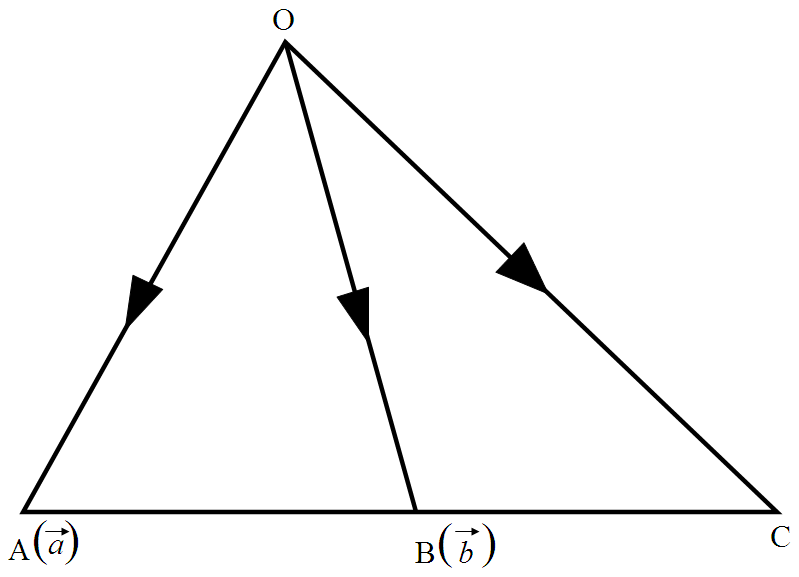
It is given that B is the mid-point of AC.
$\therefore$ Position vector of B $= \frac{\text{Positionn vector of A + Positionn vector of C}}{2}$
$\Rightarrow \overrightarrow{\text{OB}} = \frac{\overrightarrow{\text{OA}} + \overrightarrow{\text{OC}}}{2}$
$\Rightarrow \vec{\text{b}} = \frac{\vec{\text{a}}+\overrightarrow{\text{OC}}}{2}$
$\Rightarrow \vec{\text{a}} + \overrightarrow{\text{OC}} = 2\vec{\text{b}}$
$\Rightarrow \overrightarrow{\text{OC}} = 2\vec{\text{b}} - \vec{\text{a}}$ View full question & answer→Question 853 Marks
Find the sine of the angle between the vectors $\vec{\text{a}}=3\hat{\text{i}}+\hat{\text{j}}+2\hat{\text{k}}$ and $\vec{\text{b}}=2\hat{\text{i}}-2\hat{\text{j}}+4\hat{\text{k}}.$
AnswerWe know that, angle between two vectors $\vec{\text{a}}$ and $\vec{\text{b}}$ is given by
$\cos\theta=\frac{\vec{\text{a}}\cdot\vec{\text{b}}}{|\vec{\vec{\text{a}}}||\vec{\text{b}}|}$
$=\frac{(3\hat{\text{i}}+\hat{\text{j}}+2\hat{\text{k}})\cdot(2\hat{\text{i}}-2\hat{\text{j}}+4\hat{\text{k}})}{\sqrt{3^2+1^2+2^2}\sqrt{2^2+(-2)^2+4^2}}$
$\therefore\cos\theta=\frac{3}{\sqrt{21}}$
$\therefore\sin\theta=\sqrt{1-\cos^2\theta}$
$\sqrt{1-\frac{9}{21}}=\frac{2}{\sqrt{7}}$
View full question & answer→Question 863 Marks
Find the area of the parallelogram whose diagonals are:
$4\hat{\text{i}}-\hat{\text{j}}-3\hat{\text{k}}$ and $-2\hat{\text{i}}+\hat{\text{j}}-2\hat{\text{k}}$
AnswerArea of parallalogram $=\frac{1}{2}\big|\vec{\text{d}}_1\times\vec{\text{d}}_2\big|$
Here, $\vec{\text{d}}_1=4\hat{\text{i}}-\hat{\text{j}}-3\hat{\text{k}}$
$\vec{\text{d}}_2=-2\hat{\text{i}}+\hat{\text{j}}-2\hat{\text{k}}$
$\vec{\text{d}_1}\times\vec{\text{d}_2}=\begin{vmatrix}\hat{\text{i}}&\hat{\text{j}}&\hat{\text{k}}\\4&-1&-3\\-2&1&-2 \end{vmatrix}$
$=\hat{\text{i}}(2+3)-\hat{\text{j}}(-8-6)+\hat{\text{k}}(4-2)$
$=5\hat{\text{i}}+14\hat{\text{j}}+2\hat{\text{k}}$
$\big|\vec{\text{d}}_1\times\vec{\text{d}}_2\big|=\sqrt{(5)^2+(14)^2+(2)^2}$
$=\sqrt{25+196+4}$
$=\sqrt{225}$
$=15$
Area of parallelgram $=\frac{1}{2}\big|\vec{\text{d}}_1\times\vec{\text{d}}_2\big|$
Area of parallelogram $=\frac{15}{2}\text{ sq. unit}$
View full question & answer→Question 873 Marks
If either vector $\vec{a}=\vec{0}\ \text{or}\ \vec{b}=\vec{0},\ \text{then}\ \vec{a}\cdot\vec{b}=0.$ But the converse need not be true. Justify your answer with an example.
AnswerCase I: $\ \text{Vector}\ \vec{a}=\vec{0}.$ Therefore by definition of zero vector, $\ \big|\vec{a}\big|=0\ \ ....\text{(i)}$$\therefore \ \vec{a}.\vec{b}=\big|\vec{a}\big|.\Big|\vec{b}\Big|\text{cos}\theta=0.\Big|\vec{b}\Big|\text{cos}\theta$ [Form eq. (i)]
$\Rightarrow\ \ \vec{a}.\vec{b}=0$
Case II: $\ \text{Vector}\ \vec{b}=\vec{0}.$ Therefore by definition of zero vector, $\ \big|\vec{b}\big|=0\ \ \ .....\text{(ii)}$
$\therefore\ \ \vec{a}.\vec{b}=\big|\vec{a}\big|.\Big|\vec{b}\Big|\text{cos}\theta=\vec{a}.0.\text{cos}\theta$ [Form eq. (ii)]
$\Rightarrow\ \ \vec{a}.\vec{b}=0$
But the converse is not true. Justification: $\\ \text{Let}\ \vec{a}=\hat{i}+\hat{j}+\hat{k}$$\text{Therefore},\ \big|\vec{a}\big|=\sqrt{(1)^2+(1)^2+(1)^2}=\sqrt{3}\neq0$
$\text{Therefore},\ \ \vec{a}\neq\vec{0}$
$\text{Again let}\ \ \ \vec{b}=\hat{i}+\hat{j}-2\hat{k}$
$\therefore\ \ \ \Big|\vec{b}\Big|=\sqrt{(1)^2+(1)^2+(-2)^2}=\sqrt{6}\neq0$
$\text{Therefore},\ \vec{b}\neq\vec{0}$
$\text{But}\ \ \ \vec{a}.\vec{b}=1(1)+1(1)+1(-2)=1+1+-2=0$
$\text{Hence, here}\ \vec{a}.\vec{b}=0,\ \text{but}\ \vec{a}\neq\vec{0}\ \text{and}\ \vec{b}\neq\vec{0}.$
View full question & answer→Question 883 Marks
If A, B, C, D are the points with position vectors $\hat{\text{i}}+\hat{\text{j}}-\hat{\text{k}},\ 2\hat{\text{i}}-\hat{\text{j}}+3\hat{\text{k}},\ 2\hat{\text{i}}-3\hat{\text{k}},$ respectively, find the projection of $\overrightarrow{\text{AB}}$ along $\overrightarrow{\text{CD}}.$
AnswerWe have $\overrightarrow{\text{AB}}=\hat{\text{i}}+\hat{\text{j}}-\hat{\text{k}},\ \overrightarrow{\text{OB}}=2\hat{\text{i}}-\hat{\text{j}}+3\hat{\text{k}},$
$\overrightarrow{\text{OC}}=\ 2\hat{\text{i}}-3\hat{\text{k}}$ and $\overrightarrow{\text{OD}}=3\hat{\text{i}}-2\hat{\text{j}}+\hat{\text{k}}$
$\therefore\overrightarrow{\text{AB}}=\overrightarrow{\text{OB}}-\overrightarrow{\text{OA}}$
$=(2\hat{\text{i}}-\hat{\text{j}}+3\hat{\text{k}})-(\hat{\text{i}}+\hat{\text{j}}-\hat{\text{k}})$
$=\hat{\text{i}}-2\hat{\text{j}}+4\hat{\text{k}}$
and $\overrightarrow{\text{CD}}=\overrightarrow{\text{OD}}-\overrightarrow{\text{OC}}$
$=(3\hat{\text{i}}-2\hat{\text{j}}+\hat{\text{k}})-(2\hat{\text{i}}-3\hat{\text{k}})$
$=\hat{\text{i}}-2\hat{\text{j}}+4\hat{\text{k}}$
Now the projection of $\overrightarrow{\text{AB}}$ along $\overrightarrow{\text{CD}}$
$=\overrightarrow{\text{AB}}.\frac{\overrightarrow{\text{CD}}}{|\overrightarrow{\text{CD}|}}$
$=\frac{(\hat{\text{i}}-2\hat{\text{j}}+4\hat{\text{k}})\cdot(\hat{\text{i}}-2\hat{\text{j}}+4\hat{\text{k}})}{\sqrt{1^1+2^2+4^2}}$
$=\frac{1+4+16}{\sqrt{21}}=\frac{21}{\sqrt{21}}$
$=\sqrt{21}\text{ units}$
View full question & answer→Question 893 Marks
Find a vector of magnitude 5 units, and parallel to the resultant of the vectors $\vec{\text{a}}=2\hat{\text{i}}+3\hat{\text{j}}-\hat{\text{k}}$ and $\vec{\text{b}}=\hat{\text{i}}-2\hat{\text{j}}+\hat{\text{k}}.$
AnswerWe have,
$\vec{\text{a}}=2\hat{\text{i}}+3\hat{\text{j}}-\hat{\text{k}}\ \text{and}\ \vec{\text{b}}=\hat{\text{i}}-2\hat{\text{j}}+\hat{\text{k}}.$
$\text{Let}\ \vec{\text{c}}\ \text{be the resultant of}\ \vec{\text{a}}\ \text{and}\ \vec{\text{b}}$
Then,
$\vec{\text{c}}=\vec{\text{a}}+\vec{\text{b}}=(2+1)\hat{\text{i}}+(3-2)\hat{\text{j}}+(-1+1)\hat{\text{k}}=3\hat{\text{i}}+\hat{\text{ j}}$
$\therefore|\vec{\text{c}}|=\sqrt{3^{2}+1^{2}}=\sqrt{9+1}=\sqrt{10}$
$\therefore\hat{\text{c}}=\frac{\vec{\text{c}}}{|\vec{\text{c}}|}=\frac{\big(3\hat{\text{i}}+\hat{\text{j}}\big)}{\sqrt{10}}$
Hence, the vector of magnltude 5 units and parallel to the resultant of vectors $\vec{\text{a}}\ \text{and}\ \vec{\text{b}} \ \text{is}$
$\pm5\cdot\hat{c}=\pm5\cdot\frac{1}{\sqrt{10}}\big(3\hat{\text{i}}+\hat{\text{j}}\big)$ $=\pm\frac{3\sqrt{10}\hat{\text{i}}}{2}\pm\frac{\sqrt{10}}{2}\hat{\text{j}}.$
View full question & answer→Question 903 Marks
Find the area of the parallelogram determinrd by the vectors:
$\hat{\text{i}}-3\hat{\text{j}}+\hat{\text{k}}$ and $\hat{\text{i}}+\hat{\text{j}}+\hat{\text{k}}.$
AnswerLet:
$\vec{\text{a}}=\hat{\text{i}}-3\hat{\text{j}}+\hat{\text{k}}$
$\vec{\text{b}}=\hat{\text{i}}+\hat{\text{j}}+\hat{\text{k}}$
$\vec{\text{a}}\times\vec{\text{b}}=\begin{vmatrix}\hat{\text{i}}&\hat{\text{j}}&\hat{\text{k}}\\1&-3&1\\1&1&1 \end{vmatrix}$
$=(-3-1)\hat{\text{i}}-(1-1)\hat{\text{j}}+(1+3)\hat{\text{k}}$
$=-4\hat{\text{i}}+0\hat{\text{j}}+4\hat{\text{k}}$
Area of the parallelogram $=\big|\vec{\text{a}}\times\vec{\text{b}}\big|$
$=\sqrt{(-4)^2+0+4^2}$
$=\sqrt{32}$
$=4\sqrt{2}\text{ sq. units.}$
View full question & answer→Question 913 Marks
$\text{If}\ \ \vec{\text{a}}=\vec{\text{b}}+\vec{\text{c}},$ then is it true that $\big|\vec{\text{a}}\big|=\big|\vec{\text{b}}\big|+\big|\vec{\text{c}}\big|?$ Justify your answer.
Answer$\text{If}\ \triangle\text{ABC},\ \text{let}\ \overrightarrow{\text{CB}}=\vec{\text{a}},\ \overrightarrow{\text{CA}}=\vec{\text{b}},\text{and}\ \overrightarrow{\text{AB}}=\vec{\text{c}}$ (as shown in the following figure).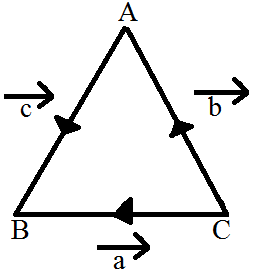
Now, by the triangle law of vector additio, we have $\vec{\text{a}}=\vec{\text{b}}+\vec{\text{c}}$It is clearly known that $|\vec{\text{a}}|,\big|\vec{\text{b}}\big|,\ \text{and}\ \big|\vec{\text{c}}\big|$ represent the sides of $\triangle\text{ABC}.$
Also, it is known that the sum of the lengths of any two sides of a triangle is greater than the third side. $\therefore\ |\vec{\text{a}}|<\big|\vec{b}\big|+|\vec{c}|$ Hence, it is not true that $|\vec{\text{a}}|=\big|\vec{\text{b}}\big|+\big|\vec{\text{c}}\big|$ View full question & answer→Question 923 Marks
Show that the points A, B and C with position vectors, $\vec{a}=3\hat{i}-4\hat{j}-4\hat{k},\ \vec{b}=2\hat{i}-\hat{j}+\hat{k}\ $ $\text{and}\ \vec{c}=\hat{i}-3\hat{j}-5\hat{k},$ respectively form the vertices of a right angled triangle.
AnswerPosition vectors of points A, B, and C are respectively given as:
$\vec{a}=3\hat{i}-4\hat{j}-4\hat{k},\ \vec{b}=2\hat{i}-\hat{j}+\hat{k}\ \text{and}\ \vec{c}$ $=\hat{i}-3\hat{j}-5\hat{k}$
$\therefore\overrightarrow{\text{AB}}=\vec{b}-\vec{a}={(2-3)}\hat{i}+(-1+4)\hat{j}+(1+4)\hat{k}$ $=-\hat{i}+3\hat{j}+5\hat{k}$
$\overrightarrow{\text{BC}}=\vec{c}-\vec{b}={(1-2)}\hat{i}+(-3+1)\hat{j}+(-5-1)\hat{k}$ $=-\hat{i}-2\hat{j}-6\hat{k}$
$\overrightarrow{\text{CA}}=\vec{a}-\vec{c}={(3-1)}\hat{i}+(-4+3)\hat{j}+(-4+5)\hat{k}$ $=2\hat{i}-\hat{j}+\hat{k}$
$\therefore\bigg|\overrightarrow{\text{AB}}\bigg|^2=(-1)^2+3^2+5^2=1+9+25=35$
$\bigg|\overrightarrow{\text{BC}}\bigg|^2=(-1)^2+(-2)^2+(-6)^2$ $=1+4+36=41$
$\bigg|\overrightarrow{\text{CA}}\bigg|^2=2^2+(-1)^2+1^2=4+1+1=6$
$\therefore\bigg|\overrightarrow{\text{AB}}\bigg|^2+\bigg|\overrightarrow{\text{CA}}\bigg|^2=36+6=41=\bigg|\overrightarrow{\text{BC}}\bigg|^2$
Hence, ABC is a right-angled triangle.
View full question & answer→Question 933 Marks
Find $|\vec{\text{a}|}$ and $\big|\vec{\text{b}}\big|$ if
$\big(\vec{\text{a}}+\vec{\text{b}}\big).\big(\vec{\text{a}}-\vec{\text{b}}\big)=8$ and $|\vec{\text{a}}|=8\big|\vec{\text{b}}\big|$
Answer $\big(\vec{\text{a }}.\vec{\text{b}}\big).\big(\vec{\text{a}}-\vec{\text{b}}\big)=8$
$\Rightarrow \vec{\text{a}}.\vec{\text{a}}-\vec{\text{a}}.\vec{\text{b}}+\vec{\text{b}}.\vec{\text{a}}-\vec{\text{b}}.\vec{\text{b}}=8$
$\Rightarrow|\vec{\text{a}}|^2-\big|\vec{\text{b}}\big|^2=8$
$\Rightarrow\big(8\big|\vec{\text{b}}\big|\big)^2-\big|\vec{\text{b}}\big|^2=8$ $\big[|\vec{\text{a}}|=8\big|\vec{\text{b}}\big|\big]$
$\Rightarrow64\big|\vec{\text{b}}\big|^2-\big|\vec{\text{b}}\big|^2=8$
$\Rightarrow63\big|\vec{\text{b}}\big|^2=8$
$\Rightarrow\big|\vec{\text{b}}\big|^2=\frac{8}{63}$
$\Rightarrow\big|\vec{\text{b}}\big|=\sqrt{\frac{8}{63}}$ [Magnitude of a vectoer is non-negative]
$\Rightarrow\big|\vec{\text{b}}\big|=\frac{2\sqrt{2}}{3\sqrt{7}}$
$|\vec{\text{a}}|=8\big|\vec{\text{b}}\big|=\frac{8\times2\sqrt{2}}{3\sqrt{7}}=\frac{16\sqrt{2}}{3\sqrt{7}}$
View full question & answer→Question 943 Marks
For any two vectors $\vec{\text{a}}$ and $\vec{\text{b}},$ prove that $\big|\vec{\text{a}}\times\vec{\text{b}}\big|^2=\begin{vmatrix}\vec{\text{a}}.\vec{\text{a}}&\vec{\text{a}}.\vec{\text{b}}\\\vec{\text{b}}.\vec{\text{a}}&\vec{\text{b}} .\vec{\text{b}}\end{vmatrix}.$
Answer$\text{RHS}=\begin{vmatrix}\vec{\text{a}}.\vec{\text{a}}&\vec{\text{a}}.\vec{\text{b}}\\\vec{\text{b}}.\vec{\text{a}}&\vec{\text{b}} .\vec{\text{b}}\end{vmatrix}.$
$=\begin{vmatrix}|\vec{\text{a}}|^2&|\vec{\text{a}}|\big|\vec{\text{b}}\big|\cos\theta\\|\vec{\text{a}}|\big|\vec{\text{b}}\big|\cos\theta&\big|\vec{\text{b}}\big|^2 \end{vmatrix}$
$=|\vec{\text{a}}|^2\big|\vec{\text{b}}\big|^2-|\vec{\text{a}}|^2\big|\vec{\text{b}}\big|^2\cos^2\theta$
$=|\vec{\text{a}}|^2\big|\vec{\text{b}}\big|^2(1-\cos^2\theta)$
$=|\vec{\text{a}}|^2\big|\vec{\text{b}}\big|^2\sin^2\theta$
$=\big(|\vec{\text{a}}|\big|\vec{\text{b}}\big|\sin\theta\big)^2$
$=\big|\vec{\text{a}}\times\vec{\text{b}}\big|^2$
$=\text{LHS}$
Hence proved.
View full question & answer→Question 953 Marks
If the sum of two unit vectors is a unit vector prove that the magnitude of their difference is $\sqrt{3.}$
AnswerGiven that $\hat{\text{a}},\hat{\text{b}}$ and $\big|\hat{\text{a}}+\hat{\text{b}}\big|$ are unit vectors.
So, $|\hat{\text{a}}|=1,|\hat{\text{b}}|=1$and $\big|\big|\hat{\text{a}}+\hat{\text{b}}\big|\big|=1$
WE have
$\big|\hat{\text{a}}+\hat{\text{b}}\big|^2+\big|\hat{\text{a}}-\hat{\text{b}}\big|^2=2\big(|\hat{\text{a}}|^2+\big|\hat{\text{b}}\big|^2\big)$
$\Rightarrow1+\big|\hat{\text{a}}-\hat{\text{b}}\big|^2=2(1+1)$
$\Rightarrow1+\big|\hat{\text{a}}-\hat{\text{b}}\big|^2=4$
$\Rightarrow\big|\hat{\text{a}}-\hat{\text{b}}\big|^2=3$
$\Rightarrow\big|\hat{\text{a}}-\hat{\text{b}}\big|=\sqrt{3}$
View full question & answer→Question 963 Marks
Show that the points whose position vectors are as given below are collinear:
$3\hat{\text{i}}-2\hat{\text{j}}+4\hat{\text{k}},\ \hat{\text{i}}+\hat{\text{j}}+\hat{\text{k}}$ and $-\hat{\text{i}}+4\hat{\text{j}}-2\hat{\text{k}}$
AnswerLet the points be A, B and C with position vectors $3\hat{\text{i}}-2\hat{\text{j}}+4\hat{\text{k}},\ \hat{\text{i}}+\hat{\text{j}}+\hat{\text{k}}$ and $-\hat{\text{i}}+4\hat{\text{j}}-2\hat{\text{k}}$ respectively. Then, $\overrightarrow{\text{AB}}=$ Position vector of B - Position vector of A$=\hat{\text{i}}+\hat{\text{j}}+\hat{\text{k}}-3\hat{\text{i}}+2\hat{\text{j}}-4\hat{\text{k}}$
$=-2\hat{\text{i}}+3\hat{\text{j}}-3\hat{\text{k}}$
$\overrightarrow{\text{BC}}=$ Position vector of C - Position vector of B
$=-\hat{\text{i}}+4\hat{\text{j}}-2\hat{\text{k}}-\hat{\text{i}}-\hat{\text{j}}-\hat{\text{k}}$
$=-2\hat{\text{i}}+3\hat{\text{j}}-3\hat{\text{k}}$
$\therefore\ \overrightarrow{\text{AB}}=\overrightarrow{\text{BC}}$
So, $\overrightarrow{\text{AB}}$ and $\overrightarrow{\text{BC}}$ are parallel vectors. But B is a point common to them. Hence, A, B, and C are collinear.
View full question & answer→Question 973 Marks
If the vertices A, B and C of $\triangle\text{ABC}$ have position vectors (1, 2, 3), (-1, 0, 0) and (0, 1, 2), respectively, what is the magnitude of $\angle\text{ABC}?$
AnswerGive that
$\overrightarrow{\text{OA}}=\hat{\text{i}}+2\hat{\text{j}}+3\hat{\text{k}};\overrightarrow{\text{OB}}=-1\hat{\text{i}}+0\hat{\text{j}}+0\hat{\text{k}};\overrightarrow{\text{OC}}=0\hat{\text{i}}+1\hat{\text{j}}+2\hat{\text{k}}$
$\overrightarrow{\text{AB}}=\overrightarrow{\text{OB}}-\overrightarrow{\text{OA}}=-2\hat{\text{i}}-2\hat{\text{j}}-3\hat{\text{k}}\\\Rightarrow\Big|\overrightarrow{\text{AB}}\Big|=\sqrt{4+4+9}=\sqrt{17}$
$\overrightarrow{\text{BC}}=\overrightarrow{\text{OC}}-\overrightarrow{\text{OB}}=\hat{\text{i}}+\hat{\text{j}}+2\hat{\text{k}}\\\Rightarrow\Big|\overrightarrow{\text{BC}}\Big|=\sqrt{1+1+4}=\sqrt{6}$
$\overrightarrow{\text{CA}}=\overrightarrow{\text{OA}}-\overrightarrow{\text{OC}}=\hat{\text{i}}+\hat{\text{j}}+\hat{\text{k}}\\\Rightarrow\Big|\overrightarrow{\text{CA}}\Big|=\sqrt{1+1+1}=\sqrt{3}$
$\cos\angle\text{ABC}=\frac{\big|\overrightarrow{\text{AB}}.\overrightarrow{\text{BC}}\big|}{\big|\overrightarrow{\text{AB}}\big|\big|\overrightarrow{\text{BC}}\big|}=\frac{|-2-2-6|}{(\sqrt{17})(\sqrt{6})}=\frac{10}{\sqrt{102}}$
$\Rightarrow\angle\text{ABC}=\cos^{-1}\Big(\frac{10}{\sqrt{102}}\Big)$
View full question & answer→Question 983 Marks
If the vertices A, B, C of a triangle ABC are the points with position vectors $\text{a}_1\hat{\text{i}}+\text{a}_2\hat{\text{j}}+\text{a}_3\hat{\text{k}},\ \text{b}_1\hat{\text{i}}+\text{b}_2\hat{\text{j}}+\text{b}_3\hat{\text{k}},\ \text{c}_1\hat{\text{i}}+\text{c}_2\hat{\text{j}}+\text{c}_3\hat{\text{k}}$ respectively, what are the vectors determined by its sides? Find the length of these vectors.
AnswerGiven the vertices of a triangle A, B and C with position vectors $\text{a}_1\hat{\text{i}}+\text{a}_2\hat{\text{j}}+\text{a}_3\hat{\text{k}},\ \text{b}_1\hat{\text{i}}+\text{b}_2\hat{\text{j}}+\text{b}_3\hat{\text{k}}$ and $\text{c}_1\hat{\text{i}}+\text{c}_2\hat{\text{j}}+\text{c}_3\hat{\text{k}}$ respectively. Then,
$\overrightarrow{\text{AB}}=(\text{b}_1-\text{a}_1)\hat{\text{i}}+(\text{b}_2-\text{a}_2)\hat{\text{j}}+(\text{b}_3-\text{a}_3)\hat{\text{k}}$
$\overrightarrow{\text{BC}}=(\text{c}_1-\text{b}_1)\hat{\text{i}}+(\text{c}_2-\text{b}_2)\hat{\text{j}}+(\text{c}_3-\text{b}_3)\hat{\text{k}}$
$\overrightarrow{\text{CA}}=(\text{a}_1-\text{c}_1)\hat{\text{i}}+(\text{a}_2-\text{c}_2)\hat{\text{j}}+(\text{a}_3-\text{c}_3)\hat{\text{k}}$
Therefore, the length of these vectors are:
$\Big|\overrightarrow{\text{AB}}\Big|=\sqrt{(\text{b}_1-\text{a}_1)^2+(\text{b}_2-\text{a}_2)^2+(\text{b}_3-\text{a}_3)^2}$
$\Big|\overrightarrow{\text{BC}}\Big|=\sqrt{(\text{c}_1-\text{b}_1)^2+(\text{c}_2-\text{b}_2)^2+(\text{c}_3-\text{b}_3)^2}$
$\Big|\overrightarrow{\text{CA}}\Big|=\sqrt{(\text{a}_1-\text{c}_1)^2+(\text{a}_2-\text{c}_2)^2+(\text{a}_3-\text{c}_3)^2}$
View full question & answer→Question 993 Marks
Find the area of the parallelogram whose diagonals are:
$3\hat{\text{i}}+4\hat{\text{j}}$ and $\hat{\text{i}}+\hat{\text{j}}+\hat{\text{k}}$
AnswerGiven, $\text{d}_1=3\hat{\text{i}}+4\hat{\text{j}}$
$\text{d}_2=\hat{\text{i}}+\hat{\text{j}}+\hat{\text{k}}$
$\vec{\text{d}_1}\times\vec{\text{d}_2}=\begin{vmatrix}\hat{\text{i}}&\hat{\text{j}}&\hat{\text{k}}\\3&4&0\\1&1&1 \end{vmatrix}$
$=\hat{\text{i}}(4-0)-\hat{\text{j}}(3-0)+\hat{\text{k}}(3-4)$
$=4\hat{\text{i}}-3\hat{\text{j}}-\hat{\text{k}}$
$\big|\vec{\text{d}}_1\times\vec{\text{d}}_2\big|=\sqrt{(4)^2+(-3)^2+(-1)^2}$
$=\sqrt{16+9+1}$
$=\sqrt{26}$
Area of parallelogram $=\frac{1}{2}\big|\vec{\text{d}}_1\times\vec{\text{d}}_2\big|$
Area of parallelogram $=\frac{\sqrt{26}}{2}\text{ sq. unit}$
View full question & answer→Question 1003 Marks
Let $\vec{\text{a}}=\hat{\text{i}}+\hat{\text{j}}+\hat{\text{k}},\vec{\text{b}}=\hat{\text{i}}$ and $\vec{\text{c}}=\text{c}_1\hat{\text{i}}+\text{c}_2\hat{\text{j}}+\text{c}_3\hat{\text{k}}.$ Then, If $C_2 = -1$ and $C_3 = 1,$ show that no value of $C_1$ can make $\vec{\text{a}},\vec{\text{b}}$ and $\vec{\text{c}}$ coplanar.
AnswerIf $C_{2 }= -1$ and $C_3 = 1,$ then $\vec{\text{a}}=\hat{\text{i}}+\vec{\text{j}}+\vec{\text{k}},\vec{\text{b}}=\hat{\text{i}}$ and $\vec{\text{c}}={\text{c}}_1\hat{\text{i}}-\hat{\text{j}}+\hat{\text{k}}.$
We know that vectors $\vec{\text{a}},\vec{\text{b}},\vec{\text{c}}$ are coplanar if $\big[\vec{\text{a}}\vec{\text{b}}{\text{c}}\big]=0.$
for $\big[\vec{\text{a}},\vec{\text{b}},\text{c}\big]$ to be coplanar:
$\therefore\big[\vec{\text{a}}\vec{\text{b}}\vec{\text{c}}\big]=0$
$\Rightarrow\begin{vmatrix}1&1&1\\1&0&0\\\text{c}_1&-1&1 \end{vmatrix}=0$
$\Rightarrow 1(0-0)-1(1-0)+1(-1-0)=0$
$\Rightarrow-1-1=0$
$\Rightarrow -2=0$
But this is never possible, whatever be the value of $C_1.$
Thus, no value of $C_1$ can make $\vec{\text{a}},\vec{\text{b}}$ and $\vec{\text{c}}$ coplanar.
View full question & answer→