Questions · Page 4 of 4

M.C.Q (1 Marks)

Question 1511 Mark
find the coordinate of the tip of the position vector which is equivalent to $\overrightarrow{\text{AB}}$ where the coordinates of A and B are (-1, 3) and (-2, 1) respectively:
  1. (+1, +2)
  2. (+1, -2)
  3. (-1, +2)
  4. (-1, -2)
Answer
  1. (-1, -2)
View full question & answer
Question 1521 Mark
If $\vec{\text{a}}.\hat{\text{i}}=\vec{\text{a}}.\big(\hat{\text{i}}+\hat{\text{j}}\big)=\vec{\text{a}}.\big(\hat{\text{i}}+\hat{\text{j}}+\hat{\text{k}}\big)=1.$then $\vec{\text{a}}=$
  1. $\vec{0}$
  2. $\hat{\text{i}}$
  3. $\hat{\text{j}}$
  4. $\hat{\text{i}}+\hat{\text{j}}+\hat{\text{k}}$
Answer
  1. $\hat{\text{i}}$
Solution:
Let $\vec{\text{a}}=\text{a}_1\hat{\text{i}}+\text{a}_2\hat{\text{j}}+\text{a}_3\hat{\text{k}}$
$\vec{\text{a}}.\hat{\text{i}}=\text{a}_1$
and $\vec{\text{a}}.\big(\hat{\text{i}}+\hat{\text{j}}\big)=\text{a}_1+\text{a}_2$
and $\vec{\text{a}}.\big(\hat{\text{i}}+\hat{\text{j}}+\hat{\text{k}}\big)=\text{a}_1+\text{a}_2+\text{a}_3$
Given,
$\vec{\text{a}}.\hat{\text{i}}=\vec{\text{a}}.\big(\hat{\text{i}}+\hat{\text{j}}\big)=\vec{\text{a}}.\big(\hat{\text{i}}+\hat{\text{j}}+\hat{\text{k}}\big)=1$
$\Rightarrow\text{a}_1=\text{a}_1+\text{a}_2=\text{a}_1+\text{a}_2+\text{a}_3=1$
$\Rightarrow\text{a}_1=1,\text{a}_2=0,\text{a}_3=0$
So, $\vec{\text{a}}=\text{a}_1\hat{\text{i}}+\text{a}_2\hat{\text{j}}+\text{a}_3\hat{\text{k}}=1\hat{\text{i}}+0\hat{\text{j}}+0\hat{\text{k}}=\hat{\text{i}}$
View full question & answer
Question 1531 Mark
If the position vectors of P and Q are $\hat{\text{i}}+3\hat{\text{j}}-7\hat{\text{k}}$ and $5\hat{\text{i}}-2\hat{\text{j}}+4\hat{\text{k}}$ then the cosine of the angle getween $\overrightarrow{\text{PQ}}$ and y-axis is:
  1. $\frac{5}{\sqrt{162}}$
  2. $\frac{4}{\sqrt{162}}$
  3. $-\frac{5}{\sqrt{162}}$
  4. $\frac{11}{\sqrt{162}}$
Answer
  1. $-\frac{5}{\sqrt{162}}$
Solution:
$\overrightarrow{\text{PQ}}=\overrightarrow{\text{OQ}}-\overrightarrow{\text{OP}}=5\hat{\text{i}}-2\hat{\text{j}}+4\hat{\text{k}}-\big(\hat{\text{i}}+3\hat{\text{j}}-7\hat{\text{k}}\big)=4\hat{\text{i}}-5\hat{\text{j}}+11\hat{\text{k}}$
The unit vector along y-axis is $\hat{\text{j}}.$
Let $\theta$ be the required angle.
$\cos\theta=\frac{\overrightarrow{\text{PQ}}.\hat{\text{j}}}{\big|\overrightarrow{\text{PQ}}\big|\big|\hat{\text{j}}\big|}=\frac{-5}{\sqrt{16+25+121}\sqrt{1}}=\frac{-5}{\sqrt{162}}$
View full question & answer
Question 1541 Mark
If $\hat{\text{i}},\hat{\text{j}},\hat{\text{k}}$ are unit vectors, then
  1. $\hat{\text{i}}.\hat{\text{j}}=1$
  2. $\hat{\text{i}}.\hat{\text{i}}=1$
  3. $\hat{\text{i}}\times\hat{\text{j}}=1$
  4. $\hat{\text{i}}\times\big(\hat{\text{j}}\times\hat{\text{k}}\big)=1$
Answer
  1. $\hat{\text{i}}.\hat{\text{i}}=1$
Solution:
Let us check each option one by one.
  1.  We know
$\hat{\text{i}}.\hat{\text{j}}=0$
$\neq1$
  1.  We know
$\hat{\text{i}}.\hat{\text{i}}=|\hat{\text{i}}|^2$
$=1^2$
$=1$
  1. $\hat{\text{i}}\times\hat{\text{j}}=\hat{\text{k}}$
$\neq1$
  1. $\hat{\text{i}}\times\big(\hat{\text{i}}\times\hat{\text{k}}\big)=\hat{\text{i}}\times\hat{\text{i}}$
$=0$
$\neq1$
View full question & answer
Question 1551 Mark
The direction cosines l, m and n of two lines are connected by the relations l + m + n = 0, l m = 0, then the angles between them is:
  1. $\frac{\pi}{3}$
  2. $\frac{\pi}{4}$
  3. $\frac{\pi}{2}$
  4. 0
Answer
  1. $\frac{\pi}{3}$
View full question & answer
MCQ 1561 Mark
The equation of normal to the curve $3x^2 - y^2 = 8$ which is parallel to the line $x + 3y = 8$ is$:$
  • A
    $3x - y = 8$
  • B
    $3x + y + 8 = 0$
  • $\text{x + 3y} \underline{+} 8 = 0$
  • D
    $x + 3y = 0$
Answer
Correct option: C.
$\text{x + 3y} \underline{+} 8 = 0$
View full question & answer
Question 1571 Mark
Which of the following holds true for a vector quantity:
  1. It has only magnitude
  2. It has only direction
  3. A vector has both direction and magnitude
  4. A vector can never be negative
Answer
  1. A vector has both direction and magnitude
Solution:
A quantity which has both magnitude and direction is called a vector quantity. The quantity which has only magnitude but no direction is called a scalar quantity.
View full question & answer
Question 1591 Mark
If $\vec{\text{a}},\vec{\text{b}},\vec{\text{c}}$ and $\vec{\text{d}}$ are the position vector of points A, B, C, D such that no three of them are collinear and $\vec{\text{a}}+\vec{\text{c}}=\vec{\text{b}}+\vec{\text{d}}$, then ABCD is a,
  1. Rhombus.
  2. Rectangle.
  3. Square.
  4. Parallelogram.
Answer
  1. Parallelogram
Solution:
Given:
$\vec{\text{a}}+\vec{\text{c}}=\vec{\text{b}}+\vec{\text{d}}$
$\Rightarrow\vec{\text{c}}-\vec{\text{d}}=\vec{\text{b}}-\vec{\text{a}}$
$\Rightarrow\overrightarrow{\text{AB}}=\overrightarrow{\text{DC}}$
And $\vec{\text{a}}+\vec{\text{c}}=\vec{\text{b}}+\vec{\text{d}}$
$\Rightarrow\vec{\text{c}}-\vec{\text{b}}=\vec{\text{d}}-\vec{\text{a}}$
$\Rightarrow\overrightarrow{\text{AD}}=\overrightarrow{\text{BC}}$
Also, since $\vec{\text{a}}+\vec{\text{c}}=\vec{\text{b}}+\vec{\text{d}}$
$\Rightarrow\frac{1}2\big(\vec{\text{a}}+\vec{\text{c}}\big)=\frac{1}2\big(\vec{\text{b}}+\vec{\text{d}}\big)$
So, position vector of mid-point of BD = position vector of mid-point of AC.
Hence diagonals bisect each other.
The given ABCD is a parallelogram.
View full question & answer
Question 1601 Mark
If $\vec{\text{a}},\ \vec{\text{b}},\ \vec{\text{c}}$ are three non-zero vectors, no two of which are collinear and the vector $\vec{\text{a}}+\vec{\text{b}}$ is collinear with $\vec{\text{c}}$, $\vec{\text{b}}+\vec{\text{c}}$ is collinear with $\vec{\text{a}}$, then $\vec{\text{a}}+\vec{\text{b}}+\vec{\text{c}}=$
  1. $\vec{\text{a}}$
  2. $\vec{\text{b}}$
  3. $\vec{\text{c}}$
  4. None of these
Answer
  1. None of these
Solution:
$\vec{\text{a}}+\vec{\text{b}}$ is collinear with $\vec{\text{c}}$
$\therefore\ \vec{\text{a}}+\vec{\text{b}}=\text{x}\vec{\text{c}}\ \dots(1)$
where x is scalar and $\text{x}\neq0$.
$\vec{\text{b}}+\vec{\text{c}}$ is collinear with $\vec{\text{a}}$
$\vec{\text{b}}+\vec{\text{c}}=\text{y}\vec{\text{a}}\ \dots(2)$
y is scalar and $\text{y}\neq0$
Substracting (2) from (1) we get,
$\vec{\text{a}}-\vec{\text{c}}=\text{x}\vec{\text{c}}-\text{y}\vec{\text{a}}$
$\vec{\text{a}}(1+\text{y})=(1+\text{x})\vec{\text{c}}$
As given $\vec{\text{a}},\ \vec{\text{c}}$ are not collinear,
$\therefore\ 1+\text{y}=0$ and $1+\text{x}=0$
$\text{y}=-1$ and $\text{x}=-1$
Putting the value of x in equation (1)
$\vec{\text{a}}+\vec{\text{b}}=-\vec{\text{c}}$
$\vec{\text{a}}+\vec{\text{b}}+\vec{\text{c}}=0$
View full question & answer
Question 1611 Mark
If $\theta$ is the angle between any two vectors $\vec{\text{a}}$ and $\vec{\text{b}},$ then $\big|\vec{\text{a}}.\vec{\text{b}}\big|=\big|\vec{\text{a}}\times\vec{\text{b}}\big|$ when $\theta$ is equal to:
  1. $0$
  2. $\frac{\pi}{4}$
  3. $\frac{\pi}{2}$
  4. $\pi$
Answer
  1. $\frac{\pi}{4}$
Solution:
Let $\theta$ be the angle between $\vec{\text{a}}$ and $\vec{\text{b}}.$
We know
$\big|\vec{\text{a}}\times\vec{\text{b}}\big|=|\vec{\text{a}}|\big|\vec{\text{b}}\big|\sin\theta$
$\vec{\text{a}}.\vec{\text{b}}=|\vec{\text{a}}|\big|\vec{\text{b}}\big|\cos\theta$
$\Rightarrow\big|\vec{\text{a}}.\vec{\text{b}}\big|=\big||\vec{\text{a}}|\big|\vec{\text{b}}\big|\cos\theta\big|=|\vec{\text{a}}|\big|\vec{\text{b}}\big||\cos\theta|$
Given: $\big|\vec{\text{a}}.\vec{\text{b}}\big|=\big|\vec{\text{a}}\times\vec{\text{b}}\big|$
$\Rightarrow|\vec{\text{a}}|\big|\vec{\text{b}}\big||\cos\theta|=|\vec{\text{a}}|\big|\vec{\text{b}}\big|\sin\theta$
$\Rightarrow|\cos\theta|=\sin\theta$
$\Rightarrow\theta=\frac{\pi}{4}$
View full question & answer
Question 1621 Mark
If points $\text{A}(60\hat{\text{i}}+3\hat{\text{j}}),\ \text{B}(40\hat{\text{i}}-8\hat{\text{j}})$ and $\text{C}(\text{a}\hat{\text{i}}+52\hat{\text{j}})$ are collinear, then a is equal to,
  1. 40
  2. -40
  3. 20
  4. -20
Answer
  1. -40
Solution:
Given: Three points $\text{A}(60\hat{\text{i}}+3\hat{\text{j}}),\ \text{B}(40\hat{\text{i}}-8\hat{\text{j}})$ and $\text{C}(\text{a}\hat{\text{i}}+52\hat{\text{j}})$ are collinear. Then,
$\overrightarrow{\text{AB}}=\lambda\overrightarrow{\text{BC}}$
We have,
$\overrightarrow{\text{AB}}=\big(40\hat{\text{i}}-8\hat{\text{j}}\big)-\big(60\hat{\text{i}}+3\hat{\text{j}}\big)$
$=-20\hat{\text{i}}-11\hat{\text{j}}$
$\overrightarrow{\text{BC}}=\big(\text{a}\hat{\text{i}}-52\hat{\text{j}}\big)-\big(40\hat{\text{i}}-8\hat{\text{j}}\big)$
$=(\text{a}-40)\hat{\text{i}}-44\hat{\text{j}}$
Therefore,
$\overrightarrow{\text{AB}}=\lambda\overrightarrow{\text{BC}}$
$\Rightarrow-20\hat{\text{i}}-11\hat{\text{j}}=\lambda(\text{a}-40)\hat{\text{i}}-\lambda44\hat{\text{j}}$
$\Rightarrow\lambda(\text{a}-40)=-20,\ -44\lambda=-11\Rightarrow\lambda=\frac{1}4$
$\Rightarrow\text{a}-40=-80$
$\Rightarrow\text{a}=-40$
View full question & answer
Question 1631 Mark
The distance of the point (-3, 4, 5) from the origin:
  1. 50
  2. $5\sqrt{2}$ 
  3. 6
  4. None of these 
Answer
  1. $5\sqrt{2}$
View full question & answer
Question 1641 Mark
If $\mid\text{a}\mid=4$ and $-3\underline{<}\lambda\underline{<}2$ then the range of $\mid\lambda\text{a}\mid$ is:
  1. [0, 8]
  2. [-12, 8]
  3. [0, 12]
  4. [8, 12]
Answer
  1. [0, 12]
View full question & answer
Question 1651 Mark
If the vectors $3\hat{\text{i}}+\lambda\hat{\text{j}}+\hat{\text{k}}$ and $2\hat{\text{i}}-\hat{\text{j}}+8\hat{\text{k}}$ are perpendicular, then $\lambda$ is equal to: 
  1. $-14$
  2. $7$
  3. $14$
  4. $\frac{1}{7}$
Answer
  1. $14$
Solution:
It is given that vectors $3\hat{\text{i}}+\lambda\hat{\text{j}}+\hat{\text{k}}$ and $2\hat{\text{i}}-\hat{\text{j}}+8\hat{\text{k}}$ are perpendicular.
So, their dot product is zero.
$\big(3\hat{\text{i}}+\lambda\hat{\text{j}}+\hat{\text{k}}\big).\big(2\hat{\text{i}}-\hat{\text{j}}+8\hat{\text{k}}\big)=0$
$\Rightarrow6-\lambda+8=0$
$\Rightarrow14-\lambda=0$
$\therefore\lambda=14$
View full question & answer
Question 1661 Mark
Choose the correct answer from the given four options.
The vectors $\lambda\hat{\text{i}}+\hat{\text{j}}+2\hat{\text{k}},\ \hat{\text{i}}+\lambda\hat{\text{j}}-\hat{\text{k}}$ and $2\hat{\text{i}}-\hat{\text{j}}+\lambda\hat{\text{k}}$ are coplanar if:
  1. $\lambda=-2$
  2. $\lambda=0$
  3. $\lambda=1$
  4. $\lambda=-1$
Answer
  1. $\lambda=-2$
Solution:
Let $\vec{\text{a}}=\lambda\hat{\text{i}}+\hat{\text{j}}+2\hat{\text{k}},\ \vec{\text{b}}=\hat{\text{i}}+\lambda\hat{\text{j}}-\hat{\text{k}}$ and $\vec{\text{c}}=2\hat{\text{i}}-\hat{\text{j}}+\lambda\hat{\text{k}}$
For $\vec{\text{a}},\vec{\text{b}}$ and $\vec{\text{c}}$ to be coplanar,
$\begin{vmatrix}\lambda&1&2 \\1&\lambda&-1\\2&-1&\lambda \end{vmatrix}=0$
$\Rightarrow\lambda(\lambda^2-1)-1(\lambda+2)+2(-1-2\lambda)=0$
$\Rightarrow\lambda^3-\lambda-\lambda-2-2-4\lambda=0$
$\Rightarrow\lambda^3-6\lambda-4=0$
$\Rightarrow(\lambda+2)(\lambda^2-2\lambda-2)=0$
$\Rightarrow\lambda=-2$ or $\lambda=\frac{2\pm\sqrt{12}}{2}$
$\Rightarrow\lambda=-2$ or $\lambda=1\pm\sqrt{3}$
View full question & answer
MCQ 1671 Mark
The equation of tangent to the curve $y(1 + x^2) = 2 - x, w$ here it crosses $x-$axis is$:$
  • $x + 5y = 2$
  • B
    $x - 5y = 2$
  • C
    $5x - y = 2$
  • D
    $5x + y = 2$
Answer
Correct option: A.
$x + 5y = 2$
$x + 5y = 2$
View full question & answer
Question 1681 Mark
The vector $(\cos\text{a}\cos\beta)\hat{\text{i}}+(\cos\text{a}\sin\beta)\hat{\text{j}}+(\sin\text{a})\hat{\text{k}}$is a:
  1. Null vector
  2. Unit vector
  3. Constant vector
  4. None of these
Answer
  1. Unit vector
Solution:
Let $\vec{\text{a}}=(\cos\text{a}\cos\beta)\hat{\text{i}}+(\cos\text{a}\sin\beta)\hat{\text{j}}+(\sin\text{a})\hat{\text{k}}$
$|\vec{\text{a}}|=\sqrt{\cos^2\text{a}\cos^2\beta+\cos^2\text{a}\sin^2\beta+\sin^2\text{a}}$
$=\sqrt{\cos^2\text{a}(\cos^2\beta+\sin^2\beta)+\sin^2\text{a}}$
$=\sqrt{\cos^2\text{a}(1)+\sin^2\text{a}}$
$=\sqrt{\cos^2\text{a}+\sin^2\text{a}}$
$=\sqrt{1}$
$=1$
So, $\vec{\text{a}}$ is a unit vector.
View full question & answer
Question 1691 Mark
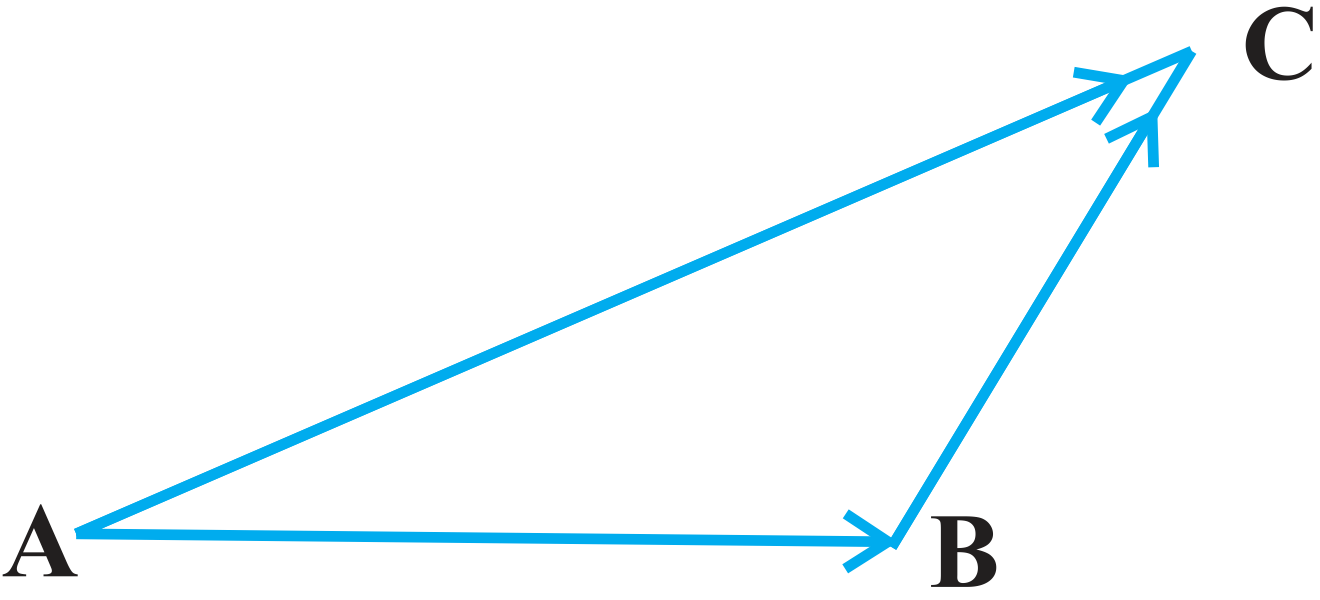
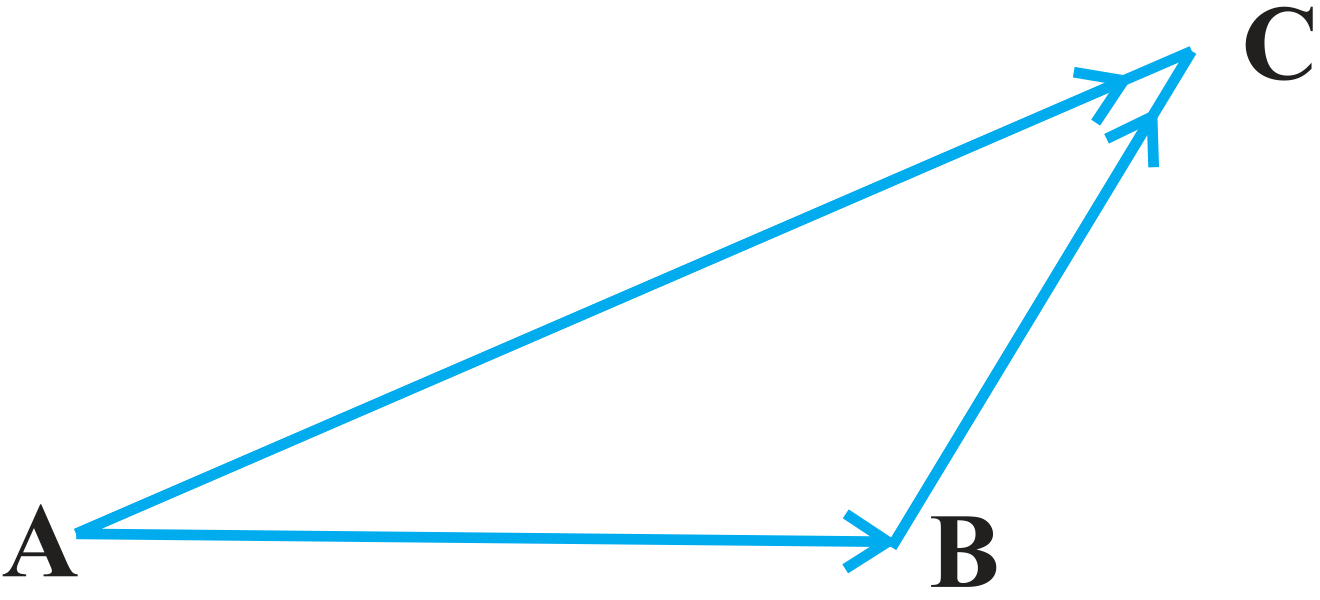
In triangle ABC (Fig 10.18), which of the following is not true:
  1. $\overrightarrow{\text{AB}}+\overrightarrow{\text{BC}}+\overrightarrow{\text{CA}}=\vec{0}$
  2. $\overrightarrow{\text{AB}}+\overrightarrow{\text{BC}}-\overrightarrow{\text{AC}}=\vec{0}$
  3. $\overrightarrow{\text{AB}}+\overrightarrow{\text{BC}}-\overrightarrow{\text{CA}}=\vec{0}$
  4. $\overrightarrow{\text{AB}}-\overrightarrow{\text{CB}}+\overrightarrow{\text{CA}}=\vec{0}$
Answer

On applying the triangle law of addition in the given triangle, we have:
$\overrightarrow{\text{AB}}+\overrightarrow{\text{BC}}=\overrightarrow{\text{AC}}\ \ \ \ \ \ \ \ \ ....(1)$
$\Rightarrow\overrightarrow{\text{AB}}+\overrightarrow{\text{BC}}=-\overrightarrow{\text{CA}}$
$\Rightarrow\overrightarrow{\text{AB}}+\overrightarrow{\text{BC}}+\overrightarrow{\text{CA}}=\vec{0}\ \ \ \ ....(2)$
$\therefore$ The equation given in alternative A is true.
$\overrightarrow{\text{AB}}+\overrightarrow{\text{BC}}=\overrightarrow{\text{AC}}$
$\Rightarrow\overrightarrow{\text{AB}}+\overrightarrow{\text{BC}}-\overrightarrow{\text{AC}}=\vec{0}$
$\therefore$ The equation given in alternative B is true.
From equation (2), we have:
$\overrightarrow{\text{AB}}-\overrightarrow{\text{CB}}+\overrightarrow{\text{CA}}=\vec{0}$
$\therefore$ The equation given in alternative D is true.
Now, consider the equation given in alternative C:
$\overrightarrow{\text{AB}}+\overrightarrow{\text{BC}}-\overrightarrow{\text{CA}}=\vec{0}$
$\Rightarrow\overrightarrow{\text{AB}}+\overrightarrow{\text{BC}}=\overrightarrow{\text{CA}}\ \ \ \ ....(3)$
From equations (1) and (3), we have:
$\overrightarrow{\text{AC}}=\overrightarrow{\text{CA}}$
$\Rightarrow\overrightarrow{\text{AC}}=-\overrightarrow{\text{AC}}$
$\Rightarrow\overrightarrow{\text{AC}}+\overrightarrow{\text{AC}}=\vec{0}$
$\Rightarrow2\overrightarrow{\text{AC}}=\vec{0}$
$\Rightarrow\overrightarrow{\text{AC}}=\vec{0},$ which is not true.
Hence, the equation given in alternative C is incorrect.
The correct answer is C.
View full question & answer
Question 1701 Mark
If $\vec{\text{a}}$ is a non-zero of magnitude 'a' and $\lambda$ is a non-zero scalar, then $\lambda\vec{\text{a}}$ is a unit vector if:
  1. $\lambda=1$
  2. $\lambda=-1$
  3. $\text{a}=|\lambda|$
  4. $\text{a}=\frac{1}{|\lambda|}$
Answer
  1. $\text{a}=\frac{1}{|\lambda|}$
Solution:
Given that
$|\vec{\text{a}}|=\text{a};$
Now,
$|\lambda\vec{\text{a}}|=1$
$\Rightarrow|\lambda||\vec{\text{a}}|=1$
$\Rightarrow|\lambda|\text{a}=1$
$\Rightarrow\text{a}=\frac{1}{|\lambda|}$
View full question & answer
Question 1711 Mark
ABCD is a parallelogram with AC and BD as diagonals. Then, $\overrightarrow{\text{AC}}-\overrightarrow{\text{BD}}=$
  1. $4\overrightarrow{\text{AB}}$
  2. $3\overrightarrow{\text{AB}}$
  3. $2\overrightarrow{\text{AB}}$
  4. $\overrightarrow{\text{AB}}$
Answer
  1. $2\overrightarrow{\text{AB}}$
Solution:
Given: ABCD, a parallelogram with diagonals AC and BD. Then,
$\overrightarrow{\text{AC}}=\overrightarrow{\text{AB}}+\overrightarrow{\text{BC}}$
$\overrightarrow{\text{AD}}=\overrightarrow{\text{AB}}+\overrightarrow{\text{BD}}$
​​​​​​​$\Rightarrow\ \overrightarrow{\text{BD}}=\overrightarrow{\text{AD}}-\overrightarrow{\text{AB}}$
$\therefore​​​​​​​\overrightarrow{\text{AC}}-\overrightarrow{\text{BD}}=\overrightarrow{\text{AB}}+\overrightarrow{\text{BC}}-\overrightarrow{\text{AD}}+\overrightarrow{\text{AB}}=2\overrightarrow{\text{AB}}$ $\Big[\because\ \overrightarrow{\text{AD}}=\overrightarrow{\text{BC}}\Big]$
View full question & answer
Question 1721 Mark
Choose the correct answer from the given four options.
The number of vectors of unit length perpendicular to the vectors $\vec{\text{a}}=2\hat{\text{i}}+\hat{\text{j}}+\hat{2\text{k}}$ and $\vec{\text{b}}=\hat{\text{j}}+\hat{\text{k}}$ is:
  1. One.
  2. Two.
  3. Three.
  4. Infinite.
Answer
  1. Two.
Solution:
The number of vectors of unit length perpendicular to the vectors $\vec{\text{a}}$ and $\vec{\text{b}}$ is $\vec{\text{c}}$ (say) i.e., $\vec{\text{c}}=\pm(\vec{\text{a}}\times\vec{\text{b}})$
So, there will be two vectors of unit length perpendicular to the vectors $\vec{\text{a}}$ and $\vec{\text{b}}.$
View full question & answer
M.C.Q (1 Marks) - Page 4 - MATHS STD 12 Science Questions - Vidyadip