MCQ 11 Mark
If the projection of $\vec{\text{a}}=\hat{\text{i}}-2\hat{\text{j}}+3\hat{\text{k}}$ on $\vec{\text{b}}=2\hat{\text{i}}+\lambda\hat{\text{k}}$ is zero, then the value of $\lambda$ is :
- A
$0$
- B
$1$
- ✓
$\frac{-2}{3}$
- D
$\frac{-3}{2}$
AnswerCorrect option: C. $\frac{-2}{3}$
Since, two non zero vector $\vec{\text{a}}\ \ \ \vec{\text{b}}$ are i.e.,
$\vec{\text{a}}=\hat{\text{i}}-2\hat{\text{j}}+3\hat{\text{k}}$
$\vec{\text{b}}=2\hat{\text{i}}+\lambda\hat{\text{k}}$
$\vec{\text{a}}.\vec{\text{b}}=0$
$(\hat{\text{i}}-2\hat{\text{j}}+3\hat{\text{k}}).(2\hat{\text{i}}+\lambda\hat{\text{k}})=0$
$2+3\lambda=0$
$-2=3\lambda$
$\lambda=\frac{-2}{3}$
View full question & answer→MCQ 21 Mark
$\overrightarrow{\text{r}} = \overrightarrow{\text{x}}{\hat{\text{i}}}+ \overrightarrow{\text{y}}{\hat{\text{j}}}$ is the equation of:
View full question & answer→MCQ 31 Mark
A set of vectors taken in a given order gives a closed polygon. Then the resultant of these vectors is:
MCQ 41 Mark
Two or more vectors having the same initial point are:
AnswerTwo or more vectors having same initial points are known as $Co-$initial vectors.
View full question & answer→MCQ 51 Mark
- A
- ✓
- C
Neither scalar nor vector
- D
View full question & answer→MCQ 61 Mark
If the curve $ay+x^2=7$ and $x^3=y,$ cut orthogonally at $(1, 1)$ then the value of a is:
View full question & answer→MCQ 71 Mark
If $\theta$ is the angle between the vectors $2\hat{\text{i}}-2\hat{\text{j}}+4\hat{\text{k}}$ and $3\hat{\text{i}}+\hat{\text{j}}+2\hat{\text{k}},$ then $\sin\theta=$
- A
$\frac{2}{3}$
- ✓
$\frac{2}{\sqrt{7}}$
- C
$\frac{\sqrt{2}}{7}$
- D
$\sqrt{\frac{2}{7}}$
AnswerCorrect option: B. $\frac{2}{\sqrt{7}}$
Let :
$\vec{\text{a}}=2\hat{\text{i}}-2\hat{\text{j}}+4\hat{\text{k}}$
$\vec{\text{b}}=3\hat{\text{i}}+\hat{\text{j}}+2\hat{\text{k}}$
$|\vec{\text{a}}|=\sqrt{2^2+(-2)^2+4^2}$
$=\sqrt{4+4+16}$
$=\sqrt{24}$
$=2\sqrt{6}$
$\Big|\vec{\text{b}}\big|=\sqrt{3^2+1^2+2^2}$
$=\sqrt{9+1+4}$
$=\sqrt{14}$
$\vec{\text{a}}\times\vec{\text{b}}=\begin{vmatrix}\hat{\text{i}}&\hat{\text{j}}&\hat{\text{k}}\\2&-2&4\\3&1&2 \end{vmatrix}$
$=-8\hat{\text{i}}+8\hat{\text{j}}+8\hat{\text{k}}$
$\big|\vec{\text{a}}\times\vec{\text{b}}\big|=\sqrt{64+64+64}$
$=\sqrt{192}$
$=8\sqrt{3}$
Let $\theta$ be the angle between $\vec{\text{a}}$ and $\vec{\text{b}}.$
$\big|\vec{\text{a}}\times\vec{\text{b}}\big|=|\vec{\text{a}}|\big|\vec{\text{b}}\big|\sin\theta$
$\Rightarrow8\sqrt{3}=(2\sqrt{6})(\sqrt{14})\sin\theta$
$\Rightarrow\sin\theta=\frac{8\sqrt{3}}{4\sqrt{21}}$
$=\frac{2}{\sqrt{7}}$
$\Rightarrow\theta=\sin^{-1}\Big(\frac{2}{\sqrt{7}}\Big)$
View full question & answer→MCQ 81 Mark
Which of the given qualities is a vector:
AnswerSpeed is a vector quantity as it has both magnitude and direction. Time, weight, volume have only magnitude and no direction. they all are scalar quantity.
View full question & answer→MCQ 91 Mark
If vectors $(\text{x}-2)\ \vec{\text{a}}+\vec{\text{b}}$ and $(2\text{x}+1)\ \vec{\text{a}}-\vec{\text{b}}$ are parallel then $x:$
- ✓
$\frac{1}{3}$
- B
$3$
- C
$-3$
- D
$\frac{-1}{3}$
AnswerCorrect option: A. $\frac{1}{3}$
As vectors $(x - 2) a + b$ and $(2x + 1) a - b$ are parallel.
$\frac{\text{x}-2}{2\text{x}+1}=-1$
$\Rightarrow\text{x} - 2=-2\text{x}-1$
$\therefore\text{x}=\frac{1}{3}$
View full question & answer→MCQ 101 Mark
Choose the correct answer from the given four options. Projection vector of $\vec{\text{a}}$ on $\vec{\text{b}}$ is:
- ✓
$\bigg(\frac{\vec{\text{a}}\cdot\vec{\text{b}}}{|\vec{\text{b}}|^2}\bigg)\vec{\text{b}}$
- B
$\frac{\vec{\text{a}}\cdot\vec{\text{b}}}{|\vec{\text{b}}|}$
- C
$\frac{\vec{\text{a}}\cdot\vec{\text{b}}}{|\vec{\text{a}}|}$
- D
$\bigg(\frac{\vec{\text{a}}\cdot\vec{\text{b}}}{|\vec{\text{a}}|^2}\bigg)\vec{\text{b}}$
AnswerCorrect option: A. $\bigg(\frac{\vec{\text{a}}\cdot\vec{\text{b}}}{|\vec{\text{b}}|^2}\bigg)\vec{\text{b}}$
Projection vector of $\vec{\text{a}}$ on $\vec{\text{b}}$ is given by $\vec{\text{a}}\cdot\frac{\vec{\text{b}}}{|\vec{\text{b}}|}\vec{\text{b}}=\bigg(\frac{\vec{\text{a}}\cdot\vec{\text{b}}}{|\vec{\text{b}}|^2}\bigg)\vec{\text{b}}$
View full question & answer→MCQ 111 Mark
The unit vector in the direction of $\overrightarrow{\text{a}}$ is:
AnswerCorrect option: A. $\frac{\vec{\text{a}}}{\mid\vec{\text{a}\mid}}$
Consider the given vector $\vec{\text{a}}.$ Unit vector $\hat{\text{a}}$
View full question & answer→MCQ 121 Mark
Choose the correct answer from the given four options. Assume that in a family, each child is equally likely to be a boy or a girl. A family with three children is chosen at random. The probability that the eldest child is a girl given that the family has at least one girl is :
- A
$\frac{1}{2}$
- B
$\frac{1}{3}$
- C
$\frac{2}{3}$
- ✓
$\frac{4}{7}$
AnswerCorrect option: D. $\frac{4}{7}$
Here, $S=\{\text{(B, B, B),(G, G, G),(B, G, G),(G, B, G),(G, G, B),(G . B, B),(B, G, B),(B, B . G)}\}$
$E _1=$ Event that a family has atleast one girl, then
$E_1=\{\text{(G, B, B),(B, G, B),(B, B . G),(G, G, B),(B, G, G),(G . B, G),(G, G, G)}\}$
$E _2=$ Event that the eldest child is a girl, then
$E_2=\{\text{(G, B, B),(G, G, B),(G, B, G)(G, G, G)}\}$
$\therefore\text{E}_1\cup\text{E}_2=\left\{(\text{G},\text{B},\text{B}),(\text{G},\text{G},\text{B}),(\text{G},\text{B},\text{G}),(\text{G},\text{G},\text{G})\right\}$
$\therefore\text{P}\Big(\frac{\text{E}_2}{\text{E}_1}\Big)=\frac{\text{P}(\text{E}_1\cap\text{E}_2)}{\text{P}(\text{E}_1)}$
$=\frac{\frac{4}{8}}{\frac{7}{8}}=\frac{4}{7}$
View full question & answer→MCQ 131 Mark
If $\vec{\text{a}}$ and $\vec{\text{b}}$ are unit vectors,then the greatest value of $\sqrt{3}\big|\vec{\text{a}}+\vec{\text{b}}\big|+\big|\vec{\text{a}}-\vec{\text{b}}\big|$ is :
AnswerWe have
$\sqrt{3}\big|\vec{\text{a}}+\vec{\text{b}}\big|+\big|\vec{\text{a}}-\vec{\text{b}}\big|$
$=\sqrt{3}\times\sqrt{|\vec{\text{a}}|^2+\big|\vec{\text{b}}\big|^2+2|\vec{\text{a}}|\big|\vec{\text{b}}\big|\cos\theta}+\sqrt{|\vec{\text{a}}|^2+\big|\vec{\text{b}}\big|^2-2|\vec{\text{a}}|\big|\vec{\text{b}}\big|\cos\theta}$
$=\sqrt{3}\times\sqrt{1^2+1^2+2\times1\times1\cos\theta}+\sqrt{1^2+1^2-2\times1\times1\cos\theta}\ ($As $\vec{\text{a}}$ and $\vec{\text{b}}$ unit vectors$)$
$=\sqrt{3}\times\sqrt{2+2\cos\theta}+\sqrt{2-2\cos\theta}$
$=\sqrt{3}\times\sqrt{2(1+\cos\theta)}+\sqrt{2(1-\cos\theta)}$
$=\sqrt{3}\times\sqrt{2\times2\cos^2\frac{\theta}{2}}+\sqrt{2\times2\sin^2\frac{\theta}{2}}$
$=2\sqrt{3}\cos\frac{\theta}{2}+2\sin\frac{\theta}{2}$
$=2\big(\sqrt{3}\cos\frac{\theta}{2}+\sin\frac{\theta}{2}\big)$
$=2\times2\big(\frac{\sqrt{3}}{2}\cos\frac{\theta}{2}+\frac{1}{2}\sin\frac{\theta}{2}\big)$
$=2\times2\big(\sin\frac{\pi}{3}\cos\frac{\theta}{2}+\cos\frac{\pi}{3}\sin\frac{\theta}{2}\big)$
$=4\sin\big(\frac{\pi}{3}+\frac{\theta}{2}\big)$
Now, maximum value of $\sin\text{a}=1$
$\Rightarrow $ Maximum value of $\sin\big(\frac{\pi}{3}+\frac{\theta}{2}\big)=1$
$\Rightarrow $ Maximum value of $4\sin\big(\frac{\pi}{3}+\frac{\theta}{2}\big)=4$
$\therefore$ Maximum velue of $\sqrt{3}\big|\vec{\text{a}}+\vec{\text{b}}\big|+\big|\vec{\text{a}}-\vec{\text{b}}\big|=4$
View full question & answer→MCQ 141 Mark
If the vectors $\hat{\text{i}}-2\text{x}\hat{\text{j}}+3\text{y}\hat{\text{k}}$ and $\hat{\text{i}}+2\text{x}\hat{\text{j}}-3\text{y}\hat{\text{k}}$ are perpendicular, then the locus of $(x,y)$ is :
AnswerLet, $\vec{\text{a}}=\hat{\text{i}}-2\text{x}\hat{\text{j}}+3\text{y}\hat{\text{k}}$ and $\vec{\text{b}}=\hat{\text{i}}+2\text{x}\hat{\text{j}}-3\text{y}\hat{\text{k}}$
It is given that the vectors are perpendicular. so, their dot product is zero.
$\vec{\text{a}}.\vec{\text{b}}=0$
$\Rightarrow\big(\hat{\text{i}}-2\text{x}\hat{\text{j}}+3\text{y}\hat{\text{k}}\big).\big(\hat{\text{i}}+2\text{x}\hat{\text{j}}-3\text{y}\hat{\text{k}}\big)=0$
$\Rightarrow1-4\text{x}^2-9\text{y}^2=0$
$\Rightarrow4\text{x}^2+9\text{y}^2=1$
Dividing both sides by $36,$ we get
$\frac{\text{x}^2}{9}+\frac{\text{y}^2}{4}=1$
This is an ellipse.
View full question & answer→MCQ 151 Mark
If $\vec{\text{a}},\vec{\text{b}},\vec{\text{c}}$ are three non$-$coplanar vectors, then $\big(\vec{\text{a}}+\vec{\text{b}}+\vec{\text{c}}\big).\big[\big(\vec{\text{a}}+\vec{\text{b}}\big)\times\big(\vec{\text{a}}+\vec{\text{c}}\big)\big]$ equals:
- A
$0$
- B
$\big[\vec{\text{a}}\vec{\text{b}}\vec{\text{c}}\big]$
- C
$2\big[\vec{\text{a}}\vec{\text{b}}\vec{\text{c}}\big]$
- ✓
$-\big[\vec{\text{a}}\vec{\text{b}}\vec{\text{c}}\big]$
AnswerCorrect option: D. $-\big[\vec{\text{a}}\vec{\text{b}}\vec{\text{c}}\big]$
$\big(\vec{\text{a}}+\vec{\text{b}}+\vec{\text{c}}\big).\big[\big(\vec{\text{a}}+\vec{\text{b}}\big)\times\big(\vec{\text{a}}+\vec{\text{c}}\big)\big]$
$=\big(\vec{\text{a}}+\vec{\text{b}}+\vec{\text{c}}\big).\big(\vec{\text{a}}\times\vec{\text{a}}+\vec{\text{a}}\times\vec{\text{c}}+\vec{\text{b}}\times\vec{\text{a}}+\vec{\text{b}}\times\vec{\text{c}}\big)$
$=\big(\vec{\text{a}}+\vec{\text{b}}+\vec{\text{c}}\big).\big(\vec{\text{a}}\times\vec{\text{c}}+\vec{\text{b}}\times\vec{\text{a}}+\vec{\text{b}}\times\vec{\text{c}}\big)$
$=0+0+\big[\vec{\text{a}}\vec{\text{b}}\vec{\text{c}}\big]+\big[\vec{\text{b}}\vec{\text{a}}\vec{\text{c}}\big]+0+0+0+\big[\vec{\text{c}}\vec{\text{b}}\vec{\text{a}}\big]+0$
$=-\big[\vec{\text{a}}\vec{\text{b}}\vec{\text{c}}\big]$
View full question & answer→MCQ 161 Mark
If $\overline{\text{a}},\overline{\text{b}},\overline{\text{c}}$ are unit vectors such that $\overline{\text{a}}+\overline{\text{b}}+\overline{\text{c}}+\overline{\text{c.a}}=$
- A
$\frac{3}{2}$
- ✓
$-\frac{3}{2}$
- C
$\frac{1}{2}$
- D
$-\frac{1}{2}$
AnswerCorrect option: B. $-\frac{3}{2}$
View full question & answer→MCQ 171 Mark
If $\mid\text{a}\times\text{b}\mid=4$ and $\mid\text{a.b}\mid=2$ then $\mid{\text{a}}\mid^2\mid{\text{b}}\mid^2$ is equal to:
View full question & answer→MCQ 181 Mark
Let $\vec{\text{a}},\vec{\text{b}},\vec{\text{c}}$ be three unit vectors, such that $\big|\vec{\text{a}}+\vec{\text{b}}+\vec{\text{c}}\big|=1$ and $\vec{\text{a}}$ is perpendicular to $\vec{\text{b}}.$ If $\vec{\text{c}}$ makes angle $\alpha$ and $\beta$ with $\vec{\text{a}}$ and $\vec{\text{b}}$ respectively, then $\cos\alpha+\cos\beta=$
- A
$-\frac{3}{2}$
- B
$\frac{3}{2}$
- C
$1$
- ✓
$-1$
AnswerGiven that $\vec{\text{a}},\vec{\text{b}}$ and $\vec{\text{c}}$ are unit vectors.
So, $|\vec{\text{a}}|=1,\big|\vec{\text{b}}\big|=1$ and $\vec{\text{c}}=1.$
Since $\vec{\text{a}}$ and $\vec{\text{b}}$ are mutually perpendicular,
$\vec{\text{a}}.\vec{\text{b}}=0$
Now,
$\big|\vec{\text{a}}+\vec{\text{b}}+\vec{\text{c}}\big|=1$
$\Rightarrow\big|\vec{\text{a}}+\vec{\text{b}}+\vec{\text{c}}\big|^2=1$
$\Rightarrow|\vec{\text{a}}|^2+\big|\vec{\text{b}}\big|^2+|\vec{\text{c}}|^2+2\vec{\text{a}}.\vec{\text{b}}+2\vec{\text{b}}.\vec{\text{c}}+2\vec{\text{c}}.\vec{\text{a}}=1$
$\Rightarrow1+1+1+2(0)+2|\vec{\text{a}}|\big|\vec{\text{b}\big|}\cos\beta+2|\vec{\text{c}}||\vec{\text{a}}|\cos\alpha=1$
$\Rightarrow3+2(\cos\alpha+\cos\beta)=1$
$\Rightarrow2(\cos\alpha+\cos\beta)=-2$
$\Rightarrow\cos\alpha+\cos\beta=-1$
View full question & answer→MCQ 191 Mark
$\big(\vec{\text{a}}+2\vec{\text{b}}-\vec{\text{c}}\big).\big\{\big(\vec{\text{a}}-\vec{\text{b}}\big)\times\big(\vec{\text{a}}-\vec{\text{b}}-\vec{\text{c}}\big)\big\}$ is equal to:
- A
$\big(\vec{\text{a}}\vec{\text{b}}\vec{\text{c}}\big)$
- B
$2\big(\vec{\text{a}}\vec{\text{b}}\vec{\text{c}}\big)$
- ✓
$3\big(\vec{\text{a}}\vec{\text{b}}\vec{\text{c}}\big)$
- D
$0$
AnswerCorrect option: C. $3\big(\vec{\text{a}}\vec{\text{b}}\vec{\text{c}}\big)$
$\big(\vec{\text{a}}+2\vec{\text{b}}-\vec{\text{c}}\big).\big\{\big(\vec{\text{a}}-\vec{\text{b}}\big)\times\big(\vec{\text{a}}-\vec{\text{b}}-\vec{\text{c}}\big)\big\}$
$=\big(\vec{\text{a}}+2\vec{\text{b}}-\vec{\text{c}}\big).\big(\vec{\text{a}}\times\vec{\text{a}}-\vec{\text{a}}\times\vec{\text{b}}-\vec{\text{a}}\times\vec{\text{c}}-\vec{\text{b}}\times\vec{\text{a}}+\vec{\text{b}}\times\vec{\text{b}}+\vec{\text{b}}\times\vec{\text{c}}\big)$
$=\big(\vec{\text{a}}+2\vec{\text{b}}-\vec{\text{c}}\big).\big(-\vec{\text{a}}\times\vec{\text{b}}-\vec{\text{a}}\times\vec{\text{c}}+\vec{\text{a}}\times\vec{\text{b}}+\vec{\text{b}}\times\vec{\text{c}}\big)$
$=\big(\vec{\text{a}}+2\vec{\text{b}}-\vec{\text{c}}\big).\big(-\vec{\text{a}}\times\vec{\text{c}}+\vec{\text{b}}\times\vec{\text{c}}\big)$
$=\big[\text{a}\text{b}\text{c}\big]+2\big[\text{a}\text{b}\text{c}\big]$
$=3\big[\text{a}\text{b}\text{c}\big]$
View full question & answer→MCQ 201 Mark
If $\big[2\vec{\text{a}}+4\vec{\text{b}}\vec{\text{c}}\vec{\text{d}}\big]=\lambda\big[\vec{\text{a}}\vec{\text{c}}\vec{\text{d}}\big]+\mu\big[\vec{\text{b}}\vec{\text{c}}\vec{\text{d}}\big],$ then $\lambda+\mu=$
AnswerWe have
$\big[2\vec{\text{a}}+4\vec{\text{b}}\vec{\text{c}}\vec{\text{d}}\big]=\lambda\big[\vec{\text{a}}\vec{\text{c}}\vec{\text{d}}\big]+\mu\big[\vec{\text{b}}\vec{\text{c}}\vec{\text{d}}\big]$
$\Rightarrow\big[\big(2\vec{\text{a}}+4\vec{\text{b}}\big]\times\vec{\text{c}}\big].\vec{\text{d}}=\lambda\big[\vec{\text{a}}\vec{\text{c}}\vec{\text{d}}\big]+\mu\big[\vec{\text{b}}\vec{\text{c}}\vec{\text{d}}\big] ($By definition of scalar triple product$)$
$\Rightarrow\big[\big(2\vec{\text{a}}\times\vec{\text{c}}\big)+\big(4\vec{\text{b}}\times\vec{\text{c}}\big)\big].\vec{\text{d}}=\lambda\big[\vec{\text{a}}\vec{\text{c}}\vec{\text{d}}\big]+\mu\big[\vec{\text{b}}\vec{\text{c}}\vec{\text{d}}\big]$
$\Rightarrow\big(2\vec{\text{a}}\times\vec{\text{c}}\big).\vec{\text{d}}+\big(4\vec{\text{b}}\times\vec{\text{c}}\big).\vec{\text{d}}=\lambda\big[\vec{\text{a}}\vec{\text{c}}\vec{\text{d}}\big]+\mu\big[\vec{\text{b}}\vec{\text{c}}\vec{\text{d}}\big]$
$\Rightarrow\big[2\vec{\text{a}}\vec{\text{ c }}\vec{\text{d}}\big]+\big[4\vec{\text{b}}\vec{\text{ c }}\vec{\text{d}}\big]=\lambda\big[\vec{\text{a}}\vec{\text{ c }}\vec{\text{d}}\big]+\mu\big[\vec{\text{b}}\vec{\text{ c }}\vec{\text{d}}\big]$
$\Rightarrow2\big[\vec{\text{a}}\vec{\text{c}}\vec{\text{d}}\big]+4\big[\vec{\text{b}}\vec{\text{c}}\vec{\text{d}}\big]=\lambda\big[\vec{\text{a}}\vec{\text{c}}\vec{\text{d}}\big]+\mu\big[\vec{\text{b}}\vec{\text{c}}\vec{\text{d}}\big]$ $\big(\therefore\big[\lambda\vec{\text{a}}\vec{\text{b}}\vec{\text{c}}\big]=\lambda\big[\vec{\text{a}}\vec{\text{b}}\vec{\text{c}}\big]$ for any scaler $\lambda\big)$
Comparing both sides, we get
$\lambda=2$
$\mu=4$
$\therefore\lambda+\mu=2+4=6$
View full question & answer→MCQ 211 Mark
A unit vector perpendicular to both $\hat{\text{i}}+\hat{\text{j}}$ and $\hat{\text{j}}+\hat{\text{k}}$ is:
- A
$\hat{\text{i}}-\hat{\text{j}}+\hat{\text{k}}$
- B
$\hat{\text{i}}+\hat{\text{j}}+\hat{\text{k}}$
- C
$\frac{1}{\sqrt{3}}\big(\hat{\text{i}}+\hat{\text{j}}+\hat{\text{k}}\big)$
- ✓
$\frac{1}{\sqrt{3}}\big(\hat{\text{i}}-\hat{\text{j}}+\hat{\text{k}}\big)$
AnswerCorrect option: D. $\frac{1}{\sqrt{3}}\big(\hat{\text{i}}-\hat{\text{j}}+\hat{\text{k}}\big)$
Let:
$\vec{\text{a}}=\hat{\text{i}}+\hat{\text{j}}+0\hat{\text{k}}$
$\vec{\text{b}}=0\hat{\text{i}}+\hat{\text{j}}+\hat{\text{k}}$
$\therefore\vec{\text{a}}\times\vec{\text{b}}=\begin{vmatrix}\hat{\text{i}}&\hat{\text{j}}&\hat{\text{k}}\\1&1&0\\0&1&1 \end{vmatrix}$
$=\hat{\text{i}}-\hat{\text{j}}+\hat{\text{k}}$
$\Rightarrow\big|\vec{\text{a}}\times\vec{\text{b}}\big|=\sqrt{1+1+1}$
$=\sqrt{3}$
Unit vector perpendicular to $\vec{\text{a}}$ and $\vec{\text{b}}=\frac{\vec{\text{a}}\times\vec{\text{b}}}{\big|\vec{\text{a}}\times\vec{\text{b}}\big|}=\frac{\hat{\text{i}}-\hat{\text{j}}+\hat{\text{k}}}{\sqrt{3}}$
Disclaimer: The answer given for this question in the textbook is incorrect.
View full question & answer→MCQ 221 Mark
The ratio in which $2x + 3y + 5z = 1$ divides the line joining the points $(1, 0, -3)$ and $(1, -5, 7)$ is:
- ✓
$5 : 3$
- B
$3 : 2$
- C
$2 : 1$
- D
$1 : 3$
AnswerCorrect option: A. $5 : 3$
View full question & answer→MCQ 231 Mark
Choose the correct answer from the given four options. The value of $\lambda$ for which the vectors $3\hat{\text{i}}-6\hat{\text{j}}+\hat{\text{k}}$ and $2\hat{\text{i}}-4\hat{\text{j}}+\lambda\hat{\text{k}}$ are parallel, is:
- ✓
$\frac{2}{3}$
- B
$\frac{3}{2}$
- C
$\frac{5}{2}$
- D
$\frac{2}{5}$
AnswerCorrect option: A. $\frac{2}{3}$
As the vectors $3\hat{\text{i}}-6\hat{\text{j}}+\hat{\text{k}}$ and $2\hat{\text{i}}-4\hat{\text{j}}+\lambda\hat{\text{k}}$ are parallel
$\therefore\frac{3}{2}=\frac{-6}{-4}=\frac{1}{\lambda}$
$\Rightarrow\lambda=\frac{2}{3}$
View full question & answer→MCQ 241 Mark
What is the length of the longer diagonal of the parallelogram constructed on $5\vec{\text{a}}+2\vec{\text{b}}$ and $\vec{\text{a}}-3\vec{\text{b}}$ if it is given that $|\vec{\text{a}}|=2\sqrt{2},\big|\vec{\text{b}}\big|=3$ and the angle between $\vec{\text{a}}$ and $\vec{\text{b}}$ is $\frac{\pi}{4}\ ?$
- A
$15$
- B
$\sqrt{113}$
- ✓
$\sqrt{593}$
- D
$\sqrt{369}$
AnswerCorrect option: C. $\sqrt{593}$
Let $\text{ABCD}$ be a parallelogram in which
side $\overrightarrow{\text{AB}}=\overrightarrow{\text{DC}}=5\vec{\text{a}}+2\vec{\text{b}}$
and $\overrightarrow{\text{AD}}=\overrightarrow{\text{BC}}=\vec{\text{a}}-3\vec{\text{b}}$
and diagonals are $AC$ and $BD.$
Now, $\overrightarrow{\text{AC}}=\overrightarrow{\text{AB}}+\overrightarrow{\text{BC}}$
$=\big(5\vec{\text{a}}+2\vec{\text{b}\big)}+\big(\vec{\text{a}}-3\vec{\text{b}}\big)$
$=6\vec{\text{a}}-\vec{\text{b}}$
$\therefore\big|\overrightarrow{\text{AC}}\big|=\big|6\vec{\text{a}}-\vec{\text{b}\big|}$
$=\sqrt{|6\vec{\text{a}}|^2+\big|\vec{\text{b}}\big|^2-2\times|6\vec{\text{a}}|\times\big|\vec{\text{b}}\big|\cos\theta}$
$=\sqrt{36|\vec{\text{a}}|^2+\big|\vec{\text{b}}\big|^2-12\times|\vec{\text{a}}|\times\big|\vec{\text{b}}\big|\cos\frac{\pi}{4}}$
$=\sqrt{36|2\sqrt{2}|^2+|3|^2-12\times|2\sqrt{2}|\times|3|\times\frac{1}{\sqrt{2}}}$
$=\sqrt{288+9-72}$
$=\sqrt{225}=15\text{ units}$
$\overrightarrow{\text{BD}}=\overrightarrow{\text{BA}}+\overrightarrow{\text{BD}}$
$=-\overrightarrow{\text{AB}}+\overrightarrow{\text{BD}}$
$=-\big(5\vec{\text{a}}+2\vec{\text{b}}\big)+\big(\vec{\text{a}}-3\vec{\text{b}}\big)$
$=-4\vec{\text{a}}-5\vec{\text{b}}$
$\therefore|\overrightarrow{\text{BD}}|=\big|-4\vec{\text{a}}-5\vec{\text{b}}\big|$
$=\big|4\vec{\text{a}}+5\vec{\text{b}}\big|$
$=\sqrt{|4\vec{\text{a}}|^2+|5\vec{\text{b}}|^2+2|4\vec{\text{a}}|\times|5\vec{\text{b}|}\cos\theta}$
$=\sqrt{16|\vec{\text{a}}|^2+25\big|\vec{\text{b}}\big|^2+40\times|\vec{\text{a}}|\times\big|\vec{\text{b}}\big|\cos\frac{\pi}{4}}$
$=\sqrt{16|2\sqrt{2}|^2+25|3|^2+40\times|2\sqrt{2}|\times|3|\times\frac{1}{\sqrt{2}}}$
$=\sqrt{128+25+240}$
$=\sqrt{593}\text{ units}$
Therefore, the larger diagonal $=\sqrt{593}$
View full question & answer→MCQ 251 Mark
If $a, b, c$ are position vectors of the vertices of a $\Delta\text{ABC}$ then $\overrightarrow{\text{AB}}+\overrightarrow{\text{BC}}+\overrightarrow{\text{CA}}=$
AnswerIf we join head to tail all the vectors, then we end up at the initial point where we started, that is vertice $A.$ the net sum is $0.$
View full question & answer→MCQ 261 Mark
vectors $\vec{\text{a}}$ and $\vec{\text{b}}$ are inclined at angle $\theta=120^\circ.$ if $|\vec{\text{a}}|=1,\big|\vec{\text{b}}\big|=2,$ then $\big[\big(\vec{\text{a}}+3\vec{\text{b}}\big)\times\big(3\vec{\text{a}}-\vec{\text{b}}\big)\big]^2$ is equal to:
Answer$\big(\vec{\text{a}}+3\vec{\text{b}}\big)\times\big(3\vec{\text{a}}-\vec{\text{b}}\big)$
$=3\big(\vec{\text{a}}\times\vec{\text{a}}\big)-\vec{\text{a}}\times\vec{\text{b}}+9\big(\vec{\text{b}}\times\vec{\text{a}}\big)-3\big(\vec{\text{b}}\times\vec{\text{b}}\big)$
$=3(0)-\vec{\text{a}}\times\vec{\text{b}}-9\big(\vec{\text{a}}\times\vec{\text{b}}\big)-3(0)$
$=-10\big(\vec{\text{a}}\times\vec{\text{b}}\big)$
Now,
$\big|\big(\vec{\text{a}}\times3\vec{\text{b}}\big)\times\big(3\vec{\text{a}}-\vec{\text{b}}\big)\big|^2$
$=\big|-10\big(\vec{\text{a}}\times\vec{\text{b}}\big)\big|^2$
$=100\big|\big(\vec{\text{a}}\times\vec{\text{b}}\big)\big|^2$
$=100|\vec{\text{a}}|^2\big|\vec{\text{b}}\big|^2\sin^2120$
$=100(1)^2(2)^2\Big(\frac{\sqrt{3}}{2}\Big)^2$
$=400\times\frac{3}{4}$
$=300$
View full question & answer→MCQ 271 Mark
A point from a vector starts is called and where it ends is called its:
- A
Terminal point, endpoint.
- ✓
Initial point, terminal point
- C
- D
AnswerCorrect option: B. Initial point, terminal point
View full question & answer→MCQ 281 Mark
If the position vectors of $P, Q$ are respectively $5a + 4b$ and $3a - 2b$ then $\vec{\text{QP}}=$
- ✓
$2a + 6b$
- B
$2a − 6b$
- C
$2a + 5b$
- D
$2a − 5b$
AnswerCorrect option: A. $2a + 6b$
View full question & answer→MCQ 291 Mark
The summation of two unit vectors is a third unit vector, then the modulus of the difference of the unit vector is:
- ✓
$\sqrt{3}$
- B
$1-\sqrt{3}$
- C
$1+\sqrt{3}$
- D
$-\sqrt{3}$
AnswerCorrect option: A. $\sqrt{3}$
View full question & answer→MCQ 301 Mark
If $\vec{\text{a}},\vec{\text{b}},\vec{\text{c}}$ are any three mutualy perpendicular vectors of equal magnitude a, then $\big|\vec{\text{a}}+\vec{\text{b}}+\vec{\text{c}}\big|$ is equal to
- A
$\text{a}$
- B
$\sqrt{2}\text{a}$
- ✓
$\sqrt{3}\text{a}$
- D
$2\text{a}$
AnswerCorrect option: C. $\sqrt{3}\text{a}$
Given that
So, $|\vec{\text{a}}|=\big|\vec{\text{b}}\big|=|\vec{\text{c}}|=\text{a}\dots(1)$
Since they are mutually perpendicular,
$\vec{\text{a}}.\vec{\text{b}}=\vec{\text{b}}.\vec{\text{c}}=\vec{\text{c}}.\vec{\text{a}}=0\dots(2)$
Now,
$\big|\vec{\text{a}}+\vec{\text{b}}+\vec{\text{c}}\big|^2=|\vec{\text{a}}|^2+\big|\vec{\text{b}}\big|^2+|\vec{\text{c}}|^2+2\vec{\text{a}}.\vec{\text{b}}+2\vec{\text{b}}.\vec{\text{c}}+2\vec{\text{c}}.\vec{\text{a}}$
$=\text{a}^2+\text{a}^2+\text{a}^2+0+0+0 [$using $(1)$ and $(2)]$
$=3\text{a}^2$
$\therefore\big|\vec{\text{a}}+\vec{\text{b}}+\vec{\text{c}}\big|=\sqrt{3}\text{a}$
View full question & answer→MCQ 311 Mark
If $\vec{a}\ \text{and}\ \vec{b}$ are two collinear vectors, then which of the following are incorrect:
- A
$\vec{b}=\lambda\vec{a},\ \text{for some scalar}\ \lambda$
- B
$\vec{a}=\pm\vec{b}$
- C
The respective components of $\vec{a}\ \text{and}\ \vec{b}$ are proportional.
- ✓
Both the vectors $\vec{a}\ \text{and}\ \vec{b}$ have same direction, but different magnitudes.
AnswerCorrect option: D. Both the vectors $\vec{a}\ \text{and}\ \vec{b}$ have same direction, but different magnitudes.
If $\vec{a}\ \text{and}\ \vec{b}$ are two collinear vectors, then they are parallel. Therefore, we have: $\vec{b}=\lambda\vec{a}\ (\text{For some scalar}\ \lambda)$ $\text{If}\ \lambda=\pm1,\ \text{then}\ \vec{a}=\pm\vec{b}$ $\text{If}\ \vec{a}=a_1\hat{i}+a_2\hat{j}+a_3\hat{k}\ \text{and}\ \vec{b}$ $=b_1\hat{i}+b_2\hat{j}+b_3\hat{k}, \text{then}\ \vec{b}=\lambda\vec{a}.$ $\Rightarrow{b_1}\hat{i}+b_2\hat{j}+b_3\hat{k}=\lambda\big({a_1}\hat{i}+a_2\hat{j}+a_3\hat{k}\big)$ $\Rightarrow{b_1}\hat{i}+b_2\hat{j}+b_3\hat{k}=\big(\lambda{a_1}\big)\hat{i}+\big(\lambda{a_2}\big)\hat{j}+\big(\lambda{a_3}\big)\hat{k}$ $\Rightarrow{b_1}=\lambda{a_1,}\ b_2=\lambda{a_2,}\ b_3=\lambda{a_3}$$\Rightarrow\frac{b_1}{a_1}=\frac{b_2}{a_2}=\frac{b_3}{a_3}=\lambda$
Thus, the respective components of $\vec{a}\ \text{and}\ \vec{b}$ are proportional. However, vectors $\vec{a}\ \text{and}\ \vec{b}$ can have different directions. Hence, the statement given in D is incorrect. The correct answer is D.
View full question & answer→MCQ 321 Mark
If $\big|\vec{\text{a}}\times\vec{\text{b}}\big|=4,\big|\vec{\text{a}}.\vec{\text{b}}\big|=2,$ then $|\vec{\text{a}}|^2\big|\vec{\text{b}}\big|^2=$
View full question & answer→MCQ 331 Mark
$\text{The value of}\ \hat{\text{i}}\cdot(\hat{\text{j}}\times\hat{\text{k}})+\hat{\text{j}}\cdot(\hat{\text{i}}\times\hat{\text{k}})+\hat{\text{k}}\cdot(\hat{\text{i}}\times\hat{\text{j}})\ \text{is}$
Answer$\hat{\text{i}}\cdot\Big(\hat{\text{j}}\times\hat{\text{k}}\Big)+\hat{\text{j}}\cdot\Big(\hat{\text{i}}\times\hat{\text{k}}\Big)+\hat{\text{k}}\cdot\Big(\hat{\text{i}}\times\hat{\text{j}}\Big)$
$=\hat{\text{i}}\cdot\hat{\text{i}}+\hat{\text{j}}\cdot\Big(-\hat{\text{j}}\Big)+\hat{\text{k}}\cdot\hat{\text{k}}$
$=1-\hat{\text{j}}\cdot\hat{\text{j}}+1$
=1-1+1
=1
The correct answer is C.
View full question & answer→MCQ 341 Mark
Choose the correct answer:$\text{Let}\ \vec{\text{a}}\ \text{and}\ \vec{\text{b}}$ be two unit vectors and $\theta$ is the angle between them. Then $\vec{\text{a}}+\vec{\text{b}}$ is a unit vector if,
- A
$\theta=\frac{\pi}{4}$
- B
$\theta=\frac{\pi}{3}$
- C
$\theta=\frac{\pi}{2}$
- ✓
$\theta=\frac{2\pi}{3}$
AnswerCorrect option: D. $\theta=\frac{2\pi}{3}$
$\text{Let}\ \vec{\text{a}}\ \text{and}\ \vec{\text{b}}$ be two unit vectors and $\theta$ be the angle between them.
$\text{Then},\ \big|\vec{\text{a}}\big|=\Big|\vec{\text{b}}\Big|=1.$
$\text{Now},\ \vec{\text{a}}+\vec{\text{b}}$ is a unit vector if $\Big|\vec{\text{a}}+\vec{\text{b}}\Big|=1.$
$\Big|\vec{\text{a}}+\vec{\text{b}}\Big|=1$
$\Rightarrow\Big(\vec{\text{a}}+\vec{\text{b}}\Big)^2=1$
$\Rightarrow\Big(\vec{\text{a}}+\vec{\text{b}}\Big)\cdot\Big(\vec{\text{a}}+\vec{\text{b}}\Big)=1$
$\Rightarrow\vec{\text{a}}.\vec{\text{a}}+\vec{\text{a}}.\vec{\text{b}}+\vec{\text{b}}.\vec{\text{a}}+\vec{\text{b}}.\vec{\text{b}}=1$
$\Rightarrow\Big|\vec{\text{a}}\Big|^2+2\vec{\text{a}}.\vec{\text{b}}+\Big|\vec{\text{b}}\Big|^2=1$
$\Rightarrow1^2+2\Big|\vec{\text{a}}\Big|\Big|\vec{\text{b}}\Big|\cos\theta+1^2=1$
$\Rightarrow1+2.1.1\cos\theta+1=1$
$\Rightarrow\cos\theta=-\frac{1}{2}$
$\Rightarrow\theta=-\frac{2\pi}{3}$
Hence, $\vec{\text{a}}+\vec{\text{b}}$ is a unit vector if $\theta=\frac{2\pi}{3}.$
The correct answer is D.
View full question & answer→MCQ 351 Mark
The projection of the vector $\hat{\text{i}}+\hat{\text{j}}+\hat{\text{k}}$ along the vector of $\hat{\text{j}}$ is:
AnswerLet $\vec{\text{a}}=\hat{\text{i}}+\hat{\text{j}}+\hat{\text{k}}$ and $\vec{\text{b}}=\hat{\text{j}}$
The projection of $\vec{\text{a}}$ on $\vec{\text{b}}$ is $\frac{\vec{\text{a}}.\vec{\text{b}}}{\big|\vec{\text{b}}\big|}$
$=\frac{\big(\hat{\text{i}}+\hat{\text{j}}+\hat{\text{k}}\big).\hat{\text{j}}}{|\hat{\text{j}}|}$
$=\frac{0+1+0}{1}$
$=1$
View full question & answer→MCQ 361 Mark
The position vectors of the points $\text{A, B, C}$ are $2\hat{\text{i}}+\hat{\text{j}}-\hat{\text{k}},\ 3\hat{\text{i}}-2\hat{\text{j}}+\hat{\text{k}}$ and $\hat{\text{i}}+4\hat{\text{j}}-3\hat{\text{k}}$ respectively. These points,
- ✓
Form an isosceles triangle.
- B
- C
- D
AnswerCorrect option: A. Form an isosceles triangle.
Given : Position vectors of $\text{A, B, C}$ are $2\hat{\text{i}}+\hat{\text{j}}-\hat{\text{k}},\ 3\hat{\text{i}}-2\hat{\text{j}}+\hat{\text{k}}$ and $\hat{\text{i}}+4\hat{\text{j}}-3\hat{\text{k}}$.
Then,
$\overrightarrow{\text{AB}}=\big(3\hat{\text{i}}-2\hat{\text{j}}+\hat{\text{k}}\big)-\big(2\hat{\text{i}}+\hat{\text{j}}-\hat{\text{k}}\big)$
$=\hat{\text{i}}-3\hat{\text{j}}+2\hat{\text{k}}$
$\overrightarrow{\text{BC}}=\big(\hat{\text{i}}+4\hat{\text{j}}-3\hat{\text{k}}\big)-\big(3\hat{\text{i}}-2\hat{\text{j}}+\hat{\text{k}}\big)$
$=-2\hat{\text{i}}+6\hat{\text{j}}-4\hat{\text{k}}$
$\overrightarrow{\text{CA}}=\big(2\hat{\text{i}}+\hat{\text{j}}-\hat{\text{k}}\big)-\big(\hat{\text{i}}+4\hat{\text{j}}-3\hat{\text{k}}\big)$
$=\hat{\text{i}}-3\hat{\text{j}}+2\hat{\text{k}}$
Now, $\Big|\overrightarrow{\text{AB}}\Big|=\sqrt{1^2+(-3)^2+2^2}$
$=\sqrt{1+9+4}$
$=\sqrt{14}$
$\Big|\overrightarrow{\text{CA}}\Big|=\sqrt{1^2+(-3)^2+2^2}$
$=\sqrt{1+9+4}$
$=\sqrt{14}$
$\Big|\overrightarrow{\text{BC}}\Big|=\sqrt{(-2)^2+6^2+(-4)^2}$
$=\sqrt{4+36+16}$
$=\sqrt{56}$
$\therefore\Big|\overrightarrow{\text{AB}}\Big|=\Big|\overrightarrow{\text{CA}}\Big|$
Hence, the triangle is isosceles as two of its sides are equal.
View full question & answer→MCQ 371 Mark
If $\mid\text{a}\mid=5,\mid\text{b}\mid=13$ and $\mid\text{a}\times{\text{b}}\mid=25$ find $a.b:$
- A
$\underline{+}10$
- B
$\underline{+}40$
- ✓
$\underline{+}60$
- D
$\underline{+}25$
AnswerCorrect option: C. $\underline{+}60$
View full question & answer→MCQ 381 Mark
If $\vec{\text{a}}$ and $\vec{\text{b}}$ are unit vectors, then which of the following values of $\vec{\text{a}}.\vec{\text{b}}$ is not possible?
- ✓
$\sqrt{3}$
- B
$\frac{\sqrt{3}}{2}$
- C
$\frac{1}{\sqrt{2}}$
- D
$\frac{-1}{2}$
AnswerCorrect option: A. $\sqrt{3}$
It is given that $\vec{\text{a}}$ and $\vec{\text{b}}$ are unit vectors.
$\Rightarrow|\vec{\text{a}}|=\big|\vec{\text{b}}\big|=1$
Now,
$\vec{\text{a}}.\vec{\text{b}}$
$=|\vec{\text{a}}|\big|\vec{\text{b}}\big|\cos\theta$
$=(1)(2)\cos\theta$
$=\cos\theta$
The range of $\cos\theta$ is $[-1,1].$
$\therefore\sqrt{3}$ is not a possible value of $\cos\theta$ as it is greater than $1.$
View full question & answer→MCQ 391 Mark
If $G$ is the intersection of diagonals of a parallelogram $\text{ABCD}$ and $O$ is any point, then $\overrightarrow{\text{OA}}+\overrightarrow{\text{OB}}+\overrightarrow{\text{OC}}+\overrightarrow{\text{OD}}=$
- A
$2\overrightarrow{\text{OG}}$
- ✓
$4\overrightarrow{\text{OG}}$
- C
$5\overrightarrow{\text{OG}}$
- D
$3\overrightarrow{\text{OG}}$
AnswerCorrect option: B. $4\overrightarrow{\text{OG}}$
Let us consider the point $O$ as origin.
$G$ is the mid $-$ point of $AC.$
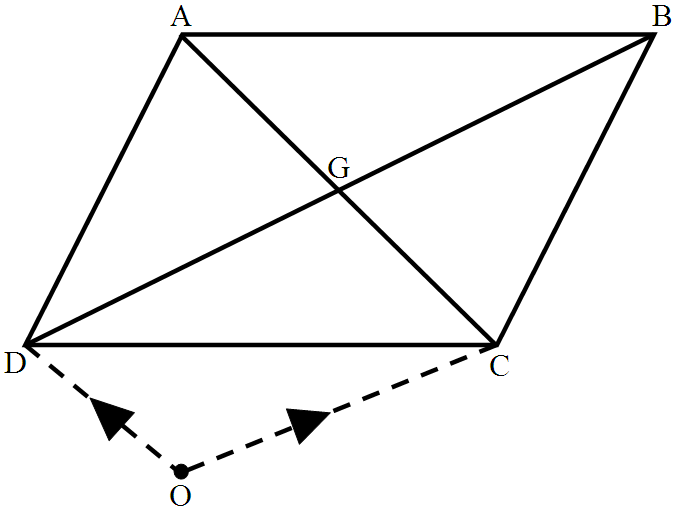
$\therefore\ \overrightarrow{\text{OG}}=\frac{\overrightarrow{\text{OA}}+\overrightarrow{\text{OC}}}2$
$2\overrightarrow{\text{OG}}=\overrightarrow{\text{OA}}+\overrightarrow{\text{OC}}\ \dots(1)$
Also, $G$ is the mid $-$ point $\text{BD}$
$\therefore\ \overrightarrow{\text{OG}}=\frac{\overrightarrow{\text{OB}}+\overrightarrow{\text{OD}}}2$
$2\overrightarrow{\text{OG}}=\overrightarrow{\text{OB}}+\overrightarrow{\text{OD}}\ \dots(2)$
On adding $(1)$ and $(2)$ we get,
$2\overrightarrow{\text{OG}}+2\overrightarrow{\text{OG}}=\overrightarrow{\text{OA}}+\overrightarrow{\text{OB}}+\overrightarrow{\text{OC}}+\overrightarrow{\text{OD}}$
$4\overrightarrow{\text{OG}}=\overrightarrow{\text{OA}}+\overrightarrow{\text{OB}}+\overrightarrow{\text{OC}}+\overrightarrow{\text{OD}}$
$\therefore\overrightarrow{\text{OA}}+\overrightarrow{\text{OB}}+\overrightarrow{\text{OC}}+\overrightarrow{\text{OD}}=4\overrightarrow{\text{OG}}$ View full question & answer→MCQ 401 Mark
The vectors $2\hat{\text{i}}+3\hat{\text{j}}-4\hat{\text{k}}$ and $\text{a}\hat{\text{i}}+\text{b}\hat{\text{j}}+\text{c}\hat{\text{k}}$ are perpendicular if :
- A
$a = 2, b = 3, c = -4$
- ✓
$a = 4, b = 4, c = 5$
- C
$a = 4, b = 4, c = -5$
- D
$a = -4, b = 4, c = -5$
AnswerCorrect option: B. $a = 4, b = 4, c = 5$
It is given that vectors $2\hat{\text{i}}+3\hat{\text{j}}-4\hat{\text{k}}$ and $\text{a}\hat{\text{i}}+\text{b}\hat{\text{j}}+\text{c}\hat{\text{k}}$ are perpendicular.
So, their dot product is zero.
$\Rightarrow2\text{a}+3\text{b}-4\text{c}=0$
$(\text{b})\text{a}=4;\text{b}=4;\text{c}=5$
$\Rightarrow2(4)+3(4)-4(5)=0$
$8+12-20=0$
$0=0,$ which is true.
View full question & answer→MCQ 411 Mark
The resultant of two concurrent forces $\vec{\text{nOP}}$ and $\vec{\text{mOQ}}$ is $(\text{m+n})\vec{\text{OR.}}$ Then $R$ divides $PQ$ in the ratio:
- ✓
$m : n$
- B
$n : m$
- C
$1 : n$
- D
$m : 1$
AnswerCorrect option: A. $m : n$
Applying Section Formula
$\text{R}=\frac{\text{KQ}+\text{P}}{\text{K}+1}$
$(\text{K+1})\text{R = KQ + P}$
$\text{K+1}=\frac{\text{m+n}}{\text{n}}$
$\text{K}=\frac{\text{m}}{\text{n}}$
View full question & answer→MCQ 421 Mark
If $\vec{\text{a}}$ is a non$-$zero of magnitude $'a\ '$ and $\lambda$ is a non$-$zero scalar, then $\lambda\vec{\text{a}}$ is a unit vector if:
AnswerCorrect option: D. $\text{a}=\frac{1}{|\lambda|}$
Given that
$|\vec{\text{a}}|=\text{a};$
Now $,|\lambda\vec{\text{a}}|=1$
$\Rightarrow|\lambda||\vec{\text{a}}|=1$
$\Rightarrow|\lambda|\text{a}=1$
$\Rightarrow\text{a}=\frac{1}{|\lambda|}$
View full question & answer→MCQ 431 Mark
$\text{ABCD}$ is a parallelogram with $AC$ and $BD$ as diagonals. Then, $\overrightarrow{\text{AC}}-\overrightarrow{\text{BD}}=$
- A
$4\overrightarrow{\text{AB}}$
- B
$3\overrightarrow{\text{AB}}$
- ✓
$2\overrightarrow{\text{AB}}$
- D
$\overrightarrow{\text{AB}}$
AnswerCorrect option: C. $2\overrightarrow{\text{AB}}$
Given: $\text{ABCD},$ a parallelogram with diagonals $AC$ and $BD.$
Then, $\overrightarrow{\text{AC}}=\overrightarrow{\text{AB}}+\overrightarrow{\text{BC}}$
$\overrightarrow{\text{AD}}=\overrightarrow{\text{AB}}+\overrightarrow{\text{BD}}$
$\Rightarrow \overrightarrow{\text{BD}}=\overrightarrow{\text{AD}}-\overrightarrow{\text{AB}}$
$\therefore\overrightarrow{\text{AC}}-\overrightarrow{\text{BD}}=\overrightarrow{\text{AB}}+\overrightarrow{\text{BC}}-\overrightarrow{\text{AD}}+\overrightarrow{\text{AB}}=2\overrightarrow{\text{AB}}$
$\Big[\because\ \overrightarrow{\text{AD}}=\overrightarrow{\text{BC}}\Big]$
View full question & answer→MCQ 441 Mark
Choose the correct answer from the given four options. The number of vectors of unit length perpendicular to the vectors $\vec{\text{a}}=2\hat{\text{i}}+\hat{\text{j}}+\hat{2\text{k}}$ and $\vec{\text{b}}=\hat{\text{j}}+\hat{\text{k}}$ is:
AnswerThe number of vectors of unit length perpendicular to the vectors $\vec{\text{a}}$ and $\vec{\text{b}}$ is $\vec{\text{c}} \ ($say$) \ i.e., \vec{\text{c}}=\pm(\vec{\text{a}}\times\vec{\text{b}})$
So, there will be two vectors of unit length perpendicular to the vectors $\vec{\text{a}}$ and $\vec{\text{b}}.$
View full question & answer→MCQ 451 Mark
Can two different vectors have the same magnitude:
AnswerTwo vectors can have the same magnitude.
Magnitude of vector $i - 2j + k$ is equal to magnitude of vector $2i + j - k.$
View full question & answer→MCQ 461 Mark
The value of $\hat{\text{i}}.\big(\hat{\text{j}}\times\hat{\text{k}}\big)+\hat{\text{j}}.\big(\hat{\text{i}}\times\hat{\text{k}}\big)+\hat{\text{k}}.\big(\hat{\text{i}}\times\hat{\text{j}}\big),$ is:
Answer$\hat{\text{i}}.\big(\hat{\text{j}}\times\hat{\text{k}}\big)+\hat{\text{j}}.\big(\hat{\text{i}}\times\hat{\text{k}}\big)+\hat{\text{k}}.\big(\hat{\text{i}}\times\hat{\text{j}}\big)$
$=\hat{\text{i}}.\hat{\text{i}}+\hat{\text{j}}.(-\hat{\text{j}})+\hat{\text{k}}.\hat{\text{k}}$
$=|\hat{\text{i}}|^2-|\hat{\text{j}}|^2+|\hat{\text{k}}|^2$
$=1-1+1$
$=1$
View full question & answer→MCQ 471 Mark
If $\theta$ is the angle between two vectors $\vec{\text{a}}$ and $\vec{\text{b}},$ then $\vec{\text{a}}.\vec{\text{b}}\geq0$ only when:
AnswerCorrect option: B. $0\leq\theta\leq\frac{\pi}{2}$
$\vec{\text{a}}.\vec{\text{b}}\geq0$
$\Rightarrow|\vec{\text{a}}|\big|\vec{\text{b}}\big|\cos\theta\geq0$
$\Rightarrow\cos\theta\geq0$
$\Rightarrow0\leq\theta\leq\frac{\pi}{2}$
View full question & answer→MCQ 481 Mark
If $\vec{\text{a}}$ is any vector, then $\big(\vec{\text{a}}\times\hat{\text{i}}\big)^2+\big(\vec{\text{a}}\times\hat{\text{j}}\big)^2+\big(\vec{\text{a}}\times\hat{\text{k}}\big)^2=$
- A
$\vec{\text{a}}^2$
- ✓
$2\vec{\text{a}}^2$
- C
$3\vec{\text{a}}^2$
- D
$4\vec{\text{a}}^2$
AnswerCorrect option: B. $2\vec{\text{a}}^2$
Let $\vec{\text{a}}={\text{a}}_1\hat{\text{i}}+{\text{a}}_2\hat{\text{j}}+{\text{a}}_3\hat{\text{k}}$
$\vec{\text{a}}\times\hat{\text{i}}=\begin{vmatrix}\hat{\text{i}}&\hat{\text{j}}&\hat{\text{k}}\\\text{a}_1&\text{a}_2&\text{a}_3\\1&0&0 \end{vmatrix}$
$=\text{a}_3\hat{\text{j}}-\text{a}_2\hat{\text{k}}$
$\Rightarrow\big(\vec{\text{a}}\times\hat{\text{i}}\big)^2=\big(\text{a}_3\hat{\text{j}}-\text{a}_2\hat{\text{k}}\big)^2$
$={\text{a}_3}^2|\hat{\text{j}}|^2+{\text{a}_2}^2|\hat{\text{k}}|^2-2\text{a}_3\text{a}_2\big(\hat{\text{j}}.\hat{\text{k}}\big)$
$={\text{a}_3}^2+{\text{a}_2}^2$ $\big(\because\hat{\text{j}}.\hat{\text{k}}=0\dots(1)\big)$
$\therefore\vec{\text{a}}\times\hat{\text{j}}=\begin{vmatrix}\hat{\text{i}}&\hat{\text{j}}&\hat{\text{k}}\\\text{a}_1&\text{a}_2&\text{a}_3\\0&1&0 \end{vmatrix}$
$=-\text{a}_3\hat{\text{i}}+\text{a}_1\hat{\text{k}}$
$\Rightarrow\big(\vec{\text{a}}\times\hat{\text{j}}\big)^2=\big(-\text{a}_3\hat{\text{i}}+\text{a}_1\hat{\text{k}}\big)^2$
$={\text{a}_3}^2|\hat{\text{i}}|^2+{\text{a}_1}^2|\hat{\text{k}}|^2-2\text{a}_3\text{a}_2\big(\hat{\text{i}}.\hat{\text{k}}\big)$
$={\text{a}_3}^2+{\text{a}_1}^2$ $(\because\hat{\text{i}}.\hat{\text{k}}=0)\dots(2)$
$\therefore\vec{\text{a}}\times\hat{\text{k}}=\begin{vmatrix}\hat{\text{i}}&\hat{\text{j}}&\hat{\text{k}}\\\text{a}_1&\text{a}_2&\text{a}_3\\0&0&1 \end{vmatrix}$
$=\text{a}_2\hat{\text{i}}-\text{a}_1\hat{\text{j}}$
$\Rightarrow\big(\vec{\text{a}}\times\hat{\text{k}}\big)^2=\big(\text{a}_2\hat{\text{i}}-\text{a}_1\hat{\text{j}}\big)^2$
$={\text{a}_2}^2|\hat{\text{i}}|^2+{\text{a}_1}^2|\hat{\text{j}}|^2-2\text{a}_1\text{a}_2\big(\hat{\text{i}}.\hat{\text{j}}\big)$
$={\text{a}_2}^2+{\text{a}_1}^2$ $(\because\hat{\text{i}}.\hat{\text{j}}=0)\dots(3)$
Adding $(1), (2)$ and $(3),$ we get
$\big(\vec{\text{a}}\times\hat{\text{i}}\big)^2+\big(\vec{\text{a}}\times\hat{\text{j}}\big)^2+\big(\vec{\text{a}}\times\hat{\text{k}}\big)^2$
$={\text{a}_3}^2+{\text{a}_2}^2+{\text{a}_3}^2+{\text{a}_1}^2+{\text{a}_2}^2+{\text{a}_1}^2$
$=2\big({\text{a}_1}^2+{\text{a}_2}^2+{\text{a}_3}^2\big)$
$=2\vec{\text{a}}^2$ $\big(\because|\vec{\text{a}}|=\sqrt{{\text{a}z_1}^2+{\text{a}_2}^2+{\text{a}_3}^2}\big)$
View full question & answer→MCQ 491 Mark
In a regular hexagon $\text{ABCDEF}, \overrightarrow{\text{AB}}=\vec{\text{a}},\ \overrightarrow{\text{BC}}=\vec{\text{b}}$ and $\overrightarrow{\text{CD}}=\vec{\text{c}}$. Then, $\overrightarrow{\text{AE}}=$
- A
$\vec{\text{a}}+\vec{\text{b}}+\vec{\text{c}}$
- B
$2\vec{\text{a}}+\vec{\text{b}}+\vec{\text{c}}$
- ✓
$\vec{\text{b}}+\vec{\text{c}}$
- D
$\vec{\text{a}}+2\vec{\text{b}}+2\vec{\text{c}}$
AnswerCorrect option: C. $\vec{\text{b}}+\vec{\text{c}}$
Given a regular hexagon $\text{ABCDEF}, \overrightarrow{\text{AB}}=\vec{\text{a}},\ \overrightarrow{\text{BC}}=\vec{\text{b}}$ and $\overrightarrow{\text{CD}}=\vec{\text{c}}$.
Then,
In $\triangle{\text{ABC}}$, we have
$\overrightarrow{\text{AC}}=\vec{\text{a}}+\vec{\text{b}}$
In $\triangle{\text{ACD}}$, we have
$\overrightarrow{\text{AC}}+\overrightarrow{\text{CD}}=\overrightarrow{\text{AD}}$
$\Rightarrow\overrightarrow{\text{AD}}=\overrightarrow{\text{AC}}+\vec{\text{c}}$
$\Rightarrow\overrightarrow{\text{AD}}=\vec{\text{a}}+\vec{\text{b}}+\vec{\text{c}}$
Again, in $\triangle{\text{ADE}}$, we have
$\overrightarrow{\text{AE}}=\overrightarrow{\text{AD}}+\overrightarrow{\text{DE}}$
$\Rightarrow\overrightarrow{\text{AE}}=\vec{\text{a}}+\vec{\text{b}}+\vec{\text{c}}-\vec{\text{a}}$
$\Rightarrow\overrightarrow{\text{AE}}=\vec{\text{b}}+\vec{\text{c}}$
Hence option $(c).$
View full question & answer→MCQ 501 Mark
If $\vec{\text{a}}$ and $\vec{\text{b}}$ are two collinear vectors, then which of the follwoing are incorrect?
- A
$\vec{\text{b}}=\lambda\vec{\text{a}}$ for some scalar $\lambda$
- B
$\vec{\text{a}}=\pm\vec{\text{b}}$
- C
The respective components of $\vec{\text{a}}$ and $\vec{\text{b}}$ are proportional.
- ✓
Both the vectors $\vec{\text{a}}$ and $\vec{\text{b}}$ have the same direction but different magnitudes.
AnswerCorrect option: D. Both the vectors $\vec{\text{a}}$ and $\vec{\text{b}}$ have the same direction but different magnitudes.
If $\vec{\text{a}}$ and $\vec{\text{b}}$ are collinear vectors, then they are parallel.
Therefore, we have $\vec{\text{b}}=\lambda\vec{\text{a}}$, for some scalar $\lambda$.
If $\lambda=\pm1$
$\Rightarrow\vec{\text{a}}=\pm\vec{\text{b}}$
If $\vec{\text{b}}=\text{b}_1\hat{\text{i}}+\text{b}_2\hat{\text{j}}+\text{b}_3\hat{\text{k}}$ and $\vec{\text{a}}=\text{a}_1\hat{\text{i}}+\text{a}_2\hat{\text{j}}+\text{a}_3\hat{\text{k}}$.
Then,
$\vec{\text{b}}=\lambda\vec{\text{a}}$
$\Rightarrow\ \text{b}_1\hat{\text{i}}+\text{b}_2\hat{\text{j}}+\text{b}_3\hat{\text{k}}=\lambda\big(\text{a}_1\hat{\text{i}}+\text{a}_2\hat{\text{j}}+\text{a}_3\hat{\text{k}}\big)$
$\Rightarrow\ \text{b}_1\hat{\text{i}}+\text{b}_2\hat{\text{j}}+\text{b}_3\hat{\text{k}}=(\lambda\text{a}_1)\hat{\text{i}}+(\lambda\text{a}_2)\hat{\text{j}}+(\lambda\text{a}_3)\hat{\text{k}}$
$\Rightarrow\ \text{b}_1=\lambda\text{a}_1,\ \text{b}_2=\lambda\text{a}_2,\ \text{b}_3=\lambda\text{a}_3$
$\Rightarrow\ \frac{\text{b}_1}{\text{a}_1}=\frac{\text{b}_2}{\text{a}_2}=\frac{\text{b}_3}{\text{a}_3}=\lambda$
Thus, the respective components of $\vec{\text{a}}$ and $\vec{\text{b}}$ can have different directions.
Hence, the statement given in $(d)$ is incorrect.
View full question & answer→