MCQ 511 Mark
Let $G$ be the centroid of $\triangle{\text{ABC}}$. if $\overrightarrow{\text{AB}}=\vec{\text{a}},\overrightarrow{\text{AC}}=\vec{\text{b}}$, then the bisector $\overrightarrow{\text{AG}}$, in terms of $\vec{\text{a}}$ and $\vec{\text{b}}$ is,
- A
$\frac{2}3\big(\vec{\text{a}}+\vec{\text{b}}\big)$
- B
$\frac{1}6\big(\vec{\text{a}}+\vec{\text{b}}\big)$
- ✓
$\frac{1}3\big(\vec{\text{a}}+\vec{\text{b}}\big)$
- D
$\frac{1}2\big(\vec{\text{a}}+\vec{\text{b}}\big)$
AnswerCorrect option: C. $\frac{1}3\big(\vec{\text{a}}+\vec{\text{b}}\big)$
Taking $A$ as origin. Then, position vector of $A, B$ and $C$ are $\vec0,\vec{\text{a}}$ and $\vec{\text{b}}$ respectively.
Then, Centroid $G$ has position vector $\frac{\vec0+\vec{\text{a}}+\vec{\text{b}}}3=\frac{\vec{\text{a}}+\vec{\text{b}}}3$
Therefore, $\text{AG}=\frac{\vec{\text{a}}+\vec{\text{b}}}3-\vec0=\frac{\vec{\text{a}}+\vec{\text{b}}}3$
View full question & answer→MCQ 521 Mark
If $\theta$ is an acute angle and the vector $(\sin\theta)\hat{\text{i}}+(\cos\theta)\hat{\text{j}}$ is perpendicular to the vector $\hat{\text{i}}-\sqrt{3}\hat{\text{j}},$
- A
$\frac{\pi}{6}$
- B
$\frac{\pi}{5}$
- C
$\frac{\pi}{4}$
- ✓
$\frac{\pi}{3}$
AnswerCorrect option: D. $\frac{\pi}{3}$
The given vectors are perpendicular.
so, their dot product is zero.
$\big[(\sin\theta)\hat{\text{i}}+(\cos\theta)\hat{\text{j}}\big].\big(\hat{\text{j}}-\sqrt{3}\hat{\text{j}}\big)=0$
$\Rightarrow\sin\theta-\sqrt{3}\cos\theta=0$
$\Rightarrow\sin\theta=\sqrt{3}\cos\theta$
$\Rightarrow\tan\theta=\sqrt{3}$
$\Rightarrow\theta=\frac{\pi}{3} ($because $\theta$ is acute$)$
View full question & answer→MCQ 531 Mark
The curve $y-x:$
AnswerCorrect option: B. A horizontal tangent $($parallel to $x-$axis$)$
View full question & answer→MCQ 541 Mark
If three points $A, B$ and $C$ have position vectors $\hat{\text{i}}+\text{x}\hat{\text{j}}+3\hat{\text{k}},\ 3\hat{\text{i}}+4\hat{\text{j}}+7\hat{\text{k}}$ and $\text{y}\hat{\text{i}}-2\hat{\text{j}}-5\hat{\text{k}}$ respectively are collinear, then $(x, y) =$
- ✓
$(2, -3)$
- B
$(-2, 3)$
- C
$(-2, -3)$
- D
$(2, 3)$
AnswerCorrect option: A. $(2, -3)$
Given position vector of $A, B$ and $C$ are $\hat{\text{i}}+\text{x}\hat{\text{j}}+3\hat{\text{k}},\ 3\hat{\text{i}}+4\hat{\text{j}}+7\hat{\text{k}}$ and $\text{y}\hat{\text{i}}-2\hat{\text{j}}-5\hat{\text{k}}$. Then,
$\overrightarrow{\text{AB}}=3\hat{\text{i}}+4\hat{\text{j}}+7\hat{\text{k}}-\hat{\text{i}}-\text{x}\hat{\text{j}}-3\hat{\text{k}}$
$=2\hat{\text{i}}+(4-\text{x})\hat{\text{j}}+4\hat{\text{k}}$
$\overrightarrow{\text{BC}}=\text{y}\hat{\text{i}}-2\hat{\text{j}}-5\hat{\text{k}}-3\hat{\text{i}}-4\hat{\text{j}}-7\hat{\text{k}}$
$=(\text{y}-3)\hat{\text{i}}-6\hat{\text{j}}-12\hat{\text{k}}$
Since, the given vectors are collinear.
$\therefore\ \overrightarrow{\text{AB}}=\lambda\overrightarrow{\text{BC}}$
$\Rightarrow\ 2\hat{\text{i}}+(4-\text{x})\hat{\text{j}}+4\hat{\text{k}}=\lambda(\text{y}-3)\hat{\text{i}}-6\lambda\hat{\text{j}}-12\lambda\hat{\text{k}}$
$\Rightarrow\ 2=\lambda(\text{y}-3),\ (4-\text{x})=-6\lambda,\ 4=-12\lambda$
$\Rightarrow\ 2=\lambda(\text{y}-3),\ (4-\text{x})=-6\lambda,\ \lambda=-\frac{1}3$
$\Rightarrow\ 2=-\frac{1}3(\text{y}-3),\ (4-\text{x})=-6\times\Big(-\frac{1}3\Big)$
$\Rightarrow\ -6=\text{y}-3,\ 4-\text{x}=2$
$\Rightarrow\ \text{y}=-3,\ \text{x}=2$
View full question & answer→MCQ 551 Mark
Choose the correct answer
If $\theta$ is the angle between two vectors $\vec{\text{a}}\ \text{and}\ \vec{\text{b}},\ \text{then}\ \vec{\text{a}}\cdot\vec{\text{b}}\geq0$ only when,
AnswerCorrect option: B. $0\leq\theta\leq\frac{\pi}{2}$
Let $\theta$ be the angle between two vectors $\vec{\text{a}}\ \text{and}\ \vec{\text{b}}.$Then, without loss of generality, $\vec{\text{a}}\ \text{and}\ \vec{\text{b}}$ are non-zero vectors so that $|\vec{\text{a}}|\ \text{and}\ \Big|\vec{\text{b}}\Big|$ are positive
It is known that $\vec{\text{a}}\cdot\vec{\text{b}}=|\vec{\text{a}}| \Big|\vec{\text{b}}\Big|\cos\theta.$
$\therefore\vec{\text{a}}\cdot\vec{\text{b}}\geq0$
$\Rightarrow|\vec{\text{a}}| \Big|\vec{\text{b}}\Big|\cos\theta\geq0$
$\Rightarrow\cos\theta\geq0\ \ \ \Big[\big|\vec{\text{a}}\big|\ \text{and}\ \Big|\vec{\text{b}}\Big|\ \text{are positive}\Big]$
$\Rightarrow0\leq\theta\leq\frac{\pi}{2}$
Hence, $\vec{\text{a}}.\vec{\text{b}}\geq0\ \text{when}\ 0\leq\theta\leq\frac{\pi}{2}.$
The correct answer is B.
View full question & answer→MCQ 561 Mark
Which of the following holds true for a vector quantity:
- A
- B
- ✓
A vector has both direction and magnitude
- D
A vector can never be negative
AnswerCorrect option: C. A vector has both direction and magnitude
A quantity which has both magnitude and direction is called a vector quantity. The quantity which has only magnitude but no direction is called a scalar quantity.
View full question & answer→MCQ 571 Mark
Choose the correct answer
If $\theta$ is the angle between any two vectors $\vec{\text{a}}\ \text{and}\ \vec{\text{b}}, \text{then}\ |\vec{\text{a}}\cdot\vec{\text{b}}|=|\vec{\text{a}}\times\vec{\text{b}}|\ \text{when}\ \theta$ is equal to
- A
- ✓
$\frac{\pi}{4}$
- C
$\frac{\pi}{2}$
- D
$\pi$
AnswerCorrect option: B. $\frac{\pi}{4}$
Let $\theta$ be the angle between two vectors $\vec{\text{a}}\ \text{and}\ \vec{\text{b}}.$
Then, without loss of generality, $\vec{\text{a}}\ \text{and}\ \vec{\text{b}}$ are non-zero vectors, so that $\big|\vec{\text{a}}\big|\ \text{and}\ \Big|\vec{\text{b}}\Big|$ are position.
$\Big|\vec{\text{a}}\cdot\vec{\text{b}}\Big|=\Big|\vec{\text{a}}\times\vec{\text{b}}\Big|$
$\Rightarrow\big|\vec{\text{a}}\big|\Big|\vec{\text{b}}\Big|\cos\theta=\big|\vec{\text{a}}\big|\Big|\vec{\text{b}}\Big|\sin\theta$
$\Rightarrow\cos\theta=\sin\theta\ \ \ \Big[\big|\vec{\text{a}}\big|\ \text{and}\ \Big|\vec{\text{b}}\Big|\Big]\ \text{are positive}$
$\Rightarrow\tan\theta=1$
$\Rightarrow\theta=\frac{\pi}{4}$
Hence, $\Big|\vec{\text{a}}.\vec{\text{b}}\Big|=\Big|\vec{\text{a}}\times\vec{\text{b}}\Big|$ when $\theta$ is equal to $\frac{\pi}{4}.$
The correct answer is B.
View full question & answer→MCQ 581 Mark
If $y = x:$
- ✓
$0.32$
- B
$0.032$
- C
$5.68$
- D
$5.968$
AnswerCorrect option: A. $0.32$
View full question & answer→MCQ 591 Mark
Choose the correct answer from the given four options. If $|\vec{\text{a}}|=4$ and $-3\leq\lambda\leq2,$ then the range of $|\lambda\vec{\text{a}}|$ is :
- A
$[0,8]$
- B
$[-12,8]$
- ✓
$[0,12]$
- D
$[8,12]$
AnswerCorrect option: C. $[0,12]$
We have $|\vec{\text{a}}|=4$ and $-3\leq\lambda\leq2$
Now $|\lambda\vec{\text{a}}|=|\lambda||\vec{\text{a}}|=4|\lambda|$
Now $-3\leq\lambda\leq2$
$\Rightarrow0\leq|\lambda|\leq3$
$\Rightarrow0\leq4|\lambda|\leq12$
$\Rightarrow0\leq|\lambda\vec{\text{a}}|\leq12$
View full question & answer→MCQ 601 Mark
For any three vectors $\vec{\text{a}},\vec{\text{b}},\vec{\text{c}}$ the expression $\big(\vec{\text{a}}-\vec{\text{b}}\big).\big\{\big(\vec{\text{b}}-\vec{\text{c}}\big)\times\big(\vec{\text{c}}-\vec{\text{a}}\big)\big\}$ equals:
- A
$\big[\vec{\text{a}}\vec{\text{b}}\vec{\text{c}}\big]$
- B
$2\big[\vec{\text{a}}\vec{\text{b}}\vec{\text{c}}\big]$
- C
$\big[\vec{\text{a}}\vec{\text{b}}\vec{\text{c}]}^2$
- ✓
AnswerWe have
$\big(\vec{\text{a}}-\vec{\text{b}}\big).\big[\big(\vec{\text{b}}-\vec{\text{c}}\big)\times\big(\vec{\text{c}}-\vec{\text{a}}\big)\big]$
$=\big(\vec{\text{a}}-\vec{\text{b}}\big).\big[\big(\vec{\text{b}}-\vec{\text{c}}\big)\times\vec{\text{c}}-\big(\vec{\text{b}}-\vec{\text{c}}\big)\times\vec{\text{a}}\big]$
$=\big(\vec{\text{a}}-\vec{\text{b}}\big).\big(\vec{\text{b}}\times\vec{\text{c}}-\vec{\text{c}}\times\vec{\text{c}}-\vec{\text{b}}\times\vec{\text{a}}+\vec{\text{c}}\times\vec{\text{a}}\big)$
$=\big(\vec{\text{a}}-\vec{\text{b}}\big).\big(\vec{\text{b}}\times{\vec{\text{c}}}-0-\vec{\text{b}}\times\vec{\text{a}}+\vec{\text{c}}\times\vec{\text{a}}\big)$
$=\big(\vec{\text{a}}-\vec{\text{b}}\big).\big(\vec{\text{b}}\times\vec{\text{c}}\big)-\big(\vec{\text{a}}-\vec{\text{b}}\big).\big(\vec{\text{b}}\times\vec{\text{a}}\big)+\big(\vec{\text{a}}-\vec{\text{b}}\big).\big(\vec{\text{c}}\times\vec{\text{a}}\big)$
$=\vec{\text{a}}.\big(\vec{\text{b}}\times\vec{\text{c}}\big)-\vec{\text{b}}\big(\vec{\text{b}}\times\vec{\text{c}}\big)-\vec{\text{a}}\big(\vec{\text{b}}\times\vec{\text{a}}\big)\\+\vec{\text{b}}.\big(\vec{\text{b}}\times\vec{\text{a}}\big)+\vec{\text{a}}.\big(\vec{\text{c}}\times\vec{\text{a}}\big)-\vec{\text{b}}.\big(\vec{\text{c}}\times\vec{\text{a}}\big)$
$=\big[\vec{\text{a}}\vec{\text{b}}\vec{\text{c}}\big]-0-0+0+0-\big[\vec{\text{b}}\vec{\text{c}}\vec{\text{a}}\big]$ $\big(\therefore\big[\vec{\text{b}}\vec{\text{b}}\vec{\text{c}}\big]=\big[\vec{\text{a}}\vec{\text{b}}\vec{\text{a}}\big]=\big[\vec{\text{b}}\vec{\text{b}}\vec{\text{a}}\big]=0\big)$
$=\big[\vec{\text{a}}\vec{\text{b}}\vec{\text{c}}\big]-\big[\vec{\text{a}}\vec{\text{b}}\vec{\text{c}}\big]$ $\big(\therefore\big[\vec{\text{a}}\vec{\text{b}}\vec{\text{c}}\big]=\big[\vec{\text{b}}\vec{\text{c}}\vec{\text{a}}\big]=\big[\vec{\text{c}}\vec{\text{a}}\vec{\text{b}}\big]\big)$
$=0$
View full question & answer→MCQ 611 Mark
If $\vec{\text{a}},\ \vec{\text{b}},\ \vec{\text{c}}$ are three non-zero vectors, no two of which are collinear and the vector $\vec{\text{a}}+\vec{\text{b}}$ is collinear with $\vec{\text{c}}$, $\vec{\text{b}}+\vec{\text{c}}$ is collinear with $\vec{\text{a}}$, then $\vec{\text{a}}+\vec{\text{b}}+\vec{\text{c}}=$
- A
$\vec{\text{a}}$
- B
$\vec{\text{b}}$
- C
$\vec{\text{c}}$
- ✓
Answer$\vec{\text{a}}+\vec{\text{b}}$ is collinear with $\vec{\text{c}}$
$\therefore\ \vec{\text{a}}+\vec{\text{b}}=\text{x}\vec{\text{c}}\ \dots(1)$
where $x$ is scalar and $\text{x}\neq0$.
$\vec{\text{b}}+\vec{\text{c}}$ is collinear with $\vec{\text{a}}$
$\vec{\text{b}}+\vec{\text{c}}=\text{y}\vec{\text{a}}\ \dots(2)$
$y$ is scalar and $\text{y}\neq0$
Substracting $(2)$ from $(1)$ we get,
$\vec{\text{a}}-\vec{\text{c}}=\text{x}\vec{\text{c}}-\text{y}\vec{\text{a}}$
$\vec{\text{a}}(1+\text{y})=(1+\text{x})\vec{\text{c}}$
As given $\vec{\text{a}},\ \vec{\text{c}}$ are not collinear,
$\therefore\ 1+\text{y}=0$ and $1+\text{x}=0$
$\text{y}=-1$ and $\text{x}=-1$
Putting the value of $x$ in equation $(1)$
$\vec{\text{a}}+\vec{\text{b}}=-\vec{\text{c}}$
$\vec{\text{a}}+\vec{\text{b}}+\vec{\text{c}}=0$
View full question & answer→MCQ 621 Mark
Area of a rectangle having vertices A, B, C and D with position vectors $-\hat{i}+\frac{1}{2}\hat{j}+4\hat{k},\ \hat{i}+\frac{1}{2}\hat{j}+4\hat{k},$ $\hat{i}-\frac{1}{2}\hat{j}+4\hat{k}\ \text{and} \ -\hat{i}-\frac{1}{2}\hat{j}+4\hat{k},$
Answer$\text{Given:}\ \text{ABCD is a rectangle}$
$ \text{Now} \ \ \overrightarrow{\text{AB}}\ $ = Position vector of point B - Position vector of point A
$=\hat{i}+\frac{1}{2}\hat{j}+4\hat{k}-\bigg(-\hat{i}+\frac{1}{2}\hat{j}+4\hat{k}\bigg)$ $=\hat{i}+\frac{1}{2}\hat{j}+4\hat{k}+\hat{i}-\frac{1}{2}\hat{j}-4\hat{k}$
$=2\hat{i}+0\hat{j}+0\hat{k}$
$\therefore \ \text{AB}=\bigg|{\overrightarrow{\text{AB}}\bigg|}\ \ =\sqrt{4+0+0}=\sqrt{4}=2$
$\text{And}\ \ \overrightarrow{\text{AD}}$ = Position vector of point D - Position vector of point A
$=-\hat{i}-\frac{1}{2}\hat{j}+4\hat{k}-\bigg(-\hat{i}+\frac{1}{2}\hat{j}+4\hat{k}\bigg)$ $=-\hat{i}-\frac{1}{2}\hat{j}+4\hat{k}+\hat{i}-\frac{1}{2}\hat{j}-4\hat{k}$
$=0\hat{i}-\hat{j}+0\hat{k}$
$\therefore\ \text{AD}=\bigg|\overrightarrow{\text{AD}}\bigg|=\sqrt{0+1+0}=\sqrt{1}=1$
$\therefore\ $ Area of rectangle ABCD = Length x Breadth = AB × AD = 2 × 1 = 2 eq. units
Therefore, option (C) is correct.
View full question & answer→MCQ 631 Mark
Which of the below given is a vector quantity:
- A
$8\ kg$
- B
$4$ seconds
- ✓
$6$ Newton
- D
$90 \mathrm{~cm}^3$
AnswerCorrect option: C. $6$ Newton
$6$ Newton is a vector quantity as it is a force. Force is a vector quantity which has both magnitude and direction.
View full question & answer→MCQ 641 Mark
If $\text{ABCDEF}$ is a regular hexagon, then $\overrightarrow{\text{AD}}+\overrightarrow{\text{EB}}+\overrightarrow{\text{FC}}$ equals,
- A
$2\overrightarrow{\text{AB}}$
- B
$\vec0$
- C
$3\overrightarrow{\text{AB}}$
- ✓
$4\overrightarrow{\text{AB}}$
AnswerCorrect option: D. $4\overrightarrow{\text{AB}}$
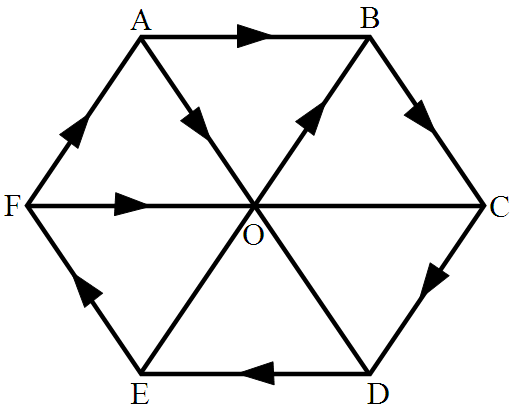
$\overrightarrow{\text{AD}}=2\overrightarrow{\text{BC}}$
$\overrightarrow{\text{EB}}=2\overrightarrow{\text{FA}}$
$\overrightarrow{\text{FC}}=2\overrightarrow{\text{AB}}$
$\overrightarrow{\text{AD}}+\overrightarrow{\text{EB}}=2\Big(\overrightarrow{\text{BC}}+\overrightarrow{\text{FA}}\Big)$
$=2\Big(\overrightarrow{\text{AO}}+\overrightarrow{\text{FA}}\Big)$ $\Big(\because\ \overrightarrow{\text{BC}}=\overrightarrow{\text{AO}}\Big)$
In triangle $\text{AOF},$
$\overrightarrow{\text{FA}}+\overrightarrow{\text{AO}}+\overrightarrow{\text{FO}}=0$
$\therefore\ \overrightarrow{\text{FA}}+\overrightarrow{\text{AO}}=-\overrightarrow{\text{FO}}$
$\therefore\overrightarrow{\text{AD}}+\overrightarrow{\text{EB}}=-2\overrightarrow{\text{FO}}$
And $\overrightarrow{\text{AB}}=-\overrightarrow{\text{FO}}$
$\therefore\overrightarrow{\text{AD}}+\overrightarrow{\text{EB}}=2\overrightarrow{\text{AB}}$
$\therefore\overrightarrow{\text{AD}}+\overrightarrow{\text{EB}}+\overrightarrow{\text{FC}}$
$=2\overrightarrow{\text{AB}}+2\overrightarrow{\text{AB}}$
$=4\overrightarrow{\text{AB}}$ View full question & answer→MCQ 651 Mark
If $\vec{\text{a}},\vec{\text{b}},\vec{\text{c}}$ and $\vec{\text{d}}$ are the position vector of points $\text{A, B, C, D}$ such that no three of them are collinear and $\vec{\text{a}}+\vec{\text{c}}=\vec{\text{b}}+\vec{\text{d}}$, then $\text{ABCD}$ is a,
AnswerGiven :
$\vec{\text{a}}+\vec{\text{c}}=\vec{\text{b}}+\vec{\text{d}}$
$\Rightarrow\vec{\text{c}}-\vec{\text{d}}=\vec{\text{b}}-\vec{\text{a}}$
$\Rightarrow\overrightarrow{\text{AB}}=\overrightarrow{\text{DC}}$
And $\vec{\text{a}}+\vec{\text{c}}=\vec{\text{b}}+\vec{\text{d}}$
$\Rightarrow\vec{\text{c}}-\vec{\text{b}}=\vec{\text{d}}-\vec{\text{a}}$
$\Rightarrow\overrightarrow{\text{AD}}=\overrightarrow{\text{BC}}$
Also, since $\vec{\text{a}}+\vec{\text{c}}=\vec{\text{b}}+\vec{\text{d}}$
$\Rightarrow\frac{1}2\big(\vec{\text{a}}+\vec{\text{c}}\big)=\frac{1}2\big(\vec{\text{b}}+\vec{\text{d}}\big)$
So, position vector of mid $-$ point of $\text{BD} =$ position vector of mid $-$ point of $\text{AC}.$
Hence diagonals bisect each other.
The given $\text{ABCD}$ is a parallelogram.
View full question & answer→MCQ 661 Mark
A vector whose initial and terminal points coincide, is:
AnswerThe vector whose initial and terminals points are coincide has the length $0.$
we call it to be a zero vector and the zero vector no has the particular direction,
so that it can be assigned in any direction.
View full question & answer→MCQ 671 Mark
Forces $3\overrightarrow{\text{OA}},\ 5\overrightarrow{\text{OB}}$ act along $OA$ and $OB$. If their resultant passes through $C$ on $AB,$ then,
AnswerCorrect option: C. $3AC = 5CB$
Draw $ON,$ the perpendicular to the line $AB$
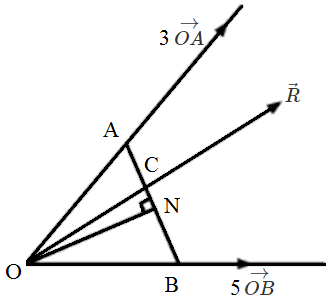
Let $\vec{\text{i}}$ be the unit vector along $\text{ON}$
The resultant force $\vec{\text{R}}=3\overrightarrow{\text{OA}}+5\overrightarrow{\text{OB}}\ \dots(1)$
The angles between $\vec{\text{i}}$ and the forces $\vec{\text{R}},\ 3\overrightarrow{\text{OA}},\ 5\overrightarrow{\text{OB}}$ are $\angle\text{CON},\ \angle\text{AON},\ \angle\text{BON}$ respectively.
$\vec{\text{R}}.\vec{\text{i}}=3\overrightarrow{\text{OA}}.\vec{\text{i}}+5\overrightarrow{\text{OB}}.\vec{\text{i}}$
$\Rightarrow\text{R}.1.\cos\angle\text{CON}$
$=3\overrightarrow{\text{OA}}.1.\cos\angle\text{AON}+5\overrightarrow{\text{OB}}.1.\cos\angle{\text{BON}}$
$\text{R}.\frac{\text{ON}}{\text{OC}}=3\text{OA}\times\frac{\text{ON}}{\text{OA}}+5\text{OB}\frac{\text{ON}}{\text{OB}}$
$\frac{\text{R}}{\text{OC}}=(3+5)$
$\text{R}=8\overrightarrow{\text{OC}}$
We know that,
$\overrightarrow{\text{OA}}=\overrightarrow{\text{OC}}+\overrightarrow{\text{CA}}$
$\Rightarrow3\overrightarrow{\text{OA}}=3\overrightarrow{\text{OC}}+3\overrightarrow{\text{CA}}\ \dots(\text{i})$
$\overrightarrow{\text{OB}}=\overrightarrow{\text{OC}}+\overrightarrow{\text{CB}}$
$\Rightarrow5\overrightarrow{\text{OB}}=5\overrightarrow{\text{OC}}+5\overrightarrow{\text{CB}}\ \dots(\text{ii})$
On adding $(i)$ and $(ii)$ we get,
$3\overrightarrow{\text{OA}}+5\overrightarrow{\text{OB}}=8\overrightarrow{\text{OC}}+3\overrightarrow{\text{CA}}+5\overrightarrow{\text{CB}}$
$\vec{\text{R}}=8\overrightarrow{\text{OC}}+3\overrightarrow{\text{CA}}+5\overrightarrow{\text{CB}}$
$8\overrightarrow{\text{OC}}=8\overrightarrow{\text{OC}}+3\overrightarrow{\text{CA}}+5\overrightarrow{\text{CB}}$
$\Big|3\overrightarrow{\text{AC}}\Big|=\Big|5\overrightarrow{\text{CB}}\Big|$
$\Rightarrow3\overrightarrow{\text{AC}}=5\overrightarrow{\text{CB}}$ View full question & answer→MCQ 681 Mark
The Polygon Law of Vector Addition is simply an extension of:
- A
Parallelogram Law of Vector Addition
- ✓
Triangular Law of Vector Addition
- C
Both $A$ and $B$
- D
AnswerCorrect option: B. Triangular Law of Vector Addition
The Polygon Law of Vector Addition is simply an extension of Triangular Law of Vector Addition.
Here, we take into consideration more than two sides unlike in triangular law of vector addition.
View full question & answer→MCQ 691 Mark
If $\theta$ is the angle between any two vectors $\vec{\text{a}}$ and $\vec{\text{b}},$ then $\big|\vec{\text{a}}.\vec{\text{b}}\big|=\big|\vec{\text{a}}\times\vec{\text{b}}\big|$ when $\theta$ is equal to:
- A
$0$
- ✓
$\frac{\pi}{4}$
- C
$\frac{\pi}{2}$
- D
$\pi$
AnswerCorrect option: B. $\frac{\pi}{4}$
Let $\theta$ be the angle between $\vec{\text{a}}$ and $\vec{\text{b}}.$
We know
$\big|\vec{\text{a}}\times\vec{\text{b}}\big|=|\vec{\text{a}}|\big|\vec{\text{b}}\big|\sin\theta$
$\vec{\text{a}}.\vec{\text{b}}=|\vec{\text{a}}|\big|\vec{\text{b}}\big|\cos\theta$
$\Rightarrow\big|\vec{\text{a}}.\vec{\text{b}}\big|=\big||\vec{\text{a}}|\big|\vec{\text{b}}\big|\cos\theta\big|=|\vec{\text{a}}|\big|\vec{\text{b}}\big||\cos\theta|$
Given: $\big|\vec{\text{a}}.\vec{\text{b}}\big|=\big|\vec{\text{a}}\times\vec{\text{b}}\big|$
$\Rightarrow|\vec{\text{a}}|\big|\vec{\text{b}}\big||\cos\theta|=|\vec{\text{a}}|\big|\vec{\text{b}}\big|\sin\theta$
$\Rightarrow|\cos\theta|=\sin\theta$
$\Rightarrow\theta=\frac{\pi}{4}$
View full question & answer→MCQ 701 Mark
If points $\text{A}(60\hat{\text{i}}+3\hat{\text{j}}),\ \text{B}(40\hat{\text{i}}-8\hat{\text{j}})$ and $\text{C}(\text{a}\hat{\text{i}}+52\hat{\text{j}})$ are collinear, then a is equal to,
AnswerGiven: Three points $\text{A}(60\hat{\text{i}}+3\hat{\text{j}}),\ \text{B}(40\hat{\text{i}}-8\hat{\text{j}})$ and $\text{C}(\text{a}\hat{\text{i}}+52\hat{\text{j}})$ are collinear.
Then, $\overrightarrow{\text{AB}}=\lambda\overrightarrow{\text{BC}}$
We have, $\overrightarrow{\text{AB}}=\big(40\hat{\text{i}}-8\hat{\text{j}}\big)-\big(60\hat{\text{i}}+3\hat{\text{j}}\big)$
$=-20\hat{\text{i}}-11\hat{\text{j}}$
$\overrightarrow{\text{BC}}=\big(\text{a}\hat{\text{i}}-52\hat{\text{j}}\big)-\big(40\hat{\text{i}}-8\hat{\text{j}}\big)$
$=(\text{a}-40)\hat{\text{i}}-44\hat{\text{j}}$
Therefore, $\overrightarrow{\text{AB}}=\lambda\overrightarrow{\text{BC}}$
$\Rightarrow-20\hat{\text{i}}-11\hat{\text{j}}=\lambda(\text{a}-40)\hat{\text{i}}-\lambda44\hat{\text{j}}$
$\Rightarrow\lambda(\text{a}-40)=-20,\ -44\lambda=-11\Rightarrow\lambda=\frac{1}4$
$\Rightarrow\text{a}-40=-80$
$\Rightarrow\text{a}=-40$
View full question & answer→MCQ 711 Mark
The Polygon Law of Vector Addition is simply an extension of $.............?$
- A
Parallelogram Law of Vector Addition
- ✓
Triangular Law of Vector Addition
- C
Both $A$ and $B$
- D
AnswerCorrect option: B. Triangular Law of Vector Addition
The Polygon Law of Vector Addition is simply an extension of Triangular Law of Vector Addition.
Here we take into consideration more than two sides unlike in triangular law of vector addition.
View full question & answer→MCQ 721 Mark
If two or more vectors are parallel to the same line, irrespective of their magnitudes and directions, then they are:
AnswerCollinear vectors are two or more vectors which are parallel to the same line irrespective of their magnitude and direction.
View full question & answer→MCQ 731 Mark
If $\vec{\text{a}}$ and $\vec{\text{b}}$ be two unit vectors and $\theta$ the angle between them, than $\vec{\text{a}}+\vec{\text{b}}$ is a unit vector if $\theta=$
- A
$\frac{\pi}{4}$
- B
$\frac{\pi}{3}$
- C
$\frac{\pi}{2}$
- ✓
$\frac{2\pi}{3}$
AnswerCorrect option: D. $\frac{2\pi}{3}$
We have
$|\vec{\text{a}}|=1$ and $\big|\vec{\text{b}\big|}=1$
Now, $\big|\vec{\text{a}}+\vec{\text{b}}\big|=1$
$\Rightarrow|\vec{\text{a}}|^2+\big|\vec{\text{b}\big|}^2+2\vec{\text{a}}.\vec{\text{b}}=1$
$\Rightarrow1+1+2|\vec{\text{a}}|\big|\vec{\text{b}}\big|\cos\theta=1$
$\Rightarrow2+2\cos\theta=1$
$\Rightarrow2\cos\theta=-1$
$\Rightarrow\cos\theta=\frac{-1}{2}$
$\Rightarrow\theta=\frac{2\pi}{3}$
View full question & answer→MCQ 741 Mark
The distance of the point $(-3, 4, 5)$ from the origin:
AnswerCorrect option: B. $5\sqrt{2}$
View full question & answer→MCQ 751 Mark
The vector component of $\vec{\text{b}}$ perpendicular to $\vec{\text{a}}$ is:
- A
$\big(\vec{\text{b}}.\vec{\text{c}}\big)\vec{\text{a}}$
- ✓
$\frac{\vec{\text{a}}\times\big(\vec{\text{b}}\times\vec{\text{a}}\big)}{|\vec{\text{a}}|^2}$
- C
$\vec{\text{a}}\times\big(\vec{\text{b}}\times\vec{\text{a}}\big)$
- D
AnswerCorrect option: B. $\frac{\vec{\text{a}}\times\big(\vec{\text{b}}\times\vec{\text{a}}\big)}{|\vec{\text{a}}|^2}$
The vector component of $\vec{\text{b}}$ perpendicular to $\vec{\text{a}}$ is
$=\frac{\vec{\text{a}}\times\big(\vec{\text{b}}\times\vec{\text{a}}\big)}{|\vec{\text{a}}|^2}$
View full question & answer→MCQ 761 Mark
If $\mid\text{a}\mid=4$ and $-3\underline{<}\lambda\underline{<}2$ then the range of $\mid\lambda\text{a}\mid$ is:
- A
$[0, 8]$
- B
$[-12, 8]$
- ✓
$[0, 12]$
- D
$[8, 12]$
AnswerCorrect option: C. $[0, 12]$
View full question & answer→MCQ 771 Mark
What is the value of $x$ and $y,$ if $2i + 3j = xi + yj:$
- A
$4, 9$
- B
$3, 2$
- ✓
$2, 3$
- D
$0, 0$
AnswerCorrect option: C. $2, 3$
$2i + 3j = xi + yj$
On comparing the two equations, we have,
$x = 2$ and $y = 3$
View full question & answer→MCQ 781 Mark
Choose the correct answer from the given four options. For any vector $\vec{\text{a}},$ the value of $(\vec{\text{a}}\times\hat{\text{i}})^2+(\vec{\text{a}}\times\hat{\text{j}})^2+(\vec{\text{a}}\times\hat{\text{k}})^2$ is :
- A
$\vec{\text{a}}^2$
- B
$3\vec{\text{a}}^2$
- C
$4\vec{\text{a}}^2$
- ✓
$2\vec{\text{a}}^2$
AnswerCorrect option: D. $2\vec{\text{a}}^2$
Let $\vec{\text{a}}^2=\text{x}\hat{\text{i}}+\text{y}\hat{\text{j}}+\text{z}\hat{\text{k}}$
$\therefore\vec{\text{a}}^2=\text{x}^2+\text{y}^2+\text{z}^2$
$\therefore\ \vec{\text{a}}\times\vec{\text{i}}\begin{vmatrix}\hat{\text{i}}&\hat{\text{j}}&\hat{\text{k}} \\\text{x}&\text{y}&\text{z}\\1&0&0 \end{vmatrix}$
$=\hat{\text{i}}[0]-\hat{\text{j}}[-\text{z}]+\hat{\text{k}}[-\text{y}]$
$=\text{z}\hat{\text{j}}-\text{y}\hat{\text{k}}$
$\therefore\ (\vec{\text{a}}\times\hat{\text{i}})=(\text{z}\hat{\text{j}}-\text{y}\hat{\text{k}})(\text{z}\hat{\text{j}}-\text{y}\hat{\text{k}})$
$=\text{y}^2+\text{z}^2$
Similarly, $(\vec{\text{a}}\times\hat{\text{j}})^2=\text{x}^2+\text{z}^2$
And $(\vec{\text{a}}\times\hat{\text{k}})^2=\text{x}^2+\text{y}^2$
$\therefore\ (\vec{\text{a}}\times\hat{\text{i}})^2+(\vec{\text{a}}\times\hat{\text{j}})^2+(\vec{\text{a}}\times\hat{\text{k}})^2$
$=\text{y}^2+\text{z}^2+\text{x}^2+\text{z}^2+\text{x}^2+\text{y}^2$
$2(\text{x}^2+\text{y}^2+\text{z}^2)=2\vec{\text{a}}^2$
View full question & answer→MCQ 791 Mark
Choose the correct answer from the given four options. If $\vec{\text{a}},\vec{\text{b}},\vec{\text{c}}$ are three vectors such that $\vec{\text{a}}+\vec{\text{b}}+\vec{\text{c}}=\vec{0}$ and $|\vec{\text{a}}|=2,|\vec{\text{b}}|=3$ and $|\vec{\text{c}}|=5,$ then the value of $\vec{\text{a}}\cdot\vec{\text{b}}+\vec{\text{b}}\cdot\vec{\text{c}}+\vec{\text{c}}\cdot\vec{\text{a}}$ is:
AnswerCorrect option: C. $-19.$
Here, $\vec{\text{a}}+\vec{\text{b}}+\vec{\text{c}}=\vec{0}$ and $\vec{\text{a}}^2=4,\vec{\text{b}}^2=9,\vec{\text{c}}^2=25$
$\therefore(\vec{\text{a}}+\vec{\text{b}}+\vec{\text{c}})\cdot(\vec{\text{a}}+\vec{\text{b}}+\vec{\text{c}})=0$
$\Rightarrow\vec{\text{a}}^2+\vec{\text{a}}\cdot\vec{\text{b}}+\vec{\text{a}}\cdot\vec{\text{c}}+\vec{\text{b}}\cdot\vec{\text{a}}+\vec{\text{b}}^2+\vec{\text{b}}\cdot\vec{\text{c}}+\vec{\text{c}}\cdot\vec{\text{a}}+\vec{\text{c}}\cdot\vec{\text{b}}+\vec{\text{c}}^2=0$
$\Rightarrow\vec{\text{a}}+\vec{\text{b}}+\vec{\text{c}}+2(\vec{\text{a}}\cdot\vec{\text{b}}+\vec{\text{b}}\cdot\vec{\text{c}}+\vec{\text{c}}\cdot\vec{\text{a}})=0$ $[\because\vec{\text{a}}\cdot\vec{\text{b}}=\vec{\text{b}}\cdot\vec{\text{a}}]$
$\Rightarrow4+9+25+2(\vec{\text{a}}\cdot\vec{\text{b}}+\vec{\text{b}}\cdot\vec{\text{c}}+\vec{\text{c}}\cdot\vec{\text{a}})=0$
$\Rightarrow\vec{\text{a}}\cdot\vec{\text{b}}+\vec{\text{b}}\cdot\vec{\text{c}}+\vec{\text{c}}\cdot\vec{\text{a}}=0$
$\Rightarrow\frac{-38}{2}=-19$
View full question & answer→MCQ 801 Mark
If the points $A$ and $B$ are $(1, 2, -1),$ and $(2, 1, -1)$ respectively, then $ \vec{ \text{AB }} $ is:
- A
$\hat{\text{i}}+\hat{\text{j}}$
- ✓
$\hat{\text{i}}-\hat{\text{j}}$
- C
$2\hat{\text{i}}+\hat{\text{j}}-\hat{\text{k}}$
- D
$\hat{\text{i}}+\hat{\text{j}}+\hat{\text{k}}$
AnswerCorrect option: B. $\hat{\text{i}}-\hat{\text{j}}$
$ \vec{ \text{AB}}=\langle{2-1, 1-2,-1+1}\rangle$
$=\langle{1, -1, 0}\rangle$
$\therefore \vec{ \text{AB}}=\hat{\text{i}}-\hat{\text{j}}$
View full question & answer→MCQ 811 Mark
$\big[\vec{\text{a}}\vec{\text{b}}\vec{\text{a}}\times\vec{\text{b}}\big]+\big(\vec{\text{a}}.\vec{\text{b}}\big)^2=$
- ✓
$\big|\vec{\text{a}}\big|^2\big|\vec{\text{b}}\big|^2$
- B
$\big|\vec{\text{a}}+\vec{\text{b}}\big|^2$
- C
$\big|\vec{\text{a}}\big|^2+\big|\vec{\text{b}}\big|^2$
- D
$2\big|\vec{\text{a}}\big|^2\big|\vec{\text{b}}\big|^2$
AnswerCorrect option: A. $\big|\vec{\text{a}}\big|^2\big|\vec{\text{b}}\big|^2$
We have
$\big[\vec{\text{a}}\vec{\text{b}}\vec{\text{a}}\times\vec{\text{b}}\big]+\big(\vec{\text{a}}.\vec{\text{b}}\big)^2$
$=\big(\vec{\text{a}}\times\vec{\text{b}}\big).\big(\vec{\text{a}}\times\vec{\text{b}}\big)+\big(\vec{\text{a}}.\vec{\text{b}}\big)^2$
$=\big|\big(\vec{\text{a}}\times\vec{\text{b}}\big)\big|^2+\big(\vec{\text{a}}.\vec{\text{b}}\big)^2$
$=\big(\big|\vec{\text{a}}\big|\big|\vec{\text{b}}\big|\sin\theta\big)^2+\big(\big|\vec{\text{a}}\big|\big|\vec{\text{b}}\big|\cos\theta\big)^2$
$=\big|\vec{\text{a}}\big|^2\big|{\text{b}}\big|^2\sin^2\theta+\big|\vec{\text{a}}\big|^2\big|\vec{\text{b}}\big|^2\cos^2\theta$
$=\big|\vec{\text{a}}\big|^2\big|\vec{\text{b}}\big|^2\big(\sin^2\theta+\cos^2\theta\big)$
$=\big|\vec{\text{a}}\big|^2\big|\vec{\text{b}}\big|^2$
View full question & answer→MCQ 821 Mark
Choose the correct answer from the given four options. Find the value of $\lambda$ such that the vectors $\vec{\text{a}}=2\hat{\text{i}}+\lambda\hat{\text{j}}+\hat{\text{k}}$ and $\vec{\text{a}}=\hat{\text{i}}+2\hat{\text{j}}+3\hat{\text{k}}$ are orthogonal:
- A
$0$
- B
$1$
- C
$\frac{3}{2}$
- ✓
$-\frac{5}{2}$
AnswerCorrect option: D. $-\frac{5}{2}$
Given two non$-$zero vectors $\vec{\text{a}}$ and $\vec{\text{b}}$ are orthogonal
$\therefore\ \vec{\text{a}}\cdot\vec{\text{b}}=0$
$\therefore\ (2\hat{\text{i}}+\lambda\hat{\text{j}}+\hat{\text{k}})\cdot(\hat{\text{i}}+2\hat{\text{j}}+\hat{3\text{k}})=0$
$\Rightarrow2+2\lambda+3=0$
$\Rightarrow\lambda=-\frac{5}{2}$
View full question & answer→MCQ 831 Mark
If the vectors $3\hat{\text{i}}+\lambda\hat{\text{j}}+\hat{\text{k}}$ and $2\hat{\text{i}}-\hat{\text{j}}+8\hat{\text{k}}$ are perpendicular, then $\lambda$ is equal to :
- A
$-14$
- B
$7$
- ✓
$14$
- D
$\frac{1}{7}$
AnswerIt is given that vectors $3\hat{\text{i}}+\lambda\hat{\text{j}}+\hat{\text{k}}$ and $2\hat{\text{i}}-\hat{\text{j}}+8\hat{\text{k}}$ are perpendicular.
So, their dot product is zero.
$\big(3\hat{\text{i}}+\lambda\hat{\text{j}}+\hat{\text{k}}\big).\big(2\hat{\text{i}}-\hat{\text{j}}+8\hat{\text{k}}\big)=0$
$\Rightarrow6-\lambda+8=0$
$\Rightarrow14-\lambda=0$
$\therefore\lambda=14$
View full question & answer→MCQ 841 Mark
Choose the correct answer from the given four options. The vectors $\lambda\hat{\text{i}}+\hat{\text{j}}+2\hat{\text{k}},\ \hat{\text{i}}+\lambda\hat{\text{j}}-\hat{\text{k}}$ and $2\hat{\text{i}}-\hat{\text{j}}+\lambda\hat{\text{k}}$ are coplanar if :
- ✓
$\lambda=-2$
- B
$\lambda=0$
- C
$\lambda=1$
- D
$\lambda=-1$
AnswerCorrect option: A. $\lambda=-2$
Let $\vec{\text{a}}=\lambda\hat{\text{i}}+\hat{\text{j}}+2\hat{\text{k}},\ \vec{\text{b}}=\hat{\text{i}}+\lambda\hat{\text{j}}-\hat{\text{k}}$ and $\vec{\text{c}}=2\hat{\text{i}}-\hat{\text{j}}+\lambda\hat{\text{k}}$
For $\vec{\text{a}},\vec{\text{b}}$ and $\vec{\text{c}}$ to be coplanar,
$\begin{vmatrix}\lambda&1&2 \\1&\lambda&-1\\2&-1&\lambda \end{vmatrix}=0$
$\Rightarrow\lambda(\lambda^2-1)-1(\lambda+2)+2(-1-2\lambda)=0$
$\Rightarrow\lambda^3-\lambda-\lambda-2-2-4\lambda=0$
$\Rightarrow\lambda^3-6\lambda-4=0$
$\Rightarrow(\lambda+2)(\lambda^2-2\lambda-2)=0$
$\Rightarrow\lambda=-2$ or $\lambda=\frac{2\pm\sqrt{12}}{2}$
$\Rightarrow\lambda=-2$ or $\lambda=1\pm\sqrt{3}$
View full question & answer→MCQ 851 Mark
Let $\vec{\text{a}}$ and $\vec{\text{b}}$ be two unit vectors and a be the angle between them. Then, $\vec{\text{a}}+\vec{\text{b}}$ is a unit vector if :
AnswerCorrect option: C. $\text{a}=\frac{2\pi}{3}$
$\vec{\text{a}}$ and $\vec{\text{b}}$ are unit vectors.
$\Rightarrow|\vec{\text{a}}|=\big|\vec{\text{b}}\big|=1\dots(1)$
Now,
$\vec{\text{a}}.\vec{\text{b}}=|\vec{\text{a}}|\big|\vec{\text{b}}\big|\cos\text{a}$
$\Rightarrow\vec{\text{a}}.\vec{\text{b}}=\cos\text{a}\dots(2)$
$[$using $(1)]$
Given that
$\Big|\vec{\text{a}}+\vec{\text{b}}\big|=1$
Squaring both sides, we get
$\big|\vec{\text{a}}+\vec{\text{b}}\big|^2=1$
$\Rightarrow|\vec{\text{a}}|^2+\big|\vec{\text{b}}\big|^2+2\vec{\text{a}}.\vec{\text{b}}=1$
$\Rightarrow1+1+2\cos\text{a}=1\ [$using $(1)$ and $(2)]$
$\Rightarrow2+2\cos\text{a}=1$
$\Rightarrow2\cos\text{a}=-1$
$\Rightarrow\cos\text{a}=\frac{-1}{2}$
$\Rightarrow\text{a}=\frac{2\pi}{3}$
View full question & answer→MCQ 861 Mark
If $\vec{\text{a}}$ and $\vec{\text{b}}$ are unit vectors inclined at an angle $\theta,$ then the value of $\big|\vec{\text{a}}-\vec{\text{b}}\big|$ is:
- ✓
$2\sin\frac{\theta}{2}$
- B
$2\sin\theta$
- C
$2\cos\frac{\theta}{2}$
- D
$2\cos\theta$
AnswerCorrect option: A. $2\sin\frac{\theta}{2}$
$\vec{\text{a}}.\vec{\text{b}}=|\vec{\text{a}}|\big|\vec{\text{b}}\big|\cos\theta$
$=1\times1\cos\theta ($Because $\vec{\text{a}}$ and $\vec{\text{b}}$ are unit vectors$)$
$=\cos\theta\dots(1)$
$\big|\vec{\text{a}}-\vec{\text{b}}\big|^2=|\vec{\text{a}}|^2+\big|\vec{\text{b}}\big|^2-2\vec{\text{a}}.\vec{\text{b}}$
$=1+1-2\cos\theta [$using $(1)]$
$=2-2\cos\theta$
$=2(1-\cos)$
$=2\big(2\sin^2\frac{\theta}{2}\big)$
$=4\sin^2\frac{\theta}{2}$
$\therefore\big|\vec{\text{a}}-\vec{\text{b}}\big|=2\sin\frac{\theta}{2}$
View full question & answer→MCQ 871 Mark
The value of $\big[\vec{\text{a}}-\vec{\text{b}},\vec{\text{b}}-\vec{\text{c}},\vec{\text{c}}-\vec{\text{a}}\big],$ where $\big|\vec{\text{a}}\big|=1,\big|\vec{\text{b}}\big|=5,\big|\vec{\text{c}}\big|=3,$ is:
AnswerWe have
$\big[\vec{\text{a}}-\vec{\text{b}},\vec{\text{b}}-\vec{\text{c}},\vec{\text{c}}-\vec{\text{a}}\big]$
$=\big(\big(\vec{\text{a}}-\vec{\text{b}}\big)\times\big(\vec{\text{b}}-\vec{\text{c}}\big)\big).\big(\vec{\text{c}}.\vec{\text{a}}\big) ($By definition of scalar triple product$)$
$=\big(\big(\vec{\text{a}}-\vec{\text{b}}\big)\times\vec{\text{b}}-\big(\vec{\text{a}}-\vec{\text{b}}\big)\times\vec{\text{c}}\big).\big(\vec{\text{c}}-\vec{\text{a}}\big)$
$=\big(\vec{\text{a}}\times\vec{\text{b}}-\vec{\text{b}}\times{\vec{\text{b}}}-\vec{\text{a}}\times\vec{\text{c}}+\vec{\text{b}}\times\vec{\text{c}}\big).\big(\vec{\text{c}}-\vec{\text{a}}\big)$
$=\big(\vec{\text{a}}\times\vec{\text{b}}-0-\vec{\text{a}}\times\vec{\text{c}}+\vec{\text{b}}\times\vec{\text{c}}\big).\big(\vec{\text{c}}-\vec{\text{a}}\big)$
$=\big(\vec{\text{a}}\times\vec{\text{b}}\big).\big(\vec{\text{c}}-\vec{\text{a}}\big)-\big(\vec{\text{a}}\times\vec{\text{c}}\big).\big(\vec{\text{c}}-\vec{\text{a}}\big)+\big(\vec{\text{b}}\times\vec{\text{c}}\big).\big(\vec{\text{c}}-\vec{\text{a}}\big)$
$=\big(\vec{\text{a}}\times\vec{\text{b}}\big).\vec{\text{c}}-\big(\vec{\text{a}}\times\vec{\text{b}}\big).\vec{\text{a}}-\big(\vec{\text{a}}\times\vec{\text{c}}\big).\vec{\text{c}}+\big(\vec{\text{a}}\times\vec{\text{c}}\big).\vec{\text{a}}+\big(\vec{\text{b}}\times\vec{\text{c}}\big).\vec{\text{c}}\big(\vec{\text{b}}\times\vec{\text{c}}\big)\\.\vec{\text{a}}\big[\vec{\text{a}}\vec{\text{b}}\vec{\text{c}}\big]-\big[\vec{\text{a}}\vec{\text{b}}\vec{\text{a}}\big]-\big[\vec{\text{a}}\vec{\text{c}}\vec{\text{c}}\big]+\big[\vec{\text{a}}\vec{\text{c}}\vec{\text{a}}\big]+\big[\vec{\text{b}}\vec{\text{c}}\vec{\text{c}}\big]-\big[\vec{\text{b}}\vec{\text{c}}\vec{\text{a}}\big]$
$=\big[\vec{\text{a}}\vec{\text{b}}\vec{\text{c}}\big]-0+0+0-\big[\vec{\text{a}}\vec{\text{b}}\vec{\text{c}}\big]$ $\big(\therefore\big[\vec{\text{a}}\vec{\text{b}}\vec{\text{c}}\big]=\big[\vec{\text{b}}\vec{\text{c}}\vec{\text{a}}\big]=\big[\vec{\text{c}}\vec{\text{a}}\vec{\text{b}}\big]\big)$
$=0$
View full question & answer→MCQ 881 Mark
If $\vec{\text{a}} $ lies in the plane of vectors $\vec{\text{b}}$ and $\vec{\text{c}},$ then which of the following is correct?
- ✓
$\big[\vec{\text{a}}\vec{\text{b}}\vec{\text{c}}\big]=0$
- B
$\big[\vec{\text{a}}\vec{\text{b}}\vec{\text{c}}\big]=1$
- C
$\big[\vec{\text{a}}\vec{\text{b}}\vec{\text{c}}\big]=3$
- D
$\big[\vec{\text{b}}\vec{\text{c}}\vec{\text{a}}\big]=1$
AnswerCorrect option: A. $\big[\vec{\text{a}}\vec{\text{b}}\vec{\text{c}}\big]=0$
If $\vec{\text{a}}$ lies in the plane of vectors $\vec{\text{b}}$ and $\vec{\text{c}},$ then $\vec{\text{a}},\vec{\text{b}},\vec{\text{c}}$ will lie in the same plane$, i.e.$ they will be coplanar.
$\therefore \big[\vec{\text{a}}\vec{\text{b}}\vec{\text{c}}\big]=0$
View full question & answer→MCQ 891 Mark
Which of the following is not a vector quantity:
AnswerDensity is a scalar quantity as it has only magnitude but no direction. Speed, force, velocity has both magnitude and direction.
$\therefore$ They all are vectors.
View full question & answer→MCQ 901 Mark
If one point on the vector $2i − 4j − k$ is $(2, 1, 3),$ the other point is ?
- A
$(−4, 3, 2)$
- B
$(4, −3, −2)$
- C
$(3, 2, 1)$
- ✓
$(4, −3, 2)$
AnswerCorrect option: D. $(4, −3, 2)$
Let the other point on the vector $2i − 4j − k$ be $(x, y, z).$
Given point on the vector is $(2, 1, 3).$
Thus the vector is represented as
$(2, − 4, − 1) = (x, y, z) − (2, 1, 3)$
$(2, − 4, − 1) = (x − 2, y − 1, z − 3)$
Equating the corresponding points we get $2 = x − 2, −4 = y − 1,−1 = z − 3$
$\Rightarrow x = 4, y = −3, z = 2$
View full question & answer→MCQ 911 Mark
What is the magnitude of vector $-3i + 5j:$
- ✓
$\sqrt{34}$
- B
$\sqrt{32}$
- C
$\sqrt{8}$
- D
$\sqrt{16}$
AnswerCorrect option: A. $\sqrt{34}$
Vector$, V = -3i + 5j$
Magnitude of the vector$, V$
$\mid\text{v}\mid=\sqrt{{(-3)^2}+5^2}$
$=\sqrt{(9+25)}$
$=\sqrt{34}$
View full question & answer→MCQ 921 Mark
If $\vec{\text{a}}+\vec{\text{b}}+\vec{\text{c}}=\vec{0},|\vec{\text{a}}|=3,\big|\vec{\text{b}}\big|=5,|\vec{\text{c}}|=7,$then the angle between $\vec{\text{a}}$ and $\vec{\text{b}}$ is :
- A
$\frac{\pi}{6}$
- B
$\frac{2\pi}{3}$
- C
$\frac{5\pi}{3}$
- ✓
$\frac{\pi}{3}$
AnswerCorrect option: D. $\frac{\pi}{3}$
Given, $|\vec{\text{a}}|=3,\big|\vec{\text{b}}\big|=5$ and $|\vec{\text{c}}|=7\dots(1)$
Let $\theta$ be the angle between $\vec{\text{a}}$ and $\vec{\text{b}}.$
Given that
$\vec{\text{a}}+\vec{\text{b}}+\vec{\text{c}}=0$
$\Rightarrow\vec{\text{a}}+\vec{\text{b}}=-\vec{\text{c}}$
$\Rightarrow\big|\vec{\text{a}}+\vec{\text{b}}\big|=|-\vec{\text{c}}|^2$
$\Rightarrow|\vec{\text{a}}|^2+\big|\vec{\text{b}}\big|^2+2\vec{\text{a}}.\vec{\text{b}}=|\vec{\text{c}}|^2$
$\Rightarrow2\vec{\text{a}}.\vec{\text{b}}=|\vec{\text{c}}|^2-|\vec{\text{a}}|^2-\big|\vec{\text{b}}\big|^2$
$\Rightarrow2\vec{\text{a}}.\vec{\text{b}}=7^2-3^3-5^2\ [$using $(1)]$
$\Rightarrow2\vec{\text{a}}.\vec{\text{b}}=15$
$\Rightarrow2|\vec{\text{a}}|\big|\vec{\text{b}}\big|\cos\theta=15$
$\Rightarrow2(3)(5)\cos\theta=15\ [$using $(1)]$
$\Rightarrow\cos\theta=\frac{1}{2}$
$\therefore\theta=\frac{\pi}{3}$
View full question & answer→MCQ 931 Mark
If $\vec{\text{a}}=\hat{\text{i}}+\hat{\text{j}}-\hat{\text{k}},\vec{\text{b}}=-\hat{\text{i}}+2\hat{\text{j}}+2\hat{\text{k}}$ and $\vec{\text{c}}=-\hat{\text{i}}+2\hat{\text{j}}-\hat{\text{k}},$ then a unit vector normal to the vectors $\vec{\text{a}}+\vec{\text{b}}$ and $\vec{\text{b}}-\vec{\text{c}}$ is :
- ✓
$\hat{\text{i}}$
- B
$\hat{\text{j}}$
- C
$\hat{\text{k}}$
- D
AnswerCorrect option: A. $\hat{\text{i}}$
$\vec{\text{a}}+\vec{\text{b}}=0\hat{\text{i}}+3\hat{\text{j}}+\hat{\text{k}}$
$\vec{\text{b}}-\vec{\text{c}}=0\hat{\text{i}}-0\hat{\text{j}}+3\hat{\text{k}}$
$\big(\vec{\text{a}}\times\vec{\text{b}}\big)\times\big(\vec{\text{b}}-\vec{\text{c}}\big)=\begin{vmatrix}\hat{\text{i}}&\hat{\text{j}}&\hat{\text{k}}\\0&3&1\\0&0&3 \end{vmatrix}$
$=9\hat{\text{i}}$
$\big|\big(\vec{\text{a}}+\vec{\text{b}}\big)\times\big(\vec{\text{b}}-\vec{\text{c}}\big)\big|=9|\hat{\text{i}}|$
$=9(1)$
$=9$
Unit vector perpendicular to both $\vec{\text{a}}+\vec{\text{b}}$ and $\vec{\text{b}}-\vec{\text{c}}=\frac{\big(\vec{\text{a}}+\vec{\text{b}}\big)\times\big(\vec{\text{b}}-\vec{\text{c}}\big)}{\big|\big(\vec{\text{a}}+\vec{\text{b}}\big)\times\big(\vec{\text{b}}-\vec{\text{c}}\big)\big|}$
$=\frac{9\hat{\text{i}}}{9}$
$=\hat{\text{i}}$
View full question & answer→MCQ 941 Mark
Let $a, b$ and $c$ be vectors with magnitudes $3, 4$ and $5$ respectively and $a + b + c = 0,$ then the values of $a.b + b.c + c.a$ is:
View full question & answer→MCQ 951 Mark
The equation of tangent to the curve $y\left(1+x^2\right)=2-x, w$ here it crosses $x-$axis is:
- ✓
$x + 5y = 2$
- B
$x - 5y = 2$
- C
$5x - y = 2$
- D
$5x + y = 2$
AnswerCorrect option: A. $x + 5y = 2$
View full question & answer→MCQ 961 Mark
The values of $x$ for which the angle between $\vec{\text{a}}=2\text{x}^2\hat{\text{i}}+4\text{x}\hat{\text{j}}+\hat{\text{k}},\vec{\text{b}}=7\hat{\text{i}}-2\hat{\text{j}}+\text{x}\hat{\text{k}}$ is obtuse and the angle between $\vec{\text{b}}$ and the $z-$ axis is acute and less than $\frac{\pi}{6}$ are :
- A
$\text{x} > \frac{1}{2}$ or $\text{x} < 0$
- ✓
$0 < \text{x} < \frac{1}{2}$
- C
$\frac{1}{2} < \text{x} < 15$
- D
$\phi$
AnswerCorrect option: B. $0 < \text{x} < \frac{1}{2}$
$\vec{\text{a}}=2\text{x}^2\hat{\text{i}}+4\text{x}\hat{\text{j}}+\hat{\text{k}}, \vec{\text{b}}=7\hat{\text{i}}-2\hat{\text{j}}+\text{x}\hat{\text{k}}$
Let the angle between vector $a $ and vector $b$ be $A$.
$\therefore\cos\text{A}=\frac{\vec{\text{a}}.\vec{\text{b}}}{|\vec{\text{a}}|\big|\vec{\text{b}}\big|}=\frac{\big(2\text{x}^2\hat{\text{i}}+4\text{x}\hat{\text{j}}+\hat{\text{k}}\big).\big(7\hat{\text{i}}-2\hat{\text{j}}+\text{x}\hat{\text{k}}\big)}{\big|2\text{x}^2\hat{\text{i}}+4\text{x}\hat{\text{j}}+\hat{\text{k}}\big|\big|7\hat{\text{i}}-2\hat{\text{j}}+\text{x}\hat{\text{k}}\big|}$
$=\frac{14\text{x}^2-8\text{x}+\text{x}}{\sqrt{4\text{x}^4+16\text{x}^2+1}\sqrt{49+4+\text{x}^2}}$
$=\frac{14\text{x}^2-8\text{x}+\text{x}}{\sqrt{4\text{x}^4+16\text{x}^2+1}\sqrt{53+\text{x}^2}}$
Now, $\angle\text{A}$ is an obtuse angle.
$\therefore\cos\text{A} < 0$
$\Rightarrow\frac{14\text{x}^2-7\text{x}}{\sqrt{4\text{x}^4+16\text{x}^2+1}\sqrt{53+\text{x}^2}}<0$
$\Rightarrow14\text{x}^2-7\text{x} < 0$
$\Rightarrow2\text{x}^2-\text{x} < 0$
$\Rightarrow\text{x}(2\text{x}-1) < 0$
$\Rightarrow\text{x} < 0\ \ \ 2\text{x}-1>0$ or $\text{x} > 0\ \ \ 2\text{x}-1<0$
$\Rightarrow\text{x} < 0\ \ \ \text{x} > \frac{1}{2}$ or $\text{x} > 0\ \ \ \text{x}<\frac{1}{2}$
$\Rightarrow\text{x} > 0\ \ \ \text{x} < \frac{1}{2}\ ($As there cannot be any number less than zero and greater than $\frac{1}{2})$
$\Rightarrow\text{x}\in(0,\frac{1}{2})\dots(1)$
Let the equation of the $z-$ axis be $\text{z}\hat{\text{k}}.$
And let the angle between $\vec{\text{b}}$ and $z-$ axis be $B.$
$\therefore\cos\text{B}=\frac{\big(7\hat{\text{i}}-2\hat{\text{j}}+\text{x}\hat{\text{k}}\big).\big(\text{z}\hat{\text{k}}\big)}{\big|7\hat{\text{i}}-2\hat{\text{j}}+\text{x}\hat{\text{k}}\big|\big|\text{z}\hat{\text{k}}\big|}$
$=\frac{\text{xz}}{\text{z}\sqrt{49+4+\text{x}^2}}$
$=\frac{\text{x}}{\sqrt{53+\text{x}^2}}$
Now, angle $B$ is acute and less than $\frac{\pi}{6}.$
$\therefore0 < \frac{\text{x}}{\sqrt{53+\text{x}^2}} < \cos\frac{\pi}{6}$
$\Rightarrow0 < \text{x} < \frac{\sqrt{3}}{2}\sqrt{53+\text{x}^2}\dots(2)$
From $(1)$ and $(2)$ we get
$0 < \text{x} < \frac{1}{2}$
View full question & answer→MCQ 971 Mark
Choose the correct answer from the given four options. The position vector of the point which divides the join of points $2\vec{\text{a}}-3\vec{\text{b}}$ and $\vec{\text{a}}+\vec{\text{b}}$ in the ratio $3 : 1$ is :
- A
$\frac{3\vec{\text{a}}-2\vec{\text{b}}}{2}$
- B
$\frac{7\vec{\text{a}}-8\vec{\text{b}}}{4}$
- C
$\frac{3\vec{\text{a}}}{4}$
- ✓
$\frac{5\vec{\text{a}}}{4}$
AnswerCorrect option: D. $\frac{5\vec{\text{a}}}{4}$
Let the given points be $\text{A}(2\vec{\text{a}}-3\vec{\text{b}})$ and $\text{B}(\vec{\text{a}}+\vec{\text{b}})$
Let $C$ divides $AB$ in ratio $3 : 1$
Now the position vector of a point $C$ dividing the line segment joining the points $P$ and $Q,$ whose position vectors are $p$ and $q$ in the ratio $m : n$ internally, is given by $\frac{\text{m}\vec{\text{q}}+\text{n}\vec{\text{p}}}{\text{m}+\text{n}}$
$\therefore$ Position vector $\text{C}=\frac{3(\vec{\text{a}}+\vec{\text{b}})+1(\vec{2\text{a}}-3\vec{\text{b}})}{3+1}$
$\Rightarrow\text{C}=\frac{5\vec{\text{a}}}{4}$
View full question & answer→MCQ 981 Mark
Four forces act on a point object. The object will be in equilibrium, if:
AnswerCorrect option: D. They form a closed figure of $4$ sides when added as Polygon law
The equilibrium condition is obtained when the net force acting on the body is zero.
and a closed polygon of $4$ sides will give the resultant force as zero and forcing acting will be in the same plane.
View full question & answer→MCQ 991 Mark
The vector $\vec{\text{b}}=3\hat{\text{i}}+4\hat{\text{k}}$ is to be written as the sum of a vector $\vec{\alpha}$ parallel to $\vec{\text{a}}=\hat{\text{i}}+\hat{\text{j}}$ and $a$ vector $\vec{\beta}$ perpendicular to $\vec{\text{a}}.$ Then $\vec{\alpha}=$
- ✓
$\frac{3}{2}\big(\hat{\text{i}}+\hat{\text{j}}\big)$
- B
$\frac{2}{3}\big(\hat{\text{i}}+\hat{\text{j}}\big)$
- C
$\frac{1}{2}\big(\hat{\text{i}}+\hat{\text{j}}\big)$
- D
$\frac{1}{3}\big(\hat{\text{i}}+\hat{\text{j}}\big)$
AnswerCorrect option: A. $\frac{3}{2}\big(\hat{\text{i}}+\hat{\text{j}}\big)$
Let :
$\vec{\alpha}=\text{a}_1\hat{\text{i}}+\text{a}_2\hat{\text{j}}+\text{a}_3\hat{\text{k}}$
$\vec{\beta}=\text{b}_1\hat{\text{i}}+\text{b}_2\hat{\text{j}}+\text{b}_3\hat{\text{k}}$
Now,
$\vec{\text{b}}=3\hat{\text{i}}+4\hat{\text{k}}=\vec{\alpha}+\vec{\beta}\ ($Given$)$
$\Rightarrow3\hat{\text{i}}+0\hat{\text{j}}+4\hat{\text{k}}=(\text{a}_1+\text{b}_1)\hat{\text{i}}+(\text{a}_2+\text{b}_2)\hat{\text{j}}+(\text{a}_3+\text{b}_3)\hat{\text{k}}$
$\Rightarrow\text{a}_1+\text{b}_1=3;\text{a}_2+\text{b}_2=0;\text{a}_3+\text{b}_3=4$
$\Rightarrow\text{a}_1+\text{b}_1=3;\text{a}_2=-\text{b}_2;\text{a}_3+\text{b}_3=4\dots(1)$
$\vec{\text{a}}=\hat{\text{i}}+\hat{\text{j}}\ ($Given$)$
Also, $\vec{\alpha}$ is parallrl to $\vec{\text{a}}.$
$\Rightarrow\vec{\alpha}\times\vec{\text{a}}=\vec{0}$
$\Rightarrow\begin{vmatrix}\hat{\text{i}}&\hat{\text{j}}&\hat{\text{k}}\\\text{a}_1&\text{a}_2&\text{a}_3\\1&1&0\end{vmatrix}=\vec{0}$
$\Rightarrow-\text{a}_3\hat{\text{i}}+\text{a}_3\hat{\text{j}}+(\text{a}_1-\text{a}_2)\hat{\text{k}}=0\hat{\text{i}}+0\hat{\text{j}}+0\hat{\text{k}}$
$\Rightarrow\text{a}_3=0;\text{a}_1-\text{a}_2=0$
$\Rightarrow\text{a}_3=0;\text{a}_1=\text{a}_2\dots(2)$
Since $\vec{\beta}$ is perpendicular to $\vec{\text{a}},$ we get
$\Rightarrow\vec{\beta}.\vec{\text{a}}=0$
$\Rightarrow\big(\text{b}_1\hat{\text{i}}+\text{b}_2\hat{\text{j}}+\text{b}_3\hat{\text{k}}\big).\big(\hat{\text{i}}.\hat{\text{j}}\big)=0$
$\Rightarrow\text{b}_1+\text{b}_2=0$
$\Rightarrow\text{b}_1=-\text{b}_2\dots(3)$
Solving $(1), (2)$ and $(3),$ we get
$\text{a}_1=\frac{3}{2};\text{a}_2=\frac{3}{2};\text{a}_3=0$
$\therefore\vec{\alpha}=\text{a}_1\hat{\text{i}}+\text{a}_2\hat{\text{j}}+\text{a}_3\hat{\text{k}}$
$=\frac{3}{2}\hat{\text{i}}+\frac{3}{2}\hat{\text{j}}+0\hat{\text{k}}$
$=\frac{3}{2}\big(\hat{\text{i}}+\hat{\text{j}}\big)$
View full question & answer→MCQ 1001 Mark
Choose the correct answer from the given four options. The vector in the direction of the vector $\hat{\text{i}}-2\hat{\text{j}}+2\hat{\text{k}}$ that has magnitude $9$ is :
- A
$\hat{\text{i}}-2\hat{\text{j}}+2\hat{\text{k}}$
- B
$\frac{\hat{\text{i}}-2\hat{\text{j}}+2\hat{\text{k}}}{3}$
- ✓
$3(\hat{\text{i}}-2\hat{\text{j}}+2\hat{\text{k}})$
- D
$9(\hat{\text{i}}-2\hat{\text{j}}+2\hat{\text{k}})$
AnswerCorrect option: C. $3(\hat{\text{i}}-2\hat{\text{j}}+2\hat{\text{k}})$
Let $\vec{\text{a}}=\hat{\text{i}}-2\hat{\text{j}}+2\hat{\text{k}}$
Any vector in the direction of a vector is given by $\frac{\vec{\text{a}}}{|\vec{\text{a}}|}$
$=\frac{\hat{\text{i}}-2\hat{\text{j}}+2\hat{\text{k}}}{\sqrt{1^2+2^2+2^2}}=\frac{\hat{\text{i}}-2\hat{\text{j}}+2\hat{\text{k}}}{3}$
$\therefore$ Vector in the direction of with magnitude $9$ is
$9\cdot\frac{\vec{\text{a}}}{|\vec{\text{a}}|}=9\cdot\frac{\hat{\text{i}}-2\hat{\text{j}}+2\hat{\text{k}}}{3}$
$=3(\hat{\text{i}}-2\hat{\text{j}}+2\hat{\text{k}})$
View full question & answer→