Question
What is transformer? What is its transformation ratio ?

Answer

Transformer : It is the most important electrical appliance used to convert electric power at low voltage and high current to electric power at high voltage and low current and vice versa. It works on the principle of mutual induction, hence it works for alternating current only and not for direct current. It was first devised by Josheph Henry.
Transformers are of two types: (i) Step-up transformer. (ii) Step-down transformer.
Step-up transformer convert power at low voltage and high current to power at high voltage and low current.
Step-down transformer convert power a high voltage and low current to power at low voltage and high current.
Transformation Ratio : In a transformer the ratio of number of turns in its secondary coil to the number of turns in its primary coil is called its transformation ratio and is denoted by r.
Hence.
$r = \frac{\text{Number of turns in secondary coil}}{\text{Number of turns in primary coil}}$
$r=\frac{N_{s}}{N_{p}}$
Since step-up transformer Ns > Np and in step-down transformer NS < NP hence the value of r is greater than 1 for step-up transformer and is less than 1 for step-down transformer.

Need a full question paper?

Generate a complete, print-ready paper with questions like this in minutes — across 16+ boards, with answer keys.
Start Generating Free

Similar questions

A body rotating at $20 \ \text{rad/s}$ is acted upon by a constant torque providing it a deceleration of $2\ce{rad/s}^2$. At what time will the body have kinetic energy same as the initial value if the torque continues to act?
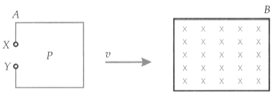
A rectangular coil P is moved from a point A to another point B with uniform velocity 'v' through a region of a uniform magnetic field acting normally inwards as shown in the figure. Show graphically (i) the variation of magnetic flux associated with the coil with time, (ii) the variation of induced emf across points X and Y of the coil with time. 
Image

Explain the nature of variation in magnetic flux as represented by the graph in the first case.
Is $\text{p}=\frac{\text{E}}{\text{c}}$ valid for electrons?
A toroid has a core $($non$-$ferromagnetic$)$ of inner radius $25 \ cm$ and outer radius $26 \ cm,$ around which $3500$ turns of a wire are wound. If the current in the wire is $11 A,$ what is the magnetic field,
  1. Outside the toroid,
  2. Inside the core of the toroid and,
  3. In the empty space surrounded by the toroid.
A square plate of mass $120g$ and edge $5.0\ cm$ rotates about one of the edges. If it has a uniform angular acceleration of $0.2\ rad/s^2,$ what torque acts on the plate?
The heat current is written as $\frac{\triangle\text{Q}}{\triangle\text{t}}.$ Why don't we write $\frac{\text{dQ}}{\text{dt}}?$
  1. When an AC source is connected to an ideal capacitor, show that the average power supplied by the source over a complete cycle is zero.
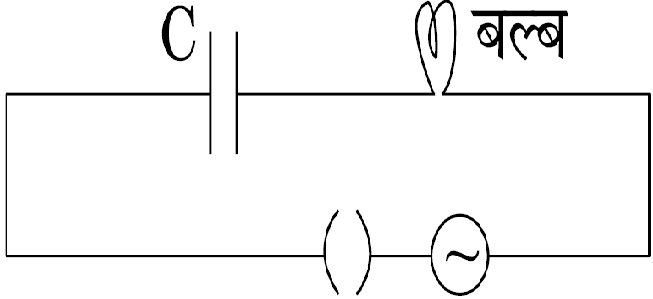
  2. A bulb is connected in series with a variable capacitor and an A.C. source as shown. What happens to the brightness of the bulb when the key is the capacitor is gradually reduced?
What is reverse bias? Explain the change occuring in the junction under the effect of reverse bias.
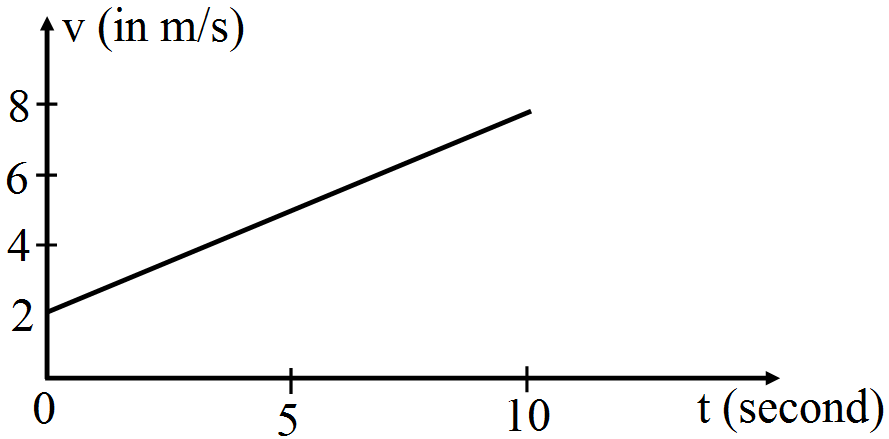
Figure shows the graph of velocity versus time for a particle going along the $X-$axis. Find:
  1. The acceleration.
  2. The distance travelled in $0$ to $10s.$
  3. The displacement in $0$ to $10s.$
A parallel plate capacitor is charged to a potential difference V from a direct current source, while there is air between the plates. Without separating the capacitor from the battery, a dielectric medium of dielectric constant K has been filled in place of air. Explain with reasons which of the following changes will occur? Also give explanation of the answers.(i) Potential difference (ii) Electric field between the plates (iii) Capacitance (iv) charge (v) energy.