Question
Why do $\alpha$-particles have high ionising power?

Answer

$\alpha$-particles are heavier, they move slowly; so possess large momentum. Due to this property they come in contact with large number of particles; so they possess high ionising power.

Need a full question paper?

Generate a complete, print-ready paper with questions like this in minutes — across 16+ boards, with answer keys.
Start Generating Free

Similar questions

You are facing a circular wire carrying an electric current. The current is clockwise as seen by you. Is the field at the centre coming towards you or going away from you?
(a) An electrostatic field line is a continuous curve. ie., a field line cannot have sudden breaks. Why not?
(b) Explain why two field lines never cross each other at any point.
A Galilean telescope is $27\ cm$ long when focused to form an image at infinity. If the objective has a focal length of $30\ cm,$ what is the focal length of the eyepiece?
Explain Rutherford's nuclear model of the atom.
The electric field E due to any point charge near it is defined as $\text{E}=\lim\limits_{\text{q}\rightarrow0}\frac{\text{F}}{\text{q}}$ where q is the test charge and F is the force acting on it. What is the physical significance of $\lim\limits_{\text{q}\rightarrow0}$ in this expression?
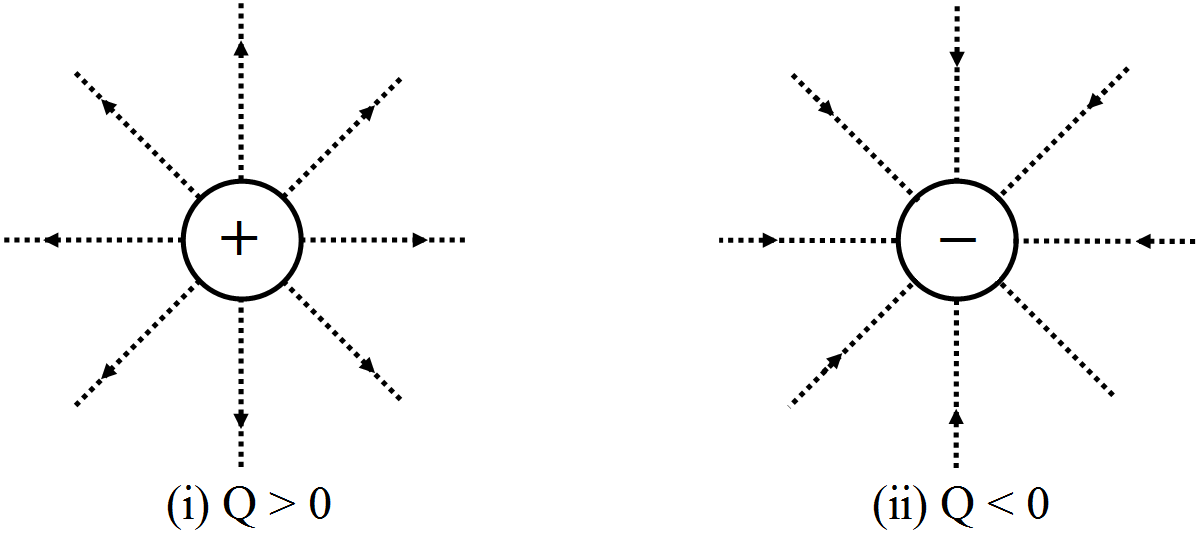
Draw the electric lines of point charge Q when,
  1. Q > 0
  2. Q < 0.
Answer the following question:
When viewing through a compound microscope, our eyes should be positioned not on the eyepiece but a short distance away from it for best viewing. Why? How much should be that short distance between the eye and eyepiece?
An electric current of 2.0A passes through a wire of resistance $25\Omega$. How much heat will be developed in 1minute?
Give brief information about the solenoid.
Draw the circuit diagram of an illuminated photodiode in reverse bias. How is photodiode used to measure light intensity?
The speed of sound as measured by a student in the laboratory on a winter day is $340m/s$ when the room temperature is $17^\circ\ C.$ What speed will be measured by another student repeating the experiment on a day when the room temperature is $32^\circ\ C$?