Questions · Page 2 of 5

M.C.Q (1 Marks)

Question 511 Mark
Of the following pairs of species which one will have the same electronic configuration for both members?
Answer
Carbon and the positive ion of nitrogen $(N^+)$ will have the same electronic configuration.
The electronic configuration of both Carbon and the positive ion of nitrogen is as follows$:$
$1s^22s^22p^6.$
View full question & answer
Question 521 Mark
How many spectral lines does hydrogen have?
Answer
  1. Four
Explanation:
Niels Bohr calculated the energies that a hydrogen atom would have in each of its energy levels, based on the wavelength of the spectral lines.
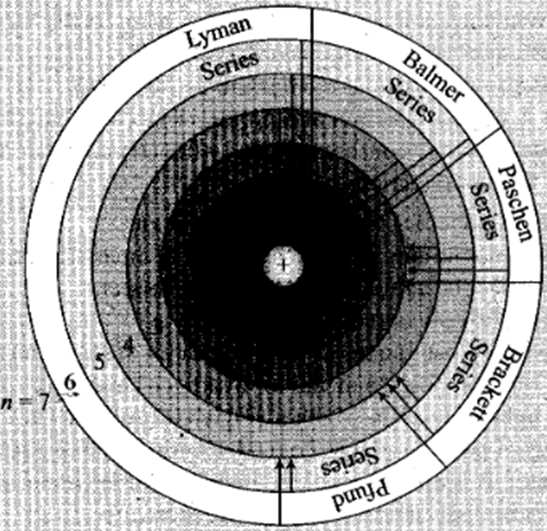
Then he found out that there are four spectral lines for hydrogen, namely, Lyman, Balmer, Paschen, and Brackett series.
The Lyman series lies in the UV region, whereas the Balmer series lies in the visible region, and the last two lie in the infrared region.
View full question & answer
Question 531 Mark
The possible values of principal quantum number can be:
Answer
  1. 1, 2, 3...8
Explanation:
Values of Principle quantum number are 1, 2, 3, 4.....8. 0 is not a Principle quantum number. 
Only odd numbers are not Principle quantum numbers either.
Odd numbers, as well as even numbers, are Principle quantum number except 0 and negative integers.
View full question & answer
Question 541 Mark
Identify which of the following is the smallest discrete value of electromagnetic energy?
Answer
  1. Photon
Explanation:
Quantum is the minimum amount of any physical entity involved in an interaction. It is a discrete quantity of energy proportional in magnitude to the frequency of the radiation it represents. It implies that the magnitude of the physical property can take on only certain discrete values.
A photon is a quantum of electromagnetic energy, which means, that the electromagnetic energy is composed of a number of the smallest particles possible called photons, whose energy depends upon the frequency of them.
View full question & answer
Question 551 Mark
Pick out correct statement from the following regarding photons: 
Answer
  1. Zero rest mass and spin of unity
Explanation:
Rest mass of photon is zero because it is just a form of energy.
Spin of a photon is 1.
View full question & answer
Question 561 Mark
Which of the following is NOT a postulate of Bohr's model of the hydrogen atom? 
Answer
  1. The position of an electron in the hydrogen atom is not defined.
Explanation:
Bohr showed that the electron in the hydrogen atom could only be found in certain selected (quantized) orbits, and no others. 
View full question & answer
Question 571 Mark
In the ground state in ...A... electrons are in stable equilibrium while in ...B... electrons always experiences a net force. Here, A and B refer to?
Answer
  1. Thomson’s model, Rutherford’s model.
View full question & answer
Question 581 Mark
If the spins of electrons of atoms in a substance are paired, then the substance will have:
Answer
  1. Diamagnetic Nature
Explanation:
Spins are paired means clockwise and anticlock  wise rotation cancel each other, so it does not have  any free electron.
$\therefore$ it is in dimagnetic in nature. 
View full question & answer
Question 591 Mark
As an electron makes a transition from an excited state to the ground state of a hydrogen - like atom/ion?
Answer
  1. Its kinetic energy increases but potential energy and total energy decrease.
View full question & answer
Question 601 Mark
The possible values of ml​ are:
Answer
  1. from -1 to + 1
Explanation:
Values for the quantum number ml​ are -1, 0, + 1
View full question & answer
Question 611 Mark
The hyperfine lines in the spectrum is related to:
Answer
  1. nuclear magnetic spin
Explanation:
In atomic physics, hyperfine structure is the different effects leading to small shifts and splitting in the energy levels of atoms, molecules and ions.  The name is a reference to the fine structure which results from the interaction between the magnetic moments associated with electron spin and the electrons' orbital angular momentum. Hyperfine structure, with energy shifts is typically orders of magnitude smaller than the fine structure, results from the interactions of the nucleus (or nuclei, in molecules) with internally generated electric and magnetic fields.
View full question & answer
Question 621 Mark
Which of the following did Bohr use to explain his theory?
Answer
  1. The quantization of angular momentum.
Explanation:
To explain his theory, Niels Bohr used the quantization of angular momentum.
It means the radius of the orbit and the energy will be quantized.
The Boundary conditions for the wave function are periodic.
View full question & answer
Question 631 Mark
The ground state energy of hydrogen atom is -13.6 eV. The kinetic and potential energies of the electron in this state are:
Answer
  1. 13.6 eV,-27.2 eV
View full question & answer
Question 641 Mark
The idea of parmanu was given by:
Answer
  1. Maharishi Kanad
Explanation:
John Dalton (1766 – 1844), an English chemist and physicist, is the man credited today with the development of atomic theory. However, a theory of atoms was actually formulated 2,500 years before Dalton by an Indian sage and philosopher, known as Acharya Kanad.
View full question & answer
Question 651 Mark
When a photon stimulates the emission of another photon, the two photons have:
Answer
  1. All of the above
Explanation:
When a photon stimulates the emission of another photon, the two photons have same energy, direction, phase, and wavelength or we can say that the two photons are coherent. When an atom is present in its excited state then if a photon of energy equal to the energy gap between the excited state and any lower stable state is incident on this atom then the atom transits from upper state to the lower stable state by emitting a photon of energy equal to the energy gap between the two states. It is called stimulated emission. The emitted photon and incident photon have same energy and hence same wavelength. Also these two photons will be in phase and in the same direction. This process of producing monochromatic and unidirectional light is called lasing action.
View full question & answer
Question 661 Mark
The time taken by a photo$-$electron to come out after the photon strikes is approximately:
Answer
The time by a photoeletron to come out after the photon strikes is approximately $10^{−10}$ seconds. This is a fact.
View full question & answer
Question 671 Mark
Taking the Bohr radius as $a_0 = 53\ pm,$ the radius of $Li^{++} $ ion in its ground state, on the basis of Bohr’s model, will be about:
Answer
Key concept: Bohr's redius of orbit $($for Hydrogen and $H_2-$like atoms$)$: For an electron around a stationary nucleus, the electrostatics force of attraction provides the necessary centripetal force.

i.e., $\frac{1}{4\pi\epsilon_0}\frac{(\text{Ze})\text{e}}{\text{r}^2}=\frac{\text{mv^2}}{\text{r}}\ .....(\text{i})$
Also $\text{mvr}=\frac{\text{nh}}{2\pi}\ .....(\text{ii})$
From equation $(i)$ and $(ii)$, radius of $n^{th} $ orbit
$\text{r}_\text{n}=\frac{\text{n}^2\text{h}^2}{4\pi^2\text{kZme}^2}=\frac{\text{n}^2\text{h}^2\epsilon_0}{\pi\text{mZe}^2}=0.53\frac{\text{n}^2}{\text{Z}}\mathring{\text{A}}\ \Big(\text{k}=\frac{1}{4\pi\epsilon_0}\Big)$
$\Rightarrow\ \text{r}_\text{n}\propto\frac{\text{n}^2}{\text{Z}}\text{ or }\text{r}_\text{n}\propto\frac{1}{\text{Z}}$
$\text{r}_\text{n}=\text{a}_0\frac{\text{n}^2}{\text{Z}},$ where $a_0 =$ the Bohr radius$ = 53pm$
The atomic number $(Z)$ of lithium is $3.$
As $\text{r}_\text{n}=\text{a}_0\frac{\text{n}^2}{\text{Z}},$
Therefore, the radius of $Li^{++} $ ion in its ground statr, on the basis of Bohr's model, will be about $\frac{1}{3}$ times to that of Bohr radius.
Therefore, the radius of lithium ion is near $\text{r}=\frac{53}{3}\approx18\text{pm}.$
View full question & answer
Question 681 Mark
If an element has 22 electrons then what will be its atomic number?
Answer
  1. 22
Explanation:
Atomic number of any element is equal no of electron.
Atomic no. = no. of proton = no of electron.
View full question & answer
Question 691 Mark
The fine structure of hydrogen spectrum can be explained by:
Answer
  1. the spin angular momentum of electrons.
Explanation:
The fine structure describes the splitting of the spectral lines of atoms due to electron spin angular momentum.
View full question & answer
Question 701 Mark
Solar spectrum is an example of:
Answer
  1. Line absorption spectrum
Explanation:
Solar spectrum is a line absorption spectrum which is also called as Fraunhofer lines of missing wavelengths.
View full question & answer
Question 711 Mark
When an electron jumps from its orbit to another orbit, energy is:
Answer
  1. Depends on the energy levels of the orbits
Explanation:
When an electron jumps from lower energy level to higher energy level it absorbs energy and when it jumps from higher energy level to lower energy level it emits energy.
So whether the electron emits or absorbs energy depends on the energy levels of the orbit
View full question & answer
Question 721 Mark
Suppose, the electron in a hydrogen atom makes transition from $n = 3$ to $n = 2$ in $10^{-8}s.$ The order of the torque acting on the electron in this period, using the relation between torque and angular momentum as discussed in the chapter on rotational mechanics is:
Answer
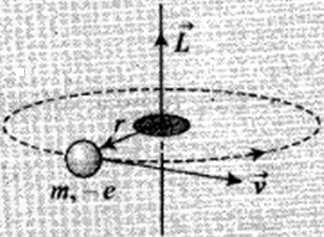
The angular momentum of the electron for the $n^{th}$ state is given by,
$\text{L}_\text{n}=\frac{\text{nh}}{2\pi}$
Angular momentum of the electron for $\text{n}=3,\ \text{L}_\text{i}=\frac{3\text{h}}{2\pi}$
Angular momentum of the electron for $\text{n}=2,\ \text{L}_\text{f}=\frac{2\text{h}}{2\pi}$
The torque is the time rate of change of the angular momentum.
Torque, $\tau=\frac{\text{L}_\text{f}-\text{L}_\text{i}}{\text{t}}$
$=\frac{\big(\frac{2\text{h}}{2\pi}\big)-\big(\frac{3\text{h}}{2\pi}\big)}{10^{-8}}$
$=\frac{-\big(\frac{\text{h}}{2\pi}\big)}{10^{-8}}$
$=\frac{-10^{-34}}{10^{-8}}$ $\Big[\because\frac{\text{h}}{2\pi}\approx10^{-34}\text{J}-\text{s}\Big]$
$=-10^{-42}\text{N}-\text{m}$
The magnitude of the torque is $10^{-42}N-m.$
View full question & answer
Question 731 Mark
The Balmer series for the $H-$ atom can be observed:
Answer
If we measure the frequencies of light emitted due to transitions between excited states and the first excited state.
A​​​​s a sequence of frequencies with the higher frequencies getting closely packed.
Key concept :
​​​​​​​The vatious lines in the atomic spectra are produced when electrons jump fron higher energy state to a lower energy state and photons are emitted.
These spectral lines are called emission lines.
  1. Mainly there are five series and each series is named after its discoverer as Lyman series, Balmer series, Paschan series, Bracket series and Pfund series.
  2. According to the Bohr's theory the wavelength of the radiations emitted from hydrogen atom is given by
$\frac{1}{\lambda}=\text{R}\bigg[\frac{1}{\text{n}_1^2}-\frac{1}{\text{n}_2^2}\bigg]$
$\Rightarrow\ \lambda=\frac{\text{n}_1^2\text{n}_2^2}{(\text{n}_2^2-\text{n}_1^2)\text{R}}=\frac{\text{n}_1^2}{\Big(1-\frac{\text{n}_1^2}{\text{n}_2^2}\Big)\text{R}}$
where $n_2 =$ outer orbit $($electron jumps from this orbit$), n_1 =$ inner orbit $($electron falls in this orbit$)​​​​​​​$​​​​​​​
  1. First line of the series is called first member, for this lines wavelength is maximum $(\lambda_\text{max})$.
  2. For maximum wavelength if $n_1 = n,$ then $n_2 = n + 1.$
  3. So $\lambda_\text{max}=\frac{\text{n}^2(\text{n}+1)^2}{(2\text{n}+1)\text{R}}$.
  4. Last line of the series is called series limit, for this line wavelength is minimum $(\lambda_\text{max})$.
  5. Foe minimum wavelength $\text{n}_2=\infty,\text{n}_1=\text{n}.\text{ So}\lambda_\text{min}=\frac{\text{n}^2}{\text{R}}.$
  6. The radio of first member and series limit can be calculated as $\frac{\lambda_\text{max}}{\lambda_\text{min}}=\frac{(\text{n}+1)^2}{(2\text{n}+1)}$.
Different spectral series
 
Spectral Series
Transition
$\lambda_\text{max}$
$\lambda_\text{min}$
$\frac{\lambda_\text{max}}{\lambda_\text{min}}$
Region
$1.$
Lyman series
$\text{n}_2=2,3,4 \ ....\infty$
$\text{n}_1=1$
$\frac{4}{3\text{R}}$
$\frac{1}{\text{R}}$
$\frac{4}{3}$
Ultraviolet region
$2.$
Blamer series
$\text{n}_2=3,4,5 \ ....\infty$
$\text{n}_1=2$
$\frac{36}{5\text{R}}$
$\frac{4}{\text{R}}$
$\frac{9}{5}$
Visible region
$3.$
Paschen series
 
$\text{n}_2=4,5,6 \ ....\infty$
$\text{n}_1=3$
$\frac{144}{7\text{R}}$
$\frac{9}{\text{R}}$
$\frac{16}{7}$
Infrared region
$4.$
Bracket series
$\text{n}_2=5,6,7 \ ....\infty$
$\text{n}_1=4$
$\frac{400}{9\text{R}}$
$\frac{16}{\text{R}}$
$\frac{25}{9}$
Infrared region
$5.$
Pfund series
$\text{n}_2=6,7,8 \ ....\infty$
$\text{n}_1=5$
$\frac{900}{11\text{R}}$
$\frac{25}{\text{R}}$
$\frac{36}{11}$
Infrared region
From above discussion we can say Balmer series for the $H-$ atom can be observed if we measure the frequencies of light emitted due to transitions between higher excited states and the first excited state and as a sequence of frequencies with the higher frequencies getting closely packed.
View full question & answer
Question 741 Mark
Raman effect shows:
Answer
  1. None of the above
Explanation:
Raman effect deals with inelastic scattering of photon particles by interaction with vibrational and rotational transitions in the bonds( Raman scattering can occur with a change in energy of a molecule due to a transition) it has nothing to do with polarisation, quantum nature, wave nature (photon scattering ) and Brillouin zone scattering.
View full question & answer
Question 751 Mark
In a laboratory experiment on emission from atomic hydrogen in a discharge tube, only a small number of lines are observed whereas a large number of lines are present in the hydrogen spectrum of a star. This is because in a laboratory:
Answer
  1. The temperature of hydrogen is much smaller than that of the star.
Explanation:
The number of lines of the hydrogen spectrum depends on the excitation of the hydrogen atom. This is dependent on the heat energy absorbed by the hydrogen atoms. More the temperature of the hydrogen sample, more is the heat energy. The temperature of hydrogen at the star is much more than that can be produced in the laboratory. Hence, less number of lines are observed in the hydrogen spectrum in the laboratory than that in a star.
View full question & answer
Question 771 Mark
In a Rutherford scattering experiment when a projectile of charge $Z_1$ and mass $M_1$ approaches a target nucleus of charge $Z_2$ and mass $M_2,$ the distance of closest approach is $r.$ The energy of the projectile is?
Answer
Directly proportional to $Z_1 Z_{2.}$
View full question & answer
Question 781 Mark
Spectrum of sunlight is an example for:
Answer
  1. Line absorption spectrum
Explanation:
Dark/ Bright light seen in an otherwise uniform and continous spectrum is a spectral line, this is due to emission or absorption of light in a narrow frequency range, compared with the nearby frequencies.
Spectrum of sunlight is an example for line absorption spectrum.
View full question & answer
Question 791 Mark
What causes spectral lines?
Answer
  1. The transition of electrons between two energy levels.
Explanation:
The observed spectral lines are caused by the transition of electrons between two energy levels in an atom.
The emission spectrum of the hydrogen atom is divided into many spectral series, with wavelengths that are given by Rydberg’s formula.
View full question & answer
Question 801 Mark
There are seven orbitals in a subshell then the value of l for it will be:
Answer
  1. 1 = 3
Explanation:
The shape of orbitals i.e. number of orbitals depends on the subshell in which they are found.
The maximum possible number of orbitals i.e. the allowed orientations in space are denoted by magnetic quantum number and is given by.
ml ​= 2l + 1
7 = 2l + 1 
2l = 6
l = 3
View full question & answer
Question 811 Mark
An incandescent filament emits a spectrum which is:
Answer
  1. continuous spectrum
Explanation:
An electric bulb, a candle or a red hot iron piece emits light, which has continuously varying wavelengths. 
So it shows continuous emission spectrum.
View full question & answer
Question 821 Mark
When a photon stimulates the emission of another photon, the two photons have:
Answer
  1. Same phase
Explanation:
A photon with of a particular wavelength stimulates the emission of a photon of same wavelength which will stimulate another photon and so on and therfore the collection of these photons with same wavelength these are called monochromatic they will have same wavelength phase energy and direction and combine to form the laser beam.
View full question & answer
Question 831 Mark
Which one did Rutherford consider to be supported by the results of experiments in which α-particles were scattered by gold foil?
Answer
  1. The force of repulsion between an atomic nucleus and an α-particle varies with distance according to inverse square law.
View full question & answer
Question 841 Mark
Which one of the following properties is not found in cathode rays?
Answer
  1. Cathode rays are not deflected by electric and magnetic field
Explanation:
Properties of cathode rays:
They are produced by the negative electrode, or cathode, in an evacuated tube, and travel towards the anode.
They travel in straight lines and cast sharp shadows.
They have energy and can do work.
They are deflected by electric and magnetic fields and have a negative charge.
View full question & answer
Question 851 Mark
The angular momentum of an electron in an orbit is quantized because it is a necessary condition for the compatibility with:
Answer
  1. Particle nature of electron
Explanation:
Quantization of angular momentum comes from the particle nature of electrons, and all of its postulates.
View full question & answer
Question 861 Mark
According to the uncertainty principle for an electron, time measurement will become uncertain if which of the following is measured with high certainty?
Answer
  1. Energy
Explanation:
According to the uncertainty principle,
$\triangle\text{E}.\triangle\text{t}>=\frac{\text{h}}{2\pi}.$
Thus the time measured will become uncertain if $\triangle\text{E}$ is measured with high certainty.
View full question & answer
Question 871 Mark
In a cathode ray tube, what is the effect on the beam of particles if the anode voltage is increased ?
Answer
  1. Kinetic Energy of electron beam increase
Explanation:
Electrons emitted by the cathode are attracted to the focusing anode if the anode voltage is increased.
Thus, Kinetic Energy of electron beam increase.
View full question & answer
Question 891 Mark
The fluorescence of the glass (discharge) tube at very low pressure is characteristic of ________:
Answer
  1. The phosphors in the material of the glass
Explanation:
Fluorescence is the emission of light by a substance that as absorbed light as other electromagnetic radiation. It occurs due to presence of phosphorous in the metal tube. Because phosphorous is a material that glows when exposed to electrical energy. Because actual conversion of electrical to light energy takes place on display screen when electron strike phosphorous.
View full question & answer
Question 911 Mark
According to the classical theory, the circular path of the electrons is:
Answer
  1. Spiral
Explanation:
According to classical theory, the circular path of the electrons is spiral.
View full question & answer
Question 921 Mark
According to the quantum theory of light, the energy of light is carried in discrete units called:
Answer
  1. Photons
Explanation:
According to the quantum theory of light, energy of light is carried in discrete units called photons.
View full question & answer
Question 931 Mark
If an α-particle collides head-on with a nucleus, what is its impact parameter?
Answer
  1. Zero
Explanation:
The perpendicular distance between the path of a projectile and the center of the potential field is the impact parameter.
Therefore, for a head-on collision of the α-particle with a nucleus, the impact parameter is equal to zero.
View full question & answer
Question 941 Mark
What did Rutherford’s alpha particle experiment prove?
Answer
  1. Nucleus
Explanation:
Rutherford’s alpha particle experiment proved the existence of the nucleus.
View full question & answer
Question 951 Mark
Number of spectral lines in hydrogen atom is:
Answer
Explanation:
Number of spectral lines in hydrogen atom ∞.
View full question & answer
Question 961 Mark
Which one of the following device makes use of the electrons to strike certain substances to produce fluorescence?
Answer
  1. Thermionic value
Explanation:
The device which makes use of the electrons to strike certain substances to produce fluorescence is Cathode ray oscilloscope.
View full question & answer
Question 971 Mark
A hydrogen atom in ground state absorbs $10.2eV$ of energy. The orbital angular momentum of the electron is increased by:
Answer
Let after absorption of energy, the hydrogen atom goes to the $n^{th}$ excited state.
Therefore, the energy absorbed can be written as,
$10.2=13.6\times\Big(\frac{1}{1^2}-\frac{1}{\text{n}^2}\Big)$
$\Rightarrow\frac{10.2}{13.6}=1-\frac{1}{\text{n}^2}$
$\Rightarrow\frac{1}{\text{n}^2}=\frac{13.6-10.2}{13.6}$
$\Rightarrow\frac{1}{\text{n}^2}=\frac{3.4}{13.6}$
$\Rightarrow\text{n}^2=4$
$\Rightarrow\text{n}=2$
The orbital angular momentum of the electron in the $n^{th}$ state is given by,
$\text{L}_\text{n}=\frac{\text{nh}}{2\pi}$
Change in the angular momentum, $\Delta\text{L}=\frac{2\text{h}}{2\pi}-\frac{\text{h}}{2\pi}=\frac{\text{h}}{2\pi}$
$\therefore\Delta\text{T}=1.05\times10^{-34}\text{Js}$
View full question & answer
Question 981 Mark
The visible region of hydrogen spectrum was first studied by:
Answer
  1. Balmer
Explanation:
Visible region of hydrogen spectrum was first studied by Balmer, therefore they are also called as Balmer lines.
View full question & answer
Question 991 Mark
Which source is associated with a line emission spectrum?
Answer
  1. Neon street sign
Explanation: 
Neon street sign gives a line emission spectrum.
When neon atoms gain enough energy to become excited, light is produced. Atom releases a photon when it returns to a lower energy state.
Therefore, the source associated with a line emission spectrum is the neon street sign.
View full question & answer
Question 1001 Mark
Choose the wrong statement:
Answer
  1. Electrons cannot be diffracted by crystals
Explanation:
Fast moving electrons are associated with wave and hence they show diffraction.
View full question & answer