Question
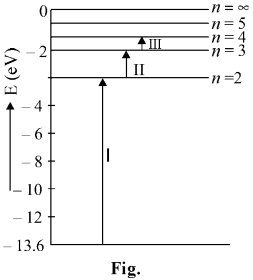
The photons of continuous frequency range are passing through rarafied hydrogen pattern. Three absorbed lines are shown in Fig.
Image
(i) To which series of hydrogen spectrum, these lines are related?
(ii) Out of them which has maximum wavelength?
Answer

(i) I = Lyman series, II = Balmer series, III = Paschen series.
(ii) Since $\lambda=\frac{h c}{\Delta E }$; For maximum wavelength, $\Delta E$ should be minimum. It is for III line. So its wavelength will be maximum.

Need a full question paper?

Generate a complete, print-ready paper with questions like this in minutes — across 16+ boards, with answer keys.

Start Generating Free

Similar questions

On which two factors the extent of polarization in a polar dielectric depends ? what is polarization of dielectric ? Write its formula.
Consider the situation of the previous problem. Take "the table plus the ball" as the system. Friction between the table and the ball is then an internal force. As the ball slows down, the momentum of the system decreases. Which external force is responsible for this change in the momentum?
Explain $n$-type and $p$-type semiconductors on the basis of band theory.
A lamp is connected in series with a capacitor. Predict your observations for dc and ac connections. What happens in each case if the capacitance of the capacitor is reduced?
Protons with kinetic energy K emerge from an accelerator as a narrow beam. The beam is bent by a perpendicular magnetic field, so that it just misses a plane target kept at a distance l in front of the accelerator. Find the magnetic field.
Plot a graph showing variation of de Broglie wavelength $(\lambda)$ associated with a charged particle of mass m, versus $\frac{1}{\sqrt{\text{V}}},$ where V is the potential difference through which the particle is accelerated. How does this graph give us the information regarding the magnitude of the charge of the particle?
A charge $Q$ is placed at a distance $\frac{\text{a}}{2}$ above the centre of a horizontal, square surface of edge a as shown in figure. Find the flux of the electric field through the square surface.
Can there be a potential difference between two adjacent conductors carrying the same charge?
A plate of thickness t made of a material of refractive index $\mu$ is placed in front of one of the slits in a double slit experiment.
  1. Find the change in the optical path due to introduction of the plate.
  2. What should be the minimum thickness t which will make the intensity at the centre of the fringe pattern zero? Wavelength of the light used is $\lambda$. Neglect any absorption of light in the plate.
What is meant by radioactive equilibrium?