Question
Explain emf, potential difference and internal resistance of cell and derive the relation between them. (or derive the relation between emf, potential difference and internal resistance of the cell.)
Answer

Image
Image
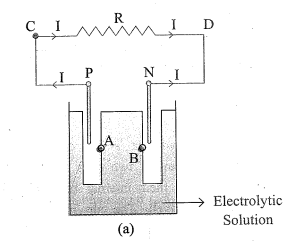
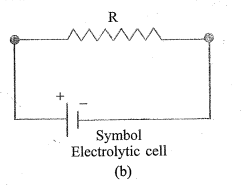
The figure shows the electrolytic cell. Electrolytic cell is used to maintain a steady current in an electric circuit.
As shown in the figure, two electrodes, positive (P) and negative (N) are immersed in an electrolytic solution.
Because of being dipped in the solution, the electrodes exchange charges with the electrolyte.
The potential difference between the positive electrode and the adjacent point A is $V _{+}$and the potential difference between negative electrode to the adjacent point B is $- V _{-}$.
So, the potential difference between P and N is $V_{+}-\left(-V_{-}\right)=V_{+}+V_{-}$
This potential difference is called the electromotive force (emf) of the cell and it is denoted by $\varepsilon$.
$\therefore \varepsilon= V _{+}+ V _{-}>0$
→Definition of emf : The potential difference between two electrodes when no current is flowing through the cell is called the emf of the cell.
As shown in the figure, consider a resistor R connected across the cell and current I flows across R from C to D and current in electrolyte current flows from N to P . clearly, across the electrolyte the same current flows through the electrolyte.
The electrolyte through which a current flows has a finite resistance $r \&$ it is called the internal resistance.
→Case I : $R =\infty$ (infinite)
According to ohm's law
$I =\frac{ V }{ R } \rightarrow I =0$
where V is the potential difference between P and N and it is called terminal voltage (or voltage) of the cell.
The potential difference between P and N , V (terminal voltage or voltage)
$=$ Potential difference between P and A
+ Potential difference between A and B
+ Potential difference between B and N
$\begin{aligned}
V & = V _{+}+ V _{-} \\
\therefore V & =\varepsilon
\end{aligned}$
Thus, emf $\varepsilon$ is the potential difference between the positive and negative electrodes in an open circuit i.e when no current is flowing through the cell.
→Case II : $R =$ Finite
when $R$ is finite, electric current flows through the cell. In that case the potential difference between P and N is
$\begin{aligned}
V & = V _{+}+ V _{-}- I r \\
\therefore \quad V & =\varepsilon- I r
\end{aligned}$
The negative sign in the expression (Ir) for the potential difference between A and B . This is because the current I flows from B to A in the electrolyte.

Need a full question paper?

Generate a complete, print-ready paper with questions like this in minutes — across 16+ boards, with answer keys.

Start Generating Free

Similar questions

A square coil of side 10 cm consists of 20 turns and carries a current of 12 A. The coil is suspended vertically and the normal to the plane of the coil makes an angle of 30º with the direction of a uniform horizontal magnetic field of magnitude 0.80 T. What is the magnitude of torque experienced by the coil?
A person has near point at 100cm. What power of lens is needed to read at 20cm if he/ she uses.
  1. Contact lens,
  2. Spectacles having glasses 2.0cm separated from the eyes?
Calculate the temperature at which the resistance of a conductor becomes 20% more than its resistance at 27°C. The value of the temperature coefficient of resistance of the conductor is $2.0 \times 10\frac{-4}{\text{K}}.$
A bulb rated 60W at 220V is connected across a household supply of alternating voltage of 220V. Calculate the maximum instantaneous current through the filament.
A cylinder rotating at an angular speed of $50\ce{ rev/s}$ is brought in contact with an identical stationary cylinder. Because of the kinetic friction, torques act on the two cylinders, accelerating the stationary one and decelerating the moving one. If the common magnitude of the acceleration and deceleration be one revolution per second square, how long will it take before the two cylinders have equal angular speed?
Using Bohr’s postulates, obtain the expression for the total energy of the electron in the stationary states of the hydrogen atom. Hence draw the energy level diagram showing how the line spectra corresponding to Balmer series occur due to transition between energy levels.
The output of an OR gate is connected to both the inputs of a NAND gate. Draw the logic circuit of this combination of gates and write its truth table.
A solenoid of length $1.0m,$ radius $1\ cm$ and total turns $1000$ wound on it, carries a current of $5A$. Calculate the magnitude of the axial magnetic field inside the solenoid. If an electron was to move with a speed of $104ms^{–1}$ along the axis of this current carrying solenoid, what would be the force experienced by this electron?
When a glass rod is rubbed with a silk cloth, charges appear on both. A similar phenomenon is observed with many other pairs of bodies. Explain how this observation is consistent with the law of conservation of charge.
Derive the equation for the torque acting on a current carrying loop placed at an angle $\theta$ with uniform magnetic field $(\vec{B})$.