Question
Define capacitance of a capacitor. Derive expression for stored energy between plates of parallel plate capacitor. Show that energy-density between plates of parallel capacitor can be expressed as $\frac{1}{2}\in_{0}E^{2}$ , when E = Electric Field between plates.
Answer

Capacitance: It is the capacity of a conductor for acquiring electric charge. It is defined as follows :
"The electrical capacitance of a conductor is defined as the ratio of the charge given to the conductor and potential raised due to it." It is denoted by C.
If $q$ be the quant ity of charge given to any conductor and V be the potential raised by the charge, then :
$\text { Capacitance } =\frac{\text { ElectricCharge }}{\text { RiseinPotential }} $
$\Rightarrow \quad C =\frac{q}{V}$ ...(1)
It depends upon the size and shape of the conductor and upon the nature of surrounding medium and presence of other conductors.
If $V =1$, then from equation (1), we get
$C=q .$
Thus, the capacitance of a conductor is numerically equal to the charge to be given to a conductor to raise its potential by unity.
S.I. Unit of capacitance. The SI unit of capacitance is farad. It is so named in the honour of Michael Faraday and is depicted by F.
Energy of a charged capacitor : The energy of a charged capacitor is measured by the total work done in charging the capacitor to a given potential.Let $q$ be the charge given to the capacitor so that its potential becomes V , then :
$V=\frac{q}{C}$
where C is the capacitance of the capacitor, $1 / C$ is a constant here.
$\therefore \quad V \propto q .$
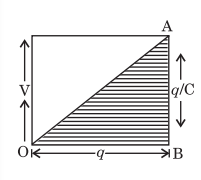
Graph between potential and charge is shown in the following figure. It is a straight line OA. Area OAB represents the energy stored in the capacitor in charging it. Thus stored potential energy \
$U =$ Area of $\Delta OAB$
$=\frac{1}{2} OB \times BA $
$=\frac{1}{2} \times q \times \frac{q}{C} $
$\Rightarrow U =\frac{ 1 }{2}\left(\frac{ q ^2}{ C }\right) $ ...(1)
$\text { But } q =CV $
$\therefore U =\frac{1}{2} \frac{(CV)^2}{C} \Rightarrow U =\frac{ 1 }{2} C V ^2 $ ...(2)
$\Rightarrow U =\frac{1}{2} CV(V) ; \text { but } CV=q $
$\therefore U =\frac{ 1 }{2} q V$ ...(3)
This energy of the charged capacitor remains in the medium between plates.
Energy density : The energy of a charged parallel plate capacitor is stored in the medium existing between its plates. "Energy density of a parallel plate capacitor is defined as the amount of energy stored per unit volume of the space (i.e. medium) between the plates of the capacitor." It is denoted by $u$.
Image
i.e. $\quad u=\frac{\text { Total Energy Stored ' } U}{\text { Volume of space between the plates }}$
But $\quad U =\frac{1}{2} CV ^2$ and Volume $= A \times d$
where
$C =$ capacitance of the capacitor,
$V =$ potential difference between the plates of the capacitor,
$A=$ area of each of the plates of the capacitor and
$d=$ distance between the plates of the capacitor.
$\therefore \quad u=\frac{\frac{1}{2} CV^2}{A \times d} \Rightarrow u=\frac{CV^2}{2 A d}$
But capacitance of the air capacitor
$C =\frac{\varepsilon_0 A}{d} $
$\Rightarrow \quad u =\frac{\left(\varepsilon_0 A / d\right) \times V^2}{2 A d} \Rightarrow u =\frac{1}{2} \varepsilon_0\left(\frac{ V }{ d }\right)^2$ ... (1)
But $\frac{V}{d}=$ Electric field intensity between the plates of the capacitor = E
$\therefore \quad u =\frac{1}{2} \varepsilon_0 E ^2$ ... (2)
If the space between the plates be filled with some medium of dielectric constant $K$, then the energy density would be
$u=\frac{1}{2} K \varepsilon_0 E^2$ ...(3)
The S. I. unit of $u$ is $\text { joule/metre}^3$.

Need a full question paper?

Generate a complete, print-ready paper with questions like this in minutes — across 16+ boards, with answer keys.

Start Generating Free

Similar questions

Prove that energy remains conserved in electromagnetic induction.
The initial pressure and volume of a given mass of a gas $\Big(\frac{\text{C}_\text{P}}{\text{C}_\text{V}}=\gamma\Big)$ are $P_0$ and $V_0.$ The gas can exchange heat with the surrounding.
  1. It is slowly compressed to a volume $\frac{\text{V}_0}{2}$ and then suddenly compressed to $\frac{\text{V}_0}{4}.$ Find the final pressure.
  2. If the gas is suddenly compressed from the volume $V_0$ to $\frac{\text{V}_0}{2}$ and then slowly compressed to $\frac{\text{V}_0}{4},$ what will be the final pressure?
A mica strip and a polysterene strip are fitted on the two slits of a double slit apparatus. The thickness of the strips is $0.50\ mm$ and the separation between the slits is $0.12\ cm$. The refractive index of mica and polysterene are $1.58$ and $1.55$ respectively for the light of wavelength $590\ nm$ which is used in the experiment. The interference is observed on a screen a distance one meter away.
  1. What would be the fringe $-$ width?
  2. At what distance from the centre will the first maximum be located
Suppose that the electric field amplitude of an electromagnetic wave is $E_0 = 120 N/C$ and that its frequency is $ν = 50.0 MHz. (a)$ Determine $, B_0, ω, k,$ and $\lambda . (b)$ Find expressions for $E$ and $B$.
A solid wire of radius $10\ cm$ carries a current $5.0A$ distributed uniformly over its cross$-$section. Find the magnetic field $B$ at a point at a distance $(a)\ 2\ cm\  (b)\ 10\ cm$ and $(c)\ 20\ cm$ away from the axis. Sketch a graph of $B$ versus $x$ for $0 < x < 20\ cm.$
The $\text{K}_\alpha$ X-rays of aluminium (Z = 13) and zinc (Z = 30) have wavelengths 887pm and 146pm respectively. Use Moseley's law $\sqrt{\text{v}}=\text{a}(\text{z-b})$ to find the wavelengths of the $\text{K}_\alpha$ X-ray of iron (Z = 26).
  1. Two insulated charged copper spheres $A$ and $B$ have their centres separated by a distance of $50 \ cm$. What is the mutual force of electrostatic repulsion if the charge on each is $6.5 \times 10^{-7} C?$ The radii of A and B are negligible compared to the distance of separation.
  2. What is the force of repulsion if each sphere is charged double the above amount, and the distance between them is halved?
The volume of an ideal gas $(\gamma=1.5)$ is changed adiabatically from $4.00$ litres to $3.00$ litres. Find the ratio of,
  1. The final pressure to the initial pressure.
  2. The final temperature to the initial temperature.
What is meant by the transverse nature of electromagnetic waves? Draw a diagram showing the propagation of an electromagnetic wave along X-direction, indicating clearly the directions of oscillating electric and magnetic fields associated with it.
  1. Draw a ray diagram to show the image formation by a combination of two thin convex lenses in contact. Obtain the expression for the power of this combination in terms of the focal lengths of the lenses.
  2. A ray of light passing from air through an equilateral glass prism undergoes minimum deviation when the angle of incidence is $\frac{3}{4}^{th}$ of the angle of prism. Calculate the speed of light in the prism.