Questions

5 Marks Questions

Take a timed test

15 questions · self-marked practice — reveal the answer and mark yourself.

Question 15 Marks
Find the magnitude of the electric field at a point 4cm away from a line charge of density $2 \times 10^{-6}Cm^{-1}.$
Answer
Given: Charge density of the line containing charge, $\lambda=2\times10^{-6}\text{Cm}^{-1}$ We need to find the electric field at a distance of 4cm away from the line charge. We take a Gaussian surface around the line charge of cylindrical shape of radius $r = 4 \times 10^{-2}m$ and height l.
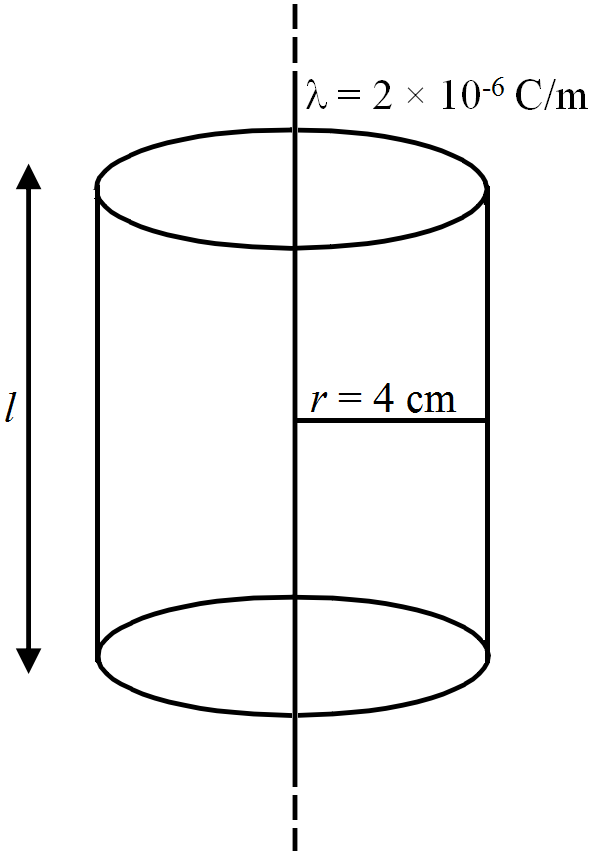
The charge enclosed by the Gaussian surface, $\text{q}_{\text{en}}=\lambda\text{l}$ Let the magnitude of the electric field at a distance of 4cm away from the line charge be E. Thus, net flux through the Gaussian surface, $\phi=\oint\overrightarrow{\text{E}}.\text{d}\overrightarrow{\text{s}}$ There will be no flux through the circular bases of the cylinder; there will be flux only from the curved surface. The electric field lines are directed radially outward, from the line charge to the cylinder. Therefore, the lines will be perpendicular to the curved surface. Thus, $\phi=\oint\overrightarrow{\text{E}}.\text{d}\overrightarrow{\text{s}}=\text{E}\oint\text{ds}$ Applying Gauss's theorem, $\phi=\frac{\text{q}_{\text{en}}}{\in_0}$ $\text{E}\times2\pi\text{rl}=\frac{\lambda\text{l}}{\in_0}$ $\text{E}=\frac{\lambda}{2\pi\text{r}\in_0}$ $\text{E}=\frac{2\times10^{-6}}{2\times3.14\times8.85\times10^{-12}\times4\times10^{-2}}$ $\text{E}=8.99\times10^5\text{N/C}$
View full question & answer
Question 25 Marks
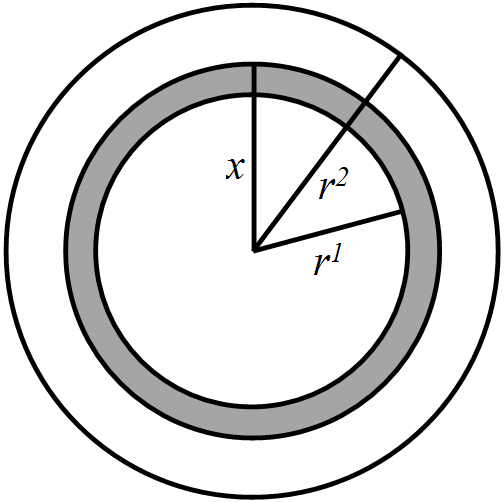
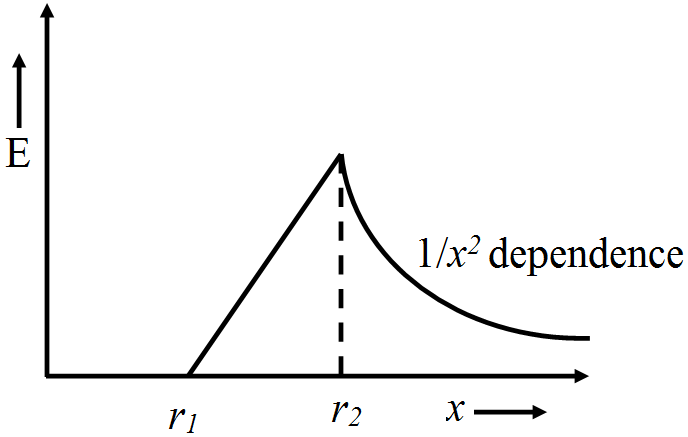
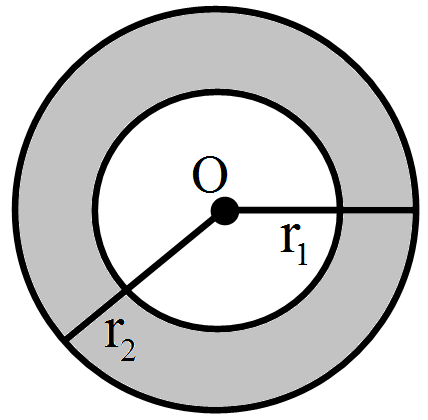
A charge Q is distributed uniformly within the material of a hollow sphere of inner and outer radii $r_1$ and $r_2$ (figure). Find the electric field at a point P a distance x away from the centre for $r_1 < x < r_2$ Draw a rough graph showing the electric field as a function of x for $O < x < 2r_2$ (figure).
Answer
Amount of charge present on the hollow sphere = Q Inner radii of the hollow sphere $= r_1$ Outer radii of the hollow sphere $= r_2$​​​​​​​ Consider an imaginary sphere of radius x. The charge on the sphere can be found by multiplying the volume charge density of the hollow spherical volume with the volume of the imaginary sphere of radius $(x - r_1)$. Charge per unit volume of the hollow sphere, $\text{p}=\frac{\text{Q}}{\frac{4}{3}\pi\big(\text{r}_2^3-\text{r}_1^3\big)}$ Charge enclosed by this imaginary sphere of radius x: q = ρ × Volume of the part consisting of charge $\text{q}=\frac{\frac{4}{3}\pi\big(\text{x}^3-\text{r}_1^3\big)\text{Q}}{\frac{4}{3}\pi\big(\text{r}_2^3-\text{r}_1^3\big)}$ $\text{q}=\frac{\big(\text{x}^3-\text{r}_1^3\big)}{\big(\text{r}_2^3-\text{r}_1^3\big)}\text{Q}$ According to Gauss's Law, $\oint\text{E.ds}=\frac{\text{q}}{\in_0}$ Here, the surface integral is carried out on the sphere of radius x and q is the charge enclosed by this sphere.

$\oint\text{E.ds}=\frac{\text{q}}{\in_0}$ $\text{E}(4\pi\text{x}^2)=\frac{\text{q}}{\in_0}$ $\text{E}(4\pi\text{x}^2)=\frac{\big(\text{x}^3-\text{r}^3_1\big)\text{Q}}{\big(\text{r}^3_2-\text{r}^3_1\big)\in_0}$ $\text{E}=\frac{\big(\text{x}^3-\text{r}^3_1\big)\text{Q}}{4\pi\text{x}^2\in_0\big(\text{r}^3_2-\text{r}^3_1\big)}$ The electric field is directly proportional to x for $r_1 < x < r.$ The electric field for $r_2 < x < 2r_{2,}$ $\text{E}=\frac{\text{Q}}{4\pi\in_0\text{x}^2}$ Thus, the graph can be drawn as:​​​​​​​
View full question & answer
Question 35 Marks
A charge Q is uniformly distributed on a thin spherical shell. What is the field at the centre of the shell? If a point charge is brought close to the shell, will the field at the centre change? Does your answer depend on whether the shell is conducting or nonconducting?
Answer
The field at the centre of the shell is zero. As all the charge given to a conductor resides on the surface, the field at any point inside the conducting sphere is zero. Also, the charge distribution at the surface is uniform so, all the electric field vectors due to these charges at the centre are equal and opposite. So, they cancel each other, resulting in a zero net value of the field.
When a charge is brought near the shell, due to induction, opposite polarity charges induce on the surface nearer to the charge and the same polarity charges appear on the face farther from the charge. In this way, a field is generated inside the shell. Hence, the field at the centre is non-zero.
Yes, our answer changes in case of a non-conducting spherical shell. As the charge given to the surface of a non-conducting spherical shell spreads non-uniformly, there is a net electric field at the centre of the sphere.
View full question & answer
Question 45 Marks
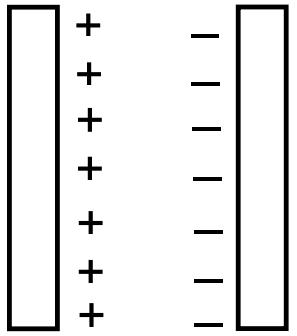
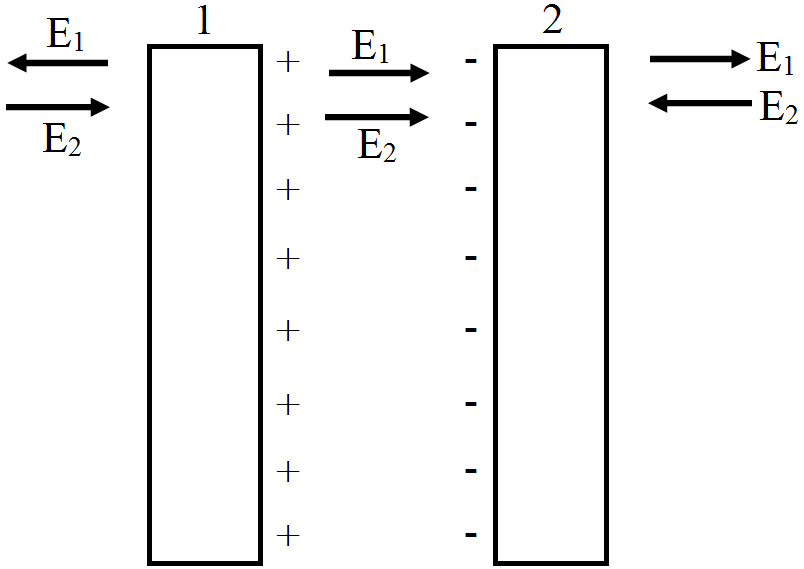
Two large conducting plates are placed parallel to each other and they carry equal and opposite charges with surface density $\sigma$ as shown in figure. Find the electric field:
  1. At the left of the plates.
  2. In between the plates.
  3. At the right of the plates.
Answer

Given :
Surface charge density on the plates $=\sigma$
The electric field due to plate 1, $\text{E}_1=\frac{\sigma}{2\in_0}$
The electric field due to plate 2, $\text{E}_2=\frac{\sigma}{2\in_0}$
  1. The strength of the electric field due to both the plates will be same but their directions will be opposite to each other on any point at the left of the two plates.
Thus, the net electric field at a point on the left of plate 1 $=\frac{\sigma}{2\in_0}-\frac{\sigma}{2\in_0}=0$
  1. Here the direction of the fields will be same. So, they will add up to give the resultant field in this region.
Total electric field:
$\frac{\sigma}{2\in_0}+\frac{\sigma}{2\in_0}=\frac{\sigma}{\in_0}$
  1. The strength of the electric field due to both the plates will be same but their directions will be opposite to each other at any point on the right of the two plates.
Thus, the net electric field at a point on the left of plate 2 $=\frac{\sigma}{2\in_0}-\frac{\sigma}{2\in_0}=0$
View full question & answer
Question 55 Marks
A small plane area is rotated in an electric field. In which orientation of the area is the flux of electric field through the area maximum? In which orientation is it zero?
Answer
The flux of an electric field $\overrightarrow{\text{E}}$ through a surface area $\Delta\overrightarrow{\text{S}}$ is given by $\Delta\phi=\overrightarrow{\text{E}}.\Delta\overrightarrow{\text{S}},$ where $\Delta\phi$ is the flux.
Therefore, $\Delta\phi={\text{E}}\Delta{\text{S}}\cos\theta.$ Here, $\theta$ is the angle between the electric field $\overrightarrow{\text{E}}$ and the normal to the surface area.
Thus, for the flux to be maximum, $\cos\theta$ should be maximum. Thus, for $\theta=0,$ the flux is maximum, i.e. the electric field lines are perpendicular to the surface area.
The flux is minimum if $\theta=90.$ Thus, $\cos\theta=0$ and, hence, flux is also 0. Thus, if the electric field lines are parallel to the surface area, the flux is minimum.
View full question & answer
Question 65 Marks
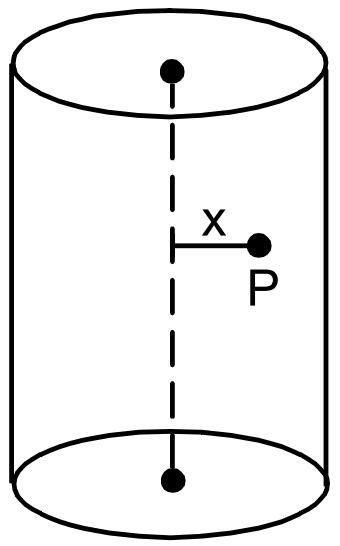
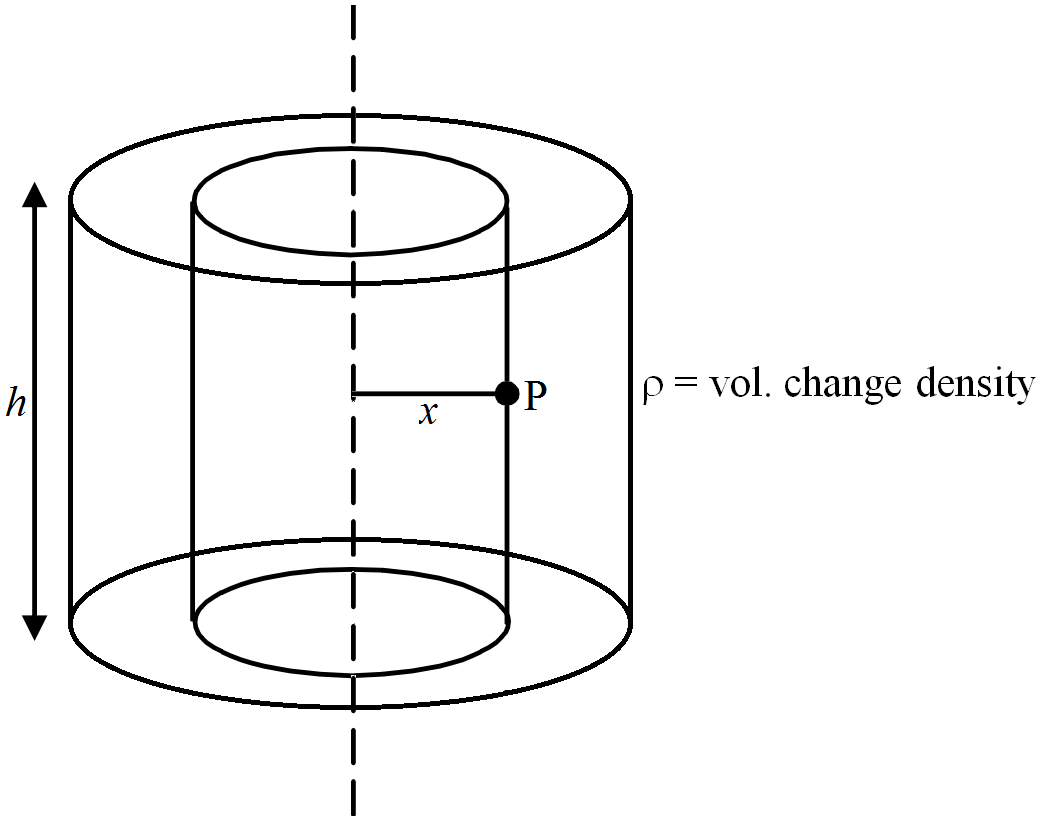
A long cylindrical volume contains a uniformly distributed charge of density $\rho.$ Find the electric field at a point P inside the cylindrical volume at a distance x from its axis (figure).
Answer
Given: Volume charge density inside the cylinder $=\rho.$ Let the radius of the cylinder be r. Let charge enclosed by the given cylinder be Q Consider a Gaussian cylindrical surface of radius x and height h. Let charge enclosed by the cylinder of radius x be q′.
The charge on this imaginary cylinder can be found by taking the product of the volume charge density of the cylinder and the volume of the imaginary cylinder. Thus, $\text{q}'=\rho\big(\pi\text{x}^2\text{h}\big)$ From Gauss's Law, $\oint\text{E.ds}=\frac{\text{q}_{\text{en}}}{\in_0}$ $\text{E}.2\pi\text{xh}=\frac{\rho(\pi\text{x}^2\text{h})}{\in_0}$ $\text{E}=\frac{\rho\text{x}}{2\in_0}$
View full question & answer
Question 75 Marks
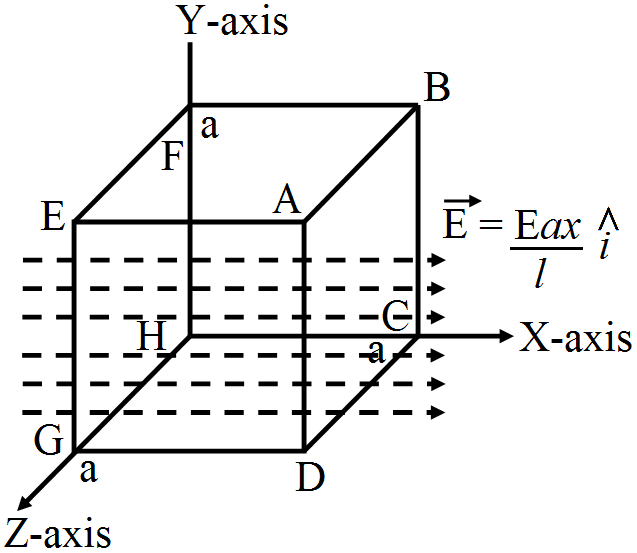
The electric field in a region is given by $\overrightarrow{\text{E}}=\frac{\text{E}_0\text{x}}{\text{l}}\vec{\text{i}}.$ Find the charge contained inside a cubical volume bounded by the surfaces $x = 0, x = a, y = 0, y = a, z = 0$ and $z = a$. Take $E_0 = 5 \times 10^3Nc^{-1}, l = 2cm$ and $a = 1cm.$
Answer
Given: Electric field strength, $\overrightarrow{\text{E}}=\frac{\text{E}_0\text{x}}{\text{l}}\hat{\text{i}}$ Length, l = 2cm Edge of the cube, a = 1cm $E_0 = 5.0 \times 10^3N/C$

It is observed that the flux passes mainly through the surfaces ABCD and EFGH. The surfaces AEFB and CHGD are parallel to the electric field. So, electric flux for these surfaces is zero. The electric field intensity at the surface EFGH will be zero.
If the charge is inside the cube, then equal flux will pass through the two parallel surfaces ABCD and EFGH. We can calculate flux passing only through one surface. Thus, $\overrightarrow{\text{E}}=\frac{\text{E}_0\text{x}}{\text{l}}\hat{\text{i}}$ At EFGH, x = 0; thus, the electric field at EFGH is zero. At ABCD, x = a; thus, the electric field at ABCD is $\overrightarrow{\text{E}}=\frac{\text{E}_0\text{a}}{\text{l}}\hat{\text{i}}.$ The net flux through the whole cube is only through the side ABCD and is given by $\phi=\overrightarrow{\text{E}}.\overrightarrow{\text{A}}=\Big(\frac{\text{E}_0\text{a}}{\text{l}}\hat{\text{i}}\Big).\big(\text{a}\hat{\text{i}}\big)=\frac{\text{E}_0\text{a}^2}{\text{l}}$ Net flux $=\phi=\frac{5\times10^3}{2\times10^{-2}}\times\big(1\times10^{-2}\big)^2\text{Nm}^2/\text{C}$ $=25\text{Nm}^2/\text{C}$ Thus, the net charge, $\text{q}=\in_0\phi$ $\text{q}=8.85\times10^{-12}\times25$ $\text{q}=22.125\times10^{-13}$ $\text{q}=2.2125\times10^{-12}\text{C}$
View full question & answer
Question 85 Marks
Consider the situation of the previous problem:
  1. Find the tension in the string in equilibrium.
  2. Suppose the ball is slightly pushed aside and released. Find the time period of the small oscillations.
Answer

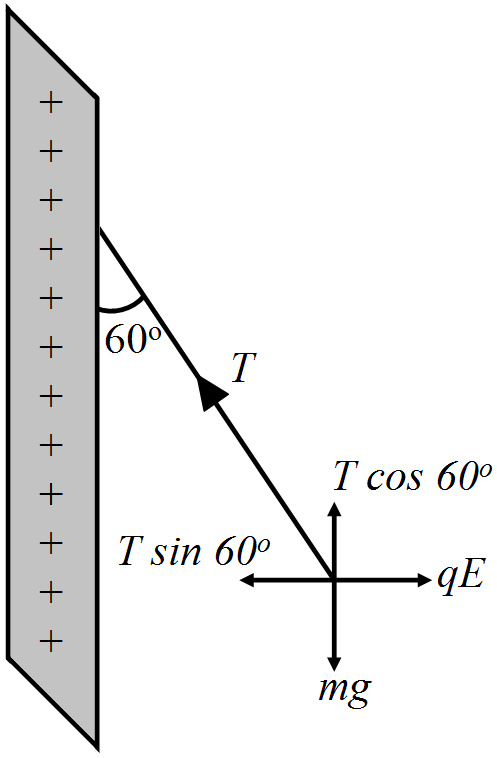
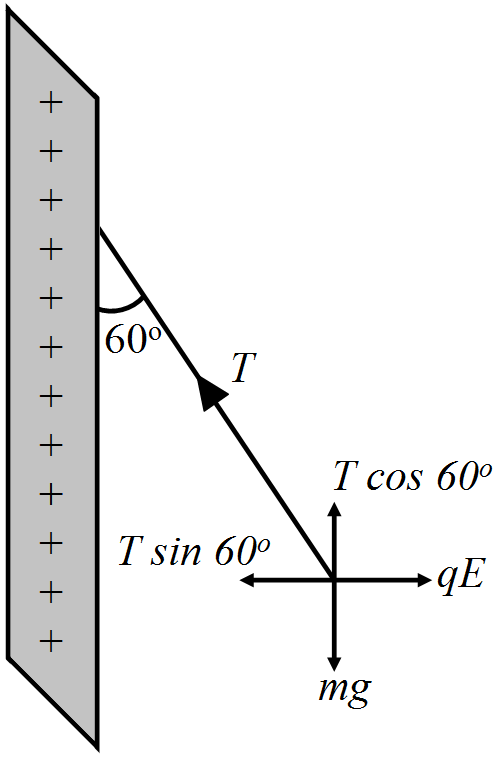
In equilibrium state, the thread makes an angle of 60° with the vertical.
The tension in the thread is resolved into horizontal and vertical components.
Then, tension in the string in equilibrium,
$\text{T}\cos60^\circ=\text{mg}$
$\text{T}\times\frac{1}{2}=\big(10\times10^{-3}\big)\times10$
$\text{T}=\big(10\times10^{-3}\big)\times10\times2=0.20\text{N}$
(b) As it is displaced from equilibrium, net force on the ball,
$\text{F}=\sqrt{(\text{mg})^2+\Big(\frac{\text{q}\sigma}{2\in_0}\Big)^2}$
As F = ma
$\Rightarrow\text{a}=\sqrt{(\text{g})^2+\Big(\frac{\text{q}\sigma}{m2\in_0}\Big)^2}$
The surface charge density of the plate (as calculated in the previous question), $\sigma=7.5\times10^{-7}\text{C/m}^2$
Charge on the ball, $q = 4 \times 10^{-6}C$
Mass of the ball, m = The time period of oscillation of the given simple pendulum,
$\text{T}=2\pi\sqrt{\frac{\text{l}}{\text{g}}}$
$=2\pi\sqrt{\frac{10\times10^{-2}}{9.8}}$
$=0.45\text{sec}$
View full question & answer
Question 95 Marks
Two large conducting plates are placed parallel to each other with a separation of 2.00cm between them. An electron starting from rest near one of the plates reaches the other plate in 2.00 microseconds. Find the surface charge density on the inner surfaces.
Answer
Distance travelled by the electron, $d = 2cm$
Time taken to cross the region, $t = 2 \times 10^{-6}s$
Let the surface charge density at the conducting plates be $\sigma.$
Let the acceleration of the electron be a.
Applying the 2nd equation of motion, we get:
$\text{d}=\frac{1}{2}\text{at}^2$
$\Rightarrow\text{a}=\frac{2\text{d}}{\text{t}^2}$
This acceleration is provided by the Coulombic force. So,
$\text{a}=\frac{\text{qE}}{\text{m}}=\frac{2\text{d}}{\text{t}^2}$
$\Rightarrow\text{E}=\frac{2\text{md}}{\text{qt}^2}$
$\Rightarrow\text{E}=\frac{2\times\big(9.1\times10^{-31}\big)\times\big(2\times10^{-2}\big)}{\big(1.6\times10^{-19}\big)\times\big(4\times10^{-12}\big)}$
$\Rightarrow\text{E}=5.6875\times10^{-2}\text{N/C}$
Also, we know that electric field due to a plate,
$\text{E}=\frac{\sigma}{\in_0}$
$\Rightarrow\sigma=\in_ 0\text{E}$
$\Rightarrow\sigma=\big(8.85\times10^{-12}\big)\times\big(5.68\times10^{-2}\big)\text{C/m}^2$
$\Rightarrow\sigma=50.33\times10^{-14}\text{C/m}^2$
$\Rightarrow\sigma=0.503\times10^{-12}\text{C/m}^2$
View full question & answer
Question 105 Marks
A long cylindrical wire carries a positive charge of linear density $2.0 \times 10^{-8}Cm^{-1}$. An electron revolves around it in a circular path under the influence of the attractive electrostatic force. Find the kinetic energy of the electron. Note that it is independent of the radius.
Answer
Let the linear charge density of the wire be $\lambda.$
The electric field due to a charge distributed on a wire at a perpendicular distance r from the wire,
$\text{E}=\frac{\lambda}{2\pi\in_0\text{r}}$
The electrostatic force on the electron will provide the electron the necessary centripetal force required by it to move in a circular orbit. Thus,
$\text{qE}=\frac{\text{mv}^2}{\text{r}}$
$\Rightarrow\text{mv}^2=\text{qEr}\ \dots(1)$
Kinetic energy of the electron, $\text{K}=\frac{1}{2}\text{mv}^2$
From (1),
$\text{K}=\frac{\text{qEr}}{2}$
$\text{K}=\frac{\text{qr}}{2}\frac{\lambda}{2\pi\in_0\text{r}}$ $\Big[\because\text{E}=\frac{\lambda}{2\pi\in_0\text{r}}\Big]$
$\text{K}=\big(1.6\times10^{-19}\big)\times\big(2\times10^{-8}\big)\times\big(9\times10^{9}\big)\text{J}$
$\text{K}=2.88\times10^{-17}\text{J}$
View full question & answer
Question 115 Marks
The radius of a gold nucleus (Z = 79) is about $7.0 \times 10^{-15}m$. Assume that the positive charge is distributed uniformly throughout the nuclear volume. Find the strength of the electric field at:
  1. The surface of the nucleus.
  2. At the middle point of a radius. Remembering that gold is a conductor, is it justified to assume that the positive charge is uniformly distributed over the entire volume of the nucleus and does not come to the outer surface?
Answer
Given:
Atomic number of gold = 79
Charge on the gold nucleus, $\text{Q}=79\times\big(1.6\times10^{-19}\big)\text{C}$
The charge is distributed across the entire volume. So, using Gauss's Law, we get:
  1. $\phi=\oint\overrightarrow{\text{E}}.\text{d}\overrightarrow{\text{s}}=\frac{\text{Q}}{\in_0}$
$\Rightarrow\oint\text{Eds}=\frac{\text{Q}}{\in_0}$
The value of E is fixed for a particular radius.
$\Rightarrow\text{E}\oint\text{ds}=\frac{\text{Q}}{\in_0}$
$\Rightarrow\text{E}\times4\pi\text{r}^2=\frac{\text{Q}}{\in_0}$
$\Rightarrow\text{E}=\frac{\text{Q}}{\in_0\times4\pi\text{r}^2}$
$\Rightarrow\text{E}=\frac{79\times(1.6\times10^{-10})}{(8.85\times10^{-13})\times4\times3.14\times(7\times10^{-10})^2}$
$\Rightarrow\text{E}=2.315131\times10^{21}\text{N/C}$
  1. To find the electric field at the middle point of the radius:
Radius, $\text{r}=\frac{7}{2}\times10^{-10}\text{m}$
Volume,
$\text{V}=\frac{4}{3}\pi\text{r}^3$
$=\frac{4}3{}\times\frac{22}{7}\times\frac{343}{8}\times10^{-30}$
Net charge $= 79 \times 1.6 \times 10^{-19}C$
Volume charge density
$=\frac{79\times1.6\times10^{-19}}{\frac{4}{3}\pi\times343\times10^{-30}}$
So, the charge enclosed by this imaginary sphere of radius $r = 3.5 \times 10^{-10}$
$=\frac{79\times1.6\times10^{-19}}{\frac{4}{3}\pi\times343\times10^{-30}}\times\frac{4}3{}\pi\times\frac{343}{8}\times10^{-30}$
$=\frac{79\times1.6\times10^{-19}}{8}$
$\Rightarrow\text{E}=\frac{79\times1.6\times10^{-19}}{8\times4\pi\in_0\text{x}^2}$ at $\text{r}=3.5\times10^{-10}$
$=1.16\times10^{21}\text{N/C}$
As electric charge is given to a conductor, it gets distributed on its surface. But nucleons are bound by the strong force inside the nucleus. Thus, the nuclear charge does not come out and reside on the surface of the conductor. Thus, the charge can be assumed to be uniformly distributed in the entire volume of the nucleus.
View full question & answer
Question 125 Marks
One end of a 10cm long silk thread is fixed to a large vertical surface of a charged nonconducting plate and the other end is fastened to a small ball having a mass of 10g and a charge of $4.0 \times 10^{-5}C$. In equilibrium, the thread makes an angle of 60° with the vertical. Find the surface charge density on the plate.
Answer


There are two forces acting on the ball. These are:
  1. Weight of the ball, W = mg
  2. Coulomb force acting on the charged ball due to the electric field of the plate, F = qE
Due to these forces, a tension develops in the thread.
Let the surface charge density on the plate be $\sigma.$
Electric field of a plate,
$\text{E}=\frac{\sigma}{2\in_0}$
It is given that in equilibrium, the thread makes an angle of 60° with the vertical.
Resolving the tension in the string along horizontal and vertical directions, we get:
$\text{T}\cos60^\circ=\text{mg}$
$\text{T}\sin60^\circ=\text{qE}$
$\Rightarrow\tan60^\circ=\frac{\text{qE}}{\text{mg}}$
$\Rightarrow\text{E}=\frac{\text{mg}\tan60^\circ}{\text{q}}$
Also, electric field due to a plate,
$\text{E}=\frac{\sigma}{2\in_0}=\frac{\text{mg}\tan60^\circ}{\text{q}}$
$\sigma=\frac{2\in_0\text{mg}\tan60^\circ}{\text{q}}$
$\sigma=\frac{2\times\big(8.85\times10^{-12}\big)\times\big(10\times10^{-3}\times9.8\big)\times1.732}{4.0\times10^{-6}}$
$\sigma=7.5\times10^{-7}\text{C/m}^2$
View full question & answer
Question 135 Marks
A charge Q is placed at the centre of an uncharged, hollow metallic sphere of radius a:
  1. Find the surface charge density on the inner surface and on the outer surface.
  2. If a charge q is put on the sphere, what would be the surface charge densities on the inner and the outer surfaces?
  3. Find the electric field inside the sphere at a distance x from the centre in the situations (a) and (b).
Answer
Given:
Amount of charge present at the centre of the hollow sphere = Q
We know that charge given to a hollow sphere will move to its surface.
Due to induction, the charge induced at the inner surface = -Q
Thus, the charge induced on the outer surface = +Q
  1. Surface charge density is the charge per unit area, i.e.
$\sigma=\frac{\text{Charge}}{\text{Total surface area}}$

Surface charge density of the inner surface, $\sigma_{\text{in}}=\frac{-\text{Q}}{4\pi\text{a}^2}$

Surface charge density of the outer surface, $\sigma_{\text{out}}=\frac{\text{Q}}{4\pi\text{a}^2}$
  1. Now if another charge q is added to the outer surface, all the charge on the metal surface will move to the outer surface. Thus, it will not affect the charge induced on the inner surface. Hence the inner surface charge density,
$\sigma_{\text{in}}=-\frac{\text{q}}{4\pi\text{a}^2}$

As the charge has been added to the outer surface, the total charge on the outer surface will become (Q + q).

So the outer surface charge density, $\sigma_{\text{out}}=\frac{\text{q}+\text{Q}}{4\pi\text{a}^2}$
  1. To find the electric field inside the sphere at a distance x from the centre in both the situations,let us assume an imaginary sphere inside the hollow sphere at a distance x from the centre.
Applying Gauss's Law on the surface of this imaginary sphere,we get:

$\oint\text{E.ds}=\frac{\text{Q}}{\in_0}$

$\text{E}\oint\text{ds}=\frac{\text{Q}}{\in_0}$

$\text{E}\big(4\pi\text{x}^2\big)=\frac{\text{Q}}{\in_0}$

$\text{E}=\frac{\text{Q}}{\in_0}\times\frac{1}{4\pi\text{x}^2}=\frac{\text{Q}}{4\pi\in_0\text{x}^2}$

Here, Q is the charge enclosed by the sphere.

For situation (b):

As the point is inside the sphere, there is no effect of the charge q given to the shell.

Thus, the electric field at the distance x:

$\text{E}=\frac{\text{Q}}{4\pi\in_0\text{x}^2}$
View full question & answer
Question 145 Marks
Consider the following very rough model of a beryllium atom. The nucleus has four protons and four neutrons confined to a small volume of radius $10^{-15}m$. The two 1s electrons make a spherical charge cloud at an average distance of $1.3 \times 10^{-11}m$ from the nucleus, whereas the two 2s electrons make another spherical cloud at an average distance of $5.2 \times 10^{-11}m$ from the nucleus. Find the electric field at:
  1. A point just inside the 1s cloud.
  2. A point just inside the 2s cloud.
Answer
  1. Let us consider the three surfaces as three concentric spheres A, B and C.
Let us take $q = 1.6 \times 10^{-19}C.$
Sphere A is the nucleus; so, the charge on sphere $A, q_1 = 4q$
Sphere B is the sphere enclosing the nucleus and the 2 1s electrons; so charge on this sphere, $q_2 = 4q - 2q = 2q.$
Sphere C is the sphere enclosing the nucleus and the 4 electrons of Be; so, the charge enclosed by this sphere, $q_3 = 4q - 4q = 0.$
Radius of sphere $A, r_1 = 10^{-15}m$
Radius of sphere $B, r_2 = 1.3 \times 10^{-11}m$
Radius of sphere $C, r_3 = 5.2 \times 10^{-11}m$
As the point 'P' is just inside the spherical cloud 1s, its distance from the centre
$x = 1.3 \times 10^{-11}m$
Electric field,
$\text{E}=\frac{\text{q}}{4\pi\in_0\text{x}^2}$
Here, the charge enclosed is due to the charge of the 4 protons inside the nucleus. So,
$\text{E}=\frac{4\times\big(1.6\times10^{-19}\big)}{4\times3.14\times\big(8.85\times10^{-12}\big)\times\big(1.3\times10^{-11}\big)^2}$
$\text{E}=3.4\times10^{13}\text{N/C}$
  1. For a point just inside the 2s cloud, the total charge enclosed will be due to the 4 protons and 2 electrons. Charge enclosed,
$q_{en}= 2q = 2 \times (1.6 \times 10^{-19})C$
Hence, electric field,
$\text{E}=\frac{\text{q}_{\text{en}}}{4\pi\in_0\text{x}^2}$
$\text{x}=5.2\times10^{-11}\text{m}$
$\text{E}=\frac{2\times\big(1.6\times10^{-19}\big)}{4\times3.14\times\big(8.5\times10^{-12}\big)\times\big(5.2\times10^{-11}\big)^2}$
$\text{E}=1.065\times\text{10}^{12}\text{N/C}$
Thus, $\text{E}=1.1\times\text{10}^{12}\text{N/C}$
View full question & answer
Question 155 Marks
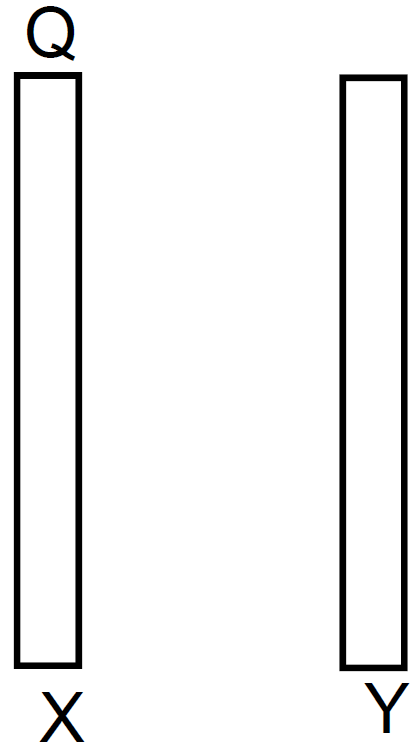
Two conducting plates X and Y, each having large surface area A (on one side), are placed parallel to each other as shown in figure. The plate X is given a charge Q whereas the other is neutral. Find:
  1. The surface charge density at the inner surface of the plate X.
  2. The electric field at a point to the left of the plates.
  3. The electric field at a point in between the plates.
  4. The electric field at a point to the right of the plates.
Answer
  1. Given that the charge present on the plate is Q. The other plate will get the same charge Q due to convection.
Let the surface charge densities on both sides of the plate be $\sigma_1$ and $\sigma_2.$

Now, electric field due to a plate,

$\text{E}=\frac{\sigma}{2\in_0}$

So, the magnitudes of the electric fields due to this plate on each side $=\frac{\sigma_1}{2\in_0}$ and $\frac{\sigma_2}{2\in_0}$

The plate has two sides, each of area A. So, the net charge given to the plate will be equally distributed on both the sides.This implies that the charge developed on each side will be:

$\text{q}_1=\text{q}_2=\frac{\text{Q}}{2}$

This implies that the net surface charge density on each side $=\frac{\text{Q}}{2\text{A}}$
  1. Electric field to the left of the plates
On the left side of the plate surface, charge density,

$\sigma=\frac{\text{Q}}{2\text{A}}$

Hence, electric field $=\frac{\text{Q}}{2\text{A}\in_0}$

This must be directed towards the left, as 'X' is the positively-charged plate.
  1. Here, the charged plate 'X' acts as the only source of electric field, with positive in the inner side. Plate Y is neutral. So, a negative charge will be induced on its inner side. 'Y' attracts the charged particle towards itself. So, the middle portion E is towards the right and is equal to $\frac{\text{Q}}{2\text{A}\in_0}.$
  2. Similarly for the extreme right, the outer side of plate 'Y' acts as positive and hence it repels to the right with $\text{E}=\frac{\text{Q}}{2\text{A}\in_0}.$
View full question & answer