Questions

3 Marks Question

Take a timed test

8 questions · self-marked practice — reveal the answer and mark yourself.

Question 13 Marks
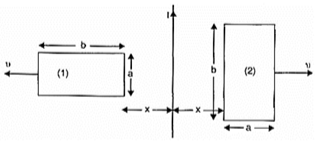
The figure shows two identical rectangular loops (1) and (2) placed on a table along with a straight long current carrying conductor between them.
i. What will be the directions of the induced current in the loops when they are pulled away from the conductor with same velocity v?
ii. Will the emf induced in the two loops be equal?
Image
Answer
i. The direction of induced current will be such that it tends to maintain the original flux. So induced current flows anticlockwise in loop 1 and clockwise in loop 2.
ii. No, the emf's induced in the two loops will not be equal. Since, the rate of change of flux is more in the second coil, emf induced in the second coil is more than that in the first coil. 
Emf in the first coil, $E _1= Bav$
Emf in the school coil, $E _2= Bbv$
Since, $b > a$ therefore, $E _2> E _1$
View full question & answer
Question 23 Marks
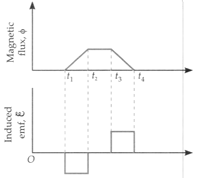
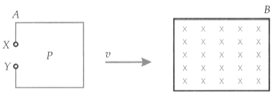
A rectangular coil P is moved from a point A to another point B with uniform velocity 'v' through a region of a uniform magnetic field acting normally inwards as shown in the figure. Show graphically (i) the variation of magnetic flux associated with the coil with time, (ii) the variation of induced emf across points X and Y of the coil with time. 
Image

Explain the nature of variation in magnetic flux as represented by the graph in the first case.
Answer
The graphs given in the figure show the variation of flux $\phi$ with time $t$ and induced emf $\varepsilon$ with time t , respectively.
Image

Explanation of variation of magnetic time. Magnetic flux is proportional to the coil linked with flux. Initially, the coil lies magnetic field, flux through it is zero. As the field at time $t_1$ the flux begins to increase. with time. Between times $t_2$ and $t_3$, in the magnetic field, so flux remains: After this the flux decreases linearly with reduces to zero at time $t_4$, when the coil co the magnetic field.

View full question & answer
Question 33 Marks
How is the spacing between fringes in a double slit experiment affected if:
a. the slits separation is increased,
b. the colour of light used is changed from red to blue,
c. the whole apparatus is submerged in a oil of refractive index 1.2?
Justify your anwer in each case.
Answer
$\beta=n \frac{\lambda D}{d}$
a. As d increases, $\beta$ decreases so spacing between fringes also decreases.
b. As $\lambda$ decreases, $\beta$ also decreases so spacing between fringes also decreases.
c. As whole apparatus is submerged in oil, $\lambda$ decreases So $\beta$ decreases and spacing between fringes will be narrow.
View full question & answer
Question 43 Marks
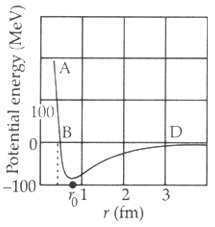
$i$. Draw a plot showing the variation of potential energy of a pair of nucleons as a function of their separation. Mark the regions where the nuclear force is
$a$. attractive and
$b$. repulsive.
$ii$.  In the nuclear reaction ${ }_0 n^1+{ }_{92}^{235} U \rightarrow_{54}^a Xe +{ }_b^{94} Sr +2{ }_0 n^1$ determine the values of $a$ and $b$.
Answer
Image
For $r>r_0$, the force is attractive
For $r < r _0$, the force is repulsive
We have, In nuclear reactions , mass no .is conserved
Hence $ , 1+235=a+94+2 \times 1$
$\therefore a=236-96=140$
In nuclear reactions, charge no. is conserved .
So $0+92=54+b+2 \times 0$
$\therefore b =92-54=38$
View full question & answer
Question 53 Marks
Red light, however bright it is, cannot produce the emission of electrons from a clean zinc surface. But even weak ultraviolet radiation can do so. Why?
Electrons are emitted from the cathode of negligible work function, when photons of wavelength $\lambda$ are incident on it. Derive the expression for the de Broglie wavelength of the electrons emitted in terms of the wavelength of the incident light.
Answer
The frequency of ultraviolet radiations is more while that of red light is less than the threshold frequency for a zinc surface, so ultraviolet radiations can cause the emission of electrons and red light cannot.
From Einstein's photoelectric equation $, K.E$. of a photoelectron is
$\frac{1}{2} m \nu^2=h \nu-W_0=h \nu-0=\frac{h c}{\lambda}$
$\text { or } v=\sqrt{\frac{2 h c}{m \lambda}}$
de Broglie wavelength of electrons,
$\lambda_e=\frac{h}{m v}$
$=\frac{h}{m} \sqrt{\frac{m \lambda}{2 h c}}$
$=\sqrt{\frac{h \lambda}{2 m c}}$
View full question & answer
Question 63 Marks
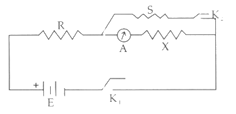
The reading of the $($ideal$)$ ammeter, in the circuit shown here, is equal too. 
Image

$i$. when key $K_1$ is closed but key $K_2$ is open.
$ii.$  $\frac{I}{n}$ when both keys $K _1$ and $K _2$ are closed.
Find the expression of the resistance of $X$ in terms of the resistances of $R$ and $S$.
Answer
$i$. Current I when $K_2$ is open
$I=\frac{E}{R+X}$
$ii$. Current I'when $K_2$ is closed
$I^{\prime}=\frac{E}{R+\left(\frac{S X}{S+X}\right)}=\frac{E(S+X)}{R(S+X)+S X} \ ($so $,S$ and $X$ are parallel$)$
Current flowing through
$X ,\left(I^{\prime}=I / 2\right)$
$\frac{I}{2}=\frac{I^{\prime} S}{S+X}=\frac{E S}{R(S+X)+S X} \ ($by putting the value of $I ,$ we get$)$
$\Rightarrow \frac{E}{2(R+X)}=\frac{E S}{R(S+X)+S X}$
$\Rightarrow 2( R + X ) S = R ( S + X )+ SX$
$2 RS +2 XS = RS + RX + SX$
$RS = RX - SX$
$X=\frac{R S}{(R-S)}$
View full question & answer
Question 73 Marks
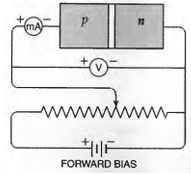
Draw the circuit diagram showing how a p-n junction diode is
i. forward biased
ii. reverse biased
How is the width of depletion layer affected in the two cases?
Answer
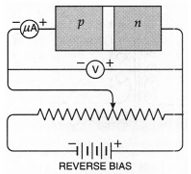
i. The forward-bias connections of a p-n junction are as shown in Fig. 
Image

When the p-n junction is forward biased, the depletion layer becomes thin. It is because, the polarity of the external d.c. source opposes the fictitious battery developed across the junction. As a result, the potential drop across the junction decreases making the depletion layer thin. It leads to the low resistance of the junction diode during forward bias.
ii. The reverse-bias connections of a p-n junction are as shown in Fig. 
Image

When the p-n junction is reverse biased, the depletion layer becomes thick. It is because, the external d.c. source aids the fictitious battery. It results in the increase of potential drop across the junction and the depletion layer appears thick. Because of the increased thickness of the depletion layer, the p-n junction offers high resistance during reverse bias.
View full question & answer
Question 83 Marks
Hydrogen atom in its ground state is excited by means of monochromatic radiation of wavelength $975 \stackrel{\circ}{A}$.
$i.$  How many different lines are possible in the resulting spectrum?
$ii.$ Calculate the longest wavelength amongst them. You may assume the ionization energy for hydrogen atom as $13.6 eV$ .
Answer
$i$. Energy of the ground state $( n =1)=- \ ($ionization energy $)=-13.6 eV$
The wavelength of the incident radiation, $\lambda=975$$\stackrel{0}{A}$
$\therefore$ The energy of the incident photon $= hc / \lambda$
$=\frac{6.63 \times 10^{-34} \times 3 \times 10^5}{975 \times 10^{-10} \times 1.6 \times 10^{-19}}=12.75 eV$
Let electron is exerted to nth orbit,
$\Rightarrow 12.75=13.6\left(\frac{1}{1^2}-\frac{1}{n^2}\right)$
$\Rightarrow n =4$
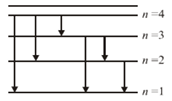
The quantum transitions to the less excited states gives six possible lines as follows:
$ n =4:(4 \rightarrow 3),(4 \rightarrow 2),(4 \rightarrow 1)$
$n =3:(3 \rightarrow 2),(3 \rightarrow 1)$
$n =2:(2 \rightarrow 1)$
Image
$ii.$ The longest wavelength emitted is for the transitions $(4 \rightarrow 3)$ where energy difference is minimum.
$ E _{\min }=\left( E _4- E _3\right)=13.6\left(\frac{1}{3^2}-\frac{1}{4^2}\right)=0.661 e
$
$\text { Thus } \lambda_{\max }=\frac{h c}{ E _{\min }}$
$=\frac{6.63 \times 10^{-34} \times 3 \times 10^8}{0.661 \times 1.6 \times 10^{-19}} m$
$\approx 18807 \mathring A$
View full question & answer