Question
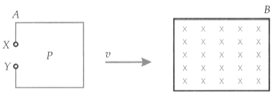
A rectangular coil P is moved from a point A to another point B with uniform velocity 'v' through a region of a uniform magnetic field acting normally inwards as shown in the figure. Show graphically (i) the variation of magnetic flux associated with the coil with time, (ii) the variation of induced emf across points X and Y of the coil with time. 
Image

Explain the nature of variation in magnetic flux as represented by the graph in the first case.
Answer

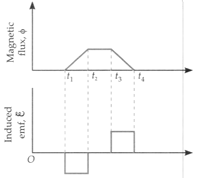
The graphs given in the figure show the variation of flux $\phi$ with time $t$ and induced emf $\varepsilon$ with time t , respectively.
Image

Explanation of variation of magnetic time. Magnetic flux is proportional to the coil linked with flux. Initially, the coil lies magnetic field, flux through it is zero. As the field at time $t_1$ the flux begins to increase. with time. Between times $t_2$ and $t_3$, in the magnetic field, so flux remains: After this the flux decreases linearly with reduces to zero at time $t_4$, when the coil co the magnetic field.

Need a full question paper?

Generate a complete, print-ready paper with questions like this in minutes — across 16+ boards, with answer keys.

Start Generating Free

Similar questions

Suppose that the particle in Exercise in $1.33$ is an electron projected with velocity $v_x= 2.0 \times 10^6 m s^{–1}.$ If $E$ between the plates separated by $0.5 \ cm$ is $9.1 \times 10^2N/C,$ where will the electron strike the upper plate? $(|e|=1.6 \times 10^{–19}C, m_e = 9.1 \times 10^{–31} \ kg.)$
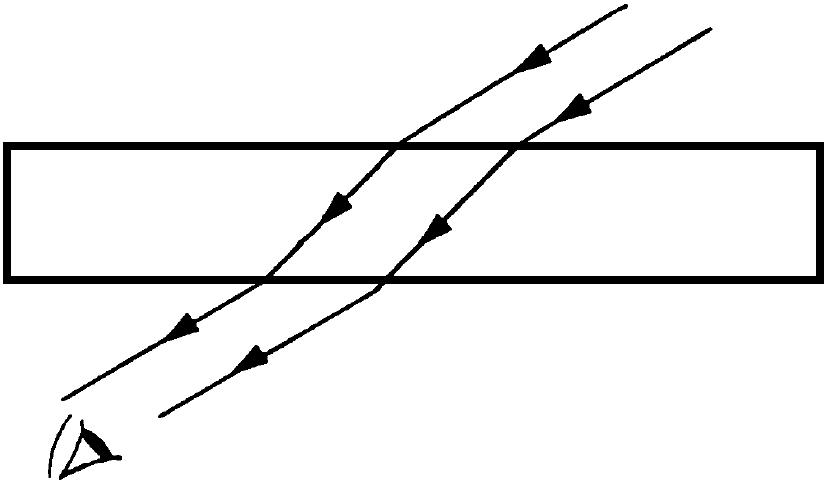
A narrow beam of light passes through a slab obliquely and is then received by an eye. The index of refraction of the material in the slab fluctuates slowly with time. How will it appear to the eye? The twinkling of stars has a similar explanation.
 A proton and an $\alpha$ particle move perpendicular to a magnetic field. Find the ratio of radii of circular paths described by them when both have (i) equal velocities, and (ii) equal kinetic energy.
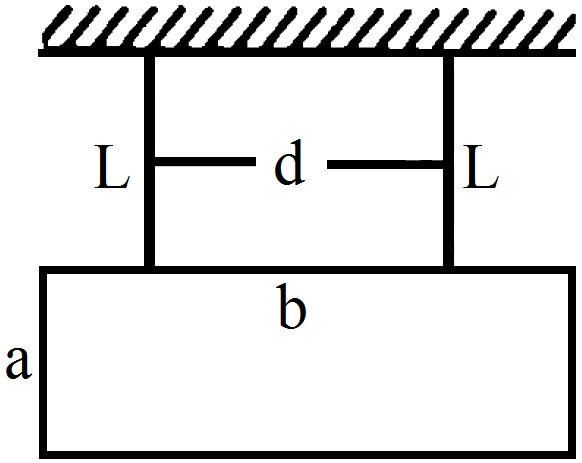
A rectangular plate of sides a and b is suspended from a ceiling by two parallel strings of length L each figure The separation between the strings is d. The plate is displaced slightly in its plane keeping the strings tight. Show that it will execute simple harmonic motion. Find the time period.
State the principle of working of a galvanometer.
A galvanometer of resistance $G$ is converted into a voltmeter to measure upto $V$ volts by connecting a resistance $R_1$ in series with the coil. If a resistance $R_2$ is connected in series with it, then it can measure upto $V/2$ volts. Find the resistance, in terms of $R_1$ and $R_2,$ required to be connected to convert it into a voltmeter that can read upto $2 V.$ Also find the resistance $G$ of the galvanometer in terms of $R_1$ and $R_2.$
An ac circuit is made from series combination of components of circuits X and Y . Current is ahead of voltage by $\frac{\pi}{4}$. If component $X$ is pure resistor whose value is $100 \Omega$ then (i) what is the name of component $Y$ ? (ii) If root mean square value of voltage is 141 V , then find the root mean square value of the current.
Two charged particles, having equal charges of $2.0 \times 10^{-5}C$ each, are brought from infinity to within a separation of $10\ cm.$ Find the increase in the electric potential energy during the process.
A small telescope has an objective lens of focal length $144 \ cm$ and an eyepiece of focal length $6.0 \ cm$. What is the magnifying power of the telescope? What is the separation between the objective and the eyepiece?
With the help of a circuit diagram, explain how two p-n junction diodes along with a centre tapped transformer can be used as a full wave rectifier.
Get the electric field due to a uniformly charged thin spherical shell.