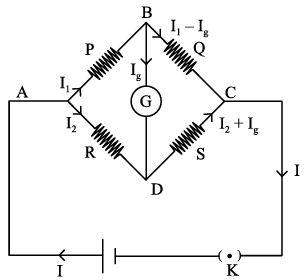
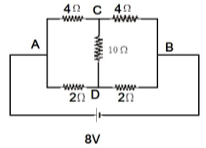
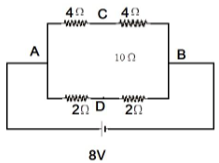
Question 15 Marks
(I) (a) Write two limitations of ohm’s law. Plot their I-V characteristics.
(b) A heating element connected across a battery of 100 V having an internal resistance of $1 \Omega$ draws an initial current of 10 A at room temperature 20.0 °C which settles after a few seconds to a steady value. What is the power consumed by battery itself after the steady temperature of 320.0 °C is attained? Temperature coefficient of resistance averaged over the temperature range involved is $3.70 \times 10^{-4}{ }^{\circ} C ^{-1}$.
(b) A heating element connected across a battery of 100 V having an internal resistance of $1 \Omega$ draws an initial current of 10 A at room temperature 20.0 °C which settles after a few seconds to a steady value. What is the power consumed by battery itself after the steady temperature of 320.0 °C is attained? Temperature coefficient of resistance averaged over the temperature range involved is $3.70 \times 10^{-4}{ }^{\circ} C ^{-1}$.
Answer
View full question & answer→(I) (a) Kirchhoff’s I Law : The algebraic sum of all the currents meeting at a point in an electrical circuit is always equal to zero.
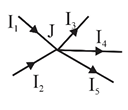
$\left[+l_1\right]+\left[+I_2\right]+\left[-I_3\right]+\left[-l_4\right]+\left[-I_5\right]=0$
OR $l_1+I_2=I_3+l_4+I_5$
Kirchhoff’s II Law : The algebraic sum of the changes in potential around any closed resistor loop must be zero.
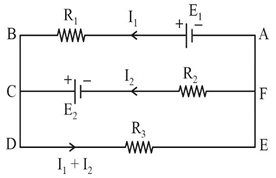
closed mesh ABCFA
$\left[+E_1\right]\left[-I_1 R_1\right]+\left[-E_2\right]+\left[+I_2 R\right]=0$ ..(1)
closed mesh FCDEF
$\left[+E_2\right]+\left[-\left(I_1+I_2\right)\right] R_3+\left[-I_2 R_2\right]=0$ ..(2)
(b) $I=\frac{\varepsilon}{R_0+r} \quad$ Where $R_0$ is resistor at room tempere $20^{\circ}$
$\begin{array}{c}\Rightarrow R_0=\frac{\varepsilon}{L}-1 \\ \text { OR } \quad R_0=\frac{100}{10}-1=R_0=9 \Omega\end{array}$
Now Final temperature is $320^{\circ} C$
$\begin{aligned} R & =R_0(1+\alpha \Delta T) \\ & =9\left(\left(1+3.7 \times 10^{-4} \times 300\right)\right. \\ & =10 Ohm \end{aligned}$
$\begin{aligned} \text { Power Consumed by cell }(P) & =t^2 r \\ & =\left(\frac{t}{k_0+r}\right)^2 \times r \quad \text { Watt } \\ & =\left(\frac{100}{11}\right)^2=82.64 W\end{aligned}$
$\left[+l_1\right]+\left[+I_2\right]+\left[-I_3\right]+\left[-l_4\right]+\left[-I_5\right]=0$
OR $l_1+I_2=I_3+l_4+I_5$
Kirchhoff’s II Law : The algebraic sum of the changes in potential around any closed resistor loop must be zero.
closed mesh ABCFA
$\left[+E_1\right]\left[-I_1 R_1\right]+\left[-E_2\right]+\left[+I_2 R\right]=0$ ..(1)
closed mesh FCDEF
$\left[+E_2\right]+\left[-\left(I_1+I_2\right)\right] R_3+\left[-I_2 R_2\right]=0$ ..(2)
(b) $I=\frac{\varepsilon}{R_0+r} \quad$ Where $R_0$ is resistor at room tempere $20^{\circ}$
$\begin{array}{c}\Rightarrow R_0=\frac{\varepsilon}{L}-1 \\ \text { OR } \quad R_0=\frac{100}{10}-1=R_0=9 \Omega\end{array}$
Now Final temperature is $320^{\circ} C$
$\begin{aligned} R & =R_0(1+\alpha \Delta T) \\ & =9\left(\left(1+3.7 \times 10^{-4} \times 300\right)\right. \\ & =10 Ohm \end{aligned}$
$\begin{aligned} \text { Power Consumed by cell }(P) & =t^2 r \\ & =\left(\frac{t}{k_0+r}\right)^2 \times r \quad \text { Watt } \\ & =\left(\frac{100}{11}\right)^2=82.64 W\end{aligned}$