Question
(I) (a) Write two limitations of ohm’s law. Plot their I-V characteristics.
(b) A heating element connected across a battery of 100 V having an internal resistance of $1 \Omega$ draws an initial current of 10 A at room temperature 20.0 °C which settles after a few seconds to a steady value. What is the power consumed by battery itself after the steady temperature of 320.0 °C is attained? Temperature coefficient of resistance averaged over the temperature range involved is $3.70 \times 10^{-4}{ }^{\circ} C ^{-1}$.
Answer

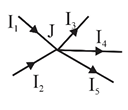
(I) (a) Kirchhoff’s I Law : The algebraic sum of all the currents meeting at a point in an electrical circuit is always equal to zero.

Image

$\left[+l_1\right]+\left[+I_2\right]+\left[-I_3\right]+\left[-l_4\right]+\left[-I_5\right]=0$
OR $l_1+I_2=I_3+l_4+I_5$
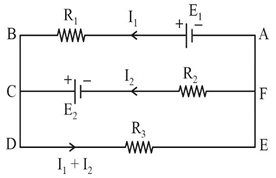
Kirchhoff’s II Law : The algebraic sum of the changes in potential around any closed resistor loop must be zero.

Image

closed mesh ABCFA
$\left[+E_1\right]\left[-I_1 R_1\right]+\left[-E_2\right]+\left[+I_2 R\right]=0$ ..(1)
closed mesh FCDEF
$\left[+E_2\right]+\left[-\left(I_1+I_2\right)\right] R_3+\left[-I_2 R_2\right]=0$ ..(2)

(b) $I=\frac{\varepsilon}{R_0+r} \quad$ Where $R_0$ is resistor at room tempere $20^{\circ}$
$\begin{array}{c}\Rightarrow R_0=\frac{\varepsilon}{L}-1 \\ \text { OR } \quad R_0=\frac{100}{10}-1=R_0=9 \Omega\end{array}$
Now Final temperature is $320^{\circ} C$
$\begin{aligned} R & =R_0(1+\alpha \Delta T) \\ & =9\left(\left(1+3.7 \times 10^{-4} \times 300\right)\right. \\ & =10 Ohm \end{aligned}$
$\begin{aligned} \text { Power Consumed by cell }(P) & =t^2 r \\ & =\left(\frac{t}{k_0+r}\right)^2 \times r \quad \text { Watt } \\ & =\left(\frac{100}{11}\right)^2=82.64 W\end{aligned}$

Need a full question paper?

Generate a complete, print-ready paper with questions like this in minutes — across 16+ boards, with answer keys.

Start Generating Free

Similar questions

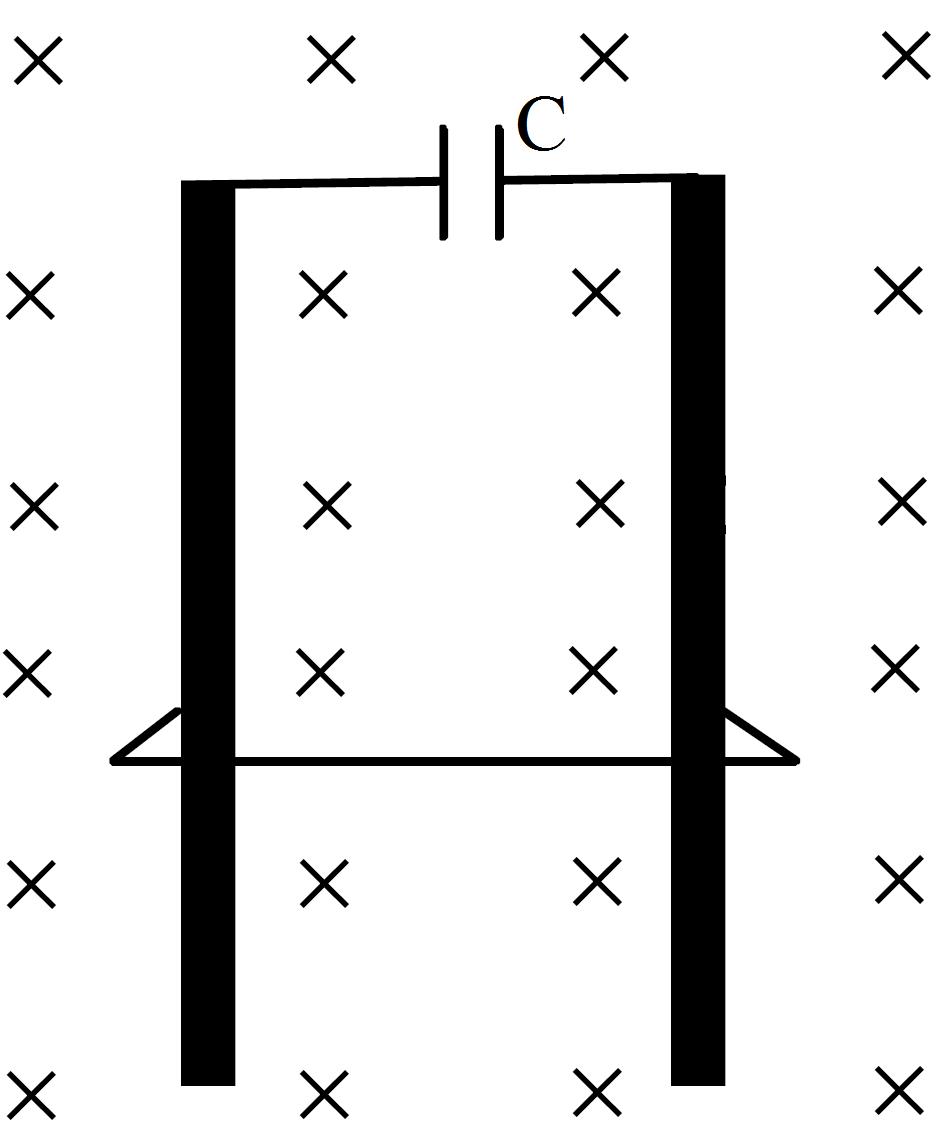
A wire of mass m and length l can slide freely on a pair of smooth, vertical rails (figure). A magnetic field B exists in the region in the direction perpendicular to the plane of the rails. The rails are connected at the top end by a capacitor of capacitance C. Find the acceleration of the wire neglecting any electric resistance.
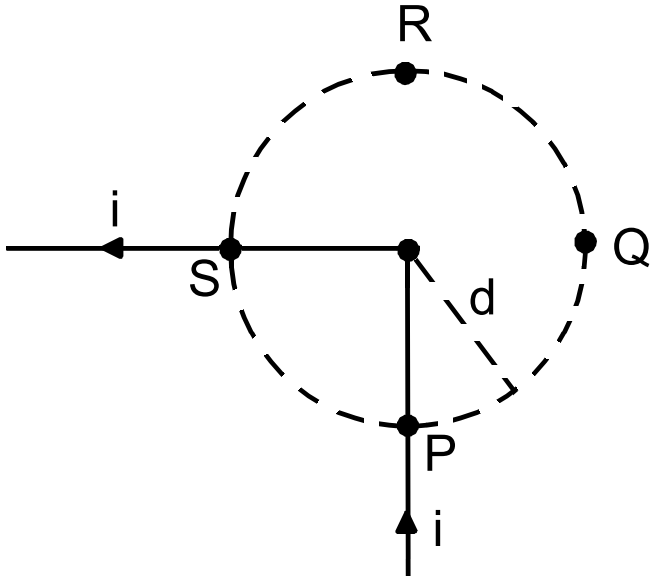
Figure shows a long wire bent at the middle to form a right angle. Show that the magnitudes of the magnetic fields at the points $\text{P, Q, R}$ and $S$ are equal and find this magnitude.
The half $-$ life of ${40}K$ is $1.30 \times 10^9y$. A sample of $1.00g$ of pure $\text{KCI}$ gives $160\  \text{counts/ s}$. Calculate the relative abundance of ${40}K ($fraction of ${40}K$ present$)$ in natural potassium.
Define common potential. Find the expression for redistribution of charges and energy loss when capacitors are connected together.
A rectangular conducting loop consists of two wires on two opposite sides of length $l$ joined together by rods of length $d.$ The wires are each of the same material but with cross$-$sections differing by a factor of $2.$ The thicker wire has a resistance $R$ and the rods are of low resistance, which in turn are connected to a constant voltage source $V_0.$ The loop is placed in uniform a magnetic field $B$ at $45^\circ$ to its plane. Find $\tau$, the torque exerted by the magnetic field on the loop about an axis through the centres of rods.
Compute induced current and induced charge in electromagnetic induction and also write Fleming's right hand rule.
Suppose the ceiling in the previous problem is that of an elevator which is going up with an acceleration of $2.0m/s^2$. Find the elongations.
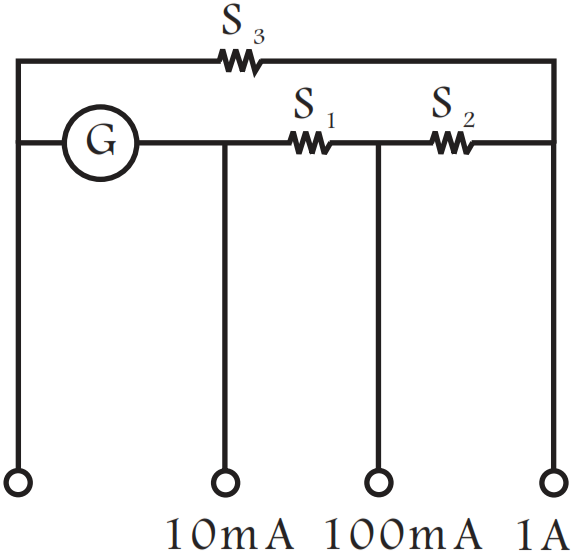
A multirange current meter can be constructed by using a galvanometer circuit as shown in Fig. We want a current meter that can measure $10mA,$ $100mA$ and $1A$ using a galvanometer of resistance $10\Omega$ and that prduces maximum deflection for current of $1mA.$ Find $S_1, S_2$ and $S_3$ that have to be used.
A body starts slipping down an incline and moves half meter in half second. How long will it take to move the next half meter?
Consider a circular ring of radius r, uniformly charged with linear charge density $\lambda.$ Find the electric potential at a point on the axis at a distance x from the centre of the ring. Using this expression for the potential, find the electric field at this point.