Question
Derive an expression for potential due to a dipole for distances large compared to the size of the dipole. How is the potential due to dipole different from that due to a single charge?
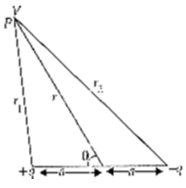
Image

Answer

Consider origin at the centre of dipole.
As per superposition principle, potential due to dipole will be the sum of potentials due to charges $q$ and $-q$
$V=\frac{1}{4 \pi \varepsilon_0}\left[\frac{q}{r_1}-\frac{q}{r_2}\right]$
Where,
$r_1$ and $r_2=$ distances of point $P$ from $q$ and $-q$.
$ r_1^2=r^2+a^2-2 \operatorname{ar cos} \theta $
$ r_2^2=r^2+a^2+2 \operatorname{ar cos} \theta $
If r is greater than a, and taking terms upto first order in $a / r$
$ r _1^2= r ^2\left[1-\frac{2 a \cos \theta}{r}+\frac{a^2}{r^2}\right]$
$=r^2\left[1-\frac{2 a \cos \theta}{r}\right]$
Also $,  r _2^2= r ^2\left[1+\frac{2 a \cos \theta}{r}\right]$
With the help of Binomial theorem, keeping terms upto first order is shown below:
$\frac{1}{r_1} \equiv \frac{1}{r}\left[1-\frac{2 a \cos \theta}{r}\right]^{\frac{1}{2}}$
$\equiv \frac{1}{r}\left[1+\frac{a}{r} \cos \theta\right]$
$\frac{1}{r_2} \equiv \frac{1}{r}\left[1+\frac{2 a \cos \theta}{r}\right]^{\frac{1}{2}}$
$\equiv \frac{1}{r}\left[1-\frac{a}{r} \cos \theta\right] $
As $p = qa$
$ V=\frac{1}{4 \pi \varepsilon_0} \frac{q(2 a) \cos \theta}{r^2}$
$V=\frac{p}{4 \pi \varepsilon_0} \cdot \frac{\cos \theta}{r^2} $
Now, $p \cos \theta=\vec{p} . \hat{r}$
Hence electric potential of dipole for distances large compared to size of dipole is given as below :
$ V=\frac{1}{4 \pi \varepsilon_0} \cdot \frac{\vec{p} \hat{r}}{r^2} \text { for } r \gg a$
$---$ For potential at any point on axis, $\theta=[0, \pi]$
$V= \pm \frac{1}{4 \pi \varepsilon_0} \cdot \frac{q}{r} $
potential is positive when $\theta=0$
potential is negative when $\theta=\pi$
Hence, electric potential falls at large distance, as $\frac{1}{r^2}$ and not as $\frac{1}{r}$

Need a full question paper?

Generate a complete, print-ready paper with questions like this in minutes — across 16+ boards, with answer keys.

Start Generating Free

Similar questions

A polariod (I) is placed in front of a monochromatic source. Another polatiod (II) is placed in front of this polaroid (I) and rotated till no light passes. A third polaroid (III) is now placed in between (I) and (II). In this case, will light emerge from (II). Explain.
Standing waves of frequency $5.0kHz$ are produced in a tube filled with oxygen at $300K$. The separation between the consecutive nodes is $3.3\ cm$. Calculate the specific heat capacities $C_p$ and $C_{v }$ of the gas.
Consider a $20W$ bulb emitting light of wavelength $5000\mathring{\text{A}}$ and shining on a metal surface kept at a distance $2\ m$. Assume that the metal surface has work function of $2eV$ and that each atom on the metal surface can be treated as a circular disk of radius $1.5\mathring{\text{A}}$.
  1. Estimate no. of photons emitted by the bulb per second. $[$Assume no other losses$]$
  2. Will there be photoelectric emission?
  3. How much time would be required by the atomc disk to receive energy equal to work function $(2eV)$?
  4. How many photons would atomic disk receive within time duration calculated in $(iii)$  above?
  5. Can you explain how photoelectric effect was observed instantaneously?
Hint: Time calculated in part $(iii)$ is from classical consideration and you may further take the target of surface area say $1\ cm^2$ and estimate what would happen?
What is polaroid? Write its uses.
Answer the following question:
The small ozone layer on top of the stratosphere is crucial for human survival. Why?
Explain the principle of superposition in terms of position vectors of charges.
A horizontal cesium plate ($\phi$ = l.9 eV) is moved vertically downward at a constant speed u in a room full of radiation of wavelength 250 run and above. What should be the minimum value of u so that the vertically upward component of velocity is nonpositive for each photoelectron?
Two moving coil meters, M1 and M2 have the following particulars:$\begin{array}{l} R _1=10 \Omega, N_1=30 \\
A_1=3.6 \times 10^{-3} m^2, B_1=0.25 T\end{array}$
$\begin{array}{l} R _2=14 \Omega, N_2=42 \\
A_2=1.8 \times 10^{-3} m^2, B_2=0.50 T\end{array}$
(The spring constants are identical for the two meters).
Determine the ratio of (a) current sensitivity and (b) voltage sensitivity of M2 and M1.
Radiation coming from transition $n = 2$ to $n = 1$ of hydrogen atoms falls on helium ions in $n = 1$ and $n = 2$ states. What are the possible transitions of helium ions as they absorbs energy from the radiation?
Three capacitors having capacitances $20\mu\text{F},\ 30\mu\text{F}$ and $40\mu\text{F}$ are connected in series with a 12V battery. Find the charge on each of the capacitors. How much work has been done by the battery in charging the capacitors?