Question 13 Marks
Derive the equation for the torque acting on current-carrying coil place in uniform magnetic ficld $\overrightarrow{ B }$.
Answer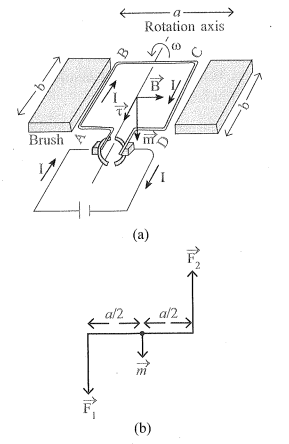
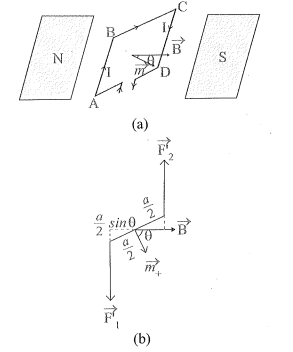
→Figure shows a rectangular coil ABCD is placed in a uniform magnetic field in such a way that its plane lies in the magnetic field.
→The current passing through the coil is I . The length and width of the coil are $a$ and $b$ respectively.
→The field exerts no force on the two arms AD and BC of the loop. (Because the field is parallel to the currents through these two arms.)
→Suppose a force $\overrightarrow{F_1}$ is applied perpendicularly to the $\operatorname{arm} AB$ of the coil, which is directed into the plane of the loop. Its magnitude is $F _1{ }^{\prime}=I b B$
→Similarly, it exerts a force $\overrightarrow{ F _2^{\prime}}$ on the arm CD and it is directed out of the plane of the paper. Its magnitude is $F _2{ }^{\prime}= I b B$
→Both these forces $\vec{F}_1^{\prime}$ and $\overrightarrow{ F _2^{\prime}}$ are equal in magnitude and opposite in direction, so the net force is zero.
→But, these two forces are not collinear so they form a couple, causing a torque on the loop. This torque causes the coil to rotate.
→Torque acting on the coil,
$\begin{aligned}
\tau & = F _1{ }^{\prime}\left(\frac{a}{2}\right)+ F _2{ }^{\prime}\left(\frac{a}{2}\right) \\
\therefore \tau & = I b B\left(\frac{a}{2}\right)+ I b B\left(\frac{a}{2}\right) \\
\therefore \tau & =2 I b B \frac{a}{2} \\
\therefore \quad \tau & = I (a b) B \\
\therefore \quad \tau & = IAB
\end{aligned}$
Where, $A =a b$ is a area of the rectangle.
View full question & answer→→Figure shows a rectangular coil ABCD is placed in a uniform magnetic field in such a way that its plane lies in the magnetic field.
→The current passing through the coil is I . The length and width of the coil are $a$ and $b$ respectively.
→The field exerts no force on the two arms AD and BC of the loop. (Because the field is parallel to the currents through these two arms.)
→Suppose a force $\overrightarrow{F_1}$ is applied perpendicularly to the $\operatorname{arm} AB$ of the coil, which is directed into the plane of the loop. Its magnitude is $F _1{ }^{\prime}=I b B$
→Similarly, it exerts a force $\overrightarrow{ F _2^{\prime}}$ on the arm CD and it is directed out of the plane of the paper. Its magnitude is $F _2{ }^{\prime}= I b B$
→Both these forces $\vec{F}_1^{\prime}$ and $\overrightarrow{ F _2^{\prime}}$ are equal in magnitude and opposite in direction, so the net force is zero.
→But, these two forces are not collinear so they form a couple, causing a torque on the loop. This torque causes the coil to rotate.
→Torque acting on the coil,
$\begin{aligned}
\tau & = F _1{ }^{\prime}\left(\frac{a}{2}\right)+ F _2{ }^{\prime}\left(\frac{a}{2}\right) \\
\therefore \tau & = I b B\left(\frac{a}{2}\right)+ I b B\left(\frac{a}{2}\right) \\
\therefore \tau & =2 I b B \frac{a}{2} \\
\therefore \quad \tau & = I (a b) B \\
\therefore \quad \tau & = IAB
\end{aligned}$
Where, $A =a b$ is a area of the rectangle.