Questions

Case study (4 Marks)

Take a timed test

26 questions · self-marked practice — reveal the answer and mark yourself.

Question 14 Marks
A short magnet makes 40 oscillations per minute when used in an oscillation magnetometer at a place where the earth's horizontal magnetic field is $2\mu\text{T.}$ Another short magnet of magnetic moment $1.6A-m^2$ is placed 20cm east of the oscillating magnet. Find the new frequency of oscillation if the magnet has its north pole:
  1. Towards north.
  2. Towards south.
Answer
$\gamma_1=40$ oscillations/ minute
$\text{B}_\text{H}=25\mu\text{T}$
m of second magnet $= 1.6A-m^2$
$d = 20cm = 0.2m$
For north facing north
$\gamma_1=\frac{1}{2\pi}\sqrt{\frac{\text{MB}_{\text{H}}}{\text{I}}}$
$\gamma_2=\frac{1}{2\pi}\sqrt{\frac{\text{M}(\text{B}_{\text{H}}-\text{B})}{\text{I}}}$
$\text{B}=\frac{\mu_0}{4\pi}\frac{\text{m}}{\text{d}^3}=\frac{10^{-7}\times1.6}{8\times10^{-3}}=20\mu\text{T}$
$\frac{\gamma_1}{\gamma_2}=\sqrt{\frac{\text{B}}{\text{B}_{\text{H}-\text{B}}}}\Rightarrow\frac{40}{\gamma_2}=\sqrt{\frac{25}{5}}\Rightarrow\gamma_2=\frac{40}{\sqrt{5}}$
$=17.88\approx18\text{ osci/min}$
For north pole facing south
$\gamma_1=\frac{1}{2\pi}\sqrt{\frac{\text{MB}_{\text{H}}}{\text{I}}}$
$\gamma_2=\frac{1}{2\pi}\sqrt{\frac{\text{M}(\text{B}_{\text{H}}-\text{B})}{\text{I}}}$
$\frac{\gamma_1}{\gamma_2}=\sqrt{\frac{\text{B}}{\text{B}_{\text{H}-\text{B}}}}\Rightarrow\frac{40}{\gamma_2}=\sqrt{\frac{25}{45}}\Rightarrow\gamma_2=\frac{40}{\sqrt{\Big(\frac{25}{45}\Big)}}$
$=53.66\approx54\text{ osci/min}$

View full question & answer
Question 24 Marks
The magnetic field due to the earth has a horizontal component of $26\mu\text{T}$ at a place where the dip is 60°. Find the vertical component and the magnitude of the field.
Answer
$\delta(\text{dip}) =60^\circ$$\text{B}_\text{H}=\text{B}\cos60^\circ$
$\Rightarrow\text{B}=52\times10^{-6}=52\mu\text{T}$
$\text{B}_\text{v}=\text{B}\sin\delta=52\times10^{-6}\frac{\sqrt{3}}{2}$
$=44.98\mu\text{T} \approx45\mu\text{T}$
View full question & answer
Question 34 Marks
A long bar magnet has a pole strength of 10A-m. Find the magnetic field at a point on the axis of the magnet at a distance of 5cm from the north pole of the magnet.
Answer
$\text{m}=10\text{A-m,}$ $\text{d}=5\text{cm}=0.05\text{m}$ $\text{B}=\frac{\mu_0\text{m}}{4\pi\text{r}^2}=\frac{10^{-7}\times10}{(5\times10^{-2})^2}=\frac{10^{-2}}{25}=4\times10^{-4}\text{ Tesla}$
View full question & answer
Question 44 Marks
The needle of a dip circle shows an apparent dip of 45° in a particular position and 53° when the circle is rotated through 90°. Find the true dip.
Answer
We know:
$\text{B}_\text{H}=\frac{\mu_0\text{in}}{2\text{r}}$
Give: $\text{B}_\text{H}=3.6\times10^{-5}\times\text{T}$
$\text{i}=10\text{mA}=10^{-2}\text{A}$
$\text{n}=?$
$\theta=45^\circ$
$\tan\theta=1$
$\text{r}=10\text{cm}=0.1\text{m}$
$\text{n}=\frac{\text{B}_\text{H}\tan\theta\times2\text{r}}{\mu_0\text{i}}$
$=\frac{3.6\times10^{-5}\times2\times1\times10^{-1}}{4\pi\times10^{-7}\times10^{-2}}$
$=0.5732\times10^{3} \approx573\text{ turns}$
View full question & answer
Question 54 Marks
Two long bar magnets are placed with their axes coinciding in such a way that the north pole of the first magnet is 2·0cm from the south pole of the second. If both the magnets have a pole strength of 10A-m, find the force exerted by one magnet on the other.
Answer
$\text{m}_1=\text{m}_2=10\text{A-m}$
$\text{r}=2\text{cm}=0.02\text{m}$
we know
Force exerted by tow magnetic poles on each other $=\frac{\mu_0\text{m}_1\text{m}_2}{4\pi\text{ r}^2}=\frac{4\pi\times10^{-7}\times10^{2}}{4\pi\times4\times10^{-4}}=2.5\times10^{-2}\text{N}$
View full question & answer
Question 64 Marks
A moving-coil galvanometer has a 50-turn coil of size 2cm × 2cm. It is suspended between the magnetic poles producing a magnetic field of 0.5T. Find the torque on the coil due to the magnetic field when a current of 20mA passes through it.
Answer
Given $\theta=37^\circ$$\text{d}=10\text{cm}=0.1\text{m}$
We know
$\frac{\text{M}}{\text{B}}=\frac{4\pi}{\mu_0}\frac{(\text{d-}^2\ell^2)^2}{2\text{d}}\tan\theta$
$=\frac{4\pi}{\mu_0}\times\frac{\text{d}^4}{2\text{d}}\tan\theta$ [As the magnet is short]
$=\frac{4\pi}{4\pi\times10^{-7}}\times\frac{(0.1)^3}{2}\times\tan37^\circ$
$=0.5\times0.75\times1\times10^{-3}\times10^7$
$=3.75\times10^3\text{A-m}^2\text{T}^{-1}$
View full question & answer
Question 74 Marks
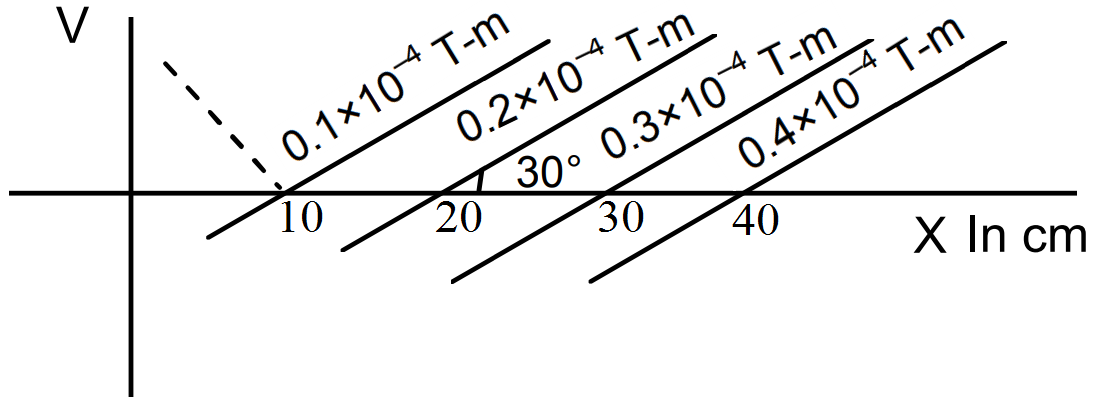
Figure shows some of the quipotential surfaces of the magnetic scalar potential. Fmd the magnetic field B at a point in the region.
Answer
Here$\text{dx}=10\sin30^\circ\text{cm}=5\text{cm}$
$\frac{\text{dV}}{\text{dx}}=\text{B}=\frac{0.1\times10^{-4}\text{T-m}}{5\times10^{-2}\text{m}}$
Since B is perpendicular to equipotential surface.
Here it is at angle 120° with (+ve) x-axis and $B = 2 \times 10^{-4}T$
View full question & answer
Question 84 Marks
A magnetic needle is free to rotate in a vertical plane which makes an angle of 60° with the magnetic meridian. If the needle stays in a direction making an angle of $\tan^{-1}\Big(\frac{2}{\sqrt{3}}\Big)$ with the horizontal, what would be the dip at that place?
Answer
Given:
Angle made by the ma by the magnetic meridian with the plane of rotation of the needle, $\theta=60^\circ$ Angle made by the needle With the horizontal, $\delta_1=\tan^{-1}\Big(\frac{2}{\sqrt{3}}\Big)$ If $\delta$ is the angle of dip, then.
$\tan\delta_1=\frac{\tan\delta}{\cos\theta}$
$\Rightarrow\tan\delta=\tan\delta\cos\theta$
$\Rightarrow\tan\delta=\tan\Big(\tan^{-1}\frac{2}{\sqrt{3}}\Big)\cos60^\circ$
$\Rightarrow\tan\delta=\frac{2}{\sqrt{3}}\times\frac{1}{2}=\frac{1}{\sqrt{3}}$
$\Rightarrow\delta=30^\circ$
View full question & answer
Question 94 Marks
A uniform magnetic field of $0.20 \times 10^{-3}$ T exists in the space. Find the change in the magnetic scalar potential as one moves through 50cm along the field.
Answer
$\text{B}=-\frac{\text{dv}}{\text{dt}}\Rightarrow\text{dv}=-\text{B dt}$$=-0.2\times10^{-3}\times0.5=-0.1\times10^{-3}\text{T-m}$
Since the sigh is-ve therefore potential decreases.
View full question & answer
Question 104 Marks
A tangent galvanometer shows a deflection of 45° when 10mA of current is passed through it. If the horizontal component of the earth's magnetic field is $B_H = 3.6\times 10^{-5} T$ and radius of the coil is 10cm, find the number of turns in the coil.
Answer
$\text{n}=50$
$\text{i}=20\times10^{-3}\text{A}$
$\text{A}=2\text{cm}\times2\text{cm}=2\times2\times10^{-4}\text{m}^{2}$
$\text{B}=0.5\text{T}$
$\tau =\text{ni}(\vec{\text{A}}\times\vec{\text{B}})=\text{ni}\text{AB}\sin90^\circ$
$=50\times20\times10^{-3}\times4\times10^{-4}\times0.5$
$=2\times10^{-4}\text{N-M}$
View full question & answer
Question 114 Marks
The reduction factor K of a tangent galvanometer is written on the instrument. The manual says that the current is obtained by multiplying this factor to tane. The procedure works well at Bhuwaneshwar. Will the procedure work if the instrument is taken to Nepal? If there is some error, can it be corrected by correcting the manual or the instrument will have to be taken back to the factory?
Answer
$\tan\theta$ can be different at different positions.
As by multiplying tan Theta of the place we can obtain right value so we do not need to take manual back to factory we only need to calculate angle of nepal w.r.t. equator.
View full question & answer
Question 124 Marks
The magnetic moment of the assumed dipole at the earth's centre is $8.0 \times 10^{22}A-m^2$. Calculate the magnetic field B at the geomagnetic poles of the earth. Radius of the earth is 6400km.
Answer
The geomagnetic pole is at the end on position of the earth.$\text{B}=\frac{\mu_0}{4\pi}\frac{2\text{M}}{\text{d}^3}=\frac{10^{-7}\times2\times8\times10^{22}}{(6400\times10^{3})^{3}}\approx60\times10^{-6}\text{t}=60\mu\text{T}$
View full question & answer
Question 134 Marks
If the earth's magnetic field has a magnitude $3.4 \times 10^{-5} T$ at the magnetic equator of the earth what would be its value at the earth's geomagnetic poles?
Answer
$\vec{\text{B}}=3.4\times10^{-5}\text{T}$
Given: $\frac{\mu_0}{4\pi}\frac{\text{M}}{\text{R}^{3}}=3.4\times10^{-5}$
$\Rightarrow\text{M}=\frac{3.4\times10^{-5}\times\text{R}^3\times4\pi}{4\pi\times10^{-7}}=3.4\times10^2\text{R}^3$
$\vec{\text{B}}\text{ at}\text{ poles}=\frac{\mu_0}{4\pi}\frac{2\text{M}}{\text{R}^3}=6.8\times10^{-5}\text{T}$
View full question & answer
Question 144 Marks
The magnetometer of the previous problem is used with the same magnet in $\tan-\text{B}$ position. Where should the magnet be placed to produce a 37° deflection of the needle?
Answer
Given $\frac{\text{M}}{\text{B}_\text{H}}=40\text{A-m}^2/\text{T}$
Since the magnet is short ‘ℓ’ can be neglected
So, $\frac{\text{M}}{\text{B}_\text{H}}=\frac{4\pi}{\mu_0}\times\frac{\text{d}^3}{2}=40$
$\Rightarrow\text{d}^3=\frac{40\times4\pi\times10^{-7}\times2}{4\pi}=8\times10^{-6}$
$\Rightarrow\text{d}=2\times10^{-2}\text{m}=2\text{cm}$
with the northpole pointing towards south.
View full question & answer
Question 154 Marks
A short magnet oscillates in an oscillation magnetometern with a time period of 0.10s where the earth's horizontal magnetic field is $24\mu\text{T}.$ A downward current of 18 A is established in a vertical wire placed 20cm east of the magnet. Find the new time period.
Answer
$\text{T}_1=2\pi\sqrt{\frac{\text{I}}{\text{MB}_\text{H}}}$Here I' = 2I
$\text{T}_1=\frac{1}{40}\text{min}$
$\text{T}_2=?$
$\frac{\text{T}_1}{\text{T}_2}=\sqrt{\frac{\text{I}}{\text{I'}}}$
$\Rightarrow\frac{1}{40\text{T}_2}=\sqrt{\frac{1}{2}}\Rightarrow\frac{1}{1600\text{T}_2^2}\frac{1}{2}$
$\Rightarrow\text{T}_2^2=\frac{1}{800}\Rightarrow\text{T}_2=0.03536\text{min}$
For 1 oscillation Time taken = 0.03536 min
For 40 Oscillation Time$=4\times0.03536=1.414=\sqrt{2}\text{ min}$
View full question & answer
Question 164 Marks
A deflection magnetometer is placed with its arms in north-south direction. How and where should a short magnet having $\frac{\text{M}}{\text{B}_\text{H}}=40\text{A-m}^2\text{T}$ be placed so that the needle can stay in any position?
Answer
According to oscillation magnetometer,
$\text{T}=2\pi \sqrt{\frac{\text{I}}{\text{MB}_\text{H}}}$
$\Rightarrow\frac{\pi}{10}=2\pi\sqrt{\frac{1.2\times10^{-4}}{\text{M}\times30\times10^{-6}}}$
$\Rightarrow\Big(\frac{1}{20}\Big)^2=\frac{1.2\times1^{-4}}{\text{M}\times30\times10^{-6}}$
$\Rightarrow\text{M}=\frac{1.2\times10^{-4}\times400}{30\times10^{-6}}$
$=16\times10^{2}\text{A-m}^2=1600\text{A-m}^2$
View full question & answer
Question 174 Marks
A short magnet produces a deflection of 37° in a deflection magnetometer in Tan-A position when placed at a separation of 10cm from the needle. Find the ratio of the magnetic moment of the magnet to the earth's horizontal magnetic field.
Answer
$\frac{\text{M}}{\text{B}_\text{H}}$ (found in the previous problem) $= 3.75 \times 10^3A-m^2 T^{-1}$
$\theta=37^\circ$
$\text{d}=?$
$\frac{\text{M}}{\text{B}_\text{H}}=\frac{4\pi}{\mu_0}(\text{d}^2+\ell^2)^\frac{3}{2}\tan\theta$
$\ell<<\text{d}$ neglecting ℓ w.r.t.d
$\Rightarrow\frac{\text{M}}{\text{B}_\text{H}}=\frac{4\pi}{\mu_0}\text{d}^3\tan\theta$
$\Rightarrow3.75\times10^3=\frac{1}{10^{-7}}\times\text{d}^3\times0.75$
$\Rightarrow\text{d}^3=\frac{3.75\times10^3\times10^{-7}}{0.75}=5\times10^{-4}$
$\Rightarrow\text{d}=0.079\text{m}=7.9\text{cm}$
View full question & answer
Question 184 Marks
A magnetic dipole of magnetic moment $0.72A-m^2$ is placed horizontally with the north pole pointing towards bsouth. Find the position of the neutral point if the horizontal component of the earth's magnetic field is $18\mu\text{T.}$
Answer
When the magnet is such that its North faces the geographic south of earth. The neutral point lies along the axial line of the magnet.$\frac{\mu_0}{4\pi}\frac{2\text{M}}{\text{d}^3}=18\times10^{-6}$
$\Rightarrow\frac{10^{-7}\times2\times0.72}{\text{d}^3}=18\times10^{-6}$
$\Rightarrow\text{d}^3=\frac{2\times0.7\times10^{-7}}{18\times10^{-6}}$
$\Rightarrow\text{d}=\Big(\frac{8\times10^{-9}}{10{-6}}\Big)^\frac{1}{3}$
$=2\times10^{-1}\text{m}=20\text{cm}$
View full question & answer
Question 194 Marks
A magnetic dipole of magnetic moment $1.44A-m^2$ is placed horizontally with the north pole pointing towards north. Find the position of the neutral point if the horizontal component of the earth's magnetic field is $18 \mu\text{T}.$
Answer
We know for a magnetic dipole with its north pointing the north, the neutral point in the broadside on position

Again $\vec{\text{B}}$ in this case $=\frac{\mu_0\text{M}}{4\pi\text{d}^3}$
$\therefore\frac{\mu_0\text{M}}{4\pi\text{d}^3}=\overrightarrow{\text{B}_\text{H}}$ due to earth
$\Rightarrow\frac{10^{-7}\times1.44}{\text{d}^3}=18\mu\text{T}$
$\Rightarrow\frac{10^{-7}\times1.44}{\text{d}^3}=18\times10^{-6}$
$\Rightarrow\text{d}^3=8\times10^{-3}$
$\Rightarrow \text{d}=2\times10^{-1}\text{m}=20\text{cm}$
In the plane bisecting the dipole.
View full question & answer
Question 204 Marks
The combination of two bar magnets makes 10 oscillations per second in an oscillation magnetometer when like poles are tied together and 2 oscillations per second when unlike poles are tied together. Find the ratio of the magnetic moments of the magnets. Neglect any induced magnetism.
Answer
$\text{B}_\text{H}=24\times10^{-6}\text{T}$$\text{T}_1=0.1$
$\text{B}=\text{B}_\text{H}-\text{B}_{\text{Wire}}=2.4\times10^{-6}-\frac{\mu_0}{2\pi}\frac{\text{i}}{\text{r}}$
$=24\times10^{-6}-\frac{2\times10^{-7}\times18}{0.2}$
$=(24-10)\times10^{-6}=14\times10^{-6}$
$\text{T}=2\pi\sqrt{\frac{\text{I}}{\text{MB}_\text{H}}}$
$\frac{\text{T}_1}{\text{T}_2}=\sqrt{\frac{\text{B}}{\text{B}_\text{H}}}$
$\Rightarrow\frac{0.1}{\text{T}_2}=\sqrt{\frac{14\times10^{-6}}{24\times10^{-6}}}\Rightarrow\Big(\frac{0.1}{\text{T}_{2}}\Big)=\frac{14}{24}$
$\Rightarrow\text{T}_{1}^2=\frac{0.01\times14}{24}\Rightarrow\text{T}_2=0.076$
View full question & answer
Question 214 Marks
A magnetic dipole of magnetic moment $0.72\sqrt{2}\text{ A-m}^2$ -is placed horizontally with the north pole pointing towards east. Find the position of the neutral point if the horizontal component of the earth's magnetic field is $18\mu\text{T.}$
Answer
Magnetic moment $=0.72\sqrt{2}\text{ A-m}^2=\text{m}$ $\text{B}=\frac{\mu_0\text{M}}{4\pi\text{d}^3}$ $\text{B}_\text{H}=18 \mu\text{T}$ $\Rightarrow\frac{4\pi\times10^{-7}\times0.72\sqrt{2}}{4\pi\times\text{d}^3}=18\times10^{-6}$ $\Rightarrow\text{d}^3=\frac{0.72\times1.414\times10^{-7}}{18\times10^{-6}}=0.005656$ $\Rightarrow\text{d}\approx0.2\text{m}=20\text{cm}$
View full question & answer
Question 224 Marks
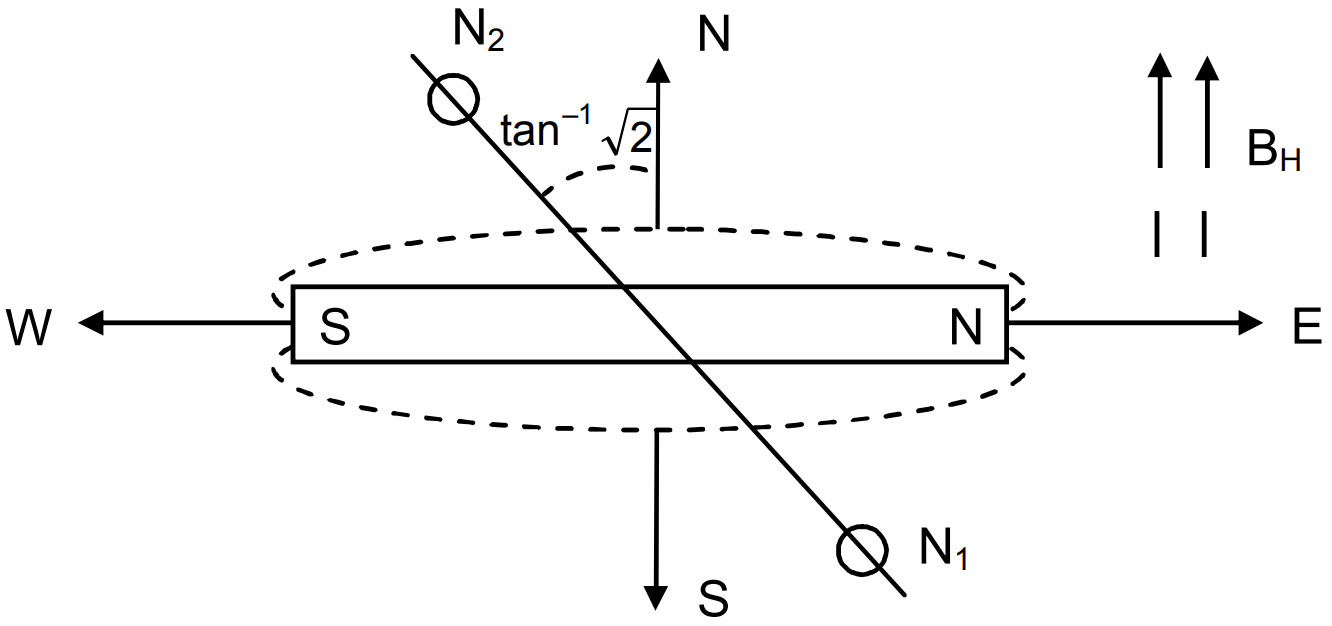
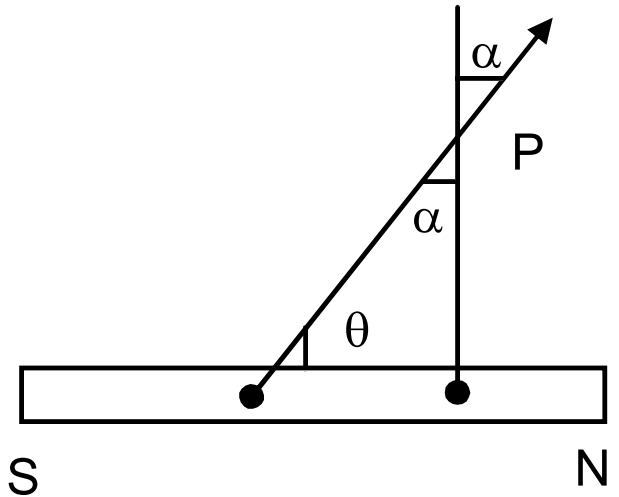
Show that the magnetic field at a point due to a magnetic dipole is perpendicular to the magnetic axis if the line joining the point with the centre of the dipole makes an angle of $\tan^{-1}(\sqrt{2})$ with the magnetic axis.
Answer
Given:$\theta=\tan^{-1}\sqrt{2}\Rightarrow\tan\theta=\sqrt{2}\Rightarrow2=\tan^2\theta$
$\Rightarrow\tan\theta=2\cot\theta\Rightarrow\frac{\tan\theta}{2}=\cot\theta$
We know $\frac{\tan\theta}{2}=\tan\propto$
Comparing we get, $\tan\propto=\cot\theta$
$\tan\propto=(90-\theta)$
$\propto=90-\theta$
$\theta +\propto=90$
Hence magnetic field due to the dipole is $\perp\text{r}$ to the magnetic axis.
View full question & answer
Question 234 Marks
A bar magnet takes $\frac{\pi}{10}$ second to complete one oscillation in an oscillation magnetometer. The moment of inertia of the magnet about the axis of rotation is $1.2 \times 10^{-4} kg-m^2$ and the earth's horizontal magnetic field is $30\mu \text{T}.$ Find the magnetic moment of the magnet.
Answer
We know: $\text{v}=\frac{1}{2\pi}\sqrt{\frac}{\text{mB}_\text{H}}{\text{I}}$For like poles tied together
$M = M_1 - M_2$ 
For unlike poles $M' = M_1+ M_2$​​​​​​​
$\frac{\text{v}_1}{\text{v}_2}=\sqrt{\frac{\text{M}_1-\text{M}_2}{\text{M} _1-\text{M}_2}}\Rightarrow\Big(\frac{10}{2}\Big)^2$
$=\frac{\text{M}_1-\text{M}_2}{\text{M}_1+\text{M}_2}\Rightarrow25=\frac{\text{M}_1-\text{M}_2}{\text{M}_1+\text{M}_2}$
$\Rightarrow\frac{26}{24}=\frac{2\text{M}_1}{2\text{M}_2}\Rightarrow\frac{\text{M}_1}{\text{M}_2}=\frac{13}{12}$
View full question & answer
Question 244 Marks
The magnetic field at a point, 10cm away from a magnetic dipole, is found to be $2.0 \times 10^{-4}T$. find the magnetic moment of the dipole if the point is.
  1. In end-on position of the dipole.
  2. In broadside-onposition of the dipole.
Answer
$\text{B}=2\times10^{-4}\text{ T}$
$\text{d}=10\text{cm}=0.1\text{m}$
  1. If the point at end-on postion.
$\text{B} =\frac{\mu_02\text{M}}{4\pi\text{ d}^3}\Rightarrow2\times10^{-4}=\frac{10^{-7}\times2\text{M}}{(10^ {-1})^3}$
$\Rightarrow\frac{2\times10^{-4}\times10^{-3}}{10^{-7}\times2}=\text{M}\Rightarrow\text{M}=1\text{Am}^2$
  1. If the point is at broad-on position.
$\frac{\mu_0\text{ M }}{4\pi\text{ d}^3}\Rightarrow2\times10^{-4}=\frac{10^{-7}\times\text{M}}{(10^{-1})^3}\Rightarrow\text{m}=2\text{Am}^2$
View full question & answer
Question 254 Marks
A bar magnet has a length of 8cm. The magnetic field at a point at a distance 3cm from the centre in the broadside-on position is found to be $4 \times 10^{-6} T.$ Find the pole strength of the magnet.
Answer
Magnetic field at the broad side on position :
$\text{B}=\frac{\mu_0}{4\pi}\frac{\text{M}}{(\text{d}^2+\ell^3)\frac{3}{2}}$
$2\text{t}=8\text{cm}$
$\text{d}=3\text{cm}$
$\Rightarrow4\times10^{-6}=\frac{10^{-7}\times\text{m}\times8\times10^{-2}}{(9\times10^{-4}+16\times10)\frac{3}{2}}$
$\Rightarrow4\times10^{-6}=\frac{10^{-9}\times\text{m}\times8}{(10^{-4})\frac{3}{2}+(25)\frac{3}{2}}$
$\Rightarrow\text{m}=\frac{4\times10^{-6}\times125\times10^{-8}}{8\times10^{-9}}=62.5\times10^{-5}\text{A-m}$
View full question & answer
Question 264 Marks
A bar magnet makes 40 oscillations per minute in an oscillation magnetometer. An identical magnet is demagnetized completely and is placed over the magnet in the magnetometer. Find the time taken for 40 oscillations by this combination. Neglect any induced magnetism.
Answer
$\gamma_1=40$ oscillations/minute
$\text{B}=25\mu\text{T}$
M of second magnet $=1.6\text{A-m}^2$
$\text{d}=20\text{cm}=0.2\text{m}$
  1. For north facing north.
$\gamma=\frac{1}{2\pi}\sqrt{\frac{\text{MB}_\text{H}}{\text{I}}}$

$\gamma=\frac{1}{2\pi}\sqrt{\frac{\text{M}(\text{B}_\text{H}-\text{B})}{\text{I}}}$

$\text{B}=\frac{\mu_0}{4\pi}\frac{\text{m}}{\text{d}^3}=\frac{10^{-7}\times1.6}{8\times10^{-3}}=20\mu\text{T}$

$\frac{\gamma_1}{\gamma_2}=\sqrt{\frac{\text{B}}{\text{B}_\text{H}-\text{B}}}\Rightarrow\frac{40}{\gamma _2}=\sqrt{\frac{25}{5}}$

$\Rightarrow\gamma_2=\frac{40}{\sqrt{5}}=17.88\approx \text{osci/min}$
  1. For north pole facing south.
$\gamma_1 =\frac{1}{2\pi}\sqrt{\frac{\text{MB}_\text{H}}{\text{I}}}$

$\gamma_2=\frac{1}{2\pi}\sqrt{\frac{\text{M} (\text{B} _\text{H}-\text{B}}{\text{I}}}$

$\frac{\gamma_1}{\gamma_2}=\sqrt{\frac{\text{B}}{\text{B}_\text{H}-\text{B}}}\Rightarrow\frac{40}{\gamma_2}=\sqrt{\frac{25}{45}}$

$\Rightarrow\gamma_2=\frac{40}{\sqrt{\big(\frac{25}{45}\big)}}=53.66\approx54\text{ osci/min}$
View full question & answer