Question
A short magnet makes 40 oscillations per minute when used in an oscillation magnetometer at a place where the earth's horizontal magnetic field is $2\mu\text{T.}$ Another short magnet of magnetic moment $1.6A-m^2$ is placed 20cm east of the oscillating magnet. Find the new frequency of oscillation if the magnet has its north pole:
  1. Towards north.
  2. Towards south.

Answer

$\gamma_1=40$ oscillations/ minute
$\text{B}_\text{H}=25\mu\text{T}$
m of second magnet $= 1.6A-m^2$
$d = 20cm = 0.2m$
For north facing north
$\gamma_1=\frac{1}{2\pi}\sqrt{\frac{\text{MB}_{\text{H}}}{\text{I}}}$
$\gamma_2=\frac{1}{2\pi}\sqrt{\frac{\text{M}(\text{B}_{\text{H}}-\text{B})}{\text{I}}}$
$\text{B}=\frac{\mu_0}{4\pi}\frac{\text{m}}{\text{d}^3}=\frac{10^{-7}\times1.6}{8\times10^{-3}}=20\mu\text{T}$
$\frac{\gamma_1}{\gamma_2}=\sqrt{\frac{\text{B}}{\text{B}_{\text{H}-\text{B}}}}\Rightarrow\frac{40}{\gamma_2}=\sqrt{\frac{25}{5}}\Rightarrow\gamma_2=\frac{40}{\sqrt{5}}$
$=17.88\approx18\text{ osci/min}$
For north pole facing south
$\gamma_1=\frac{1}{2\pi}\sqrt{\frac{\text{MB}_{\text{H}}}{\text{I}}}$
$\gamma_2=\frac{1}{2\pi}\sqrt{\frac{\text{M}(\text{B}_{\text{H}}-\text{B})}{\text{I}}}$
$\frac{\gamma_1}{\gamma_2}=\sqrt{\frac{\text{B}}{\text{B}_{\text{H}-\text{B}}}}\Rightarrow\frac{40}{\gamma_2}=\sqrt{\frac{25}{45}}\Rightarrow\gamma_2=\frac{40}{\sqrt{\Big(\frac{25}{45}\Big)}}$
$=53.66\approx54\text{ osci/min}$

Need a full question paper?

Generate a complete, print-ready paper with questions like this in minutes — across 16+ boards, with answer keys.

Start Generating Free

Similar questions

A tangent galvanometer shows a deflection of 45° when 10mA of current is passed through it. If the horizontal component of the earth's magnetic field is $B_H = 3.6\times 10^{-5} T$ and radius of the coil is 10cm, find the number of turns in the coil.
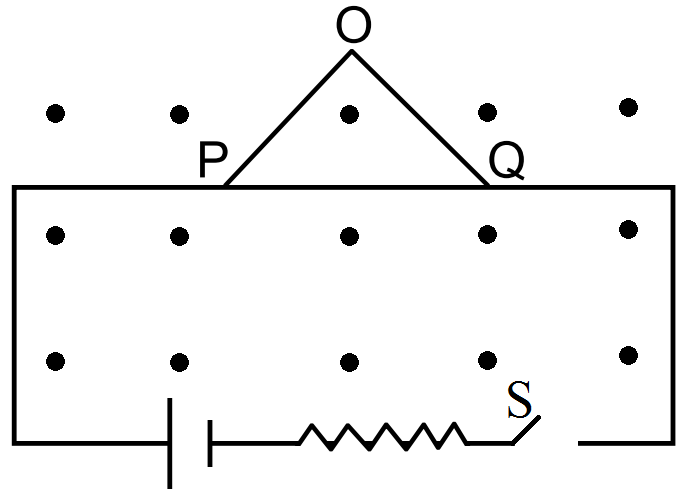
Shows a rod PQ of length 20.0cm and mass 200g suspended through a fixed point O by two threads of lengths 20.0cm each. A magnetic field of strength 0.500T exists in the vicinity of the wire PQ, as shown in the figure. The wires connecting PQ with the battery are loose and exert no force on PQ.
  1. Find the tension in the threads when the switch S is open.
  2. A current of 2.0A is established when the switch S is closed. Find the tension in the threads now.
A long bar magnet has a pole strength of 10A-m. Find the magnetic field at a point on the axis of the magnet at a distance of 5cm from the north pole of the magnet.
A magnetic dipole of magnetic moment $1.44A-m^2$ is placed horizontally with the north pole pointing towards north. Find the position of the neutral point if the horizontal component of the earth's magnetic field is $18 \mu\text{T}.$

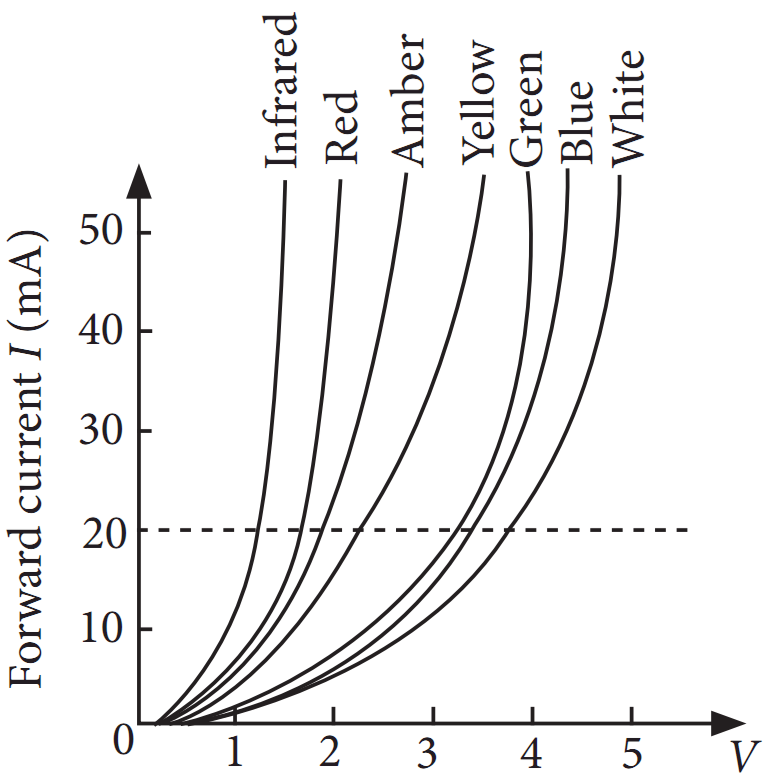
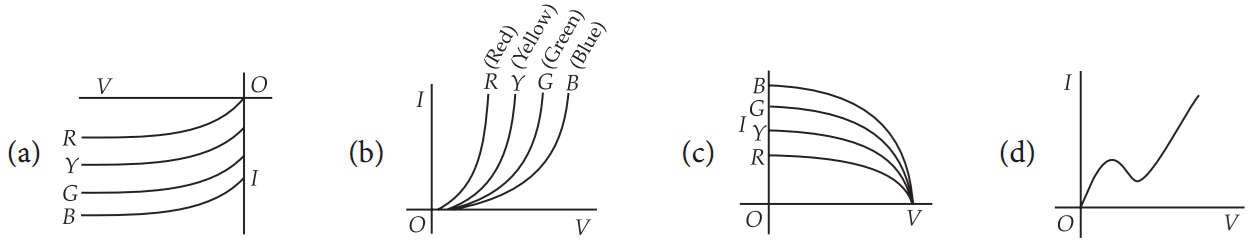
Light emitting diode is a photoelectric device which converts electrical energy into light energy. It is a heavily doped p-n junction diode which under forward biased emits spontaneous radiation. The general shape of the I-V characteristics of an LED is similar to that of a normal p-n junction diode, as shown. The barrier potentials are much higher and slightly different for each colour.
  1. The I-V characteristic of an LED is:
  1. The schematic symbol of light emitting diode is (LED).
  1. An LED is constructed from a p-n junction based on a certain Ga-As-P semiconducting material whose energy gap is 1.9eV. Identify the colour of the emitted light.
  1. Blue.
  2. Red.
  3. Violet.
  4. Green.
  1. Which one of the following statement is not correct in the case of light emitting diodes?
  1. It is a heavily doped p-n junction.
  2. It emits light only when it is forward biased.
  3. It emits light only when it is reverse biased.
  4. The energy of the tight emitted is less than the energy gap of the semiconductor used.
  1. The energy of radiation emitted by LED is:
  1. Greater than the band gap of the semiconductor used.
  2. Always less than the band gap of the semiconductor used.
  3. Always equal to the band gap of the semiconductor used.
  4. Equal to or less than the band gap of the semiconductor used.
By mistake, an eye surgeon puts a concave lens in place of the lens in the eye after a cataract operation. Will the patient be able to see clearly any object placed at any distance?
Explain diffraction by a single slit and write down the conditions for central maximum, secondary maxima and minima.
An electric charge of $17.7 \times 10^{-4}$ Coulomb is distributed uniformly on a large thin sheet of area $200 m^2$. Find the intensity of the electric field in air at a distance of 20 cm from it.
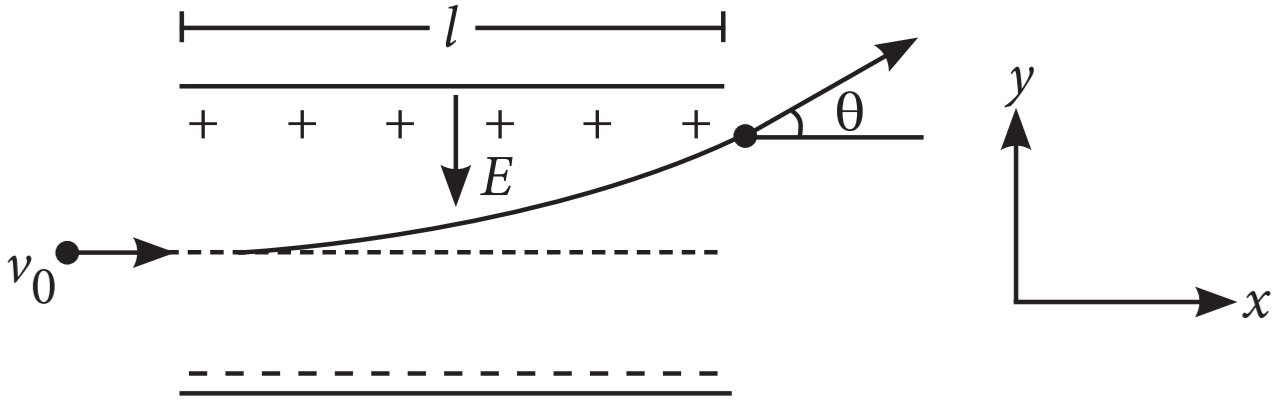
When a charged particle is placed in an electric field, it experiences an electrical force. If this is the only force on the particle, it must be the net force. The net force will cause the particle to accelerate according to Newton's second law. So $\vec{\text{F}}_\text{e}=\text{q}\vec{\text{E}}=\text{m}\vec{\text{a}}$

If $\vec{\text{E}}$ is uniform, then $\vec{\text{a}}$ is constant and $\vec{\text{a}}=\text{q}\vec{\text{E}}\text{/ m.}$ If the particle has a positive charge, its acceleration is in the direction of the field. If the particle has a negative charge, its acceleration is in the direction opposite to the electric field. Since the acceleration is constant, the kinematic equations can be used.
  1. An electron of mass m, charge e falls through a distance h metre in a uniform electric field E. Then time of fall,
  1. $\text{t}=\sqrt{\frac{\text{2hm}}{\text{eE}}}$
  2. $\text{t}=\frac{\text{2hm}}{\text{eE}}$
  3. $\text{t}=\sqrt{\frac{\text{2eE}}{\text{hm}}}$
  4. $\text{t}=\frac{\text{2eE}}{\text{hm}}$
  1. An electron moving with a constant velocity v along X-axis enters a uniform electric field applied along Y-axis. Then the electron moves:
  1. With uniform acceleration along Y-axis
  2. Without any acceleration along Y-axis
  3. In a trajectory represented as $y = ax^2$
  4. In a trajectory represented as y = ax
  1. Two equal and opposite charges of masses $m_1$ and $m_2$ are accelerated in an uniform electric field through the same distance. What is the ratio of their accelerations if their ratio of masses is $\frac{\text{m}_1}{\text{m}_2}=0.5?$
  1. $\frac{\text{a}_1}{\text{a}_2}=2$
  2. $\frac{\text{a}_1}{\text{a}_2}=0.5$
  3. $\frac{\text{a}_1}{\text{a}_2}=3$
  4. $\frac{\text{a}_1}{\text{a}_2}=1$
  1. A particle of mass m carrying charge q is kept at rest in a uniform electric field E and then released. The kinetic energy gained by the particle, when it moves through a distance y is:
  1. $\frac{1}{2}\text{qEy}^2$
  2. $qEy$
  3. $qEy^2$
  4. $qE^2y$
  1. A charged particle is free to move in an electric field. It will travel:
  1. Always along a line of force.
  2. Along a line of force, if its initial velocity is zero.
  3. Along a line of force, if it has some initial velocity in the direction of an acute angle with the line of force.
  4. None of these.
An electromagnetic wave transports linear momentum as it travels through space. If an electromagnetic wave transfers a total energy $U$ to a surface in time $t ,$ then total linear momentum delivered to the surface is $p =\frac{U}{c}$. When an electromagnetic wave falls on a surface, it exerts pressure on the surface. In $1903,$ the American scientists Nichols and Hull succeeded in measuring radiation pressures of visible light where other had failed, by making a detailed empirical analysis of the ubiquitous gas heating and ballistic effects.
$(i)$ The pressure exerted by an electromagnetic wave of intensity $I \left( W m ^{-2}\right)$ on a non $-$ reflecting surface is $( c$ is the velocity of light$)$
$(a)\ \frac{I}{c}$
$(b) \ \frac{I}{c^2}$
$(c) \ Ic ^2$
$(d) \ IC$
$(ii)$ Light with an energy flux of $18 W / cm ^2$ falls on a non $-$ reflecting surface at normal incidence.
The pressure exerted on the surface is:
$(a)\ 2 N / m ^2$
$(b)\ 6 \times 10^{-4} N / m ^2$
$(c)\ 2 \times 10^{-4} N / m ^2$
$(d)\ 6 N / m ^2$
$(iii)$ Radiation of intensity $0.5 W m ^{-2}$ are striking a metal plate. The pressure on the plate is
$(a)\ 0.212 \times 10^{-8} N m ^{-2}$
$(b)\ 0.132 \times 10^{-8} N m ^{-2}$
$(c)\ 0.166 \times 10^{-8} N m ^{-2}$
$(d)\ 0.083 \times 10^{-8} N m ^{-2}$
OR
The radiation pressure of the visible light is of the order of
$(a)\ 10^{-4} N / m$
$(b)\ 10^{-6} N / m ^2$
$(c)\ 10^{-8} N$
$(d)\ 10^{-2} N m ^2$
$(iv)$ A point source of electromagnetic radiation has an average power output of $1500 W$ . The maximum value of electric field at a distance of $3 m$ from this source $($in $V m ^{-1})$ is
$(a)\ 500$
$(b)\ \frac{500}{3}$
$(c)\ \frac{250}{3}$
$(d)\ 100$