Questions

3 Marks Question

Take a timed test

5 questions · self-marked practice — reveal the answer and mark yourself.

Question 13 Marks
Explain polarisation of light.
Answer
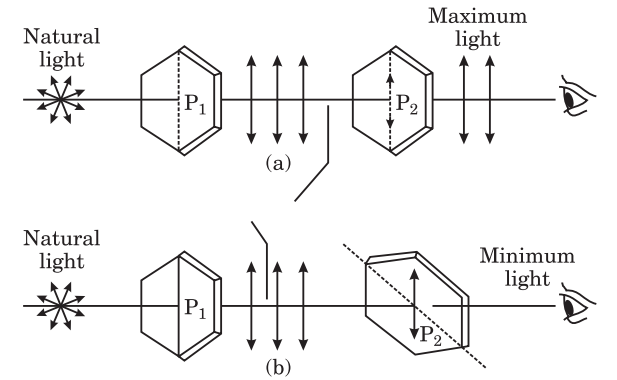
When ordinary light emerges through the tourmaline crystal plate $P_1$, its nature is not the same as it was before entering $P_{1}$, because now when the plate $P_{1}$ is rotated about the direction of transmission of light, there is a change in the intensity of the light emerging from it. It happens. When the axes of both the crystals are parallel to each other, then the intensity of the output light is maximum [Fig. (a)]. From this position, when $P_{2}$ is roatated around the direction of light transmission, the intensity of the emitted light decreases and when the axes of both the crystals are perpendicular to each other, no light is emitted [fig. (b)]. It is clear from this that the light emitted from $P_{1}$ is not symmetric about the direction of light transmission, its vibration are limited to a plane normal to the direction of transmission. This light is called polarized light and this phenomenon is called polarization of light.
Image
View full question & answer
Question 23 Marks
Establish the relation between critical angle and refractive index.
Answer
Relation between Refractive Index and Critical Angle : Suppose rarer medium is denoted by 1 and denser medium by 2. For refraction of light from denser medium to rarer medium the refractive index of rarer medium w.r.t. denser medium is given by :
$_{2}n_{1}=\frac{\sin i}{\sin r}$ [By Snell's law]
where i = Angle of incidence in denser medium, and r = Angle of refraction in rarer medium.
But according to definition of critical angle: for
$\angle r=90^{\circ}$ we have
$i=i_{c}$
(where $i _{ c }=$ critical angle at interface of two media)
$\therefore \quad{ }_2 n_1=\frac{\sin i_c}{\sin 90^{\circ}} \Rightarrow{ }_2 n_1=\frac{\sin i_c}{1}$
$\Rightarrow \quad{ }_2 n_1=\sin i_c$ ... (1)
But according to principle of reversibility of light, we have
${ }_1 n_2=\frac{1}{{ }_2 n_1}$
$\Rightarrow \quad{ }_1 n_2=\frac{1}{\sin i_c}$ ...(2)
i.e. refractive index of denser medium with respect to rarer medium is equal to the reciprocal of the sine of critical angle at interface of two media.
View full question & answer
Question 33 Marks
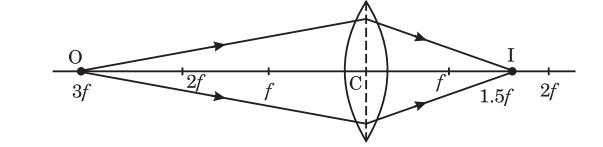
Draw a ray diagram for the image formation of an point object placed on the principal axis of the convex lens when the object is placed at a distance equal to three times of the focal length of the lens.
View full question & answer
Question 43 Marks
What is total internal reflection ?
Answer
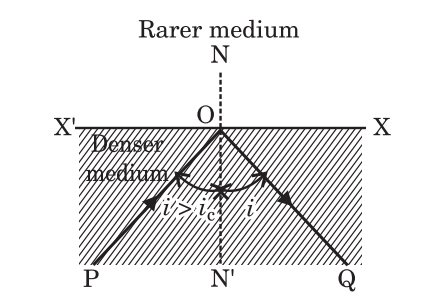
Total Internal Reflection : When a light ray passes from a denser medium into a rarer medium it is deviated away from the normal i.e., angle of refraction will be greater than angle of incidence. It follows that for a particular value of the angle of incidence in the denser medium, the angle of refraction in the rarer medium will be 90° and this particular angle of incidence is known as critical angle and is denoted by $i_{c}$(as shown in adjacent fig).
Image
For angle of incidence greater than critical angle, the angle of refraction will be greater than 90° and the ray will be reflected into the rarer medium in accordance with the laws of reflection. This phenomenon is called total internal reflection.
View full question & answer
Question 53 Marks
Define critical angle and write the conditions of total internal reflection.
Answer
Critical Angle : When refraction of light takes place from denser medium into rarer medium, the critical angle for the interface of denser and rarer medium is defined as the angle of incidence in denser medium for which angle of refraction into rarer medium is 90°. It is denoted by $i_c$.
Conditions of total internal reflection :
(i) The refraction of light should take place from denser medium into rarer medium.
(ii) The angle of incidence in the denser medium should be greater than the critical angle for the pair of the two media.
View full question & answer
3 Marks Question - Physics STD 12 Science Questions - Vidyadip