Question
Explain polarisation of light.

Answer

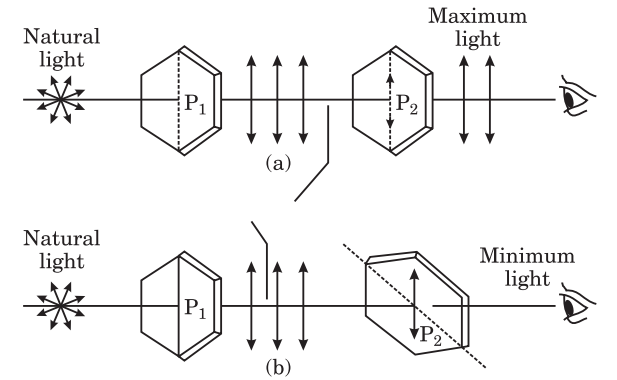
When ordinary light emerges through the tourmaline crystal plate $P_1$, its nature is not the same as it was before entering $P_{1}$, because now when the plate $P_{1}$ is rotated about the direction of transmission of light, there is a change in the intensity of the light emerging from it. It happens. When the axes of both the crystals are parallel to each other, then the intensity of the output light is maximum [Fig. (a)]. From this position, when $P_{2}$ is roatated around the direction of light transmission, the intensity of the emitted light decreases and when the axes of both the crystals are perpendicular to each other, no light is emitted [fig. (b)]. It is clear from this that the light emitted from $P_{1}$ is not symmetric about the direction of light transmission, its vibration are limited to a plane normal to the direction of transmission. This light is called polarized light and this phenomenon is called polarization of light.
Image

Need a full question paper?

Generate a complete, print-ready paper with questions like this in minutes — across 16+ boards, with answer keys.
Start Generating Free

Similar questions

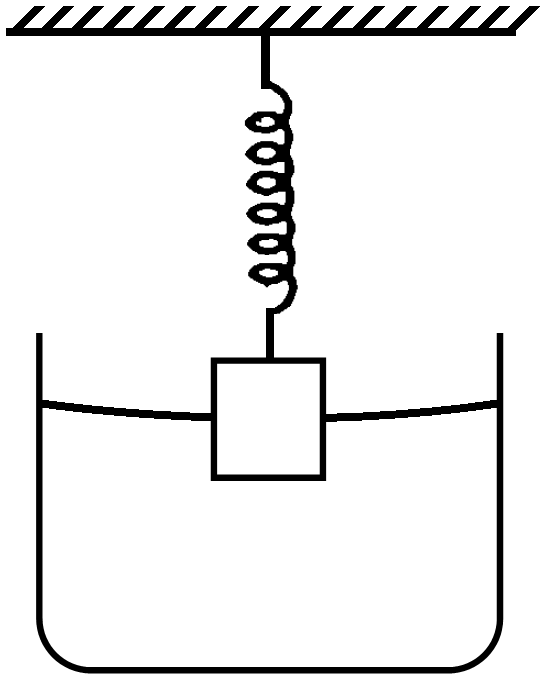
A cylindrical object of outer diameter $10\ cm,$ height $20\ cm$ and density $8000\ kg/m^3$ is supported by a vertical spring and is half dipped in water as shown in.
  1. Find the elongation of the spring in equilibrium condition.
  2. If the object is slightly depressed and released, find the time period of resulting oscillations of the object. The spring constant $= 500N/m.$
What is the magnitude of magnetic force per unit length on a wire carrying a current of $8 A$ and making an angle of $30^\circ$ with the direction of a uniform magnetic field of $0.15 T?$
  1. Define torque acting on a dipole of dipole moment $\overrightarrow{p}$ placed in a uniform electric field $\overrightarrow{\text{E}}$. Express it in the vector form and point out the direction along which it acts
  2. What happens if the field is non-uniform?
  3. What would happen if the external field $\overrightarrow{\text{E}}$ is increasing (i) parallel to $\overrightarrow{p}$ and (ii) anti-parallel to $\overrightarrow{p}$?
Repeat the previous exercise if the angle between each pair of springs is 120° initially.
A simple microscope has a magnifying power of 3.0 when the image is formed at the near point (25cm) of a normal eye.
  1. What is its focal length?
  2. What will be its magnifying power if the image is formed at infinity?
If one of the two electrons of a $H_2$ molecule is removed, we get a hydrogen molecular ion $\text{H}^+_2​.$ In the ground state of an $\text{H}^+_2​,$ the two protons are separated by roughly $1.5 \mathring A ,$ and the electron is roughly $1 \mathring A$ from each proton. Determine the potential energy of the system. Specify your choice of the zero of potential energy.
ls it always true that for two sources of equal intensity, the number of photons emitted in a given time are equal?
State Gauss᾿s theorem in electrostatics. Using this theorem, derive an expression for the electric field due to an infinitely long straight wire of linear charge density $\lambda$.
A battery of emf 10 V and internal resistance $3\ \Omega$ is connected to a resistor. If the current in the circuit is 0.5 A, what is the resistance of the resistor? What is the terminal voltage of the battery when the circuit is closed?
How does the resolving power of a compound microscope get affected on:
  1. Decreasing the diameter of its objective?
  2. Increasing the focal length of its objective?