Question
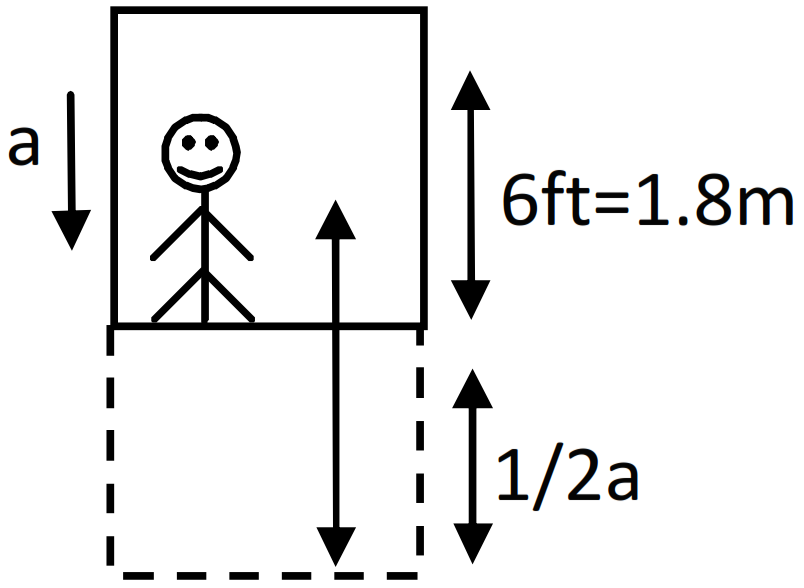
An elevator is descending with uniform acceleration. To measure the acceleration, a person in the elevator drops a coin at the moment the elevator starts. The coin is 6ft above the floor of the elevator at the time it is dropped. The person observes that the coin strikes the floor in 1 second. Calculate from these data the acceleration of the elevator.
Answer

For elevator and coin u = 0 As the elevator descends downward with acceleration a' (say) The coin has to move more distance than 1.8m to strike the floor. Time taken t = 1 sec.$\text{S}_{\text{c}}=\text{ut}+\frac{1}{2}\text{a}'\text{t}^2=0+\frac{1}{2}\text{g}(1)^2=\frac{1}{2}\text{g}$
$\text{S}_{\text{e}}=\text{ut}+\frac{1}{2}\text{at}^2=\text{u}+\frac{1}{2}\text{a}(1)^2=\frac{1}{2}\text{a}$
Total distance covered by coin is given by $=1.8+\frac{1}{2}\text{a}=\frac{1}{2}\text{g}$$\Rightarrow1.8+\frac{\text{a}}{2}=\frac{9.8}{2}=4.9$
$\Rightarrow\text{a}=6.2\text{m/s}^2=6.2\times3.28=20.34\text{ft/s}^2.$

Need a full question paper?

Generate a complete, print-ready paper with questions like this in minutes — across 16+ boards, with answer keys.

Start Generating Free

Similar questions

A simple pendulum of length I is suspended from the ceiling of a car moving with a speed v on a circular horizontal road of radius r.
  1. Find the tension in the string when it is at rest with respect to the car.
  2. Find the time period of small oscillation.
A capacitor is a device to store energy. The process of charging up a capacitor involves the transferring of electric charges from its one place to another. This work done in charging the capacitor is stored as its electrical potential energy.
If q is the charge and V is the potential difference across a capacitor at any instant during its charging, then small work done in storing an additional small charge dq against the repulsion of charge q already stored on it is $\text{dW}=\text{V.dq}=(\frac{\text{q}}{\text{C}})\text{dq}.$
  1. A system of 2 capacitors of capacitance $2\mu\text{F}$ and $4\mu\text{F}$ is connected in series across a potential difference of 6 V. The energy stored in the system is:
  1. $3\mu\text{J}$
  2. $24\mu\text{J}$
  3. $30\mu\text{J}$
  4. $108\mu\text{J}$
  1. A capacitor of capacitance of $10\mu\text{F}$ is charged to 10V. The energy stored in it is:
  1. $100\mu\text{J}$
  2. $500\mu\text{J}$
  3. $1000\mu\text{J}$
  4. $1\mu\text{J}$
  1. A parallel plate air capacitor has capacity C farad, potential V volt and energy E joule. When the gap between the plates is completely filled with dielectric:
  1. Both V and E increase.
  2. Both V and E decrease.
  3. V decreases, E increases.
  4. V increases, E decreases.
  1. A capacitor with capacitance $5\mu\text{F}$ s charged to $5\mu\text{C}.$ If the plates are pulled apart to reduce the capacitance to $2\mu\text{F},$ how much work is done?
  1. $6.25 \times 10^{-6}J$
  2. $3.75 \times 10^{-6}J$
  3. $2.16 \times 10^{-6}J$
  4. $2.55 \times 10^{-6}J$
  1. A metallic sphere ofradius 18cm has been given a charge of $5 \times 10^{-6}C$. The energy of the charged conductor is:
  1. 0.2J
  2. 0.6J
  3. 1.2J
  4. 2.4J
To keep valuable instruments away from the earth's magnetic field, they are enclosed in iron boxes. Explain.
When you push your bicycle up on an incline the potential energy of the bicyle and yourself increases. Where does this energy come from?
A magnetic field can be produced by moving, charges or electric currents. The basic equation governing the magnetic field due to a current distribution is the Biot-Savart law. Finding the magnetic field resulting from a current distribution involves the vector product, and is inherently a calculas problem when the distance from the current to the field point is continuously changing. According to this law, the magnetic field at a point due to a current element of length $\text{d}\vec{\text{I}}$ carrying current I, at a distance r from the element is $\text{dB}=\frac{\mu_0}{4\pi}\frac{\text{I}(\text{d}{\vec{\text{I}}\times\vec{\text{r}}})}{\text{r}^3}$Biot-Savart law has certain similarities as well as difference with Coloumb's law for electrostatic field e.g., there is an angle dependence in Biot-Savart law which is not present in electrostatic case.
  1. The direction of magnetic field $\text{d}\vec{\text{B}}$ due to a current element $\text{Id}\vec{\text{l}}$ at a point of distance $\vec{\text{r}}$ from it, when a current I passes through a long conductor is in the direction
  1. Of position vector $\vec{\text{r}}$ of the point.
  2. Of current element $\text{Id}\vec{\text{l}}$
  3. Perpendicular to both $\text{d}\vec{\text{l}}$ and $\vec{\text{r}}$
  4. Perpendicular to $\text{d}\vec{\text{l}}$ only.
  1. The magnetic field due to a current in a straight wire segment of length Lat a point on its perpendicular bisector at a distance r (r >> L)
  1. Decreases as $\frac{1}{\text{r}}$
  2. Decreases as $\frac{1}{\text{r}^2}$
  3. Decreases as $\frac{1}{\text{r}^3}$
  4. approaches a finite limit as $\text{r}\rightarrow\infty$
  1. Two long straight wires are set parallel to each other. Each carries a current i in the same direction and the separation between them is 2r. The intensity of the magnetic field midway between them is:
  1. $\mu_0\frac{\text{i}}{\text{r}}$
  2. $4\mu_0\frac{\text{i}}{\text{r}}$
  3. $\text{Zero}$
  4. $\mu_0\frac{\text{i}}{\text{4r}}$
  1. A long straight wire carries a current along the z-axis for any two points in the x - y plane. Which of the following is always false?
  1. The magnetic fields are equal.
  2. The directions of the magnetic fields are the same.
  3. The magnitudes of the magnetic fields are equal.
  4. The field at one point is opposite to that at the other point.
  1. Biot-Savart law can be expressed alternatively as:
  1. Coulomb's Law.
  2. Ampere's circuital law.
  3. Ohm's Law.
  4. Gauss's Law.
For the past some time, Aarti had been observing some erratic body movement, unsteadiness and lack of coordination in the activities of her sister Radha, who also used to complain of severe headache occasionally. Aarti suggested to her parents to get a medical check-up of Radha. The doctor thoroughly examined Radha and diagnosed that she has a brain tumour.
  1. What, according to you, are the values displayed by Aarti?
  2. How can radioisotopes help a doctor to diagnose brain tumour?
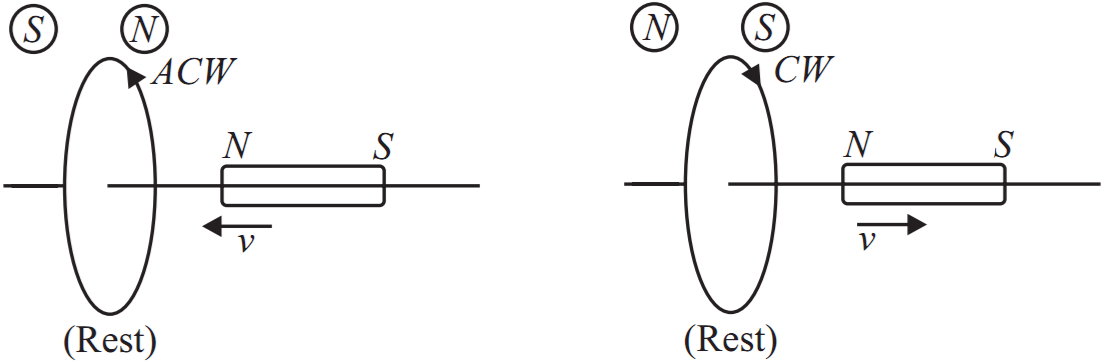
Lenz's law states that the direction of induced current in a circuit is such that it opposes the change which produces it. Tims, if the magnetic flux linked with a closed circuit increases, the induced current flows in such a direction that a magnetic flux is created in the opposite direction of the original magnetic flux. If the magnetic flux linked with the closed circuit decreases, the induced current flows in such a direction so as to create a magnetic flux in the direction of the original flux.
  1. Which of the following statements is correct?
  1. The induced e.m.f is not in the direction opposing the change in magnetic flux so as to oppose the cause which produces it.
  2. The relative motion between the coil and magnet produces change in magnetic flux.
  3. Emf is induced only if the magnet is moved towards coil.
  4. Emf is induced only if the coil is moved towards magnet.
  1. The polarity of induced emf is given by:
  1. Ampere's circuital law.
  2. Biot-Savart law.
  3. Lenz's law.
  4. Fleming's right hand rule.
  1. Lenz's law is a consequence of the law of conservation of:
  1. Charge.
  2. Mass.
  3. Momentum.
  4. Energy.
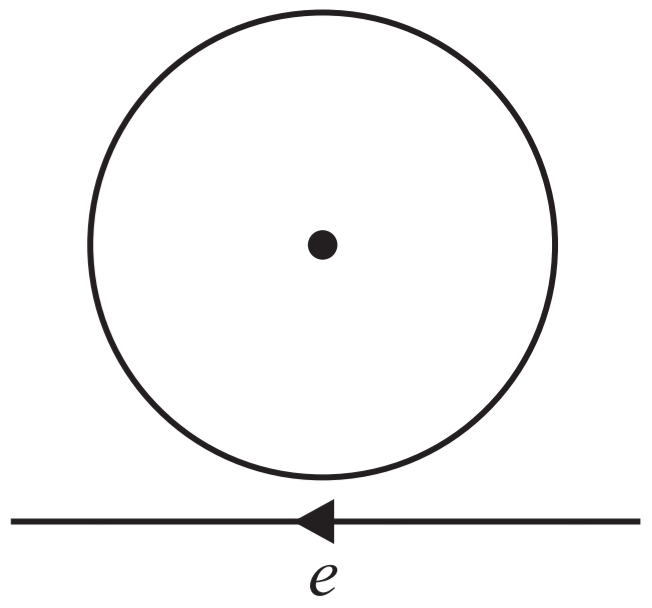
  1. Near a circular loop of conducting wire as shown in the figure, an electron moves along a straight line. The direction of the induced current if any in the loop is:
  1. Variable.
  2. Clockwise.
  3. Anticlockwise.
  4. Zero.
  1. Two identical circular coils A and Bare kept in a horizontal tube side by side without touching each other. If the current in the coil A increases with time, in response, the coil B:
  1. Is attracted by A.
  2. Remains stationary.
  3. Is repelled.
  4. Rotates.
$q, 2 q, 3 q$ and $4 q$ Coulomb charges are located at the four corners of a square of side a meter each. Prove that the electric field at its centre will be $4 \sqrt{2} \frac{k q}{a^2} N / C$
A collision experiment is done on a horizontal table kept in an elevator. Do you expect a change in the results if the elevator is accelerated up or down because of the noninertial character of the frame?
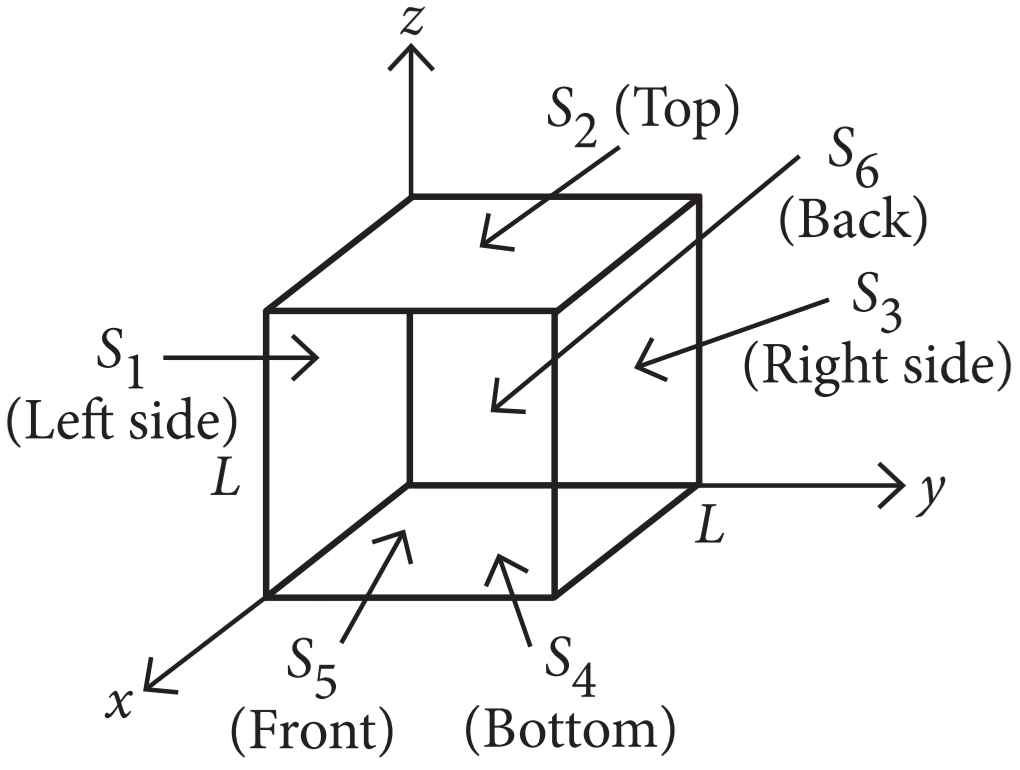
Net electric flux through a cube is the sum of fluxes through its six faces. Consider a cube as shown in figure, having sides of length L = 10.0cm. The electric field is uniform, has a magnitude $E = 4.00 \times 10^3N C^{-1}$ and is parallel to the xy plane at an angle of 37º measured from the + x - axis towards the + y - axis.
  1. Electric flux passing through surface $S_6$ is:
  1. $-24N\ m^2C^{-1}$
  2. $24N\ m^2C^{-1}$
  3. $32N\ m^2C^{-1}$
  4. $-32N\ m^2C^{-1}$
  1. Electric flux passing through surface $S_1$ is:
  1. $-24N\ m^2C^{-1}$
  2. $24N\ m^2 C^{-1}$
  3. $32N\ m^2 C^{-1}$
  4. $-32N\ m^2 C^{-1}$
  1. The surfaces that have zero flux are:
  1. $S_1$ and $S_3$
  2. $S_5$ and $S_6$
  3. $S_2$ and $S_4$
  4. $S_1$ and $S_2$
  1. The total net electric flux through all faces of the cube is:
  1. 8N $m^2\ C^{-1}$
  2. -8N $m^2\ C^{-1}$
  3. 24N $m^2\ C^{-1}$
  4. Zero.
  1. The dimensional formula of surface integral $\oint\vec{\text{E}}\cdot\text{d}\vec{\text{S}}$ of an electric field is:
  1. $[M\ L^2T^{-2} A^{-1}]$
  2. $[M\ L^3T^{-3} A^{-1}]$
  3. $[M\ L^{-1}T^3 A^{-3}]$
  4. $[M\ L^{-3}T^{-3} A^{-1}]$