Questions

2 Marks Questions

Take a timed test

12 questions · self-marked practice — reveal the answer and mark yourself.

Question 12 Marks
The force acting on a particle moving along X-axis is $F = -k(x - u_0t)$ where k is a positive constant. An observer moving at a constant velocity $v_0$, along the X-axis looks at the particle. What kind of motion does he find for the particle?
Answer
since he moves with constant velocity, he sees the same force. And this force is not that of SHM.
View full question & answer
Question 22 Marks
In measuring time period of a pendulum, it is advised to measure the time between consecutive passage through the mean position in the same direction. This is said to result in better accuracy than measuring time between consecutive passage through an extreme position. Explain.
Answer
Because mean position is fixed, while extreme position keeps on changing. So, when we use stop watch, we are very sure about the mean position.
View full question & answer
Question 32 Marks
A particle executes simple harmonic motion. If you are told that its velocity at this instant is zero, can you say what is its displacement? If you are told that its velocity at this instant is maximum, can you say what is its displacement?
Answer
No, to know the displacement we should know the initial position of the particle. If it is said that initial position is mean position then we can answer the above question.
View full question & answer
Question 42 Marks
A pendulum clock giving correct time at a place where $g = 9.800m/s^2$ is taken to another place where it loses 24 seconds during 24 hours. Find the value of g at this new place.
Answer
For the pendulum, $\frac{\text{T}_1}{\text{T}_2}=\sqrt{\frac{\text{g}_2}{\text{g}_1}}$ Given that, $\text{T}_1=2\sec,\ \text{g}_1=9.8\text{m/s}^2$$\text{T}_2=\frac{24\times3600}{\Big(\frac{24\times3600-24}{2}\Big)}=2\times\frac{3600}{3599}$
Now, $\frac{\text{g}_2}{\text{g}_1}=\Big(\frac{\text{T}_1}{\text{T}_2}\Big)^2$$\therefore\text{g}_2=(9.8)\Big(\frac{3599}{3600}\Big)^2=9.795\text{m/s}^2$
View full question & answer
Question 52 Marks
The pendulum of a clock is replaced by a spring-mass system with the spring having spring constant 0.1N/m. What mass should be attached to the spring?
Answer
$\text{k}=0.1\text{N/m}$$\text{T}=2\pi\sqrt{\frac{\text{m}}{\text{k}}}=2\sec$ [Time period of pendulum of a clock = 2 sec]
So, $4\pi^{2+}\Big(\frac{\text{m}}{\text{k}}\Big)=4$
$\therefore\text{m}=\frac{\text{k}}{\pi^2}=\frac{0.1}{10}=0.01\text{kg}\approx10\text{gm}.$
View full question & answer
Question 62 Marks
It is proposed to move a particle in simple harmonic motion on a rough horizontal surface by applying an external force along the line of motion. Sketch the graph of the applied force against the position of the particle. Note that the applied force has two values for a given position depending on whether the particle is moving in positive or negative direction.
View full question & answer
Question 72 Marks
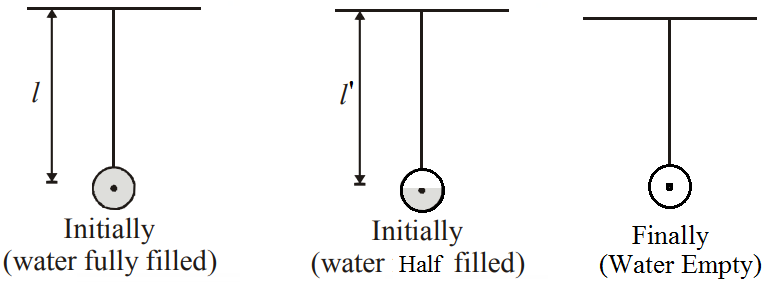
A hollow sphere filled with water is used as the bob of a pendulum. Assume that the equation for simple pendulum is valid with the distance between the point of suspension and centre of mass of the bob acting as the effective length of the pendulum. If water slowly leaks out of the bob, how will the time period vary?
Answer
first it will increase then it will decrease. $\text{T}=2\pi\sqrt{\frac{\text{l}}{\text{g}}}$ first l increases and then it decreases.
View full question & answer
Question 82 Marks
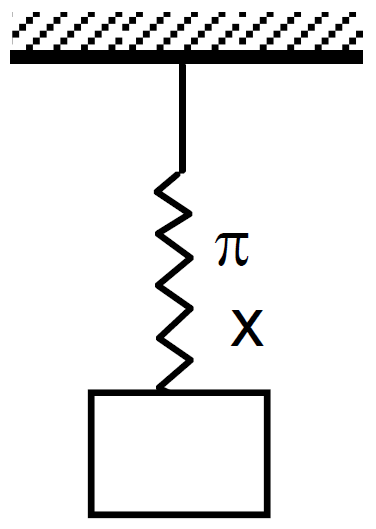
A block suspended from a vertical spring is in equilibrium. Show that the extension of the spring equals the length of an equivalent simple pendulum i.e., a pendulum having frequency same as that of the block.
Answer
Time period of simple pendulum $=2\pi\sqrt{\frac{1}{\text{g}}}$ Time period of spring is $2\pi\sqrt{\frac{\text{m}}{\text{k}}}$ $T_p= T_s$ [Frequency is same]$\Rightarrow\sqrt{\frac{1}{\text{g}}}=\sqrt{\frac{\text{m}}{\text{k}}}$
$\Rightarrow\frac{1}{\text{g}}=\frac{\text{m}}{\text{k}}$
$\Rightarrow1=\frac{\text{mg}}{\text{k}}=\frac{\text{F}}{\text{k}}=\text{x}.$ (Because, restoring force = weight = F = mg)
$\Rightarrow1=\text{x }(\text{proved})$
View full question & answer
Question 92 Marks
A pendulum having time period equal to two seconds is called a seconds pendulum. Those used in pendulum clocks are of this type. Find, the length of a seconds pendulum at a place where $\text{g}=\pi^2\text{m/s}^2.$
Answer
$\text{T}=2\sec.$$\text{T}=2\pi\sqrt{\frac{\ell}{\text{g}}}$
$\Rightarrow2=2\pi\sqrt{\frac{\ell}{10}}$
$\Rightarrow\frac{\ell}{10}=\frac{1}{\pi^2}$
$\Rightarrow\ell=1\text{cm}$ $(\therefore\pi^2\approx10)$
View full question & answer
Question 102 Marks
The angle made by the string of a simple pendulum with the vertical depends on time as $\theta=\frac{\pi}{90}\sin[(\pi\text{s}^{-1})\text{t}].$ Find the length of the pendulum if $\text{g}=\pi^2\text{m/s}^2.$
Answer
From the equation,$\theta=\pi\sin[\pi\sec^{-1}\text{t}]$
$\therefore\omega=\pi\sec^{-1}$ (comparing with the equation of SHM)
$\Rightarrow\frac{2\pi}{\text{T}}=\pi$
$\Rightarrow\text{T}=2\sec.$
We know that $\text{T}=2\pi\sqrt{\frac{\ell}{\text{g}}}$$\Rightarrow2=2\sqrt{\frac{\ell}{\text{g}}}$
$\Rightarrow1=\sqrt{\frac{\ell}{\text{g}}}$
$\Rightarrow\ell=1\text{m}.$
$\therefore$ Length of the pendulum is 1m.
View full question & answer
Question 112 Marks
A simple pendulum of length 40cm is taken inside a deep mine. Assume for the time being that the mine is 1600km deep. Calculate the time period of the pendulum there. Radius of the earth = 6400km.
Answer
Length of the pendulum = 40cm = 0.4m. Let acceleration due to gravity be g at the depth of 1600km.$\therefore\text{gd}=\text{g}(1-\frac{\text{d}}{\text{R}})=9.8\Big(1-\frac{1600}{6400}\Big)$
$=9.8\Big(1-\frac{1}{4}\Big)=9.8\times\frac{3}{4}=7.35\text{m/s}^2$
$\therefore$ Time period $\text{T}'=2\pi\sqrt{\frac{\ell}{\text{g}\delta}}$
$=2\pi\sqrt{\frac{0.4}{7.35}}=2\pi\sqrt{0.054}=2\pi\times0.23$
$=2\times3.14\times0.23=1.465\approx1.47\sec.$
View full question & answer
Question 122 Marks
A particle executes simple harmonic motion with an amplitude of 10cm. At what distance from the mean position are the kinetic and potential energies equal?
Answer
r = 10cm Because, K.E. = P.E. So, $\Big(\frac{1}{2}\Big)\text{m}\omega^2(\text{r}^2-\text{y}^2)=\Big(\frac{1}{2}\Big)\text{m}\ \omega^2\text{y}^2$$\text{r}^2-\text{y}^2=\text{y}^2$
$\Rightarrow2\text{y}^2=\text{r}^2$
$\Rightarrow\text{y}=\frac{\text{r}}{\sqrt{2}}=\frac{10}{\sqrt{2}}=5\sqrt{2}\text{cm}$ From the the mean position.
View full question & answer