Question types

Simple Harmonic Motion question types

101 questions across 6 question groups — pick any mix to generate a Physics paper with step-by-step answer keys.

101
Questions
6
Question groups
5
Question types
Sample Questions

Simple Harmonic Motion questions

One sample from each question group in this chapter. Select any group above to see the full set with answer keys.

A particle executes simple harmonic motion under the restoring force provided by a spring. The time period is $T$. If the spring is divided in two equal parts and one part is used to continue the simple harmonic motion, the time period will:
  • A
    Remain $T$
  • B
    Become $2T$
  • C
    Become $\frac{\text{T}}{2}$
  • Become $\frac{\text{T}}{\sqrt{2}}$

Answer: D.

View full solution
The total mechanical energy of a spring $-$ mass system in $1$ simple harmonic motion is $\text{E}=\frac{1}{2}\text{m}\omega^2\text{A}^2.$ Suppose the oscillating particle is replaced by another particle of double the mass while the amplitude $A$ remains the same. The new mechanical energy will:
  • A
    Become $2E$
  • B
    Become $\frac{\text{E}}{2}$
  • C
    Become $\sqrt{2\text{E}}$
  • Remain $E$.

Answer: D.

View full solution
A particle moves in a circular path with a uniform speed. Its motion is:
  • Periodic.
  • B
    Oscillatory.
  • C
    Simple harmonic.
  • D
    Angular simple harmonic.

Answer: A.

View full solution
A particle is fastened at the end of a string and is whirled in a vertical circle with the other end of the string being fixed. The motion of the particle is:
  • Periodic.
  • B
    Oscillatory.
  • C
    Simple harmonic.
  • D
    Angular simple harmonic.

Answer: A.

View full solution
A pendulum clock that keeps correct time on the earth is taken to the moon. It will run:
  • A
    At correct rate.
  • B
    6 times faster.
  • C
    $\sqrt{6}$ times faster.
  • $\sqrt{6}$ times slower.

Answer: D.

View full solution
A small creature moves with constant speed in a vertical circle on a bright day. Does its shadow formed by the sun on a horizontal plane move in a simple harmonic motion?
View full solution
A particle executing simple harmonic motion comes to rest at the extreme positions. Is the resultant force on the particle zero at these positions according to Newton's first law?
View full solution
A block of known mass is suspended from a fixed support through a light spring. Can you find the time period of vertical oscillation only by measuring the extension of the spring, when the block is in equilibrium?
View full solution
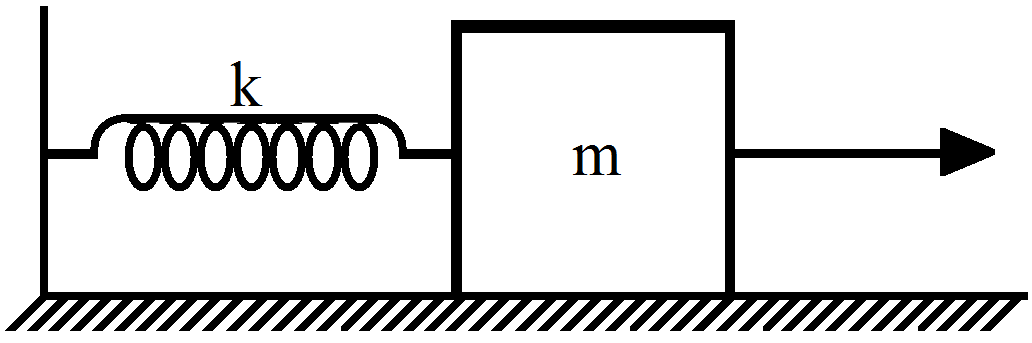
The springs shown in the figure are all unstretched in the beginning when a man starts pulling the block. The man exerts a constant force F on the block. Find the amplitude and the frequency of the motion of the block.
 
View full solution
The force acting on a particle moving along X-axis is $F = -k(x - u_0t)$ where k is a positive constant. An observer moving at a constant velocity $v_0$, along the X-axis looks at the particle. What kind of motion does he find for the particle?
View full solution
In measuring time period of a pendulum, it is advised to measure the time between consecutive passage through the mean position in the same direction. This is said to result in better accuracy than measuring time between consecutive passage through an extreme position. Explain.
View full solution
A particle executes simple harmonic motion. If you are told that its velocity at this instant is zero, can you say what is its displacement? If you are told that its velocity at this instant is maximum, can you say what is its displacement?
View full solution
A pendulum clock giving correct time at a place where $g = 9.800m/s^2$ is taken to another place where it loses 24 seconds during 24 hours. Find the value of g at this new place.
View full solution
The pendulum of a clock is replaced by a spring-mass system with the spring having spring constant 0.1N/m. What mass should be attached to the spring?
View full solution
Q 163 Marks Question3 Marks
The spring shown in figure is unstretched when a man starts pulling on the cord. The mass of the block is M. If the man exerts a constant force F, find
  1. The amplitude and the time period of the motion of the block,
  2. The energy stored in the spring when the block passes through the equilibrium position and,
  3. The kinetic energy of the block at this position.
View full solution
Q 173 Marks Question3 Marks
A spring stores 5J of energy when stretched by 25cm. It is kept vertical with the lower end fixed. A block fastened to its other end is made to undergo small oscillations. If the block makes 5 oscillations each second, what is the mass of the block?
View full solution
Q 183 Marks Question3 Marks
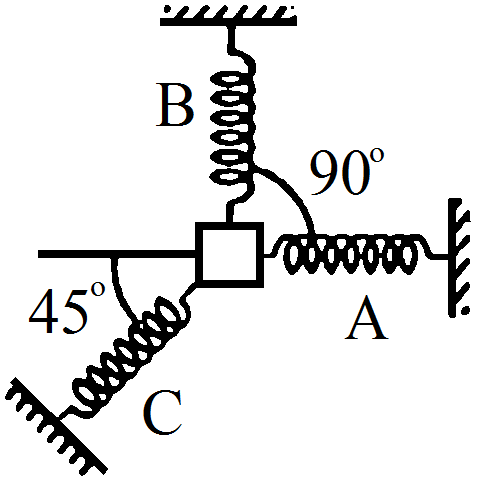
A particle of mass in is attatched to three springs A, B and C of equal force constants k as shown in figure If the particle is pushed slightly against the spring C and released, find the time period of oscillation.
View full solution
Q 193 Marks Question3 Marks
A simple pendulum of lerigth 1 feet suspended from the ceiling of an elevator takes $\frac{\pi}{3}$ seconds to complete one oscillation. Find the acceleration of the elevator.
View full solution
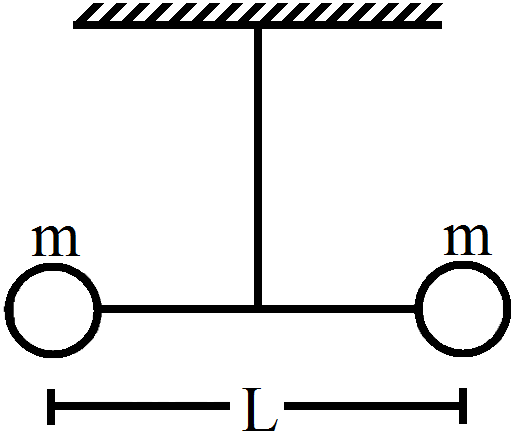
Two small balls, each of mass m are connected by a light rigid rod of length L. The system is suspended from its centre by a thin wire of torsional constant k. The rod is rotated about the wire through an angle $\theta_0$ and released. Find the tension in the rod' as the system passes through the mean position.
View full solution
A particle having mass 10g oscillates according to the equation $\text{x}=(2.0\text{cm})\sin\big[(100\text{s}^{-1})\text{t}+\frac{\pi}{6}\big].$ Find (a) the amplitude, the time period and the spring constant (b) the position, the velocity and the acceleration at t = 0.
View full solution
A particle executes simple harmonic motion with an amplitude of 10cm and time period 6s. At t = 0 it is at position x = 5cm going towards positive x-direction. Write the equation for the displacement x at time t. Find the magnitude of the acceleration of the particle at t = 4s.
View full solution
A simple pendulum of length I is suspended from the ceiling of a car moving with a speed v on a circular horizontal road of radius r.
  1. Find the tension in the string when it is at rest with respect to the car.
  2. Find the time period of small oscillation.
View full solution
A simple pendulum fixed in a car has a time period of 4 seconds when the car is moving uniformly on a horizontal road. When the accelerator is pressed, the time period changes to 3.99 seconds. Making an approximate analysis, find the acceleration of the car.
View full solution
The ear-ring of a lady shown in has a 3cm long light suspension wire.
  1. Find the time period of small oscillations if the lady is standing on the ground.
  2. The lady now sits in a merry-go-round moving at 4m/s in a circle of radius 2m. Find the time period of small oscillations of the ear-ring.
View full solution

Generate a Simple Harmonic Motion paper free

Pick question groups from the list above, set marks and difficulty, and export a branded PDF with step-by-step answer keys. First 3 chapters free — no signup.

Download App