Question
Write Huygen's principle and explain how a new spherical wave front is formed after a very small time interval.

Answer

• Huygen's principle :
"Every point or particle of a wavefront behaves as an independent secondary source, emits by itself secondary spherical waves. After a very small time interval the surface tangential to all such secondary spherical wavelets gives the position and shape of the new wavefront."
[Alternatively, "Each point of the wavefront is the source of a secondary disturbance and the wavelets emanating from these points spread out in all directions with the speed of the wave. These wavelets emanating from the wavefront are usually referred to as secondary wavelets and if we draw a common tangent to all these spheres, we obtain the new position of the wave front at a later time."]
Image
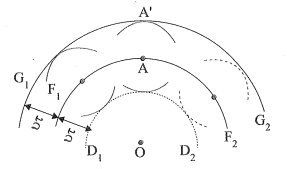
As shown in the Fig, $F _1 F_2$ represents the spherical wave front (with O as Centre) at $t=0$.
As per Huygen's principle each point on the wavefront behaves as a secondary source and the waves emanating from these point spread equally in all directions at the speed of wave. If we wish to determine the shape of the wave front at $t=\tau$, we draw spheres of radius $v \tau$ from each point on the spherical wave front where $v$ represents the speed of the waves in the medium.
If we now draw a common tangent to all these spheres, we obtain the new position of the wave front at $t =\tau$.
The new wavefront is shown in the Fig. as $G _1 G _2$, which is again a spherical with point ' O ' as centre.

Need a full question paper?

Generate a complete, print-ready paper with questions like this in minutes — across 16+ boards, with answer keys.
Start Generating Free

Similar questions

A free atom of iron emits $\text{K}_\alpha\ X-$rays of energy $6.4keV.$ Calculate the recoil kinetic energy of the atom. Mass of an iron atom $= 9.3 \times 10^{-26}kg.$
What is drift velocity? Explain the dependence of drift velocity and electric field on the mobility.
What is de-Broglie wave? Write an expression for its wavelength.
In a pure semiconductor, the number of conduction electrons is $6 \times 10^{19}$ per cubic metre. How many holes are there in a sample of size $1\ cm \times 1\ cm \times 1mm$?
Calculate the number of states per cubic metre of sodium in $3s$ band. The density of sodium is $1013\ kg/ m^3.$ How many of them are empty?
In Young’s double slit experiment, the two slits $0.15 \ mm$ apart are illuminated by monochromatic light of wavelength $450 \ nm$. The screen is $1.0 m$ away from the slits.
  1. Find the distance of the second $(i)$ bright fringe, $(ii)$ dark fringe from the central maximum.
  2. How will the fringe pattern change if the screen is moved away from the slits?
Draw the graph showing the variation of binding energy per nucleon with mass numbers. Give the reason for the decrease of binding energy per nucleon for nuclei with higher mass number.
Using Gauss’s law in electrostatics, deduce an expression for electric field intensity due to a uniformly charged infinite plane sheet. If another identical sheet is placed parallel to it, show that there is no electric field in the region between the two sheets.
A ceiling fan has a diameter (of the circle through the outer edges of the three blades) of 120cm and rpm 1500 at full speed. Consider a particle of mass 1g sticking at the outer end of a blade. How much force does it experience when the fan runs at full speed? Who exerts this force on the particle? How much force does the particle exert on the blade along its surface?
Draw a plot of potential energy of a pair of nucleons as a function of their separations. Mark the regions where the nuclear force is (i) attractive and (ii) repulsive. Write any two characteristic features of nuclear forces.