Questions · Page 4 of 4

M.C.Q (1 Marks)

MCQ 1511 Mark
If $L$ is the coherent length and c the velocity of light, the coherent time is:
  • A
    $\text{cL}$
  • $\frac{\text{L}}{\text{c}}$
  • C
    $\frac{\text{c}}{\text{L}}$
  • D
    $\frac{1}{\text{Lc}}$
Answer
Correct option: B.
$\frac{\text{L}}{\text{c}}$

$\text{Coherent time} =\frac{\text{Coherence length}}{\text{Velocity of light}}​=\frac{\text{L}}{\text{c}}​$

View full question & answer
MCQ 1521 Mark
The interference of light was first demonstrated experimentally by:
  • A
    Sir Isaac Newton
  • B
    Michelson
  • C
    Fraunhoffer
  • Thomas Young
Answer
Correct option: D.
Thomas Young

Thomas Young demonstrated the phenomenon of interference in water waves.
In $1801$, he presented a famous paper to the Royal Society entitled "On the Theory of Light and Colours" which described various interference phenomena, and in $1803$ he performed his famous double$-$slit experiment.

View full question & answer
MCQ 1531 Mark
Which of the following is a unit for intensity of light?
  • A
    Candle power
  • B
    Lux
  • Both $A\ \&\ B$
  • D
    None of the above
Answer
Correct option: C.
Both $A\ \&\ B$

In photometry, luminous intensity is a measure of the wavelength$-$weighted power emitted by a light source in a particular direction per unit solid angle, based on the luminosity function, a standardized model of the sensitivity of the human eye. The $SI$ unit of luminous intensity is the candela $(cd),$ an $SI$ base unit.

View full question & answer
MCQ 1541 Mark
Which of the following cannot be polarised?
  • A
    Radio waves
  • $\beta$ rays
  • C
    Infrared rays
  • D
    $\gamma$ rays
Answer
Correct option: B.
$\beta$ rays

$\beta$ are stream of particles comprising of electrons moving with very high velocity, hence it cannot be polarized, while others can as they are electromagnetic waves.

View full question & answer
MCQ 1551 Mark
A student wants to find if a star if moving away from the earth or towards the earth. Which of the following principle he can use?
  • A
    Newton's law of universal gravitation.
  • Red shift of light from other galaxies.
  • C
    The fact that every element of atomic number greater than $83$ is radioactive.
  • D
    Mass-energy equivalence.
Answer
Correct option: B.
Red shift of light from other galaxies.

Red shift happens when light from an object increases in wavelength. It occurs whenever a light source moves away from an observer.
Blue shift happens when light from an object decreases in wavelength. It occurs whenever a light source moves toward an observer.

View full question & answer
MCQ 1561 Mark
When a source of light is receding away from an observer, then the spectral lines will get displaced towards:
  • A
    Violet region
  • Red region
  • C
    Ultra region
  • D
    Blue region
Answer
Correct option: B.
Red region

When an object moves away from us, its light waves are stretched into lower frequencies or longer wavelengths, and we say that the light is redshifted. It also explain the expanding nature of universe.
Shifting towards red end means wavelength is increasing.

View full question & answer
MCQ 1571 Mark
The diameter of objective of a telescope is 1m. Its resolving limit for the light of wavelength $4538 \mathring{\text{A}}$, will be:
  • $5.54 \times 10^{-7} \mathrm{rad}$
  • B
    $2.54 \times 10^{-4} \mathrm{rad}$
  • C
    $6.54 \times 10^{-7} \mathrm{rad}$
  • D
    None of the above
Answer
Correct option: A.
$5.54 \times 10^{-7} \mathrm{rad}$

Resolving limit
$\text{d}\theta=\frac{1.22\lambda}{\text{a}}$
$=\frac{1.22\times4538\times10^{-10}}{1}$
$= 5.54 \times 10^{-7} \mathrm{rad}.$

View full question & answer
MCQ 1581 Mark
Human eye:
  • A
    Can detect polarized light
  • Cannot detect polarization of light
  • C
    Can detect only circularly polarized light
  • D
    Can detect only linearly polarized light
Answer
Correct option: B.
Cannot detect polarization of light

Polarization changes when plane of vibration of polarized light changes.
Human eye is insensitive to change in polarization and hence, cannot detect polarization of light.

View full question & answer
MCQ 1591 Mark
The wave-like character was experimentally proved for light by:
  • A
    Newton
  • Young
  • C
    Maxwell
  • D
    Huygens
Answer
Correct option: B.
Young

Newton's particle theory remained accepted for a long time when it was challenged by the double$-$slit experiment of Thomas Young $(1773-1829)$ in $1801$. This experiment clearly established that light coming from two coherent sources interferes and produces maxima and minima depending on the path difference.

View full question & answer
MCQ 1601 Mark
The speed of light depends:
  • A
    On elasticity of the medium only.
  • B
    On inertia of the medium only.
  • C
    On elasticity as well as inertia.
  • Neither on elasticity nor on inertia.
Answer
Correct option: D.
Neither on elasticity nor on inertia.

The speed of light in any medium depends on the refractive index of that medium, which is an intensive property. Hence, speed of light is not affected by the elasticity and inertia of the medium.

View full question & answer
MCQ 1611 Mark
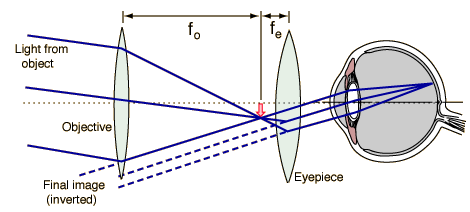
The sum of the focal lengths of the objective and an eyepiece, in case of an astronomical telescope. is equal to: $($final image is at $\infty)$
  • The length of the telescope
  • B
    Half the length of the telescope
  • C
    Double the length of the telescope
  • D
    None of these
Answer
Correct option: A.
The length of the telescope

The sum of the focal lengths of the objective and an eyepiece, in case of an astronomical telescope is equal to The length of the telescope.

View full question & answer
MCQ 1621 Mark
Three waves are given below. $I.$ Sound waves, $II$. Visible light waves, $III. X-$rays. Which of the above waves cannot be polarised?
  • $I$ only
  • B
    $III$ only
  • C
    $I$ and $II$ only
  • D
    $I, II$ and $III$
Answer
Correct option: A.
$I$ only

Only the transverse waves can be polarized.
As the sound waves are longitudinal waves in nature whereas visible light rays and $X-$rays are transverse waves.
Thus sound waves cannot be polarized.

View full question & answer
MCQ 1631 Mark
Wave nature of light is verified by $........$.
  • Interference
  • B
    Reflection
  • C
    Photoelectric effect
  • D
    Refraction
Answer
Correct option: A.
Interference

Interference
Christian Huygens verified the wave nature of light using interference.

View full question & answer
MCQ 1641 Mark
When exposed to sunlight, thin films of oil on water often exhibit brilliant colours due to the phenomenon of:
  • A
    The dispersion
  • The interference
  • C
    The diffraction
  • D
    The angular acceleration
Answer
Correct option: B.
The interference

When exposed to sunlight, thin films of oil on water often exhibit brilliant colors due to the phenomenon of interference.
In the case of a thin oil film, a layer of oil sits atop a layer of water. The oil may have an index of refraction near $1.5 $ and the water has an index of $1.33.$
The materials on either side of the oil film $($air and water$)$ both have refractive indices that are less than the index of the film.

View full question & answer
MCQ 1651 Mark
Two point white dots are $1\ mm$ apart on a black paper. They are viewed by eye of pupil of diameter $3\ mm$. Approximately what is the maximum distance up to which these dots can be resolved by the eye.
  • $5m$
  • B
    $6m$
  • C
    $1m$
  • D
    $4m$
Answer
Correct option: A.
$5m$
View full question & answer
MCQ 1661 Mark
Light is a form of $........$ that we can detect with our $........$.
  • A
    energy, ears
  • B
    corpuscles, eyes
  • energy, eyes
  • D
    sensation, skin
Answer
Correct option: C.
energy, eyes

Light is a form of energy that we can detect with our eyes.

View full question & answer
M.C.Q (1 Marks) - Page 4 - Physics STD 12 Science Questions - Vidyadip