- AViolet
- BWhite
- ✓Black
- DRed
When the film is thin,$ t \rightarrow 0$, path diff. $= \frac{\lambda}{2}$. Therefore, in reflected light, the film appears black.
Huygens considered that light was propagated in longitudinal waves.
Huygen's concept explained the direction of propagation of light waves by geometrical reconstruction of wavefront.
since photons have momentum and energy, they can produce all the three stated effects.
Newton was the first to use corpuscular theory to explain the nature of light. He was able to successfully reflection and refraction using this theory.
If white light is used a white centre fringe is observed, but all the other fringes have coloured edges, the blue edge being nearer the centre. Eventually the fringes overlap and a uniform white light is produced.
Monochromatic light is light made up of one single pure frequency.white light, which is light that contains all frequencies, That means the sum of red, yellow, green, blue and violet. Some light sources send out monochromatic light such as lasers beam.
By definition, resolving power of an optical instrument is its ability to show two closely adjacent point $($closely spaced$)$ as distinct as possible.
For light waves emitted by two sources of light to remain coherent, the initial phase difference between waves should remain constant in time. If the phase difference changes continuously or randomly with time, then the sources are incoherent.
The polarization phenomenon, verifies the transverse nature of light. Since sound has longitudinal nature, so it does not show polarization effect.
Polarizers are used in industry to reveal stress patterns in machinery and tools. Sunglasses are used to protect the eyes by polarizing the light to reduce glare using the tailor$-$made material of the glasses.
An electromagnetic wave bends round the corners of an obstacle if the size of the obstacle is comparable to the wavelength of the wave. An $AM$ wave has less frequency than an $FM$ wave, So, an $AM$ wave has a higher wavelength than an $FM$ wave and it bends round the comers of a $1m \times 1m$ board.
The wave is travelling along the $X-$axis. So, it'll have planar wavefront perpendicular to the $X-$axis.
Wave front by definition is the locus of points having same phase.
Sound waves are longitudinal waves.
The locus of all particles in a medium, vibrating in the same phase is called wave front.
The direction of propagation of light $($ray of light$)$ is perpendicular to the wave front.
A wave front is an imaginary surface where all particles lying on this vibrate in the same phase.
Huygen considered, light needs a medium to propagate called ether which is highly elastic and less denser.
Doppler effect refers to the change in wave frequency during the relative motion between a wave source and it's observer by considering that the Velocity of the observer with respect to the source velocity is negligible.
Red shift is the increase in wavelength of light observed due to Doppler Effect of light, observed when objects recede from each other.
The red shift as observed in distant galaxies suggests that the galaxies are moving away from us and from each other. This tells that the universe is expanding.
Radius of nth order Newton's ring is proportional to $\sqrt{\lambda}$ which decreases in oil since $\lambda=\frac{\lambda_\text{vacuum}}{\mu}$. Thus the radius of newton's ring decreases in oil film.
when you considered it a large distance and measuring justice Mall section of it then it can be considered to be plane wavefront source at Infinity example the one coming from sun to earth surface is considered to be plain $VU$ friend from light diverging from a point source will be spherical.
So, the wave front due to a source situated at infinity is planar.
In $1669,$ another Danish scientist, Erasmus Bartholinus discovered the polarization of light by double refraction in Iceland spar $($calcite$).$
Interference patterns are explained using wave nature of light. You can learn more from youtube video "Interference of light".
Wave travelling from a distant source always has plane wavefront.
Resolving power of telescope $\text{R}=\frac{1}{\Delta\theta}=\frac{\text{a}}{1.22\lambda}$
where, $\Delta\theta$ is angular separation between two objects.
a is the diameter of the objective.
$\lambda$ is wavelength of light.
So, clearly resolving power of a telescope depends on diameter of the objective.
When the wavelength of the light gets lengthened by the Doppler shift, we refer to the change as red shift.
A wavefront is the locus of points characterized by propagation of position of the same phase:
a propagation of a line in $1D$, a curve in $2D$ or a surface for a wave in $3D.$

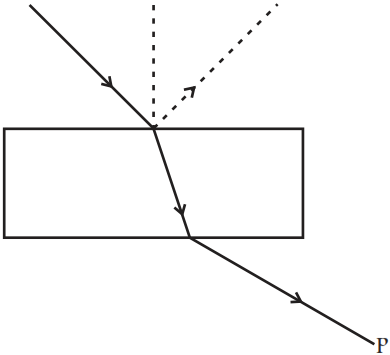
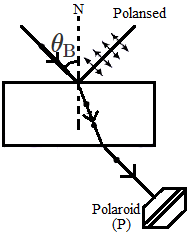
Hint: If a light beam incidents at Brewster's angle, then the transmitted beam is always unpolarised and reflected beam is always polarised.
In the given diagram, the light beam incident from air to the glass slab at Brewster's angle $(ip).$ Therefore, the incident ray represented by dot $(.),$ is unpolarised and the reflected light represented by arrow, is plane polarized.
Since, the emergent ray is unpolarised.
Hence, the intensity cannot be zero when passes through polaroid.

Huygens suggested that light may be a wave phenomenon produced by mechanical vibrations of an all pervading hypothetical homogenous medium called eather just like those in solids and liguid .This medium was supposed to be mass less with extremely high elasticity and very low density.
For a fringe to appear, the two wavelengths must interfere to give a maxima, which appears at a distance where the phase of both the rays are same, that is, at the least count multiple of the waves.
Therefore the first fringe appears at $5200 \mathring{\text{A}}$.
To accommodate $250$ fringes, the thickness of the film is $250$ times the distance where the first fringe occurs.
Thus the thickness of the air film is $1.3\ mm$
Optical light with a short wavelength is blue. When the wavelength of the light gets shortened by Doppler effect, we refer to the change in the wavelength as blue shift.
In Newton ring experiment, the band forms are circular in nature and at the centre there is presence of dark spot due to destructive interference.
The rays coming from the body of the white donkey will interfere with the black streaks on the glass and the final image of a zebra will be produced.
Ray optics is valid when characteristics dimensions are larger than the wavelength of the light, so that rectilinear property of light can be used.
When a layer of oil falls on water, the light waves reflected by the upper and lower boundaries interfere with one another to produce colours.
Thus the reason is interference of light
The range for visible light is between $4 \times 10^{-7} \mathrm{~m}$ to $7 \times 10^{-7} \mathrm{~m}$. The only wavelength that is present in this range given as an option is $6 \times 10^{-7} \mathrm{~m}$.
Convex lens always converges the parallel rays but in flood lights, we want to diverge the incident rays so as to light up more area. Thus we use a diverging lens i.e. a concave lens. Thus a convex lens is not used in flood lights.
Electromagnetic wave theory explains light as being composed of electric field vibrating in planes.
Polarisation of light refers to vibrating electric field in a particular plane.
For constructive interference,
$A_R=A_1+A_2$
Due to the constructive interference of the superimposing waves, resultant wave of larger amplitude is obtained and hence constructive interference results in the larger wave.
The length of telescope $=$ focal length of object $(-f_0) +$focal length of eyepiece $(f_e) = 100 + 5 = 105\ cm$
Fringe width $\beta= \frac{\lambda\text{D}}{\text{d}}$ where $\lambda $ is the wavelength of the light used
$\Rightarrow\beta\propto\lambda$
As wavelength of the red light is the largest among the visible light, thus fringe width is the greatest formed due to red light.
The corpuscular theory was largely developed by Sir Isaac newton. Newton's theory remained in force for more than $100$ years and took precedence over Huygen's wave front theory, partly because of Newton’s great prestige.
When the corpuscular theory failed to adequately explain the diffraction, interference and polarization of light it was abandoned in favour of Huygens' wave theory.
Christian Huygens postulated wave theory.
As to obtain a nice coloured pattern, the thickness of the film has to be similar to the wavelength of light and the bubbles are darkest where they are thinnest.
As we know the reflection, refraction, diffraction can be demonstrated with sound waves in an air column but to have polarized waves, they first need to be transverse waves but sound waves are longitudinal. Sound waves are longitudinal so they cannot be polarised.
Resolving power of a telescope:
$\text{R}=\frac{\text{a}}{1.22\lambda}$
where, a is diameter of the objective
so, $R$ increases when a is increased and a increases when aperture of objective is increased.
Huygene's wave theory assumed that the light travels slower in glass than in air. That means for a given geometrical distance in glass, there will be more waves of light than in same distance in air. Consequently, it would seem that wavelength of light decreases as light propagates through air-glass interface.