Questions

5 Marks Questions

Take a timed test

10 questions · self-marked practice — reveal the answer and mark yourself.

Question 15 Marks
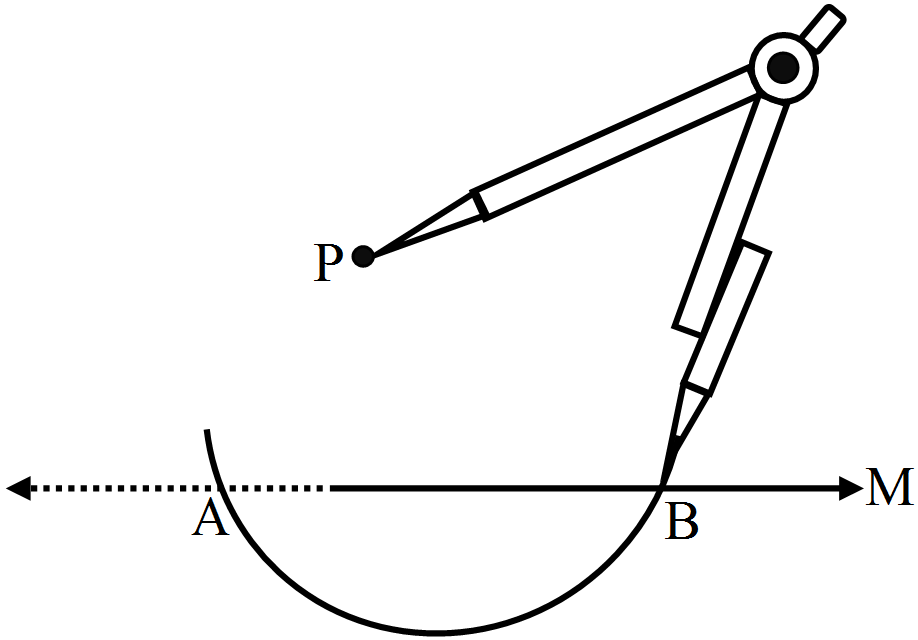
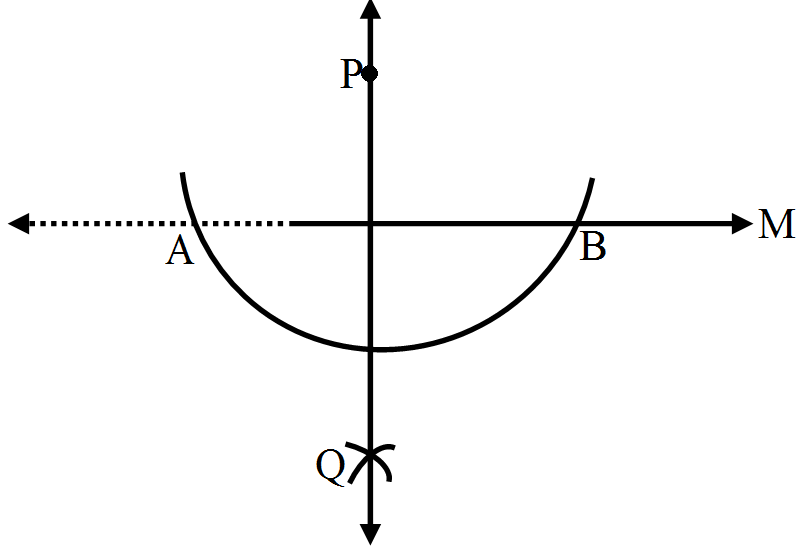
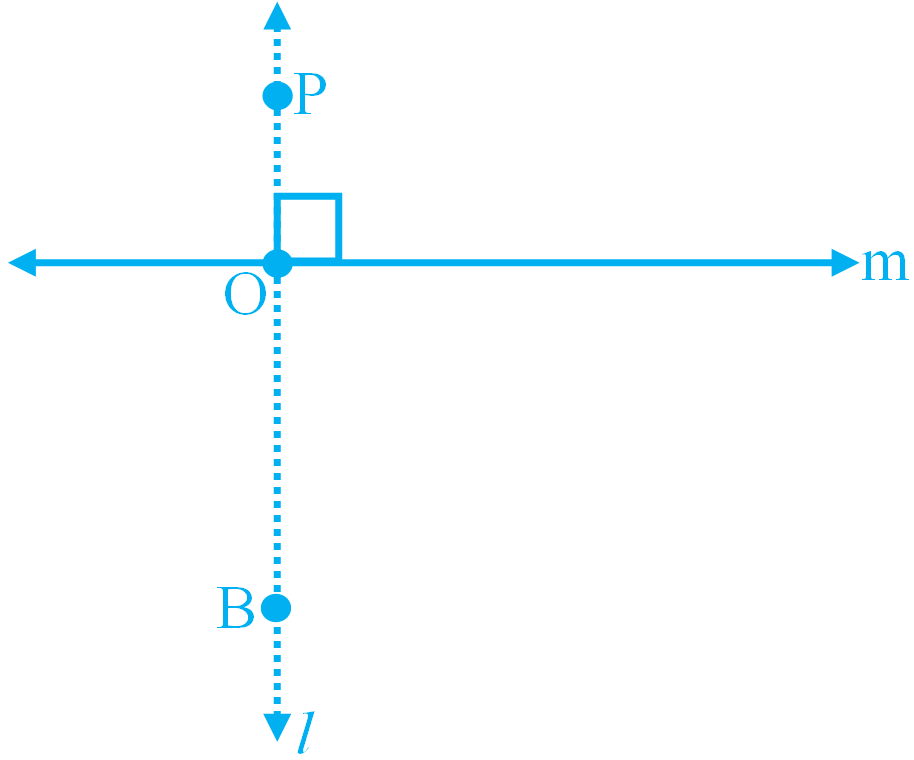
Copy Figure on your notebook and draw a perpendicular from $P$ to line m, using $(i)$ set squares $(ii)$ Protractor $(iii)$ ruler and compasses. How many such perpendiculars are you able to draw?
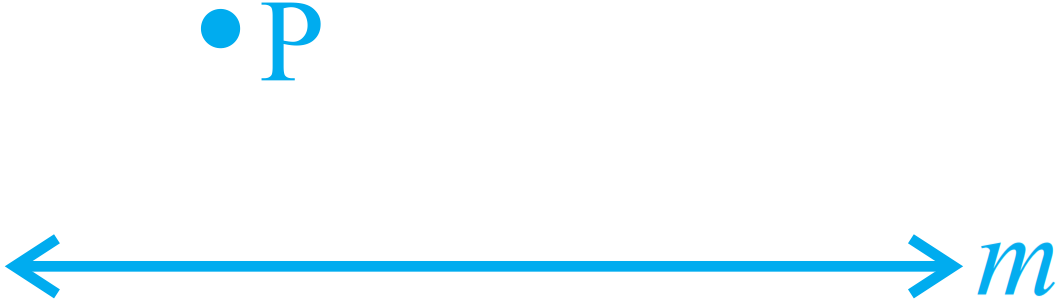
Answer
 
We draw perpendicular to $m$ from $P,$ using
$i.\ $Set Squares:
Step $I:$ Let $m$ be the given line and $P$ be a point outside $m.$ Now, extend line $m$ on both the sides.
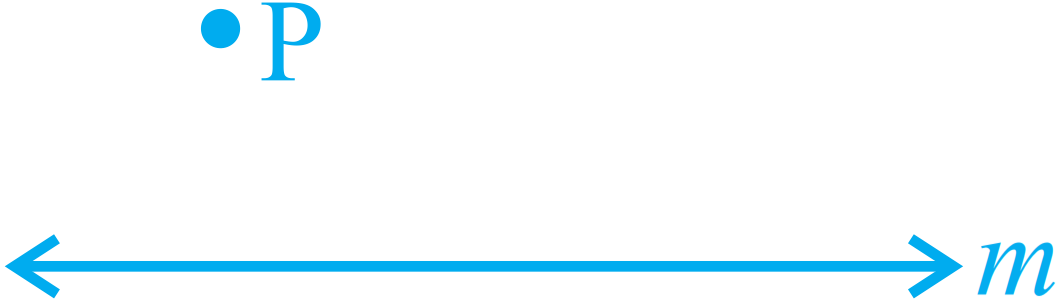
Step $II:$ Place a set square on $m,$ such that one arm of its right angle aligns along $m.$
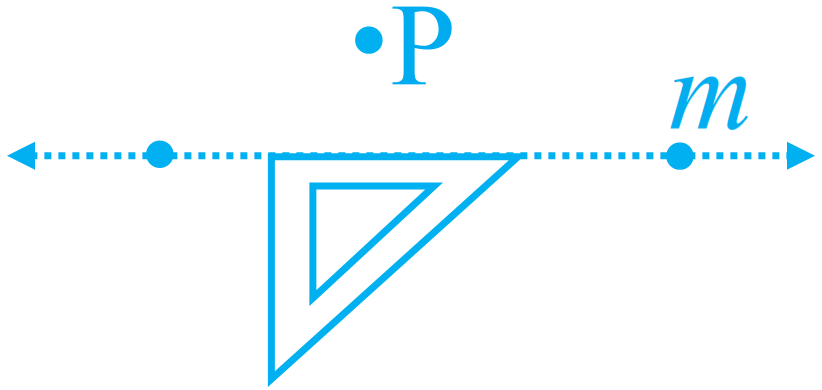
Step $III:$ Place a ruler along the edge opposite to the right angle of the set square.
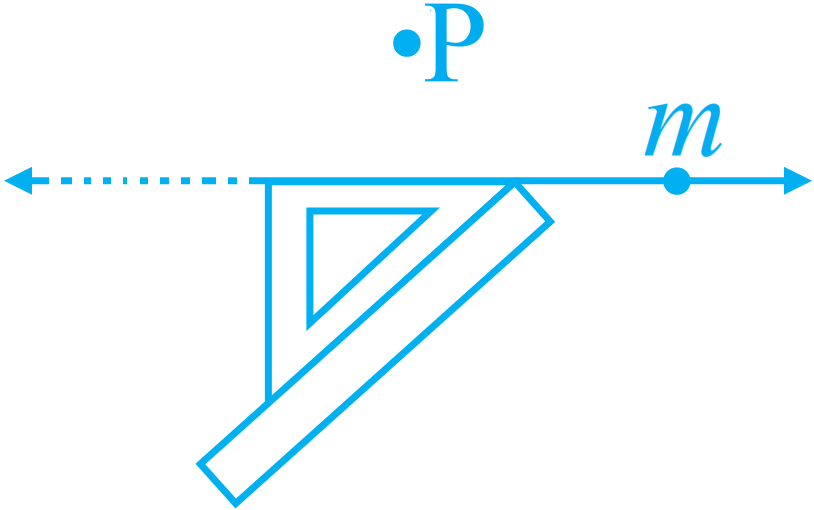
Step $IV:$ Hold the ruler fixed. Slide the set square along the ruler till the point $P$ touches the other arm of the set square.
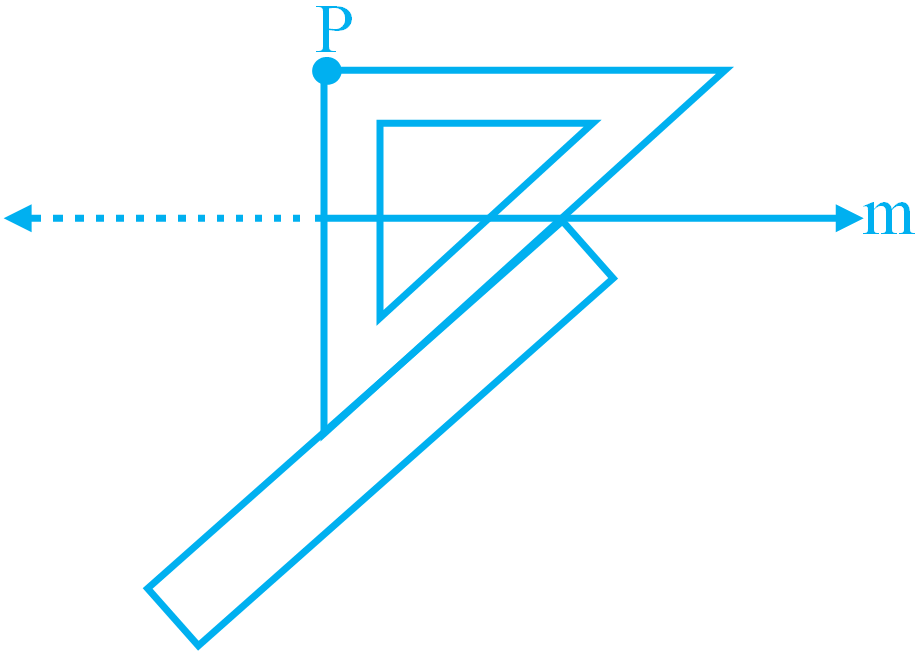
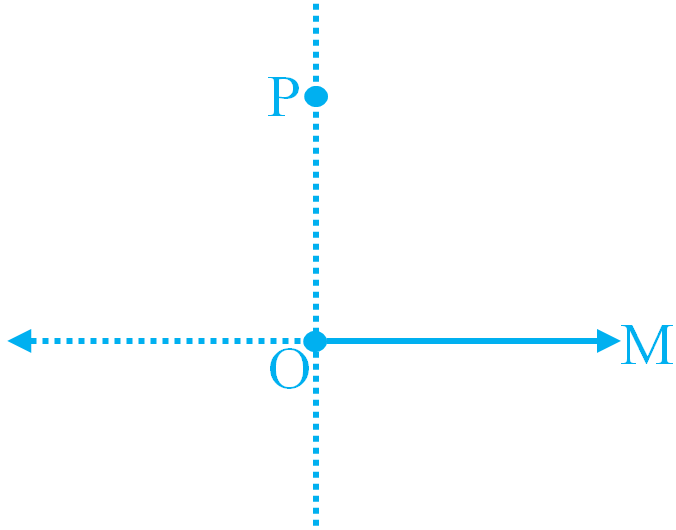
Step $V:$ Join $PM$ along the edge through $P.$ Meeting $m$ at $O.$
Now, $\text{PO}\bot\text{m.}$
$ii.\ $Protractor:
Step $I:$ Let $m$ be the given line and $P$ be a point outside $m.$
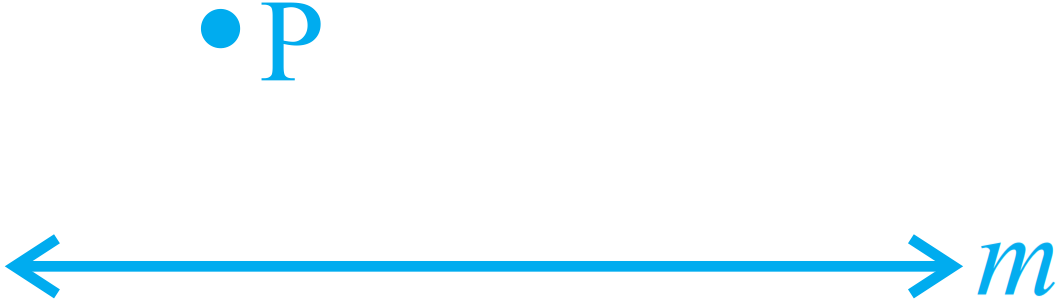
Step $II:$ Place the protractor on point $P,$ such that its centre coincides with point $P.$​​​​​​​
Step $III:$ Mark a point $B$ against the $90^\circ$ mark on the protractor.
Step $IV:$ Remove the protractor and draw a line $l$ passing through $P$ and $B$ wich intersects line m at $O.$
Then, $\text{PO}\bot\text{m}.$
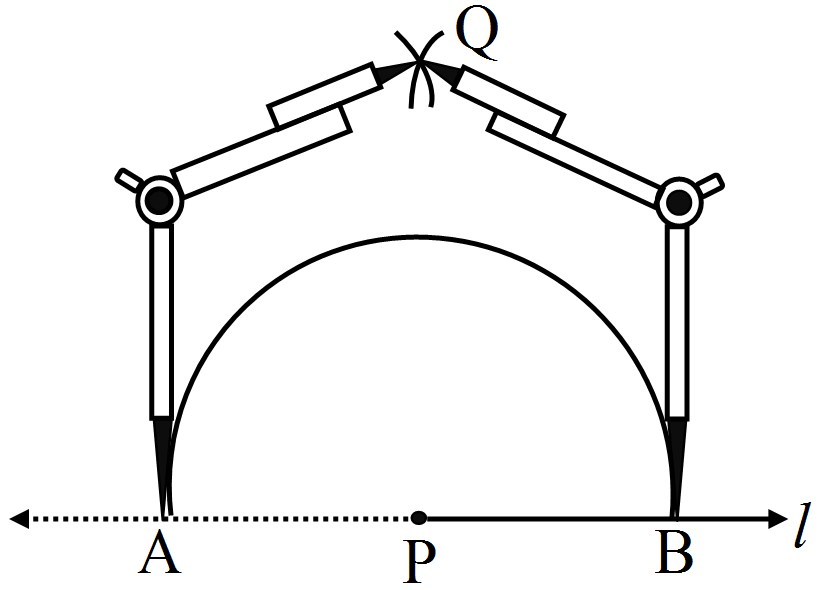
$iii.\ $​​​​​​​Ruler and Compass:
Step $I:$ Given, a line m and point $P,$ not it. Extend the given line in both derections.

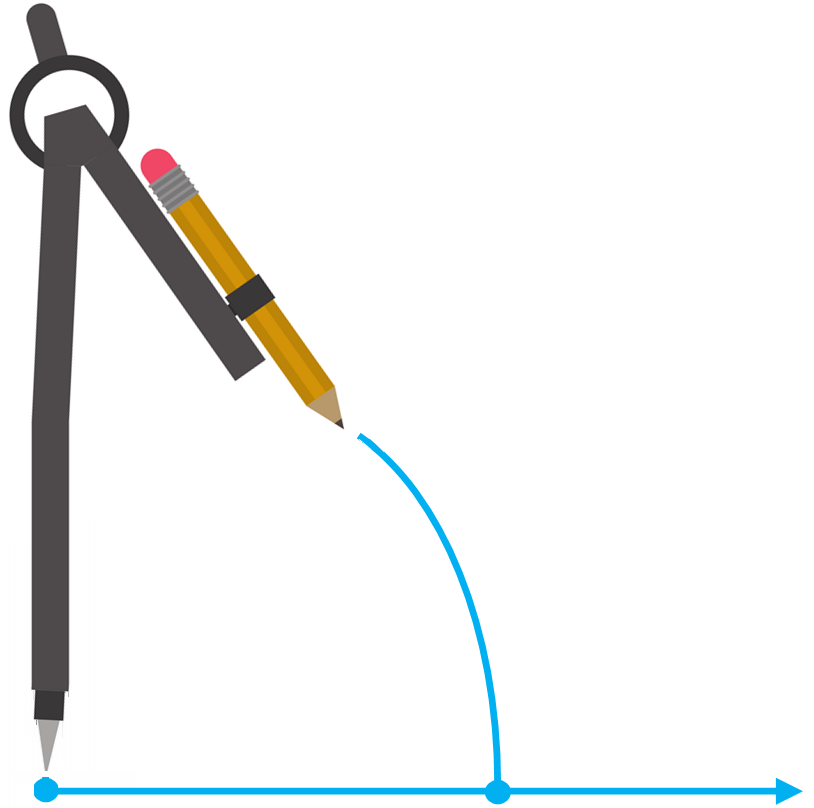
Step $II:$ With $P$ as centre, draw an arc which intersects line m at two points $A$ and $B.$​​​​​​​

Step $III:$ With $A$ and $B$ as centres and the same redius draw two arcs which intersect at a point say $Q,$ on the other side.
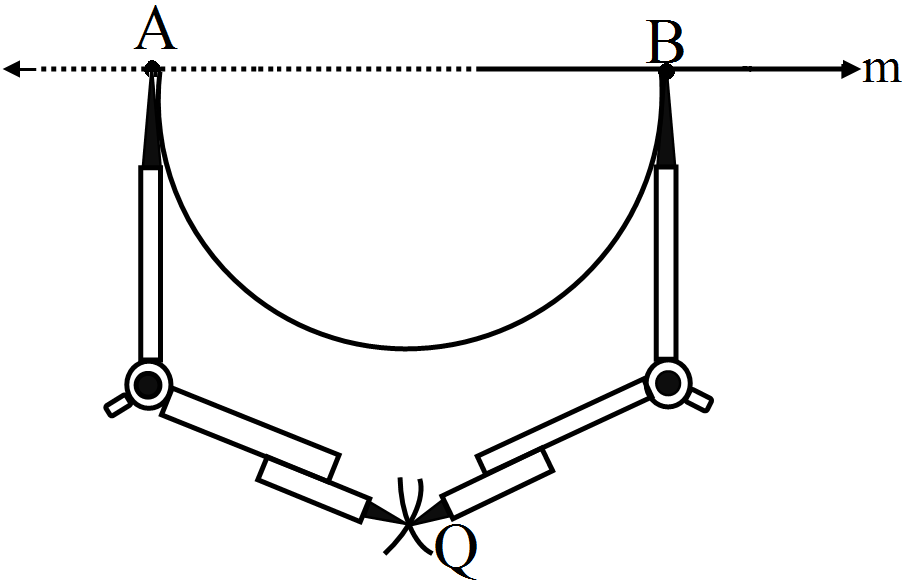
Step $IV:$ Join $PQ.$​​​​​​​

Thus, $PQ$ is perpendicular to $m.$
We are able to draw one perpendicular line.
 
View full question & answer
Question 25 Marks
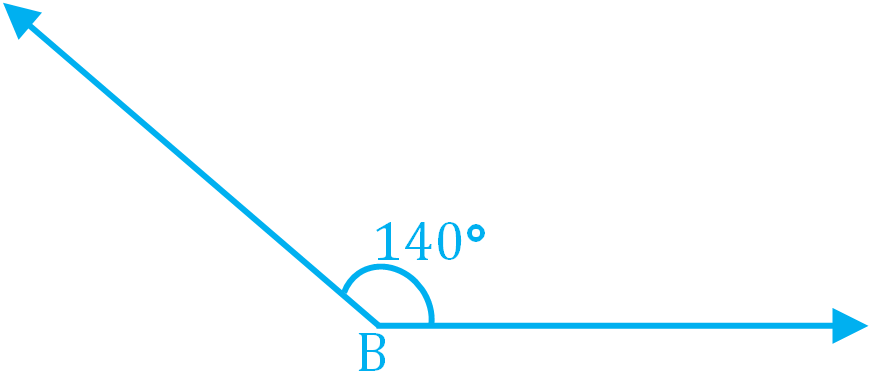
Draw an angle of $140^\circ$ with the help of a protractor and bisect it using ruler and compasses.
Answer
Step of construction are as follows:
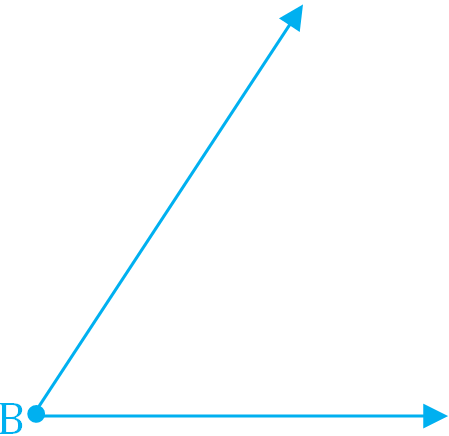
Step I: Draw an angle $\angle\text{B}=140^\circ.$

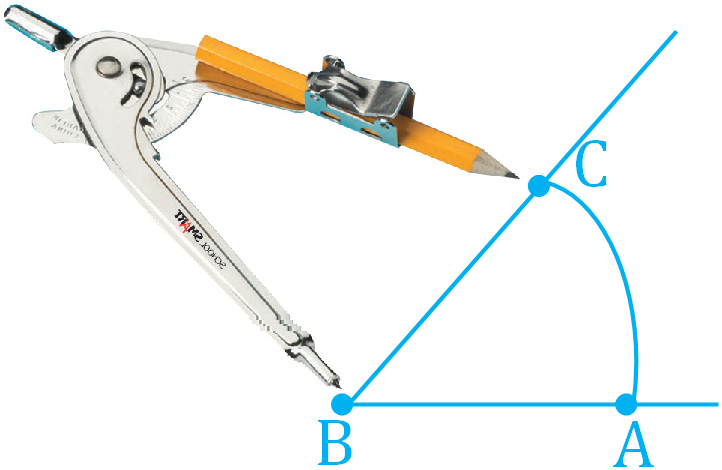
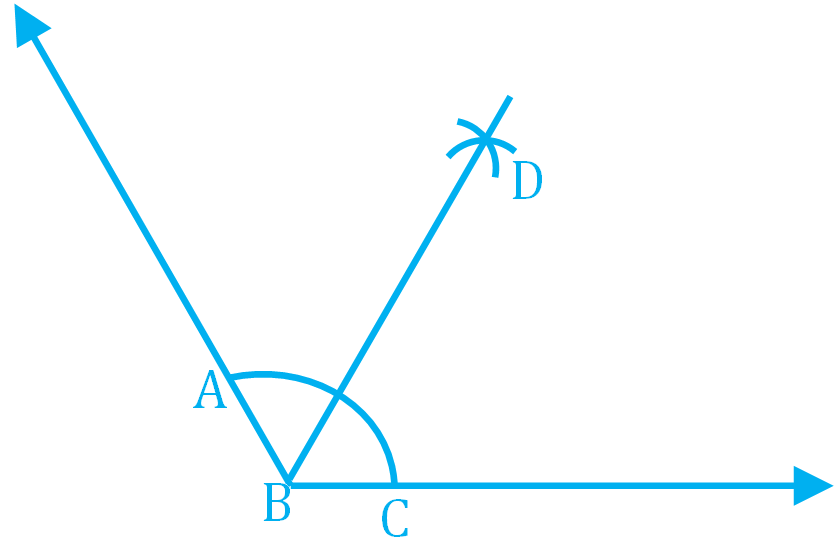
Step II: With $6$ as a centre and using compass, draw an arc which cuts both rays of $\angle\text{B},$ at $A$ and $C.$
Step III: With $A$ as centre, draw $($in the interior of $\angle\text{B})$ an arc, whose radius is more than half the length $AC.$​​​​​​​
Step IV: With $C$ as centre the same radius and draw another arc, in the interior of $\angle\text{B}.$ Let the two arcs intersect at $D.$ Then, $BD$ is the required bisector of $\angle\text{B}.$
View full question & answer
Question 35 Marks
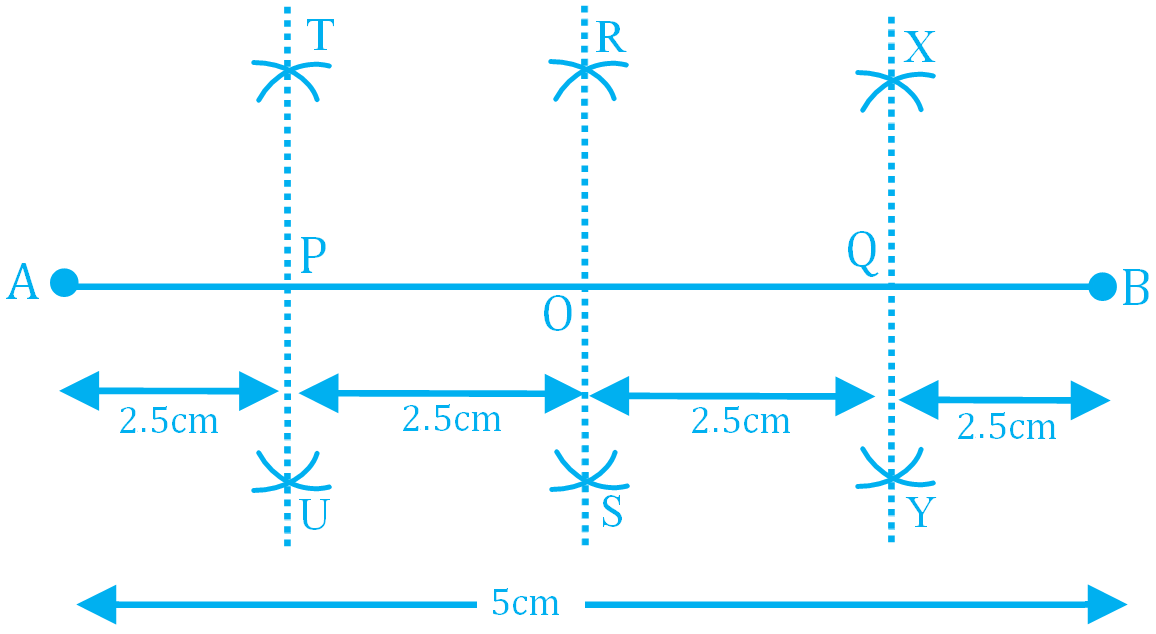
Draw a line segment of length $10\ cm.$ Divide it into four equal parts. Measure each of these parts.
Answer
Steps of construction are as follows:
Step I: Firstly, draw a line segment $AB = 10\ cm.$
Step II: With $A$ and $B$ as centre and the radius more than half of $AS,$ cut the arc both sides of $AS$ at $R$ and $S.$ Join $RS,$ it is the bisector of $AS,$ i.e. $AO = OB.$​​​​​​​
Step III: Now, with $A$ and $O$ as centre and the radius more than half of $AO,$ cut the arc both sides of $AO$ at $T$ and $U.$ Join $TU,$ it is the bisector of $AO,$ i.e. $AP = PO.$​​​​​​​
Step IV: Again, with $0$ and $B$ as centre and the radius more than half of $OB,$ cut the arc both sides of $OS$ at $X$ and $Y.$ Join $XY,$ it is the bisector of $OB,$ i.e. $OQ = QB.$​​​​​​​​​​​​​​

Step V: The line segment $AB$ is divided into $4$ equal parts; such that $AP, PO, OQ$ and $QB.$​​​​​​​
Step VI: By actual measurement, we have $AP = PO = QB = 2.5\ cm.$
View full question & answer
Question 45 Marks
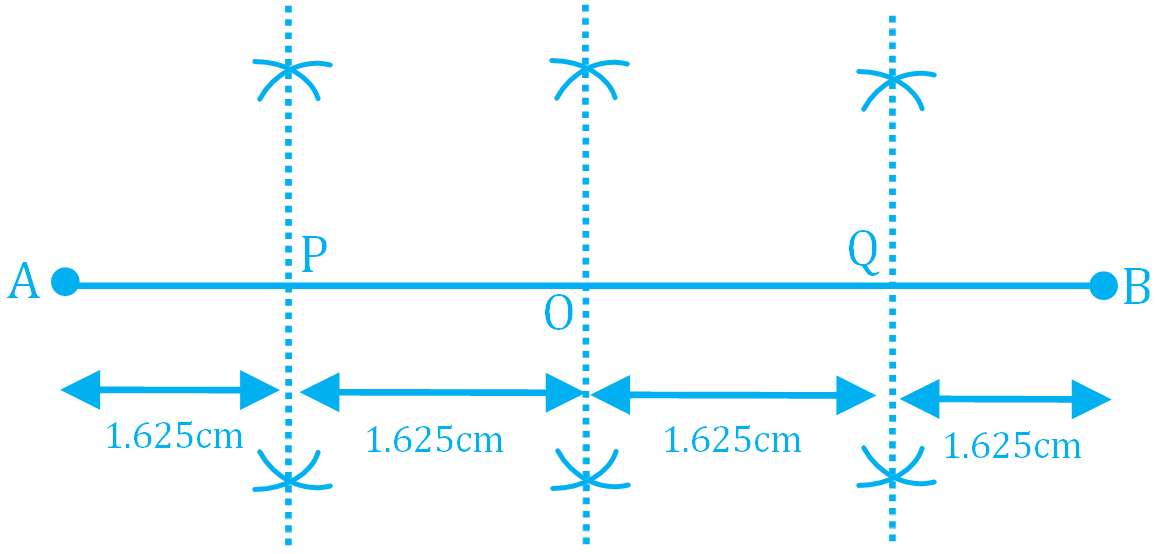
Draw a line segment of length $6.5\ cm$ and divide it into four equal parts, using ruler and compasses.
Answer
First of all, we construct $AB$ of length $6.5\ cm.$ Now, steps of construction are as follows:
Step I: Draw a line segment $AB = 6.5\ cm.$
Step II: Draw perpendicular bisector of $AB,$ which meets $AB$ at $O (\therefore O$ is the mid point of $AB),$ i.e. $AO = OB.$
 
Step III: Now, draw perpendicular bisector of $AO$ which meet $AB$ at $P,$ such that $AP = PO.$
Step IV: Then, draw perpendicular bisector of $BO$ which meet $AB$ at $Q,$ such that $BQ = OQ.$​​​​​​​
Step V: The line segment $AB$ is divided into $4$ equal parts at $P O$ and $Q.$​​​​​​​
Step VI: By actual measurement, we have $AP = PO = OQ = QB = 1.625\ cm.$
View full question & answer
Question 55 Marks
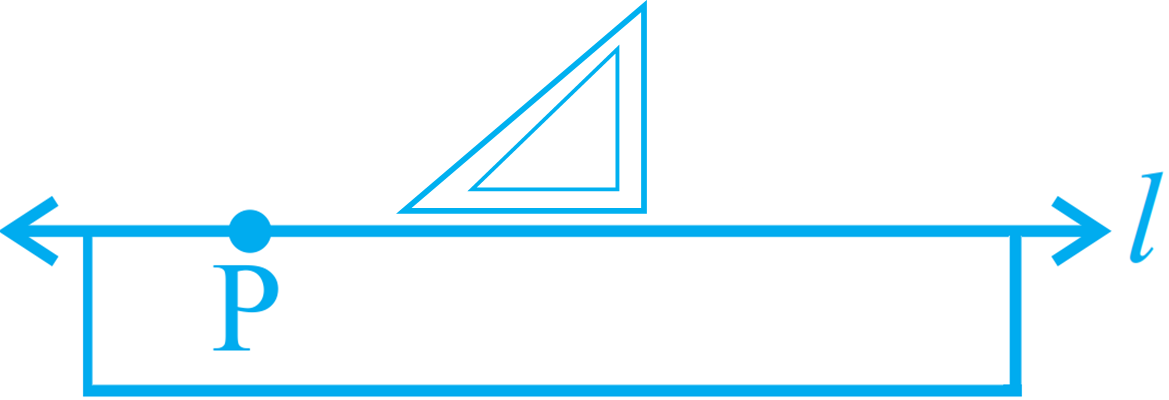
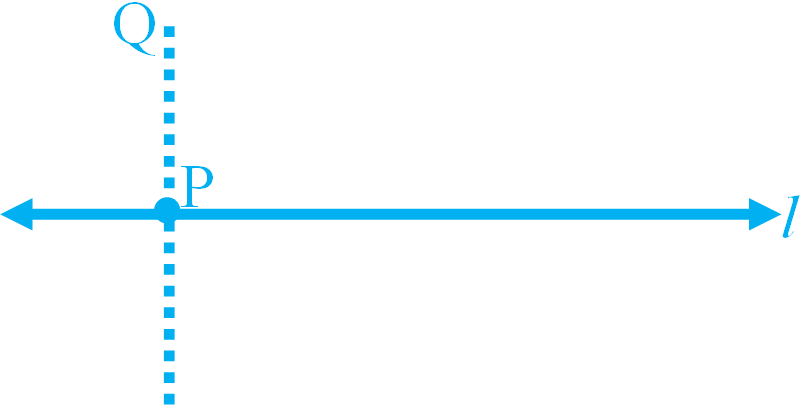
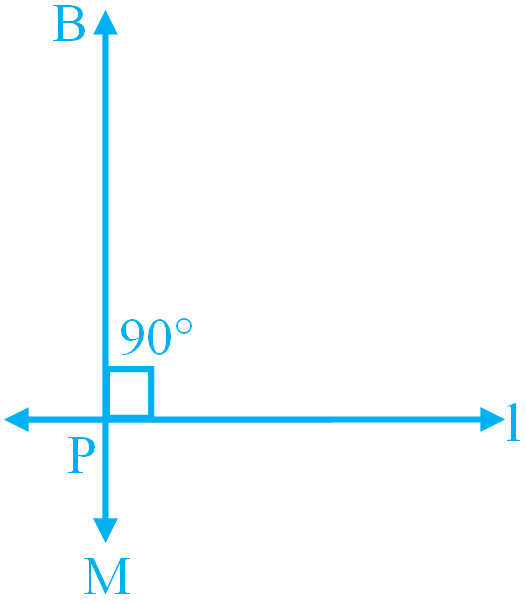
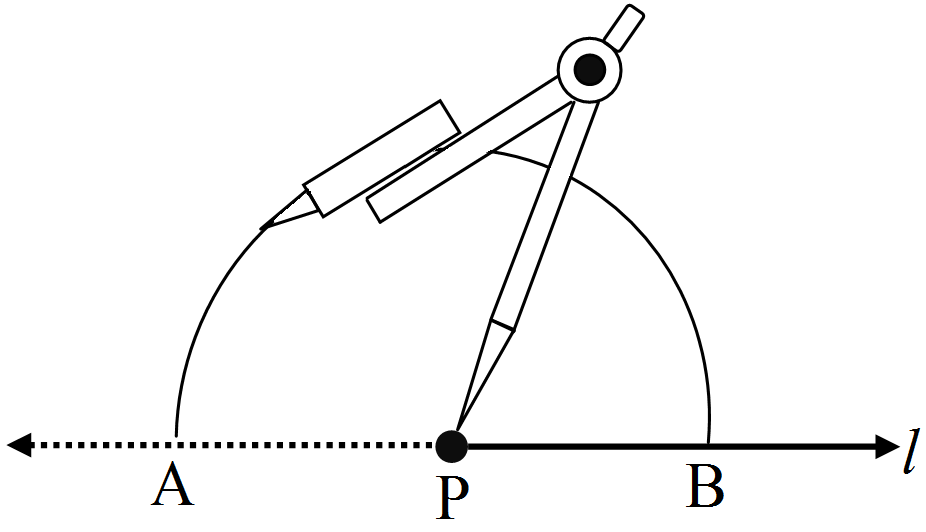
Copy Figure on your notebook and draw a perpendicular to l through $P,$ using $(i)$ set squares $(ii)$ Protractor $(iii)$ ruler and compasses. How many such perpendiculars are you able to draw?
Answer
 
We draw perpendicular to $l$ through $P$ using.
$i.\ $Set square:
Steps of construction are as follows:
Step $I:$ A line $l$ and a point $P$ are given. Note that $P$ is on the line $l.$

Step $II:$ Place a ruler with one of its edges along $l$. Hold it firmly.

Step $III:$ Place a set square with one of its edges along the already aligned edge of the ruler, such that the right angled comer is in contact with the ruler.

Step $IV:$ Hold the set square firmly in this position. Draw $\overline{\text{PQ}}$ along the edge of the set square.

$ii.\ $Protractor:
Step $I:$ A line $l$ and a point $P$ are given. Note that $P$ is on the line $l.$​​​​​​​

Step $II:$ Place the protractor on the line, such that its base line coincides with $ l$ and its centre falls on $P.$​​​​​​​
Step $III:$ Mark a point $B$ against the $90^\circ$ mark on the protractor.
Step $IV:$ Remove the protractor and draw a line m passing through $P$ and $B.$
Then, $\text{PB}\bot\text{l}$


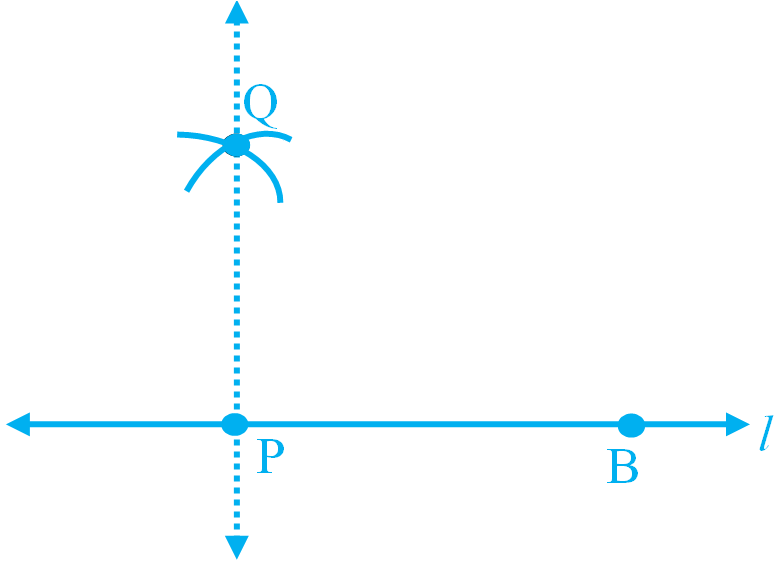
$iii.\ $Ruler and Compass:
Step $I:$ Given, a point $P$ on a line $l.$​​​​​​​

Step $II:$ With $P$ as centre and a convenient radius, construct an arc intersecting the line $l$ at two points $A$ and $B.$​​​​​​​

Step III: With $A$ and $B$ as centres and a redius greater than $AP$ construct two arcs, which cut each other at $Q.$​​​​​​​

Step $IV:$ Join $PQ.$ Then, $PQ$ is perpendicular to $l.$​​​​​​​

Hence, we are able to draw one perpendicular line.
 
View full question & answer
Question 65 Marks
Draw an angle of $80^\circ$ using a protractor and divide it into four equal parts, using ruler and compasses. Check your construction by measurement.
Answer
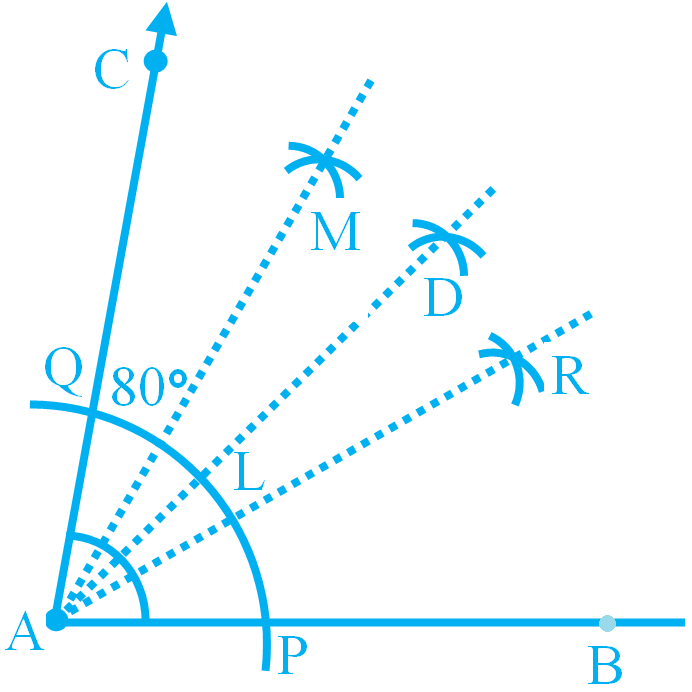
Here, to divide an angle of measure $80^\circ $ into four equal parts, we use the following steps of construction:
Step I: Draw a line segment $AB$ of any length. Place the centre of the protractor at A and the zero edge along $AB.$
Step II: Start with zero near $B$ and mark $C$ at $80^\circ .$​​​​​​​
Step III: Join $AC,$ then $\angle\text{BAC}$ is an angle of measure $80^\circ .$​​​​​​​
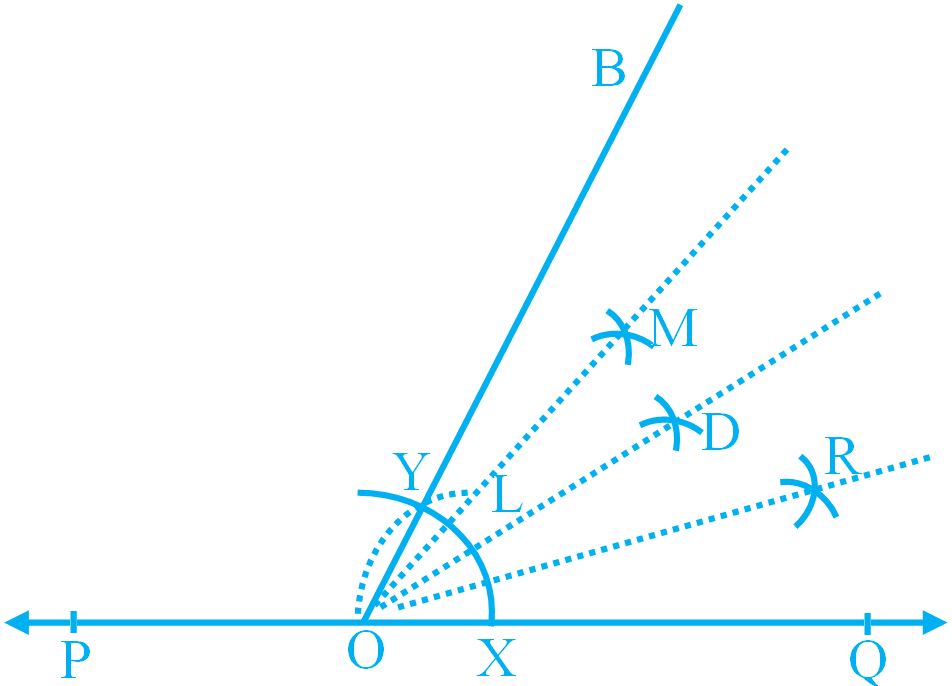
Step IV: With $A$ as centre and using compass, draw an arc that cuts both the rays of $\angle\text{A}$ at $P$ and $Q.$​​​​​​​
Step V: With $P$ as centre, draw $($in the interior of $\angle\text{A})$ an arc, whose radius is more than half the length of $PQ.$​​​​​​​

Step VI: With $Q$ as centre and the same radius, draw another arc in the interior of $A.$ Let the two arcs intersect at $D.$ Join $AD,$ cutting arc $PQ$ at $L.$ Then, $AD$ divides the $\angle\text{BCA}$ into two equal parts.
Step VII: Now, taking $P$ and $L$ as centre, having radius more than half of length $PL,$ draw two arcs respectively, which cut each other at $R.$​​​​​​​
Step VIII: Join $AR,$ which divides $\angle\text{BAD}$ into two equal parts.
Step IX: Now, taking $Q$ and $L$ as centre, having radius more than half of length $QL,$ draw two arcs respectively, which cut each other at $M.$​​​​​​​
Step X: Join $AM,$ which divide $\angle\text{CAD}$ into two equal parts. Thus, $AM, AD$ and $AR$ divide $\angle\text{BAC}$ into four equal parts.
View full question & answer
Question 75 Marks
Draw an angle of $60^\circ$ using ruler and compasses and divide it into four equal parts. Measure each part.
Answer
Step of contruction are as follows:
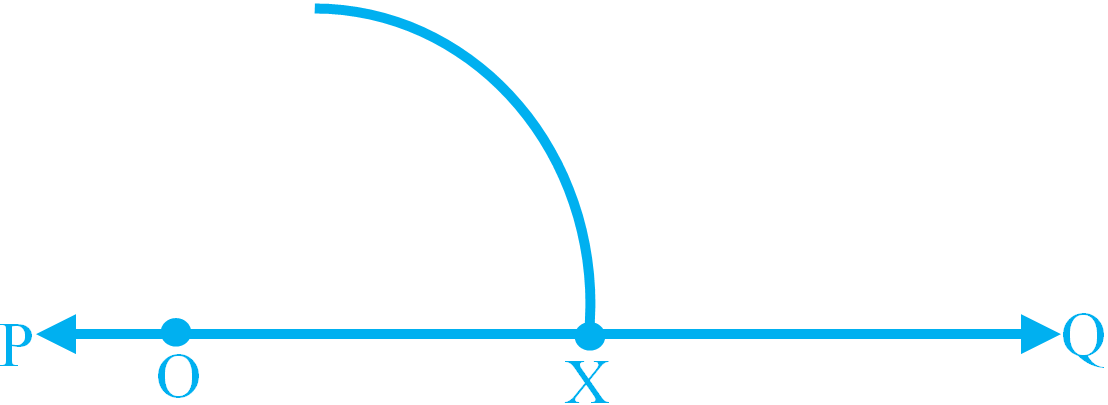
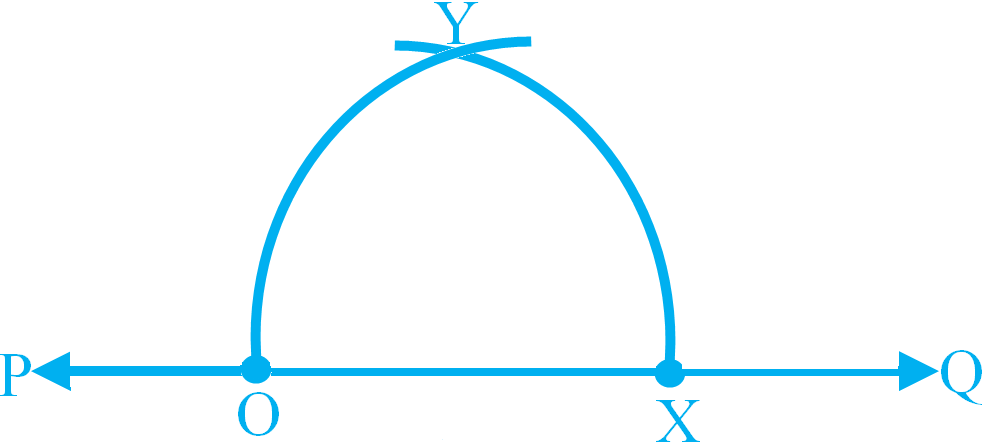
Step I: Draw a line segment $\overline{\text{PQ}}$ and mark a point $O$ on it.

Step II: Place the pointer of the compass at $O$ (as center) and draw an arc of convenient redius, which cuts the line $PQ$ at a point $X.$

Step III: With the pointer at $X$ (as center) and same redius, draw an arc that passes through $O,$ which intersect at $Y.$​​​​​​​

Step IV: Join $OY$ and produce it to $B. $ We get $\angle\text{BOX,}$ whose measure is $60^\circ$.

Step V: With $0$ as a centre and using compass draw an arc that cuts both rays of $\angle\text{O}$ at $X$ and $Y.$​​​​​​​
Step VI: With $X$ as centre, draw $($in the interior of $\angle\text{O})$ an arc, whose radius is more than half the length of $XY$​​​​​​​
Step VII: With the same radius with $Y$ as centre, draw another arc in the interior of $\angle\text{O.}$ Let the two arcs intersects at $D$. Join $OD$, cutting arc $XY$ at $L.$ Then, $OD$ divides the $(\angle\text{XOB or}\ \angle\text{QOB)}$ into two equal parts.
Step VIII: Now, taking $X$ and $L $ as centre, having radius more than half of length $XL$, draw two arcs respectively, which cut each other at $R.$​​​​​​​
Step IX: Join $OR$, which divides $\angle\text{XOD}$ into two equal parts.
Step X: Now, taking $Y$ and $L$ as centre, having radius more than half of length $YL,$ draw two arcs respectively, which cut each other at $M.$​​​​​​​
Step XI: Join $OM,$ which divide $\angle\text{BOD}$ into two equal parts.
Thus, $OM, OR$ and $OD$ divide $\angle\text{XOB} (\text{or}\ \angle\text{QOB})$ into four equal parts.
View full question & answer
Question 85 Marks
Match the following:
S.No.
Shape
S.No.
Number of lines of symmetry
$i.$
Isosceles triangle.
$a.$
$6$
$ii.$
Square.
$b.$
$5$
 
$iii.$
Kite.
$c.$
$4$
$iv.$
Equilateral triangle.
$d.$
$3$
$v.$
Rectangle.
$e.$
$2$
$vi.$
Regular hexagon.
$f.$
$1$
$vii.$
Scalene triangle.
$g.$
$0$
Answer
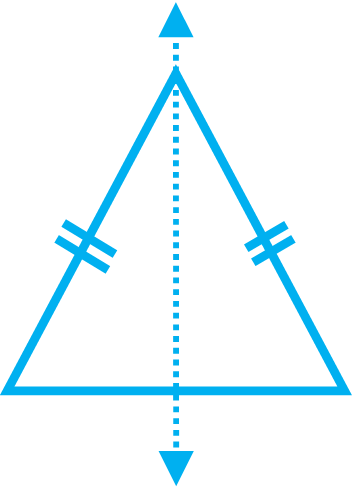
$(i)$ An isosceles triangle has $1$ line of symmetry.

$(ii)$ A square has $4$ lines of symmetry.

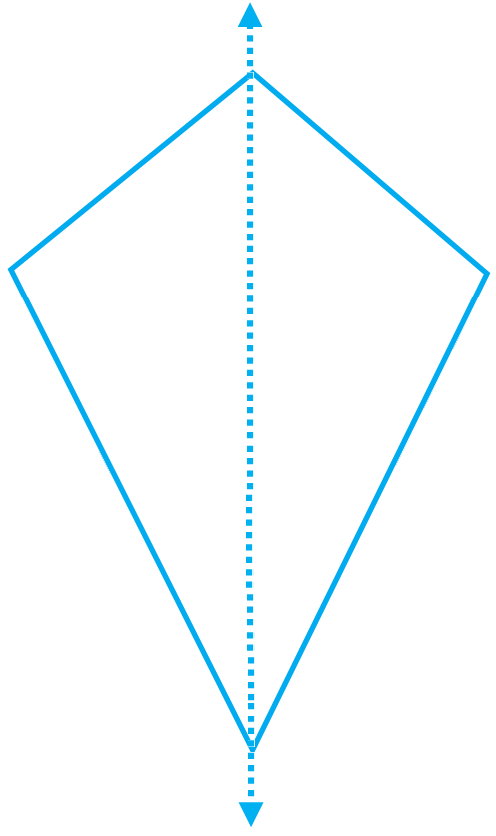
$(iii)$ A kite has $1$ line of symmetry.

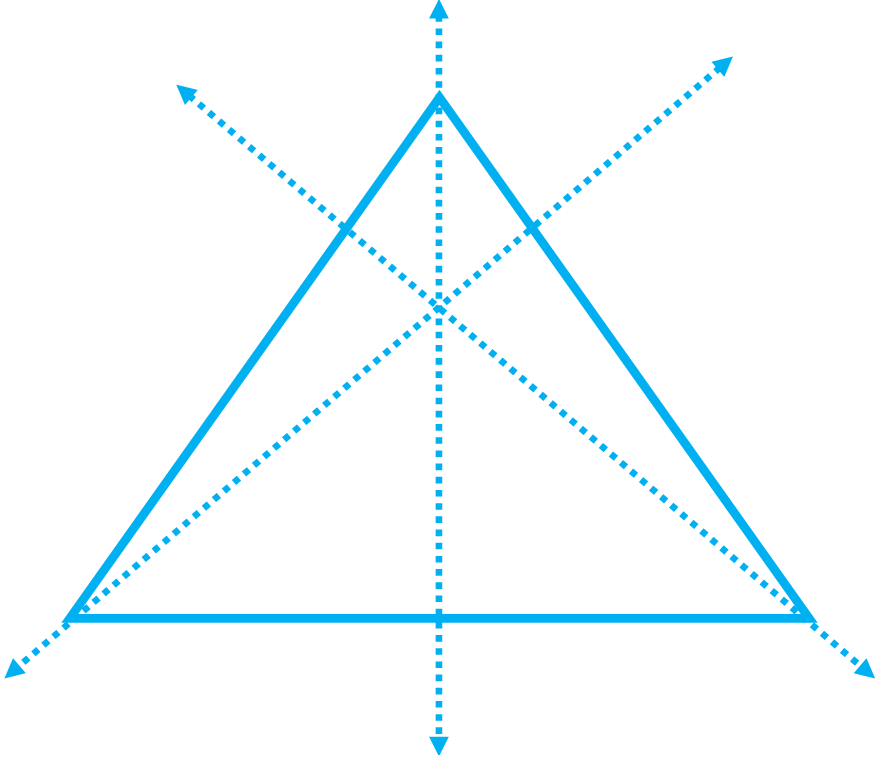
$(iv)$ An equilateral triangle has $3$ lines of symmetry.

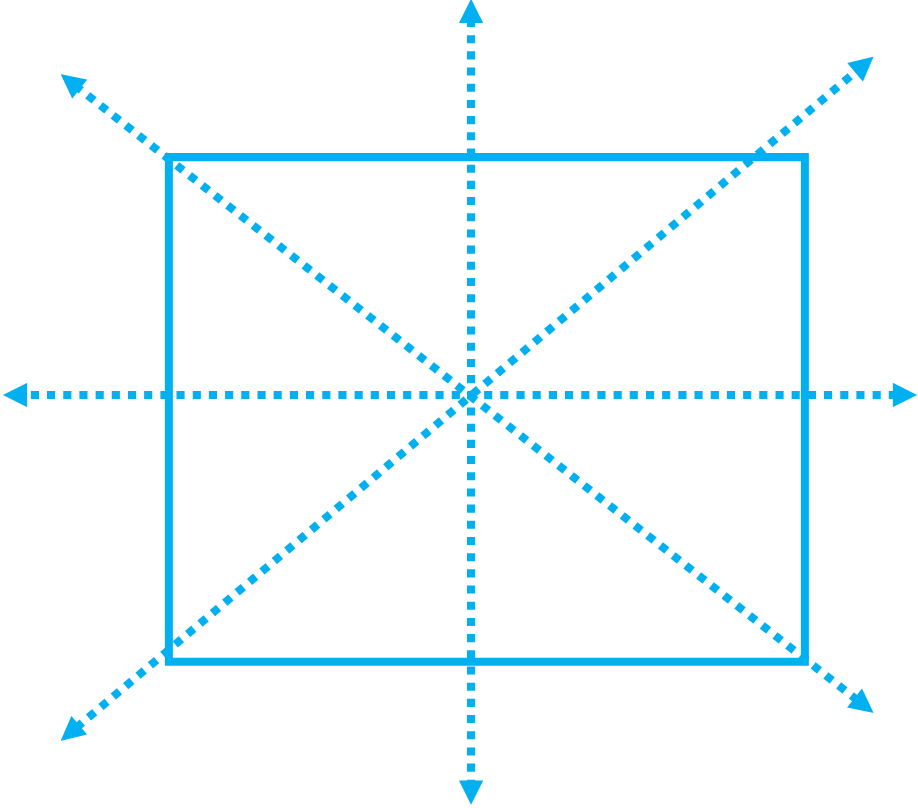
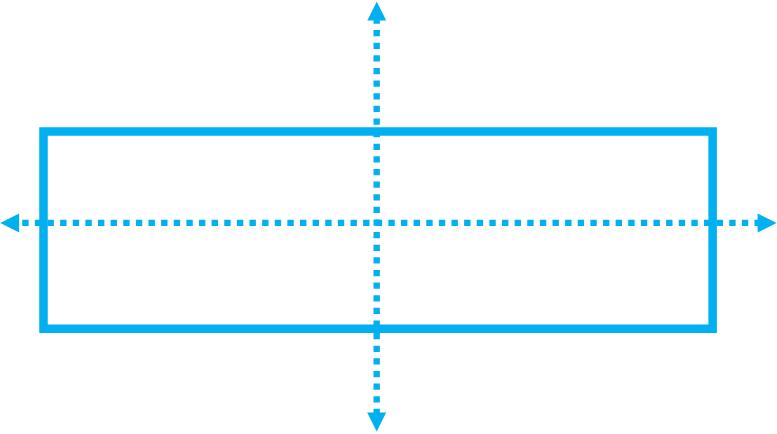
$(v)$ A rectangle has $2$ lines of symmetry.

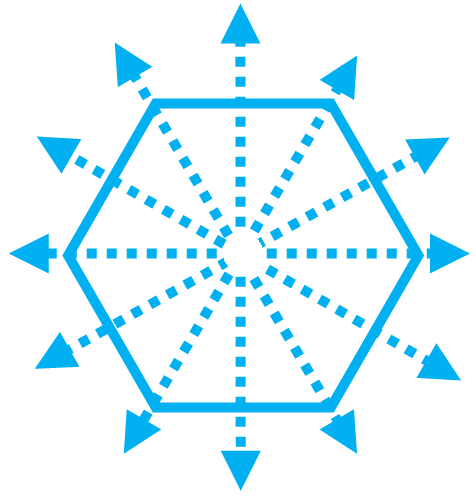
$(vi)$ A regular haxagon has $6$ lines of symmetry.

$(vii)$ A scalene triangle has no line of symmetry, i.e.
$\therefore (i) \rightarrow f, (ii) \rightarrow c, (iii) \rightarrow f, (iv) \rightarrow d, (v) \rightarrow e, (vi) \rightarrow a, (vii) \rightarrow g.$
View full question & answer
Question 95 Marks
Open your geometry box. There are some drawing tools. Observe them and complete the following table:
S.No.
Name of the tool
Number of lines of symmetry
$i.$
The Ruler.
__________________
$ii.$
The Divider.
__________________
$iii.$
The Compasses.
__________________
$iv.$
The Protactor.
__________________
$v.$
Triangular piece with two equal sides.
__________________
$vi.$
Triangular piece with unequal sides.
__________________
Answer
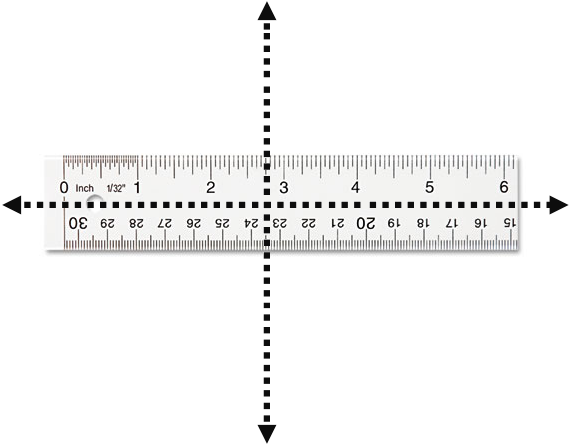
$(i)$ Ruler:It has two lines of symmetry.


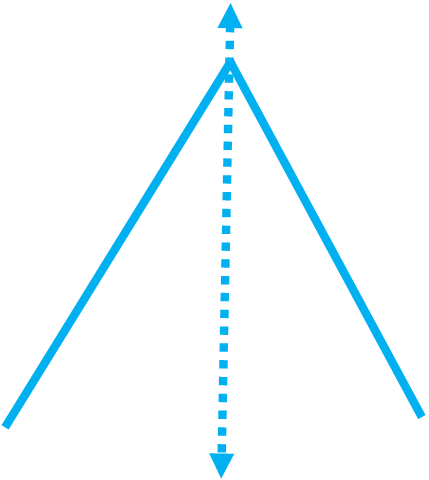
$(ii)$​​​​​​​ Divider:It has one line of symmetry.

$ (iii)$ Compass: Since, both the sides of a compass are not identical. Therefore, it has no line of symmetry.

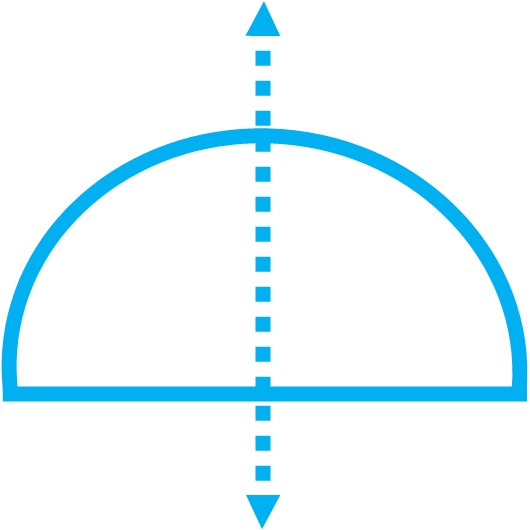
$(iv)$​​​​​​​ Protractor: Since, a protractor has a shape od semi-circle and a semi-circle has only one line of symmetry.

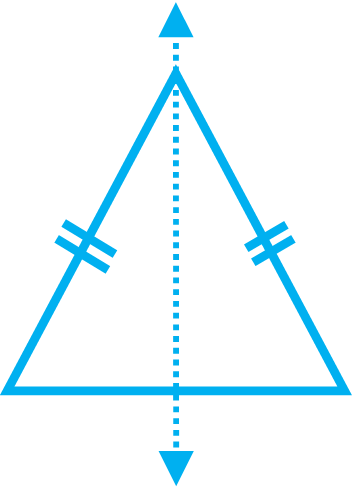
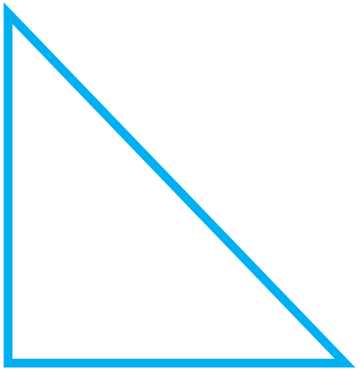
$​​​​​​​ (v)$​​​​​​​ Triangular plece with two equal sides:

$(vi) $​​​​​​​ Triangular piece with unequal sides: Since, all the sides are unequal. Therefore, it has no line of symmetry.
​​​​​​​
S.No.
Name of the tool
Number of lines of symmetry
$i.$
The Ruler.
$2$
$ii.$
The Divider.
$1$
$iii.$
The Compasses.
$0$
$iv.$
The Protactor.
$1$
$v.$
Triangular piece with two equal sides.
$1$
$vi.$
Triangular piece with unequal sides.
$0$
View full question & answer
Question 105 Marks
Draw an angle of $65^\circ$ and draw an angle equal to this angle, using ruler and compasses.
Answer
Given, $\angle\text{B}=65^\circ$

Step of construction are as follows:
Step I: Draw a line $l$ and choose a point $P$ on it.

Step II: Place the compass at $B$ and draw an arc to cut the rays of $\angle\text{B}$ at $A$ and $C.$
Step III: Use the same compass setting to draw an arc with $P$ as centre, cutting $l$ at $Q.$​​​​​​​

Step IV: Set your compass to the length $AC.$​​​​​​​

Step V: Place the compass pointer at $Q$ and draw the arc to cut the previous arc in $R.$​​​​​​​

Step VI: Join $PR.$ This gives us $\angle \text{P}.$ It has the same measure as $\angle\text{B.}$
This means $\angle\text{QPR}$ has same measure as $\angle\text{ABC.}$
View full question & answer