Questions

[5 Marks Each] QUE-ANS

Take a timed test

9 questions · self-marked practice — reveal the answer and mark yourself.

Question 15 Marks
Match Column $I$ with Column $II$ (One option of $A$ can match with more than one option of $B$)
  $COLUMN\ I$   $COLUMN\ II$
$(a)$ Magnet attracts $(i)$ resis along a particular direction
$(b)$ Magnet can be repelled $(ii)$ iron
$(c)$ Magnet if suspended freely $(iii)$ by another magnet
$(d)$ Poles of the magnet can be identified by $(iv)$ iron filing
Answer
 
$COLUMN\ I$
 
$COLUMN\ II$
$(a)$
Magnet attracts
$(ii)$
$(iii)$
$(iv)$
iron
by another magnet
iron filing
$(b)$
Magnet can be repelled
$(iii)$
by another magnet
$(c)$
Magnet if suspended freely
$(i)$
resis along a particular direction
$(d)$
Poles of the magnet can be identified by
$(iii)$
by another magnet
Explanation:
  1. - $(ii)$, $(iii)$ and $(iv)$
A magnet can attract magnetic materials like iron, iron filings and another magnet.
  1. - $(iii)$
If the North pole of a magnet is brought near the North pole of another magnet, then they both repel each other. Similarly, $S-S$ poles of two magnets repel each other.
  1. - $(i)$
A magnet always stops in a particular direction $(N-S)$, if suspended freely from a thread from its centre.
  1. - $(iii)$
Poles of a magnet can be identified only if we have another magnet having its poles marked as North pole and South pole because only then we can see the attraction and repulsion between $N-S$ poles and $N-N$ poles, respectively.
View full question & answer
Question 25 Marks
You are given an iron strip. How will you make it into a magnet?
Answer
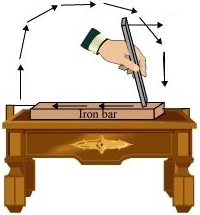
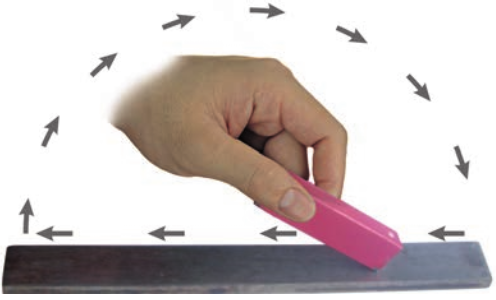
‘Touch and stroke’ method can be used to make an iron strip into a magnet. For this, a bar magnet is required. The bar magnet is moved along the length of the iron strip starting from one end to the other end (as shown in the given figure).

Then, the bar magnet is lifted from the other end and brought to the starting point again with the same pole of the bar magnet. On repeating the process for at least $40$ to $50$ times, the iron strip will become a bar magnet with two poles.
View full question & answer
Question 35 Marks
Suggest an arrangement to store a $U$ shaped magnet. How is this different from storing a pair of bar magnets?
Answer
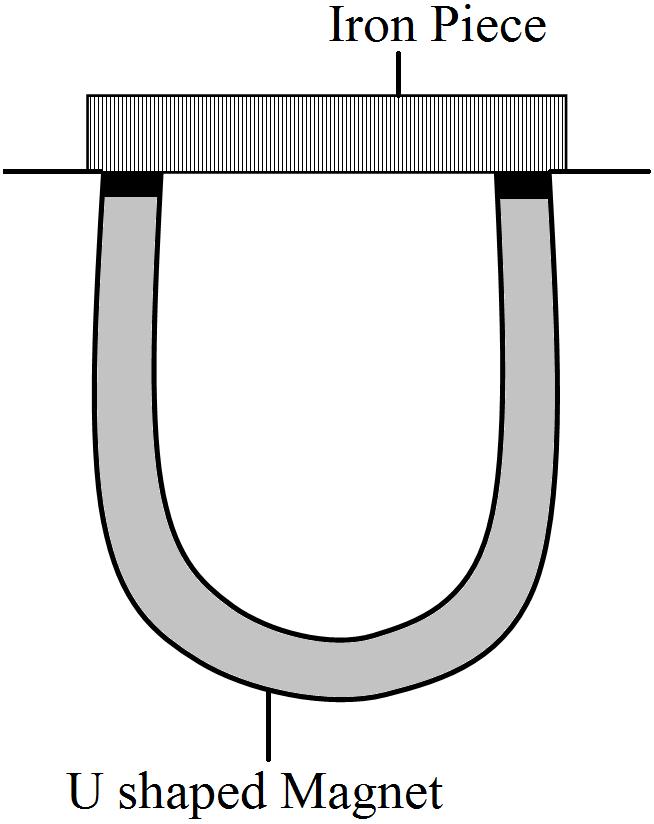
It is a suggested way shown in figure below:

$U$-shaped magnet is kept along with an iron piece across its two poles, while a pair of bar magnets is kept along with iron strips and magnets separated by wood along their length as shown in above figure.
View full question & answer
Question 45 Marks


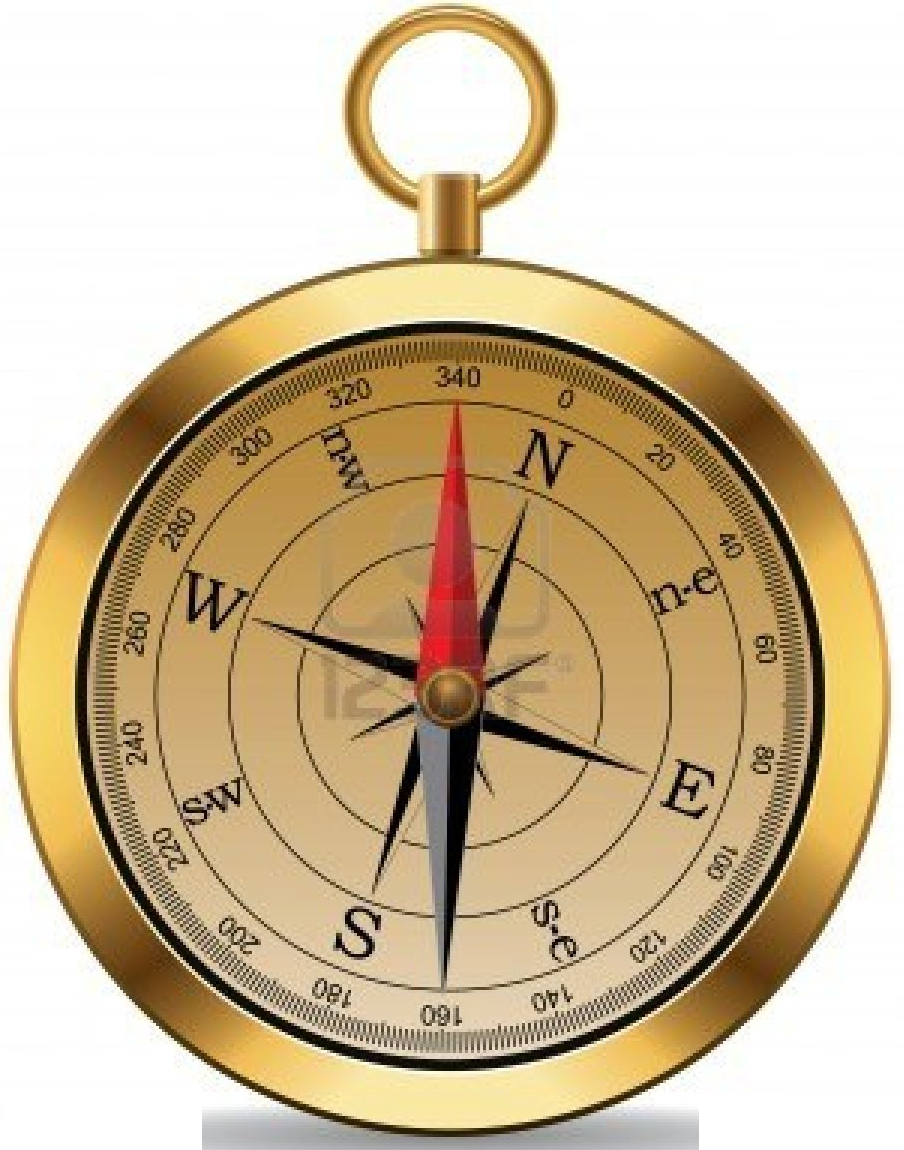
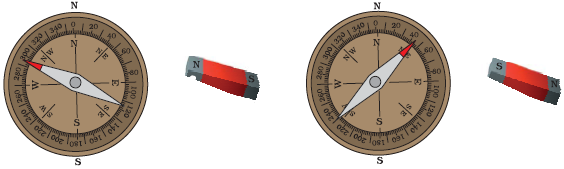
Fig. shows a magnetic campass. What will happen to the position of its needle if you bring a bar magnet near it? Draw a diagram to show the effect on the needle on bringing the bar magnet near it. Also draw the diagram to show the effect when the other end of the bar magnet is brought near it.
Answer
If we bring a bar magnet near a magnetic compass $N$, its needle will get deflected.

When we bring North pole of a bar magnet near the magnetic compass, its needle will be deflected away from the magnet as shown in Fig. $(i)$. However, when we bring South pole of bar magnet near the magnetic compass, needle will be deflected towards the magnet as shown in Fig. $(ii)$.
View full question & answer
Question 55 Marks
How will you test that ‘tea dust’ is not adulterated with iron powder?
Answer
We can do a simple experiment for this:
  1. Take tea dust on a paper.
  2. Take a bar magnet in your hand.
  3. Place the bar magnet over this dust.
  4. If some particles are attracted strongly towards this magnet by clinging to it, then definitely tea dust will have iron powder.
View full question & answer
Question 65 Marks
Suggest an activity to prepare a magnetic compass by using an iron needle and a bar magnet.
Answer
Steps involved in preparing a magnetic compass are:
  1. Take an iron needle which is to be magnetised.
  2. Magnetise it using a bar magnet.
  3. Insert the magnetised needle through a small piece of cork.
  4. Let the cork float in a water in a bowl. Make sure that the needle does not touch the water.
  5. Your magnetic compass is now ready to work. Note the direction in which the needle points when the cork is floating.
  6. Rotate the cork, with the needle fixed in it, in different directions. Note the direction in which the needle points when the cork begins to float again without rotating. You will observe that the needle indicates the North-South direction when it comes to rest.
View full question & answer
Question 75 Marks
Describe the steps involved in magnetising an iron strip with the help of a magnet.
Answer
Steps involved in magnetising an iron strip are:
  1. Take an iron strip which is to be magnetised.
  2. Keep it on a wooden table.
  3. Hold one end of a bar magnet in your hand and keep the other end of bar magnet near one edge of iron strip.
  4. Without lifting, move it along the length of iron strip till you reach the other edge.
  5. After reaching the end of iron strip, lift the bar magnet and bring it to the same position and repeat the process again and again.
  1. Bring some iron filings near the iron strip to check whether it has become a magnet. If not, continue the same process for some more time.
View full question & answer
Question 85 Marks
Three identical iron bars are kept on a table. Two out of three bars are magnets. In one of the magnet the North-South poles are marked. How will you find out which of the other two bars is a magnet? Identify the poles of this magnet.
Answer
To find out the magnet:
  1. Take the bar magnet with known poles in your hand.
  2. Take one of the other two iron bars in other hand.
  3. Bring one side of iron bar towards the South pole of the bar magnet and note down whether it is attracted or repelled.
  4. Bring other side of iron bar towards the South pole of the bar magnet and again note down the same thing.
  5. If there is an attraction in both cases $(iii)$ and $(iv)$, then it is definitely a simple iron bar.
  6. If there is an attraction in one case and repulsion in other case, then it is a bar magnet.
  7. Do the same for the third iron bar.
To find out the poles:
If in case $(iii)$, the bar is attracted, then it is North pole of the identified bar magnet. If the bar is repelled, then it is obviously a South pole of the identified bar magnet.
View full question & answer
Question 95 Marks
A magnet was brought from different directions towards a toy boat that has been floating in water in a tub. Affect observed in each case is stated in Column $I$. Possible reasons for the observed affects are mentioned in Column $II$. Match the statements given in Column $I$ with those in Column $II$.
S.No.
Column $I$
S.No.
Column $II$
$1.$
Boat gets attracted towards the magnet.
$A.$
Boat is fitted with a magnet with the north pole towards its head.
$2.$
Boat is not affected by the magnet.
$B.$
Boat is fitted with a magnet with the south pole towards its head.
$3.$
Boat moves towards the magnet when the north pole of the magnet is brought near its head.
$C.$
Boat has a small magnet fixed along its length.
$4.$
Boat moves away from the magnet when the north pole is brought near its head.
$D.$
Boat is made of magnetic material.
$5.$
Boat floats without changing its direction.
$E.$
Boat is made of a non-magnetic material.
Answer
S.No.
Column $I$
 
Column $II$
$1.$
Boat gets attracted towards the magnet.
$D.$
Boat is made of a magneticmaterial.
$2.$
Boat is not affected by the magnet.
$E.$
Boat is made of a non-magneticmaterial.
$3.$
Boat moves towards the magnet when the north pole of the magnet is brought near its head.
$B.$
Boat is fitted with a magnet with the south pole towards its head.
$4.$
Boat moves away from the magnet when the north pole is brought near its head.
$A.$
Boat is fitted with a magnet withthe north pole towards its head.
$5.$
Boat floats without changing its direction.
$C.$
Boat has a small magnet fixed along its length.
  1. Magnetic materials get attracted towards a magnet.
  2. Non-magnetic materials do not get attracted towards a magnet.
  3. Unlike poles of magnets attract each other.
  4. Like poles of magnets repel each other.
  5. Magnets always point towards the North-South direction.
View full question & answer