Questions

[5 Marks Each] QUE-ANS

Take a timed test

16 questions · self-marked practice — reveal the answer and mark yourself.

Question 15 Marks
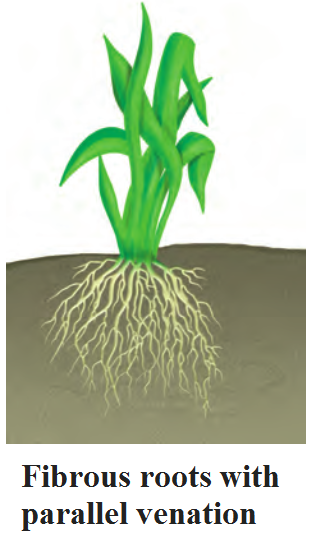
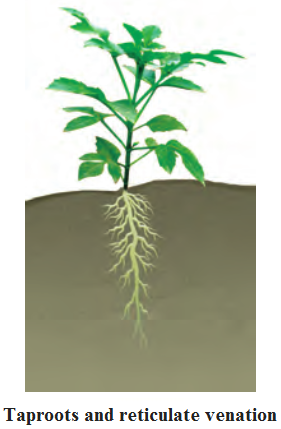
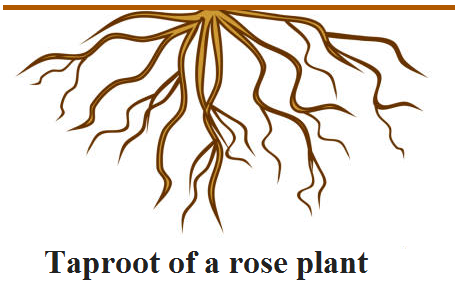
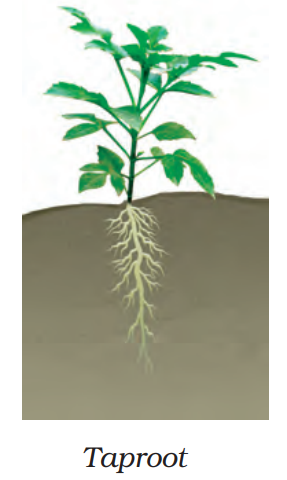
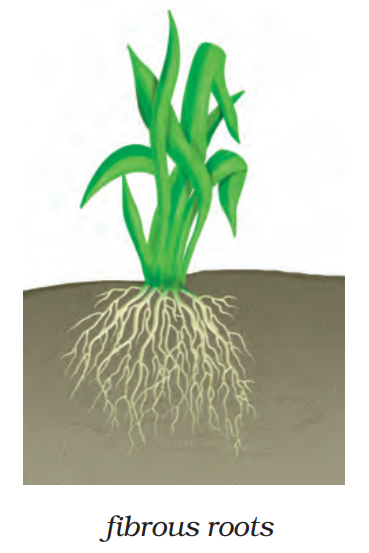
Explain the difference between taproots and fibrous roots with the help of diagrams.
Answer
S.No.
Taproots
Fibrous Roots
$1.$
There is only one main and long root from which small roots grow.
There is no main root. Many roots are grown together from the base of the stem in the form of bundle.
$2.$
These roots go deep into the soil to more depth.
These roots do not go very deep.
$3.$
These roots cannot be separated from soil easily.
These roots are easily separated from the soil.
$4.$
Found in the plants like weeds having reticulate venation in leaves.
Found in the plants like grasses having parallel venation in leaves.
View full question & answer
Question 25 Marks
Match the parts of plant given in Column $I$ with their function in Column $II$:
Serial Number
Column $I$
Serial Number
Column $II$
$A.$
Flower
$i.$
Excretion
$B.$
Leaf
$ii.$
Photosynthesis
$C.$
Stem
$iii.$
Reproduction
$D.$
Root
$iv.$
Bears branches
$E.$
 
$v$
Anchorage
Answer
Serial Number
Column $I$
Serial Number
Column $II$
$A.$
Flower
$iii.$
Reproduction
$B.$
Leaf
$ii.$ Photosynthesis
$C.$
Stem
$iv.$
Bears branches
$D.$
Root
$v$ Anchorage
Note: Plants do not have specialized excretory organs.
View full question & answer
Question 45 Marks
Identify the wrong statements and correct them:
  1. Anther is a part of the pistil.
  2. The visible parts of a bud are the petals.
  3. Lateral roots are present in a tap root.
  4. Leaves perform the function of transpiration only.
Answer
  1. It is wrong.
Correct statement– Anther is a part of stamen.
  1. It is wrong.
Correct statement–Visible part of a bud are the sepals.
  1. It is correct.
Tap root is the main root and the smaller side roots are called lateral roots.
  1. It is wrong.
Correct statement– Leaves perform three main functions, i.e. photosynthesis, transpiration and respiration.
View full question & answer
Question 55 Marks
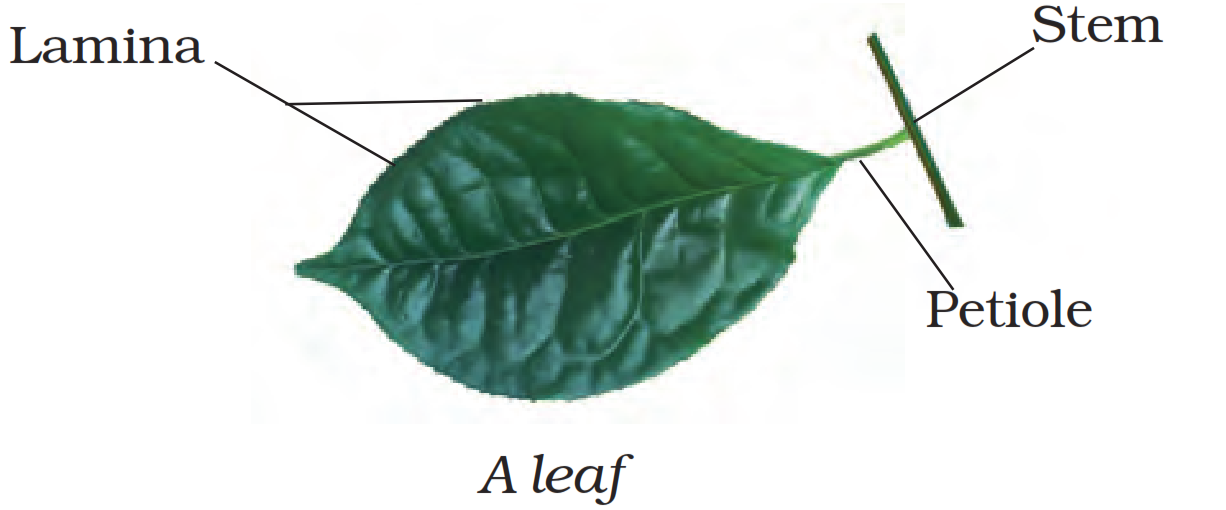
If a plant has fibrous root, what type of venation do its leaves have?
Answer

Plants with fibrous roots have parallel venation in their leaves. For example, grass, wheat, maize, etc. have fibrous roots with parallel venation.
Fibrous roots have thin and moderately growing branches arising from the stem. Parallel venation, on the other hand, has leaves in which the veins are arranged parallel to each other.
View full question & answer
Question 65 Marks
If a plant has leaves with reticulate venation, what kind of roots will it have?
Answer
Plants with reticulate venation in their leaves are likely to have tap roots. For example, a carrot or a rose plant has leaves with reticulate venation and its roots are called tap roots.

Taproots and reticulate venation: In tap roots, there is one main root known as the ‘tap root’ that grows straight down from the stem. It also has smaller roots known as ‘lateral roots’. In leaves with reticulate venation, the veins are arranged in a net-like pattern.
View full question & answer
Question 75 Marks
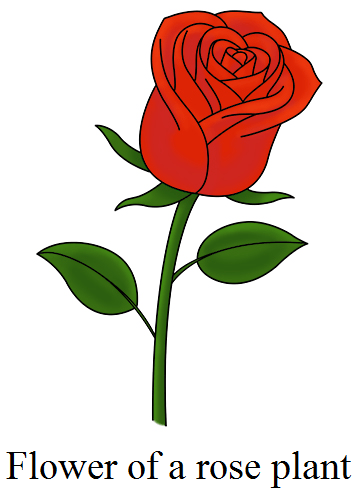
What are the parts of a flower.
Answer
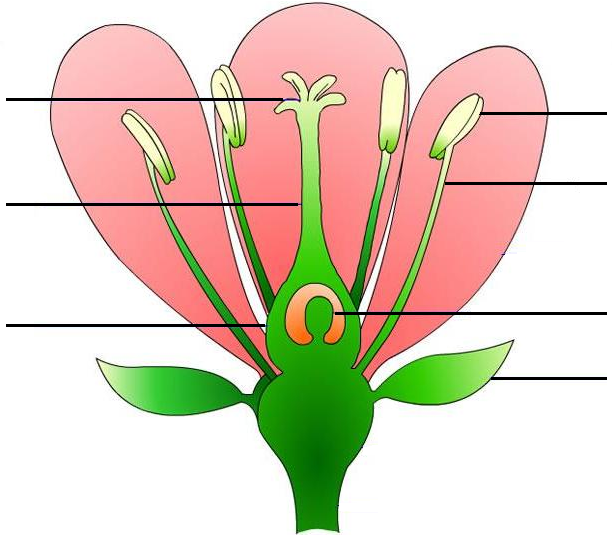
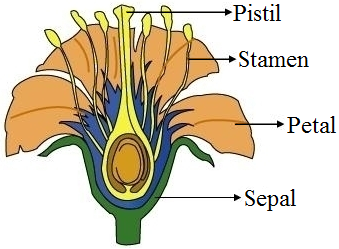
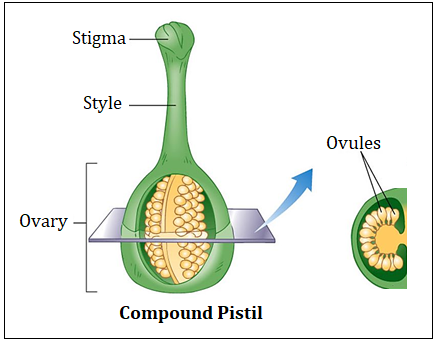
A flower consists of sepals, petals, stamens, and pistils. A stamen has two parts called the anther and the filament. A pistil has three parts called the stigma, style, and ovary.
View full question & answer
Question 85 Marks
Read the function of parts of a plant given below:
  1. Fixes plant to the soil.
  2. Prepares starch.
  3. Takes part in reproduction.
  4. Supports branches and bears flowers.
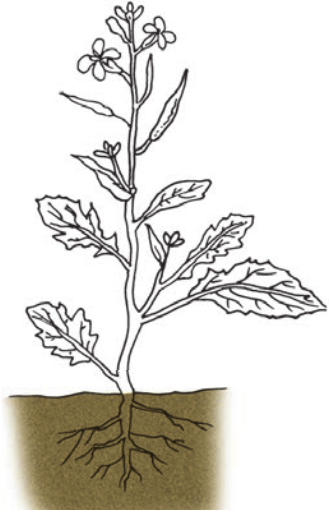
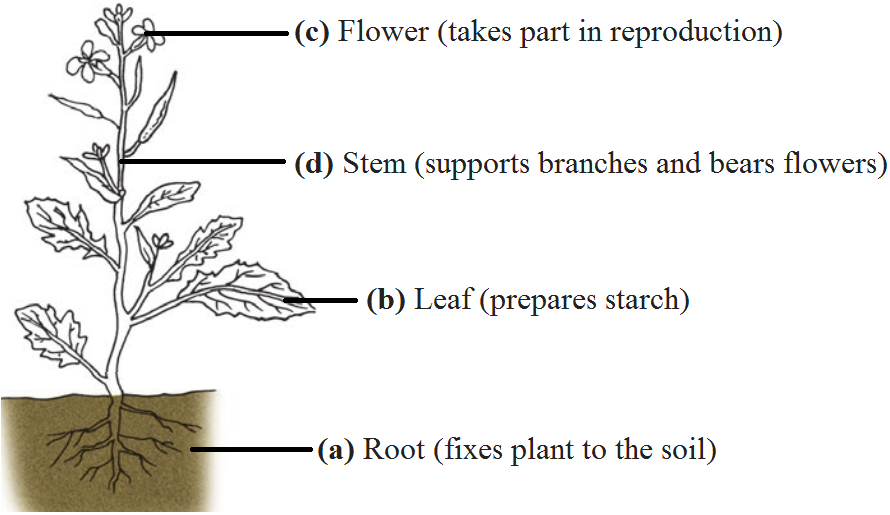
In the diagram given in fig, write the names of the parts whose functions you have just read at the appropriate space.
Answer
Functions of parts of a plant labelled are:
  1. Flower (takes part in reproduction).
  2. Stem (supports branches and bears flowers).
  3. Leaf (prepares starch).
  4. Root (fixes plant to the soil).
View full question & answer
Question 105 Marks
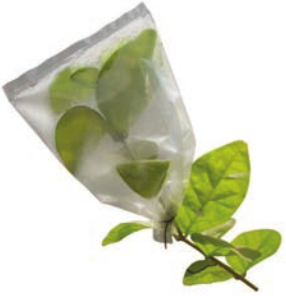
Observe the picture of an activity given as Fig carried out with leaves of plants and polythene bag.

Now answer the following:
  1. Which process is demonstrated in the activity?
  2. When will this activity show better results–on a bright sunny day or a cloudy day?
  3. What will you observe in the polythene bag after a few hours of setting up the activity?
  4. Mention any one precaution you must take while performing this activity.
Answer
  1. The process demonstrated in the activity is transpiration. It is loss of water in the form of vapour from plant.
  2. The activity will show better results on a bright sunny day because transpiration ,s maximum in sunlight.
  3. After a few hours of setting up the activity, one can observe small droplets of water inside the polythene bag. Since, the leaves are enclosed in polythene bag. the water vapour cannot escape into air and keeps on collecting inside the polythene bag.
  4. A major precaution one must take, while performing this activity is that the polythene bag should be clean and dry and its mouth should be sealed properly to make the set-up air-tight. Also, the twig should be fresh with $10-12$ leaves.
View full question & answer
Question 115 Marks
Select leaves showing reticulate venation and those showing parallel venation from the list given below and write them in the tabular form:
Peepal, neem, grass, mustard, methi, dhania (coriander), rose, tulsi, mango, sugarcane, maize, mint, wheat, rice.
Answer
S.No.
Reticulate Venation
Parallel Venation
$1.$
Peepal
Grass
$2.$
Xeem
Sugarcane
$3.$
Mustard
Maize
$4.$
Methi
Wheat
$5.$
Dhania (coriander)
  • Rose
  • Tulsi
  • Mango
  • Mint
Rice
View full question & answer
Question 125 Marks
Look carefully on the stem arising from various plants growing around you. Based on your observation, fill the following Table.
S.No.
Description of the stem
Name of the plant
$1.$
Green and tender stem.
 
$2.$
Hard, woody, thick brown stem.
 
$3.$
Hard, woody, thin stem.
 
$4.$
Branches arise from the base of the stem.
 
$5.$
Branches arise from the upper part of the stem.
 
Answer
S.No.
Description of the stem
Name of the plant
$1.$
Green and tender stem.
Pea
$2.$
Hard, woody, thick brown stem.
Mango
$3.$
Hard, woody, thin stem.
Ladyfinger
$4.$
Branches arise from the base of the stem.
Rose
$5.$
Branches arise from the upper part of the stem.
Rubber plant
View full question & answer
Question 135 Marks
Uproot few different plants around you and study them. In Table given below note the various parts seen in the different plants.
S.No.
Name of the plant
Hoot
Stem
Leaf
Flower
Fruit
Seed


Answer
S.No.
Name of the Plant
Root
Stem
Leaf
Flower
Fruit
seed
$1.$
Radish
$\checkmark$
$\checkmark$
$\checkmark$


$2.$
Oil seed
$\checkmark$
$\checkmark$
$\checkmark$
$\checkmark$
 
$\checkmark$
$3.$
Palak (spinach)
$\checkmark$
 
$\checkmark$


$4.$
Rose
$\checkmark$
$\checkmark$
$\checkmark$
$\checkmark$
 
 
$5.$
Potato
$\checkmark$
$\checkmark$
$\checkmark$


$6.$
Croton
$\checkmark$
$\checkmark$
$\checkmark$


$7.$
Nagfali (cactus)
 
$\checkmark$
$\checkmark$


$8.$
Pudona (mint)
$\checkmark$
$\checkmark$
$\checkmark$


$9.$
Dhania (coriander)
$\checkmark$
$\checkmark$
$\checkmark$
$\checkmark$
$\checkmark$
 
$10.$
Maize
$\checkmark$
$\checkmark$
$\checkmark$
 
 
$\checkmark$
$11.$
Bathua (chenopodium)
 
$\checkmark$
$\checkmark$
$\checkmark$
 
 
View full question & answer
Question 165 Marks
Match the following items given in Column $A$ with that in Column $B$:
S.No.
Column $A$
S.No.
Column $B$
$(a)$
Creeper
$(i)$
Absorption of mineral and water.
$(b)$
Herb
$(ii)$
Manufacture food.
$(c)$
Shrub
$(iii)$
Transport food, water and mineral.
$(d)$
Tree
$(iv)$
Reproduction.
$(e)$
Root
$(v)$
Need support to stand up.
$(f)$
Stem
$(vi)$
Hard and thick stem.
$(g)$
Leaf
$(vii)$
Green and tender stem.
$(h)$
Flower
$(viii)$
Hard but thin stem.
Answer
S.No.
Column $A$
S.No.
Column $B$
$(a)$
Creeper
$(v)$
Need support to stand up.
$(b)$
Herb
$(vii)$
Green and tender stem.
$(c)$
Shrub
$(viii)$
Hard but thin stem.
$(d)$
Tree
$(vi)$
Hard and thick stem.
$(e)$
Root
$(i)$
Absorption of mineral and water.
$(f)$
Stem
$(iii)$
Transport food, water and mineral.
$(g)$
Leaf
$(ii)$
Manufacture food.
$(h)$
Flower
$(iv)$
Reproduction.
View full question & answer