Question types

Water question types

323 questions across 9 question groups — pick any mix to generate a Science paper with step-by-step answer keys.

323
Questions
9
Question groups
5
Question types
Sample Questions

Water questions

One sample from each question group in this chapter. Select any group above to see the full set with answer keys.

DIRECTIONS: Read the passage (s) given below and answer the questions that/ allow Passage - Apart from drinking, there are so many activities for which we use water. Most of the water is in oceans and seas. We draw drinking water from taps which is further drawn from a well or a lake etc. We need water for which of the following?
  • A
    Baking.
  • B
    Brushing.
  • C
    Cooking.
  • All of these.

Answer: D.

View full solution
When you see clouds forming in the sky, the water above you is forming droplets in what stage of the water cycle?
  • A
    Collection
  • B
    Evaporation
  • Condensation
  • D
    Precipitation

Answer: C.

View full solution
A cloud is unable to hold droplets of water because:
  • They become heavier.
  • B
    They become lighter.
  • C
    They undergo condensation slowly.
  • D
    They undergo sublimation.

Answer: A.

View full solution
DIRECTIONS: The questions in this segment consists of two statements one labelled as ?Assertion $A$? and the other labelled as ?Reason $R?$ You are to examine these two statements carefully and decide if the assertion $A$ and reason $R$ are individually true and if so, whether the reason is a correct explanation of the assertion. Select your answers to these items using codes given below.
Assertion (A): During drought there is a shortage of food and fodder.
Reason (R): Droughts result in conservation of water.
  • A
    Both $A$ and $R$ are true and $R$ is the correct explanation of $A$
  • B
    Both $A$ and $R$ are true but $R$ is not the correct explanation of $A$
  • $A$ is true but $R$ is false
  • D
    $A$ is false but $R$ is true

Answer: C.

View full solution
DIRECTIONS: The questions in this segment consists of two statements one labelled as ?Assertion $A?$ and the other labelled as ?Reason $R?$ You are to examine these two statements carefully and decide if the assertion $A$ and reason $R$ are individually true and if so, whether the reason is a correct explanation of the assertion. Select your answers to these items using codes given below.
Assertion (A): In such areas where there is no vegetation the rain water flows quickly and has no effect on the top layer of soil of that area.
Reason (R): When water level rises in rivers, ponds etc. Due to excessive rains it causes floods.
  • A
    Both $A$ and $R$ are true and $R$ is the correct explanation of $A$
  • B
    Both $A$ and $R$ are true but $R$ is not the correct explanation of $A$
  • C
    $A$ is true but $R$ is false
  • $A$ is false but $R$ is true

Answer: D.

View full solution
DIRECTIONS: The questions in this segment consists of two statements one labelled as ?Assertion $A?$ and the other labelled as ?Reason $R?$ You are to examine these two statements carefully and decide if the assertion $A$ and reason $R$ are individually true and if so, whether the reason is a correct explanation of the assertion. Select your answers to these items using codes given below.
Assertion (A): Role of oceans in supplying usable water is quite important.
Reason (R): When the sea water reaches us, in various other forms of sources of water, it is no more saline.
  • A
    Both $A$ and $R$ are true and $R$ is the correct explanation of $A$
  • Both $A$ and $R$ are true but $R$ is not the correct explanation of $A$
  • C
    $A$ is true but $R$ is false
  • D
    $A$ is false but $R$ is true

Answer: B.

View full solution
DIRECTIONS: The questions in this segment consists of two statements one labelled as ?Assertion $A?$ and the other labelled as ?Reason $R?$ You are to examine these two statements carefully and decide if the assertion $A$ and reason $R$ are individually true and if so, whether the reason is a correct explanation of the assertion. Select your answers to these items using codes given below.
Assertion (A): The sea water is saline.
Reason (R): The sea water contains many dissolved salts.
  • Both $A$ and $R$ are true and $R$ is the correct explanation of $A$
  • B
    Both $A$ and $R$ are true but $R$ is not the correct explanation of $A$
  • C
    $A$ is true but $R$ is false
  • D
    $A$ is false but $R$ is true

Answer: A.

View full solution
DIRECTIONS: The questions in this segment consists of two statements one labelled as ?Assertion $A?$ and the other labelled as ?Reason $R?$ You are to examine these two statements carefully and decide if the assertion $A$ and reason $R$ are individually true and if so, whether the reason is a correct explanation of the assertion. Select your answers to these items using codes given below.
Assertion (A): Sea water changes to water vapours by the process of transpiration in the presence of sunlight.
Reason (R): When sea water changes into water vapour it leaves the dissolved salts behind.
  • A
    Both $A$ and $R$ are true and $R$ is the correct explanation of $A$
  • B
    Both $A$ and $R$ are true but $R$ is not the correct explanation of $A$
  • C
    $A$ is true but $R$ is false
  • $A$ is false but $R$ is true

Answer: D.

View full solution
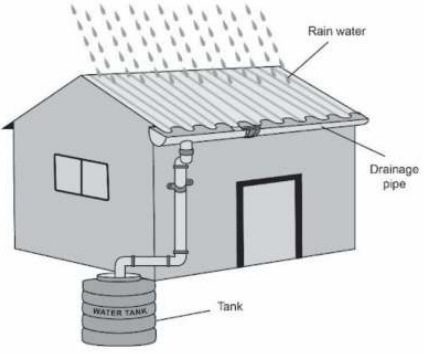
The picture shows how rainwater is stored in tanks for home use.Image
9. Is the water collected in the water tank safe for drinking? Explain your answer.
10. Why is rainwater harvesting important?
$A.$ To help plants grow better
$B.$ To reduce water pollution
$C.$ To collect water that is rich in minerals
$D.$ To reduce the demand for water supply
View full solution
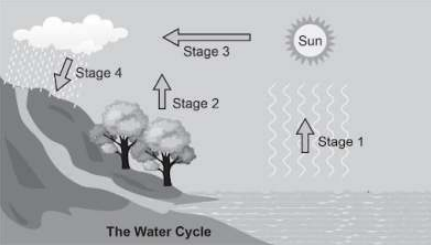
The picture shows the four different stages of the water cycle.Image
$5.$ Which stage shows the process of transpiration?
$A.$ Stage $1$
$B.$ Stage $2$
$C.$ Stage $3$
$D.$ Stage $4$
$6.$ In which stage does water vapour condense to form water droplets?
$A.$ Stage $1$
$B.$ Stage $2$
$C.$ Stage $3$
$D.$ Stage $4$
$7.$ On which day will stage $1$ of the water cycle progress the slowest?
$A.$ A hot and sunny day
$B.$ A cold and sunny day
$C.$ A hot and cloudy day
$D.$ A cold and cloudy day
$8.$ Which of the following statements about the water cycle is true?
Circle $‘Yes’$ or $‘No’$ for the correct response.
Is the statement about the water cycle true? $Yes$ or $No$
Some water is lost to the space during the water cycle. $Yes/No$
Water from the ocean and land goes into air as vapour. $Yes/No$
Water cycle is a continuous process. $Yes/No$
View full solution
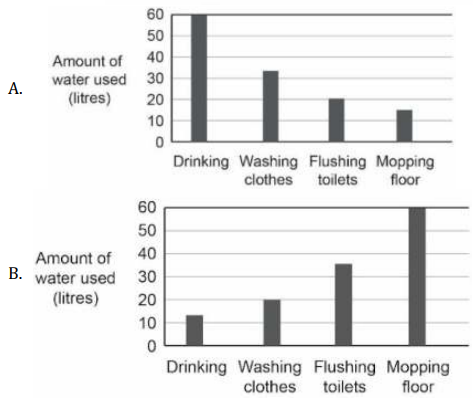
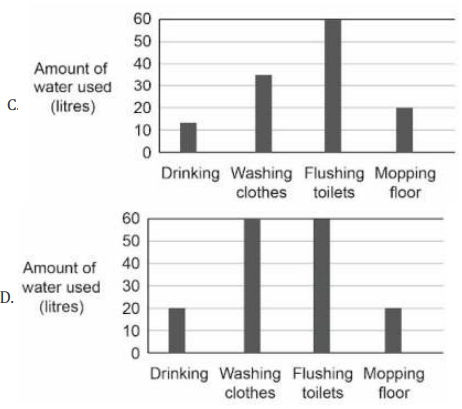
The table shows the amount of water required for different activities in a house.
Activity Amount of water used daily
Drinking $15$ litres
Washing clothes $35$ litres
Flushing toilets $60$ litres
Mopping floor $20$ litres
$1.$ Which graph correctly shows the data in the table?
Image
Image
$2.$ Which activity in the house requires the most water?
$A.$ Drinking
$B.$ Washing clothes
$C.$ Flushing toilets
$D.$ Mopping loor
$3.$ Which of these activities helps to prevent wastage of water?
$A.$ Water plants with drinking water
$B.$ Wash vegetables in running tap water
$C.$ Pour water with buckets to clean a cycle
$D.$ Close shower when applying shampoo on hair
$4.$ Which of these are the effects of loods?
Circle $‘Yes’$ or $‘No’$ for the correct response.
Is this an effect of lood? $Yes$ or $No$
Heating the magnet on ire $Yes/No$
Loss of domestic animals $Yes/No$
Decrease in groundwater level $Yes/No$
View full solution

Generate a Water paper free

Pick question groups from the list above, set marks and difficulty, and export a branded PDF with step-by-step answer keys. First 3 chapters free — no signup.

Download App