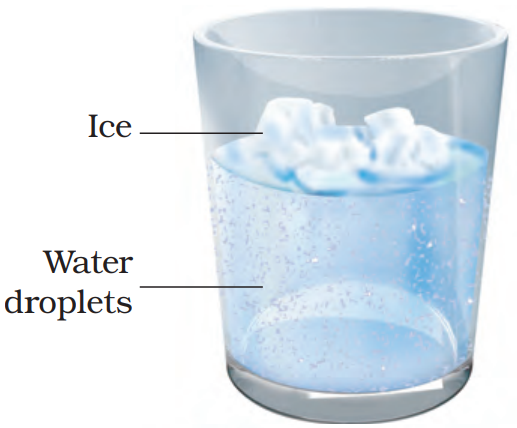
- AWater vapours as such.
- BWater vapours condensed to tiny droplets of water.
- ✓Tiny droplets of water and dust particles.
- DAll of the above.
159 questions · auto-graded multiple-choice test.
Water is useful to life on the earth. To maintain ecological balance, for sustaining life and it is also necessary for respiration in aquatic organisms.
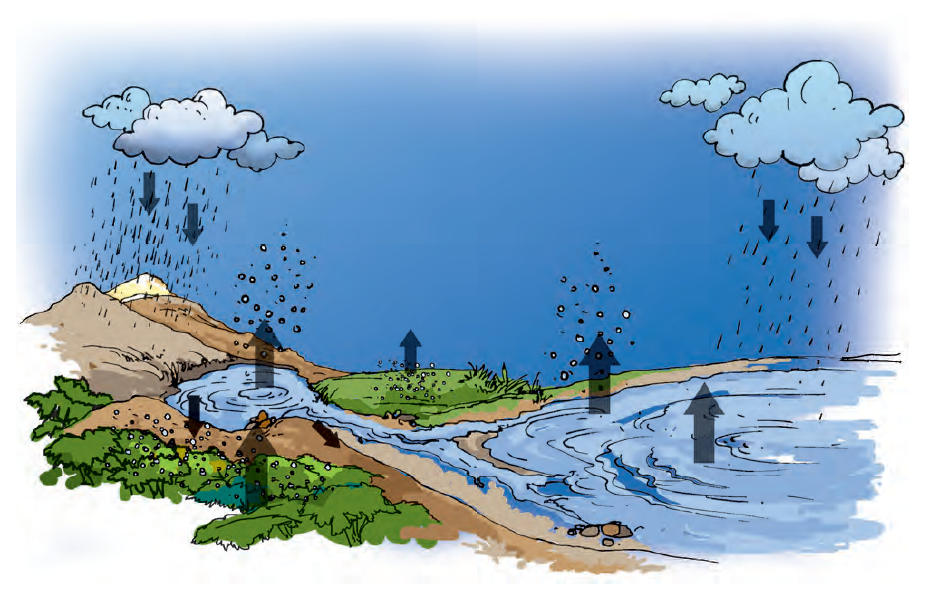
The stages are evaporation, condensation precipitation and collection.
|
S.No.
|
Column-$I$
|
S.No.
|
Column-$II$
|
|
$A$
|
Water cycle.
|
$(p)$
|
Solid state of water.
|
|
$B$
|
Hail, snow.
|
$(q)$
|
Condensation.
|
|
$C$
|
Water vapour changes to liquid water.
|
$(r)$
|
Circulation of water between ocean and land.
|
|
$D$
|
Water enters air.
|
$(s)$
|
Transpiration.
|

The puddle disappeared by evening, because of evaporation and the seepage of water into the ground.
When water boils, there will be a change in its temperature and state.
Abut $\frac23$ part of earth is covered with water.
|
S.No.
|
Column-$I$
|
S.No.
|
Column-$II$
|
|
$A$
|
Ground water
|
$(p)$
|
Excess rains.
|
|
$B$
|
Ocean
|
$(q)$
|
Aquifers.
|
|
$C$
|
Clouds
|
$(r)$
|
Water containing dissolved salts.
|
|
$D$
|
Floods
|
$(s)$
|
Water vapour and dirt.
|
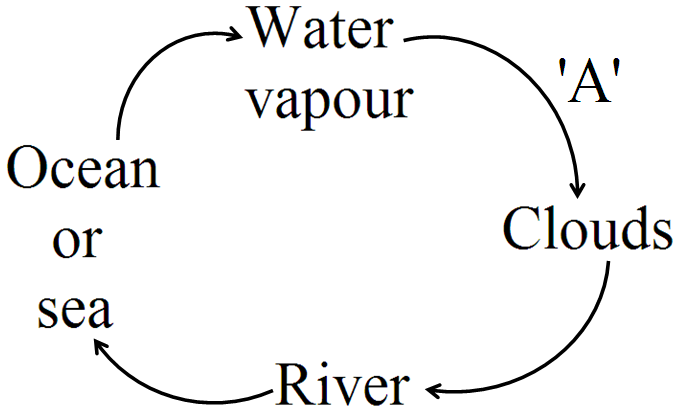
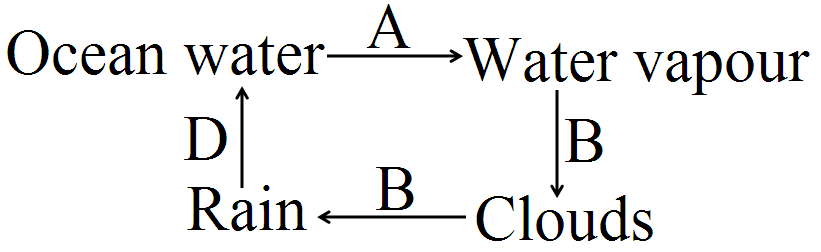
$A =$ Evaporation or transpiration, $B =$ Condensation.
Water is present in a large amount in natural substances like milk, blood and fruits.
Water is a compound because it is made up of a single type of molecules which have two different types of atoms hydrogen and oxygen.


Temperature plays an important role in the inter-conversion of water from liquid to solid-ice and gaseous state, steam.
Saline water is hard due to dissolved salts in it. Therefore, it is not used for the given purposes.
Transpiration is a process by which plants lose water.
Erosion is not a part of water cycle.
|
S.No.
|
Column-$I$
|
S.No.
|
Column-$II$
|
|
$A$
|
Drought.
|
$(p)$
|
Slow process.
|
|
$B$
|
Surface water.
|
$(q)$
|
Rivers, ponds etc.
|
|
$C$
|
Evaporation.
|
$(r)$
|
Loss of water by plants.
|
|
$D$
|
Transpiration.
|
$(s)$
|
Absence of rains for a long time.
|


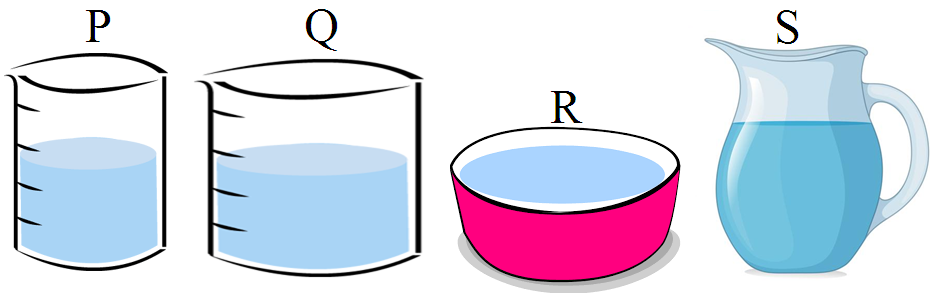
Container $S$ (a flask) has the smallest surface area of water exposed to the atmosphere. Thus, the rate of evaporation will be the slowest in flask $S.$

The effect of wind will be more towards the bottom part of the towel as this part is free. Thus, part $Z$ will dry faster than the other parts of the towel.
Only $2.6\%$ of total water is fit for human consumption.
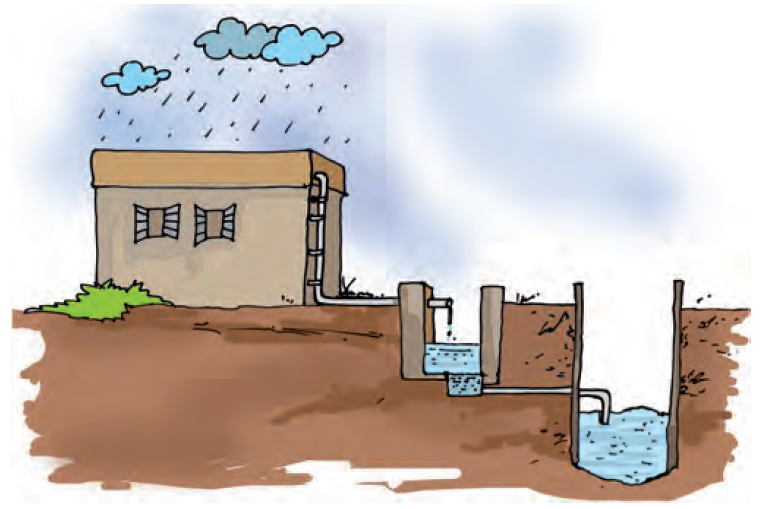
The methods of water conservation are rain water harvesting and drip irrigation.