Question 11 Mark
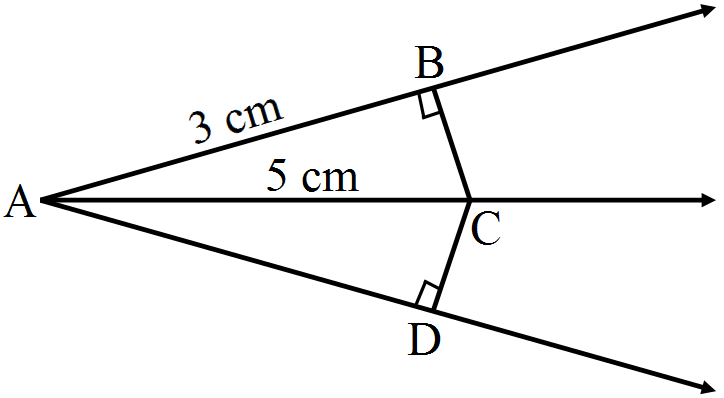
Answer- SAS
Solution:
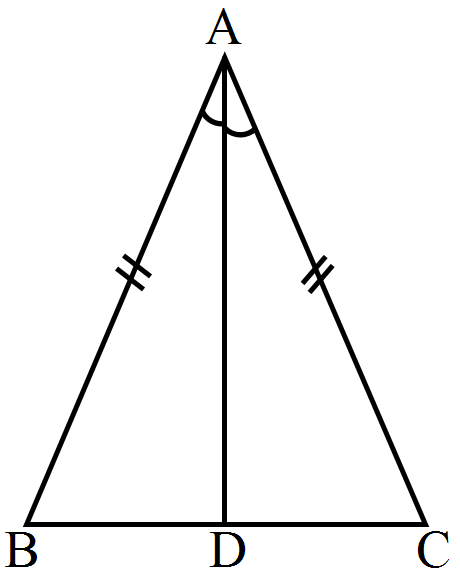
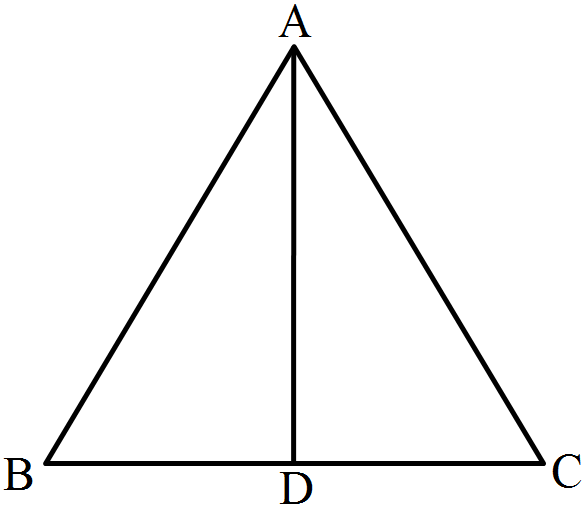
In $\triangle\text{ABD}$ and $\triangle\text{ADC},$ we have
AB = AC (Given)
$\angle\text{BAD} = \angle\text{DAC}$ ( Since AD, bisects $\angle\text{A}$)
AD = AD ( conunon in both)
Hence, $\triangle\text{ABD}\cong\triangle\text{ACD}$ by SAS.
View full question & answer→Question 21 Mark
Answer- x + y - 180º
Solution:
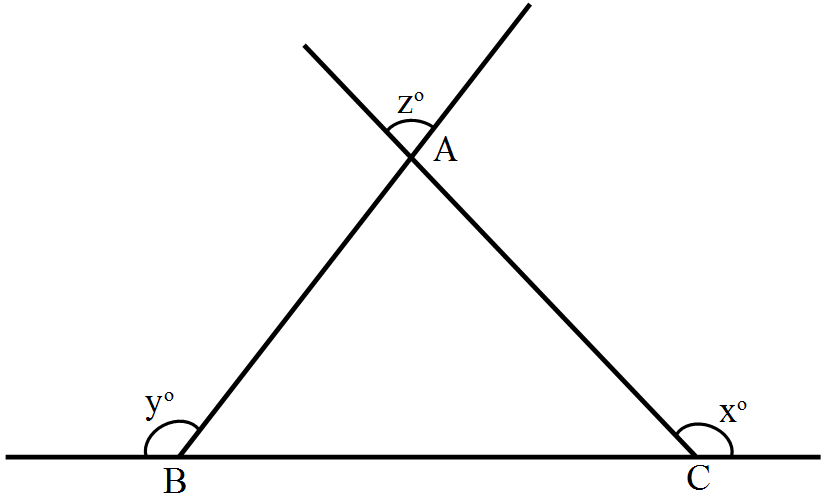
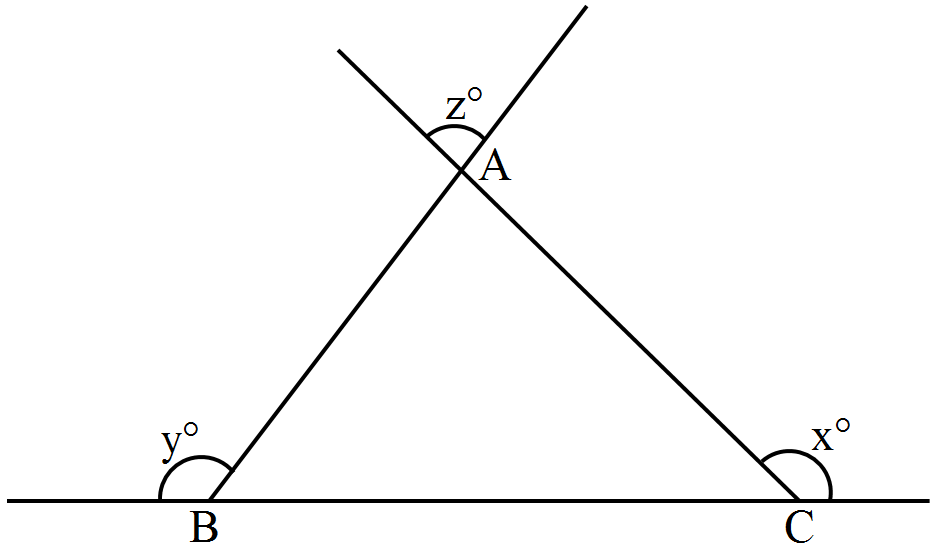
From figure
$\angle\text{A}=\text{z}^\circ$
$\angle\text{ACB}=180^\circ-\text{x}^\circ$
$\angle\text{ABC}=180^\circ-\text{y}^\circ$
Now, in $\triangle\text{ABC}$
$\angle\text{A}+\angle\text{B}+\angle\text{C}=180^\circ$
$\Rightarrow\text{z}^\circ+180^\circ-\text{y}^\circ+180^\circ-\text{x}^\circ=180^\circ$
$\Rightarrow\text{z}^\circ=\text{x}^\circ+\text{y}^\circ-180^\circ$
View full question & answer→Question 31 Mark
Answer- 60
Solution:
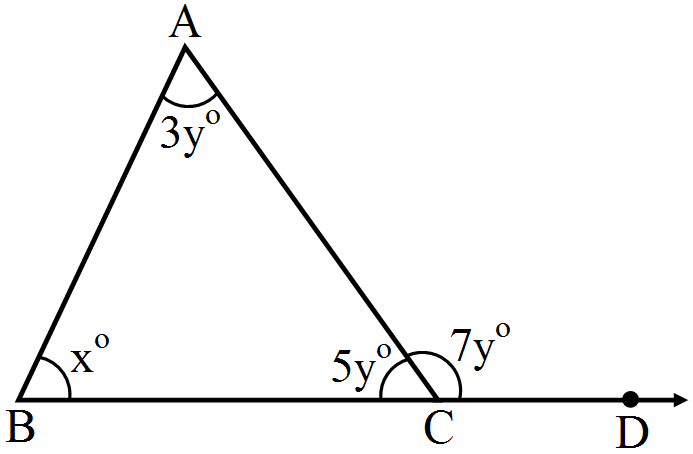
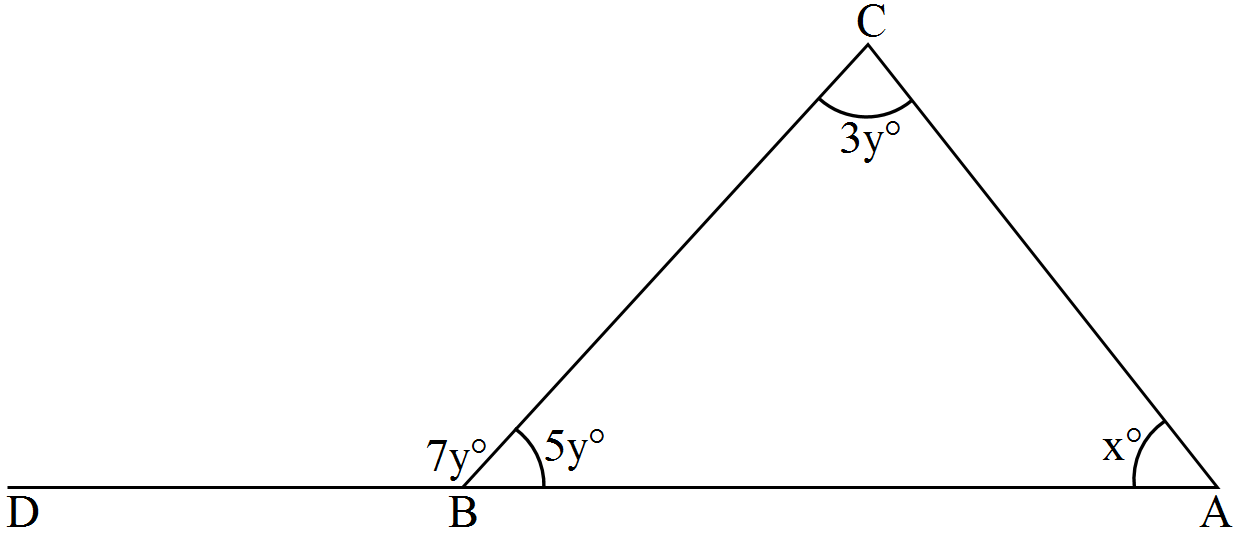
$\angle\text{ACB}=\angle\text{ACD}=180^\circ$ (linear pair)
$\Rightarrow5\text{y}+7\text{y}=180^\circ$
$\Rightarrow12\text{y}=180^\circ$
$\Rightarrow\text{y}=15^\circ$
Now, $\angle\text{ACD}=\angle\text{ABC}+\angle\text{BAC}$ (Exterior angle property)
$\Rightarrow7\text{y}=\text{x}+3\text{y}$
$\Rightarrow7(15^\circ)=\text{x}+3(15^\circ)$
$\Rightarrow105^\circ=\text{x}+45^\circ$
$\Rightarrow\text{x}=60^\circ$
View full question & answer→Question 41 Mark
An angle is 4 time its complement. Find measure.
Answer- 72º
Solution:
If x is the angle, its complement will be (90º - x),
because they have to add up to 90, and here x + (90º - x) = 90º
x is equal to 4 times of its complement, so we have
x = 4 × (90º - x)
⇒ x = 360º - 4x
⇒ 5x = 360º
$\Rightarrow\ \text{X}=\frac{360^\circ}{5}$
$\Rightarrow\ \text{X}=72^\circ$
View full question & answer→Question 51 Mark
Which of the following is not a criterion for congruence of triangles?
Answer- SSA
Solution:
SSA is not a criterion for congruence of triangles.
View full question & answer→Question 61 Mark
Answer- AB > AD
Solution:
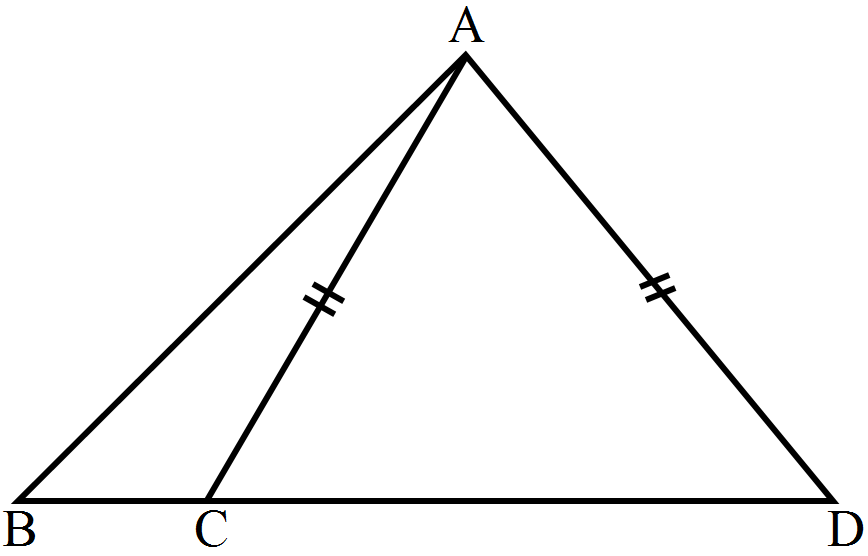
$\angle\text{D} = \angle\text{C}$ (As AC = AD)
and $\angle\text{C} = \angle\text{B}$ and $\angle\text{D} = \angle\text{B}$
Hence, AB > AD
View full question & answer→Question 71 Mark
If the bisector of the angle A of a $\triangle\text{ABC}$ is perpendicular to the base BC of the triangle then the triangle ABC is:
Answer- Equilateral
Solution:
Angle bisector is perpendicular to the opposite side only in equilateral triangle.
View full question & answer→Question 81 Mark
View full question & answer→Question 91 Mark
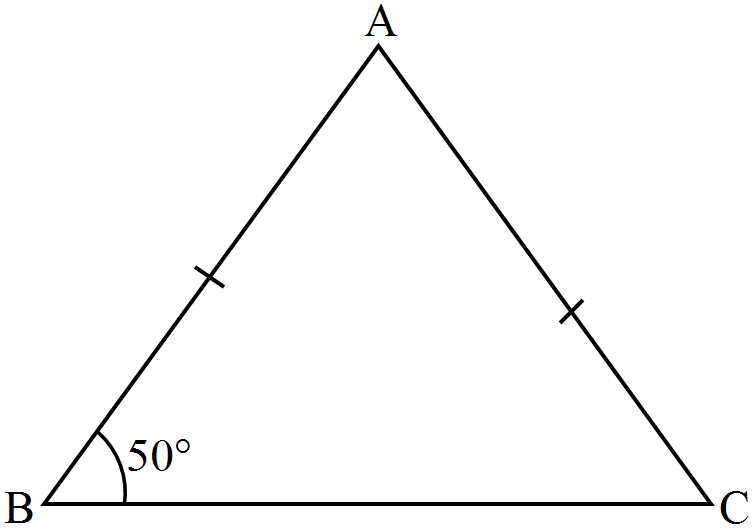
In $\triangle\text{ABC, AB=AC}$ and $\angle\text{B}=50^\circ.$ Then $\angle\text{A}=?.$
View full question & answer→Question 101 Mark
Answer- x + y - 180º
Solution:
From figure
$\angle\text{A} = \text{z}^\circ$
$\angle\text{ACB} = 180 - \text{z}^\circ$
$\angle\text{ABC} = 180 - \angle\text{y}^\circ$
Now, in $\triangle\text{ABC}$
$\angle\text{A} + \angle\text{B} + \angle\text{C} = 180^\circ$
$⇒ \text{z}^\circ + 180 - \text{y}^\circ + 180^\circ - \text{x}^\circ = 180^\circ$
$⇒ \text{z}^\circ = \text{x}^\circ + \text{y}^\circ- 180^\circ$
View full question & answer→Question 111 Mark
Answer- 360º
solution:
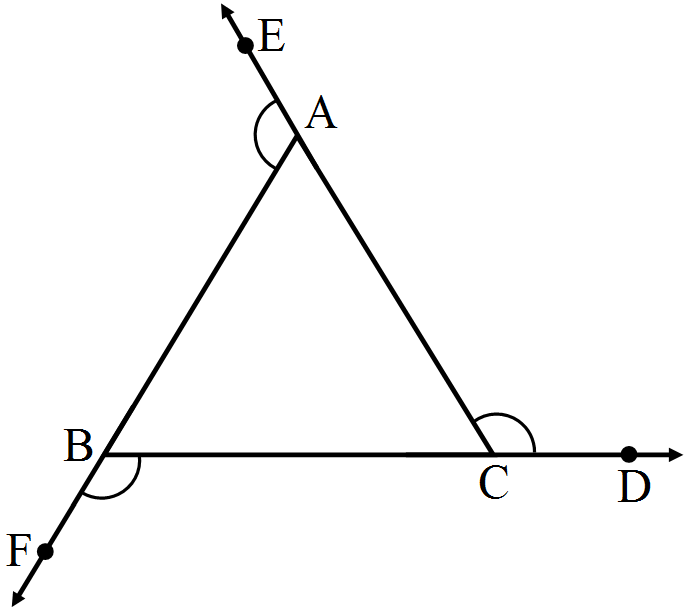
Clearly, $\angle1+\angle\text{BAE}=180^\circ\ ....(\text{i)}$(Supplementary angles)
Also, $\angle2+\angle\text{CBF}=180^\circ\ .....(\text{ii)}$ (Supplementary angles)
And $\angle\text{3}+\angle\text{ACD}=180^\circ\ .....(\text{iii)}$ (Supplementary angles)
$\therefore(\angle1+\angle2+\angle3)+(\angle\text{BAE}\\+\angle\text{CBF}+\angle\text{ACD})=540^\circ$
$\Rightarrow180^\circ+(\angle\text{BAE}+\angle\text{CBF}+\angle\text{ACD})=540^\circ$ (Angle sum property)
$\Rightarrow\angle\text{ACD}+\angle\text{BAE}+\angle\text{CBF}=360^\circ$
View full question & answer→Question 121 Mark
In the following, write the correct answer.
In $\triangle\text{ABC}$ and $\triangle\text{PQR},$ if AB = AC, $\angle\text{C}=\angle\text{P}$ and $\angle\text{B}=\angle\text{Q}$ then the two triangles are:
Answer
- Isosceles but not congruent.
Solution:
In $\triangle\text{ABC},$
AB = AC
$\angle\text{C}=\angle\text{B}$
So, is an isosceles triangle.
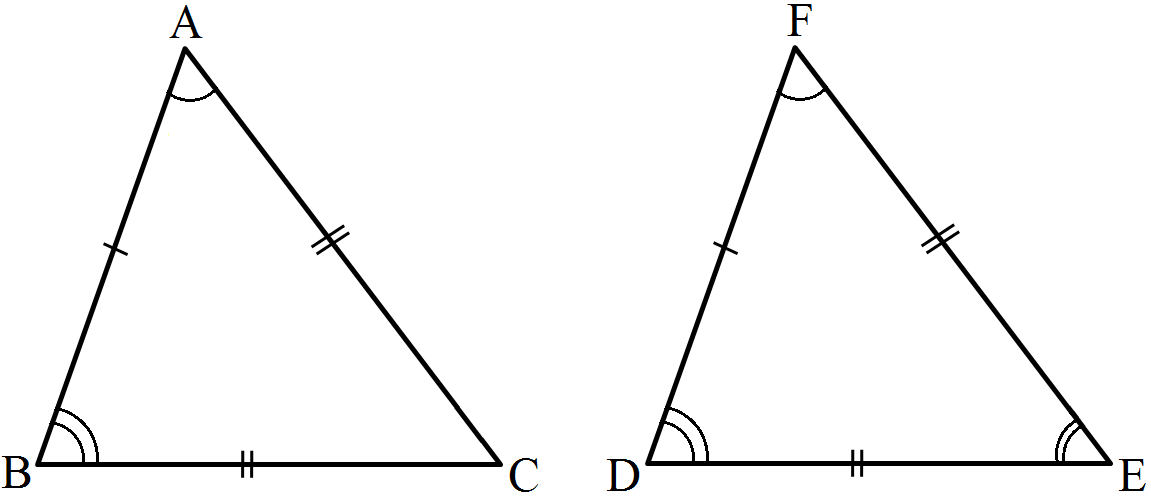
But it is given that,
$\angle\text{B}=\angle\text{Q}$
$\angle\text{C}=\angle\text{P}$
$\angle\text{P}=\angle\text{Q}$
So, is also an isosceles triangle.Therefore both triangle are isosceles but not congruent.
View full question & answer→Question 131 Mark
View full question & answer→Question 141 Mark
In the given figure, $\text{ABC}$ is an equilateral triangle. The value of $x + y$ is:
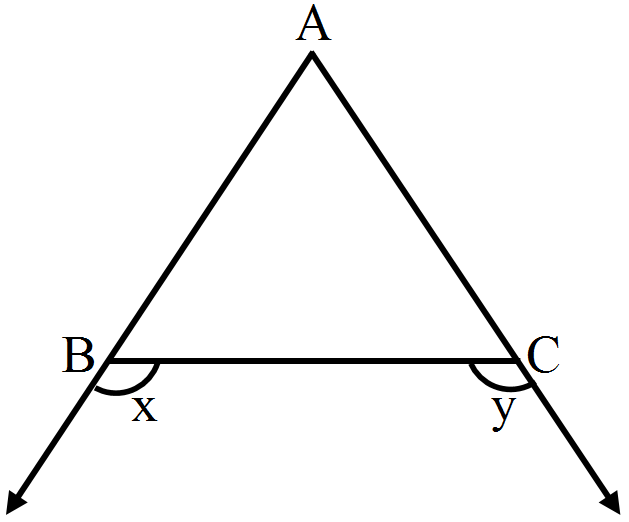
AnswerAs triangle $\text{ABC}$ is an equilateral traingle, therefore all the three angles are equal, that is, $60^\circ$ each.
$x = 180 - 60 = 120^\circ$
$y = 180 - 60 = 120^\circ$
$x + y = 120 + 120 = 240^\circ$
View full question & answer→Question 151 Mark
Answer- 1 : 1
Solution:
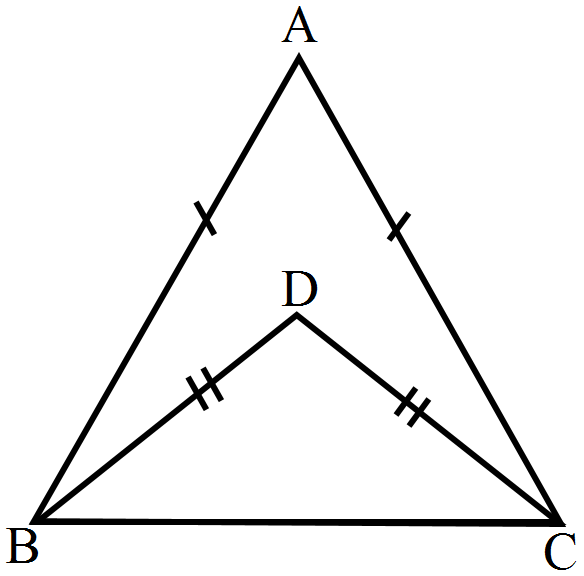
In $\triangle\text{ABC}$
AB = AC
$\therefore\ \angle\text{ABC} = \angle\text{ACB}$ (angles opposite to equal sides of a triangle are equal) ...(1)
In $\triangle\text{DBC}$
DB = DC,
$\therefore\ \angle\text{DBC} = \angle\text{DCB}$ (angles opposite to equal sides of a triangle are equal) ...(2)
Subtract 2 from 1
$\angle\text{ABC} - \angle\text{DBC} = \angle\text{ACB} - \angle\text{DCB}$ (equals subtracted from equals gives equal)
$= \angle\text{ABD} = \angle\text{ACD}$
Divide both the sides by $\angle\text{ACD}$
$\Rightarrow \frac{\angle\text{ABD}}{\angle\text{ACD}} = 1$
$\therefore\ \angle\text{ABD} : \angle\text{ACD}=1:1$
View full question & answer→Question 161 Mark
If $\triangle\text{ABC}\cong\triangle\text{ACB},$ then $\triangle\text{ABC}$ is isosceles with.
View full question & answer→Question 171 Mark
If $\triangle\text{ABC}$ is an isosceles triangle with AB = AC and $\angle\text{B} = 65^\circ,$ find $\angle\text{A}.$
Answer- 50º
Solution:
In isosceles triangle ABC
AB = AC (Given)
Therefore $\angle\text{B} = \angle\text{C} = 65^\circ$ (angles opposite to equal side are equal).
So, by applying angle sum property i.e $\angle\text{A}+\angle\text{B}+\angle\text{C}=180^\circ,$
$\angle\text{A} + 65^\circ + 65^\circ = 180^\circ$
$\angle\text{A} = 180^\circ - 130^\circ$
$\angle\text{A} = 50^\circ$
View full question & answer→Question 181 Mark
Answer- $\text{All are true}$
Solution:
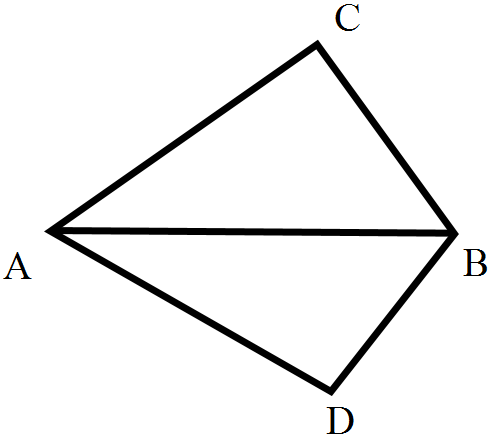
$\text{AC = AD}$
$\angle\text{AB}= \angle\text{BAD}$
$\text{AB = AB}$
By SAS, we have
$\triangle\text{ABC}\cong\triangle\text{ABD}$
Hence, we have $\text{BC = BD}$ and $\angle\text{C}= \angle\text{D}.$
So, all the given options are true.
View full question & answer→Question 191 Mark
Answer- 30º
Solution:
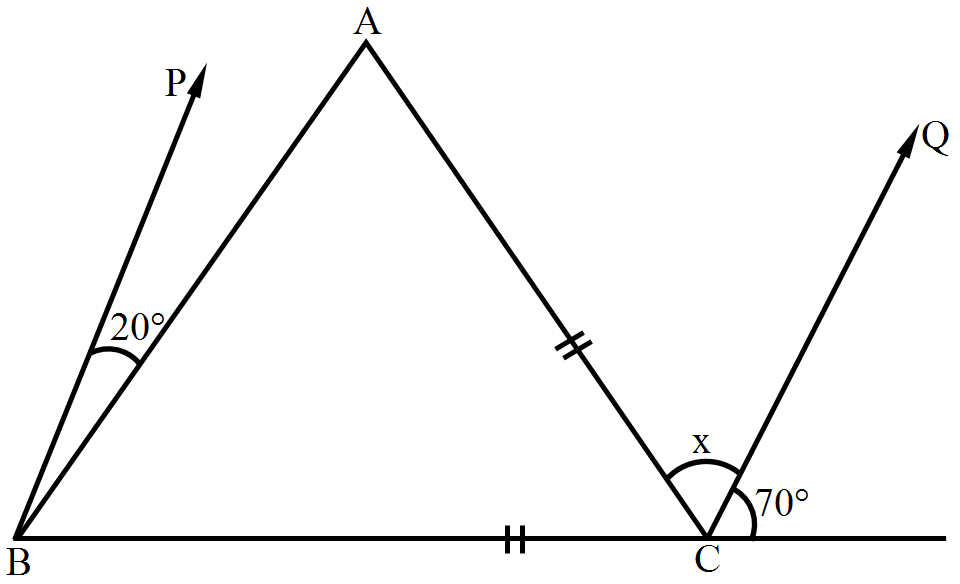
$\angle\text{PBC} = \angle\text{QCD}$ (Corresponding angles, $\text{OP || CQ}$ and BC is transverse)
$⇒\angle\text{PBC} = 70^\circ$
Now, $\angle\text{PBA} + \angle\text{ABC} = \angle\text{PBC}$
$⇒20^\circ+\angle\text{ABC}=70^\circ$
$⇒\angle\text{ABC}=50^\circ$
In $\triangle\text{ABC},$
$\angle\text{ABC} + \angle\text{BAC} + \angle\text{ACB} = 180^\circ \ ...\ (\text{i})$
Now, $\angle\text{ABC} + \angle\text{BAC} = 50^\circ$ (isosceles $\triangle$)
And, $\angle\text{ACB} = 180^\circ - (70^\circ + \text{x})$
From (i),
50º + 50º + 180º - (70º + x) = 180º
Hence x = 30º
View full question & answer→Question 201 Mark
If $\triangle\text{PQR}≡\triangle\text{EFD},$ then $\angle\text{E}=$
Answer- $\angle\text{P}$
Solution:
Since, by corresponding part of congruent $\angle\text{E}$ of $\triangle\text{EFD}$ is equal to the $\angle\text{P}$ of $\triangle\text{PQR}.$
View full question & answer→Question 211 Mark
In $\triangle\text{ABC, AB = AC}$ and $\angle\text{B}=50^{\circ}.$ Then, $\angle\text{A = } ?$
Answer- 80°
Solution:
In $\triangle\text{ABC,}$
$\text{AB = AC}$
$\Rightarrow\angle\text{C}=\angle\text{B}$ (angles opposite to equal sides are equal)
$\Rightarrow\angle\text{C}=50^{\circ}$
Now, $\angle\text{A}+\angle\text{B}+\angle\text{C}=180^{\circ}$
$\Rightarrow\angle\text{A}+50^{\circ}+50^{\circ}=180^{\circ}$
$\Rightarrow\angle\text{A}=80^{\circ}$
View full question & answer→Question 221 Mark
In an isosceles triangle, if the vertex angle is twice the sum of the base angles, then the measure of vertex angle of the triangle is:
Answer- 120º
Solution:
Let $\triangle\text{ABC}$ be an isosceles triangle with
vertex angle = $\angle\text{A}$ and base angles = $\angle\text{B}$ and $\angle\text{C}$
Now, $\angle\text{A}=2(\angle\text{B}+\angle\text{C})$
$\Rightarrow\frac{\angle\text{A}}{2}=\angle\text{B}+\angle\text{C}\ ....(1)$
Also in $\triangle\text{ABC},$
$\angle\text{A}+\angle\text{B}+\angle\text{C}=180^\circ$
$\Rightarrow\angle\text{A}+(\angle\text{B}+\angle\text{C})=180^\circ$
$\Rightarrow\angle\text{A}+\frac{\angle\text{A}}{2}=180^\circ$ .....[From (1)]
$\Rightarrow\frac{3}{2}\angle\text{A}=180^\circ$
$\Rightarrow\angle\text{A}=\frac{180^\circ\times2}{3}$
$\Rightarrow\angle\text{A}=120^\circ$
Hence, correct option is (b).
View full question & answer→Question 231 Mark
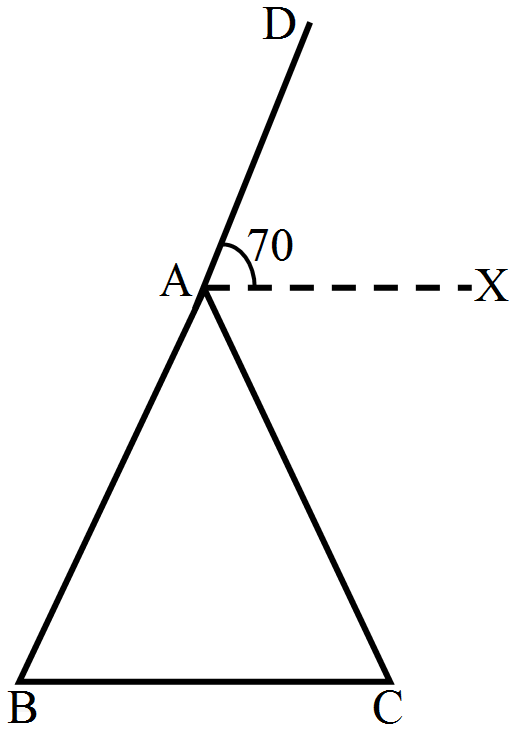
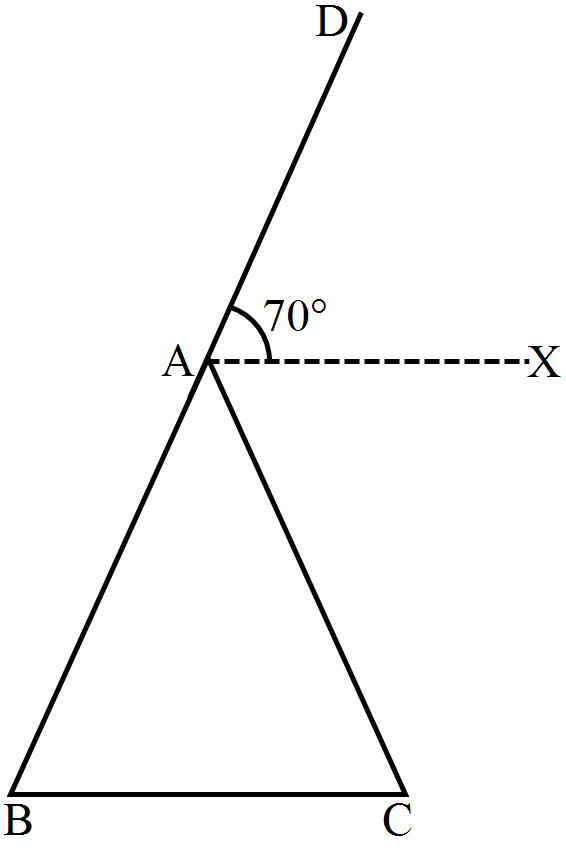
In $\triangle\text{ABC},\angle\text{B}=\angle\text{C}$ and ray AX bisects the exterior angle $\angle\text{DAC}.$ If $\angle\text{DAX}=70^\circ$ then $\angle\text{ACB}=$
View full question & answer→Question 241 Mark
In the following, write the correct answer.
In $\triangle\text{PQR}$ if $\angle\text{R}=\angle\text{P}$ and QR = 4cm and PR = 5cm. Then, the length of PQ is:
View full question & answer→Question 251 Mark
In the following, write the correct answer.
D is point on the side BC of a $\triangle\text{ABC}$ such that AD bisects Then.
View full question & answer→Question 261 Mark
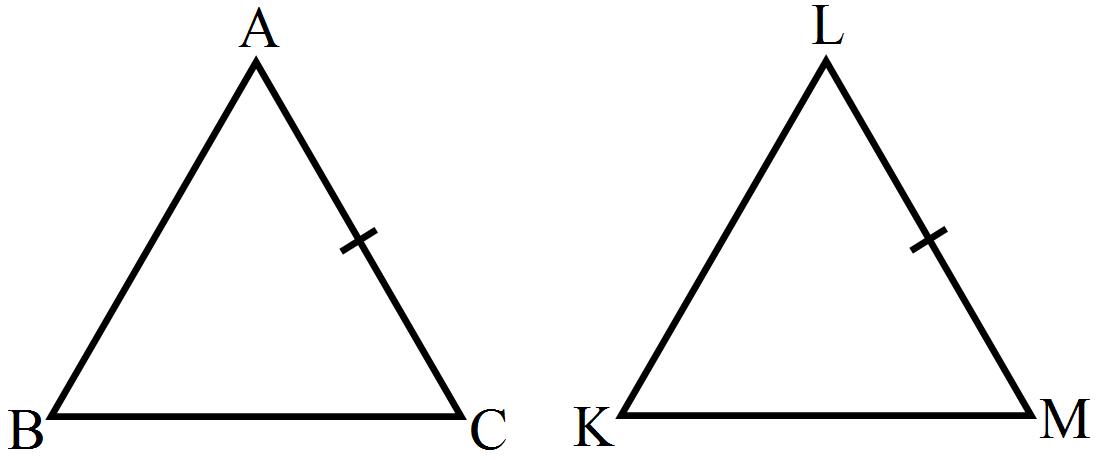
If $\triangle\text{ABC}\cong\triangle\text{LKM},$ then side of $\triangle\text{LKM}$ equal to side AC of $\triangle\text{ABC}$ is:
View full question & answer→Question 271 Mark
The area of a right angled triangle is $20m^2$ and one of the sides containing the right triangle is $4\ cm.$ Then the altitude on the hypotenuse is:
AnswerArea of right angle triangle $= 20 sq.m$
$\Rightarrow 12 \times$ Base $\times$ Height $= 20$
$\Rightarrow 12 \times$ Base $\times 4 = 20$
$\Rightarrow$ Base $= 10\ cm$
Then, Hypotenuse $=\sqrt{10^2+4^2}=2\sqrt{29}\text{m}$
If the altitude drawn to the hypotenuse of a right angle triangle, then the lenght of required altitude
$=\frac{10\times4}{2\sqrt{29}}=\frac{20}{\sqrt{29}}\text{cm}$
View full question & answer→Question 281 Mark
In $\triangle\text{ABC}$ and $\triangle\text{DEF,}$ it is given that $\angle\text{B}=\angle\text{E}$ and $\angle\text{C}=\angle\text{F}.$ In order that $\triangle\text{ABC}\cong\triangle\text{DEF},$ we must have:
Answer- BC = EF
Solution:
In $\triangle\text{ABC}$ and $\triangle\text{DEF},$
$\angle\text{B}=\angle\text{E}$ and $\angle\text{C}=\angle\text{F}$
So, the induded sides should be equal for the triangle to be congruent by the ASA congruence criterion.
Thus, we must have BC = EF.
View full question & answer→Question 291 Mark
If $\triangle\text{ABC} ≅\triangle\text{PQR}$ by SSS congruence rule, then:
Answer- BC = QR
Solution:
If $\triangle\text{ABC} ≅\triangle\text{PQR}$ by SSS congruence rule, then the corresponding sides must be equal i.e AB = PQ, BC = QR and AC = PR.
View full question & answer→Question 301 Mark
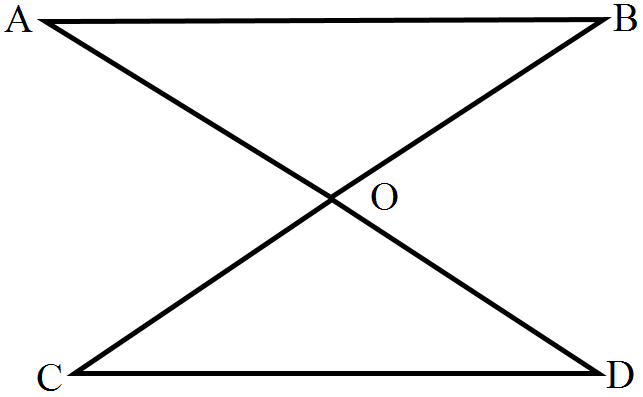
Answer- All are true
Solution:
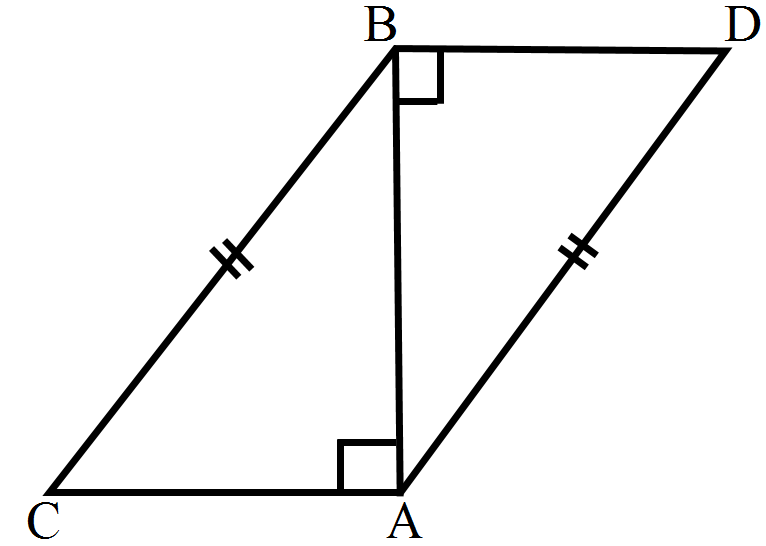
In $\triangle\text{AOB}$ and $\triangle\text{DOC}$
$\angle\text{OAB}=\angle\text{ODC}$ (alternate interior angles)
$\angle\text{OBA}=\angle\text{OCD}$
OB = OC (given)
So, from ASA congruence, we have
$\triangle\text{AOB}\cong\triangle\text{DOC}$
Now, from CPCT, we have
AB = CD
OA = OD which means O is the mid-point of AD.
Hence, all the given statements are true.
View full question & answer→Question 311 Mark
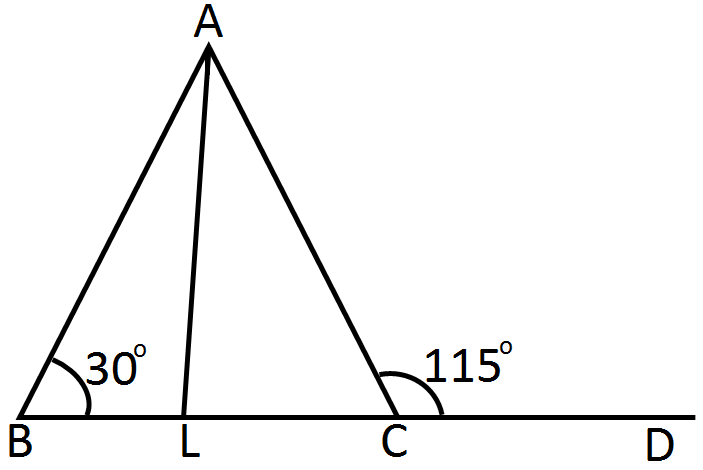
The side BC of $\triangle\text{ABC}$ is produced to a poin D. The bisector of $\angle\text{A}$ meet side BC in L. If $\angle\text{ABC}=30^\circ$ and $\angle\text{ACD}=115^\circ,$ then $\angle\text{ALC}=$
View full question & answer→Question 321 Mark
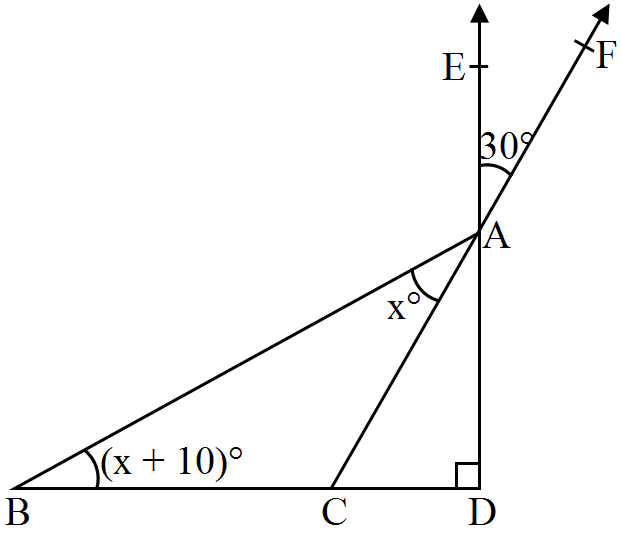
Answer- 25
Solution:
In the given figure $\angle\text{CAD}=\angle\text{EAF}$ (Vertically opposite angels)
$∴\angle\text{CAD}=30^\circ$
In $\triangle\text{ABD},$
$\angle\text{ABD}+\angle\text{BAD}+\angle\text{ADB}=180^\circ$ (Angle sum property)
$⇒(\text{x}+10)^\circ+(\text{x}^\circ+30^\circ)+90^\circ=180^\circ$
$⇒2\text{x}+130^\circ=180^\circ$
$⇒2\text{x}=180^\circ−130^\circ=50^\circ$
$⇒ \text{x} = 25$
Thus, the value of x is 25.
View full question & answer→Question 331 Mark
View full question & answer→Question 341 Mark
In the following, write the correct answer.
Two sides of a triangle are of lengths 5cm and 1.5cm. The length of the third side of the triangle cannot be:
Answer
- 3.4cm
Solution:
Since sum of any two sides of triangle is always greater than thrid side, so that side of the triangle cannot be 3.4cm becouse then,
1.5cm + 3.4cm = 4.9cm.
View full question & answer→Question 351 Mark
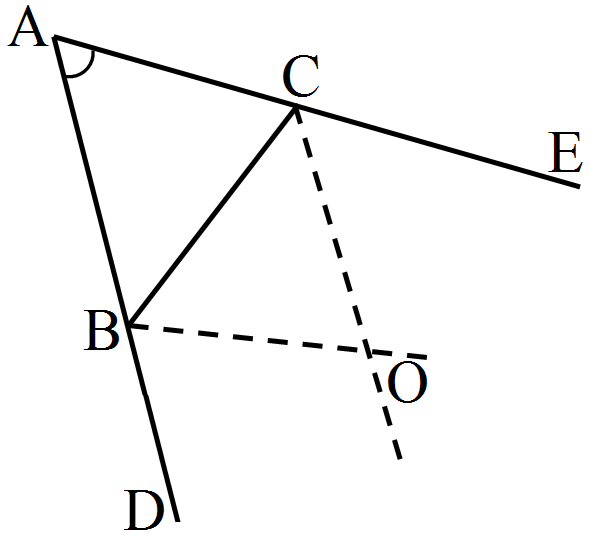
The bisects of exterior angles at B and C of $\triangle\text{ABC}$ meet at O. If $\angle\text{A}=\text{x}^\circ,$ then $\angle\text{BOC}=$
View full question & answer→Question 361 Mark
The length of two sides of a triangle are 7 units and 10 units. Which of the following length can be the length of the third side?
Answer- 13cm
Solution:
As per the rule in a triangle, the sum of any 2 sides should be greater than the third side. So, the length of the third side should be 13, Since with 7, 10 and 13 we have,
7 + 10 > 13, 7 + 13 > 10 and 13 + 10 > 7
View full question & answer→Question 371 Mark
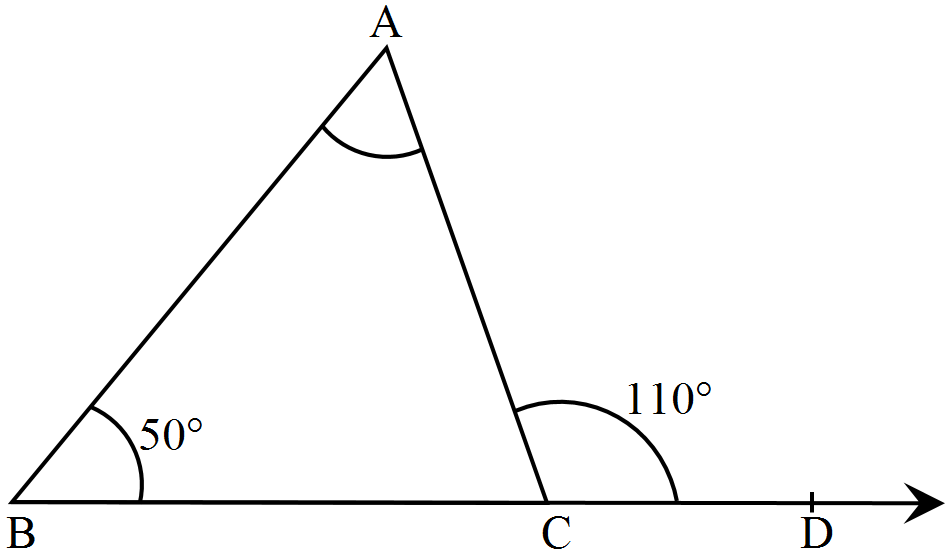
An exterior angle of the triangle is $110^\circ$, One of the opposite interior angle is $50^\circ$ . What are the other two angles?
AnswerLet the other opposite interior angle be $x$ and the remaining angle of the triangle be $z$.
Sum of the opposite two interior angle $=$ Exterior angle
$50^\circ + x = 110^\circ$
$\Rightarrow x = 60^\circ$
Now$, 60^\circ + 50^\circ + z = 180^\circ ($Angle sum property$)$
$\Rightarrow z = 70^\circ$
Therefore, the other two angles of the triangle $= 60^\circ$ and $70^\circ$
View full question & answer→Question 381 Mark
In $\triangle\text{ABC}, \ \angle\text{B} = \angle\text{C}$ and ray AX bisects the exterior angle $\triangle\text{DAC}.$ If $\triangle\text{DAX} = 70^\circ,$ then $\angle\text{ACB} =$
View full question & answer→Question 391 Mark
In $\triangle\text{ABC}$ and $\triangle\text{PQR},$ it is given that AB = AC, $\angle\text{C}=\angle\text{P}$ and $\angle\text{B}=\angle\text{Q}.$ Then, the two triangles are:
Answer- Isosceles but not congruent
Solution:
In $\triangle\text{ABC}$ and $\triangle\text{PQR},$
$\text{AB = AC}$
$\Rightarrow\angle\text{B}=\angle\text{C}$
Since $\angle\text{C}=\angle\text{P}$ and $\angle\text{B}=\angle\text{Q}$
$\Rightarrow\angle\text{P}=\angle\text{Q}$
$\Rightarrow\text{RQ = RP}$
So, the two triangle are isosceles.
But it is not possible to prove them congruent.
View full question & answer→Question 401 Mark
Answer- A triangle can have two acute angles.
Solution:
True, you may have a triangle with two or more acute angles. If a triangle has three acute angles, the triangle is called an Acute Triangle. If a triangle has two acute angles and a single obtuse angle, the triangle is called an Obtuse Triangle.
View full question & answer→Question 411 Mark
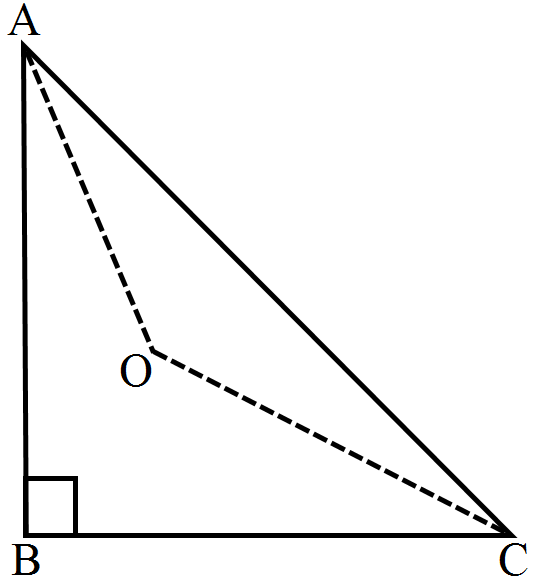
If the bisectors of the acute angles of a right triangle meet at O, then the angle at O between the two bisectors is:
Question 421 Mark
Side BC of a triangle ABC has been produced to a point D such that $\angle\text{ACD} = 120^\circ$ If $\angle\text{B} = 12\angle\text{A},$ then $\angle\text{A}$ is equal to:
Answer- 80º
Solution:
$\angle\text{B}=\frac{1}{2}\angle\text{A}$
$\angle\text{ACD}$ is an exterior angle
$\Rightarrow \angle\text{A}+\angle\text{B}=\angle\text{ACD}$
$\Rightarrow \angle\text{A}+\frac{1}{2}\angle\text{A}=120^\circ$
$\Rightarrow \frac{3\angle\text{A}}{2}=120^\circ$
$\Rightarrow\ 3\angle\text{A}=240^\circ$
$\Rightarrow\ \angle\text{A}=80^\circ$
View full question & answer→Question 431 Mark
Answer- 60°
Solution:
$∴\ \angle\text{A}+\angle\text{B}=\angle\text{ACD}$
$⇒\angle\text{A}+50^\circ=110^\circ$
$⇒\angle\text{A}=60^\circ$
View full question & answer→Question 441 Mark
If triangle ABC is obtuse angled and $\angle\text{C}$ is obtuse, then
Answer- AB > BC
Solution:
Side opposite to the largest angle is always greatest and a triangle can have only 1 angle as obtuse.
View full question & answer→Question 451 Mark
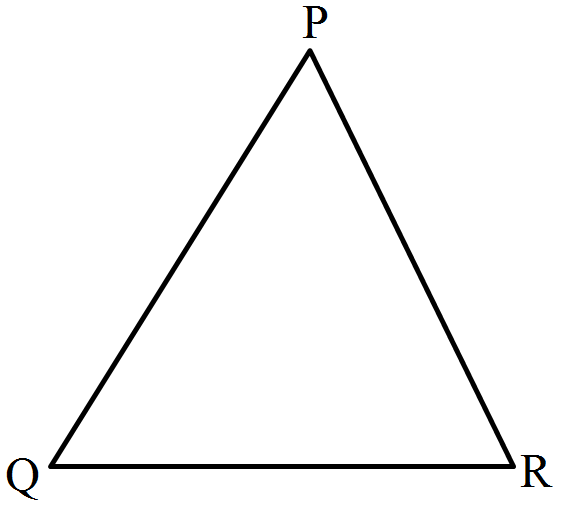
If $\triangle\text{PQR}\cong\triangle\text{EFD},$ then $\angle\text{E}=$
Answer- $\angle\text{P}$
Solution:
$\triangle\text{PQR}\cong\triangle\text{EFD},$
$\Rightarrow\angle\text{E}=\angle\text{P}$ (congruent angles of congruent triangles)
Hence, correct option is (a).
View full question & answer→Question 461 Mark
In the following, write the correct answer.
In $\triangle\text{PQR},$ if $\angle\text{R}>\angle\text{Q}$ then:
View full question & answer→Question 471 Mark
View full question & answer→Question 481 Mark
If two acute angles of a right triangle are equal, then each acute is equal to:
Answer- 45º
Solution:
Let the measure of each acute angle of a triangle be x°.
Then, we have
x° + x° + 90° = 180°
i.e. 2x° = 90°
i.e. x° = 45°
View full question & answer→Question 491 Mark
If $\angle\text{OCA}=80^\circ, \ \angle\text{COA}=40^\circ,$ and $\angle\text{BDO}=70^\circ$ then xº + yº = ?
Answer- 230º
Solution:
In the given figure, $\angle\text{BOD} = \angle\text{COA}$ (Vertically opposite angles)
$\therefore\ \angle\text{BOD} = 40^\circ ... (\text{i})$
In $\triangle\text{ACO}$
$\angle\text{OAE}=\angle\text{OCA}+\angle\text{COA}$ (Exterior angle of a triangle is equal to the sum of two opposite interior angles)
$⇒ \text{x}^\circ = 80^\circ + 40^\circ = 120^\circ ... \ (\text{ii})$
In $\angle\text{BDO},$
$\angle\text{DBF}=\angle\text{BDO}+\angle\text{BOD}$ (Exterior angle of a triangle is equal to the sum of two opposite interior angles)
$⇒\text{y}^\circ=70^\circ+40^\circ=110^\circ\ ...\ (\text{iii})$
Adding (2) and (3) we get
$\text{x}^\circ+\text{y}^\circ=120^\circ+110^\circ=230^\circ$
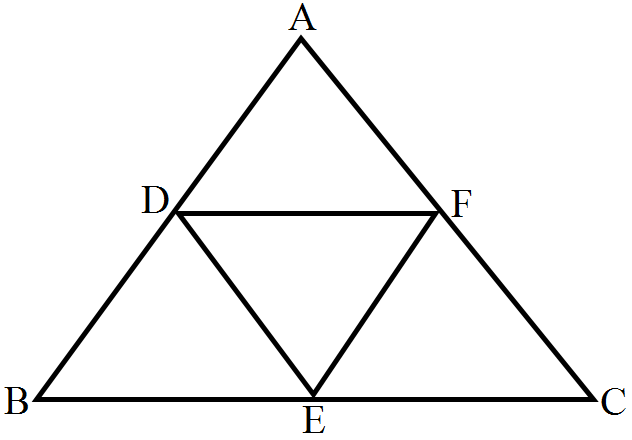
View full question & answer→Question 501 Mark
Answer- 8cm
Solution:
Using relation,
$\text{Perimeter.}\ \triangle\text{DEF}=\frac{1}{2}\text{Perimeter.}\ \triangle\text{ABC}$
$=\frac{1}{2}\times16=18\text{cm}$
View full question & answer→