Questions · Page 2 of 6

M.C.Q

Question 521 Mark
View full question & answer
Question 531 Mark
In an isosceles triangle, if the vertex angle is twice the sum of the base angles, then the measure of vertex angle of the triangle is:
Answer
  1. 120º
    Solution:
    Let the base angles be x each,
    Vertex angle = 2(x + x) = 4x
    Now, since the sum of all the angles of a triangle is 180º
    x + x + 4x = 180º
    6x = 180º
    x = 30º
    Therefore, vertex angle = 4x = 120º
View full question & answer
Question 541 Mark
Answer
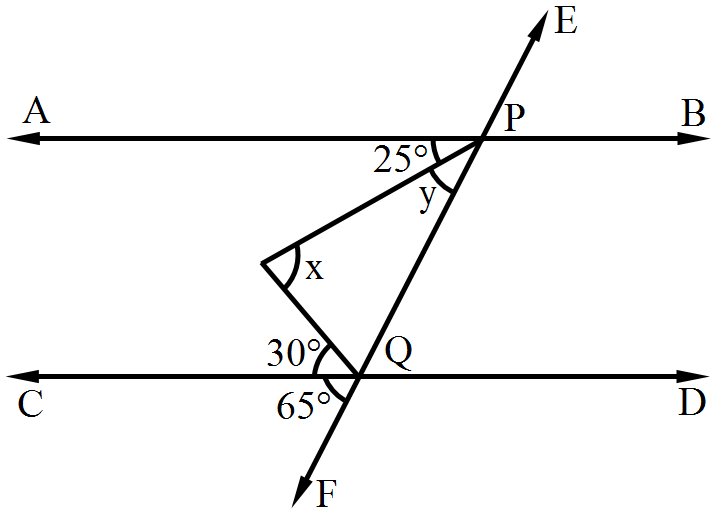
  1. x = 55º, y = 40º
    Solution:
    $\angle\text{OQP} = 180^\circ - \angle\text{OQF}$
    = 180º - (30º + 65º)
    $⇒ \angle\text{OQP} = 85^\circ\ ...\ (\text{i})$
    $\angle\text{APQ}=\angle\text{CQF}$ (Corresponding angles)
    ⇒ 25º + yº = 65º
    ⇒ yº = 65º - 25º
    ⇒ yº = 40º
    Now in $\triangle\text{OPQ}$
    $\angle\text{O}+\angle\text{OPQ}+\angle\text{PQO} = 180^\circ$
    ⇒ xº + 40º + 85º = 180º
    xº = 180º - 85º - 40º = 55º
    ⇒ x = 55º, y = 40º
View full question & answer
Question 551 Mark
$\angle\text{x}$ and $\angle\text{y}$ are exterior angles of a triangle ABC at the points B and C respectively, Also, $\angle\text{B} >\angle\text{C},$ then the relation between $\angle\text{x}$ and $\angle\text{y}$ is:
Answer
  1. $\angle\text{x} >\angle\text{y},$
    Solution:
    Since interior $\angle\text{B} >\angle\text{C},$
    Hence x < y.
View full question & answer
Question 571 Mark
Which of the following pairs of angle are supplementary?
Answer
  1. 45º, 135º
    Solution:
    We know that the sum of supplementary angle is 180º
    and the sum of 45º, 135º is also 180º.
View full question & answer
Question 581 Mark
D, E, F are the mid-point of the sides BC, CA and AB respectively of $\triangle\text{ABC}.$ Then $\triangle\text{DEF}$ is congruent to triangle.
Answer
  1. AFE, FBD, EDC
    Solution:
    DEF is the median triangle and it divides the given triangle into 4 identical triangles including median triangle.
View full question & answer
Question 591 Mark
In $\triangle\text{ABC}$ and $\triangle\text{PQR},$ AB = PR and $\angle\text{A} = \angle\text{P}.$ Then, the two triangles will be congruent by SAS axiom if:
Answer
  1. AC = PQ
    Solution:
    $\angle\text{A}$ is included between AB and AC and $\angle\text{P}$ is included between PQ and PR and corresponding sides must be equal. Since AB = PR, hence AC = PQ for the given triangles to be congruent by SAS axiom.
View full question & answer
Question 601 Mark
If $\triangle\text{ABC} \cong\triangle\text{PQR}$ by SSS congruence rule, then:
Answer
  1. BC = QR
    Solution:
    If $\triangle\text{ABC} \cong\triangle\text{PQR}$ by SSS congruence rule, then the corresponding sides must be equal i.e AB = PQ, BC = QR and AC = PR.
View full question & answer
Question 611 Mark
If $\triangle\text{PQR}\cong\triangle\text{EFD},$ then ED =
Answer
  1. PR
    Solution:
    $\triangle\text{PQR}\cong\triangle\text{EFD},$
    $\Rightarrow\text{ED}=\text{PR}$ (congruent sides of congruent triangles)
    Hence, correct option is (c)
View full question & answer
Question 621 Mark
The perimeter of a triangle is 36cm and its sides are in the ratio a : b : c = 3 : 4 : 5 then a, b, c are respectively:
Answer
  1. 9cm, 12cm, 15cm
    Solution:
    Let the three sides a, b, c be 3x, 4x and 5x respectively.
    Then according to the conditions given in the question, we have
    3x + 4x + 5x = 36
    12x = 36
    x = 3cm
    Thus, the three sides are:
    a = 3 × 3 = 9cm, b = 4 × 3 = 12cm and c = 5 × 3 = 15cm
View full question & answer
Question 631 Mark
It is not possible to construct a triangle when the lengths of its sides are:
Answer
  1. 5.3cm, 2.2cm, 3.1cm
    Solution:
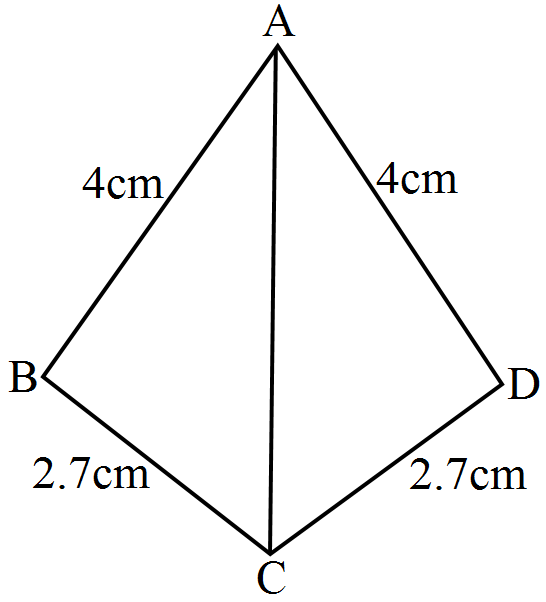
    Put the sidesof triangle a, b, c
    For a possible triangle the following are should possible.
    a + b > = c
    b + c > = a
    a + c > = b
    Here, 2.2 + 3.1 = 5.3
    So, a + b = c
    So the triangle becomes a streight line.
    So we cannot draw a triangle with sides 5.3cm, 2.2cm, 3.1cm.
View full question & answer
Question 641 Mark
View full question & answer
Question 651 Mark
An exterior angle of a triangle is equal to 100º and two interior opposite angles are equal. Each of these angles is equal to:
Answer
  1. 50º
    Solution:
    Let the two interior opposite angles be xº each.
    Now, the exterior angle is equal to the sum of the two interior opposite angles.
    xº + xº = 180º
    ⇒ 2xº = 100º
    ⇒ xº = 50º
View full question & answer
Question 661 Mark
If all the altitudes from the vertices to the opposite sides of a triangle are equal, then the triangle is:
Answer
  1. Equilateral
    Solution:
    In an equilateral triangle all the altitudes, sides, angles, perpendicular bisectors, medians and angular bisectors are equal.
View full question & answer
Question 671 Mark
If all the three angles of a triangle are equal, then each one of them is equal to:
Answer
  1. 60º
    Solution:
    Let the measure of each angle be x°.
    Now, the sum of all angles of any triangle is 180°.
    Thus, x° + x° + x° = 180°
    i.e. 3x° = 180°
    i.e. x° = 60°
View full question & answer
Question 681 Mark
Answer
  1. 230º
    Solution:
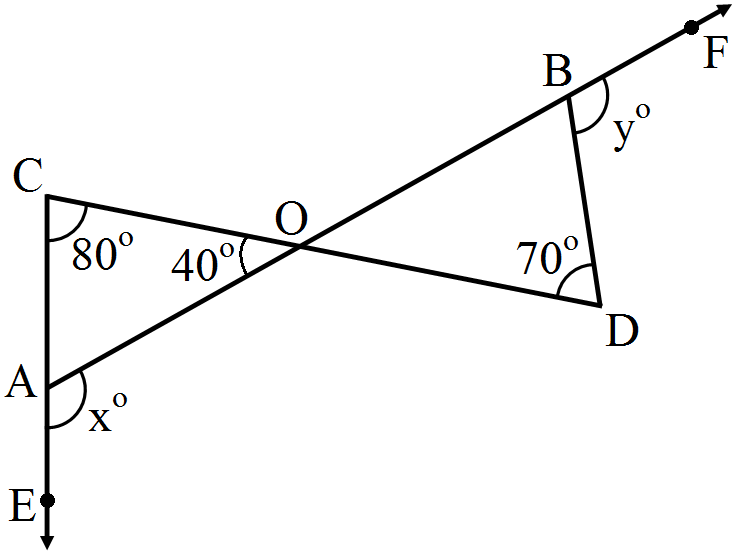
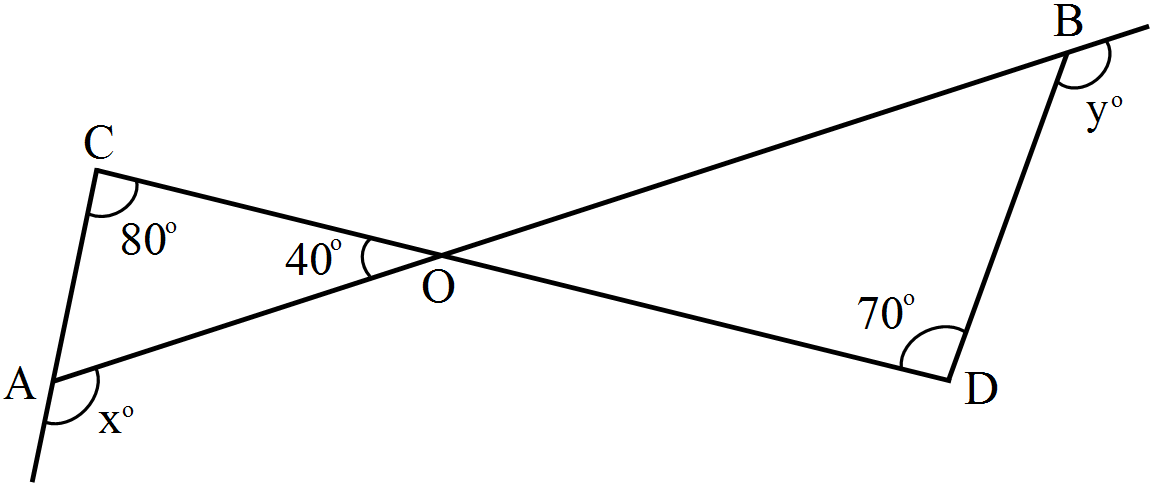
    In $\triangle\text{OAC},$ by angle sum property
    $\angle\text{OCA}+\angle\text{COA}+\angle\text{CAO}=180^\circ $
    $\Rightarrow80^\circ+40^\circ+\angle\text{CAO}=180^\circ$
    $\Rightarrow\angle\text{CAO}=60^\circ$
    $\angle\text{CAO}+\angle\text{OAE}=180^\circ$ (linear pair)
    $\Rightarrow60^\circ+\text{x}=180^\circ$
    $\Rightarrow\text{x}=120^\circ$
    $\angle\text{COA}=\angle\text{BOD}$ (vertically opposite angles)
    $\Rightarrow\angle\text{BOD}=40^\circ$
    In $\triangle\text{OBD},$ by angle sum property
    $\angle\text{OBD}+\angle\text{BOD}+\angle\text{ODB}=180^\circ$
    $\Rightarrow\angle\text{OBD}+40^\circ+70^\circ=180^\circ$
    $\Rightarrow\angle\text{OBD}=70^\circ$
    $\angle\text{OBD}+\angle\text{DBF}=180^\circ$ (linear pair)
    $\Rightarrow70^\circ+\text{y}=180^\circ$
    $\Rightarrow\text{y}=110^\circ$
    $\therefore\text{x}+\text{y}=120^\circ+110 ^\circ=230^\circ$
View full question & answer
Question 691 Mark
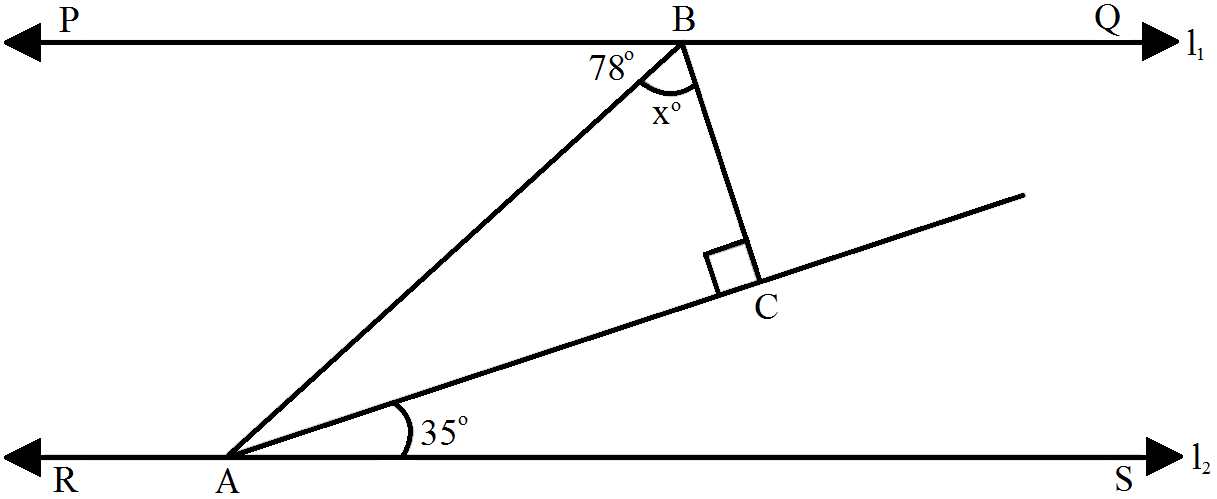
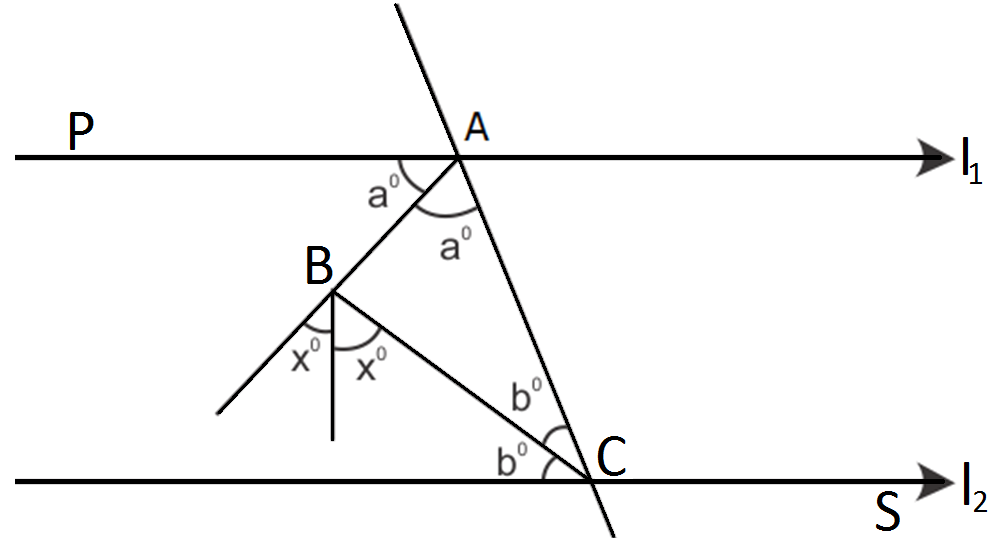
In Fig. for which value of $x$ is $l_1 || l_2$?
Answer
Let if$ l_1 || l_2$ and$ AB$ is tranverse to it.
Then,
$\angle\text{PBA}$ should be equal $\angle\text{BAS} ($Alternate angles$)$
So if $l_1 || l_2,$ then $\angle\text{BAS}=70^\circ$
$\Rightarrow\angle\text{BAC}=78^\circ-35^\circ=43^\circ\dots(1)$
Now, in $\triangle\text{ABC}$
$\text{x}^\circ+\angle\text{C}+\angle\text{BAC}=180^\circ$
$\Rightarrow\text{x}^\circ+90^\circ+43^\circ=180^\circ$
$\Rightarrow\text{x}^\circ=180^\circ-90^\circ-43^\circ=47^\circ$
$\Rightarrow\text{x}^\circ=47^\circ$
So if $x^\circ = 47^\circ$ then $l_1 || l_2$
View full question & answer
Question 701 Mark
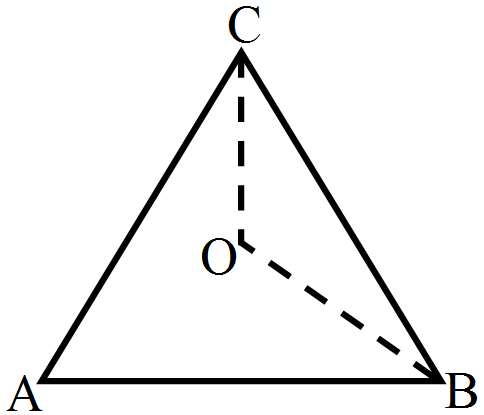
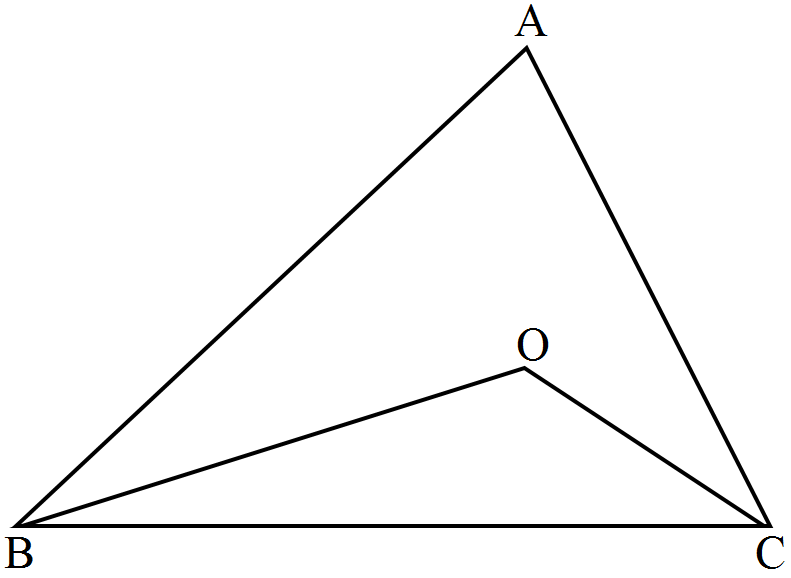
In a $\triangle\text{ABC},$ if $\angle\text{A}=60^\circ,\angle\text{B}=80^\circ$ and the bisectors of $\angle\text{B}$ and $\angle\text{C}$ meet at O, then $\angle\text{BOC}=$
View full question & answer
Question 711 Mark
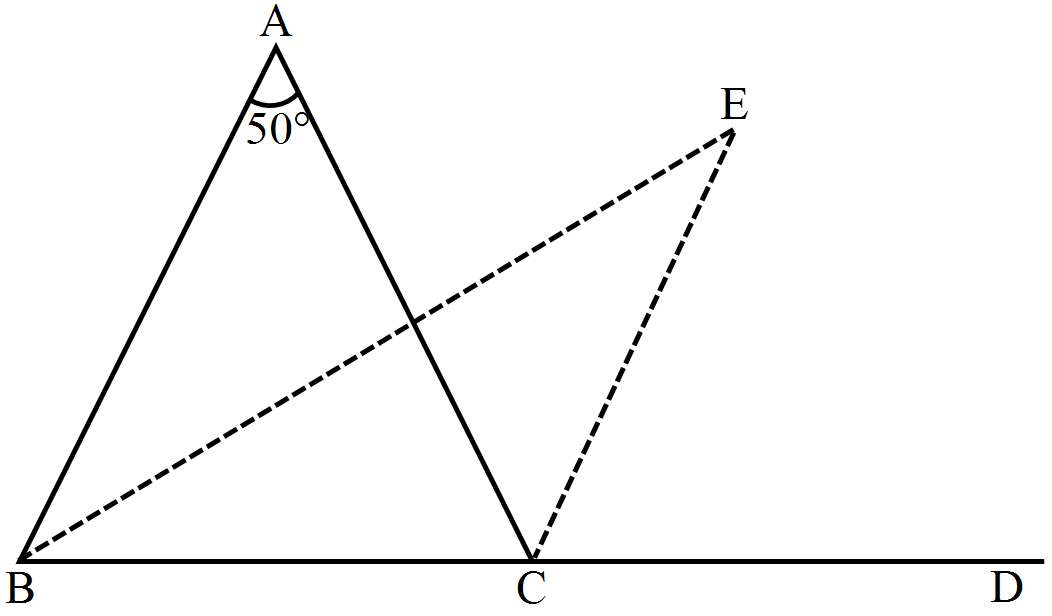
In a $\triangle\text{ABC}, \ \angle\text{A} = 50^\circ$ and BC is produced to a point D. If the bisectors $\angle\text{ACD}$ meet at E, then $\angle\text{E} =$
View full question & answer
Question 721 Mark
Which of the following statements is true?
  1. A triangle can have two acute angles.
  2. A triangle can have two right angles.
  3. A triangle can have two obtuse angles.
  4. All are true.
    Answer
    1. A
      Solution:
      A triangle can have two or even all three acute angles (in case of an equilateral triangle) but it cannot have two right angles or two obtuse angles as the sum of the interior angles of a triangle is 180º and two right angles or two obtuse angles would sum up to 180º or more leaving the no space for the third angle.
    View full question & answer
    Question 731 Mark
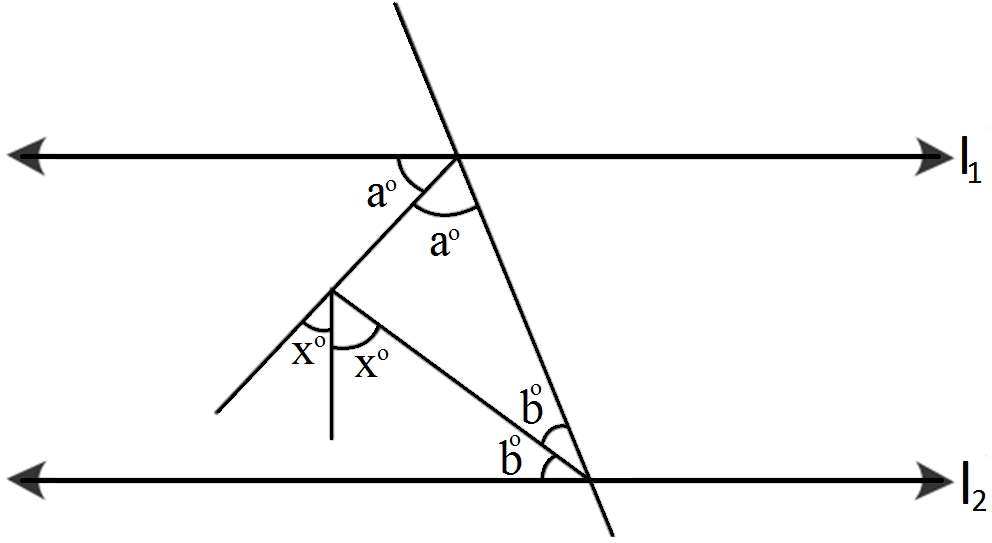
    In Fig. if$ l_1 || l_2,$ the value of $x$ is:
    Answer

    From figure,
    $\angle\text{ACS}=180^\circ-2\text{b}^\circ$
    also $\angle\text{ACS}=\angle\text{PAC}=2\text{a}^\circ ($alternate angles$)$
    $\Rightarrow2\text{a}^\circ=180^\circ-2\text{b}^\circ$
    $\Rightarrow\text{a}^\circ+\text{b}^\circ=90^\circ$
    Now, in $\triangle\text{ABC}$
    $\text{a}^\circ+\text{b}^\circ+\angle\text{ABC}=180^\circ$
    $\angle\text{ABC}=180^\circ-2\text{x}^\circ$
    $\Rightarrow\text{a}^\circ+\text{b}^\circ+180^\circ-2\text{x}^\circ=180^\circ$
    $\Rightarrow2\text{x}^\circ=\text{a}^\circ+\text{b}^\circ=90^\circ$
    $\Rightarrow\text{x}^\circ=45^\circ$
    View full question & answer
    Question 741 Mark
    Answer
    1. $\angle\text{ACD}$
      Solution:
      $\angle\text{ACD}$ is the right answer;
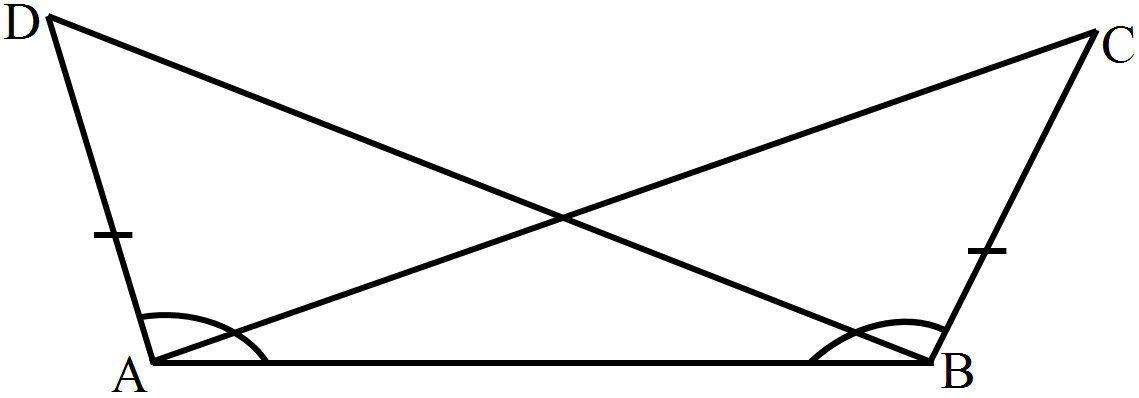
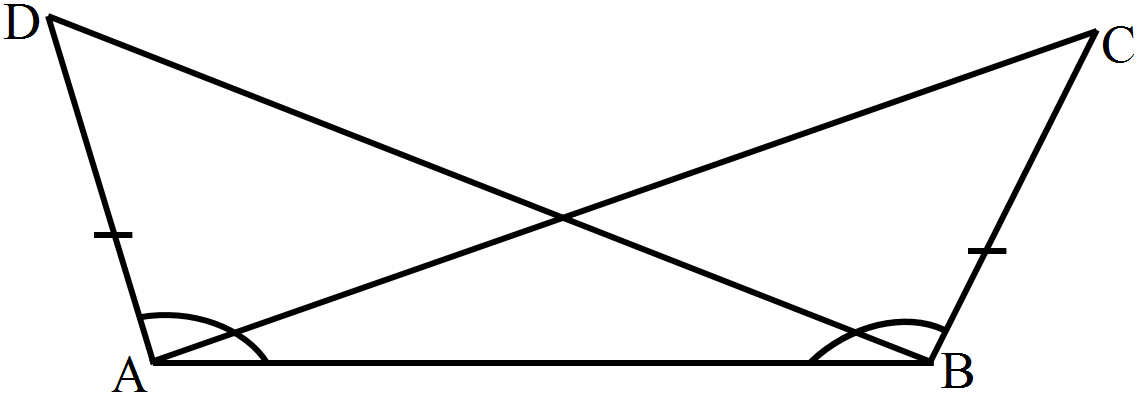
      In $\triangle\text{ACD}$ and $\triangle\text{CAB}$
      AD = BC (Given)
      $\angle\text{D}=\angle\text{B}$ (Given)
      AB = CD (Given)
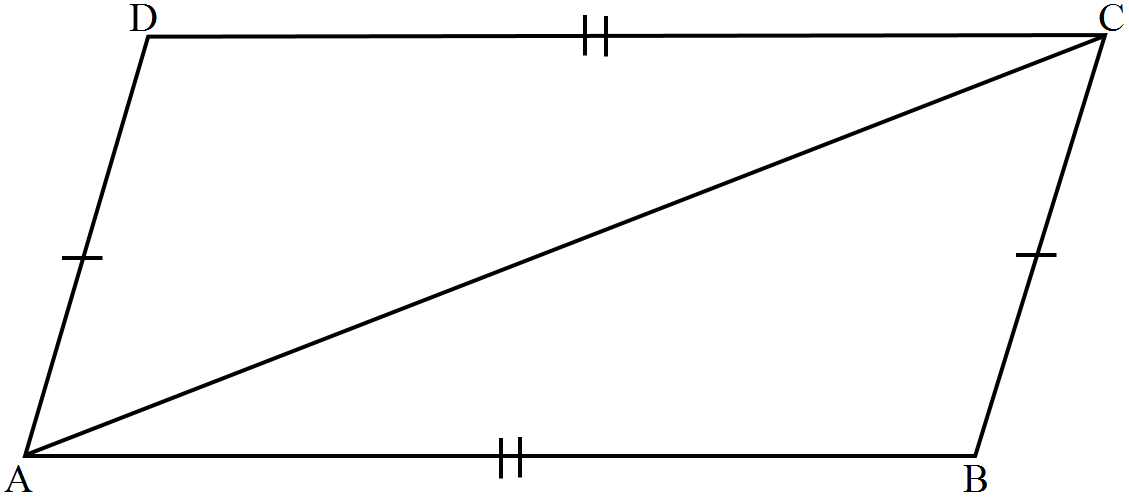
      $\therefore\triangle\text{ACD}≅\triangle\text{CAB}$ (by SAS congruence criteria),
      $⇒ \angle\text{CAB} = \angle\text{ACD}$ (cpct).
    View full question & answer
    Question 751 Mark
    Answer
    1. 72º
      Solution:
      Given that $\triangle\text{ABC}$
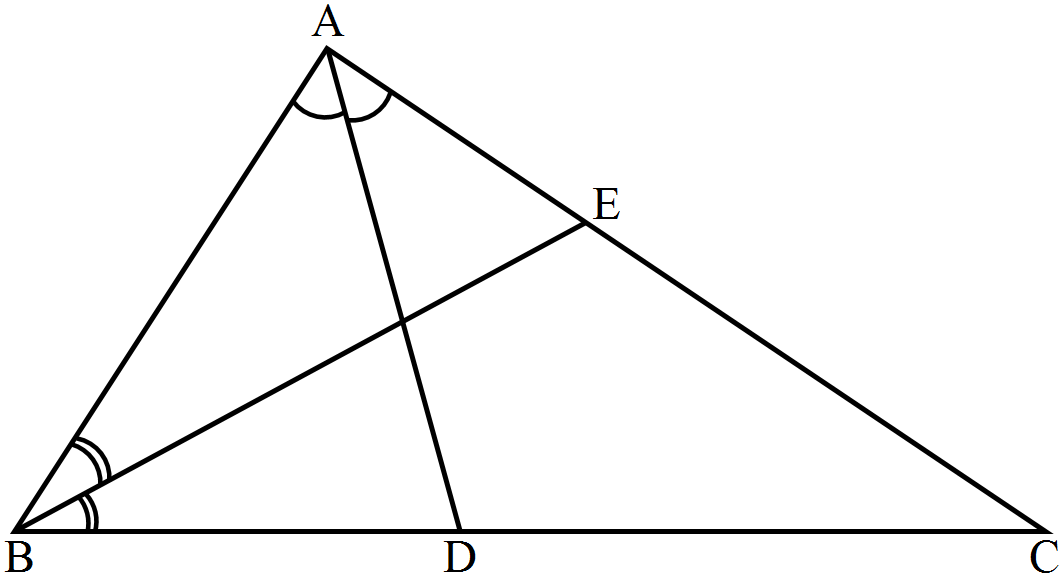
      BE is bisector of $\angle\text{B}$ and AD is bisector of $\angle\text{BAC}$
      $\angle\text{B} = 2\angle\text{C}$
      By exterior angle theorem in triangle ADC
      $\angle\text{ADB} = \angle\text{DAC} + \angle\text{C} ...\ \text{(i)}$
      In $\triangle\text{ADB},$
      $\angle\text{ABD} + \angle\text{BAD} + \angle\text{ADB} = 180^\circ$
      $2\angle\text{C} + \angle\text{BAD} + \angle\text{DAC} + \angle\text{C} = 180^\circ$ [From (i)]
      $3\angle\text{C} + \angle\text{BAC} = 180^\circ$
      $\angle\text{BAC} = 180^\circ - 3\angle\text{C} ...\ \text{(ii)}$
      Therefore,
      $\text{AB = CD}$
      $\angle\text{C} = \angle\text{DAC}$
      $\angle\text{C} = \frac{1}{2}\angle\text{BAC}\ ...\ \text{(iii)}$
      Putting value of Angle C in (ii), we get
      $\angle\text{BAC} = 180^\circ - \frac{1}{2} \angle\text{BAC}$
      $\angle\text{BAC} +\frac{3}{2} \angle\text{BAC} =180^\circ$
      $\frac{5}{2} \angle\text{BAC} =180^\circ$
      $\angle\text{BAC} = \frac{180\times2}{2}$
      $=72^\circ$
      $\angle\text{BAC} = 72^\circ$
    View full question & answer
    Question 771 Mark
    If $\triangle\text{ABC}≅\triangle\text{LKM},$ then side of $\triangle\text{LKM}$ equal to side AC of $\triangle\text{ABC}$ is:
    Answer
    1. LM
      Solution:
      Since, by corresponding part of congruent triangle AC of $\triangle\text{ABC}$ is equal to the LM of $\triangle\text{LKM}.$
    View full question & answer
    Question 791 Mark
    Answer
    1. 105º
      Solution:
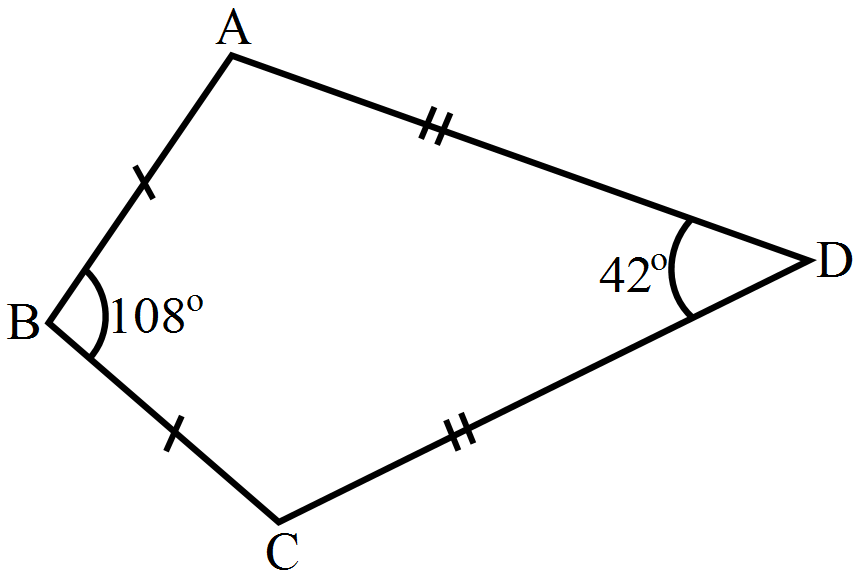
      Join AC. We get two isosceles triangles, $\triangle\text{ABC}$ and $\triangle\text{ACD}$
      In $\triangle\text{ABC},\ \angle\text{ABC}= 108^\circ$
      $\therefore\ \angle\text{BAC} = \angle\text{BCA} = \Big(\frac{180^\circ - 108^\circ}{2}\Big) = \frac{72^\circ}{2} = 36^\circ$
      In $\triangle\text{ACD},\ \angle\text{ADC}=42^\circ$
      $\therefore\ \angle\text{DAC} = \angle\text{DCA} = \Big(\frac{180^\circ - 42^\circ}{2}\Big) = \frac{138^\circ}{2} = 69^\circ$
      Now, $\angle\text{BCD} = \angle\text{BCA} + \angle\text{DCA} = 36^\circ + 69^\circ = 105^\circ$
    View full question & answer
    Question 801 Mark
    If $\triangle\text{ABC}\cong\triangle\text{PQR}$ and $\triangle\text{ABC}$ is not congruent to $\triangle\text{RPQ},$ then which of the following is not true:
    Answer
    1. $\text{BC}=\text{PQ}$
      Solution:
      $\triangle\text{ABC}\cong\triangle\text{PQR}$
      $\Rightarrow\text{AB}=\text{PR},\text{AC}=\text{PR},\text{BC}=\text{QR}$
      $\triangle\text{ABC}\not\cong\triangle\text{RQP}$
      $\Rightarrow\text{AB}\not=\text{QR},\text{AC}\not=\text{RP},\text{BC}\not=\text{PQ}$
      Hence, correct option (a).
    View full question & answer
    Question 821 Mark
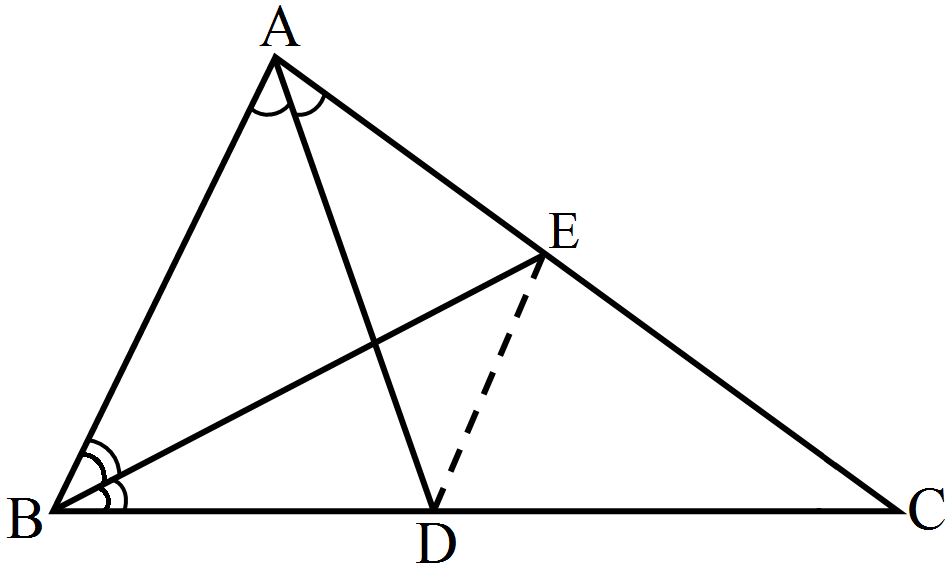
    In Fig. ABC is a triangle in which $\angle\text{B}=2\angle\text{C}.$ D is a point on side BC such that AD bisects $\angle\text{BAC}$ and $\text{AB}=\text{CD}.$ Be is the bisector of $\angle\text{B}.$ The measure of $\angle\text{BAC}$ is:
    Answer
    1. 72º
      Solution:

      $\angle\text{ABE}=\angle\text{EBC}$ $($EBC is bisector of $\angle\text{B})$
      and $\angle\text{C}=\frac{\angle\text{B}}{2}$
      $\Rightarrow\angle\text{EBC}=\angle\text{ECB}$
      So $\triangle\text{EBC}$ is isosceles triangle.
      $\Rightarrow\text{EB}=\text{EC}\ ....(1)$
      Now Consider $\triangle\text{ABE}$ and $\triangle\text{DCE}$
      $\text{AB}=\text{DC}$ (Given)
      $\text{BE}=\text{CE}$ [From (1)]
      $\angle\text{ABE}=\angle\text{DCE}$ (From above data)
      So $\triangle\text{ABE}\cong\triangle\text{DCE}$ by SAS property
      $\Rightarrow\text{AE}=\text{DE}$
      $\angle\text{BAE}=\angle\text{CDE}=\angle\text{A}$
      Now consider $\triangle\text{AED},$
      $\text{AE}=\text{DE}$ (above proved)
      $\Rightarrow\triangle\text{AED}$ is isosceles triangle
      $\Rightarrow\angle\text{EAD}=\angle\text{EDA}=\frac{\angle\text{A}}{2}$ $($AD is Bisector of $\angle\text{A})\ ....(2)$
      Now, consider $\triangle\text{ABC},$
      $\angle\text{A}+\angle\text{B}+\text{C}=180^\circ$
      $\Rightarrow\angle\text{A}+2\angle\text{C}+\angle\text{C}=180^\circ(\angle\text{B}=2\angle\text{C)}$
      $\Rightarrow\angle\text{A}+3\angle\text{C}=180^\circ\ .....(3)$
      Consider $\triangle\text{ADE},$
      $\Rightarrow\frac{\angle\text{A}}{2}+\angle\text{ADC}+\angle\text{}\text{C}=180^\circ$
      $\Rightarrow\frac{\angle\text{A}}{2}+(\angle\text{EDA}+\angle\text{CDE})+\angle\text{C}=180^\circ$
      $\Rightarrow\frac{\angle\text{A}}{2}+\frac{\angle\text{A}}{2}+\angle\text{A}+\angle\text{C}=180^\circ$
      $\Rightarrow\angle\text{}A+\angle\text{A}+\angle\text{C}=180^\circ$
      $\Rightarrow2\angle\text{A}+\angle\text{C}=180^\circ\ .....(4)$
      Right hand side of equations (3) and (4) are equal, hence Left hand side.
      $\Rightarrow\angle\text{A}+3\angle\text{C}=2\angle\text{A}+\angle\text{C}$
      $\Rightarrow\angle\text{A}=2\angle\text{C}$
      Substituting in equation (3),
      $2\angle\text{C}+3\angle\text{C}=180^\circ$
      $\Rightarrow5\angle\text{C}=180^\circ$
      $\Rightarrow\angle\text{C}=36^\circ$
      $\Rightarrow\angle\text{A}=2\times36^\circ=72^\circ$
      Hence, correct option is (a).
    View full question & answer
    Question 831 Mark
    In $\triangle\text{ABC, BC = AB}$ and $\angle\text{B}=80^{\circ}.$ Then, $\angle\text{A = ?}$
    Answer
    1. 50°
      Solution:
      In $\triangle\text{ABC,}$
      $\text{BC = AB}$
      $\Rightarrow\angle\text{A}=\angle\text{C}$ (angles opposite to equal sides are equal)
      Now, $\angle\text{A}+\angle\text{B}+\angle\text{C}=180^{\circ}$
      $\Rightarrow\angle\text{A}+80^{\circ}+\angle\text{A}=180^{\circ}$
      $\Rightarrow2\angle\text{A}+100^{\circ}$
      $\Rightarrow\angle\text{A}=50^{\circ}$
    View full question & answer
    Question 841 Mark
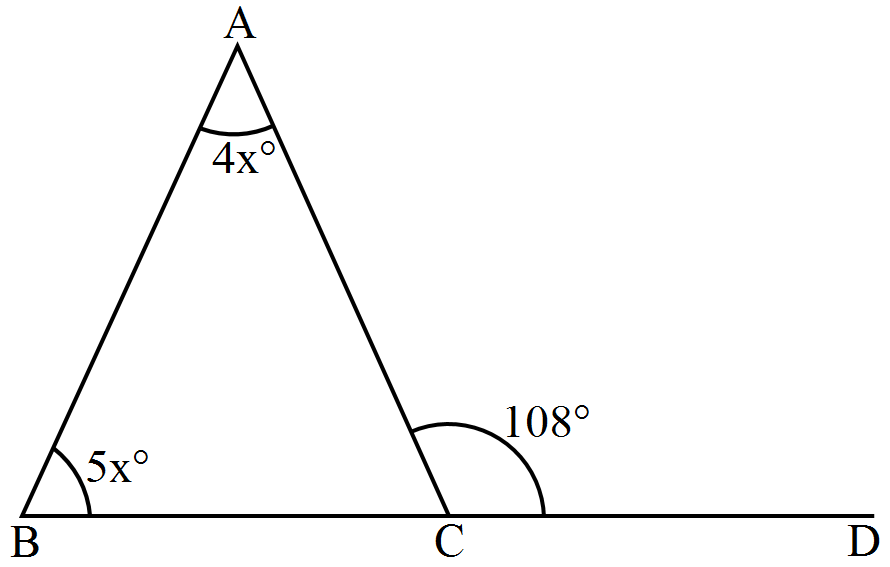
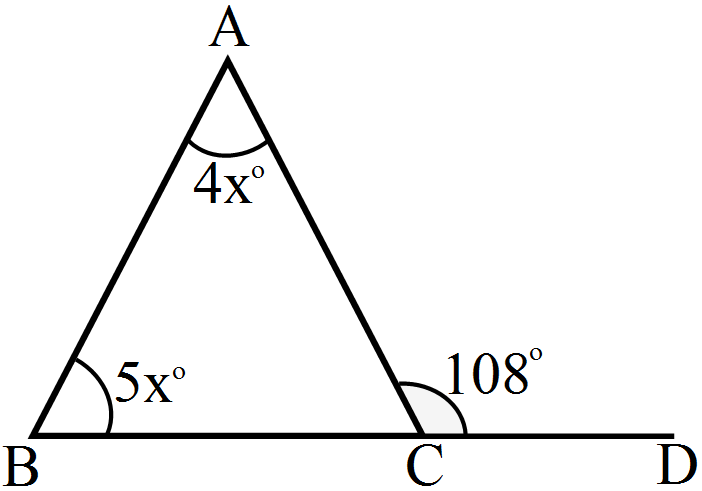
    An exterior angle of a triangle is 108º and its interior opposite angles are in the ratio 4 : 5. The angles of the triangle are:
    View full question & answer
    Question 851 Mark
    In $\triangle\text{ABC},\ \angle\text{A} = 50^\circ,\ \angle\text{B} = 60^\circ.$ Find the longest side of the triangle?
    Answer
    1. AB
      Solution:
      By angle sum property, we have,
      $\angle\text{A} + \angle\text{B} + \angle\text{C} = 180^\circ$
      $\Rightarrow 50^\circ + 60^\circ + \angle\text{C} = 180^\circ$
      $\Rightarrow\ \angle\text{C} = 180^\circ - (50^\circ+ 60^\circ) = 70^\circ$
      Therefore, $\angle\text{C}$ is the largest angle in the triangle and the side opposite to it i.e. AB is the longest side.
    View full question & answer
    Question 861 Mark
    Answer
    1. 60°
      Solution:
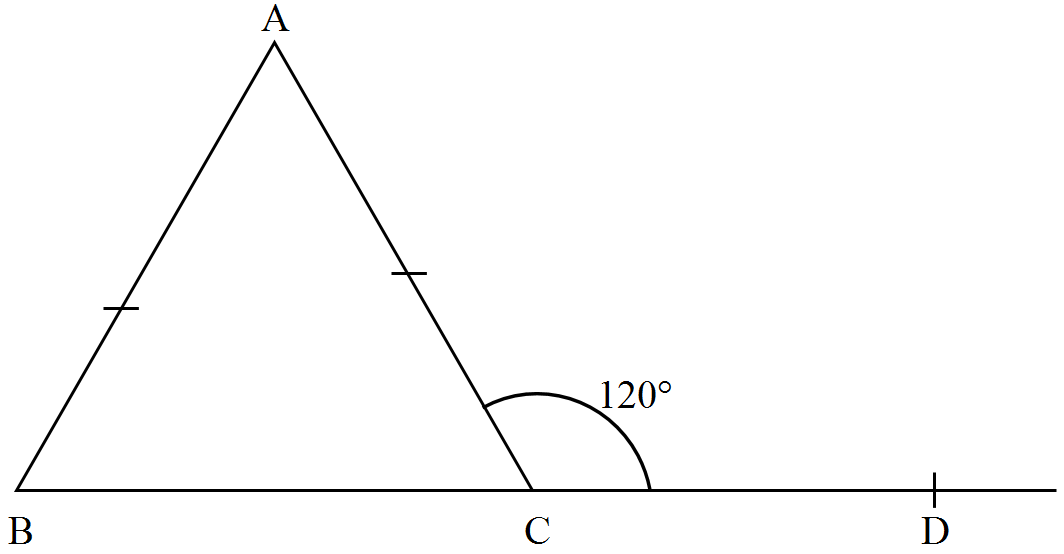
      In $\triangle\text{ABC}, \ \text{AB} = \text{AC}$
      $⇒ \angle\text{ABC} = \angle\text{ACB}$
      Also, $\angle\text{ACD}=120^\circ$
      $⇒ \angle\text{ACB} = 180^\circ- \angle\text{ACD}$ (Linear pair)
      $⇒ \angle\text{ACB} = 180^\circ- 120^\circ = 60^\circ$
      $⇒ \angle\text{ABC} = 60^\circ$
      By using angle sum property, we have
      $\angle\text{ABC} + \angle\text{ACB} + \angle\text{BAC} = 180^\circ$
      $60^\circ + 60^\circ+ \angle\text{A} = 180^\circ$
      or, $\angle\text{A} = 180^\circ - 120^\circ= 60^\circ$
    View full question & answer
    Question 871 Mark
    Answer
    1. x + y - 180
      Solution:
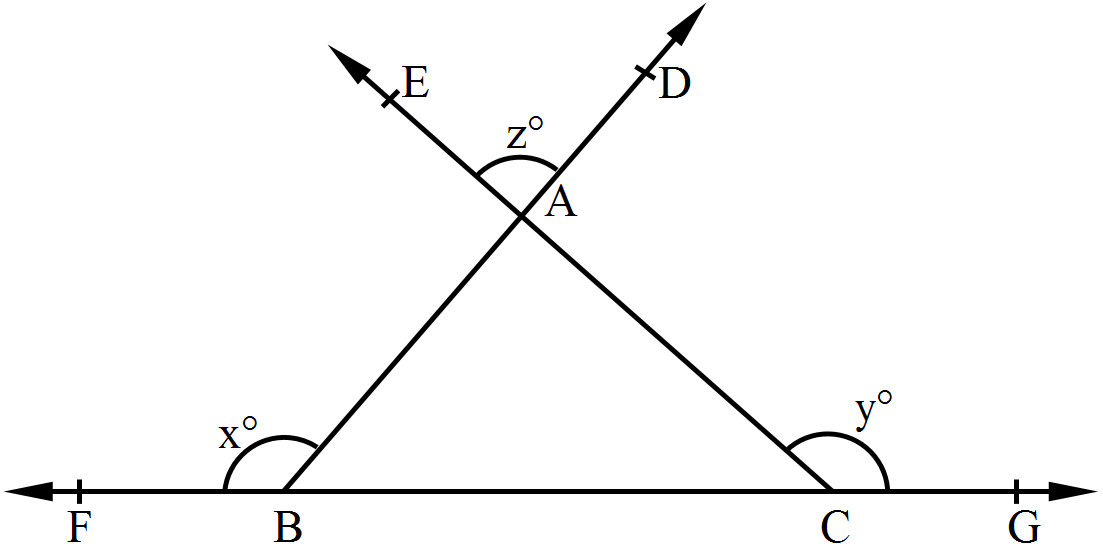
      In the given figure, $\angle\text{ABF}+\angle\text{ABC}=180^\circ$ (Linear pair of angles)
      $∴\text{x}^\circ+\angle\text{ABC}=180^\circ$
      $⇒\angle\text{ABC}=180^\circ−\text{x}°...\ (\text{i})$
      Also, $\angle\text{ACG}+\angle\text{ACB}=180^\circ$ (Linear pair of angles)
      $∴\text{y}′+\angle\text{ACB}=180^\circ$
      $⇒\angle\text{ACB}=180^\circ−\text{y}′\ ...\ \text{(ii)}$
      Also, $\angle\text{BAC}=\angle\text{DAE}=\text{z}° \ ....\ \text{(iii)}$ (Vertically opposite angles)
      In $\triangle\text{ABC}$
      $\angle\text{BAC}+\angle\text{ABC}+\angle\text{ACB}=180^\circ$ (Angle sum property)
      $∴\text{z}^\circ+180−\text{x}^\circ+180^\circ−\text{y}^\circ=180^\circ$ [Using (1), (2) and (3)]
      $⇒ \text{z} = \text{x} + \text{y} – 180$
    View full question & answer
    Question 881 Mark
    In $\triangle\text{ABC},$ if $\angle\text{C}>\angle\text{B},$ then
    Answer
    1. AB > AC
      Solution:
      Greater angle has greater side opposite to it.
    View full question & answer
    Question 901 Mark
    Answer
    1. 230º
      Solution:
      $\triangle\text{ACO}$
      $\angle\text{ACO}+\angle\text{COA}+\angle\text{COA}=180^\circ$
      Now, $\angle\text{OAC}=180^\circ-\text{x}^\circ$
      $\Rightarrow80^\circ+40^\circ+180^\circ-\text{x}^\circ=180^\circ$
      $\Rightarrow\text{x}^\circ=120^\circ$
      $\angle\text{BOD}=\angle\text{COA}=40^\circ$ (Opposite angles)
      $\angle\text{BDO}=70^\circ$
      In $\triangle\text{OBD},$
      $\angle\text{OBD}=180^\circ-40^\circ-70^\circ=70^\circ$
      Also, $\text{y}^\circ=180^\circ-\angle\text{OBD}=180^\circ-70^\circ=110^\circ$
      $\Rightarrow\text{x}^\circ+\text{y}^\circ=120^\circ+110^\circ=230^\circ$
    View full question & answer
    Question 911 Mark
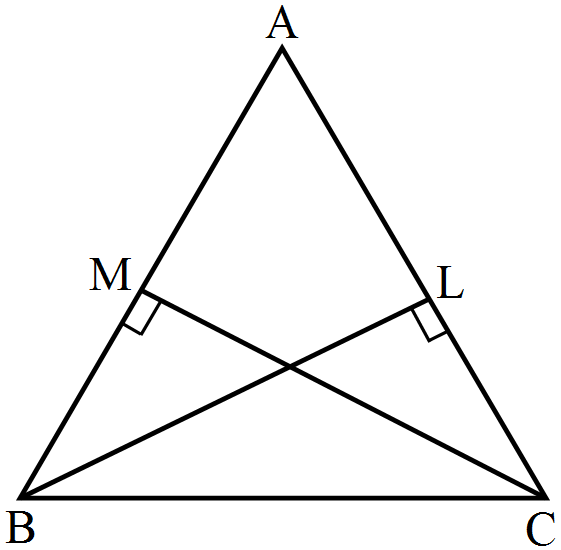
    If the altitudes from two vertices of a triangle to the opposite sides are equal, then the triangle is:
    View full question & answer
    Question 921 Mark
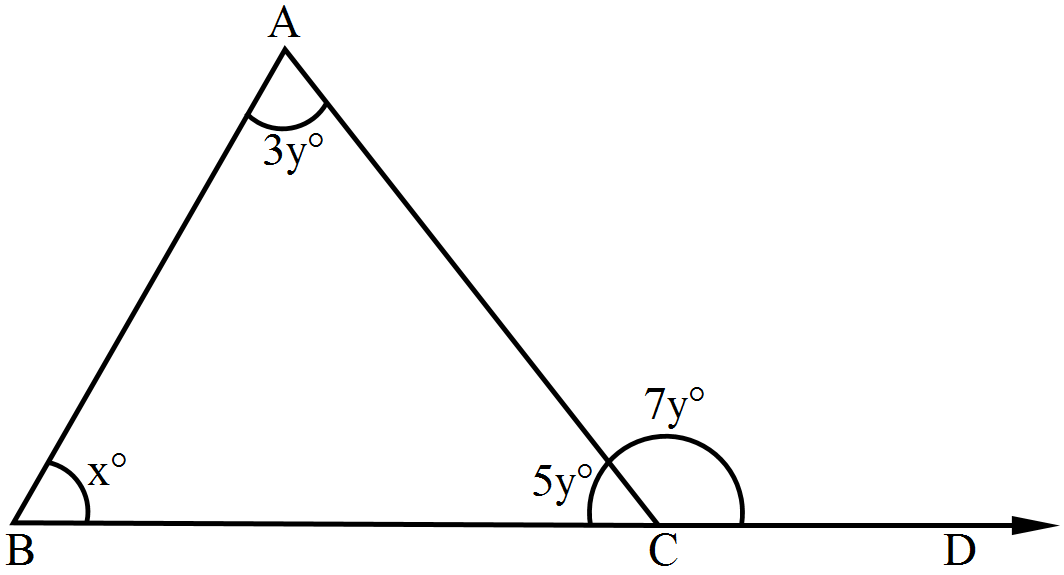
    In the given figure, side $BC$ of $\triangle\text{ABC}$ has been produced to a point $D$. If $\angle\text{A}=3\text{y}^\circ \angle\text{B}=\text{x}^\circ, \ \angle\text{C}=5\text{y}^\circ$ and $\angle\text{CBD}=7\text{y}^\circ.$ Then, the value of $x$ is:
    Answer
    In the given figure $\angle\text{ACB}+\angle\text{ACD}=180^\circ ($Linear pair of angles$)$
    $\therefore 5\text{y}′+7\text{y}′=180^\circ$
    $\Rightarrow 12y^\circ = 180^\circ$
    $\Rightarrow y = 15 ...(i)$
    In $\triangle\text{ABC},$
    $\angle\text{A}+\angle\text{B}+\angle\text{ACB}=180^\circ ($angle sum property$)$
    $\therefore 3\text{y}′+\text{x}′+5\text{y}′=180^\circ$
    $\Rightarrow x^\circ + 8y^\circ = 180^\circ$
    $\Rightarrow x^2+ 8 \times 15^\circ = 180^\circ [$using $(1)]$
    $\Rightarrow x^\circ + 120^\circ = 180^\circ$
    $\Rightarrow x^\circ = 180^\circ − 120^\circ = 60^\circ$
    Thus, the value of $x$ is $60.$
    View full question & answer
    Question 931 Mark
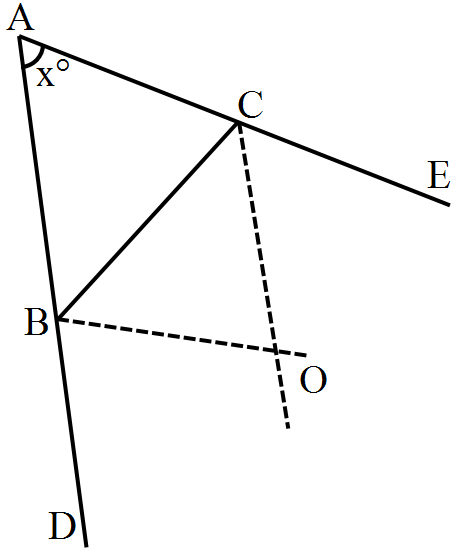
    Answer
    1. $90^\circ-\frac{\text{x}^\circ}{2}$
      Solution:
      In $\triangle\text{ABC}$
      $\angle\text{A}+\angle\text{B}+\angle\text{C}=180^\circ$
      $\angle\text{B}+\angle\text{C}=180^\circ-\text{x}^\circ\ ...\ \text{(i)}$
      $\angle\text{CBD}=180^\circ-\angle\text{B}\ ...\ \text{(ii)}$
      $\angle\text{ECB}=180^\circ-\angle\text{C}\ ...\ \text{(iii)}$
      $\Rightarrow\ \frac{\angle\text{CBD}}{2}=\angle\text{OBC}=90^\circ-\frac{\angle\text{B}}{2}\ ...\ \text{(iv)}$
      $\Rightarrow\ \frac{\angle\text{ECB}}{2}=\angle\text{OCB}=90^\circ-\frac{\angle\text{C}}{2}\ ...\ \text{(v)}$
      Now, in $\triangle\text{BOC}$
      $\angle\text{OBC}+\angle\text{OCB}+\angle\text{BOC}=180^\circ$
      $\angle\text{BOC}=180^\circ-(\angle\text{OBC}\ +\ \angle\text{OCB})$
      From eq. (iv) and (v)
      $\angle\text{BOC}=180^\circ-\Big(90^\circ-\frac{\angle\text{B}}{2}+90^\circ-\frac{\angle\text{C}}{2}\Big)$
      $=\ 180^\circ-\Big(180^\circ-\frac{\angle\text{B}}{2}-\frac{\angle\text{C}}{2}\Big)$
      $=\frac{\angle\text{B}+\angle\text{C}}{2}$
      $=\frac{180^\circ+\text{x}^\circ}{2}$
      $\angle\text{BOC}=90^\circ-\frac{\text{x}^\circ}{2}$
    View full question & answer
    Question 941 Mark
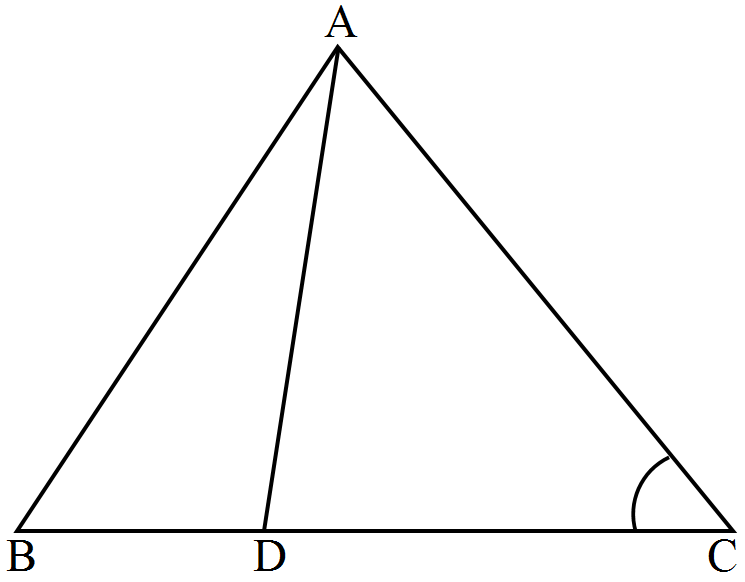
    D is a point on the side BC of a $\triangle\text{ABC}$ such that AD bisects $\triangle\text{BAC}$ then:
    Answer
    1. BA > BD
      Solution:
      Since, $\triangle\text{BAC}$ is bisected by AD, then $\triangle\text{BAD}$ is less than $\triangle\text{ABC},$ hence the side opposite $\triangle\text{ABC},$ i.e., BA is greater than the side opposite to $\triangle\text{BAD}$ i.e., BD.
    View full question & answer
    Question 951 Mark
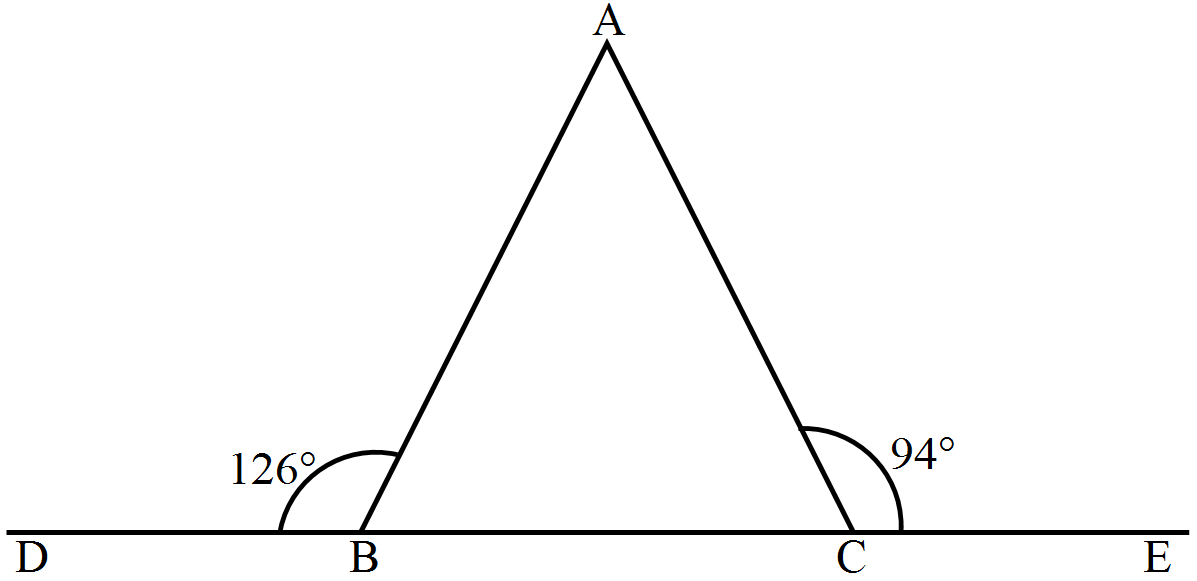
    The base BC of triangle ABC is produced both ways and the measure of exterior angles formed are 94º and 126º. Then, $\angle\text{BAC} =$
    View full question & answer
    Question 961 Mark
    D, E, F are the mid-point of the sides BC, CA and AB respectively of $\triangle\text{ABC}.$ Then $\triangle\text{DEF}$ is congruent to triangle.
    Answer
    1. AFE, BFD, CDE
      Solution:
      In anytriangle, a line joining the mid-points of any two sides is parallel to the third side.
      ⇒ EF || BC EF || DC and BD
      Similiarly DF || EC
      ⇒DF || AE and EC
      Also DE || AB.
      ⇒ DE || AF and BF
      From this information it is clear that EFDC, EFBD, EAFD
      are the parallelogram by property.
      Now consider one parallelogram EFDC
      Consider $\triangle\text{DEF}$ and $\triangle\text{EDC}$
      $\text{DE}=\text{ED}$ (common)
      $\angle\text{DEF}=\angle\text{EDC}$
      $\angle\text{EDF}=\angle\text{DEC}$ (ASA property)
      $\Rightarrow\triangle\text{DEF}\cong\triangle\text{EDC}$
      Similiarly in parallelogram EAFD,
      $\triangle\text{DEF}\cong\triangle\text{AFC}$
      And in parallelogram EFBD
      $\triangle\text{DEF}\cong\triangle\text{FBD}$
      Hence, correct option is (d).
      Note: Option (d) modified.
    View full question & answer
    Question 971 Mark
    An exterior angle of a triangle is 108º and its interior opposite angles are in the ratio 4 : 5 The angles of the triangle are:
    View full question & answer
    Question 981 Mark
    Find the measure of angles which is equal to its supplement.
    Answer
    1. 90º
      Solution:
      We know that the sum of supplementary angle is 180º
      Let the angle be x the other angle is 180° - x and the two angles are equal,
      ⇒ x = 180º - x
      ⇒ 2x = 180º
      $\Rightarrow\ \text{X}=\frac{180^\circ}{2}$
      $\Rightarrow\ \text{X}=90^\circ$
    View full question & answer
    Question 1001 Mark
    The sum of the interior angles of a triangle is:
    Answer
    1. 180º
      Solution:
      For a triangle,
      Number of sides (n) = 3
      Sum of interior angles = (n - 2) × 180º
      = (3 - 2) × 180º
      = 1 × 180º
      = 180º
    View full question & answer
    M.C.Q - Page 2 - MATHS STD 9 Questions - Vidyadip