Questions · Page 6 of 6

M.C.Q

Question 2511 Mark
In $\triangle\text{ABC},$ if $\angle\text{B} = 30^\circ$ and $\angle\text{C} = 70^\circ,$ then which of the following is the longest side?
Answer
  1. BC
    Solution:
    Since the sum of all sides of a triangle is 180°.
    So, $\angle\text{C} = 70^\circ,\ \angle\text{B} = 30^\circ,\ \angle\text{A} = 80^\circ.$
    We have a theorem which states that the side opposite to the greatest angle is the longest.
    So, the side opposite to angle A is the longest.
View full question & answer
Question 2521 Mark
The cost of turfing a triangular field at the rate of $Rs. 45$ per $100\ m^2$ is $Rs. 900.$ If the double the base of the triangle is $5$ times its height, then its height is:
Answer
Cost of turfing a triangilar field at the rate of $Rs. 45$ per $100 = Rs. 900$
$\frac{\text{Arae}\times45}{100}=900$
$\Rightarrow$ Area $= 2000\  sq.cm$
According to question,
$2 \times$ Base $= 5 \times$ Height
$\Rightarrow\ \text{Base}=\frac{\text{Height}\times5}{2}$
Area of a triangle $= 2000\  sq.cm$
$\Rightarrow\ \frac{1}{2}\times\text{Base}\times\text{Height}=2000$
$\Rightarrow\ \frac{1}{2}\times\frac{\text{Height}\times5}{2}\times\text{Height}=2000$
$\Rightarrow\ \text{(Height)}^2=1600$
$\Rightarrow\ \text{Height}=40\ \text{cm}$
View full question & answer
Question 2531 Mark
Answer
  1. 50º
    Solution:
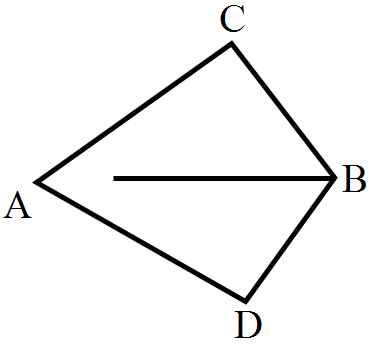
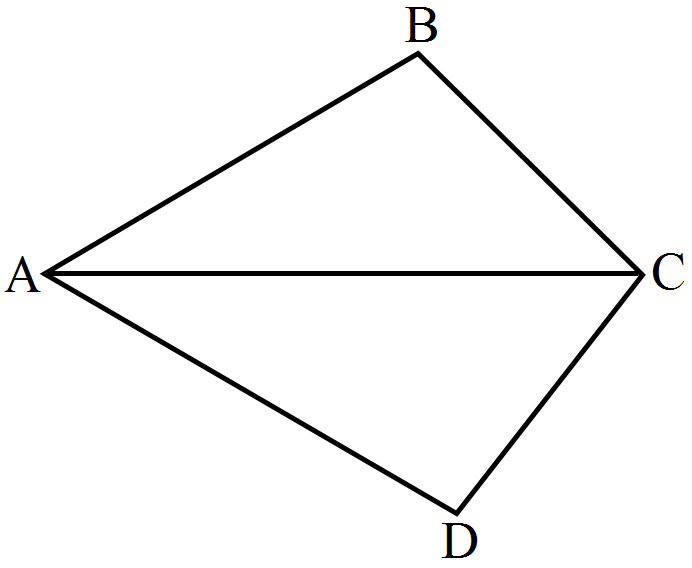
    In $\triangle\text{ABC}, \triangle\text{BAC} = 30^\circ$ and $\triangle\text{ABC}= 100^\circ$ (Given)
    $\angle\text{BAC} + \angle\text{ABC}+ \angle\text{BCA} = 180^\circ$
    $\angle\text{BCA}= 50^\circ$
    Also $\angle\text{ACD}= 50^\circ$ (Since, $\triangle\text{ABC}\cong\triangle\text{ADC}$).
View full question & answer
Question 2541 Mark
If all the three angles of a triangle are equal, then each one of them is equal to:
Answer
  1. 60º
    Solution:
    Let the measure of each angle be xº
    Now, the sum of all angles of any triangle is 180°
    Thus, xº + xº + xº = 180º
    i.e. 3xº = 180º
    i.e. xº = 60º
View full question & answer
Question 2551 Mark
Two sides of a triangle are of length 4cm and 2.5cm. The length of the third side of the triangle cannot be.
Answer
  1. 6.5cm
    Solution:
    Length of the greatest side of a triangle must be less than the sum of the other two sides.
View full question & answer
Question 2561 Mark
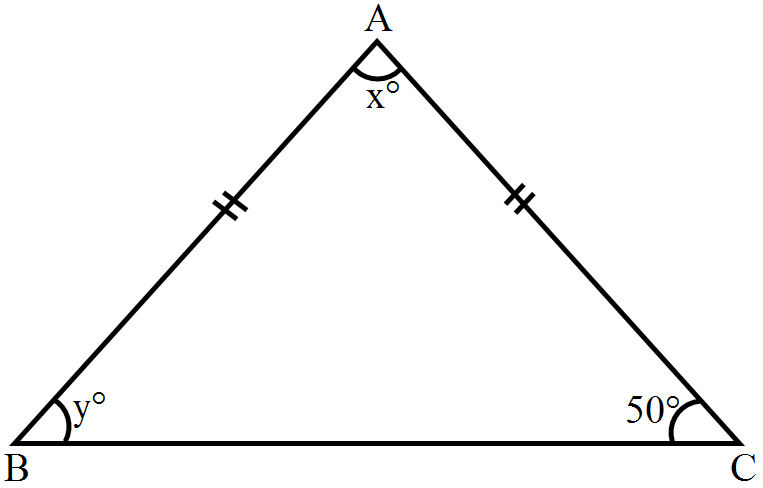
In the adjoining fig. $AB = AC$. If $\angle\text{C} = 50^\circ,$ then the value of $x$ and $y$ are:
Answer
In triangle$ ABC, AB = AC,$ hence their opposite angles will be equal.
$\Rightarrow\angle\text{B}=\angle\text{C}= 50^\circ$
$\Rightarrow y = 50^\circ$
Now, by angle sum property,
$\angle\text{A} + \angle\text{B} + \angle\text{C} = 180^\circ$
or$, x + 50^\circ + 50^\circ = 180^\circ$
or$, x + 100^\circ = 180^\circ$
$\Rightarrow x = 80^\circ$
View full question & answer
Question 2571 Mark
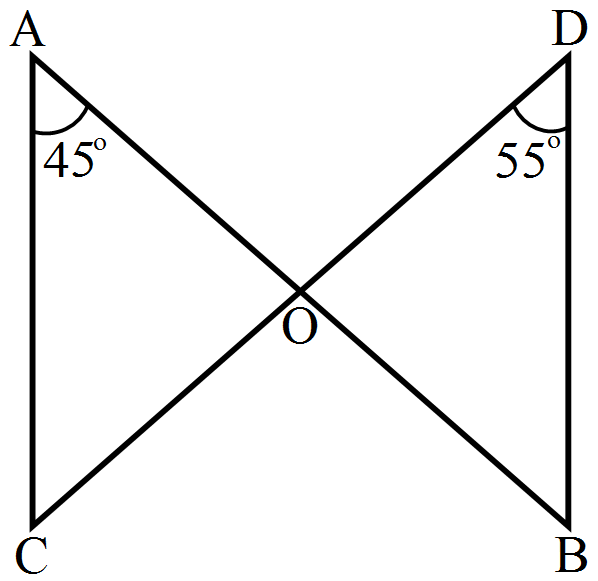
Line segments AB and CD intersect at O such that AC || DB. If $\angle\text{CAB}=45^\circ$ and $\angle\text{CDB}=55^\circ,$ then $\angle\text{BOD}=$
View full question & answer
Question 2581 Mark
In a $\triangle\text{ABC},$ if $3\angle\text{A}=4\angle\text{B}=6\angle\text{C}$ then A : B : C =?
Answer
  1. 4 : 3 : 2
    Solution:
    Given that $3\angle\text{A}=4\angle\text{B}=6\angle\text{C}=\text{k}.$
    $\Rightarrow\angle\text{A}=\frac{\text{k}}{3},\angle\text{B}=\frac{\text{k}}{4}\text{ and}\ \angle\text{C}=\frac{\text{k}}{6}$
    $\Rightarrow\text{A}:\text{B}:\text{C}=\frac{\text{k}}{3}:\frac{\text{k}}{4}:\frac{\text{k}}{6}$
    $\Rightarrow\text{A}:\text{B}:\text{C}=\frac{1}{3}:\frac{1}{4}:\frac{1}{3}$
    The LCM of 3, 4 and 6 is 12.
    Multiply by 12 throughout.
    ⇒ A : B : C = 4 : 3 : 2
View full question & answer
Question 2611 Mark
Answer
  1. 47
    Solution:
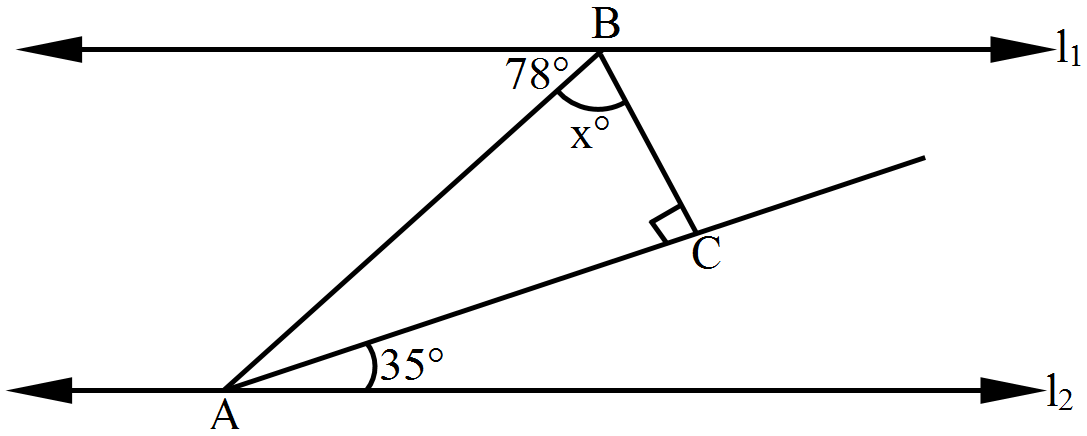
    Let if $11||12$ and AB is transverse to it
    Then,
    $\angle\text{PBA}$ should be equal to $\angle\text{BAS}$ (Alternate angles)
    So if $11||12,$ then $\angle\text{BAS}=70^\circ$
    $⇒\angle\text{BAC} = 78^\circ - 35^\circ = 43^\circ\ ...\ (\text{i})$
    Now, in $\angle\text{ABC}$
    $\text{x}^\circ + \angle\text{C} + \angle\text{BAC} = 180^\circ$
    $⇒ \text{x}^\circ + 90^\circ + 43^\circ = 180^\circ$
    $⇒ \text{x}^\circ = 180^\circ - 90^\circ - 43^\circ = 47^\circ$
    $⇒ \text{x}^\circ = 47^\circ$
    So if $\text{x}^\circ = 47^\circ$ then $11||12$
View full question & answer
Question 2621 Mark
In the following, write the correct answer.
In $\triangle\text{ABC}$ and $\triangle\text{DEF},$ if AB = AC, $\angle\text{A}=\angle\text{D}.$ The two triangles are:
Answer
  1. AC = DE
    Solution:
    In $\triangle\text{ABC},$
    AB = DF
    $\angle\text{A}=\angle\text{D}$
    We know that, two triangles will be congruent by ASA rule, if two angles and the included side of one triangle are equal to the two angles and the included side of other triangle.
    AC = DE.
View full question & answer
Question 2641 Mark
If triangle PQR is right angled at Q, then
Answer
  1. PR > PQ
    Solution:
    Then the hypotenuse should be always greater than the remaining two sides.
View full question & answer
Question 2651 Mark
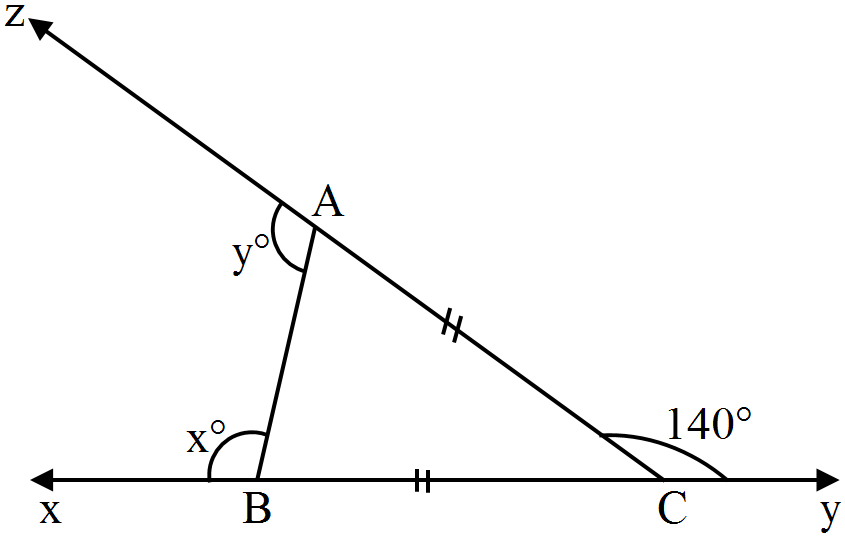
In fig, $ AC = BC $and $\angle\text{ACY} = 140^\circ.$ Find $X$ and $Y:$
​​
Answer
The two equal angles are $70$ since angle
$C = 180 - 140$
$ = 40X$
$Y = 180 - 70$
$= 110$
View full question & answer
Question 2661 Mark
Answer
  1. 65º
    Solution:
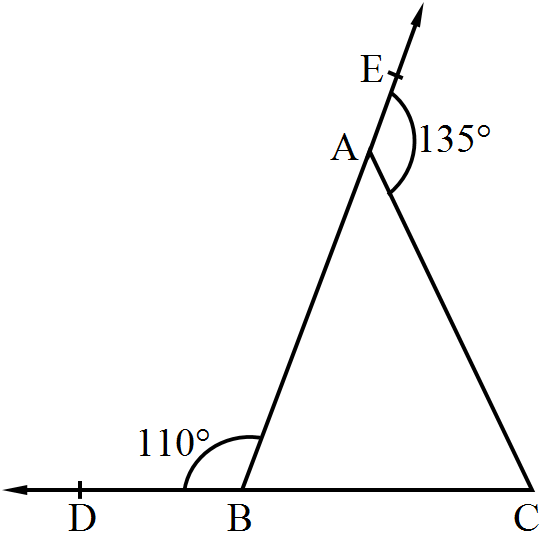
    We can find $\angle\text{CBA}$ as follows:
    Given that $\angle\text{EBA}=110^\circ$
    $\angle\text{CBA} = 180 - 110$ ... (linear pair)
    $=70^\circ$
    Given $\angle\text{CAD}=135^\circ$
    So, $\angle\text{CAB} = 180 - 135$ ... (linear pair)
    $=45^\circ$
    So, $\angle\text{ACB} = 180 - (70 + 45)$ ... (angle sum property of triangle)
    $=65^\circ$
View full question & answer
Question 2671 Mark
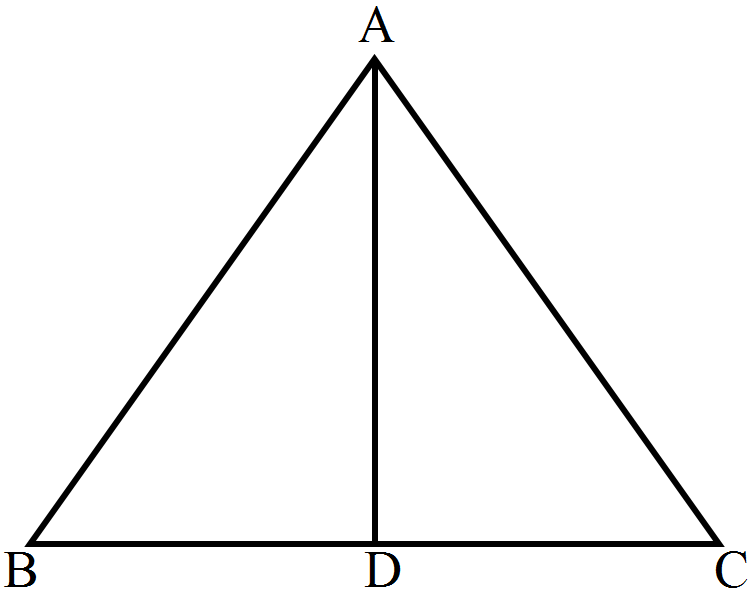
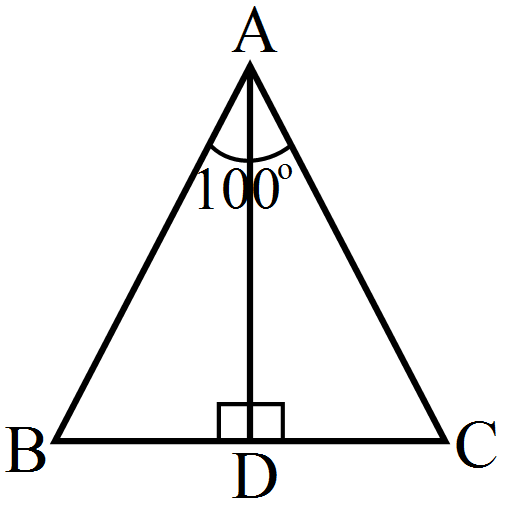
In $\triangle\text{ABC},$ if $\angle\text{A}=100^\circ,\text{AD}$ bisects $\angle\text{A}$ and $\text{AD}\perp\text{BC}.$ Then, $\angle\text{B}=$
View full question & answer
Question 2681 Mark
PQR is a right-angled triangle in which $\angle\text{P} = 90^\circ$ and PQ = PR. What is the value of $\angle\text{Q}$ and $\angle\text{R}.$
Answer
  1. 45º, 45º
    Solution:
    $\angle\text{P} = 90^\circ$
    Since, PQ = PR
    $\angle\text{Q} = \angle\text{R}$
    So, $\angle\text{Q} = \angle\text{R}=\frac{180^\circ\ -\ \angle\text{P}}{2}=\frac{180^\circ-90^\circ}{2}=\frac{90^\circ}{2}=45^\circ$
View full question & answer
Question 2691 Mark
In $\triangle\text{PQR},\ \angle\text{R} = \angle\text{P} $ and QR = 4cm and PR = 5cm. Then the length of PQ is:
Answer
  1. 4cm
    Solution:
    In a triangle, if two of its angles are equal then the sides opposite to equal angles are also equal.
    In $\triangle\text{PQR},\ \angle\text{R} = \angle\text{P}$
    ⇒ QR (side opposite to $ \angle\text{P}$) = PQ (side opposite to $ \angle\text{R}$)
    Given that, QR = 4cm
    ⇒ PQ = 4cm
View full question & answer
Question 2701 Mark
Answer
  1. 50°
    Solution:
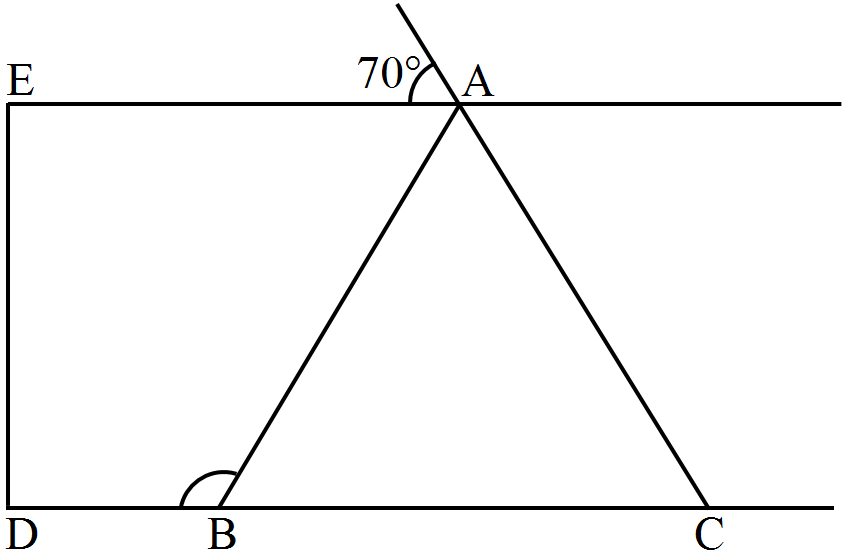
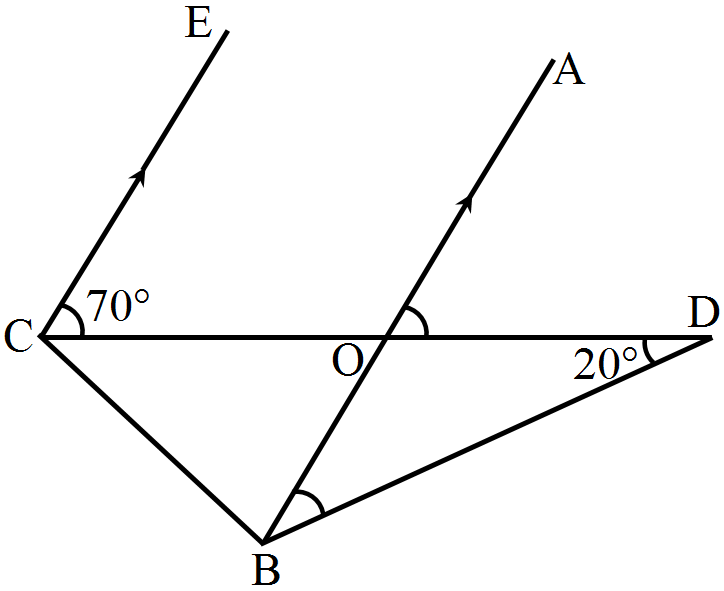
    $\text{EC}\ ||\text{ AB}$ and CD is transverse to it.
    Now $\angle\text{ECD} = \angle\text{AOD} = 70^\circ$ (Corresponding angles)
    In $\angle\text{OBD}$
    $\angle\text{OBD} + \angle\text{BOD} + \angle\text{ODB} = 180^\circ$
    $\angle\text{BOD} = 180^\circ - \angle\text{AOD} = 180^\circ - 70^\circ = 110^\circ$
    $\angle\text{ODB} = 20^\circ$ (Given)
    So, $\angle\text{OBD} = 180^\circ - \angle\text{BOD} - \angle\text{ODB}$
    $= 180^\circ - 110^\circ - 20^\circ$
    $= 50^\circ$
View full question & answer
Question 2711 Mark
Answer
  1. 55º
    Solution:
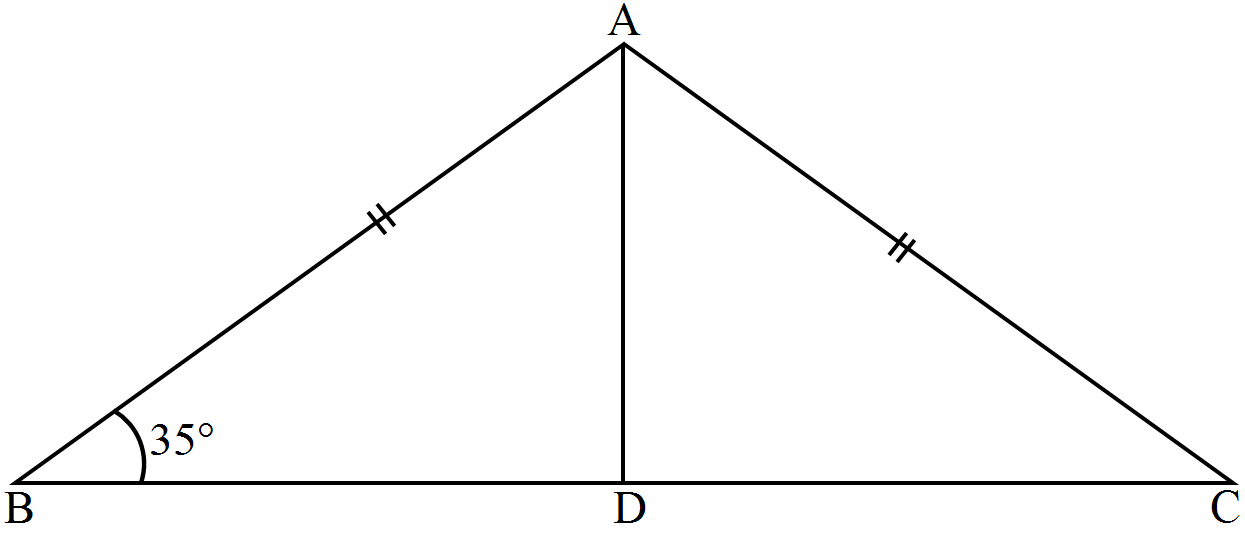
    It is given that $\angle\text{B} = 35^\circ, \text{AB} = \text{AC}$ and Ad is the median of BC
    We know that in isosceles triangle the median from he vertex to the unequal side divides it into two equal part at right angle.
    Therefore,
    $\angle\text{ADB} = 90^\circ$
    $\angle\text{B} = \angle\text{ADB} + \angle\text{A}= 180^\circ$ (Property of triangle)
    $35^\circ + 90^\circ + \angle\text{A} = 180^\circ$
    $\angle\text{A} = 180^\circ - 125^\circ$
    $\angle\text{A} = 55^\circ$
View full question & answer
Question 2721 Mark
Answer
  1. SAS
    Solution:
    ASA
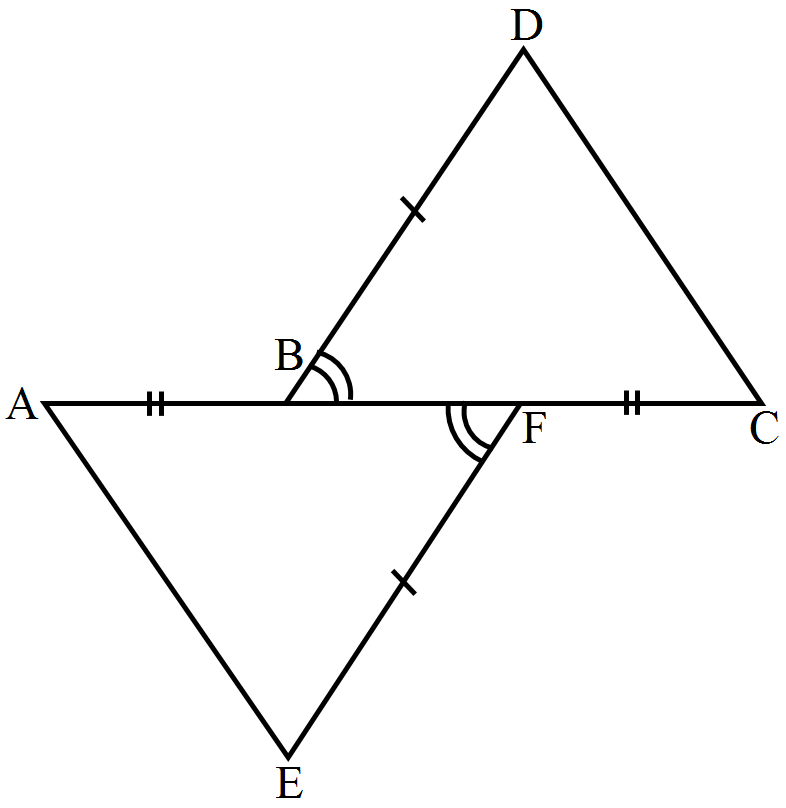
    In $\triangle\text{DBC}$ and $\triangle\text{AEF},$ we have
    AB = FC (given) by adding BF on both sides
    AF = CB
    $\triangle\text{AEF}=\ \triangle\text{CBD}$ (given)
    EF = BD (given)
    Hence, $\triangle\text{AFE}\cong\triangle\text{CBD}$ by SAS as the corresponding sides and their included angles are equal.
View full question & answer
Question 2731 Mark
Which of the following is not a criterion for congruence of triangles?
Answer
  1. SSA
    Solution:
    The criteria for congruence of triangles are SSS(Side-Side-Side), SAS(Side-Angle-Side), ASA(Angle-Side- Angle) and RHS(Right angle-Hypotenuse-Side).
View full question & answer
Question 2741 Mark
View full question & answer
M.C.Q - Page 6 - MATHS STD 9 Questions - Vidyadip