Questions · Page 5 of 6

M.C.Q

Question 2011 Mark
Answer
  1. 25
    solution:
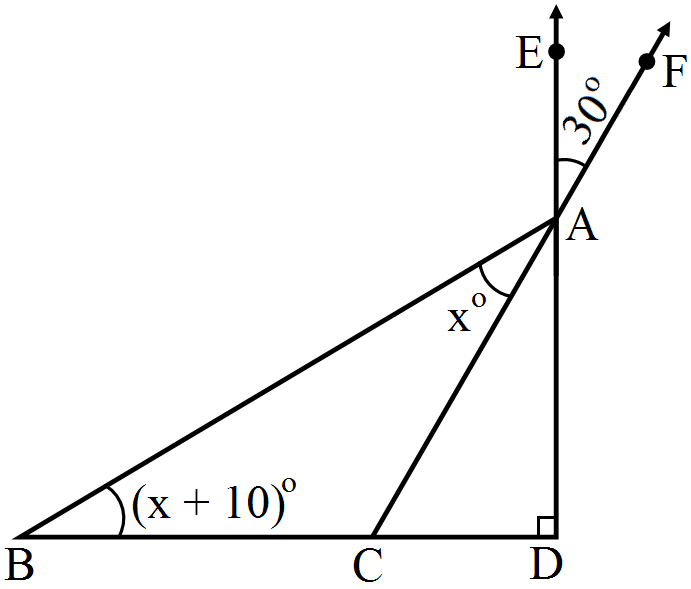
    $\angle\text{EAF}=\angle\text{CAD}$ (vertically opposite angles)
    $\Rightarrow\angle\text{CAD}=30^\circ$
    In $\triangle\text{ABD},$ by angle sum property
    $\angle\text{A}+\angle\text{B}+\angle\text{D}=180^\circ$
    $\Rightarrow(\text{x}+30)^\circ+(\text{x}+10)^\circ+90^\circ=180^\circ$
    $\Rightarrow2\text{x}+130^\circ=180^\circ$
    $\Rightarrow2\text{x}=50^\circ$
    $\Rightarrow\text{x}=25^\circ$
View full question & answer
Question 2021 Mark
In an isosceles $\triangle\text{ABC},$ if AB = AC and $\angle\text{A} = 90^\circ,$ Find $\angle\text{B}.$
Answer
  1. 45º
    Solution:
    We know that sum of all angle of a triangle is 180°
    So, $\angle\text{A}+\angle\text{B}+\angle\text{C}=180^\circ$
    $\angle\text{A} = 90^\circ$
    AB = AC
    $\angle\text{B} = \angle\text{C}$ (The angle opposite to equal side is also equal)
    $90^\circ + \angle\text{B} + \angle\text{C} = 180^\circ$
    $\angle\text{B} + \angle\text{C} = 180^\circ - 90^\circ$
    $\angle\text{B} + \angle\text{C} = 90^\circ ( \angle\text{B} = \angle\text{C})$
    $2\angle\text{B} = 90^\circ$
View full question & answer
Question 2031 Mark
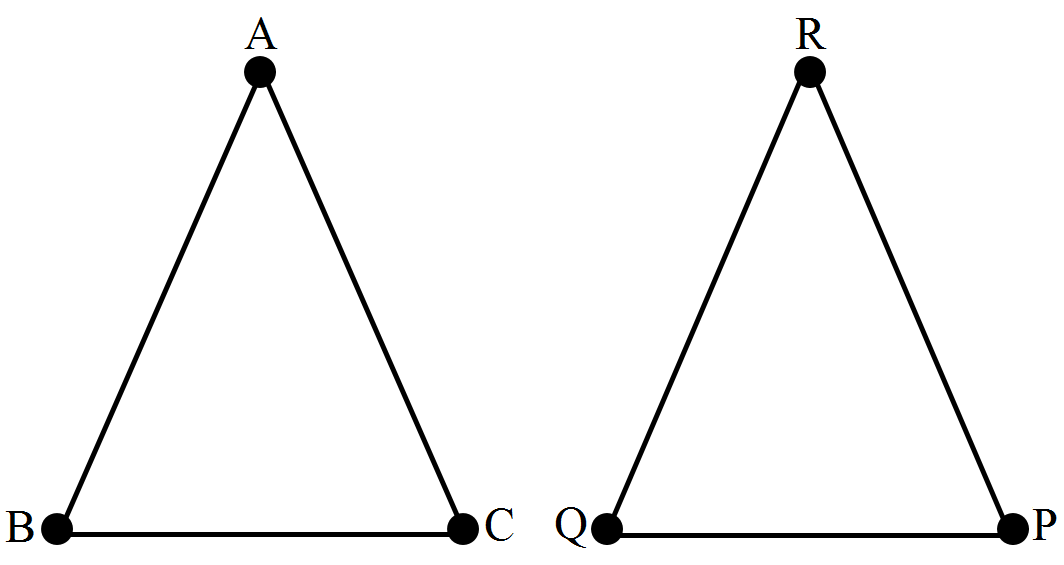
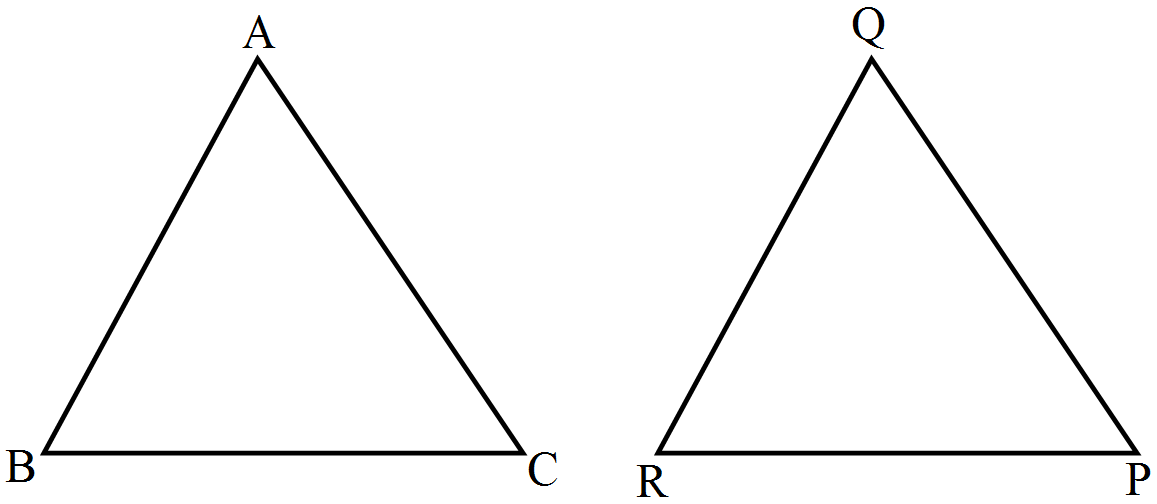
$\triangle\text{ABC}\cong\triangle\text{PQR},$ then which of the following is true?
Answer
  1. CA = RP
    Solution:
    Corresponding sides are equal for two congruent triangles.
View full question & answer
Question 2061 Mark
In $\triangle\text{PQR},\ \angle\text{P}=60^\circ,\ \angle\text{Q}=50^\circ.$ Which side of the triangle is the longest?
Answer
  1. PQ
    Solution:
    In $\triangle\text{PQR},\ \angle\text{P}=60^\circ,\ \angle\text{Q}=50^\circ.$
    Now, by angle sum property, $\angle\text{P} +\angle\text{Q} +\angle\text{R} = 180^\circ$
    $60^\circ + 50^\circ + \angle\text{R} = 180^\circ$
    or, $ \angle\text{R} = 180^\circ - 110^\circ = 70^\circ$
    So, $\angle\text{R}$ is the largest angle and the side opposite to it, i.e, PQ will be the longest side.
View full question & answer
Question 2081 Mark
In $\triangle\text{ABC, }\angle\text{C}=\angle\text{A},$ BC = 4cm and AC = 5cm. then, AB =?
Answer
  1. 4cm
    Solution:
    In $\triangle\text{ABC,}$
    $\angle\text{C}=\angle\text{A}$
    $\Rightarrow\text{AB = BC}$ (sides opposite to equal angles are equal)
    $\Rightarrow\text{AB = 4cm}$
View full question & answer
Question 2091 Mark
In $\triangle\text{ABC}$ and $\triangle\text{DEF,}$ it is given that AB = DE and BC = EF. In order that $\triangle\text{ABC}\cong\triangle\text{DEF},$ we must have:
Answer
  1. $\angle\text{B}=\angle\text{E}$
    Solution:
    In $\triangle\text{ABC}$ and $\triangle\text{DEF},$
    AB = DE and BC = EF
    SO, the induded angles should be equal for the triangle to be congurent by the SAS congruence criterion.
    Thus, we must have $\angle\text{B}=\angle\text{E}.$
View full question & answer
Question 2101 Mark
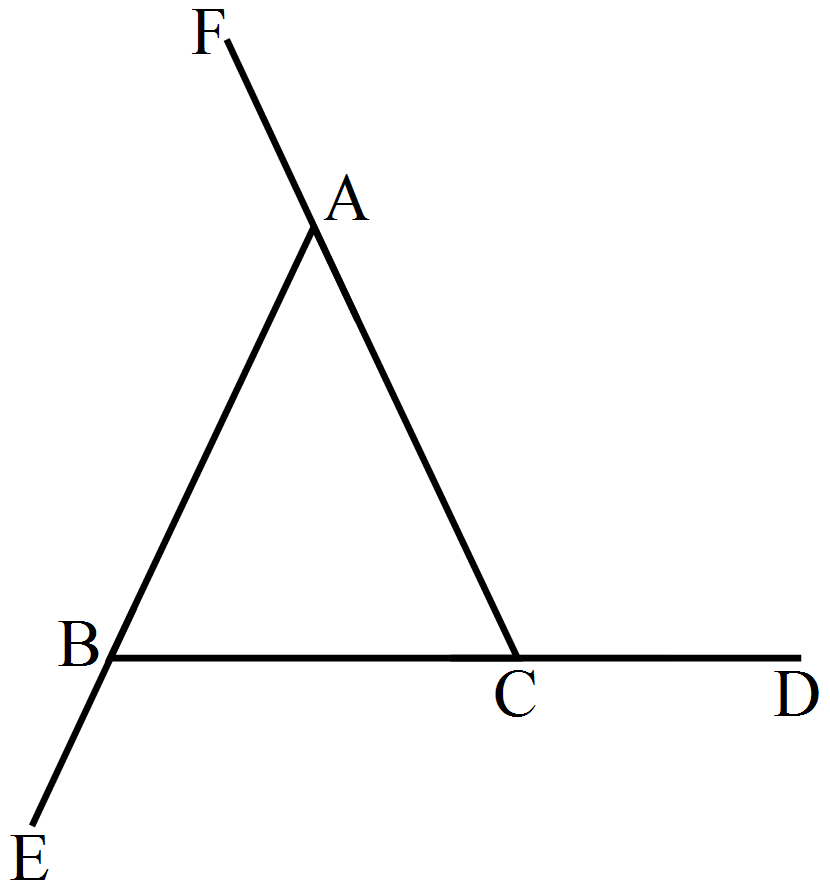
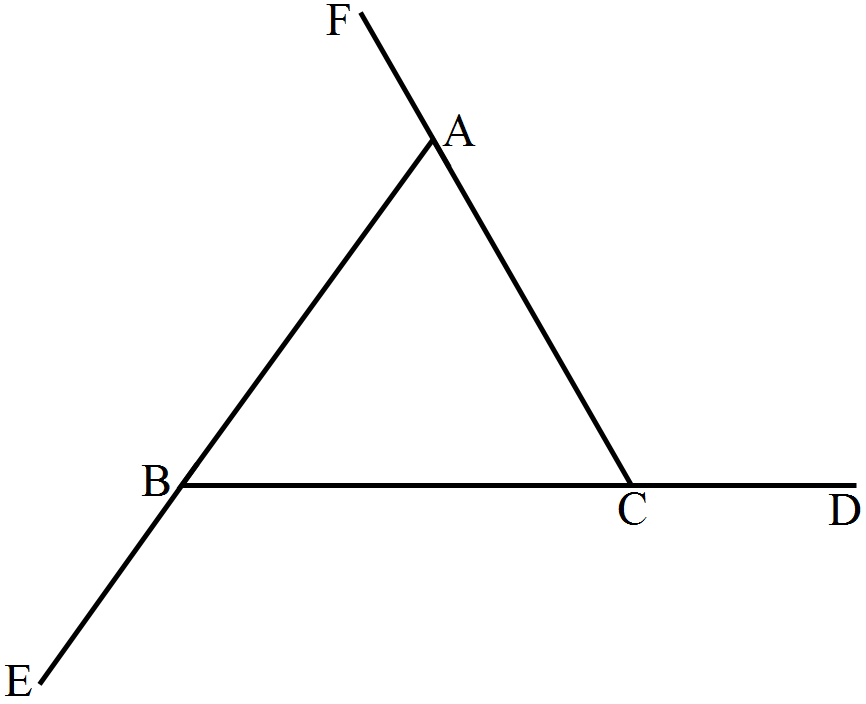
If the sides of a triangle are produced in order, then the sum of the three exterior angles so formed is:
View full question & answer
Question 2111 Mark
For any $\triangle\text{ABC},$ AB + BC is always:
Answer
  1. Greater than AC
    Soluton:
    Sum of any two sides is greater than third side.
View full question & answer
Question 2131 Mark
View full question & answer
Question 2141 Mark
In a $\triangle\text{ABC},$ if $\angle\text{A}-\angle\text{B}=42^\circ$ and $\angle\text{B}-\angle\text{C}=21^\circ$ then $\angle\text{B}=?$
Answer
  1. 53º
    Solution:
    $\angle\text{A}-\angle\text{B}=42^\circ$
    $\Rightarrow\angle\text{A}=\angle\text{B}+42^\circ$
    $\angle\text{B}-\angle\text{C}=21^\circ$
    $\Rightarrow\angle\text{C}=\angle\text{B}-21^\circ$
    In $\triangle\text{ABC},$
    $\angle\text{A}+\angle\text{B}+\angle\text{C}=180^\circ$
    $\Rightarrow\angle\text{B}+42^\circ+\angle\text{B}+\angle\text{B}-21^\circ=180^\circ$
    $\Rightarrow3\angle\text{B}=159$
    $\Rightarrow\angle\text{B}=53^\circ$
View full question & answer
Question 2151 Mark
Answer
  1. 230º
    Solution:
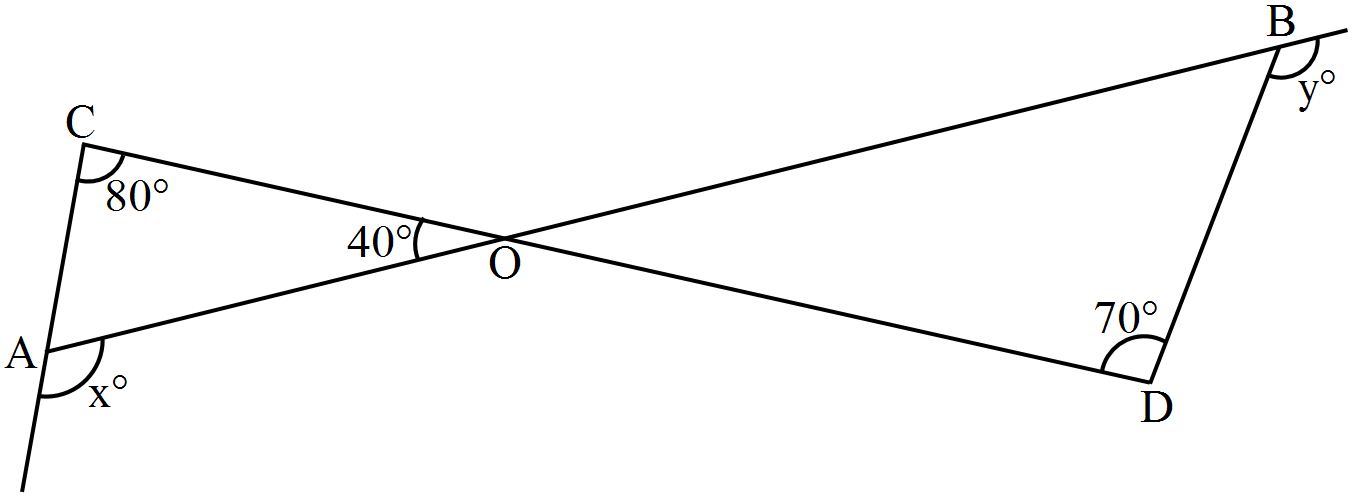
    In $\triangle\text{ACO}$
    $\angle\text{ACO} + \angle\text{COA} + \angle\text{OAC} = 180^\circ$
    Now, $\angle\text{OAC} = 180^\circ$
    $⇒\ 80^\circ + 40^\circ + 180^\circ - \text{x}^\circ= 180^\circ$
    $⇒\ \text{x}^\circ = 120^\circ$
    $ \angle\text{BOD} = \angle\text{COA} = 40^\circ$ (Opposite angles)
    $\angle\text{BDO} = 70^\circ$
    In $\triangle\text{OBD}$
    $\angle\text{OBD} = 180^\circ - 40^\circ - 70^\circ = 70^\circ$
    Also, $\text{y}^\circ = 180^\circ - \angle\text{OBD} = 180^\circ - 700^\circ = 110^\circ$
    $⇒\ \text{x}^\circ + \text{y}^\circ = 120^\circ + 110^\circ = 230^\circ$
View full question & answer
Question 2161 Mark
In a triangle, an exterior angle at a vertex is 95º and its one of the interior opposite angle is 55º, then the measure of the other interior angle is:
Answer
  1. 40º
    Solution:
    Let the other interior opposite angle be xº.
    Then, we have xº + 55º = 95º
    ⇒ xº = 95º - 55º = 40º
View full question & answer
Question 2181 Mark
View full question & answer
Question 2191 Mark
If O is any point in the interior of $\triangle\text{ABC},$ then, which of the following is true?
Answer
  1. $(\text{OA + }\text{OB} + \text{OC})\ >\ \frac{1}{2}(\text{AB + }\text{BC} + \text{CA})$
    Solution:
    Sum of any two sides of a triangle is greater than the third side.
    Join O with all sides of the triangle, we have
    OA + OB > AB ...(i)
    OA + OC > AC ...(ii)
    and, OB + OC > BC ...(iii)
    Adding the three inequalities i.e. (i) + (ii) + (iii), we get
    2(OA + OB + OC) > AB + BC + AC
    i.e. $(\text{OA + }\text{OB} + \text{OC})\ >\ \frac{1}{2}(\text{AB + }\text{BC} + \text{CA})$
View full question & answer
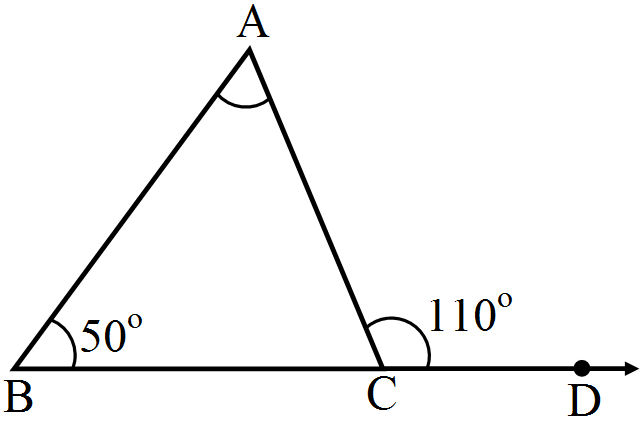
Question 2201 Mark
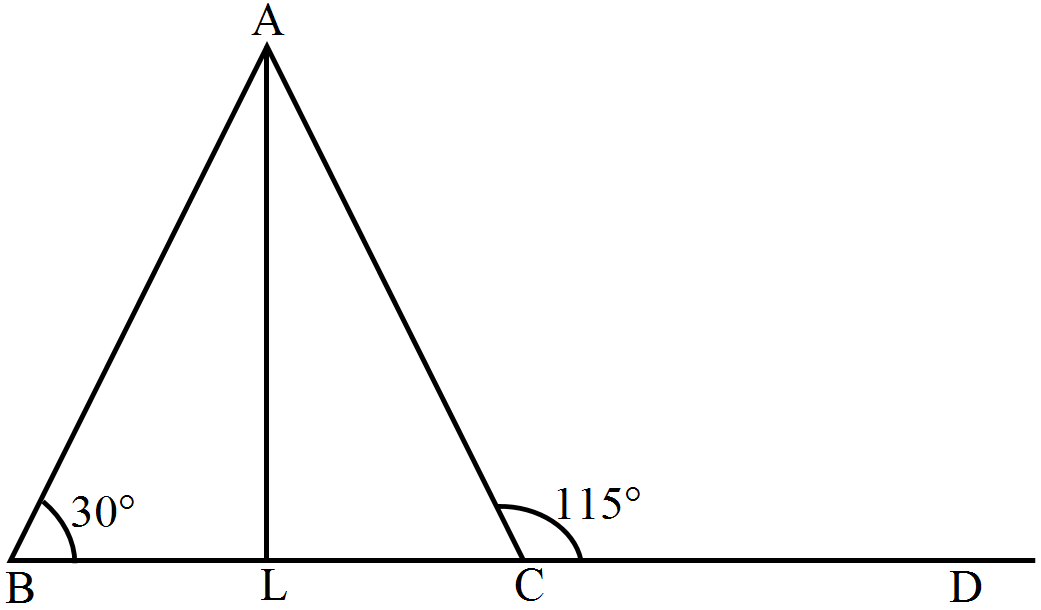
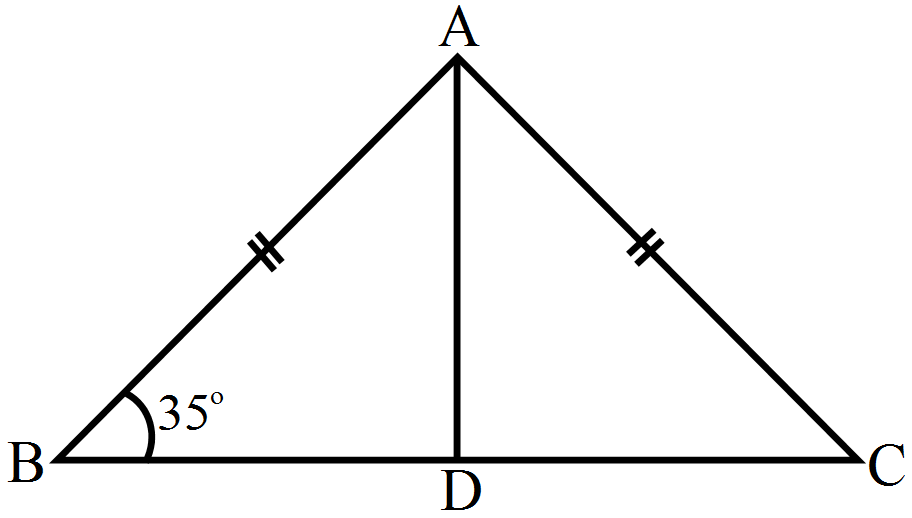
The side BC of $\triangle\text{ABC}$ is produced to a point D. The bisector of $\angle\text{A}$ meets side in L. If $\angle\text{ABC} = 30^\circ$ and $\angle\text{ACD} = 115^\circ$ then $\angle\text{ALC} =$
View full question & answer
Question 2211 Mark
View full question & answer
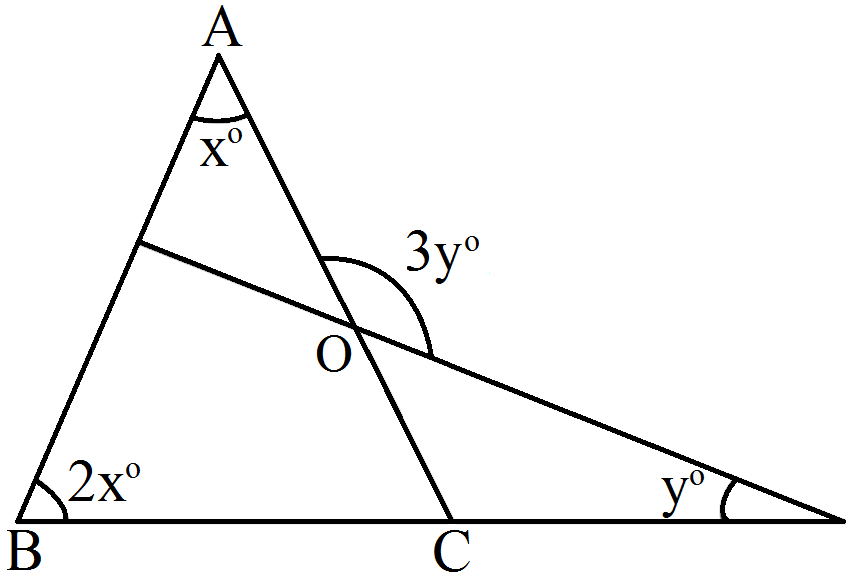
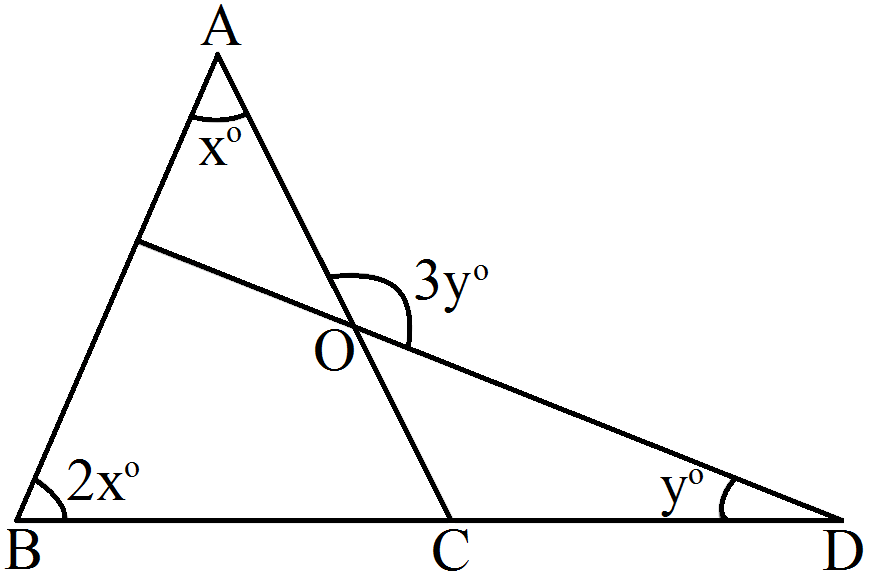
Question 2221 Mark
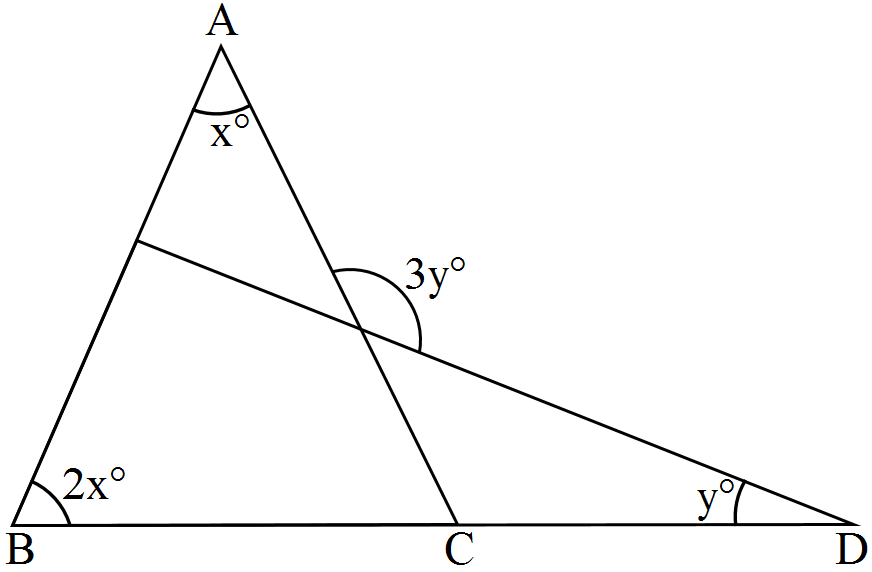
Answer
  1. $\frac{3}{2}\text{X}^\circ$
    Solution:
    From Figure, $\angle\text{DOC} = 180^\circ - \angle\text{AOD}$ (Both are Supplementary)
    $⇒\ \angle\text{DOC} = 180^\circ−3\text{y}^\circ$
    Also, $\angle\text{ACB} = 180^\circ- \angle\text{A} - \angle\text{B}$
    $⇒\angle\text{ACB} = 180^\circ - \text{x}^\circ−2\text{x}^\circ = 180^\circ - 3\text{x}^\circ$
    And $ \angle\text{ACD} = 180^\circ - \angle\text{ACB}$
    $= 180^\circ - (180^\circ- 3\text{x}^\circ)$
    $⇒\angle\text{ACD}=3\text{x}^\circ$
    Now, in $\triangle\text{OCD}$
    $\angle\text{DOC} + \angle\text{OCD} + \angle\text{D} = 180^\circ$
    $180^\circ − 3\text{y}^\circ + 3\text{x}^\circ + \text{y}^\circ = 180^\circ\ [\angle\text{OCD} = \angle\text{ACD}]$
    $⇒2\text{y}^\circ=3\text{x}^\circ$
    $\Rightarrow\ \text{Y}=\frac{3}{2}\text{X}^\circ$
View full question & answer
Question 2231 Mark
View full question & answer
Question 2241 Mark
In triangles ABC and PQR, AB = AC, $\angle\text{C} = \angle\text{P}$ and $\angle\text{B} = \angle\text{Q}.$ The two triangles are:
View full question & answer
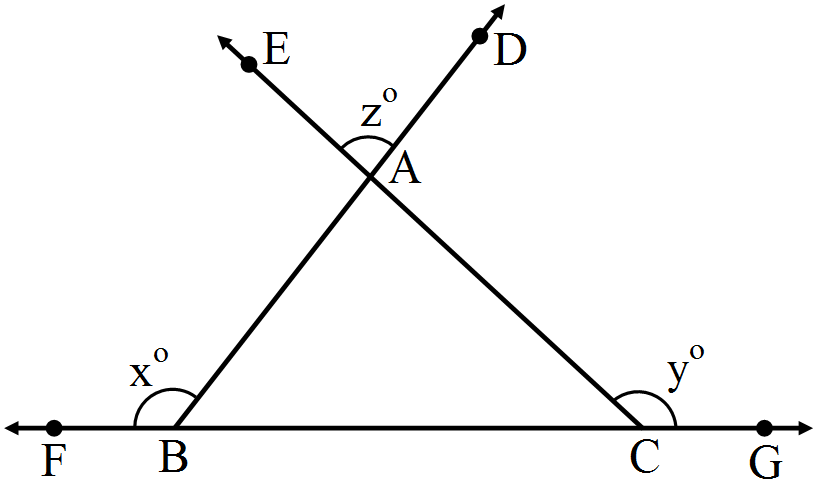
Question 2251 Mark
Answer
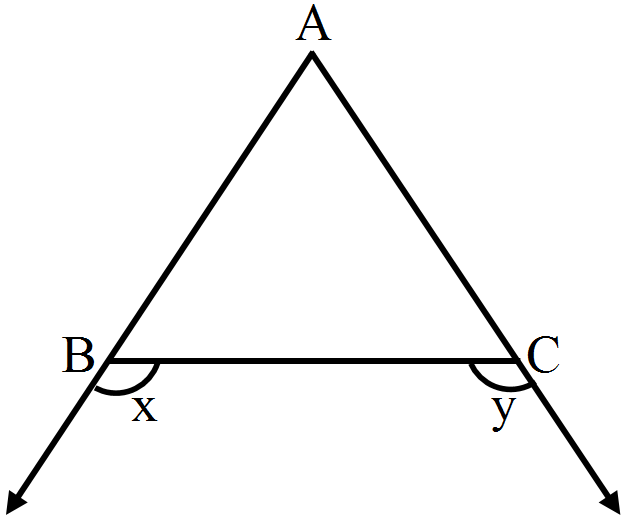
  1. x + y - 180
    Solution:
    $\angle\text{ABF}+\angle\text{ABC}=180^\circ$ (linear pair)
    $\Rightarrow\text{x}+\angle\text{ABC}=180^\circ$
    $\Rightarrow\angle\text{ABC}=180^\circ-\text{x}$
    $\angle\text{ACG}+\angle\text{ACB}=180^\circ$ (linear pair)
    $\Rightarrow\text{y}+\angle\text{ACB}=180^\circ$
    $\Rightarrow\angle\text{ACB}=180^\circ-\text{y}$
    In $\triangle\text{ABC},$ by angle sum property
    $\angle\text{ABC}+\angle\text{ACB}+\angle\text{BAC}=180^\circ$
    $\Rightarrow(180^\circ-\text{x})+(180^\circ-\text{y})+\angle\text{BAC}=180^\circ$
    $\Rightarrow\angle\text{BAC}-\text{x}-\text{y}+180^\circ=0$
    $\Rightarrow\angle\text{BAC}=\text{x}+\text{y}-180^\circ$
    Now, $\angle\text{EAD}=\angle\text{BAC}$ (vertically opposite angles)
    $\Rightarrow\text{z}=\text{x}+\text{y}-180^\circ$
View full question & answer
Question 2261 Mark
View full question & answer
Question 2271 Mark
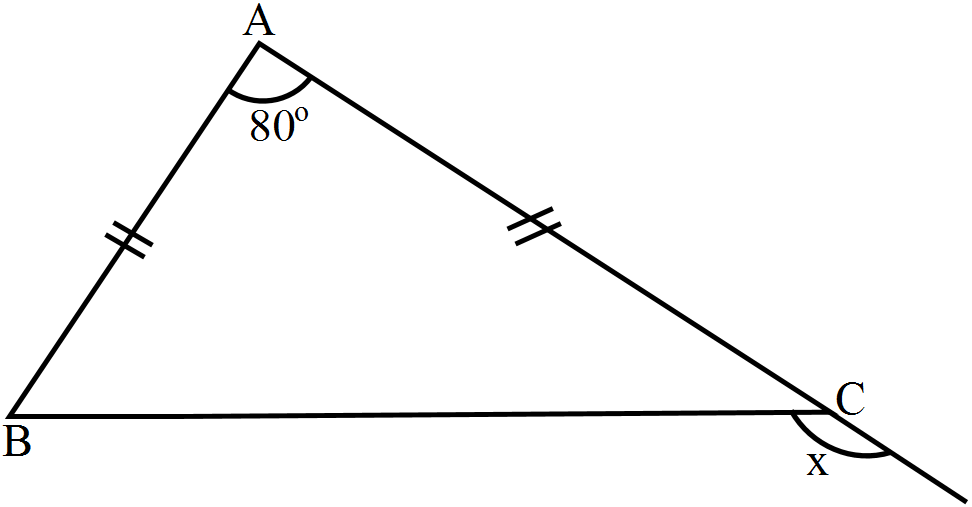
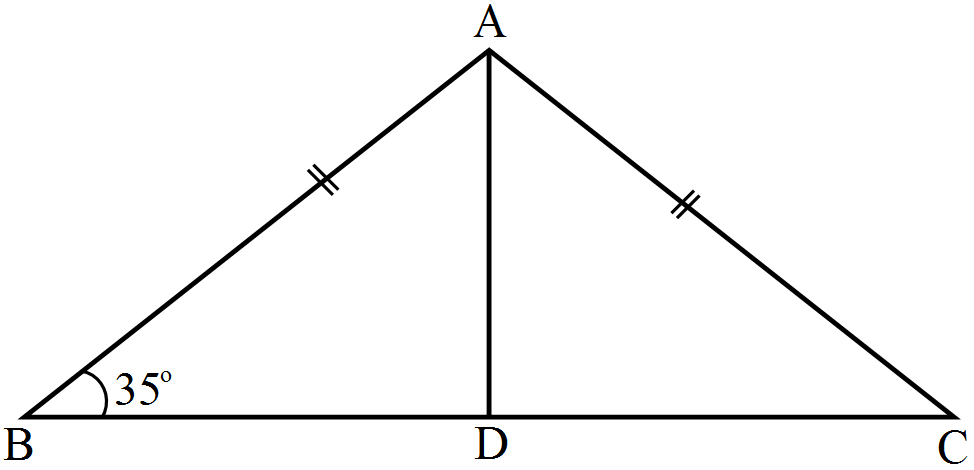
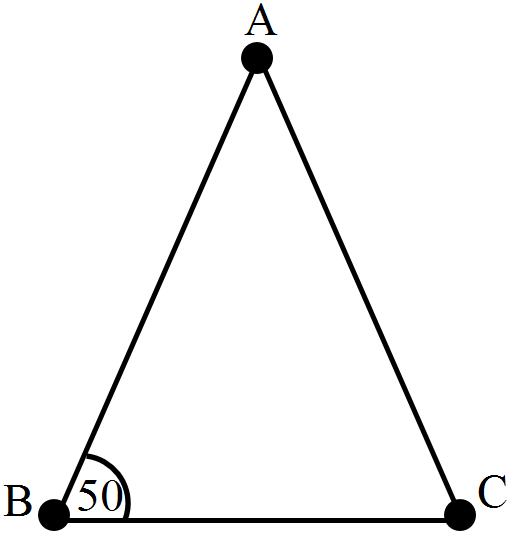
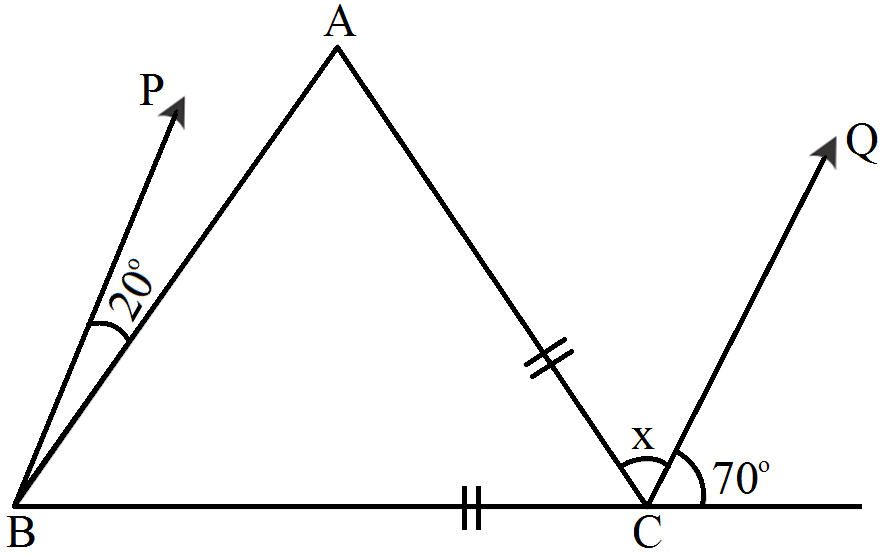
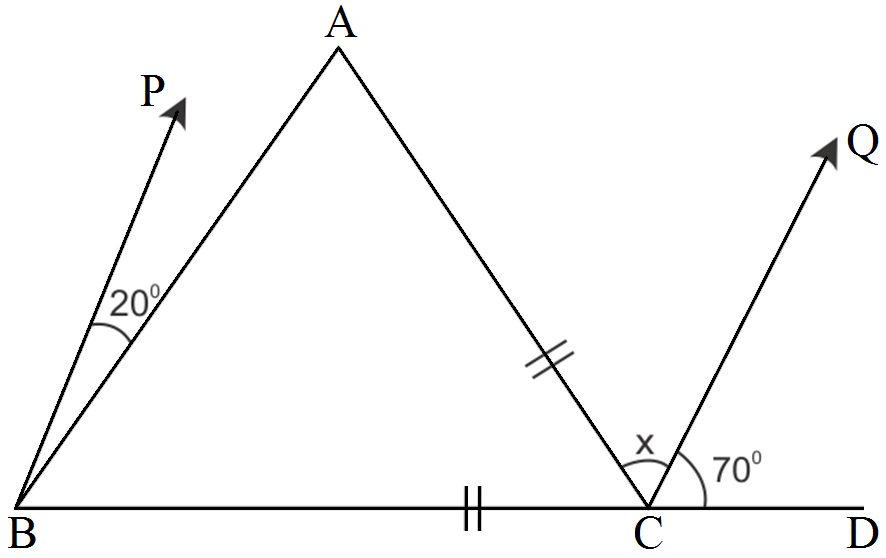
In fig, in $\triangle\text{ABC},$ $AB = AC,$ then the value of $x$ is:
Answer
Triangle $ABC$ is an iscosceles triangle and hence in the triangle other two angles are $50$ and $50.$
Therefore, $X = 180 - 50 = 130$
View full question & answer
Question 2281 Mark
View full question & answer
Question 2301 Mark
Answer
  1. 115º
    Solution:
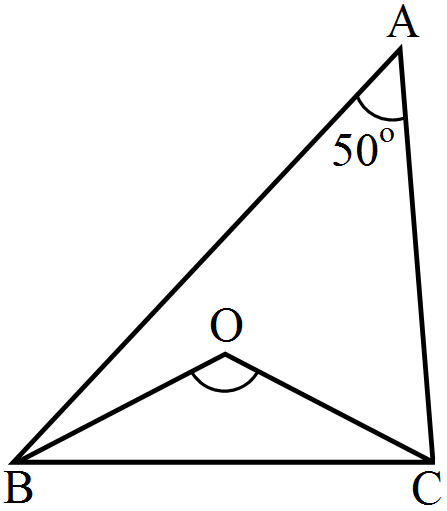
    $\angle\text{A}+\angle\text{B}+\angle\text{C}=180^\circ$ (Angle sum property)
    $\Rightarrow50^\circ+\angle\text{B}+\angle\text{C}=180^\circ$
    $\Rightarrow\angle\text{B}+\angle\text{C}=130^\circ$
    $\Rightarrow\frac{1}{2}\angle\text{B}+\frac{1}{2}\angle\text{C}=65^\circ$
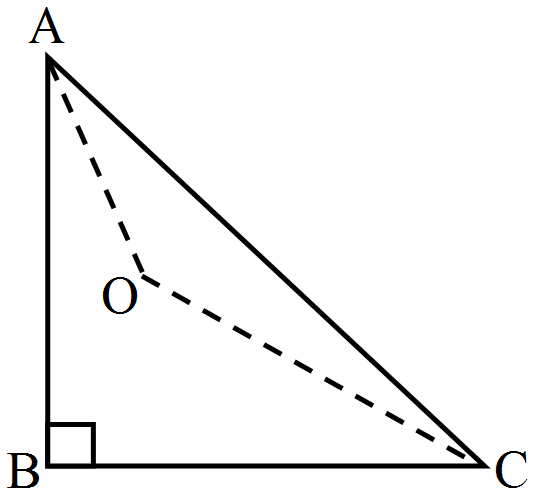
    In $\triangle\text{OBC},$
    $\angle\text{OBC}+\angle\text{OCB}+\angle\text{BOC}=180^\circ$ (Angle sum property)
    $\Rightarrow\frac{1}{2}\angle\text{B}+\frac{1}{2}\angle\text{C}+\angle\text{BOC}=180^\circ$
    $\Rightarrow65^\circ+\angle\text{BOC}=180^\circ$
    $\Rightarrow\angle\text{BOC}=115^\circ$
View full question & answer
Question 2311 Mark
An angle is 14º more than its complement. Find its measure.
Answer
  1. 52º
    Solution:
    Let the angle = x
    Its complement = 90º - x
    According to the question, x is 14° more than its complement,
    ⇒ x = (90° - x) + 14°
    ⇒ x + x = 104°
    ⇒ 2x = 104°
    $\Rightarrow\ \text{X}=\frac{104^\circ}{2}=52^\circ$
View full question & answer
Question 2331 Mark
In a triangle, an exterior angle at a vertex is 95º and its one of the interior opposite angle is 55º, then the measure of the other interior angle is:
Answer
  1. 40º
    Solution:
    Let the other interior opposite angle be xº.
    Then, we have
    xº + 55º = 95º
    ⇒ xº = 95º - 55º = 40º
View full question & answer
Question 2341 Mark
Answer
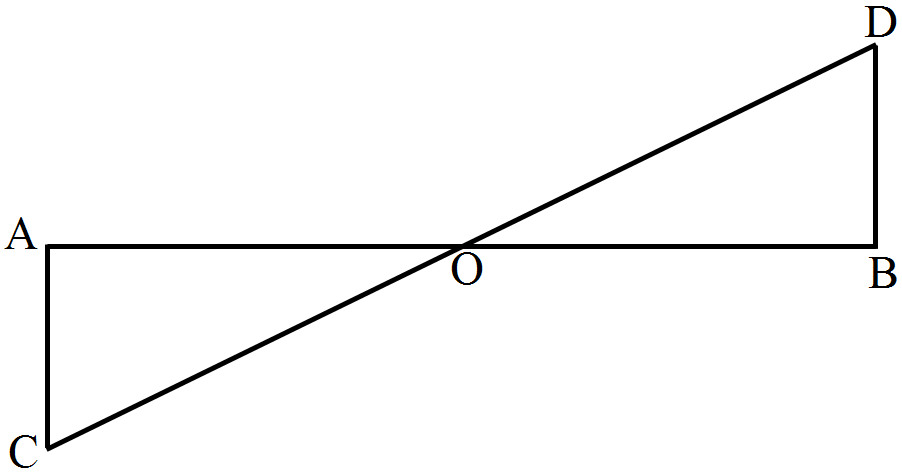
  1. $\angle\text{OBD}$
    Solution:
    In $\triangle\text{OAC}$ and $\triangle\text{OBD},$
    AO = OB As O is the mid-point of AB
    $\triangle\text{AOC}=\ \triangle\text{BOD}$ (Vertically Opposite Angles)
    $\triangle\text{AOC}=\ \triangle\text{BDO}$ (Given)
    $\therefore\ \triangle\text{OAC}=\ \triangle\text{OBD}$ (AAS Axiom)
    $\therefore\ \triangle\text{OAC}=\ \triangle\text{OBD}$ (C.P.C.T.)
View full question & answer
Question 2351 Mark
If the measure of angles of a triangle are in the ratio of 3 : 4 : 5, what is the measure of the smallest angle of the triangle?
Answer
  1. 45º
    Solution:
    The measures of angles of a triangle are in ratio 3 : 4 : 5.
    Let the angles be 3x, 4x, and 5x.
    in any triangle, sum of all angles = 180º
    ⇒ 3x + 4x + 5x = 180º
    ⇒ 12x = 180º
    ⇒ x = 15º
    So, smallest angle = 3 × 15º = 45º
View full question & answer
Question 2361 Mark
It is given that $\triangle\text{ABC} ≅\triangle\text{FDE}$ and AB = 5cm, $\angle\text{B} = 40^\circ$ and $\angle\text{A} = 80^\circ$ Then which of the following is true?
Answer
  1. $\text{DF} = 5\text{cm}, \ \angle\text{E} = 60^\circ$
    Solution:
    Given that: In $\triangle\text{ABC}, \ \text{AB} = 5\text{cm},\ \angle\text{B} = 40^\circ$ and $\angle\text{A} = 80^\circ$
    Using angles sum property of triangle, we have
    $\angle\text{A} + \angle\text{B} + \angle\text{C} = 180^\circ$
    $⇒ 80^\circ + 40^\circ + \angle\text{C} = 180^\circ$
    $⇒ 120^\circ + \angle\text{C} = 180^\circ$ [$\therefore\ \angle\text{B} = 40^\circ$ and $\angle\text{A} = 80^\circ$]
    $⇒ \angle\text{C} = 180^\circ – 120^\circ$
    $⇒ \angle\text{C} = 60^\circ$
    It is given that $\triangle\text{ABC} ≅\triangle\text{FDE},$ so we have
    AB = FD, BC = DE and $\text{AC}=\text{FE}\ \&\ \angle\text{A} = \angle\text{F}, \ \angle\text{B} = \angle\text{D}$ and $\angle\text{C} =
    \angle\text{E}$
    ⇒ AB = FD = 5cm and $\angle\text{C} = \angle\text{E} = 60^\circ$
View full question & answer
Question 2371 Mark
If the sides of a triangle are produced in order, then the sum of the three exterior angles so formed is:
View full question & answer
Question 2391 Mark
In the following, write the correct answer.
Which of the following is not a criterion for congruence of triangles?
Answer
  1. SSA
    Solution:
    We know that, two triangles are congruent, if the sides and angles of one triangle are equal to the corresponding sides and angles of the other triangle.
    Also, criterion for congruence of triangles are SAS (Side-Angle-Side), ASA (Angle-Side- Angle), SSS (Side-Side-Side) and RHS (right angle-hypotenuse-side).
    So, SSA is not a criterion for congruence of triangles.
View full question & answer
Question 2401 Mark
View full question & answer
Question 2411 Mark
In the following, write the correct answer.
In $\triangle\text{ABC}$ if BC = AB and $\angle\text{B}=80^{\circ}$ then is equal to:
Answer
  1. 50º

    Solution: In $\triangle\text{ABC}$ we have BC = AB
    But $\angle\text{B}=80^{\circ}$ $\angle\text{A}+\angle\text{B}+\angle\text{C}=180^{\circ}$
    $=\angle\text{A}+80^{\circ}\angle\text{A}=180^{\circ}$ $=2\angle\text{A}=100^{\circ}$
    $=\angle\text{A}=100^{\circ}\div2=50^{\circ}$
View full question & answer
Question 2431 Mark
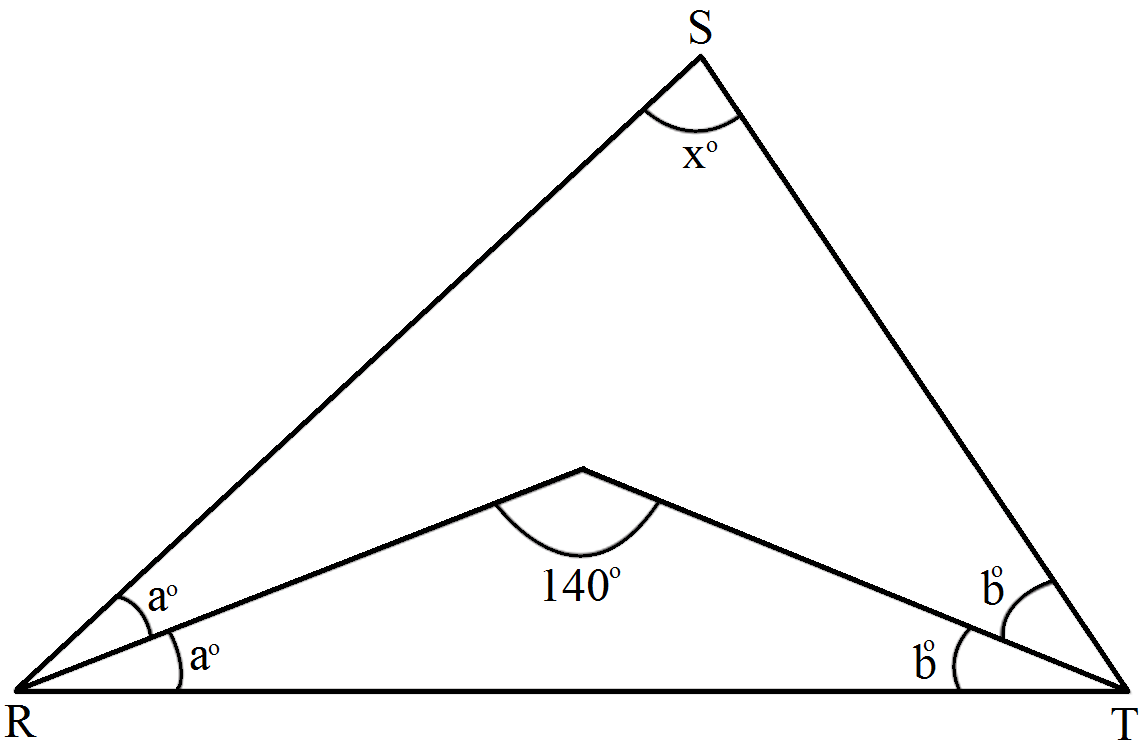
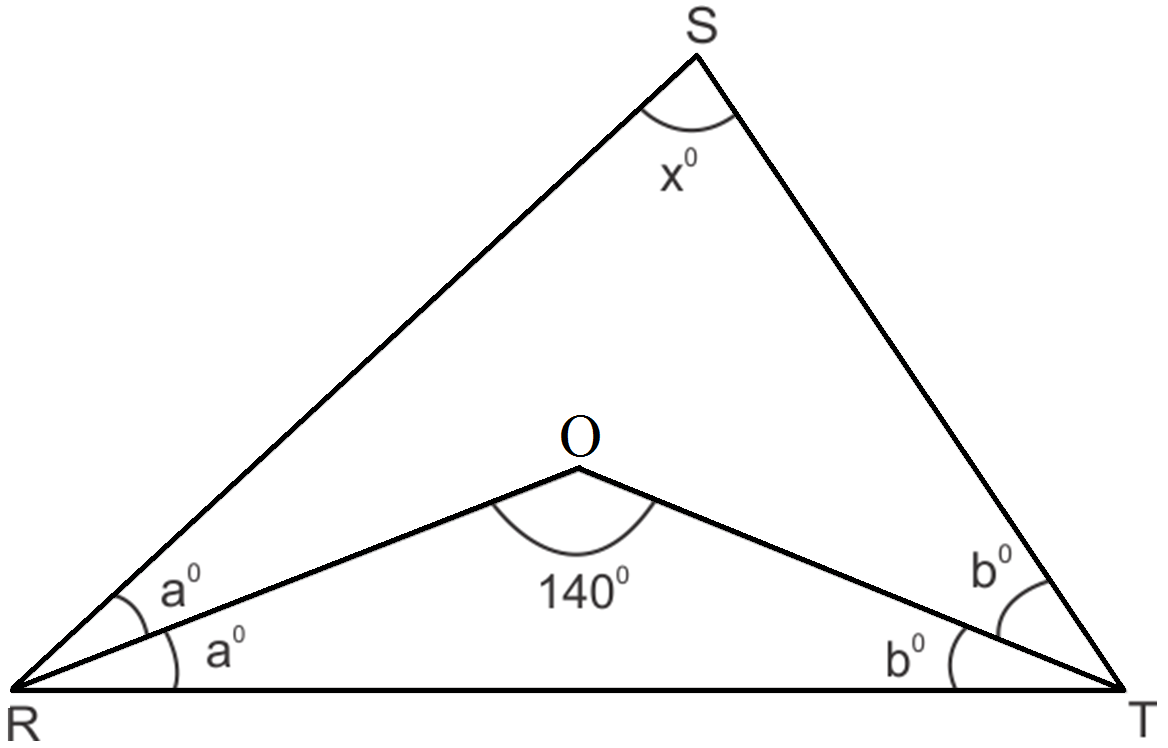
If the bisectors of the acute angles of a right triangle meet at O, then the angle at O between the two bisectors is:
View full question & answer
Question 2441 Mark
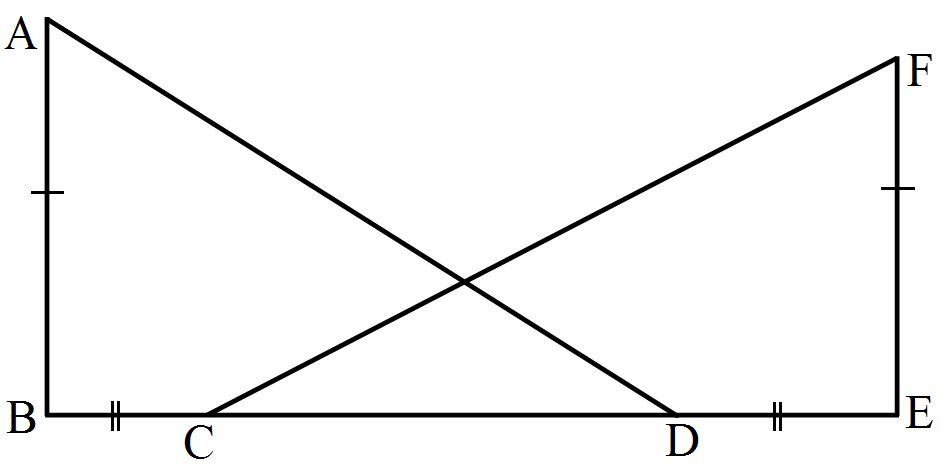
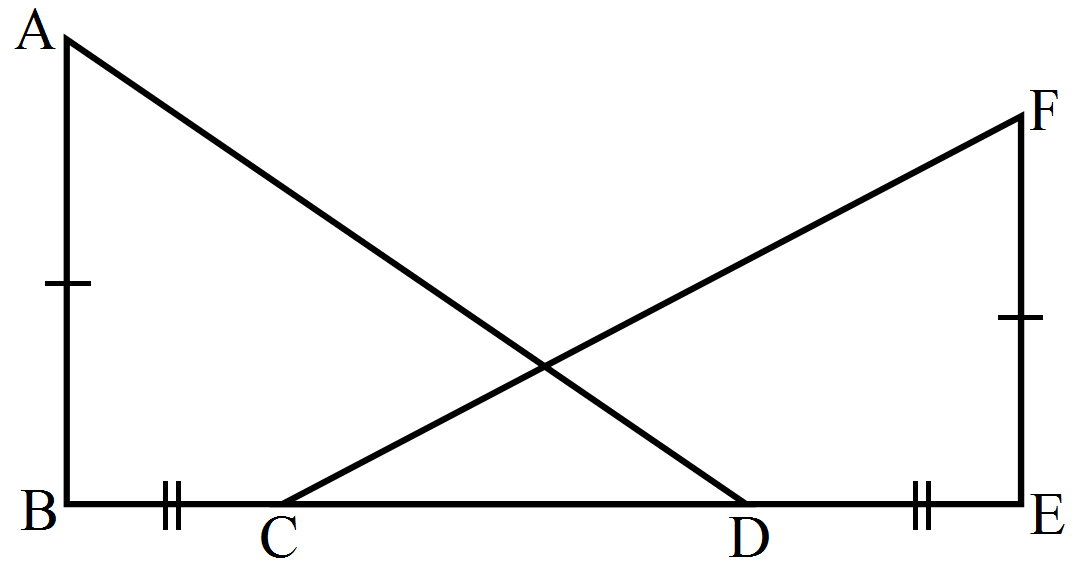
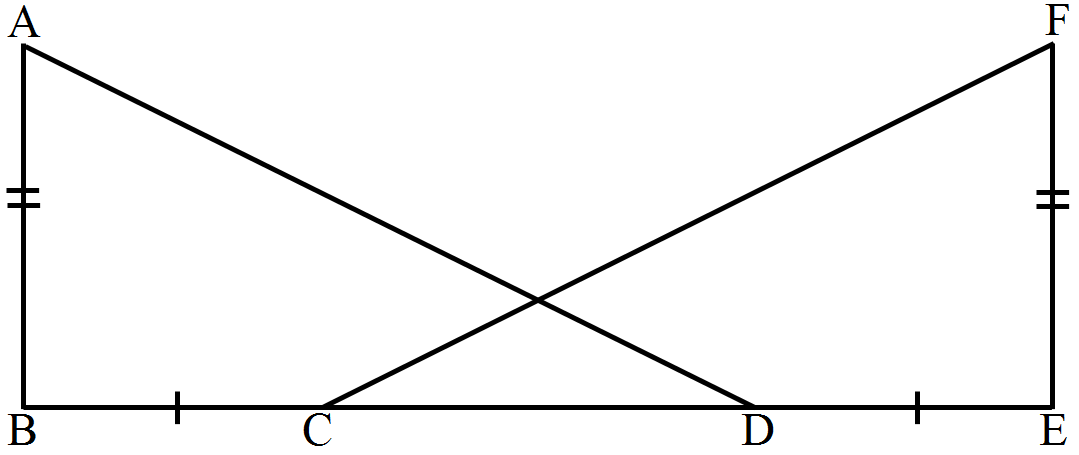
In the adjoining figure, $\text{AB}\bot\text{BE}$ and $\text{FE}\bot\text{BE}.$ If $AB = FE$ and $BC = DE,$ then.
Answer
Given:
$AB = FE, BC = ED,$
$\text{AB}\bot\text{BE}$ and $\text{FE}\bot\text{BE}.$
To Prove: $AD = FC$
Proof: In $\triangle\text{ABD}$ and $\triangle\text{FEC},$
$AB = FE ...(1) ($Given$)$
$\triangle\text{ABD}=\triangle\text{FEC} ...(2)$
Each $= 90^\circ$
$BC = ED ($Given$)$
$\Rightarrow BC + CD = ED + DC$
$\Rightarrow BD = EC ...(3)$
In view of $(1), (2)$ and $(3),$
$\triangle\text{ABD}\cong\triangle\text{FEC}$ using $\text { SAS}$ congruence rule.
View full question & answer
Question 2451 Mark
View full question & answer
Question 2461 Mark
Answer
  1. 50º
    Solution:
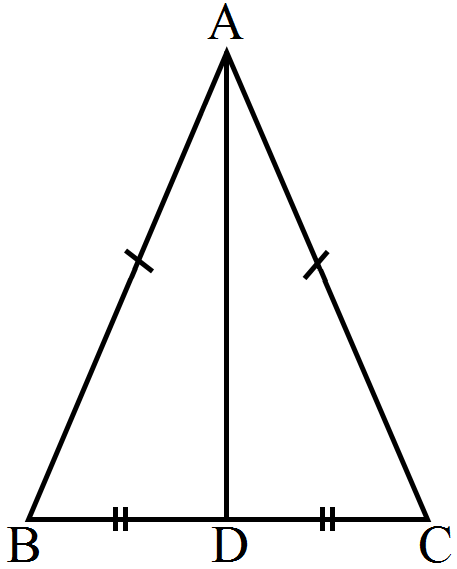
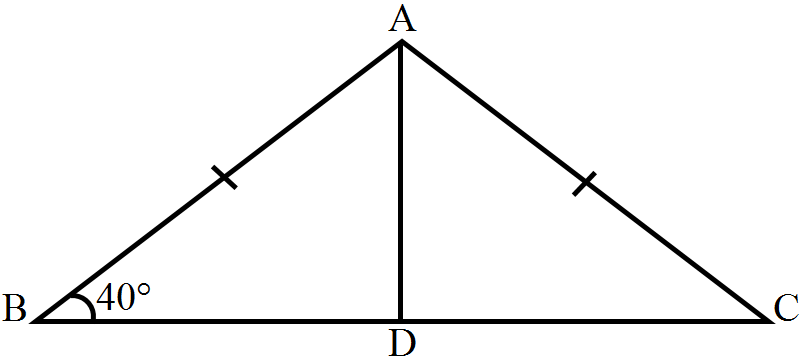
    In the given $\angle\text{ABC},\ \text{AB}\ =\ \text{AC}$
    Hence, $\angle\text{B} = \angle\text{C} = 40^\circ$
    Now, by angle sum property,
    $\angle\text{A} + \angle\text{B} + \angle\text{C} = 180^\circ$
    $\Rightarrow\ \angle\text{A} + 40^\circ + 40^\circ = 180^\circ$
    $\Rightarrow\ \angle\text{A} = 100^\circ$
    Now, in $\triangle\text{BAD}$ and $\triangle\text{DAC}.$
    AB = AC (given)
    BD = DC (D is the mid-point of BC)
    $\angle\text{ABD} = \angle\text{ACD} = 40^\circ$
    $\angle\text{A}= \frac{1}{2} × 100^\circ = 50^\circ $
    Hence by SAS, $\triangle\text{BAD}$ and $\triangle\text{DAC}$ are congruent.
    This means, $\angle\text{BAD} = \angle\text{CAD} = \frac{1}{2}$ Therefore, $\triangle\text{BAD}=50^\circ.$
View full question & answer
Question 2471 Mark
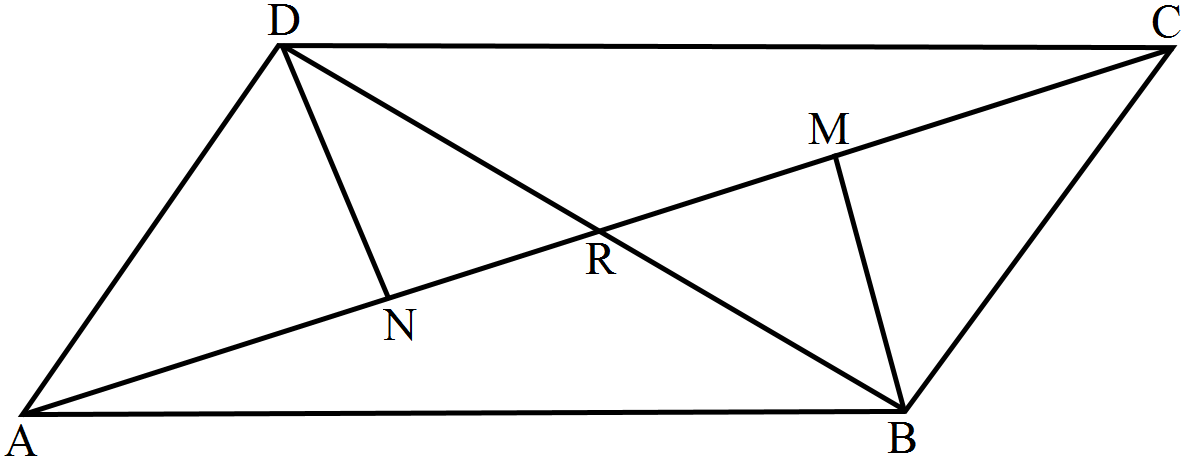
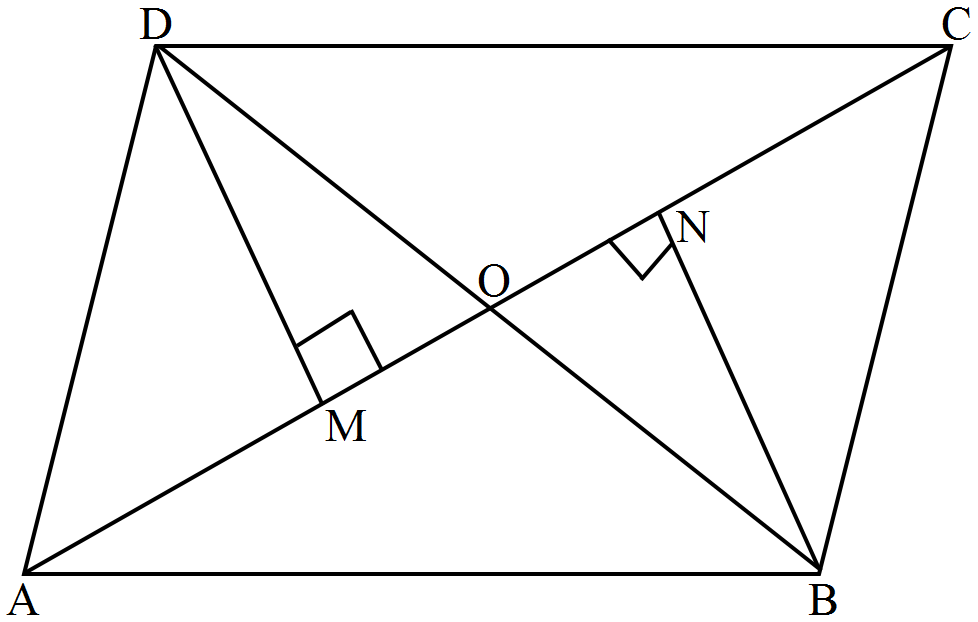
In the adjoining figure, $\text{ABCD}$ is a quadrilateral in which $BN$ and $DM$ are drawn perpendiculars to $AC$ such that $BN = DM$. If $OB = 4\ cm$. then $BD$ is:
Answer
In Triangle $DMO$ and triangle $BNO,$
$BN = DM$ and $\angle\text{DMO} = \angle\text{BNO} (90^\circ)$
$\angle\text{DMO} = \angle\text{BNO}$
Therefore, Triangle $\text{DMO}$ and triangle $\text{BNO}$ are congruent by $\text{AAS}$ criteria
Therefore, $OB = OD ($by $\text{CPCT})$
So $OD = 4\ cm, BD = OD + OB = 4 + 4 = 8\ cm$
View full question & answer
Question 2481 Mark
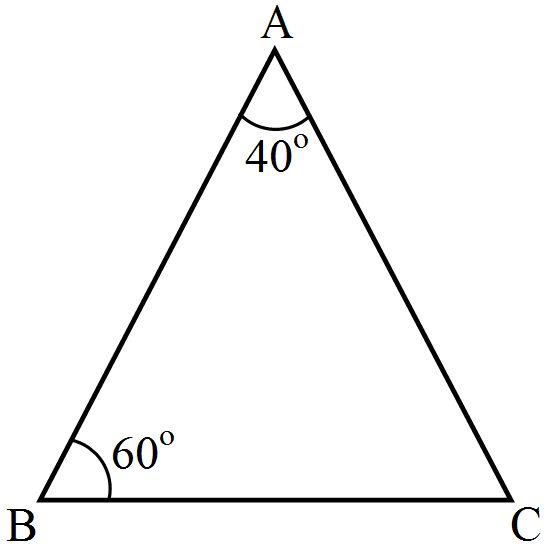
In $\triangle\text{ABC, }\angle\text{A}=40^{\circ}$ and $\angle\text{B}=60^{\circ}.$ Then the longest side of $\triangle\text{ABC}$ is:
View full question & answer
Question 2491 Mark
In $\triangle\text{ABC},$ if $\angle\text{B} = 30^\circ$ and $\angle\text{C} = 70^\circ,$ then which of the following is the longest side?
Answer
  1. BC
    Solution:
    Since the sum of all sides of a triangle is 180°.
    So, $\angle\text{C}=70^\circ,\ \angle\text{B}=70^\circ,\ \angle\text{A}=80^\circ,$
    We have a theorem which states that the side opposite to the greatest angle is the longest.
    So, the side opposite to angle A is the longest.
View full question & answer
Question 2501 Mark
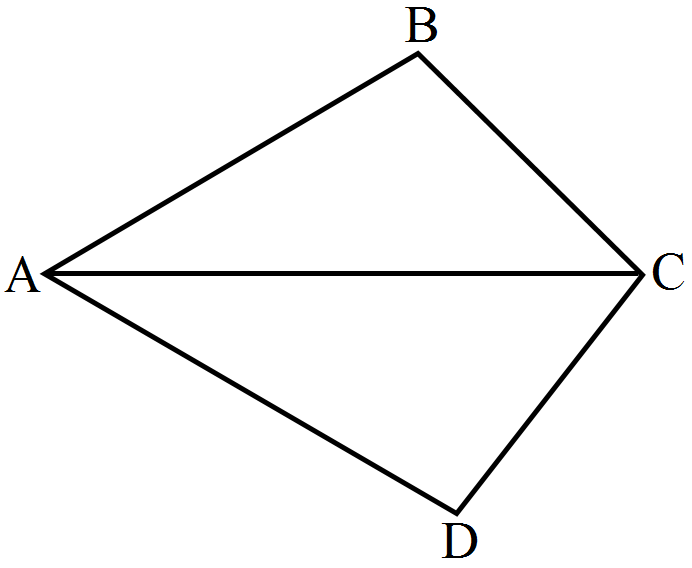
In the adjoining figure, $\triangle\text{ABC}\cong\triangle\text{ADC}.$ If $\angle\text{BAC} = 30^\circ$ and $\angle\text{ABC} = 100^\circ$ then $\angle\text{ACD}$ is equal to:
Answer
In triangle ABC, $\angle\text{BAC} = 30^\circ$ and $\angle\text{ABC} = 100^\circ ($Given$)$
$\angle\text{BAC} + \angle\text{ABC} + \angle\text{BCA} = 180^\circ$
$\angle\text{BAC} = 50^\circ$
Also $\angle\text{ACD} = 50^\circ($Since, $\triangle\text{ABC}\cong\triangle\text{ADC})$
View full question & answer
M.C.Q - Page 5 - MATHS STD 9 Questions - Vidyadip