Questions

[ 5 Marks Questions ]

🎯

Test yourself on this topic

5 questions · timed · auto-graded

Question 15 Marks
Derive the relation between Tangential acceleration and angular acceleration.
Answer
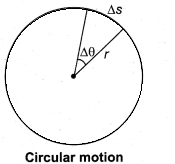
Consider an object moving along a circle of radius $r$. In a time $\Delta t$, the object travels in an arc distance As as shown in figure. The corresponding angle subtended is $\Delta \theta$
The $\Delta s$ can be written in terms of $\Delta \theta$
$
\Delta s = r \Delta \theta
$
in a time $\Delta t$, we have
$
\frac{\Delta s}{\Delta t}= t \frac{\Delta \theta}{\Delta t}
$
¡n the limit $\Delta t -0$, the above equation becomes
$
\frac{d s}{d t}=r \omega
$
Here $\frac{d s}{d t}$ is linear speed (y) which is tangential to the circle and co is angular speed.
So equation (iii) becomes.
$
v_r=r \omega
$
Image
which gives the relation between linear speed and angular speed.
Eq. (iv) is true only for circular motion. In general the relation between linear and angular velocity is given by
$
\vec{v}=\vec{\omega} \times \vec{r}
$
For circular motion eq. (y) reduces to eq. (iv) since $\vec{\omega}$ and $\overrightarrow{ r }$ are perpendicular to each other. Differentiating the eq. (iv) with respect to time, we get (since $r$ is constant)
$
\frac{d v}{d t}=\frac{r d v}{d t}= r \alpha
$
Here $\frac{d v}{d t}$ Is the tangential acceleration and is denoted as $a _{ t }=\frac{d \omega}{d t}$ is the angular acceleration $\alpha$. Then eq. ( $v$ ) becomes
$a_t=r \alpha$
View full question & answer
Question 25 Marks
Shows that the path of horizontal projectile is a parabola and derive an expression for
1. Time of flight
2. Horizontal range
3. resultant relative and any instant
4. speed of the projectile when it hits the ground?
Answer
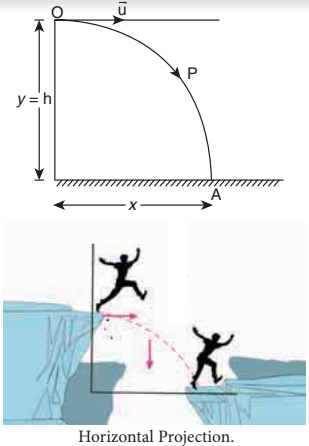
Consider a projectile, say a ball, thrown horizontally with an initial velocity $\overrightarrow{u}$ from the top of a tower of height h. As the ball moves, it covers a horizontal distance due to its uniform horizontal velocity u, and a vertical downward distance because of constant acceleration due to gravity g. Thus, under the combined effect the ball moves along the path OPA. The motion is in a 2 – dimensional plane. Let the ball take time t to reach the ground at point A, Then the horizontal distance travelled by the ball is x(t) = x, and the vertical distance travelled is y(t) = y.
Image
We can apply the kinematic equations along the x direction and y direction separately. Since this is two-dimensional motion, the velocity will have both horizontal component $u_x$ and vertical component $u_y$.Motion along horizontal direction:
The particle has zero acceleration along $x$ direction. So, the initial velocity ux remains constant throughout the motion. The distance traveled by the projectile at a time $t$ is given by the equation $x = u _{ x } t +\frac{1}{2} a t ^2$. Since $a =0$ along $x$ direction, we have $x = u _{ x } t$
Motion along downward direction:
Here $u_y=0$ (initial velocity has no downward component), $a = g$ (we choose the + ve $y -$ axis in downward direction), and distance $y$ at time t.
From equation, $y = u _{ x } t +\frac{1}{2} a t ^2$ we get
$y=\frac{1}{2} a t^2$
Substituting the value oft from equation (i) in equation (ii) we have
$y=\frac{1}{2} g \frac{x^2}{u_z^2}=\left(\frac{g}{2 u_x^2}\right) x^2$
$y = Kx x ^2$
where $K =\frac{g}{2 u_x^2}$ is constant
Equation (iii) is the equation of a parabola. Thus, the path followed by the projectile is a parabola.
1. Time of Flight:
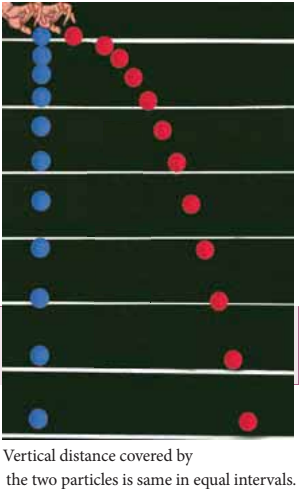
The time taken for the projectile to complete its trajectory or time taken by the projectile to hit the ground is called time of flight. Consider the example of a tower and projectile. Let $h$ be the height of a tower. Let $T$ be the time taken by the projectile to hit the ground, aftImageer being thrown horizontally from th tower.We know that $s _{ y }= u _{ y } t +\frac{1}{2} a t ^2$ for vertical motion. Here $. s _{ y }= h , t = T , u _{ y }=0$ (i.e., no initial vertical velocity). Then $h =\frac{1}{2} gt ^2$ or $T =\sqrt{\frac{2 h}{g}}$ Thus, the time of flight for projectile motion depends on the height of the tower, but is independent of the horizontal velocity of projection. If one ball falls vertically and another ball is projected horizontally with some velocity, both the balls will reach the bottom at the same time. This is illustrated in the Figure
2. Horizontal range:
The horizontal distance covered by the projectile from the foot of the tower to the point where the projectile hits the ground is called horizontal range.
For horizontal motion, we have
$S _{ x }= u _{ x } t +\frac{1}{2} a t ^2$
Here, $s_x=R$ (range), $u_x=u_1 a=0$ (no horizontal acceleration) $T$ is time of flight. Then horizontal range $=$ uT
Since the time of flight $T =\sqrt{\frac{2 h}{g}}$ we substitute this and we get the horizontal range of the particle as $R = u \sqrt{\frac{2 h}{g}}$
The above equation implies that the range $R$ is directly proportional to the initial velocity $u$ and inversely proportional to acceleration due to gravity $g$.
3. Resultant Velocity (Velocity of projectile at any time):
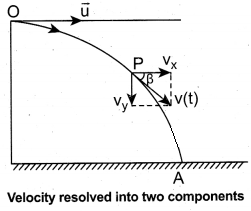
At any instant $t$, the projectile has velocity components along both $x$-axis and $y$-axis. The resultant of these two components gives the velocity of the projectile at that instant $t$, as shown in figure. The velocity component at any $t$ along horizontal ( $x$-axis) is $V_x=U_x+a_x t$Since, $u _{ x }= u$, $ax =0$, we get
$u _{ x }= u a _{ x }=0$ we get
$v _{ x }= u$
The component of velocity along vertical direction $(y-a x i s)$ is $v_y=u_y+a_y t$
Since, $u_y=0, a_y=g$, we get
$V _{ y }= gt$
Hence the velocity of the particle at any instant is -
$v = u \hat{i}+ g \hat{j}$
The speed of the particle at any instant $t$ is given by
$v =\sqrt{v_x^2+v_y^2}$
$v =\sqrt{u^2+g^2 t^2}$
Image
4. Speed of the projectile when it hits the ground:
When the projectile hits the ground after initially thrown horizontally from the top of tower of height $h$, the time of flight is -
$t =\sqrt{\frac{2 h}{g}}$
The horizontal component velocity of the projectile remains the same i.e $v_x=u$.
The vertical component velocity of the projectile at time $T$ is
$v = gT = g \sqrt{\frac{2 h}{g}}=\$
The speed of the particle when it reaches the ground is
$v =\sqrt{u^2+2 g h} \text {. }$
View full question & answer
Question 35 Marks
Explain the concept of relative velocity in one and two dimensional motion.
Answer
When two objects A and B are moving with different velocities, then the velocity of one object A with respect to another object B is called relative velocity of object A with respect to B.
Case I:
Consider two objects $A$ and $B$ moving with uniform velocities $V_A$ and $V_B$, as shown, along straight tracks in the same direction $\overrightarrow{V}_{ A }, \overrightarrow{ V }_{ B }$ with respect to ground.
The relative velocity of object $A$ with respect to object $B$ is $\vec{V}_{A B}=\vec{V}_A-\vec{V}_B$.
The relative velocity of object $B$ with respect to object $A$ is $\vec{V}_{B A}=\vec{V}_B-\vec{V}_A$ Thus, if two objects are moving in the same direction, the magnitude of relative velocity of one object with respect to another is equal to the difference in magnitude of two velocities.
Case II.
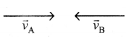
Consider two objects $A$ and $B$ moving with uniform velocities $\vec{V}_A$ and $\vec{V}_{ B }$ along the same straight tracks but opposite in direction.
Image
The relative velocity of an object $A$ with respect to object $B$ is -
$
\overrightarrow{ V }_{ AB }=\overrightarrow{ V }_{ A }-\left(-\overrightarrow{ V }_{ B }\right)=\overrightarrow{ V }_{ A }+\overrightarrow{ V }_{ B }
$
The relative velocity of an object $B$ with respect to object $A$ is
$
\overrightarrow{ V }_{ AB }=-\overrightarrow{ V }_{ A }-\overrightarrow{ V }_{ A }=-\left(\overrightarrow{ V }_{ A }+\overrightarrow{ V }_{ B }\right)
$
Thus, if two objects are moving in opposite directions, the magnitude of relative velocity of one object with respect to other is equal to the sum of magnitude of their velocities.
Case III.
Consider the velocities $\vec{v}_{ A }$ and $\overrightarrow{ v }_{ B }$ at an angle $\theta$ between their directions. The relative velocity of $A$ with respect to $B, \vec{v}_{A B}=\vec{v}_A-\vec{v}_B$
Then, the magnitude and direction of $\overrightarrow{ v }_{ AB }$ is given by $\overrightarrow{ v }_{ AB }=\sqrt{\vec{v}_{ A }^2+\vec{v}_{ B }^2-2 v_{ A } v_{ B } \cos \theta}$ and $\tan \beta=\frac{v_{ B } \sin \theta}{v_{ A }-v_{ B } \cos \theta}$ (Here $\beta$ is angle between $\left(\overrightarrow{ v }_{ B }\right.$ and $\overrightarrow{ v }_{ A }$ ) $\overrightarrow{ v }_{ A }-\overrightarrow{ v }_{ B } \cos \theta$.
(i) When $\theta=0$, the bodies move along parallel straight lines in the same direction, We have $\overrightarrow{ v }_{ AB }=\left(\overrightarrow{ v }_{ A }-\overrightarrow{ v }_{ B }\right)$ in the direction of $\overrightarrow{ v }_{ A }$. Obviously $\overrightarrow{ v }_{ BA }=\left(\overrightarrow{ v }_{ B }+\overrightarrow{ v }_{ A }\right)$ in the direction of $\overrightarrow{ v }_{ B }$.
(ii) When $\theta=180^{\circ}$, the bodies move along parallel straight lines in opposite directions, We have $\overrightarrow{ v }_{ AB }=\left(\overrightarrow{ v }_{ A }+\overrightarrow{ v }_{ B }\right)$ in the direction of $\overrightarrow{ v }_{ A }$. Similarly, $vBA =( vB + vA )$ in the direction of $\vec{v}_B$.
(iii) If the two bodies are moving at right angles to each other, then $0=90^{\circ}$. The magnitude of the relative velocity of $A$ with respect to $B =\overrightarrow{ v }_{ AB }=\sqrt{v_{ A }^2+v_{ B }^2}$.
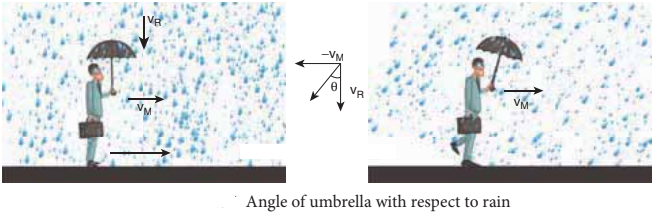
(iv) Consider a person moving horizontally with velocity $\overrightarrow{ V }_{ M }$. Let rain fall vertically with velocity $\vec{V}_R$. An umbrella is held to avoid the rain. Then the relative velocity of the rain with respect to the person is,Image
which has magnitude
$
\overrightarrow{ V }_{ RM }=\overrightarrow{ V }_{ R }-\overrightarrow{ V }_{ M }
$
And direction $0=\tan ^{-1}\left(\frac{V_{ M }}{V_{ R }}\right)$ with the vertical as shown in figure.
View full question & answer
Question 45 Marks
What are the different types of vectors?
Answer
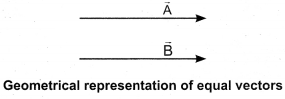
1. Equal vectors:
Two vectors A and B are said to be equal when they have equal magnitude and same direction and represent the same physical quantity
Image
(a) Collinear vectors:
Col-linear vectors are those which act along the same line. The angle between them can be 0° or 180°.

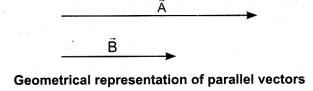
(i) Parallel vectors:
If two vectors A and B act in the same direction along the same line or on parallel lines, then the angle between them is 0°. Geometrical representation of parallel vectors.Image
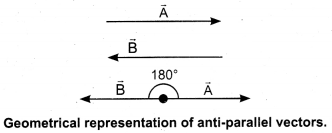
(ii) Anti-parallel vectors:
Two vectors A and B are said to be anti – parallel when they are in opposite directions along the same line or on parallel lines. Then the angle between them is 180°.
Image
2. Unit vector:
A vector divided by its magnitude is a unit vector. The unit vector for $\overrightarrow{ A }$ is denoted by $\widehat{A}$. It has a magnitude equal to unity or one.
Since, $\widehat{A}=\frac{\bar{A}}{A}$ we can write $\overrightarrow{ A }= A \widehat{A}$
Thus, we can say that the unit vector specifies only the direction of the vector quantity.

3. Orthogonal unit vectors:
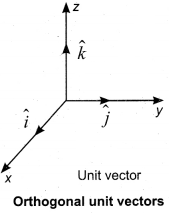
Let $\hat{i}, \hat{j}$ and $\hat{k}$ be three unit vectors which specify the directions along positive $x$-axis, positive $y$ axis and positive $z$-axis respectively. These three unit vectors are directed perpendicular to each other, the angle between any two of them is $90^{\circ} . \hat{i}, \hat{j}$ and $\hat{k}$ and are examples of orthogonal vectors. Two vectors which are perpendicular to each other are called orthogonal vectors as shown in the figure.
Image
View full question & answer
Question 55 Marks
Explain the types of motion with example.
Answer
(a) Linear motion:
An object is said to be in linear motion if it moves in a straight line.
Examples:
  • An athlete running on a straight track
  • AA particle falling vertically downwards to the Earth.
(b) Circular motion:
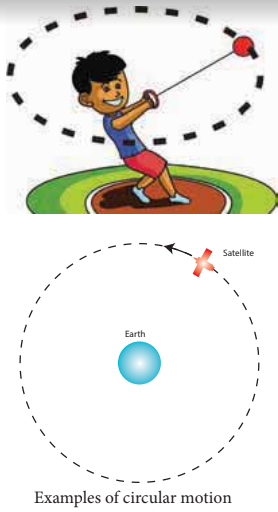
Circular motion is defined as a motion described by an object traversing a circular path.
Examples:
    • The whirling motion of a stone attached to a string.
    • The motion of a satellite around the Earth.
    • These two circular motions are shown in figure.
Image
(c) Rotational motion:
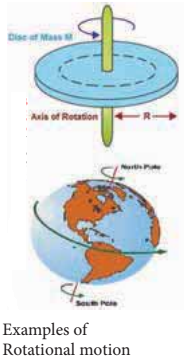
If any object moves in a rotational motion about an axis, the motion is called ‘rotation’. During rotation every point in the object transverses a circular path about an axis, (except the points located on the axis).
Examples:
    • Rotation of a disc about an axis through its center
    • Spinning of the Earth about its own axis.
    • These two rotational motions are shown in figure
Image
(d) Vibratory motion:
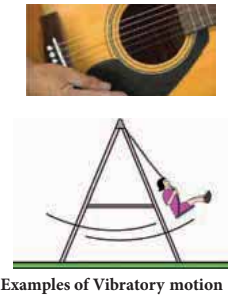
If an object or particle executes a to-and-fro motion about a fixed point, it is said to be in vibratory motion. This is sometimes also called oscillatory motion.
Examples:
  • Vibration of a string on a guitar
  • Movement of a swing
  • These motions are shown in figure
Image
Other types of motion like elliptical motion and helical motion are also possible.
View full question & answer
[ 5 Marks Questions ] - Physics STD 11 Questions - Vidyadip