(a) Linear motion:
An object is said to be in linear motion if it moves in a straight line.
Examples:
- An athlete running on a straight track
- AA particle falling vertically downwards to the Earth.
(b) Circular motion:
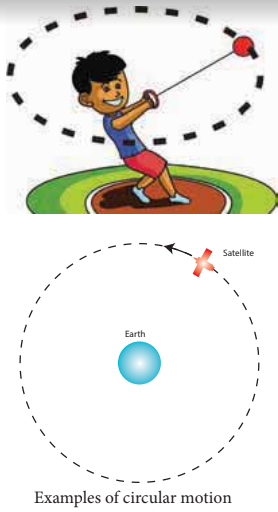
Circular motion is defined as a motion described by an object traversing a circular path.
Examples:
-
- The whirling motion of a stone attached to a string.
- The motion of a satellite around the Earth.
- These two circular motions are shown in figure.
(c) Rotational motion:
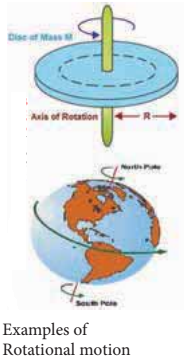
If any object moves in a rotational motion about an axis, the motion is called ‘rotation’. During rotation every point in the object transverses a circular path about an axis, (except the points located on the axis).
Examples:
-
- Rotation of a disc about an axis through its center
- Spinning of the Earth about its own axis.
- These two rotational motions are shown in figure
(d) Vibratory motion:
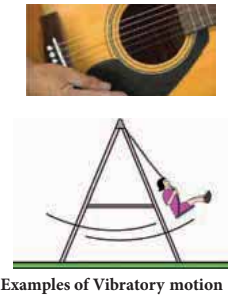
If an object or particle executes a to-and-fro motion about a fixed point, it is said to be in vibratory motion. This is sometimes also called oscillatory motion.
Examples:
- Vibration of a string on a guitar
- Movement of a swing
- These motions are shown in figure
Other types of motion like elliptical motion and helical motion are also possible.